Content
 Introduction
 Matrix Representation
 Transformations
 Standard Robot coordinate System
 Numericals
Robot Kinematics: Position Analysis
INTRODUCTION
Forward Kinematics:
to determine where the robot’s hand is?
(If all joint variables are known)
Inverse Kinematics:
to calculate what each joint variable is?
(If we desire that the hand be
located at a particular point)
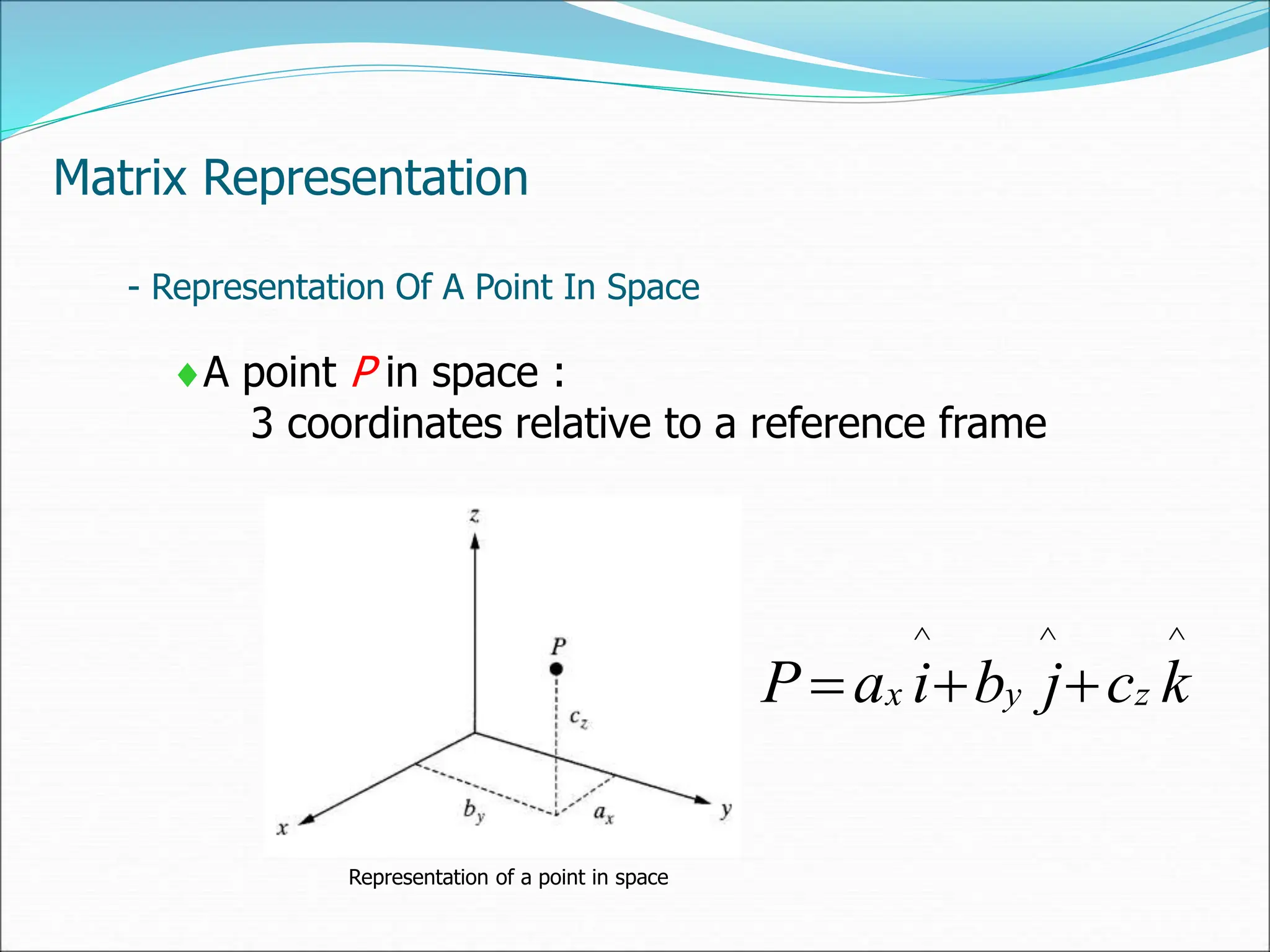
Matrix Representation
- Representation Of A Point In Space
Representation of a point in space
A point P in space :
3 coordinates relative to a reference frame
^
^
^
k
c
j
b
i
a
P z
y
x 


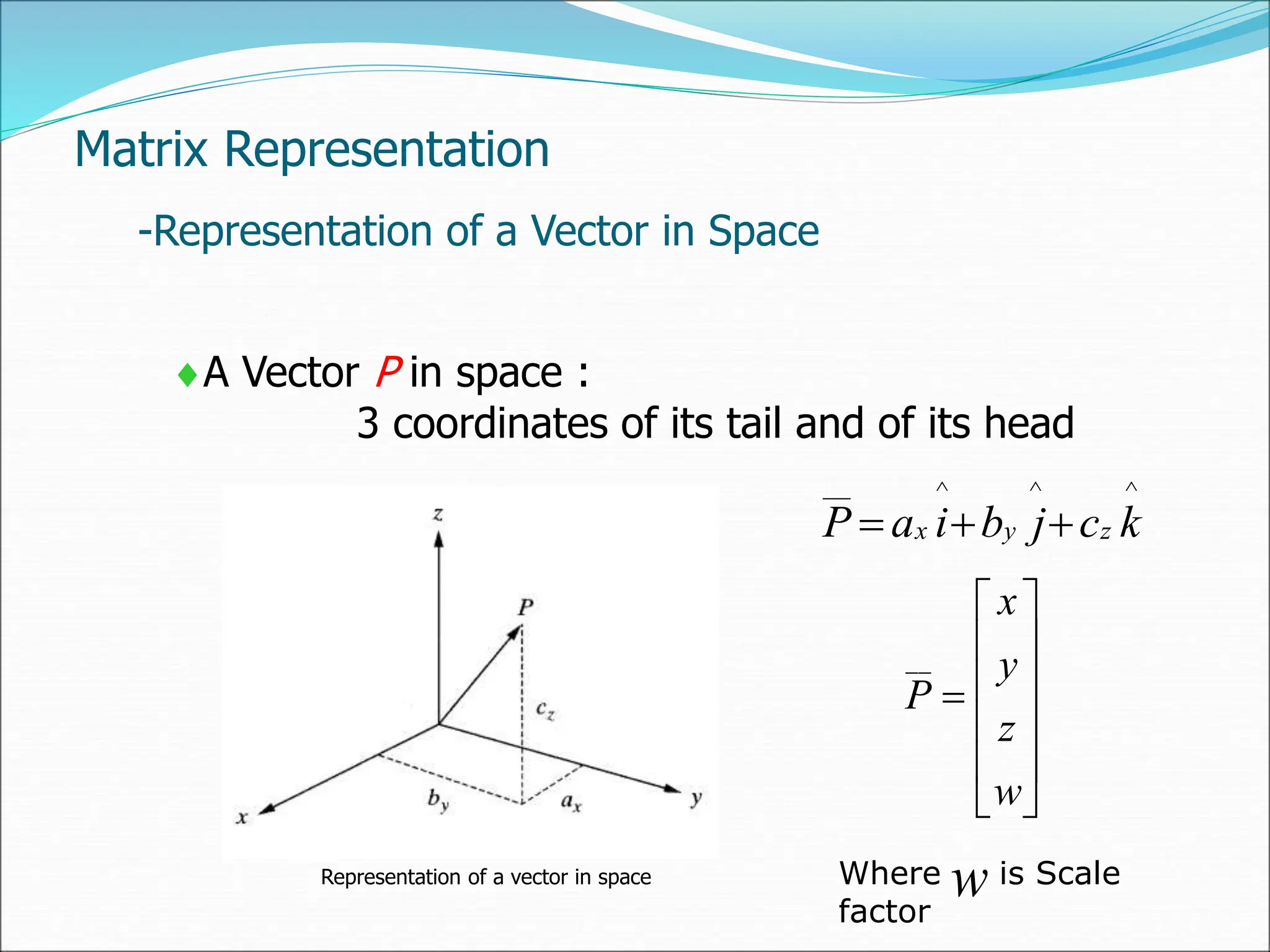
Representation of a vector in space
A Vector P in space :
3 coordinates of its tail and of its head
^
^
^
__
k
c
j
b
i
a
P z
y
x 















w
z
y
x
P
__
Matrix Representation
-Representation of a Vector in Space
Where is Scale
factor
w
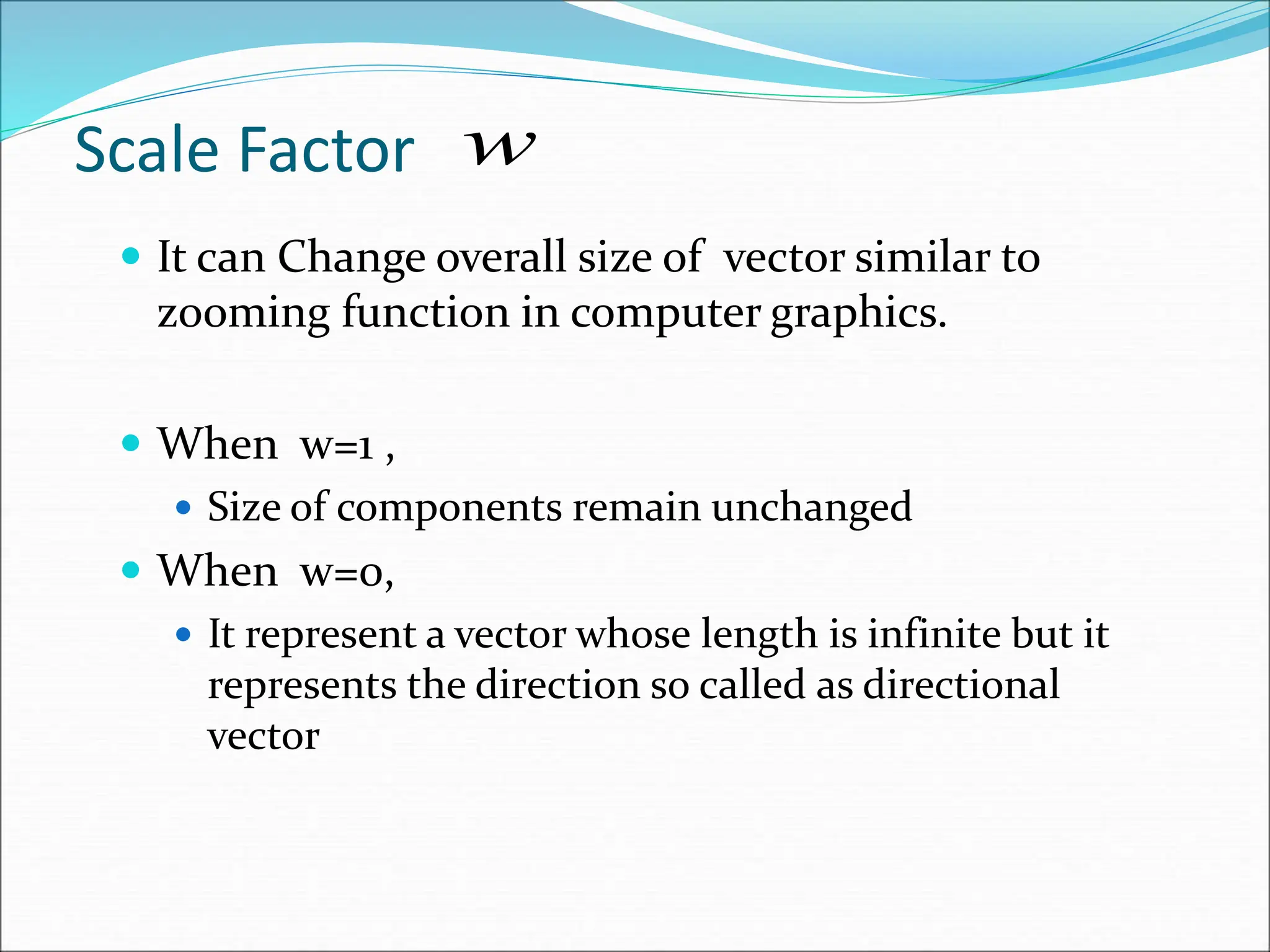
 It can Change overall size of vector similar to
zooming function in computer graphics.
 When w=1 ,
 Size of components remain unchanged
 When w=0,
 It represent a vector whose length is infinite but it
represents the direction so called as directional
vector
Scale Factor w
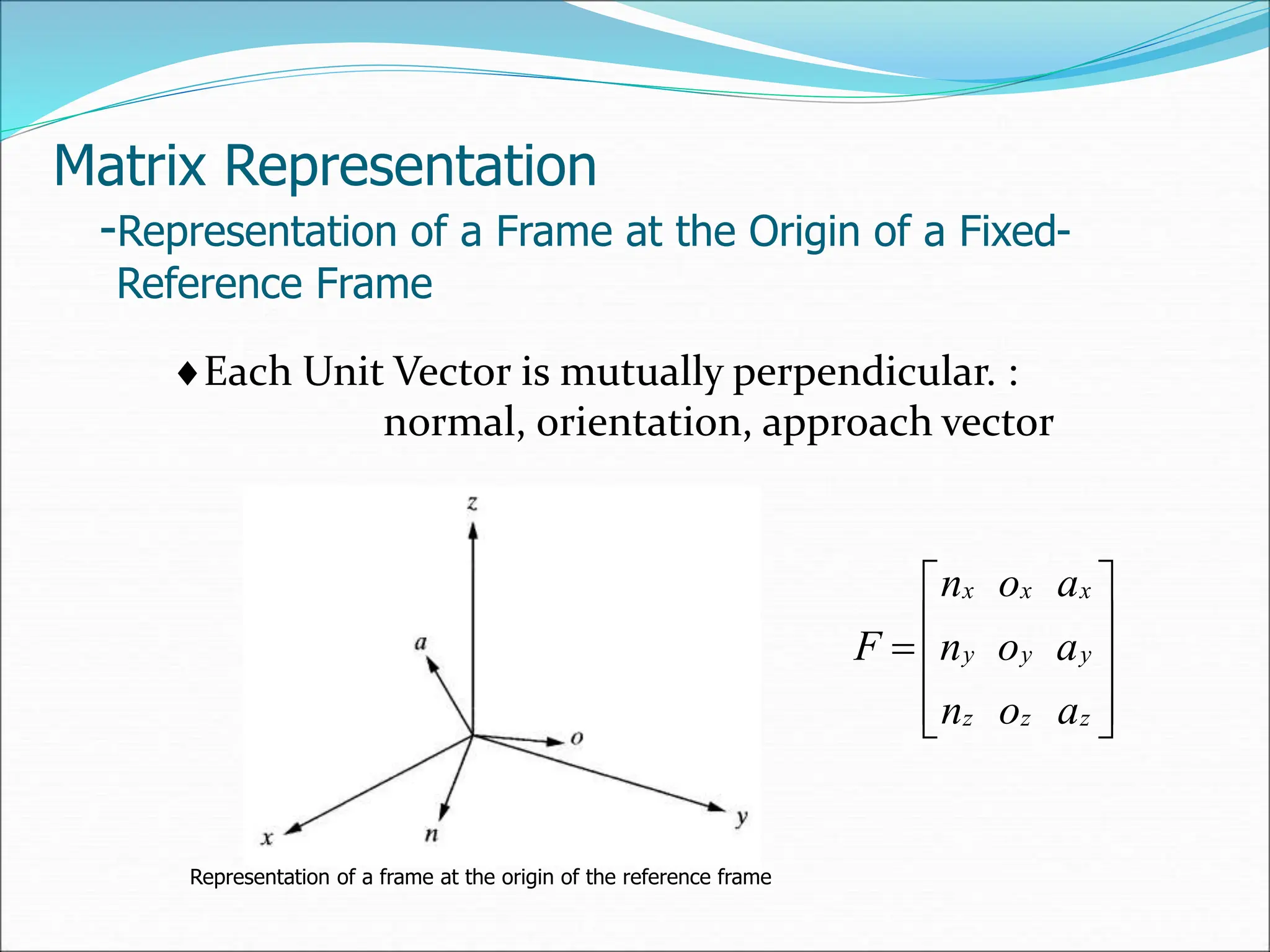
Representation of a frame at the origin of the reference frame
Each Unit Vector is mutually perpendicular. :
normal, orientation, approach vector











z
z
z
y
y
y
x
x
x
a
o
n
a
o
n
a
o
n
F
Matrix Representation
-Representation of a Frame at the Origin of a Fixed-
Reference Frame
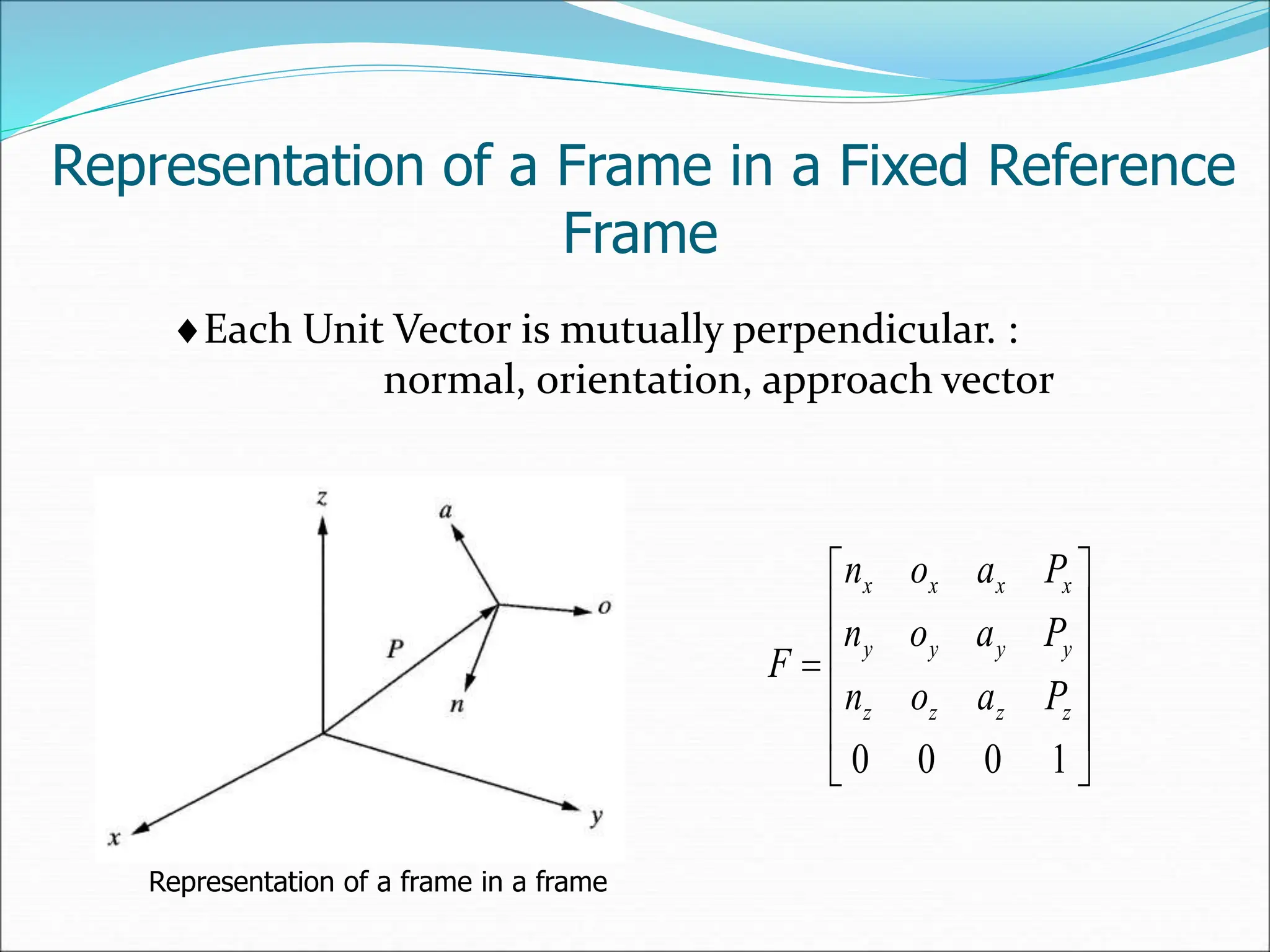
Representation of a frame in a frame
Each Unit Vector is mutually perpendicular. :
normal, orientation, approach vector













1
0
0
0
z
z
z
z
y
y
y
y
x
x
x
x
P
a
o
n
P
a
o
n
P
a
o
n
F
Representation of a Frame in a Fixed Reference
Frame
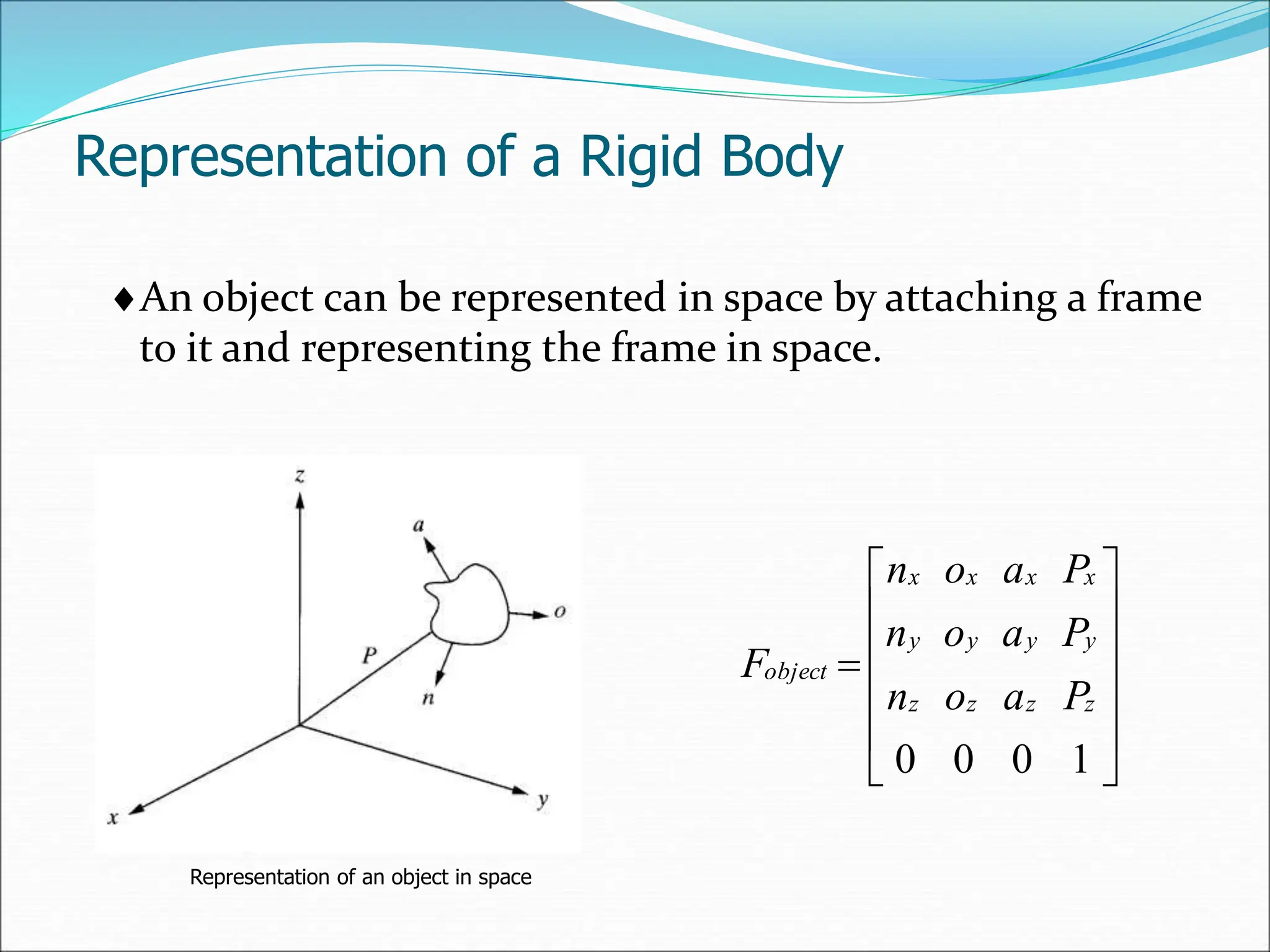
Representation of an object in space
An object can be represented in space by attaching a frame
to it and representing the frame in space.













1
0
0
0
z
z
z
z
y
y
y
y
x
x
x
x
object
P
a
o
n
P
a
o
n
P
a
o
n
F
Representation of a Rigid Body
Homogeneous Transformation Matrices
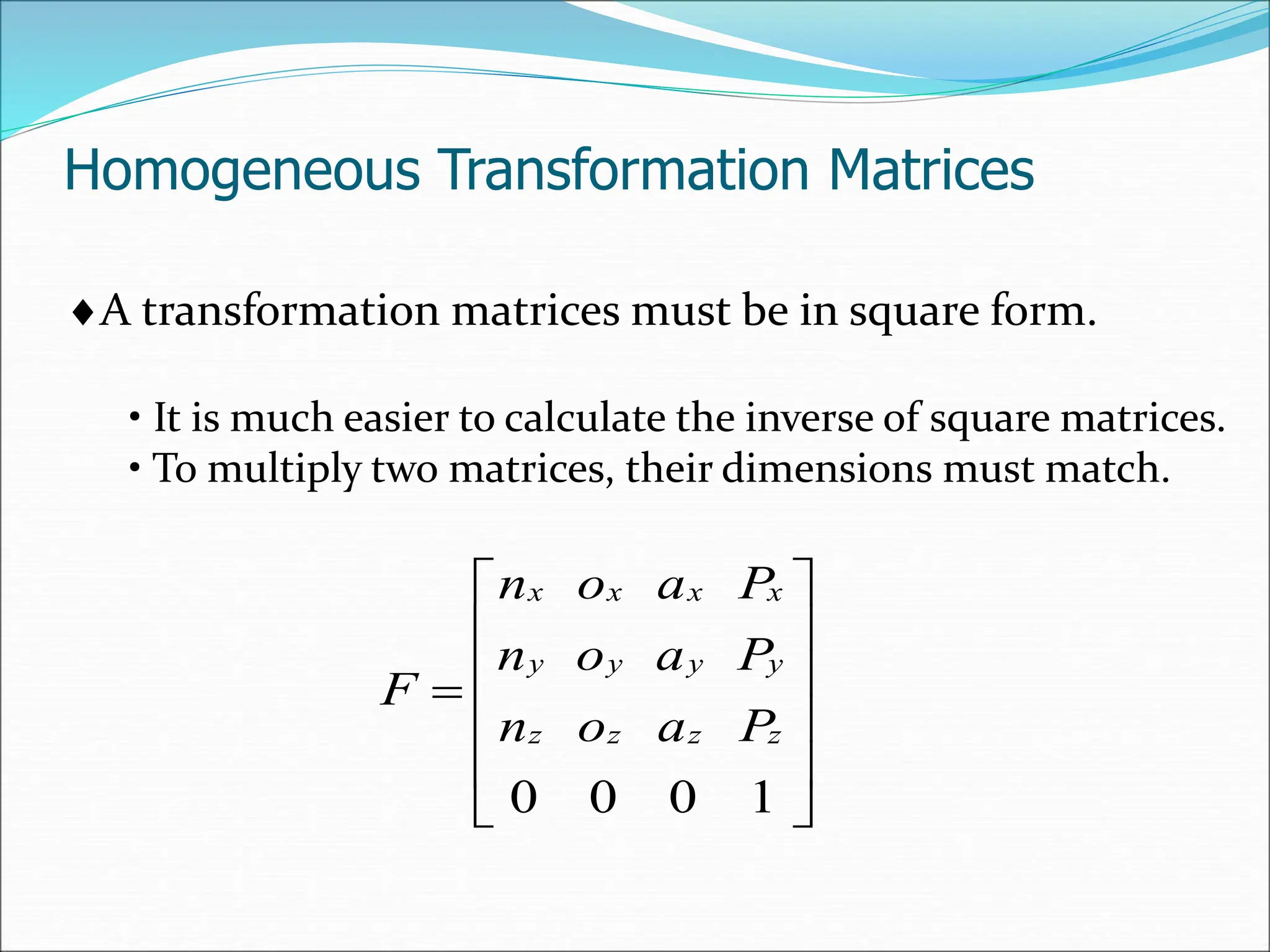
A transformation matrices must be in square form.
• It is much easier to calculate the inverse of square matrices.
• To multiply two matrices, their dimensions must match.













1
0
0
0
z
z
z
z
y
y
y
y
x
x
x
x
P
a
o
n
P
a
o
n
P
a
o
n
F
Transformations
 A transformation is defined as making a movement
in space.
 Types of Transformation are:
 A pure translation
 A pure rotation
 A combination of translation and rotation
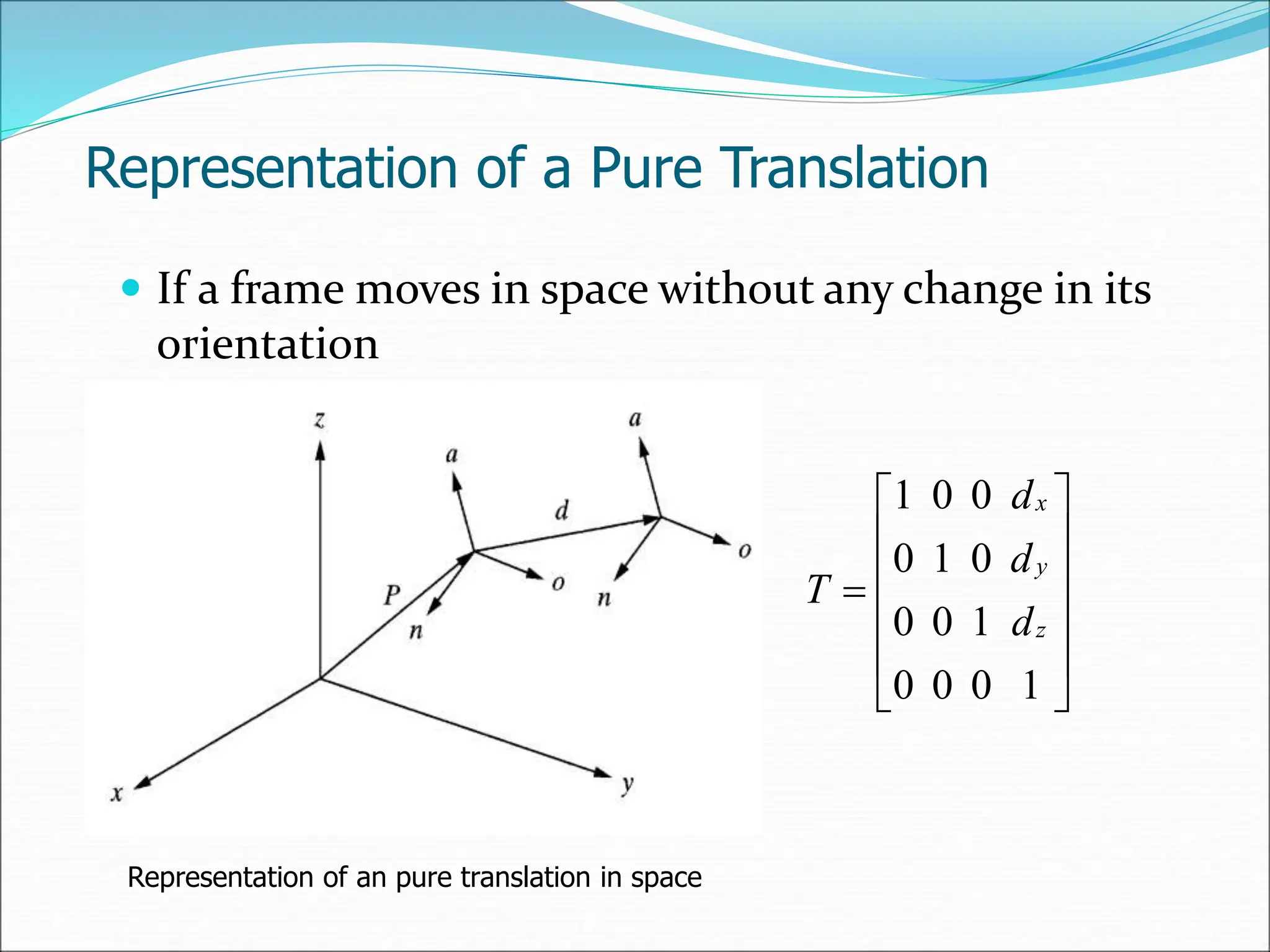
Representation of a Pure Translation
Representation of an pure translation in space













1
0
0
0
1
0
0
0
1
0
0
0
1
z
y
x
d
d
d
T
 If a frame moves in space without any change in its
orientation
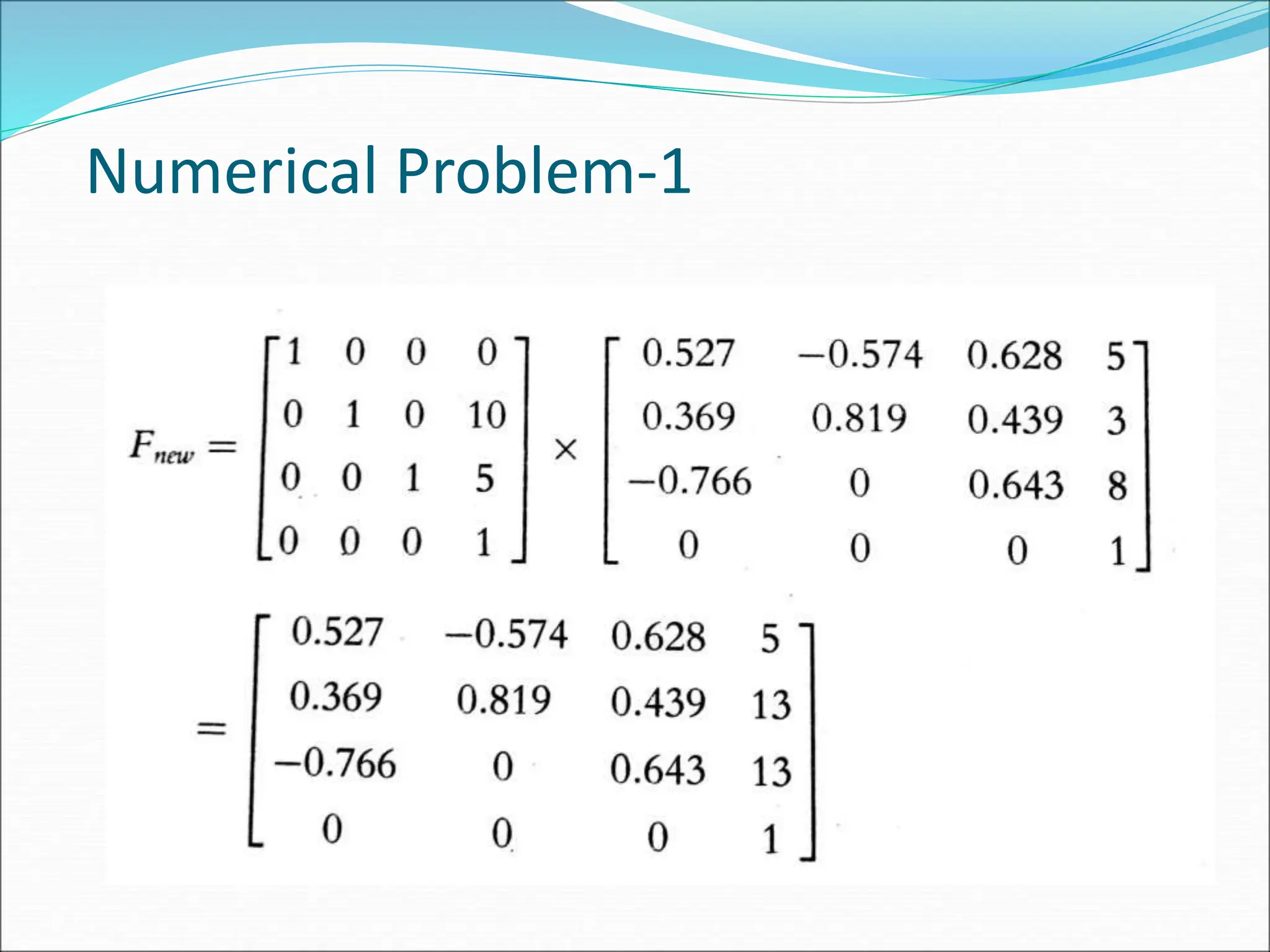
Numerical Problem-1
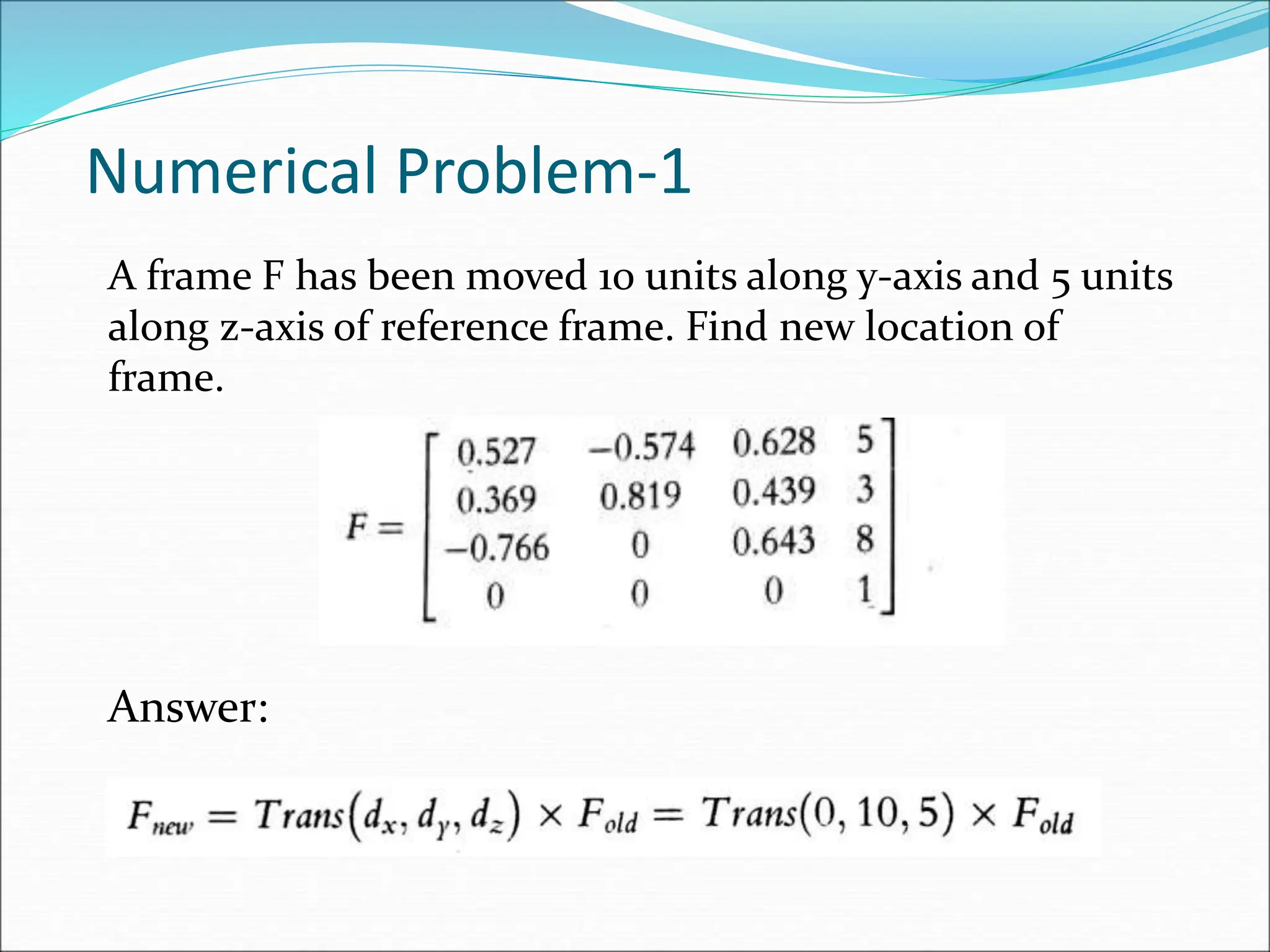
A frame F has been moved 10 units along y-axis and 5 units
along z-axis of reference frame. Find new location of
frame.
Answer:
Numerical Problem-1
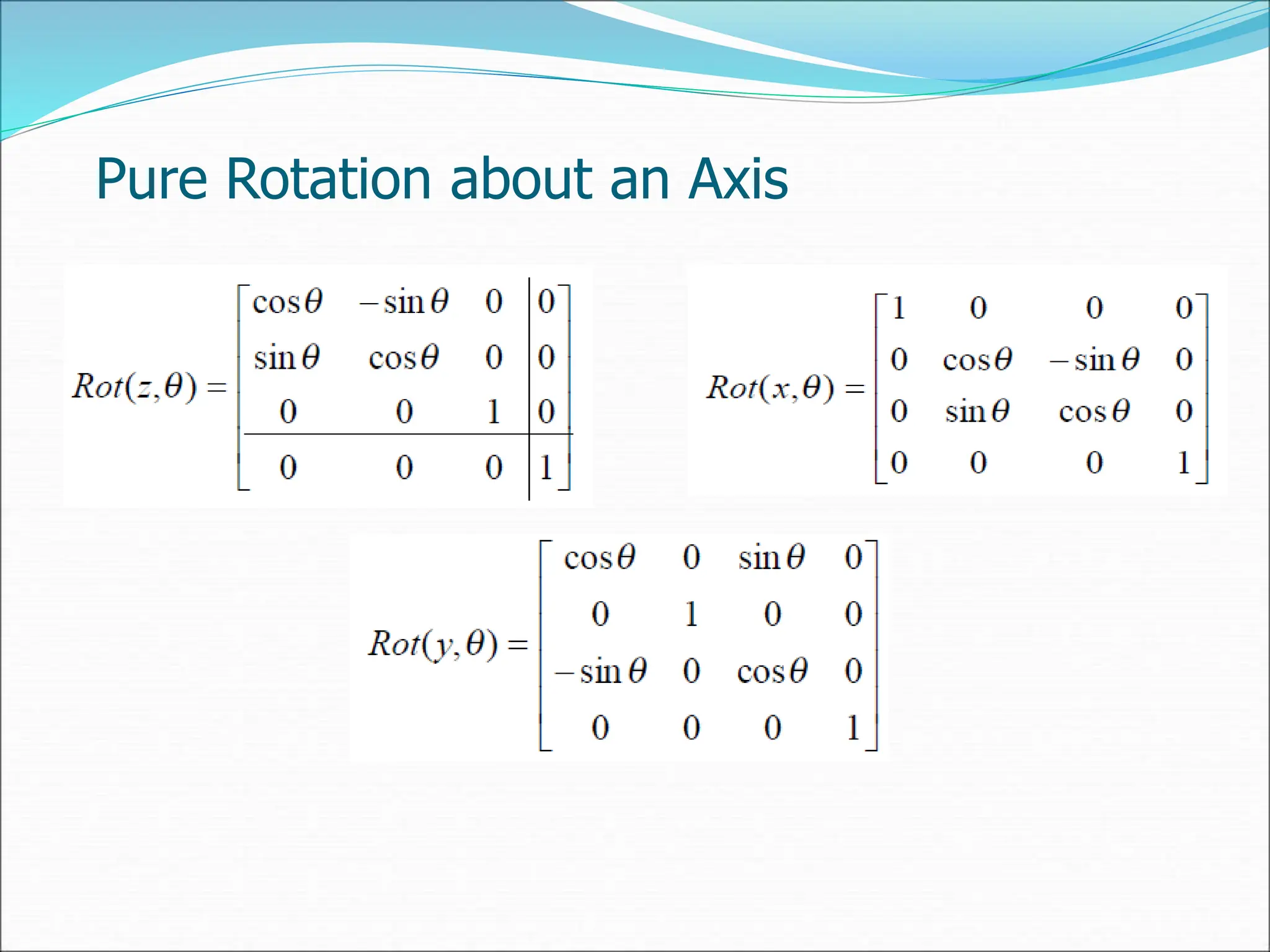
Pure Rotation about an Axis
Coordinates of a point in a rotating frame before and after rotation.
Assumption : The frame is at the origin of the reference
frame and parallel to it.
Pure Rotation about an Axis
Combined Transformations
 Combined Transformation consist of a number of
successive translations and rotations about fixed
reference frame axes.
 The order of matrices written is the opposite of the
order of transformations performed.
 If order of matrices changes then final position of
robot also changes
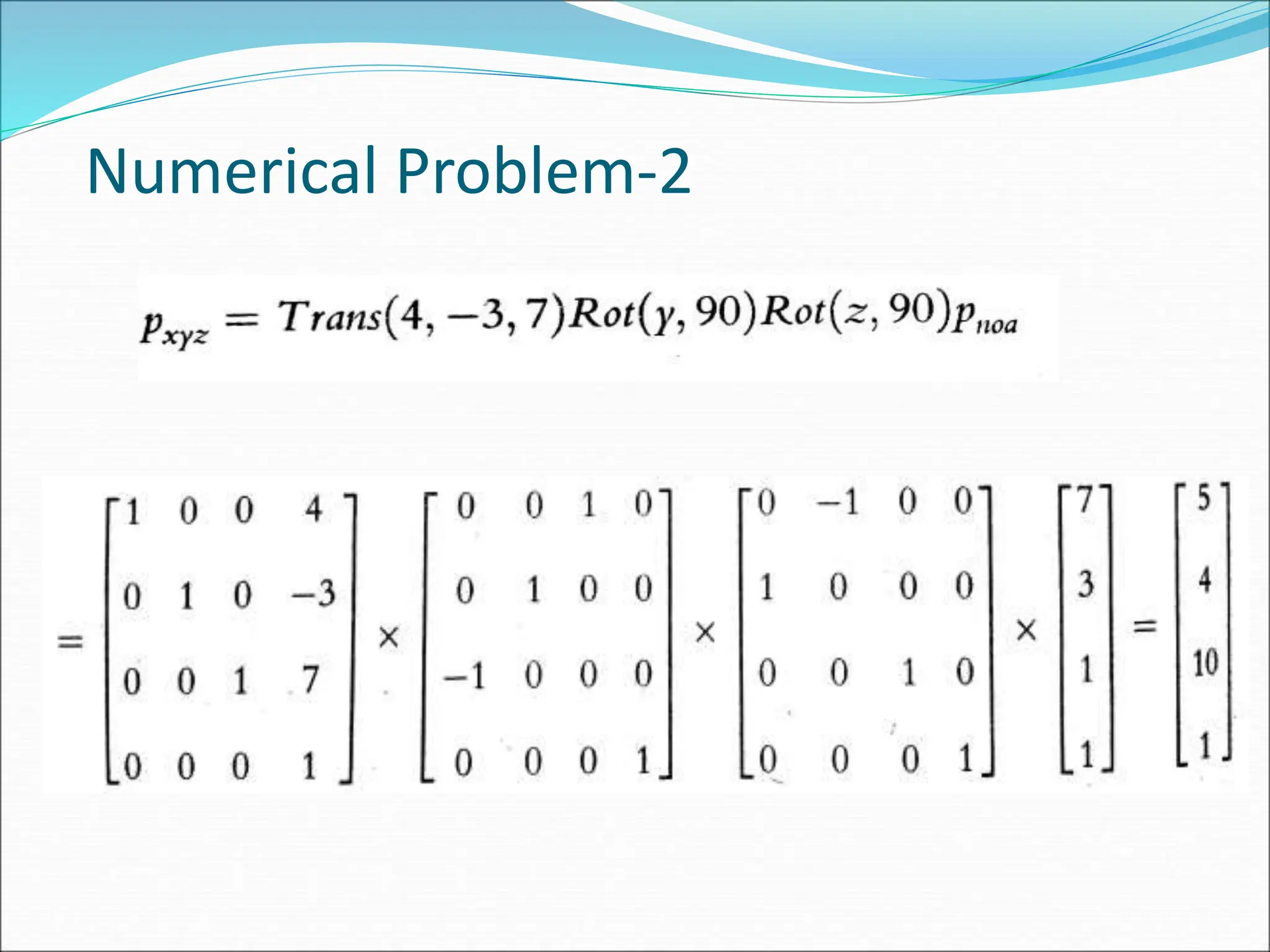
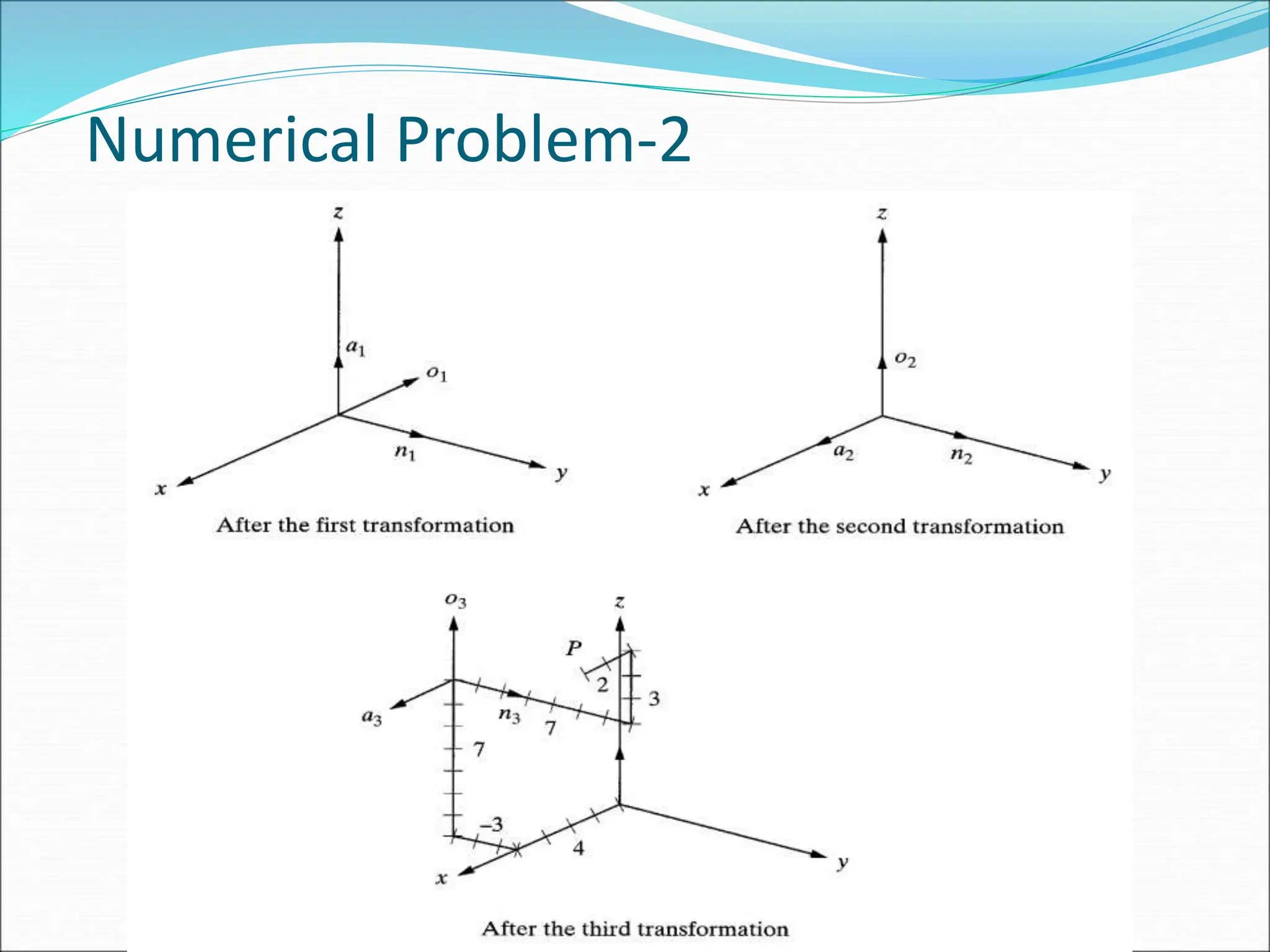
Numerical Problem (Forward Kinematics)-2
A point p(7,3,1) is attached to frame and subjected to
following transformations. Find coordinate of point
relative to reference frame.
1. Rotation of 90° about z-axis
2. Followed by rotation of 90 about y-axis
3. Followed by translation of [4,-3,7].
Answer: The matrix equation is given as
Numerical Problem-2
Fig. 2.13 Effects of three successive transformations
A number of successive translations and rotations….
Numerical Problem-2
Forward Kinematics and Inverse Kinematics equation
for position analysis and three types of standard robot
coordinate system are:
(a) Cartesian (gantry, rectangular) coordinates.
(b) Cylindrical coordinates.
(c) Spherical coordinates.
Forward and Inverse Kinematics Equations for Position
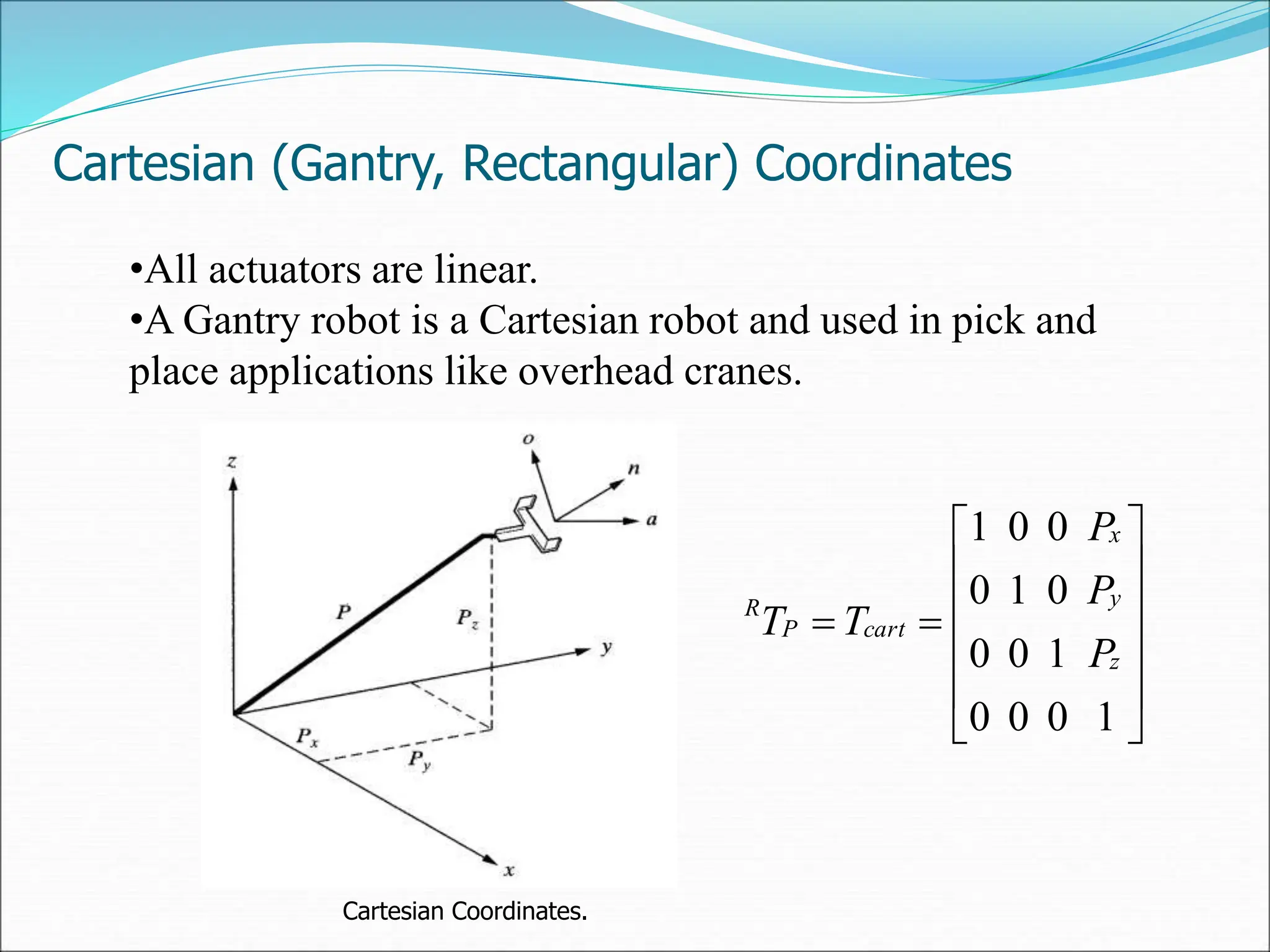
Cartesian (Gantry, Rectangular) Coordinates
•All actuators are linear.
•A Gantry robot is a Cartesian robot and used in pick and
place applications like overhead cranes.
Cartesian Coordinates.














1
0
0
0
1
0
0
0
1
0
0
0
1
z
y
x
cart
P
R
P
P
P
T
T
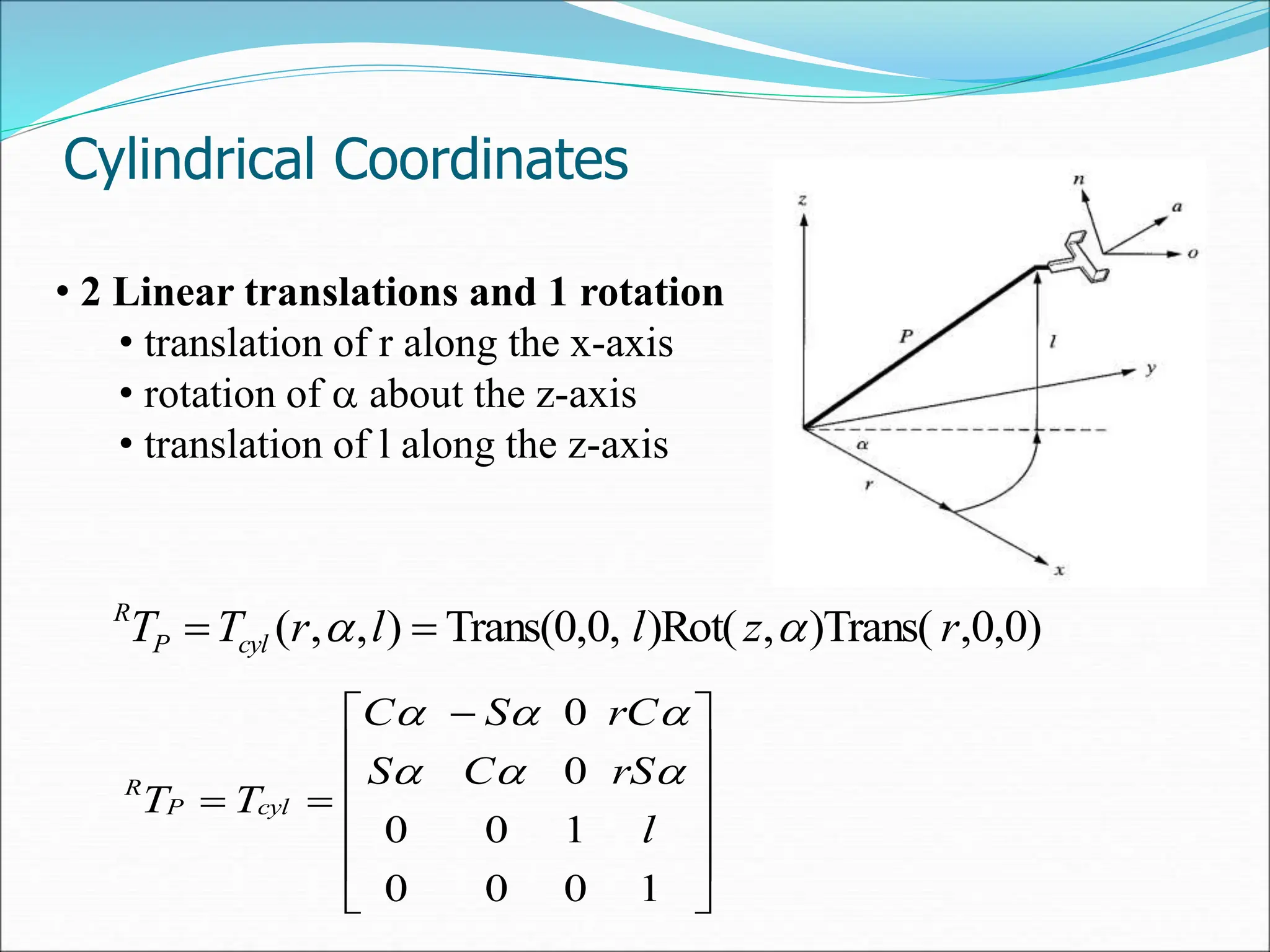
Cylindrical Coordinates
• 2 Linear translations and 1 rotation
• translation of r along the x-axis
• rotation of  about the z-axis
• translation of l along the z-axis











 


1
0
0
0
1
0
0
0
0
l
rS
C
S
rC
S
C
T
T cyl
P
R 





,0,0)
)Trans(
,
)Rot(
Trans(0,0,
)
,
,
( r
z
l
l
r
T
T cyl
P
R

 

Suppose we desire to place the origin of hand frame of a
cylindrical robot at [ 3,4,7]. Calculate the joint variables of
robot.
Answer:
Numerical Problem (Inverse Kinematics)-3











 


1
0
0
0
1
0
0
0
0
l
rS
C
S
rC
S
C
T
T cyl
P
R 




 r= 5 units
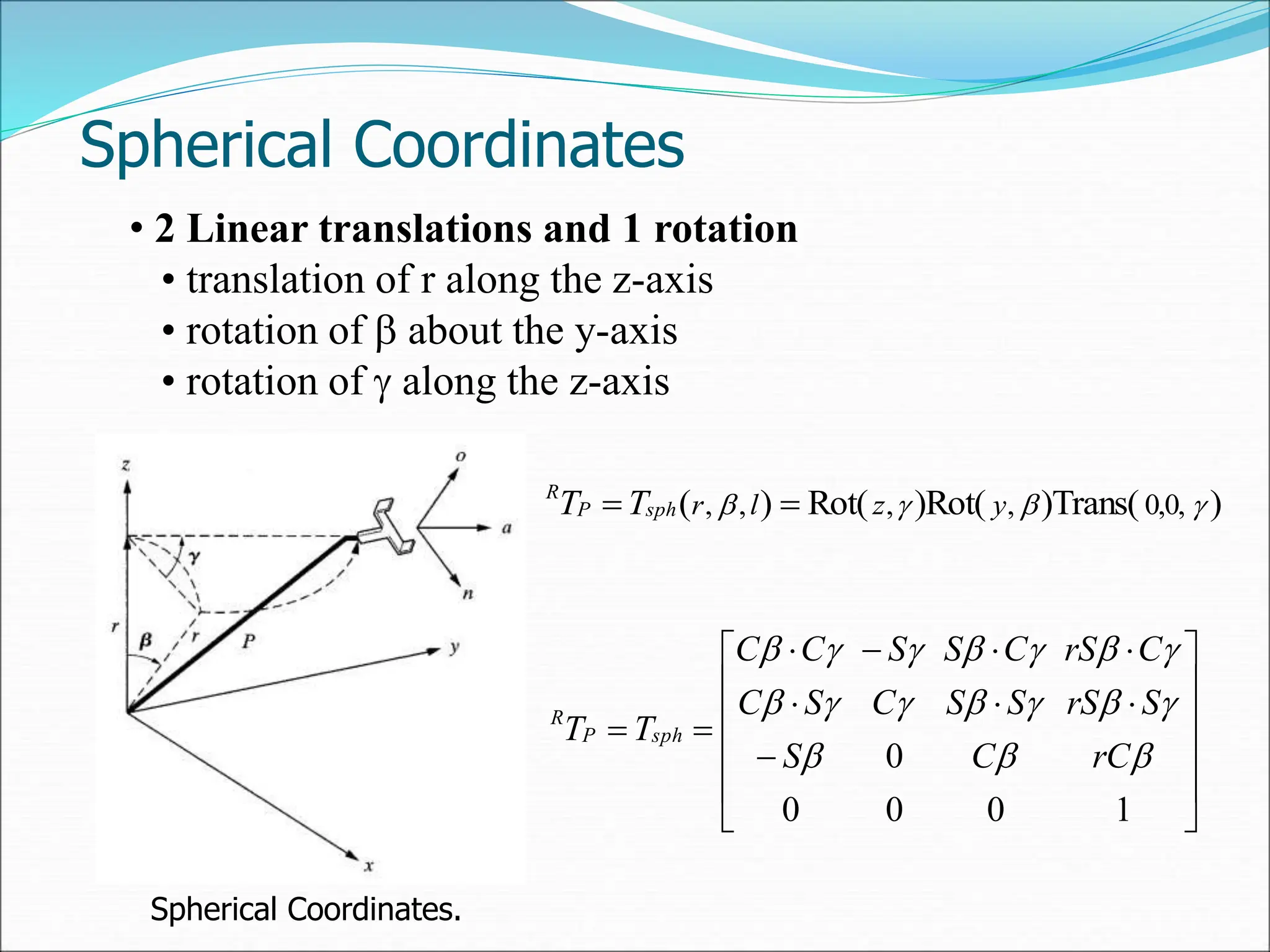
Spherical Coordinates
• 2 Linear translations and 1 rotation
• translation of r along the z-axis
• rotation of  about the y-axis
• rotation of  along the z-axis
Spherical Coordinates.






















1
0
0
0
0 
















rC
C
S
S
rS
S
S
C
S
C
C
rS
C
S
S
C
C
T
T sph
P
R
)
)Trans(
)Rot(
Rot(
)
( 0,0,
,
,
,
, 


 y
z
l
r
sph
P
R
T
T 


robotkinematics-16092vsdfva sdaf7173439.ppt

  • 1.
    Content  Introduction  MatrixRepresentation  Transformations  Standard Robot coordinate System  Numericals
  • 2.
    Robot Kinematics: PositionAnalysis INTRODUCTION Forward Kinematics: to determine where the robot’s hand is? (If all joint variables are known) Inverse Kinematics: to calculate what each joint variable is? (If we desire that the hand be located at a particular point)
  • 3.
    Matrix Representation - RepresentationOf A Point In Space Representation of a point in space A point P in space : 3 coordinates relative to a reference frame ^ ^ ^ k c j b i a P z y x   
  • 4.
    Representation of avector in space A Vector P in space : 3 coordinates of its tail and of its head ^ ^ ^ __ k c j b i a P z y x                 w z y x P __ Matrix Representation -Representation of a Vector in Space Where is Scale factor w
  • 5.
     It canChange overall size of vector similar to zooming function in computer graphics.  When w=1 ,  Size of components remain unchanged  When w=0,  It represent a vector whose length is infinite but it represents the direction so called as directional vector Scale Factor w
  • 6.
    Representation of aframe at the origin of the reference frame Each Unit Vector is mutually perpendicular. : normal, orientation, approach vector            z z z y y y x x x a o n a o n a o n F Matrix Representation -Representation of a Frame at the Origin of a Fixed- Reference Frame
  • 7.
    Representation of aframe in a frame Each Unit Vector is mutually perpendicular. : normal, orientation, approach vector              1 0 0 0 z z z z y y y y x x x x P a o n P a o n P a o n F Representation of a Frame in a Fixed Reference Frame
  • 8.
    Representation of anobject in space An object can be represented in space by attaching a frame to it and representing the frame in space.              1 0 0 0 z z z z y y y y x x x x object P a o n P a o n P a o n F Representation of a Rigid Body
  • 9.
    Homogeneous Transformation Matrices Atransformation matrices must be in square form. • It is much easier to calculate the inverse of square matrices. • To multiply two matrices, their dimensions must match.              1 0 0 0 z z z z y y y y x x x x P a o n P a o n P a o n F
  • 10.
    Transformations  A transformationis defined as making a movement in space.  Types of Transformation are:  A pure translation  A pure rotation  A combination of translation and rotation
  • 11.
    Representation of aPure Translation Representation of an pure translation in space              1 0 0 0 1 0 0 0 1 0 0 0 1 z y x d d d T  If a frame moves in space without any change in its orientation
  • 12.
    Numerical Problem-1 A frameF has been moved 10 units along y-axis and 5 units along z-axis of reference frame. Find new location of frame. Answer:
  • 13.
  • 14.
    Pure Rotation aboutan Axis Coordinates of a point in a rotating frame before and after rotation. Assumption : The frame is at the origin of the reference frame and parallel to it.
  • 15.
  • 16.
    Combined Transformations  CombinedTransformation consist of a number of successive translations and rotations about fixed reference frame axes.  The order of matrices written is the opposite of the order of transformations performed.  If order of matrices changes then final position of robot also changes
  • 17.
    Numerical Problem (ForwardKinematics)-2 A point p(7,3,1) is attached to frame and subjected to following transformations. Find coordinate of point relative to reference frame. 1. Rotation of 90° about z-axis 2. Followed by rotation of 90 about y-axis 3. Followed by translation of [4,-3,7]. Answer: The matrix equation is given as
  • 18.
  • 19.
    Fig. 2.13 Effectsof three successive transformations A number of successive translations and rotations…. Numerical Problem-2
  • 20.
    Forward Kinematics andInverse Kinematics equation for position analysis and three types of standard robot coordinate system are: (a) Cartesian (gantry, rectangular) coordinates. (b) Cylindrical coordinates. (c) Spherical coordinates. Forward and Inverse Kinematics Equations for Position
  • 21.
    Cartesian (Gantry, Rectangular)Coordinates •All actuators are linear. •A Gantry robot is a Cartesian robot and used in pick and place applications like overhead cranes. Cartesian Coordinates.               1 0 0 0 1 0 0 0 1 0 0 0 1 z y x cart P R P P P T T
  • 22.
    Cylindrical Coordinates • 2Linear translations and 1 rotation • translation of r along the x-axis • rotation of  about the z-axis • translation of l along the z-axis                1 0 0 0 1 0 0 0 0 l rS C S rC S C T T cyl P R       ,0,0) )Trans( , )Rot( Trans(0,0, ) , , ( r z l l r T T cyl P R    
  • 23.
    Suppose we desireto place the origin of hand frame of a cylindrical robot at [ 3,4,7]. Calculate the joint variables of robot. Answer: Numerical Problem (Inverse Kinematics)-3                1 0 0 0 1 0 0 0 0 l rS C S rC S C T T cyl P R       r= 5 units
  • 24.
    Spherical Coordinates • 2Linear translations and 1 rotation • translation of r along the z-axis • rotation of  about the y-axis • rotation of  along the z-axis Spherical Coordinates.                       1 0 0 0 0                  rC C S S rS S S C S C C rS C S S C C T T sph P R ) )Trans( )Rot( Rot( ) ( 0,0, , , , ,     y z l r sph P R T T  