COMBUSTION
Text Book : Thermodynamics by Yunus Cengel,
8th
Edition.
COMBUSTION
■ Combustion is a chemical reaction in which certain
element of the fuel combine with oxygen and releasing
a large quantity of energy causing an increase in
temperature of gases.
Fuel + Oxygen = Products + Heat
■ There are thousands of different hydrocarbon fuel
components, which consist mainly of hydrogen and
carbon but may also contain oxygen, nitrogen, and/or
sulphur, etc.
■ The oxygen necessary for combustion is obtained from
air, which is oxygen diluted chiefly by nitrogen.
Composition of Air
■ Table gives proportion of oxygen and nitrogen
by volume as well as by mass of dry air.
■ In combustion, oxygen is the reactive
component of air.
■ The properties of air vary geographically, with
altitude and with time.
■ It is usually sufficiently accurate to regard air
as 21% oxygen and 79% inert gases taken as
nitrogen.
■ For every one mole of oxygen, there are 3.76
moles of nitrogen in air as per molar ratio.
Gas Volume
%
Mass
%
Molar
Mass
Molar
Fraction
Molar
Ratio
O2
N2
A
CO2
20.95
78.09
0.93
0.03
23.16
75.55
1.25
0.04
32.00
28.01
38.95
44.01
0.21
0.79
1
3.76
Air 100.00 100.0
0
28.95 1.00 4.76
STOICHIOMETRY
■ Most IC engines obtain their energy from the combustion of a hydrocarbon fuel with
air, which converts chemical energy of the fuel to internal energy in the gases within
the engine.
■ The maximum amount of chemical energy that can be released (heat) from the fuel
is when it reacts (combust) with a stoichiometric amount of oxygen.
■ Stoichiometric oxygen (sometimes also called theoretical oxygen) is just enough to
convert all carbon in the fuel to CO2 and all hydrogen to H2O, with no oxygen left
over.
Types of Combustion Reactions
■ Stoichiometric Reaction. (Oxygen and fuel in exact amount required for combustion)
■ Lean Mixture Reaction. (Oxygen in excess)
■ Rich Mixture Reaction. (Fuel in excess)
Stoichiometric Reaction
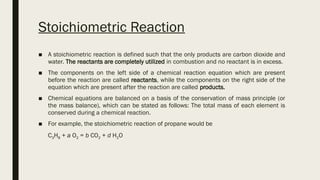
■ A stoichiometric reaction is defined such that the only products are carbon dioxide and
water. The reactants are completely utilized in combustion and no reactant is in excess.
■ The components on the left side of a chemical reaction equation which are present
before the reaction are called reactants, while the components on the right side of the
equation which are present after the reaction are called products.
■ Chemical equations are balanced on a basis of the conservation of mass principle (or
the mass balance), which can be stated as follows: The total mass of each element is
conserved during a chemical reaction.
■ For example, the stoichiometric reaction of propane would be
C3H8 + a O2 = b CO2 + d H2O
Stoichiometric Reaction (Balancing)
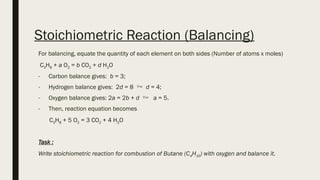
For balancing, equate the quantity of each element on both sides (Number of atoms x moles)
C3H8 + a O2 = b CO2 + d H2O
- Carbon balance gives: b = 3;
- Hydrogen balance gives: 2d = 8  d = 4;
- Oxygen balance gives: 2a = 2b + d  a = 5.
- Then, reaction equation becomes
C3H8 + 5 O2 = 3 CO2 + 4 H2O
Task :
Write stoichiometric reaction for combustion of Butane (C4H10) with oxygen and balance it.
Using Air instead of Oxygen in Combustion
■ Very small powerful engines could be built if fuel were burned with pure oxygen.
■ However, the cost of using pure oxygen would be prohibitive, and thus is not done.
■ Air is used as the source of oxygen to react with fuel.
■ Nitrogen and argon are essentially chemically neutral and do not react in the combustion
process.
■ The complete (Stoichiometric) combustion of a general hydrocarbon fuel of average molecular
composition CH with air would be
CH +  (O2 + 3.76 N2) = 1 CO2 + 2 H2O+ 3 N2
Where,
-  is the total moles of air,
- (O2 + 3.76 N2) is the composition of air.
- 1 ,2 ,3 are the moles of products.
Equivalence Ratio
■ Fuel/Air Equivalence Ratio:
For actual combustion in an engine, the fuel/air equivalence ratio is a measure of the
fuel-air mixture relative to stoichiometric conditions.
It is defined as:
where:
F/A = mf /ma = fuel-air ratio;
A/F = ma /mf = air-fuel ratio;
ma = mass of air;
mf = mass of fuel
 
 
 
 act
stoich
stoich
act
F
A
F
A
A
F
A
F
/
/
/
/



Equivalence Ratio
■ Relative Air/Fuel Ratio: The inverse of , the relative air/fuel ratio , is also
sometimes used.
■ For fuel-lean mixtures:  < 1,  > 1, oxygen in exhaust
■ For stoichiometric mixtures:  =  = 1, maximum energy released from fuel.
■ For fuel-rich mixtures:  > 1,  < 1, CO and fuel in exhaust.
 
 
 
 stoich
act
act
stoich
F
A
F
A
A
F
A
F
/
/
/
/
1


 


Overall Combustion Reaction:
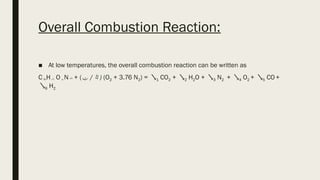
■ At low temperatures, the overall combustion reaction can be written as
CH ON + ( /) (O2 + 3.76 N2) = 1 CO2 + 2 H2O + 3 N2 + 4 O2 + 5 CO +
6 H2
Lean MIXTURE REACTIONS
■ Fuel-air mixtures with more than or less than the stoichiometric air requirement can
be burned.
■ Combustion can occur, within limits, i.e., the proportions of the fuel and air must be
in the proper range for combustion to begin.
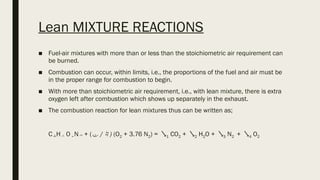
■ With more than stoichiometric air requirement, i.e., with lean mixture, there is extra
oxygen left after combustion which shows up separately in the exhaust.
■ The combustion reaction for lean mixtures thus can be written as;
CH ON + ( /) (O2 + 3.76 N2) = 1 CO2 + 2 H2O + 3 N2 + 4 O2
RICH MIXTURE REACTIONS
■ With less than stoichiometric air requirement, i.e., with fuel-rich combustion, there is
insufficient oxygen to oxidize fully the fuel C and H to CO2 and H2O. The products are
a mixture of CO2 and H2O with carbon monoxide CO and hydrogen H2 (as well as N2).
■ The combustion reaction for rich mixtures can be written as;
CH ON + ( /) (O2 + 3.76 N2) = 1 CO2 + 2 H2O + 3 N2 + 5 CO + 6 H2
COMBUSTION EFFICIENCY:
■ Under lean operating conditions the amounts of
incomplete combustion products are small.
■ Under fuel-rich operating conditions these
amounts become more substantial since there is
insufficient oxygen to complete combustion.
■ Combustion efficiency indicates the fraction of
the fuel energy supplied which is released in the
combustion process due to unburnt fuel.
■ Figure shows how combustion efficiency varies
with the fuel/air equivalence ratio for internal
combustion engines.
Combustion efficiency as a function of
fuel equivalnec ratio
50
60
70
80
90
100
0.4 0.6 0.8 1.0 1.2 1.4 1.6
Fuel Equivalence Ratio
Combustion
Efficiency
(%)
Lean
Problem
■ Write the balanced chemical reaction equation for one mole of iso-octane (C8H18)
burning with stoichiometric air. Calculate the air/fuel ratio for combustion of this
fuel.
Solution Hint:
- Write the equation for stoichiometric reaction and balance it.
C8H18 +  (O2 + 3.76 N2) = 1 CO2 + 2 H2O+ 3 N2
- Calculate air/fuel ratio by calculating the masses of air and fuel as per balanced
equation.

Combustion analysis basic concepts and strategy

  • 1.
    COMBUSTION Text Book :Thermodynamics by Yunus Cengel, 8th Edition.
  • 2.
    COMBUSTION ■ Combustion isa chemical reaction in which certain element of the fuel combine with oxygen and releasing a large quantity of energy causing an increase in temperature of gases. Fuel + Oxygen = Products + Heat ■ There are thousands of different hydrocarbon fuel components, which consist mainly of hydrogen and carbon but may also contain oxygen, nitrogen, and/or sulphur, etc. ■ The oxygen necessary for combustion is obtained from air, which is oxygen diluted chiefly by nitrogen.
  • 3.
    Composition of Air ■Table gives proportion of oxygen and nitrogen by volume as well as by mass of dry air. ■ In combustion, oxygen is the reactive component of air. ■ The properties of air vary geographically, with altitude and with time. ■ It is usually sufficiently accurate to regard air as 21% oxygen and 79% inert gases taken as nitrogen. ■ For every one mole of oxygen, there are 3.76 moles of nitrogen in air as per molar ratio. Gas Volume % Mass % Molar Mass Molar Fraction Molar Ratio O2 N2 A CO2 20.95 78.09 0.93 0.03 23.16 75.55 1.25 0.04 32.00 28.01 38.95 44.01 0.21 0.79 1 3.76 Air 100.00 100.0 0 28.95 1.00 4.76
  • 4.
    STOICHIOMETRY ■ Most ICengines obtain their energy from the combustion of a hydrocarbon fuel with air, which converts chemical energy of the fuel to internal energy in the gases within the engine. ■ The maximum amount of chemical energy that can be released (heat) from the fuel is when it reacts (combust) with a stoichiometric amount of oxygen. ■ Stoichiometric oxygen (sometimes also called theoretical oxygen) is just enough to convert all carbon in the fuel to CO2 and all hydrogen to H2O, with no oxygen left over.
  • 5.
    Types of CombustionReactions ■ Stoichiometric Reaction. (Oxygen and fuel in exact amount required for combustion) ■ Lean Mixture Reaction. (Oxygen in excess) ■ Rich Mixture Reaction. (Fuel in excess)
  • 6.
    Stoichiometric Reaction ■ Astoichiometric reaction is defined such that the only products are carbon dioxide and water. The reactants are completely utilized in combustion and no reactant is in excess. ■ The components on the left side of a chemical reaction equation which are present before the reaction are called reactants, while the components on the right side of the equation which are present after the reaction are called products. ■ Chemical equations are balanced on a basis of the conservation of mass principle (or the mass balance), which can be stated as follows: The total mass of each element is conserved during a chemical reaction. ■ For example, the stoichiometric reaction of propane would be C3H8 + a O2 = b CO2 + d H2O
  • 7.
    Stoichiometric Reaction (Balancing) Forbalancing, equate the quantity of each element on both sides (Number of atoms x moles) C3H8 + a O2 = b CO2 + d H2O - Carbon balance gives: b = 3; - Hydrogen balance gives: 2d = 8  d = 4; - Oxygen balance gives: 2a = 2b + d  a = 5. - Then, reaction equation becomes C3H8 + 5 O2 = 3 CO2 + 4 H2O Task : Write stoichiometric reaction for combustion of Butane (C4H10) with oxygen and balance it.
  • 8.
    Using Air insteadof Oxygen in Combustion ■ Very small powerful engines could be built if fuel were burned with pure oxygen. ■ However, the cost of using pure oxygen would be prohibitive, and thus is not done. ■ Air is used as the source of oxygen to react with fuel. ■ Nitrogen and argon are essentially chemically neutral and do not react in the combustion process. ■ The complete (Stoichiometric) combustion of a general hydrocarbon fuel of average molecular composition CH with air would be CH +  (O2 + 3.76 N2) = 1 CO2 + 2 H2O+ 3 N2 Where, -  is the total moles of air, - (O2 + 3.76 N2) is the composition of air. - 1 ,2 ,3 are the moles of products.
  • 9.
    Equivalence Ratio ■ Fuel/AirEquivalence Ratio: For actual combustion in an engine, the fuel/air equivalence ratio is a measure of the fuel-air mixture relative to stoichiometric conditions. It is defined as: where: F/A = mf /ma = fuel-air ratio; A/F = ma /mf = air-fuel ratio; ma = mass of air; mf = mass of fuel        act stoich stoich act F A F A A F A F / / / /   
  • 10.
    Equivalence Ratio ■ RelativeAir/Fuel Ratio: The inverse of , the relative air/fuel ratio , is also sometimes used. ■ For fuel-lean mixtures:  < 1,  > 1, oxygen in exhaust ■ For stoichiometric mixtures:  =  = 1, maximum energy released from fuel. ■ For fuel-rich mixtures:  > 1,  < 1, CO and fuel in exhaust.        stoich act act stoich F A F A A F A F / / / / 1      
  • 11.
    Overall Combustion Reaction: ■At low temperatures, the overall combustion reaction can be written as CH ON + ( /) (O2 + 3.76 N2) = 1 CO2 + 2 H2O + 3 N2 + 4 O2 + 5 CO + 6 H2
  • 12.
    Lean MIXTURE REACTIONS ■Fuel-air mixtures with more than or less than the stoichiometric air requirement can be burned. ■ Combustion can occur, within limits, i.e., the proportions of the fuel and air must be in the proper range for combustion to begin. ■ With more than stoichiometric air requirement, i.e., with lean mixture, there is extra oxygen left after combustion which shows up separately in the exhaust. ■ The combustion reaction for lean mixtures thus can be written as; CH ON + ( /) (O2 + 3.76 N2) = 1 CO2 + 2 H2O + 3 N2 + 4 O2
  • 13.
    RICH MIXTURE REACTIONS ■With less than stoichiometric air requirement, i.e., with fuel-rich combustion, there is insufficient oxygen to oxidize fully the fuel C and H to CO2 and H2O. The products are a mixture of CO2 and H2O with carbon monoxide CO and hydrogen H2 (as well as N2). ■ The combustion reaction for rich mixtures can be written as; CH ON + ( /) (O2 + 3.76 N2) = 1 CO2 + 2 H2O + 3 N2 + 5 CO + 6 H2
  • 14.
    COMBUSTION EFFICIENCY: ■ Underlean operating conditions the amounts of incomplete combustion products are small. ■ Under fuel-rich operating conditions these amounts become more substantial since there is insufficient oxygen to complete combustion. ■ Combustion efficiency indicates the fraction of the fuel energy supplied which is released in the combustion process due to unburnt fuel. ■ Figure shows how combustion efficiency varies with the fuel/air equivalence ratio for internal combustion engines. Combustion efficiency as a function of fuel equivalnec ratio 50 60 70 80 90 100 0.4 0.6 0.8 1.0 1.2 1.4 1.6 Fuel Equivalence Ratio Combustion Efficiency (%) Lean
  • 15.
    Problem ■ Write thebalanced chemical reaction equation for one mole of iso-octane (C8H18) burning with stoichiometric air. Calculate the air/fuel ratio for combustion of this fuel. Solution Hint: - Write the equation for stoichiometric reaction and balance it. C8H18 +  (O2 + 3.76 N2) = 1 CO2 + 2 H2O+ 3 N2 - Calculate air/fuel ratio by calculating the masses of air and fuel as per balanced equation.