POLARIS INSIGHT
CENTER
SAN FRANCISCO
Ketamine-Assisted
Psychotherapy, Training &
Consultation
www.polarisinsight.com
Ketamine-Assisted Psychotherapy
COPYRIGHT 2020
POLARIS INSIGHTCENTER– SAN FRANCISCO
.
Focused Clinical Issues
Module 3
KETAMINE
Polaris Insight Center
Attachment and
Psychedelic
Assisted
Therapy
Countertransference
Ethical Considerations
Code of Ethics
• MAPS – Codes Of Ethics
• Code of Ethics for Spiritual Guides from the
Council for Spiritual Practices
• Usona Code of Ethics for Entheogen Guides in a
Research Setting
• Ethics for Holotropic Breathwork Practitioners
• The Conclave
Ethics of the Set and
Setting
• Value: Ketamine as transformative
medicine
• Value: An altered state is a vulnerable
state
• Container, Secure Base, Safe Haven,
“Going On Being” (Winnicott)
• Value: Therapist's personal experience
- Clinician Know Thyself
• Some clinics require therapists NOT to
have had experience with ketamine –
clinician bias
Misconduct Prevention
and Recovery
• Open communication about psychedelic
assisted therapy
• Open discussion about negative experiences
• Ongoing consultation/supervision/case
conferences
• Continuing education
• Co-therapy pairs
• Challenges around Secrecy and Shame
• “Right use of power”:
1) Informed, 2) Conscious, 3) Caring, 4) Skillful (from Hakomi)
• Awareness of power differential
• Race, gender, LGBTQ, SES
• Domination and abdication
• Clinician’s training and history (ethical proactivity)
• Dangers of gratification and frustration
• Mutuality
Economics and
Access
• Increased accessibility without scaling
• Diversity among clinicians
• Dynamics and pragmatics of lower fees
• Assessing economic vulnerability
• Shame and exploitation
ADDITIONAL RESOURCES
• Chacruna – Towards An Ethos of Equity and Inclusion
in the Psychedelic Movement
• Developing Guidelines and Competencies for the
Training of Psychedelic Therapists – Janis Phelps
• Power in the helping professions- Adolf Guggenbuhl-
Craig
• Sex in the forbiddenzone; when therapist, doctors,
clergy, teachers and other men in power betray women’s
trust – Peter Rutter
• Ethics in Psychotherapy and Counseling;a practical
guide– Kenneth S. Pope
Collaboration with outside providers
STEPS
• Requirementof having an outsidetherapist
• Releaseof informationfor outsideproviders
• Initial contact
• Educationaround KAP, answering questions
• Establishingcollaborativerelationship
• Establishingongoing communication
Why Therapists refer Clients to KAP?
• KAP is well suited for client’s treatment plan
• Client failed many other treatments and KAP is “the last resort”
• Primary therapist feels “stuck” with the client
• Primary therapist wants to stop seeing client
• Primary therapist is following client’s lead but is not familiar of
does not agree with KAP
• Primary therapist if following client’s lead and is supportive of
KAP
Obstacles to Referring
• Naivete; Lack of information, knowledge, exposure
• Biases from clinical training and residue from war on drugs
• “Brand loyalty”/ “Party loyalty”
• Possessiveness
• Protectiveness of client
• Fear of being perceived as abandoning/rejecting
• Desire to evade, eject, or “dump” client
• Acting out of helplessness/desperation in countertransference
• Difficulty collaborating with other professionals
• Lack of healthy humility and limits of the
POSSIBLILITES
• Positive collaborative Relationship with primary therapist
• Mutually supportive, ongoing, long-term support in integration
process
• Primary therapist invested in the wisdom of inner healing
intelligence
• Potential, initial exacerbation of symptoms is understood in the
context of the healing process, rather than as a failure of treatment
CHALLENGES
• Primary therapist (PT) is not familiar with KAP
• PT is not able to trust the inner healing intelligence
• PT has a different agenda how tx should look like
• Client is experiencing crisis and PT “blames” KAP
• Not enough/established communication with PT
• PT impacted by war on drugs, or other clients who had negative
experiences with psychedelics
• “Splitting” in the psychotherapy field and team
• Including/Not including PT in experiential session
Group Ketamine Assisted Psychotherapy
Principles of
Group Work
• Confidentiality
• Irvin Yalom's Therapeutic
Factors of Group Work:
Universality, instillation of
hope, altruism, interpersonal
learning input and output,
imitative behaviors,
catharsis, self-understanding,
and existential factors
Preparation for Group
• Individual Medical and Psychological Intake prior to joining
• Consent for Group psychotherapy
• Consideration of individual experience before first group
• Collaboration of a dyad MD/therapist, or RN/therapist
• Preparing members for types of experiences that can come up in
KAP and how disruptions will be managed
• Separate room needs to be available in case one of the members
goes into deeper process needing individual attention; one co-
therapist designated to be with client and other co-therapist
stays with group
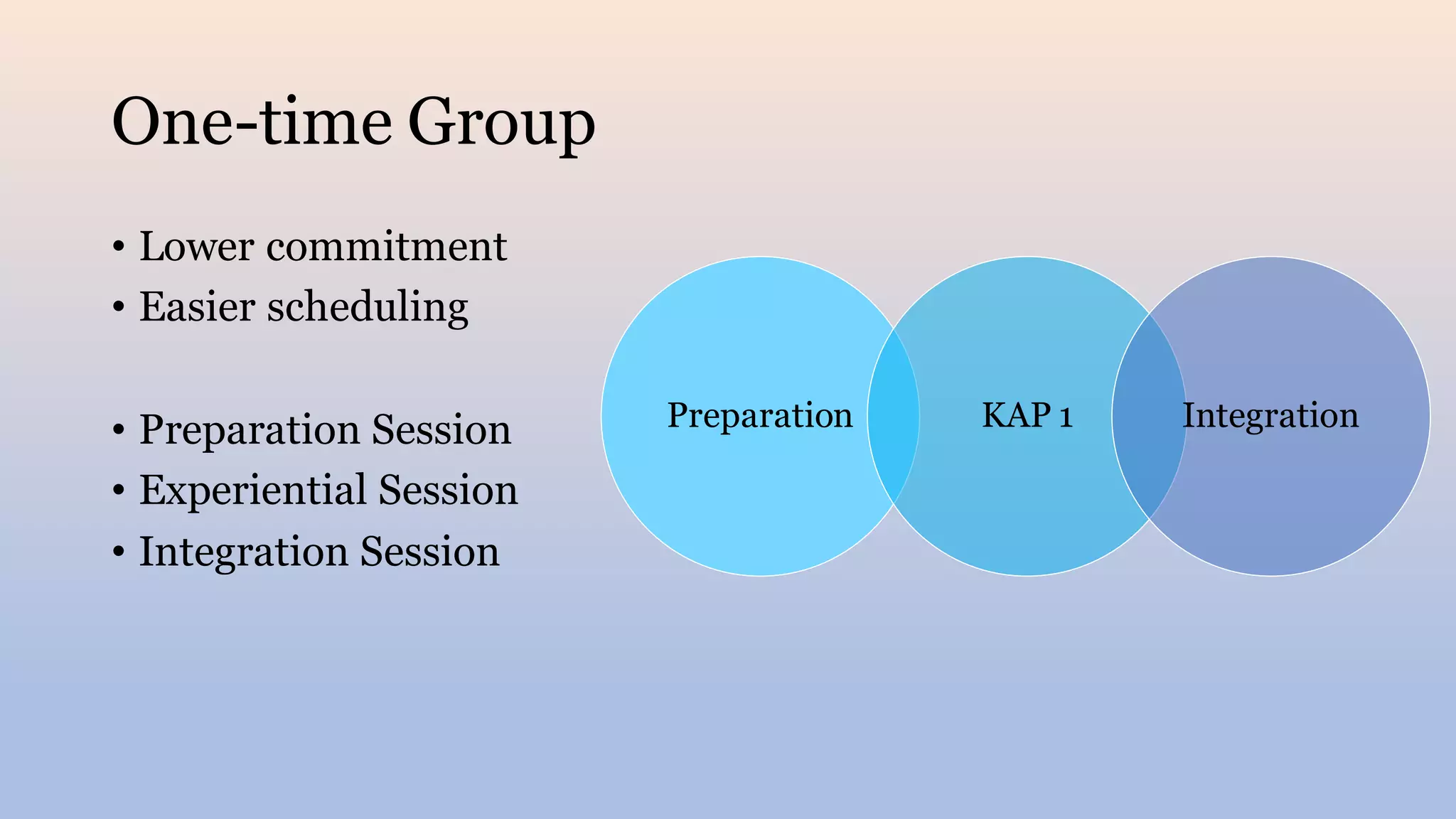
One-time Group
• Lower commitment
• Easier scheduling
• Preparation Session
• Experiential Session
• Integration Session
Preparation KAP 1 Integration
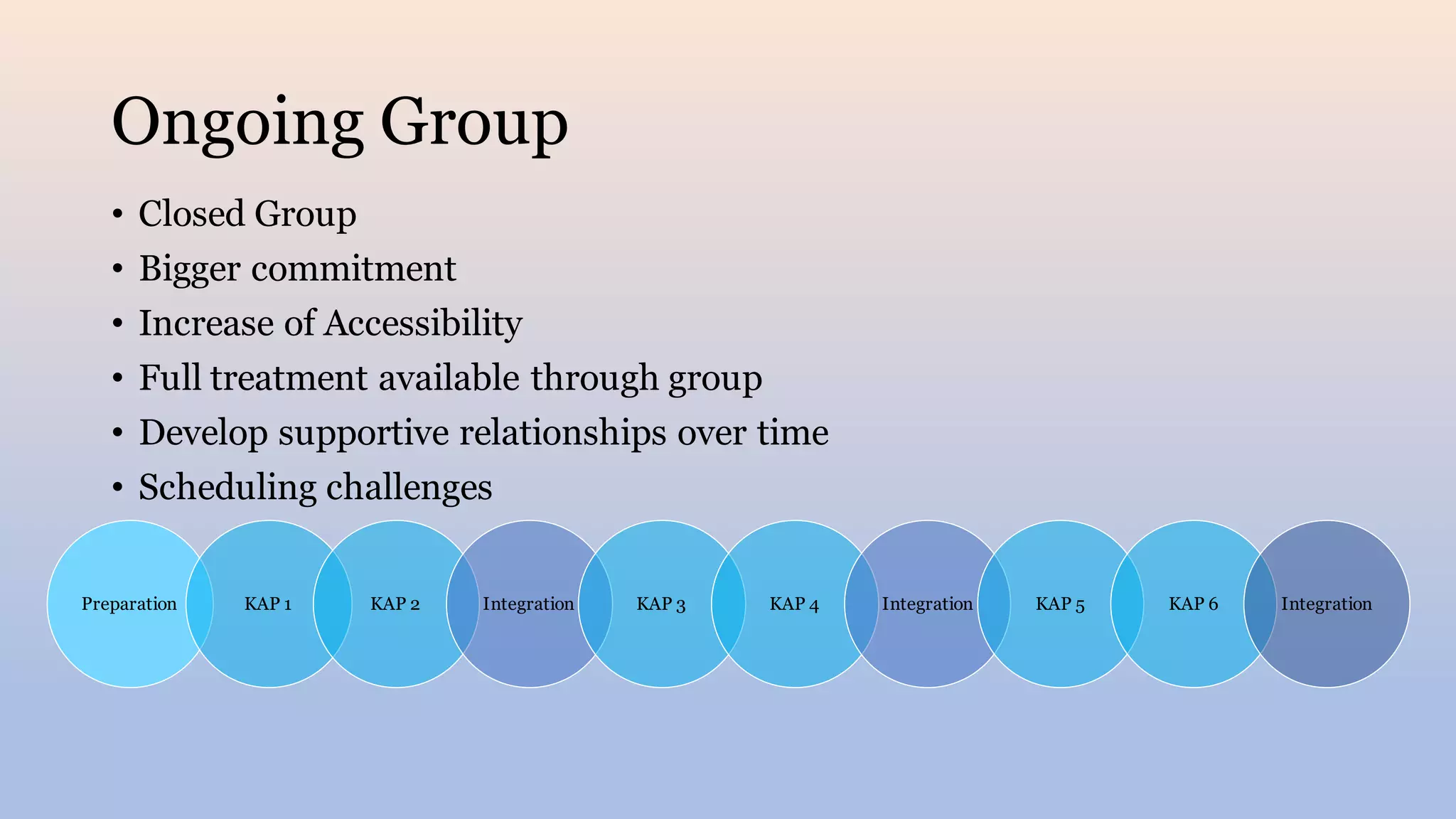
Ongoing Group
• Closed Group
• Bigger commitment
• Increase of Accessibility
• Full treatment available through group
• Develop supportive relationships over time
• Scheduling challenges
Preparation KAP 1 KAP 2 Integration KAP 3 KAP 4 Integration KAP 5 KAP 6 Integration
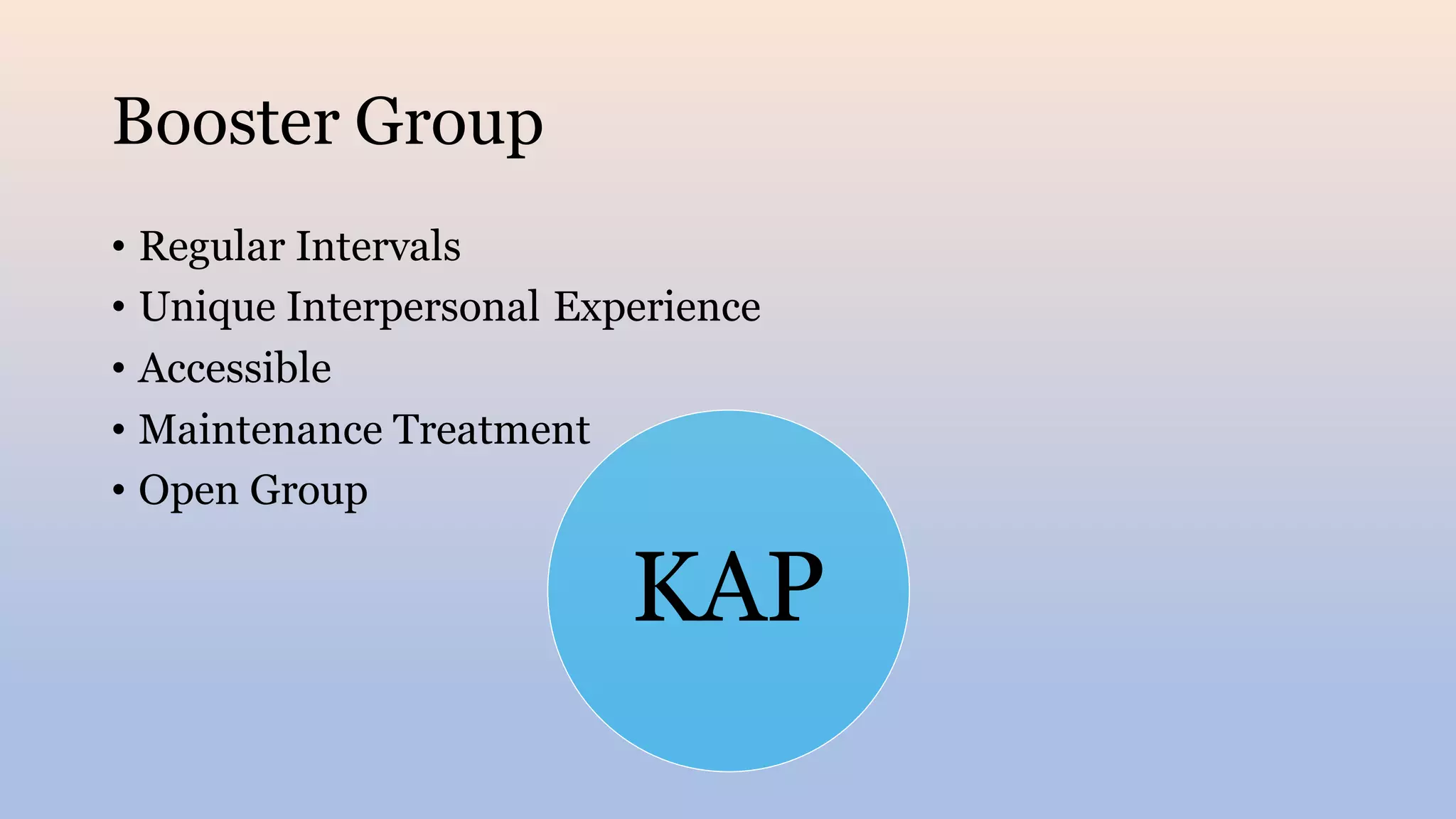
Booster Group
• Regular Intervals
• Unique Interpersonal Experience
• Accessible
• Maintenance Treatment
• Open Group
KAP
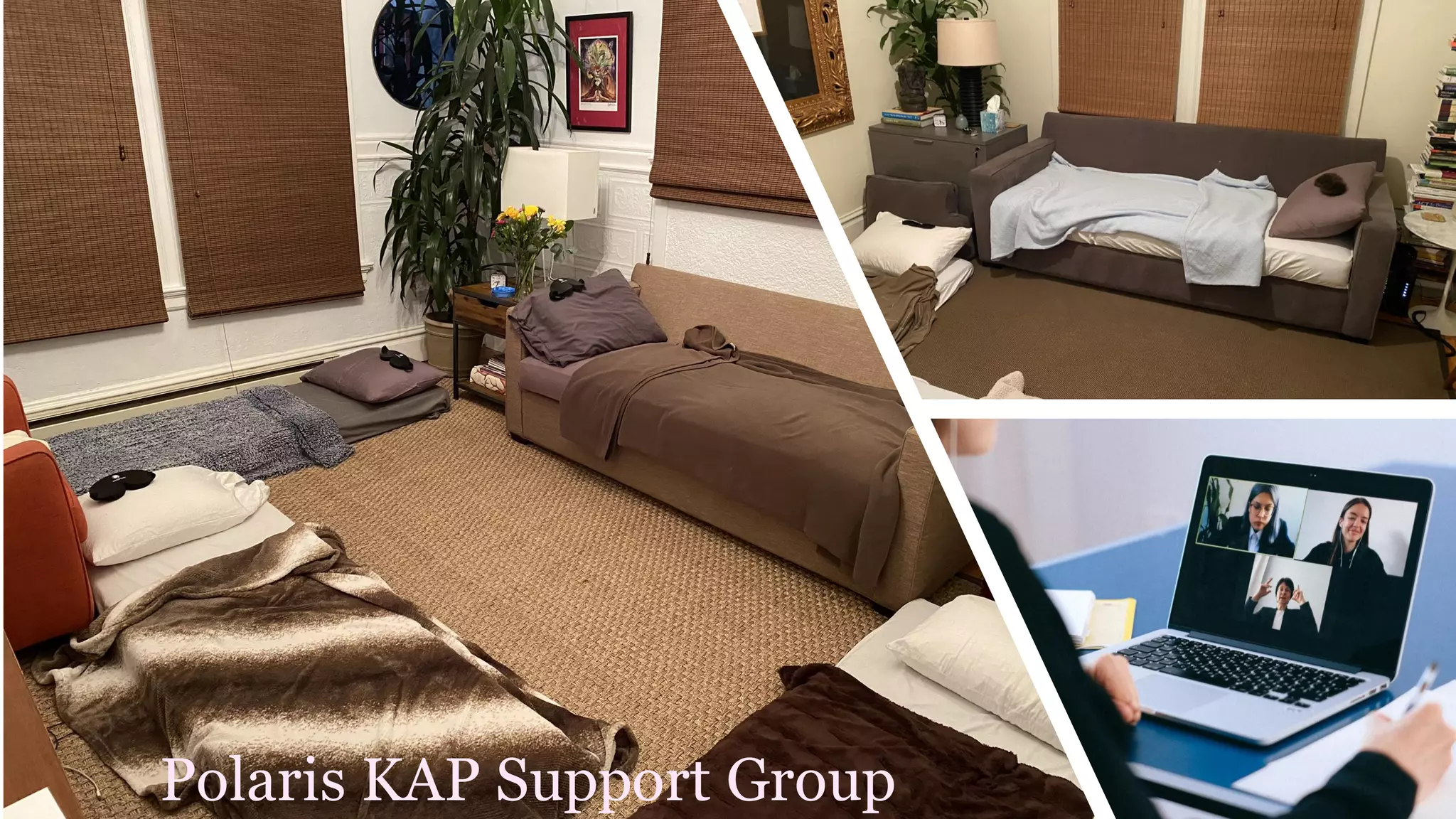
Polaris KAP Support Group
Integration Therapy
Group
• Shared Experience
• Accessible
• Support of members with similar
interests and experiences
Peer Support
Community Circle
• Discussion around psychedelic
experiences and integration
• Not specifically focused on clinical
issues BUT confidential/anonymous
• Often, non-violent communication
skills are encouraged (e.g. “I”
statements rather than “You”
statements)
• Engenders sense of
connectedness, community, and
grounding
Examples of Breakthroughs and Challenges
Loud client
Aggressive client
Hyperverbal Client
Client who triggers other peoples’ trauma
Client who is moving around a lot
Client acting out experience
Agitated client
Silent Client
Client calling for attention
Client engaging with other group members during experience
Future
Possibilities
• Long-term group
• Retreat continuity (retreat group that meets
2x/year)
Virtual
Ketamine
Assisted
Psychotherapy
Opportunities
• Geographical Accessibility
• Financial Accessibility
• Health Safety during COVID-19
• Connection during COVID
• Decrease of Nausea after session
• Improved after-care during come down
• Increased Physical Comfort
Challenges
of Virtual
Sessions
Challenges
• Increased risk in case of emergency
• Decreased ability of provide support
• Not possible to use physical touch by therapist
• Internet challenges
• Issues that are out of control of the therapist (e.g. intrusion by
others, navigating interpersonal dynamics with sitter)
• Increased preparation and setting demands on the patient
• Transition after difficult session (no recovery room)
Preparation
• Consent for KAP, Telehealth, and At-Home Lozenge Use
• Support person designation
• Appropriate Location Crisis Numbers
• Set and Setting
• Safety
• Protected time and space
• Phone set up
• Zoom set up
• Music set up
• Planning for possible challenges (internet, music)
• Planning for possible side effects
• Planning for integration
Spotify Set Up
❖Paid version
❖Cross Fade set to 12 seconds
❖Shuffle Off
❖Auto-play Off
❖Adjusting Volume of Spotify and Computer
❖Using headphones
❖Avoid sharing sound through Zoom if possible
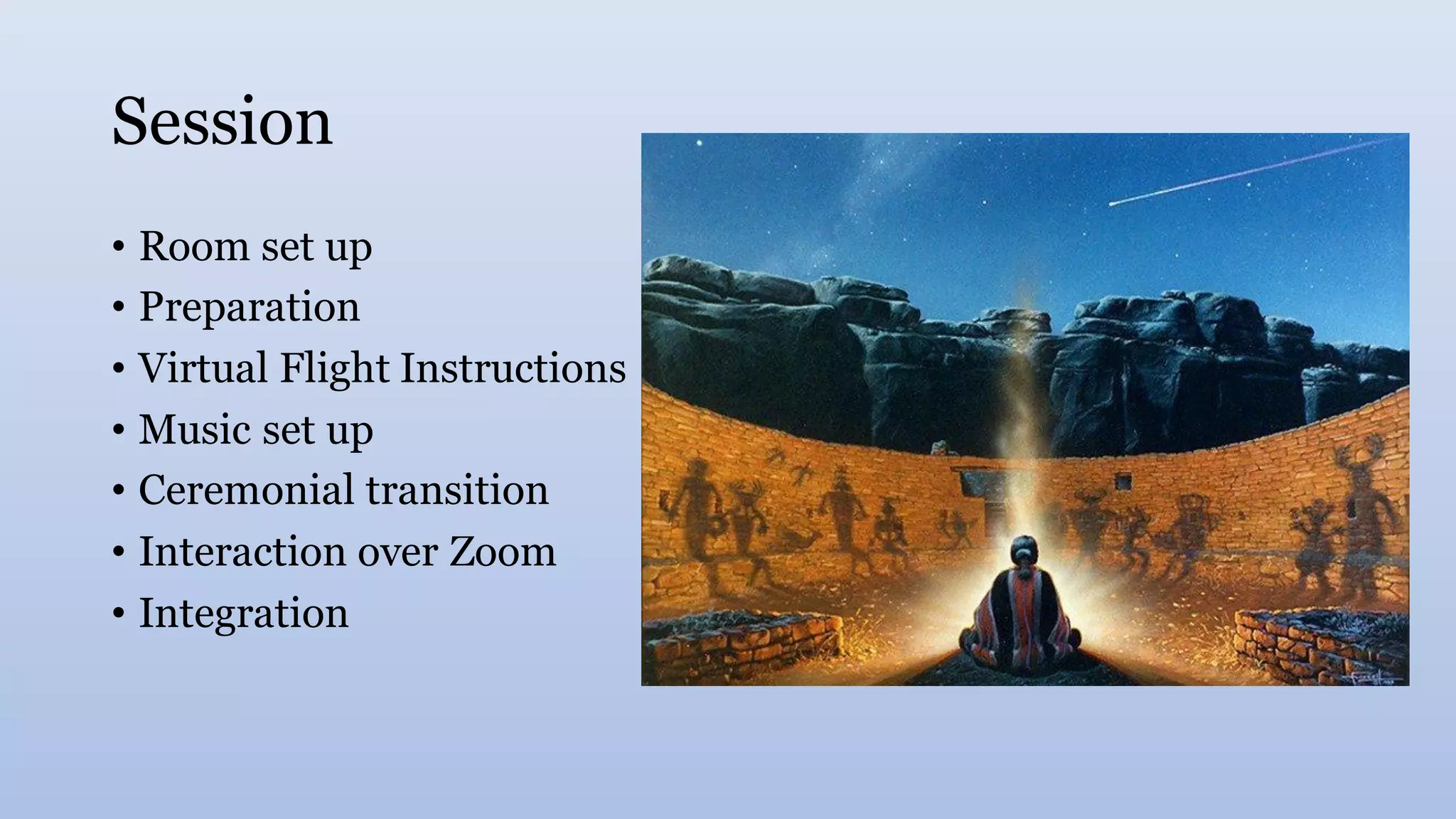
Session
• Room set up
• Preparation
• Virtual Flight Instructions
• Music set up
• Ceremonial transition
• Interaction over Zoom
• Integration
Integration and Working with Intention
• Verbalizing of the experience
• Resting
• Next-day journaling
• Next 2 days listening to the playlist as a part of integration
• Re-visiting insights, visions, experience and relating to
intention, “anchoring” (Wolfson)
• Supporting accountability to integration, verbalizing next steps
• Body, Mind, Spirit, Community and Environmental paradigms
of integration (Bourzat)
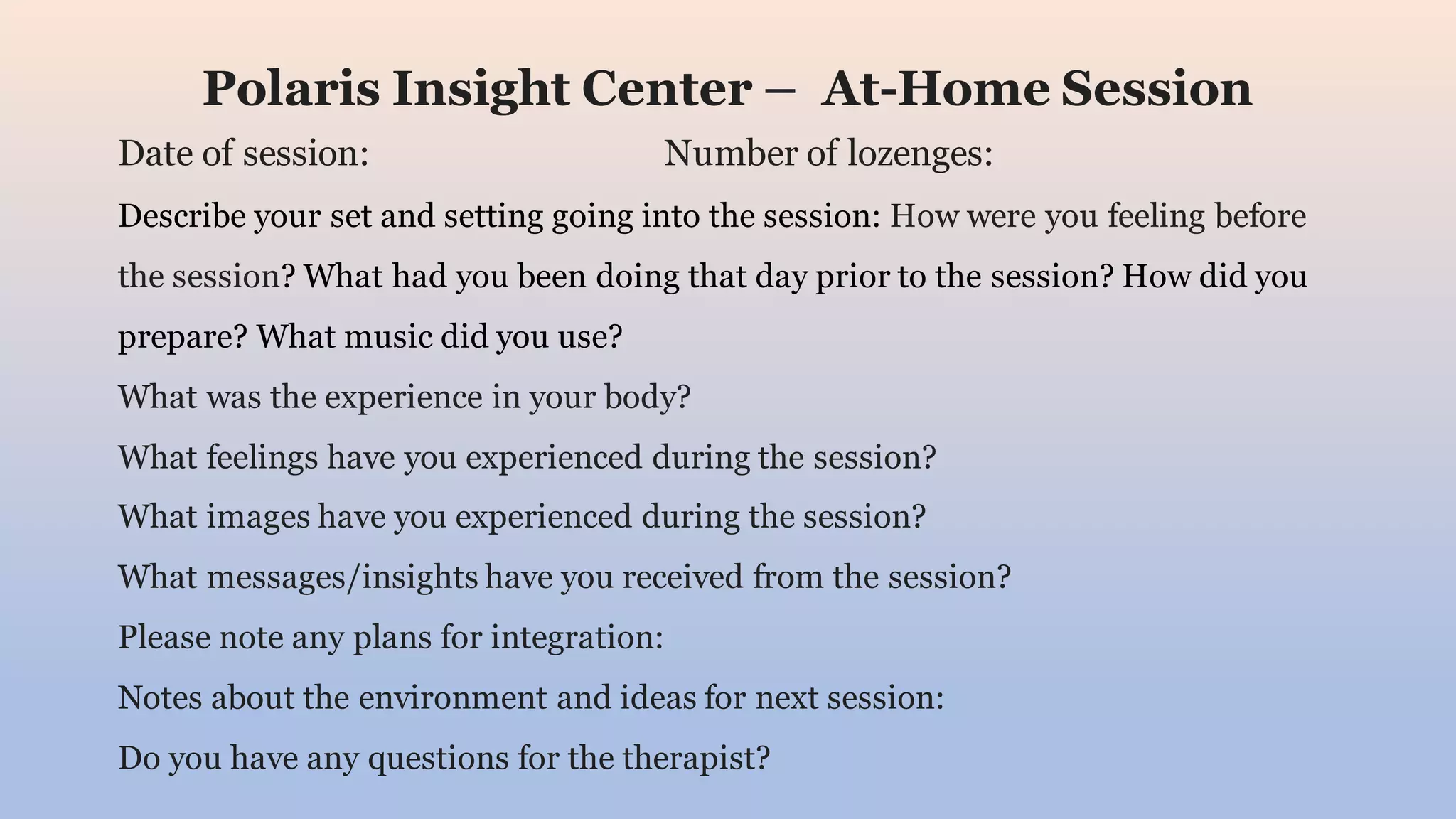
Polaris Insight Center – At-Home Session
Date of session: Number of lozenges:
Describe your set and setting going into the session: How were you feeling before
the session? What had you been doing that day prior to the session? How did you
prepare? What music did you use?
What was the experience in your body?
What feelings have you experienced during the session?
What images have you experienced during the session?
What messages/insights have you received from the session?
Please note any plans for integration:
Notes about the environment and ideas for next session:
Do you have any questions for the therapist?
Integration of Spiritual Experiences
FIVE TRUTH CLAIMS
THAT RESULT FROM
MYSTICAL EXPERIENCES
(Richards, 2014)
1. The primordial reality of the spiritual dimension of
consciousness
2. The indestructible nature of consciousness
3. Interrelatedness within the great unity of all human
beings and perhaps all life forms
4. Agape (pure benevolence, goodwill, transpersonal love)
as the ultimate energy at the core of reality
5. The incredible awesome beauty of these states in design,
visuals, wisdom and meaning
1) Confirmation of spiritual beliefs
2) Positive new view of spirituality
3) Perspective dystonic to one's spiritual beliefs
a) Family’s Response to the spiritual experience
b) Outside therapist’s response to the spiritual
experience
c) Ones’ response to the experience or
”non-experience”
Form and Formlessness
Duality and Non-duality
Humility
Inclusivity
Dialectical
Awakening/enlightenment
experiences
Level of
personality/moral/spiritual
development
Spiritual Trauma
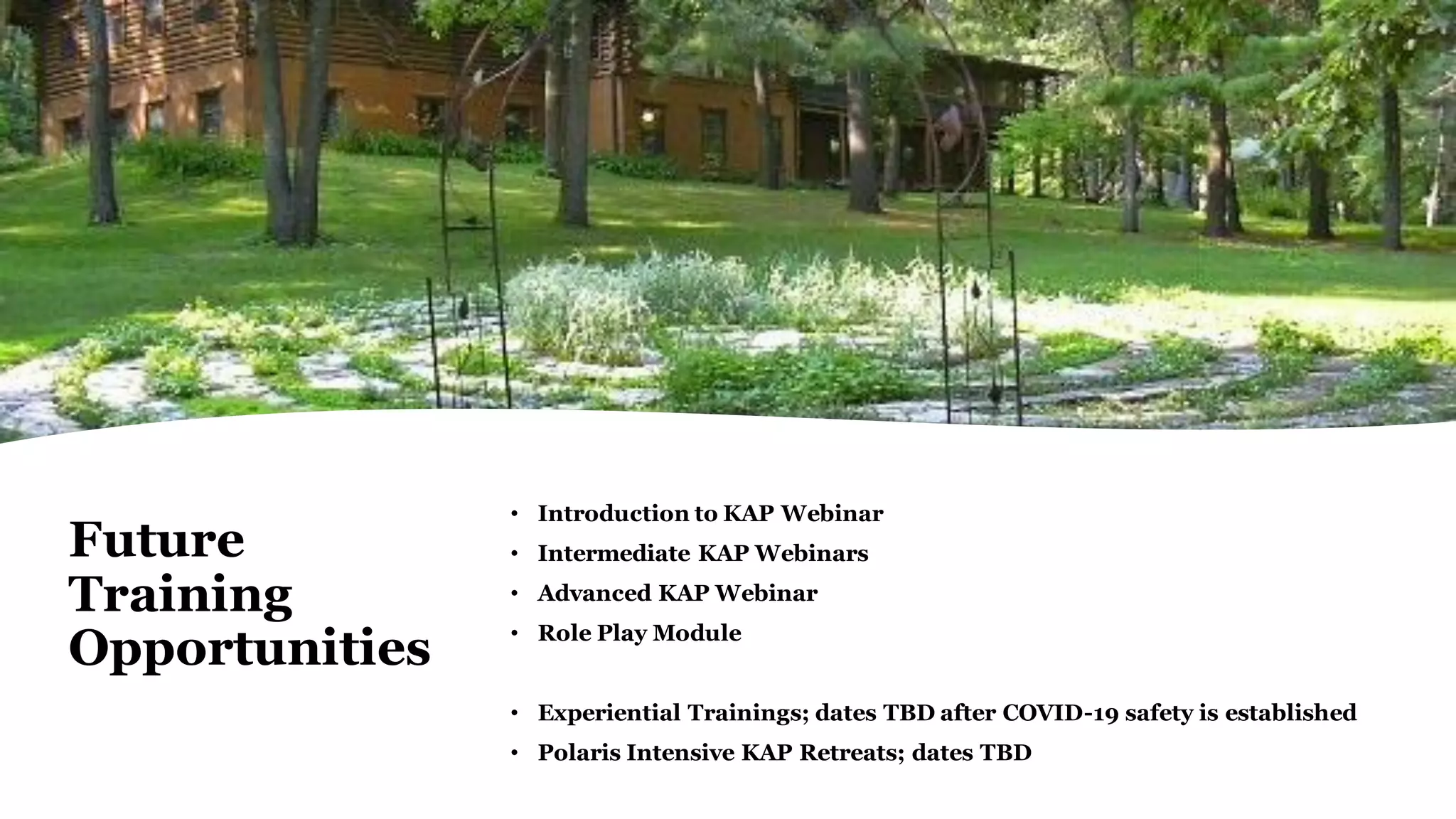
Future
Training
Opportunities
• Introduction to KAP Webinar
• Intermediate KAP Webinars
• Advanced KAP Webinar
• Role Play Module
• Experiential Trainings; dates TBD after COVID-19 safety is established
• Polaris Intensive KAP Retreats; dates TBD
Polaris Insight Center
4257 18th St.
San Francisco, CA 94114
415.800.7083
polarisinsight.com
info@polarisinsight.com
harvey@polarisinsight.com
eric@polarisinsight.com
veronika@polarisinsight.com
chris@polarisinsight.com
THANK YOU

Advanced presentation kap 3

  • 1.
    POLARIS INSIGHT CENTER SAN FRANCISCO Ketamine-Assisted Psychotherapy,Training & Consultation www.polarisinsight.com
  • 2.
    Ketamine-Assisted Psychotherapy COPYRIGHT 2020 POLARISINSIGHTCENTER– SAN FRANCISCO . Focused Clinical Issues Module 3
  • 3.
  • 5.
  • 7.
  • 8.
  • 9.
  • 10.
    Code of Ethics •MAPS – Codes Of Ethics • Code of Ethics for Spiritual Guides from the Council for Spiritual Practices • Usona Code of Ethics for Entheogen Guides in a Research Setting • Ethics for Holotropic Breathwork Practitioners • The Conclave
  • 11.
    Ethics of theSet and Setting • Value: Ketamine as transformative medicine • Value: An altered state is a vulnerable state • Container, Secure Base, Safe Haven, “Going On Being” (Winnicott) • Value: Therapist's personal experience - Clinician Know Thyself • Some clinics require therapists NOT to have had experience with ketamine – clinician bias
  • 12.
    Misconduct Prevention and Recovery •Open communication about psychedelic assisted therapy • Open discussion about negative experiences • Ongoing consultation/supervision/case conferences • Continuing education • Co-therapy pairs • Challenges around Secrecy and Shame
  • 13.
    • “Right useof power”: 1) Informed, 2) Conscious, 3) Caring, 4) Skillful (from Hakomi) • Awareness of power differential • Race, gender, LGBTQ, SES • Domination and abdication • Clinician’s training and history (ethical proactivity) • Dangers of gratification and frustration • Mutuality
  • 14.
    Economics and Access • Increasedaccessibility without scaling • Diversity among clinicians • Dynamics and pragmatics of lower fees • Assessing economic vulnerability • Shame and exploitation
  • 15.
    ADDITIONAL RESOURCES • Chacruna– Towards An Ethos of Equity and Inclusion in the Psychedelic Movement • Developing Guidelines and Competencies for the Training of Psychedelic Therapists – Janis Phelps • Power in the helping professions- Adolf Guggenbuhl- Craig • Sex in the forbiddenzone; when therapist, doctors, clergy, teachers and other men in power betray women’s trust – Peter Rutter • Ethics in Psychotherapy and Counseling;a practical guide– Kenneth S. Pope
  • 16.
  • 17.
    STEPS • Requirementof havingan outsidetherapist • Releaseof informationfor outsideproviders • Initial contact • Educationaround KAP, answering questions • Establishingcollaborativerelationship • Establishingongoing communication
  • 18.
    Why Therapists referClients to KAP? • KAP is well suited for client’s treatment plan • Client failed many other treatments and KAP is “the last resort” • Primary therapist feels “stuck” with the client • Primary therapist wants to stop seeing client • Primary therapist is following client’s lead but is not familiar of does not agree with KAP • Primary therapist if following client’s lead and is supportive of KAP
  • 19.
    Obstacles to Referring •Naivete; Lack of information, knowledge, exposure • Biases from clinical training and residue from war on drugs • “Brand loyalty”/ “Party loyalty” • Possessiveness • Protectiveness of client • Fear of being perceived as abandoning/rejecting • Desire to evade, eject, or “dump” client • Acting out of helplessness/desperation in countertransference • Difficulty collaborating with other professionals • Lack of healthy humility and limits of the
  • 20.
    POSSIBLILITES • Positive collaborativeRelationship with primary therapist • Mutually supportive, ongoing, long-term support in integration process • Primary therapist invested in the wisdom of inner healing intelligence • Potential, initial exacerbation of symptoms is understood in the context of the healing process, rather than as a failure of treatment
  • 21.
    CHALLENGES • Primary therapist(PT) is not familiar with KAP • PT is not able to trust the inner healing intelligence • PT has a different agenda how tx should look like • Client is experiencing crisis and PT “blames” KAP • Not enough/established communication with PT • PT impacted by war on drugs, or other clients who had negative experiences with psychedelics • “Splitting” in the psychotherapy field and team • Including/Not including PT in experiential session
  • 22.
  • 23.
    Principles of Group Work •Confidentiality • Irvin Yalom's Therapeutic Factors of Group Work: Universality, instillation of hope, altruism, interpersonal learning input and output, imitative behaviors, catharsis, self-understanding, and existential factors
  • 24.
    Preparation for Group •Individual Medical and Psychological Intake prior to joining • Consent for Group psychotherapy • Consideration of individual experience before first group • Collaboration of a dyad MD/therapist, or RN/therapist • Preparing members for types of experiences that can come up in KAP and how disruptions will be managed • Separate room needs to be available in case one of the members goes into deeper process needing individual attention; one co- therapist designated to be with client and other co-therapist stays with group
  • 25.
    One-time Group • Lowercommitment • Easier scheduling • Preparation Session • Experiential Session • Integration Session Preparation KAP 1 Integration
  • 26.
    Ongoing Group • ClosedGroup • Bigger commitment • Increase of Accessibility • Full treatment available through group • Develop supportive relationships over time • Scheduling challenges Preparation KAP 1 KAP 2 Integration KAP 3 KAP 4 Integration KAP 5 KAP 6 Integration
  • 27.
    Booster Group • RegularIntervals • Unique Interpersonal Experience • Accessible • Maintenance Treatment • Open Group KAP
  • 28.
  • 29.
    Integration Therapy Group • SharedExperience • Accessible • Support of members with similar interests and experiences
  • 30.
    Peer Support Community Circle •Discussion around psychedelic experiences and integration • Not specifically focused on clinical issues BUT confidential/anonymous • Often, non-violent communication skills are encouraged (e.g. “I” statements rather than “You” statements) • Engenders sense of connectedness, community, and grounding
  • 31.
    Examples of Breakthroughsand Challenges Loud client Aggressive client Hyperverbal Client Client who triggers other peoples’ trauma Client who is moving around a lot Client acting out experience Agitated client Silent Client Client calling for attention Client engaging with other group members during experience
  • 32.
    Future Possibilities • Long-term group •Retreat continuity (retreat group that meets 2x/year)
  • 33.
  • 34.
    Opportunities • Geographical Accessibility •Financial Accessibility • Health Safety during COVID-19 • Connection during COVID • Decrease of Nausea after session • Improved after-care during come down • Increased Physical Comfort
  • 35.
  • 36.
    Challenges • Increased riskin case of emergency • Decreased ability of provide support • Not possible to use physical touch by therapist • Internet challenges • Issues that are out of control of the therapist (e.g. intrusion by others, navigating interpersonal dynamics with sitter) • Increased preparation and setting demands on the patient • Transition after difficult session (no recovery room)
  • 37.
    Preparation • Consent forKAP, Telehealth, and At-Home Lozenge Use • Support person designation • Appropriate Location Crisis Numbers • Set and Setting • Safety • Protected time and space • Phone set up • Zoom set up • Music set up • Planning for possible challenges (internet, music) • Planning for possible side effects • Planning for integration
  • 38.
    Spotify Set Up ❖Paidversion ❖Cross Fade set to 12 seconds ❖Shuffle Off ❖Auto-play Off ❖Adjusting Volume of Spotify and Computer ❖Using headphones ❖Avoid sharing sound through Zoom if possible
  • 39.
    Session • Room setup • Preparation • Virtual Flight Instructions • Music set up • Ceremonial transition • Interaction over Zoom • Integration
  • 40.
    Integration and Workingwith Intention • Verbalizing of the experience • Resting • Next-day journaling • Next 2 days listening to the playlist as a part of integration • Re-visiting insights, visions, experience and relating to intention, “anchoring” (Wolfson) • Supporting accountability to integration, verbalizing next steps • Body, Mind, Spirit, Community and Environmental paradigms of integration (Bourzat)
  • 41.
    Polaris Insight Center– At-Home Session Date of session: Number of lozenges: Describe your set and setting going into the session: How were you feeling before the session? What had you been doing that day prior to the session? How did you prepare? What music did you use? What was the experience in your body? What feelings have you experienced during the session? What images have you experienced during the session? What messages/insights have you received from the session? Please note any plans for integration: Notes about the environment and ideas for next session: Do you have any questions for the therapist?
  • 42.
  • 43.
    FIVE TRUTH CLAIMS THATRESULT FROM MYSTICAL EXPERIENCES (Richards, 2014) 1. The primordial reality of the spiritual dimension of consciousness 2. The indestructible nature of consciousness 3. Interrelatedness within the great unity of all human beings and perhaps all life forms 4. Agape (pure benevolence, goodwill, transpersonal love) as the ultimate energy at the core of reality 5. The incredible awesome beauty of these states in design, visuals, wisdom and meaning
  • 44.
    1) Confirmation ofspiritual beliefs 2) Positive new view of spirituality 3) Perspective dystonic to one's spiritual beliefs a) Family’s Response to the spiritual experience b) Outside therapist’s response to the spiritual experience c) Ones’ response to the experience or ”non-experience”
  • 45.
  • 46.
  • 47.
  • 48.
  • 49.
    Future Training Opportunities • Introduction toKAP Webinar • Intermediate KAP Webinars • Advanced KAP Webinar • Role Play Module • Experiential Trainings; dates TBD after COVID-19 safety is established • Polaris Intensive KAP Retreats; dates TBD
  • 50.
    Polaris Insight Center 425718th St. San Francisco, CA 94114 415.800.7083 polarisinsight.com info@polarisinsight.com harvey@polarisinsight.com eric@polarisinsight.com veronika@polarisinsight.com chris@polarisinsight.com THANK YOU