INTROBOTICS
By: Tr. MJ Fernandez
ROBOTICS Terminology
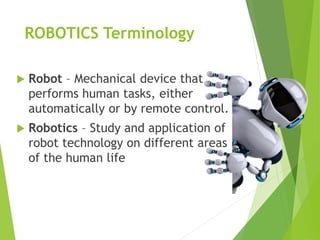
 Robot – Mechanical device that
performs human tasks, either
automatically or by remote control.
 Robotics – Study and application of
robot technology on different areas
of the human life
Definition of Robot
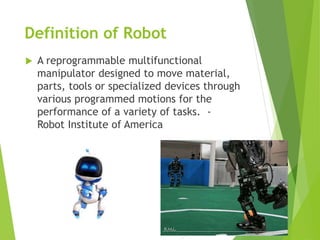
 A reprogrammable multifunctional
manipulator designed to move material,
parts, tools or specialized devices through
various programmed motions for the
performance of a variety of tasks. -
Robot Institute of America
Main Components of a Robot
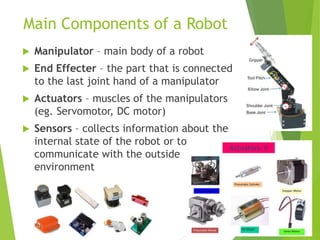
 Manipulator – main body of a robot
 End Effecter – the part that is connected
to the last joint hand of a manipulator
 Actuators – muscles of the manipulators
(eg. Servomotor, DC motor)
 Sensors – collects information about the
internal state of the robot or to
communicate with the outside
environment
Main Components of a Robot
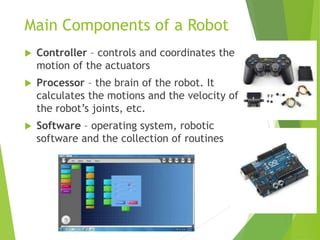
 Controller – controls and coordinates the
motion of the actuators
 Processor – the brain of the robot. It
calculates the motions and the velocity of
the robot’s joints, etc.
 Software – operating system, robotic
software and the collection of routines
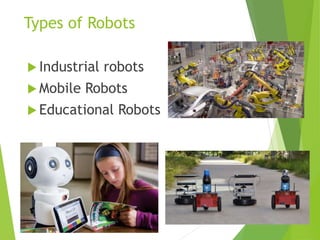
Types of Robots
 Industrial robots
 Mobile Robots
 Educational Robots
Robotics in Education
Learning robotics in school develop the skills and
knowledge of students in robotics. Robotics help
students with the following:
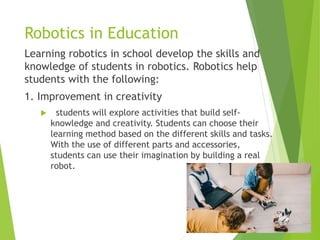
1. Improvement in creativity
 students will explore activities that build self-
knowledge and creativity. Students can choose their
learning method based on the different skills and tasks.
With the use of different parts and accessories,
students can use their imagination by building a real
robot.
Robotics in Education
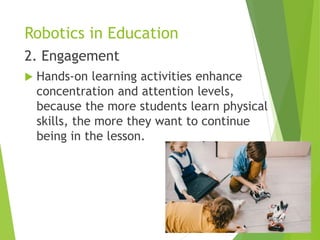
2. Engagement
 Hands-on learning activities enhance
concentration and attention levels,
because the more students learn physical
skills, the more they want to continue
being in the lesson.
Robotics in Education
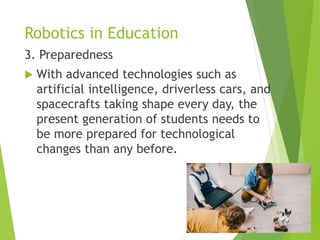
3. Preparedness
 With advanced technologies such as
artificial intelligence, driverless cars, and
spacecrafts taking shape every day, the
present generation of students needs to
be more prepared for technological
changes than any before.
Robotics in Education
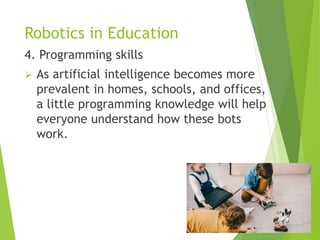
4. Programming skills
 As artificial intelligence becomes more
prevalent in homes, schools, and offices,
a little programming knowledge will help
everyone understand how these bots
work.
Robotics in Education
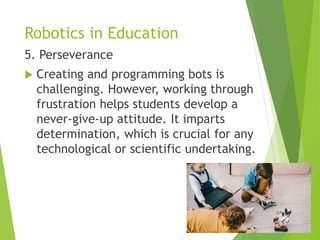
5. Perseverance
 Creating and programming bots is
challenging. However, working through
frustration helps students develop a
never-give-up attitude. It imparts
determination, which is crucial for any
technological or scientific undertaking.
Robotics in Education
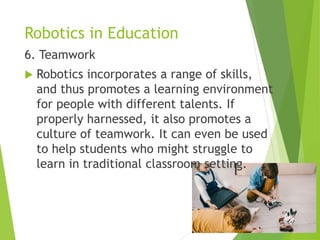
6. Teamwork
 Robotics incorporates a range of skills,
and thus promotes a learning environment
for people with different talents. If
properly harnessed, it also promotes a
culture of teamwork. It can even be used
to help students who might struggle to
learn in traditional classroom setting.
Robotics in Education
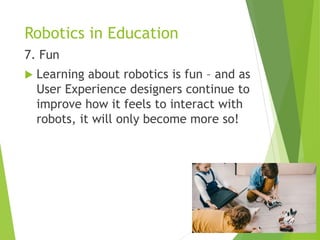
7. Fun
 Learning about robotics is fun – and as
User Experience designers continue to
improve how it feels to interact with
robots, it will only become more so!
SUMMARY
1. What is robot?
2. What is Robotics?
3. Main Components of a Robot
4. 3 Types of Robots
5. Give the 7 Robotics in Education
THANK YOU AND GOD BLESS! 

Introbotics

  • 1.
  • 2.
    ROBOTICS Terminology  Robot– Mechanical device that performs human tasks, either automatically or by remote control.  Robotics – Study and application of robot technology on different areas of the human life
  • 3.
    Definition of Robot A reprogrammable multifunctional manipulator designed to move material, parts, tools or specialized devices through various programmed motions for the performance of a variety of tasks. - Robot Institute of America
  • 4.
    Main Components ofa Robot  Manipulator – main body of a robot  End Effecter – the part that is connected to the last joint hand of a manipulator  Actuators – muscles of the manipulators (eg. Servomotor, DC motor)  Sensors – collects information about the internal state of the robot or to communicate with the outside environment
  • 5.
    Main Components ofa Robot  Controller – controls and coordinates the motion of the actuators  Processor – the brain of the robot. It calculates the motions and the velocity of the robot’s joints, etc.  Software – operating system, robotic software and the collection of routines
  • 6.
    Types of Robots Industrial robots  Mobile Robots  Educational Robots
  • 7.
    Robotics in Education Learningrobotics in school develop the skills and knowledge of students in robotics. Robotics help students with the following: 1. Improvement in creativity  students will explore activities that build self- knowledge and creativity. Students can choose their learning method based on the different skills and tasks. With the use of different parts and accessories, students can use their imagination by building a real robot.
  • 8.
    Robotics in Education 2.Engagement  Hands-on learning activities enhance concentration and attention levels, because the more students learn physical skills, the more they want to continue being in the lesson.
  • 9.
    Robotics in Education 3.Preparedness  With advanced technologies such as artificial intelligence, driverless cars, and spacecrafts taking shape every day, the present generation of students needs to be more prepared for technological changes than any before.
  • 10.
    Robotics in Education 4.Programming skills  As artificial intelligence becomes more prevalent in homes, schools, and offices, a little programming knowledge will help everyone understand how these bots work.
  • 11.
    Robotics in Education 5.Perseverance  Creating and programming bots is challenging. However, working through frustration helps students develop a never-give-up attitude. It imparts determination, which is crucial for any technological or scientific undertaking.
  • 12.
    Robotics in Education 6.Teamwork  Robotics incorporates a range of skills, and thus promotes a learning environment for people with different talents. If properly harnessed, it also promotes a culture of teamwork. It can even be used to help students who might struggle to learn in traditional classroom setting.
  • 13.
    Robotics in Education 7.Fun  Learning about robotics is fun – and as User Experience designers continue to improve how it feels to interact with robots, it will only become more so!
  • 14.
    SUMMARY 1. What isrobot? 2. What is Robotics? 3. Main Components of a Robot 4. 3 Types of Robots 5. Give the 7 Robotics in Education THANK YOU AND GOD BLESS! 