Introduction to pattern
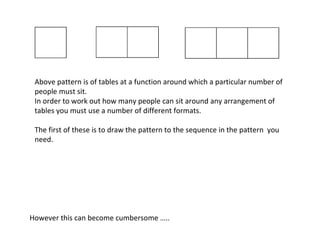
Above pattern is of tables at a function around which a particular number of people must sit. In order to work out how many people can sit around any arrangement of tables you must use a number of different formats. The first of these is to draw the pattern to the sequence in the pattern  you need.  However this can become cumbersome …..
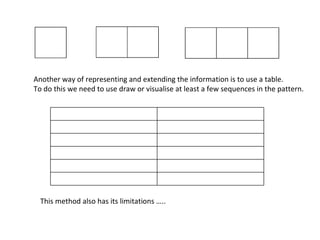
Another way of representing and extending the information is to use a table. To do this we need to use draw or visualise at least a few sequences in the pattern. This method also has its limitations …..
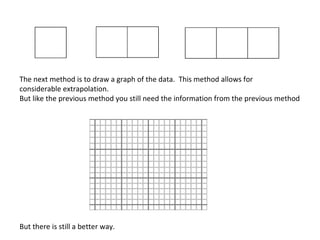
The next method is to draw a graph of the data.  This method allows for  considerable extrapolation.  But like the previous method you still need the information from the previous method  But there is still a better way.
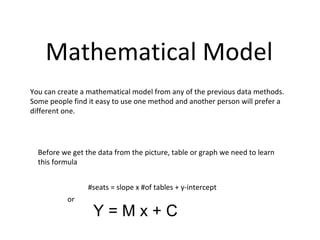
Mathematical Model You can create a mathematical model from any of the previous data methods. Some people find it easy to use one method and another person will prefer a  different one.  Before we get the data from the picture, table or graph we need to learn  this formula #seats = slope x #of tables + y-intercept or Y = M x + C
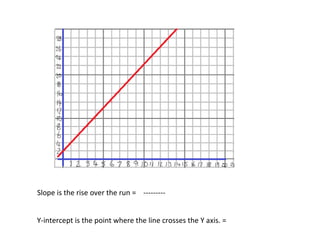
Slope is the rise over the run =  --------- Y-intercept is the point where the line crosses the Y axis. =
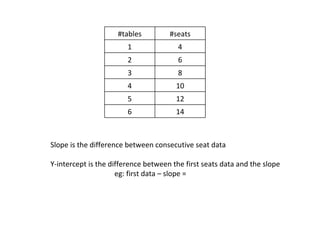
Slope is the difference between consecutive seat data Y-intercept is the difference between the first seats data and the slope eg: first data – slope =  #tables #seats 1 4 2 6 3 8 4 10 5 12 6 14
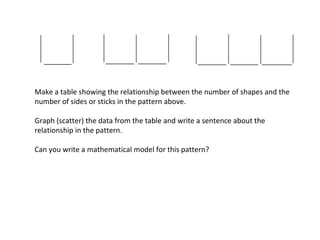
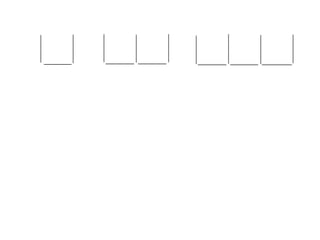
Make a table showing the relationship between the number of shapes and the number of sides or sticks in the pattern above. Graph (scatter) the data from the table and write a sentence about the relationship in the pattern. Can you write a mathematical model for this pattern?
 
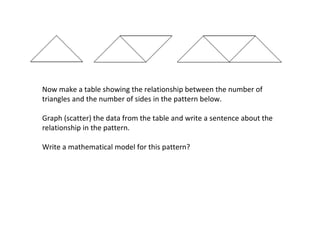
Now make a table showing the relationship between the number of triangles and the number of sides in the pattern below. Graph (scatter) the data from the table and write a sentence about the relationship in the pattern. Write a mathematical model for this pattern?
 

intro to Pattern

  • 1.
  • 2.
    Above pattern isof tables at a function around which a particular number of people must sit. In order to work out how many people can sit around any arrangement of tables you must use a number of different formats. The first of these is to draw the pattern to the sequence in the pattern you need. However this can become cumbersome …..
  • 3.
    Another way ofrepresenting and extending the information is to use a table. To do this we need to use draw or visualise at least a few sequences in the pattern. This method also has its limitations …..
  • 4.
    The next methodis to draw a graph of the data. This method allows for considerable extrapolation. But like the previous method you still need the information from the previous method But there is still a better way.
  • 5.
    Mathematical Model Youcan create a mathematical model from any of the previous data methods. Some people find it easy to use one method and another person will prefer a different one. Before we get the data from the picture, table or graph we need to learn this formula #seats = slope x #of tables + y-intercept or Y = M x + C
  • 6.
    Slope is therise over the run = --------- Y-intercept is the point where the line crosses the Y axis. =
  • 7.
    Slope is thedifference between consecutive seat data Y-intercept is the difference between the first seats data and the slope eg: first data – slope = #tables #seats 1 4 2 6 3 8 4 10 5 12 6 14
  • 8.
    Make a tableshowing the relationship between the number of shapes and the number of sides or sticks in the pattern above. Graph (scatter) the data from the table and write a sentence about the relationship in the pattern. Can you write a mathematical model for this pattern?
  • 9.
  • 10.
    Now make atable showing the relationship between the number of triangles and the number of sides in the pattern below. Graph (scatter) the data from the table and write a sentence about the relationship in the pattern. Write a mathematical model for this pattern?
  • 11.