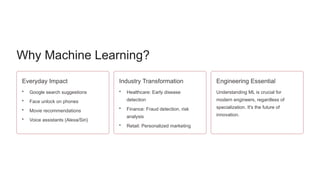
Why Machine Learning?
EverydayImpact
• Google search suggestions
• Face unlock on phones
• Movie recommendations
• Voice assistants (Alexa/Siri)
Industry Transformation
• Healthcare: Early disease
detection
• Finance: Fraud detection, risk
analysis
• Retail: Personalized marketing
Engineering Essential
Understanding ML is crucial for
modern engineers, regardless of
specialization. It's the future of
innovation.
3.
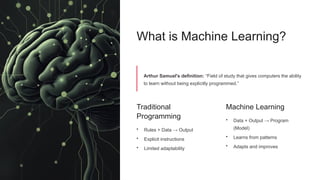
What is MachineLearning?
Arthur Samuel's definition: “Field of study that gives computers the ability
to learn without being explicitly programmed.”
Traditional
Programming
• Rules + Data → Output
• Explicit instructions
• Limited adaptability
Machine Learning
• Data + Output → Program
(Model)
• Learns from patterns
• Adapts and improves
4.
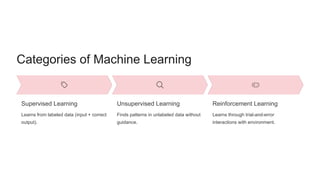
Categories of MachineLearning
Supervised Learning
Learns from labeled data (input + correct
output).
Unsupervised Learning
Finds patterns in unlabeled data without
guidance.
Reinforcement Learning
Learns through trial-and-error
interactions with environment.
5.
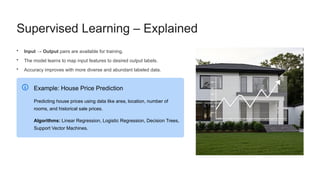
Supervised Learning –Explained
• Input → Output pairs are available for training.
• The model learns to map input features to desired output labels.
• Accuracy improves with more diverse and abundant labeled data.
Example: House Price Prediction
Predicting house prices using data like area, location, number of
rooms, and historical sale prices.
Algorithms: Linear Regression, Logistic Regression, Decision Trees,
Support Vector Machines.
6.
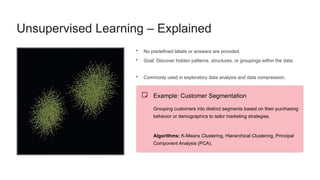
Unsupervised Learning –Explained
• No predefined labels or answers are provided.
• Goal: Discover hidden patterns, structures, or groupings within the data.
• Commonly used in exploratory data analysis and data compression.
Example: Customer Segmentation
Grouping customers into distinct segments based on their purchasing
behavior or demographics to tailor marketing strategies.
Algorithms: K-Means Clustering, Hierarchical Clustering, Principal
Component Analysis (PCA).
7.
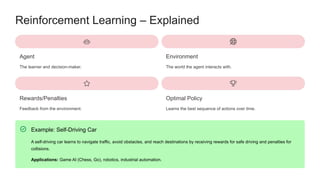
Reinforcement Learning –Explained
Agent
The learner and decision-maker.
Environment
The world the agent interacts with.
Rewards/Penalties
Feedback from the environment.
Optimal Policy
Learns the best sequence of actions over time.
Example: Self-Driving Car
A self-driving car learns to navigate traffic, avoid obstacles, and reach destinations by receiving rewards for safe driving and penalties for
collisions.
Applications: Game AI (Chess, Go), robotics, industrial automation.
8.
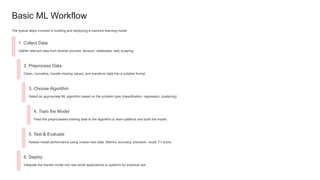
Basic ML Workflow
Thetypical steps involved in building and deploying a machine learning model.
1. Collect Data
Gather relevant data from diverse sources: sensors, databases, web scraping.
2. Preprocess Data
Clean, normalize, handle missing values, and transform data into a suitable format.
3. Choose Algorithm
Select an appropriate ML algorithm based on the problem type (classification, regression, clustering).
4. Train the Model
Feed the preprocessed training data to the algorithm to learn patterns and build the model.
5. Test & Evaluate
Assess model performance using unseen test data. Metrics: accuracy, precision, recall, F1-score.
6. Deploy
Integrate the trained model into real-world applications or systems for practical use.
9.
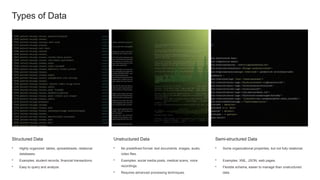
Types of Data
StructuredData
• Highly organized: tables, spreadsheets, relational
databases.
• Examples: student records, financial transactions.
• Easy to query and analyze.
Unstructured Data
• No predefined format: text documents, images, audio,
video files.
• Examples: social media posts, medical scans, voice
recordings.
• Requires advanced processing techniques.
Semi-structured Data
• Some organizational properties, but not fully relational.
• Examples: XML, JSON, web pages.
• Flexible schema, easier to manage than unstructured
data.
10.
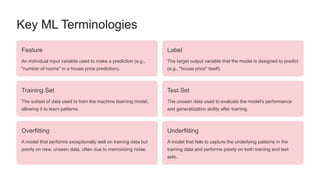
Key ML Terminologies
Feature
Anindividual input variable used to make a prediction (e.g.,
"number of rooms" in a house price prediction).
Label
The target output variable that the model is designed to predict
(e.g., "house price" itself).
Training Set
The subset of data used to train the machine learning model,
allowing it to learn patterns.
Test Set
The unseen data used to evaluate the model's performance
and generalization ability after training.
Overfitting
A model that performs exceptionally well on training data but
poorly on new, unseen data, often due to memorizing noise.
Underfitting
A model that fails to capture the underlying patterns in the
training data and performs poorly on both training and test
sets.
11.
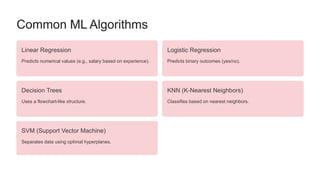
Common ML Algorithms
LinearRegression
Predicts numerical values (e.g., salary based on experience).
Logistic Regression
Predicts binary outcomes (yes/no).
Decision Trees
Uses a flowchart-like structure.
KNN (K-Nearest Neighbors)
Classifies based on nearest neighbors.
SVM (Support Vector Machine)
Separates data using optimal hyperplanes.
12.
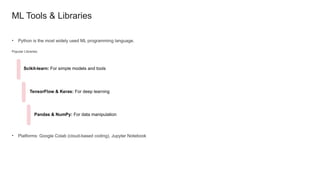
ML Tools &Libraries
Popular Libraries:
• Python is the most widely used ML programming language.
Scikit-learn: For simple models and tools
TensorFlow & Keras: For deep learning
Pandas & NumPy: For data manipulation
• Platforms: Google Colab (cloud-based coding), Jupyter Notebook
13.
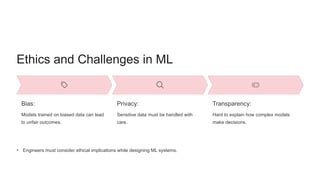
Ethics and Challengesin ML
Bias:
Models trained on biased data can lead
to unfair outcomes.
Privacy:
Sensitive data must be handled with
care.
Transparency:
Hard to explain how complex models
make decisions.
• Engineers must consider ethical implications while designing ML systems.
14.
Conclusion & LearningPath
Machine Learning is a powerful field that enables systems to learn from data and make intelligent decisions. In this
session, we explored the basics of supervised, unsupervised, and reinforcement learning along with key algorithms
and tools. Understanding ML is essential for future-ready engineers. Start small, practice regularly, and explore real-
world problems. Continue your journey with beginner-friendly platforms like Google Colab, Kaggle, and NPTEL.


![1_Introduction to Machine Learning [Autosaved].pptx](https://cdn.slidesharecdn.com/ss_thumbnails/1introductiontomachinelearningautosaved-250910004933-3913b711-thumbnail.jpg?width=640&height=640&fit=bounds)


