S I X S I G M A F O R U M M A G A Z I N E I F E B R U A R Y 2 0 1 5 I 35
THINKING
LEAN
By Bill Peterson,
LeanBP
If your lean initiatives have stalled, you may discover
the constraint isn’t on the shop floor. Most exist-
ing constraints to your operations actually will be in
your administrative or support areas. The good news?
There’s something you can do about it.
Lean applied to business processes: That’s my core
message and my life’s passion. I have developed and
taught a course for more than eight years, and I’d like
to share its main ideas with you.
My big epiphany
Back in the 1990s, I was a young operational supervisor
in an aviation mechanical component repair shop. I
was asked to reduce backlogs of aircraft parts needed
for airline operations at city stations, which were caus-
ing increased delays and cancellations. Our shop had
just started using lean methods, but it became obvious
at the end of six months that applying lean to the shop
floor was not enough.
Luckily, most of the mechanics had been through
six-step problem-solving training, so facilitating process
improvement by providing targets and giving employ-
ees time to improve was relatively easy. Empowering
mechanics to create solutions meant that their ideas
came fast and furiously—backlogs were reduced and
improvements were made in the quality of the parts
and how fast they could be produced.
But that didn’t lead to sustained success. Why? We
experienced a phenomenon that theory of constraints
creator Eli Goldratt described this way: After the con-
straint is broken, a new constraint emerges. In my years
applying lean as a consultant, I’ve seen this happen
at every organization I’ve worked with. Some of these
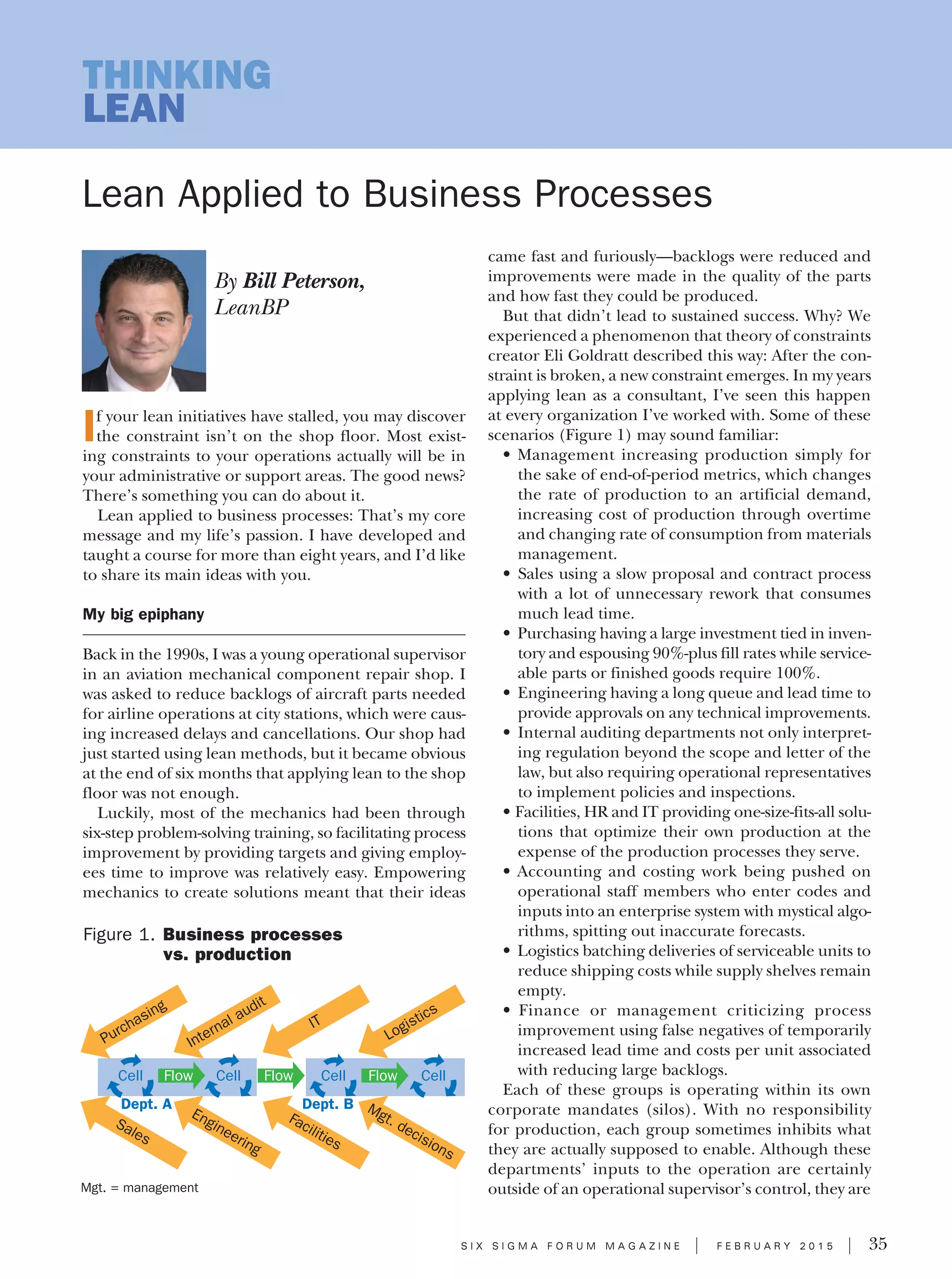
scenarios (Figure 1) may sound familiar:
• Management increasing production simply for
the sake of end-of-period metrics, which changes
the rate of production to an artificial demand,
increasing cost of production through overtime
and changing rate of consumption from materials
management.
• Sales using a slow proposal and contract process
with a lot of unnecessary rework that consumes
much lead time.
• Purchasing having a large investment tied in inven-
tory and espousing 90%-plus fill rates while service-
able parts or finished goods require 100%.
• 	Engineering having a long queue and lead time to
provide approvals on any technical improvements.
• Internal auditing departments not only interpret-
ing regulation beyond the scope and letter of the
law, but also requiring operational representatives
to implement policies and inspections.
• Facilities, HR and IT providing one-size-fits-all solu-
tions that optimize their own production at the
expense of the production processes they serve.
• Accounting and costing work being pushed on
operational staff members who enter codes and
inputs into an enterprise system with mystical algo-
rithms, spitting out inaccurate forecasts.
• Logistics batching deliveries of serviceable units to
reduce shipping costs while supply shelves remain
empty.
• Finance or management criticizing process
improvement using false negatives of temporarily
increased lead time and costs per unit associated
with reducing large backlogs.
Each of these groups is operating within its own
corporate mandates (silos). With no responsibility
for production, each group sometimes inhibits what
they are actually supposed to enable. Although these
departments’ inputs to the operation are certainly
outside of an operational supervisor’s control, they are
Lean Applied to Business Processes
Flow Flow FlowCell Cell Cell Cell
Dept. BDept. A
Purchasing
Sales
Internal audit
Engineering
IT
Facilities
Logistics
Mgt. decisions
Figure 1.	Business processes
	 vs. production
Mgt. = management
36 I F E B R U A R Y 2 0 1 5 I W W W . A S Q . O R G
definitely not outside his or her influence.
Fortunately, lean can be applied to these support-
ing processes. This was my epiphany for my own
organization, and it ultimately became my focus at the
University of Tennessee’s Aerospace and Defense MBA
program. Business processes are not unlike manufac-
turing processes, and therefore, continuous improve-
ment methods apply.
The first priority
Organizations should first go about finding the root
cause of their revenue (or mission) constraints.
Leaders should see this as their primary obligation and
should be happy to find that root cause so improve-
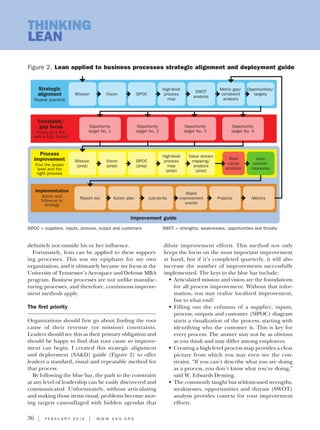
ment can begin. I created this strategic alignment
and deployment (SA&D) guide (Figure 2) to offer
leaders a standard, visual and repeatable method for
that process.
By following the blue bar, the path to the constraint
at any level of leadership can be easily discovered and
communicated. Unfortunately, without articulating
and making those items visual, problems become mov-
ing targets camouflaged with hidden agendas that
dilute improvement efforts. This method not only
keeps the focus on the most important improvement
at hand, but if it’s completed quarterly, it will also
increase the number of improvements successfully
implemented. The keys to the blue bar include:
• Articulated mission and vision are the foundations
for all process improvement. Without that infor-
mation, you may realize localized improvement,
but to what end?
• Filling out the columns of a supplier, inputs,
process, outputs and customer (SIPOC) diagram
starts a visualization of the process, starting with
identifying who the customer is. This is key for
every process: The answer may not be as obvious
as you think and may differ among employees.
• Creating a high-level process map provides a clear
picture from which you may even see the con-
straint. “If you can’t describe what you are doing
as a process, you don’t know what you’re doing,”
said W. Edwards Deming.
• The commonly taught but seldom-used strengths,
weaknesses, opportunities and threats (SWOT)
analysis provides context for your improvement
efforts.
Figure 2.	Lean applied to business processes strategic alignment and deployment guide
Improvement guide
Strategic
alignment
Repeat quarterly
Process
improvement
Find the proper
level and the
right process
Constaint/
gap focus
Focus on a few
with a high impact
Metric gap/
constraint
analysis
Opportunities/
targets
Mission
(prep)
Report out
Opportunity
target No. 1
Mission
Vision
(prep)
Action plan
Vision
SIPOC
(prep)
Just-do-its
Opportunity
target No. 2
SIPOC
High-level
process
map
(prep)
High-level
process
map
Value stream
mapping/
analysis
(prep)
Rapid
improvement
events
Opportunity
target No. 3
SWOT
analysis
Root
cause
analysis
Projects
Lean
counter­
measures
Metrics
Opportunity
target No. 4
SIPOC = suppliers, inputs, process, output and customers SWOT = strengths, weaknesses, opportunities and threats
THINKING
LEAN
Implementation
Action and
follow-up to
strategy
Simply following this method at every level of the
organization—while considering input from the high-
er level—eliminates much internal competition and
misunderstanding. The process will show the path to
the constraint and should continue at each level until
the origin is found. What could be more important
than that? If there is a policy constraint rather than a
physical constraint, what department possibly could be
above applying process improvement?
The yellow bar and green box in Figure 2 describe
how to mitigate the constraint. Wherever the path to
the constraint leads, repeat the mission, vision, SIPOC
and high-level process map to:
• Make sure the problem is not just strategic
misalignment.
• Scope the problem.
The next steps are to create a value stream map,
identify the root cause and finally, apply lean coun-
termeasures.
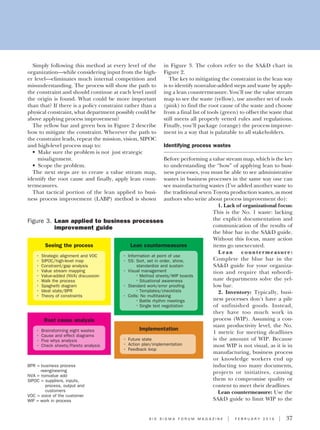
That tactical portion of the lean applied to busi-
ness process improvement (LABP) method is shown
in Figure 3. The colors refer to the SA&D chart in
Figure 2.
The key to mitigating the constraint in the lean way
is to identify nonvalue-added steps and waste by apply-
ing a lean countermeasure. You’ll use the value stream
map to see the waste (yellow), use another set of tools
(pink) to find the root cause of the waste and choose
from a final list of tools (green) to offset the waste that
still meets all properly vetted rules and regulations.
Finally, you’ll package (orange) the process improve-
ment in a way that is palatable to all stakeholders.
Identifying process wastes
Before performing a value stream map, which is the key
to understanding the “how” of applying lean to busi-
ness processes, you must be able to see administrative
wastes in business processes in the same way one can
see manufacturing wastes (I’ve added another waste to
the traditional seven Toyota production wastes, as most
authors who write about process improvement do):
1. Lack of organizational focus:
This is the No. 1 waste: lacking
the explicit documentation and
communication of the results of
the blue bar in the SA&D guide.
Without this focus, many action
items go unexecuted.
Lean countermeasure:
Complete the blue bar in the
SA&D guide for your organiza-
tion and require that subordi-
nate departments solve the yel-
low bar.
2. Inventory: Typically, busi-
ness processes don’t have a pile
of unfinished goods. Instead,
they have too much work in
process (WIP). Assuming a con-
stant productivity level, the No.
1 metric for meeting deadlines
is the amount of WIP. Because
most WIP is not visual, as it is in
manufacturing, business process
or knowledge workers end up
inducting too many documents,
projects or initiatives, causing
them to compromise quality or
content to meet their deadlines.
Lean countermeasure: Use the
SA&D guide to limit WIP to the
S I X S I G M A F O R U M M A G A Z I N E I F E B R U A R Y 2 0 1 5 I 37
Lean countermeasures
•  Information at point of use
•  5S: Sort, set in order, shine,
standardize and sustain
•  Visual management
°° Method sheets/WIP boards
°° Situational awareness
•  Standard work/error proofing
°° Templates/checklists
•  Cells: No multitasking
°° Battle rhythm meetings
°° Single text negotiation
Implementation
•  Future state
•  Action plan/implementation
•  Feedback loop
Root cause analysis
•  Brainstorming eight wastes
•  Cause and effect diagrams
•  Five whys analysis
•  Check sheets/Pareto analysis
Seeing the process
•  Strategic alignment and VOC
•  SIPOC/high-level map
•  Constraint/gap analysis
•  Value stream mapping
•  Value-added (NVA) discussion
•  Walk the process
•  Spaghetti diagram
•  Ideal state/BPR
•  Theory of constraints
Figure 3.	Lean applied to business processes
	 improvement guide
BPR = business process
reengineering
NVA = nonvalue add
SIPOC = suppliers, inputs,
process, output and
customers
VOC = voice of the customer
WIP = work in process
38 I F E B R U A R Y 2 0 1 5 I W W W . A S Q . O R G
THINKING
LEAN
important few, create a WIP board to make items visual
and keep WIP optimal.
3. Transportation: For business processes, transporta-
tion waste is the hurdle of handoffs and other obstacles
to relaying information.
Lean countermeasure: Use value stream mapping to
identify and reduce excessive handoffs; use standard
work to eliminate the need for approvals.
4. Motion: For business processes, the mental motion
of searching for information and documents in elec-
tronic folders and the search for situational awareness
in our mind’s eye represents waste.
Lean countermeasure: Sort, set in order, shine, stan-
dardize and sustain (5S) electronic and paper folders.
Use WIP boards to increase situational awareness.
5. Waiting: This waste is even more costly in business
processes than in manufacturing because knowledge
workers start other processes while they wait, forcing
their own excess WIP.
Lean countermeasure: Find the right battle rhythm to
work, meet and think.
6. Defects: Creating and revising documents seri-
ally, in other words, working asynchronously via
email ping-pong.
Lean countermeasure: Work collaboratively using
single-text negotiation. For example, teams project a
document and simultaneously review and edit, rather
than serially and separately.
7. Overprocessing: The waste of reinvention,
variation and multitasking in processes within and
between workers. For example, constantly attending
to pop-up email notifications while trying to draft a
document.
Lean countermeasure: Create standard work and
checklists (best practices by employees doing the
work). Understand and mitigate the start-up costs of
switching between tasks. Shut off your email notifica-
tion.
8. Overproduction: Business processes seldom
have excess finished knowledge products, but cer-
tainly suffer from too many emails, meetings and
reports.
Lean countermeasure: Adopt an email protocol,1
create and follow standard work for meetings, and
perform a 5S on reports.
After you’ve gathered your low-hanging fruit using
lean for manufacturing processes, you may discover
that the eight wastes, described earlier, are actually
the root causes of the constraints on the shop floor.
If you don’t apply lean to your enabling business
processes, you’ll limit the effectiveness of lean on the
operational processes they serve. Business processes
are not unlike manufacturing processes—they’re
simply less tangible.
Applying lean analytical tools to identify waste and
constraints in all your processes represents a tremen-
dous opportunity for you as a leader. The happy
result will be increased throughput with shrinking
backlogs and less rework.
REFERENCE
1. Mike Song, Vicki Halsey and Tim Burress, The Hamster Revolution: How
to Manage Your Email Before It Manages You, Berrett-Koehler Publishers,
2008.
BILL PETERSON is a lean consultant and practitioner and creator
of the workshops “Lean Applied to Business Processes, Disciplines
of Speed” and “Lead Smarter.” He has an Aerospace and Defense
MBA from the University of Tennessee in Knoxville. He is the owner
of Lean BP, and teaches at the University of Tennessee’s Depart-
ment of Graduate and Executive Education in the Haslam College
of Business.
Learn Lean Six Sigma Tools
and Concepts in 5 Phases
at your own pace.
A fun, easy to understand
way to learn and begin
applying Lean Six Sigma.
Practical, relatable examples
that will make learning
Lean Six Sigma approachable.
Get Free Yellow Belt Training & Discount Pricing
On Lean Six Sigma Training & Certification at:
GoLeanSixSigma.com/ASQ
MANAGER
O N L I N E T R A I N I N G
presented by
GREEN BELT
L E A N S I X S I G M A

LABP in ASQ Six Sigma Forum

  • 1.
    S I XS I G M A F O R U M M A G A Z I N E I F E B R U A R Y 2 0 1 5 I 35 THINKING LEAN By Bill Peterson, LeanBP If your lean initiatives have stalled, you may discover the constraint isn’t on the shop floor. Most exist- ing constraints to your operations actually will be in your administrative or support areas. The good news? There’s something you can do about it. Lean applied to business processes: That’s my core message and my life’s passion. I have developed and taught a course for more than eight years, and I’d like to share its main ideas with you. My big epiphany Back in the 1990s, I was a young operational supervisor in an aviation mechanical component repair shop. I was asked to reduce backlogs of aircraft parts needed for airline operations at city stations, which were caus- ing increased delays and cancellations. Our shop had just started using lean methods, but it became obvious at the end of six months that applying lean to the shop floor was not enough. Luckily, most of the mechanics had been through six-step problem-solving training, so facilitating process improvement by providing targets and giving employ- ees time to improve was relatively easy. Empowering mechanics to create solutions meant that their ideas came fast and furiously—backlogs were reduced and improvements were made in the quality of the parts and how fast they could be produced. But that didn’t lead to sustained success. Why? We experienced a phenomenon that theory of constraints creator Eli Goldratt described this way: After the con- straint is broken, a new constraint emerges. In my years applying lean as a consultant, I’ve seen this happen at every organization I’ve worked with. Some of these scenarios (Figure 1) may sound familiar: • Management increasing production simply for the sake of end-of-period metrics, which changes the rate of production to an artificial demand, increasing cost of production through overtime and changing rate of consumption from materials management. • Sales using a slow proposal and contract process with a lot of unnecessary rework that consumes much lead time. • Purchasing having a large investment tied in inven- tory and espousing 90%-plus fill rates while service- able parts or finished goods require 100%. • Engineering having a long queue and lead time to provide approvals on any technical improvements. • Internal auditing departments not only interpret- ing regulation beyond the scope and letter of the law, but also requiring operational representatives to implement policies and inspections. • Facilities, HR and IT providing one-size-fits-all solu- tions that optimize their own production at the expense of the production processes they serve. • Accounting and costing work being pushed on operational staff members who enter codes and inputs into an enterprise system with mystical algo- rithms, spitting out inaccurate forecasts. • Logistics batching deliveries of serviceable units to reduce shipping costs while supply shelves remain empty. • Finance or management criticizing process improvement using false negatives of temporarily increased lead time and costs per unit associated with reducing large backlogs. Each of these groups is operating within its own corporate mandates (silos). With no responsibility for production, each group sometimes inhibits what they are actually supposed to enable. Although these departments’ inputs to the operation are certainly outside of an operational supervisor’s control, they are Lean Applied to Business Processes Flow Flow FlowCell Cell Cell Cell Dept. BDept. A Purchasing Sales Internal audit Engineering IT Facilities Logistics Mgt. decisions Figure 1. Business processes vs. production Mgt. = management
  • 2.
    36 I FE B R U A R Y 2 0 1 5 I W W W . A S Q . O R G definitely not outside his or her influence. Fortunately, lean can be applied to these support- ing processes. This was my epiphany for my own organization, and it ultimately became my focus at the University of Tennessee’s Aerospace and Defense MBA program. Business processes are not unlike manufac- turing processes, and therefore, continuous improve- ment methods apply. The first priority Organizations should first go about finding the root cause of their revenue (or mission) constraints. Leaders should see this as their primary obligation and should be happy to find that root cause so improve- ment can begin. I created this strategic alignment and deployment (SA&D) guide (Figure 2) to offer leaders a standard, visual and repeatable method for that process. By following the blue bar, the path to the constraint at any level of leadership can be easily discovered and communicated. Unfortunately, without articulating and making those items visual, problems become mov- ing targets camouflaged with hidden agendas that dilute improvement efforts. This method not only keeps the focus on the most important improvement at hand, but if it’s completed quarterly, it will also increase the number of improvements successfully implemented. The keys to the blue bar include: • Articulated mission and vision are the foundations for all process improvement. Without that infor- mation, you may realize localized improvement, but to what end? • Filling out the columns of a supplier, inputs, process, outputs and customer (SIPOC) diagram starts a visualization of the process, starting with identifying who the customer is. This is key for every process: The answer may not be as obvious as you think and may differ among employees. • Creating a high-level process map provides a clear picture from which you may even see the con- straint. “If you can’t describe what you are doing as a process, you don’t know what you’re doing,” said W. Edwards Deming. • The commonly taught but seldom-used strengths, weaknesses, opportunities and threats (SWOT) analysis provides context for your improvement efforts. Figure 2. Lean applied to business processes strategic alignment and deployment guide Improvement guide Strategic alignment Repeat quarterly Process improvement Find the proper level and the right process Constaint/ gap focus Focus on a few with a high impact Metric gap/ constraint analysis Opportunities/ targets Mission (prep) Report out Opportunity target No. 1 Mission Vision (prep) Action plan Vision SIPOC (prep) Just-do-its Opportunity target No. 2 SIPOC High-level process map (prep) High-level process map Value stream mapping/ analysis (prep) Rapid improvement events Opportunity target No. 3 SWOT analysis Root cause analysis Projects Lean counter­ measures Metrics Opportunity target No. 4 SIPOC = suppliers, inputs, process, output and customers SWOT = strengths, weaknesses, opportunities and threats THINKING LEAN Implementation Action and follow-up to strategy
  • 3.
    Simply following thismethod at every level of the organization—while considering input from the high- er level—eliminates much internal competition and misunderstanding. The process will show the path to the constraint and should continue at each level until the origin is found. What could be more important than that? If there is a policy constraint rather than a physical constraint, what department possibly could be above applying process improvement? The yellow bar and green box in Figure 2 describe how to mitigate the constraint. Wherever the path to the constraint leads, repeat the mission, vision, SIPOC and high-level process map to: • Make sure the problem is not just strategic misalignment. • Scope the problem. The next steps are to create a value stream map, identify the root cause and finally, apply lean coun- termeasures. That tactical portion of the lean applied to busi- ness process improvement (LABP) method is shown in Figure 3. The colors refer to the SA&D chart in Figure 2. The key to mitigating the constraint in the lean way is to identify nonvalue-added steps and waste by apply- ing a lean countermeasure. You’ll use the value stream map to see the waste (yellow), use another set of tools (pink) to find the root cause of the waste and choose from a final list of tools (green) to offset the waste that still meets all properly vetted rules and regulations. Finally, you’ll package (orange) the process improve- ment in a way that is palatable to all stakeholders. Identifying process wastes Before performing a value stream map, which is the key to understanding the “how” of applying lean to busi- ness processes, you must be able to see administrative wastes in business processes in the same way one can see manufacturing wastes (I’ve added another waste to the traditional seven Toyota production wastes, as most authors who write about process improvement do): 1. Lack of organizational focus: This is the No. 1 waste: lacking the explicit documentation and communication of the results of the blue bar in the SA&D guide. Without this focus, many action items go unexecuted. Lean countermeasure: Complete the blue bar in the SA&D guide for your organiza- tion and require that subordi- nate departments solve the yel- low bar. 2. Inventory: Typically, busi- ness processes don’t have a pile of unfinished goods. Instead, they have too much work in process (WIP). Assuming a con- stant productivity level, the No. 1 metric for meeting deadlines is the amount of WIP. Because most WIP is not visual, as it is in manufacturing, business process or knowledge workers end up inducting too many documents, projects or initiatives, causing them to compromise quality or content to meet their deadlines. Lean countermeasure: Use the SA&D guide to limit WIP to the S I X S I G M A F O R U M M A G A Z I N E I F E B R U A R Y 2 0 1 5 I 37 Lean countermeasures •  Information at point of use •  5S: Sort, set in order, shine, standardize and sustain •  Visual management °° Method sheets/WIP boards °° Situational awareness •  Standard work/error proofing °° Templates/checklists •  Cells: No multitasking °° Battle rhythm meetings °° Single text negotiation Implementation •  Future state •  Action plan/implementation •  Feedback loop Root cause analysis •  Brainstorming eight wastes •  Cause and effect diagrams •  Five whys analysis •  Check sheets/Pareto analysis Seeing the process •  Strategic alignment and VOC •  SIPOC/high-level map •  Constraint/gap analysis •  Value stream mapping •  Value-added (NVA) discussion •  Walk the process •  Spaghetti diagram •  Ideal state/BPR •  Theory of constraints Figure 3. Lean applied to business processes improvement guide BPR = business process reengineering NVA = nonvalue add SIPOC = suppliers, inputs, process, output and customers VOC = voice of the customer WIP = work in process
  • 4.
    38 I FE B R U A R Y 2 0 1 5 I W W W . A S Q . O R G THINKING LEAN important few, create a WIP board to make items visual and keep WIP optimal. 3. Transportation: For business processes, transporta- tion waste is the hurdle of handoffs and other obstacles to relaying information. Lean countermeasure: Use value stream mapping to identify and reduce excessive handoffs; use standard work to eliminate the need for approvals. 4. Motion: For business processes, the mental motion of searching for information and documents in elec- tronic folders and the search for situational awareness in our mind’s eye represents waste. Lean countermeasure: Sort, set in order, shine, stan- dardize and sustain (5S) electronic and paper folders. Use WIP boards to increase situational awareness. 5. Waiting: This waste is even more costly in business processes than in manufacturing because knowledge workers start other processes while they wait, forcing their own excess WIP. Lean countermeasure: Find the right battle rhythm to work, meet and think. 6. Defects: Creating and revising documents seri- ally, in other words, working asynchronously via email ping-pong. Lean countermeasure: Work collaboratively using single-text negotiation. For example, teams project a document and simultaneously review and edit, rather than serially and separately. 7. Overprocessing: The waste of reinvention, variation and multitasking in processes within and between workers. For example, constantly attending to pop-up email notifications while trying to draft a document. Lean countermeasure: Create standard work and checklists (best practices by employees doing the work). Understand and mitigate the start-up costs of switching between tasks. Shut off your email notifica- tion. 8. Overproduction: Business processes seldom have excess finished knowledge products, but cer- tainly suffer from too many emails, meetings and reports. Lean countermeasure: Adopt an email protocol,1 create and follow standard work for meetings, and perform a 5S on reports. After you’ve gathered your low-hanging fruit using lean for manufacturing processes, you may discover that the eight wastes, described earlier, are actually the root causes of the constraints on the shop floor. If you don’t apply lean to your enabling business processes, you’ll limit the effectiveness of lean on the operational processes they serve. Business processes are not unlike manufacturing processes—they’re simply less tangible. Applying lean analytical tools to identify waste and constraints in all your processes represents a tremen- dous opportunity for you as a leader. The happy result will be increased throughput with shrinking backlogs and less rework. REFERENCE 1. Mike Song, Vicki Halsey and Tim Burress, The Hamster Revolution: How to Manage Your Email Before It Manages You, Berrett-Koehler Publishers, 2008. BILL PETERSON is a lean consultant and practitioner and creator of the workshops “Lean Applied to Business Processes, Disciplines of Speed” and “Lead Smarter.” He has an Aerospace and Defense MBA from the University of Tennessee in Knoxville. He is the owner of Lean BP, and teaches at the University of Tennessee’s Depart- ment of Graduate and Executive Education in the Haslam College of Business. Learn Lean Six Sigma Tools and Concepts in 5 Phases at your own pace. A fun, easy to understand way to learn and begin applying Lean Six Sigma. Practical, relatable examples that will make learning Lean Six Sigma approachable. Get Free Yellow Belt Training & Discount Pricing On Lean Six Sigma Training & Certification at: GoLeanSixSigma.com/ASQ MANAGER O N L I N E T R A I N I N G presented by GREEN BELT L E A N S I X S I G M A