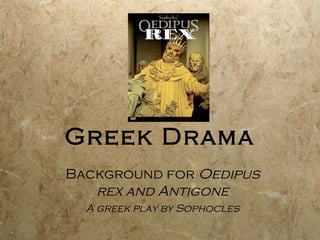
Greek Drama
Background for Oedipus
   rex and Antigone
  A greek play by Sophocles
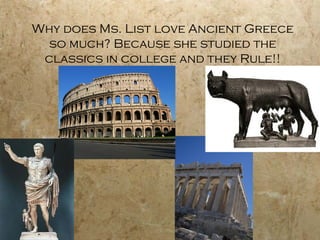
Why does Ms. List love Ancient Greece
  so much? Because she studied the
 classics in college and they Rule!!
The Basics
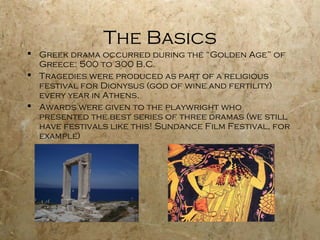
 Greek drama occurred during the “Golden Age” of
  Greece: 500 to 300 B.C.
 Tragedies were produced as part of a religious
  festival for Dionysus (god of wine and fertility)
  every year in Athens.
 Awards were given to the playwright who
  presented the best series of three dramas (we still
  have festivals like this! Sundance Film Festival, for
  example)
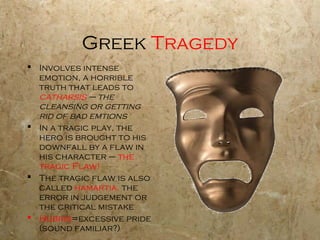
Greek Tragedy
 Involves intense
  emotion, a horrible
  truth that leads to
  catharsis – the
  cleansing or getting
  rid of bad emtions
 In a tragic play, the
  hero is brought to his
  downfall by a flaw in
  his character – the
  tragic Flaw!
 The tragic flaw is also
  called hamartia, the
  error in judgement or
  the critical mistake
 Hubris=excessive pride
  (sound familiar?)
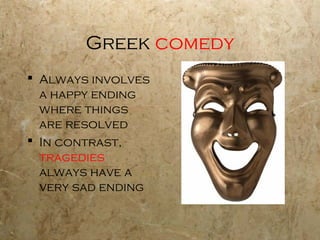
Greek comedy
 Always involves
  a happy ending
  where things
  are resolved
 In contrast,
  tragedies
  always have a
  very sad ending
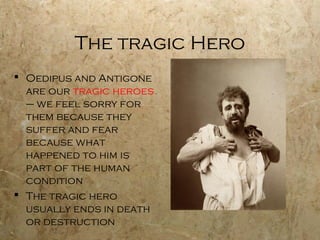
The tragic Hero
 Oedipus and Antigone
  are our tragic heroes
  – we feel sorry for
  them because they
  suffer and fear
  because what
  happened to him is
  part of the human
  condition
 The tragic hero
  usually ends in death
  or destruction
Dramatic irony
 One of the most       (Irony is a
  important elements
  in this play is        contrast
  dramatic irony –       between what
  where the audience     is expected,
  knows something
  that the               and what
  characters don’t       actually
 Watch for this as      happens)
  we read!
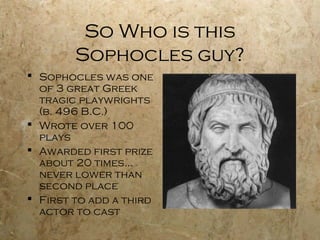
So Who is this
        Sophocles guy?
 Sophocles was one
  of 3 great Greek
  tragic playwrights
  (b. 496 B.C.)
 Wrote over 100
  plays
 Awarded first prize
  about 20 times…
  never lower than
  second place
 First to add a third
  actor to cast
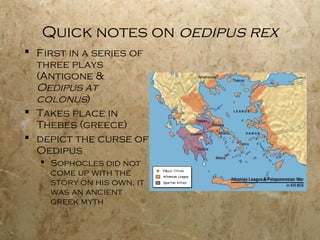
Quick notes on oedipus rex
 First in a series of
  three plays
  (Antigone &
  Oedipus at
  colonus)
 Takes place in
  Thebes (greece)
 depict the curse of
  Oedipus
   Sophocles did not
    come up with the
    story on his own, it
    was an ancient
    greek myth
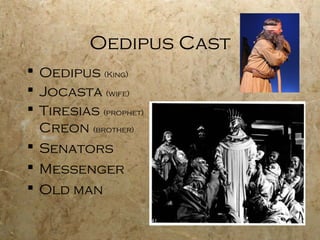
Oedipus Cast
 Oedipus (King)
 Jocasta (wife)
 Tiresias (prophet)
  Creon (brother)
 Senators
 Messenger
 Old man
Structure of
 Greek Tragedy
and the Role of
  the Chorus
  What you need to know
 when reading Oedipus Rex
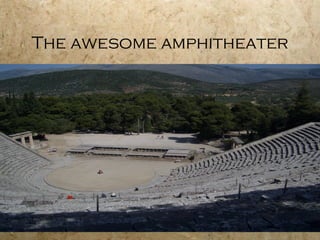
The awesome amphitheater
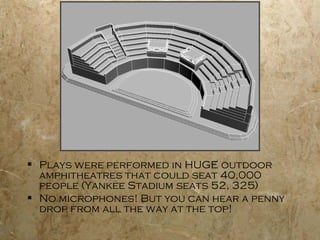
 Plays were performed in HUGE outdoor
  amphitheatres that could seat 40,000
  people (Yankee Stadium seats 52, 325)
 No microphones! But you can hear a penny
  drop from all the way at the top!
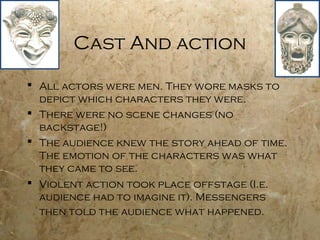
Cast And action

 All actors were men. They wore masks to
  depict which characters they were.
 There were no scene changes (no
  backstage!)
 The audience knew the story ahead of time.
  The emotion of the characters was what
  they came to see.
 Violent action took place offstage (I.e.
  audience had to imagine it). Messengers
  then told the audience what happened.
Unity of Time, Place, and
         Action
 Greek plays were much different
  from the films we are used to:
   The unity of action: Play follows one
    main storyline with no or few subplots.
   The unity of place: play occurs in a
    single place and does not change
    setting (the stage represents one place)
   The unity of time: the action in a play
    should take place over no more than 24
    hours.
So what is the chorus?
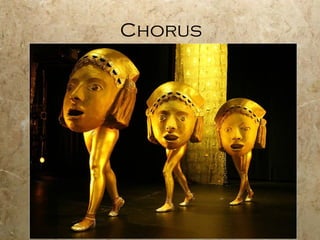
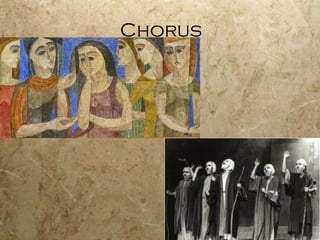
 The chorus was a group of 12-15 men who
  sang and danced during the plays.

 They often represent the community’s
  thoughts but not necessarily the poet’s
  thoughts.

 In Oedipus Rex, the chorus is made of
  senators – wise old guys!
Chorus
Chorus
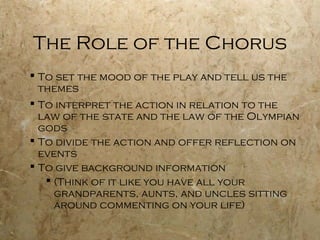
The Role of the Chorus
 To set the mood of the play and tell us the
  themes
 To interpret the action in relation to the
  law of the state and the law of the Olympian
  gods
 To divide the action and offer reflection on
  events
 To give background information
    (Think of it like you have all your
     grandparents, aunts, and uncles sitting
     around commenting on your life)
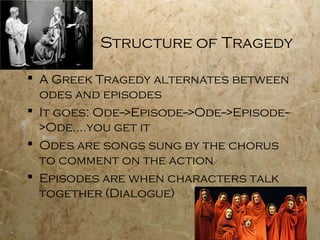
Structure of Tragedy

 A Greek Tragedy alternates between
  odes and episodes
 It goes: Ode-->Episode-->Ode-->Episode--
  >Ode….you get it
 Odes are songs sung by the chorus
  to comment on the action
 Episodes are when characters talk
  together (Dialogue)
In more detail…
 Prologue: The first part of the play that give
  background information.
 Strophe: Chorus sings while walking Right to Left
 Antistrophe: Chorus sings while walking Left to
  Right
 Choral Ode: At the end of each episode, the
  other characters leave the stage and the chorus
  sings!
The End
 Exodos: At the end of play, the chorus exits
  singing a processional song which usually
  offers words of wisdom related to the actions
  and outcome of the play.
   This is the “moral” of the story where the chorus
    tells us what we were have supposed to learn
    from the characters
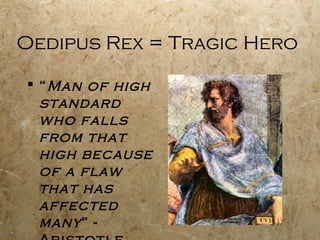
Oedipus Rex = Tragic Hero

 “ Man of high
  standard
  who falls
  from that
  high because
  of a flaw
  that has
  affected
  many ” -
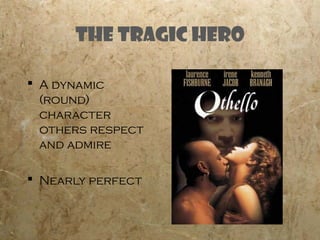
The Tragic Hero

 A dynamic
  (round)
  character
  others respect
  and admire

 Nearly perfect
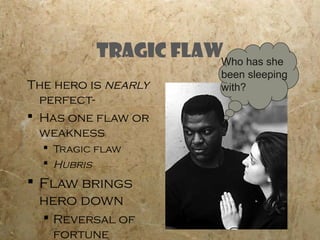
Tragic FlawWho has she
                        been sleeping
The hero is nearly      with?
  perfect-
 Has one flaw or
  weakness
   Tragic flaw
   Hubris
 Flaw brings
  hero down
   Reversal of
    fortune
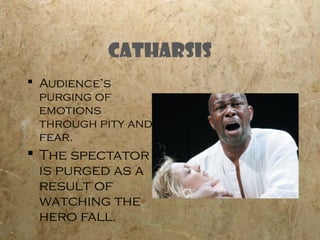
Catharsis
 Audience’s
  purging of
  emotions
  through pity and
  fear.
 The spectator
  is purged as a
  result of
  watching the
  hero fall.
Before you read
 Prologue – pg 158       2nd episode – pg 188

 1st ode – pg 168        Choral Dialogue –
                          pg 197
 1st Episode – pg 171
                          3rd Ode – pg 209
 2nd ode – pg 186
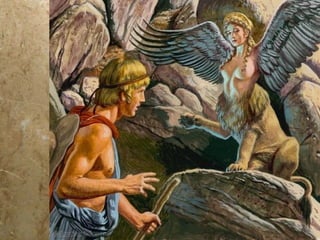
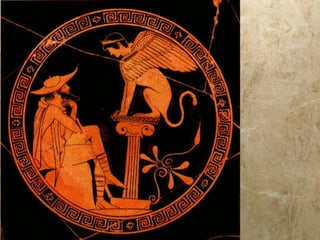
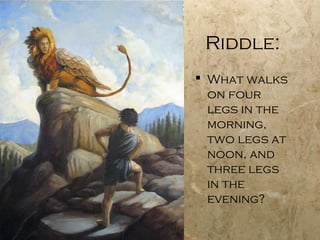
Riddle:
 What walks
  on four
  legs in the
  morning,
  two legs at
  noon, and
  three legs
  in the
  evening?
Oedipus Rex
 King of thebes, Prophecy
 Plague on the city: whoever
  killed last king Laius has to
  leave or die
 Oedipus accused by tiresias
 Oedipus suspicious of creon
 Jocasta says prophecies are
  stupid
Oedipus Continued
 Messenger comes to say
  Polybus is dead
 Polybus = Not the father
 Jocasta realizes the prophecy is
  true!
 How will it all turn out when
  your mom is your wife and you’ve
  killed your dad?
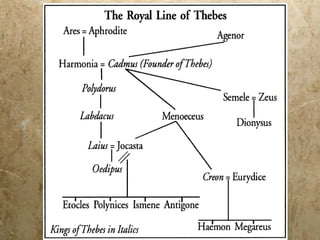
The Oedipus
Family Tree
  More Like the
  Family Stick!
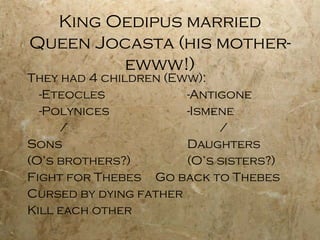
King Oedipus married
Queen Jocasta (his mother-
        ewww!)
They had 4 children (Eww):
  -Eteocles            -Antigone
  -Polynices           -Ismene
     /                      /
Sons                   Daughters
(O’s brothers?)        (O’s sisters?)
Fight for Thebes Go back to Thebes
Cursed by dying father
Kill each other
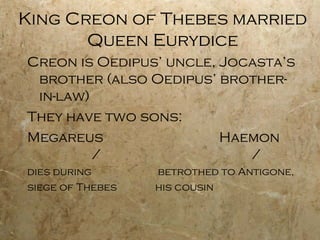
King Creon of Thebes married
       Queen Eurydice
Creon is Oedipus’ uncle, Jocasta’s
 brother (also Oedipus’ brother-
 in-law)
They have two sons:
Megareus                 Haemon
         /                  /
dies during       betrothed to Antigone,
siege of Thebes   his cousin
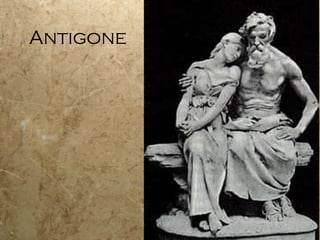
Antigone
Exit Slip!
   How is a tragedy different from a comedy?
   What is dramatic irony?
   Who is our tragic hero? Why is he tragic?
   Where does our story take place?

 Challenge: what is catharsis?
Enduring Understanding

  To what degree will you go to
   preserve self-interest versus
   acting on behalf of the
   common good?
Do Now
 Answer Journal questions 5
  and 6 in your packet
Objective
 Swbat define theme

 SWBAT analyze the themes of
  antigone by discussing enduring
  questions

 Product: A written statement of
  at least one theme in Antigone
Agenda
   Do Now
   Group Reading
   New material – Theme
   Gallery Walk – The me s o f A o ne
                                 ntig
   Independent Practice – Write yo ur
    o wn the me o f A o ne
                     ntig
Theme - Definition
 - A truth about human nature
 Expressed in 1 sentence
 Derived From (pulled from) the
  literature
Definition   Ex: Music   Ex: Politics
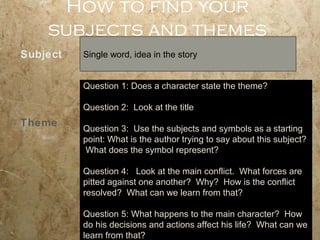
How to find your
    subjects and themes
Subject   Single word, idea in the story


          Question 1: Does a character state the theme?

          Question 2: Look at the title
Theme     Question 3: Use the subjects and symbols as a starting
          point: What is the author trying to say about this subject?
          What does the symbol represent?

          Question 4: Look at the main conflict. What forces are
          pitted against one another? Why? How is the conflict
          resolved? What can we learn from that?

          Question 5: What happens to the main character? How
          do his decisions and actions affect his life? What can we
          learn from that?
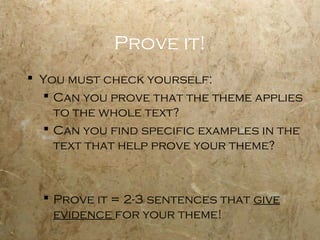
Prove it!
 You must check yourself:
   Can you prove that the theme applies
    to the whole text?
   Can you find specific examples in the
    text that help prove your theme?


   Prove it = 2-3 sentences that give
    evidence for your theme!
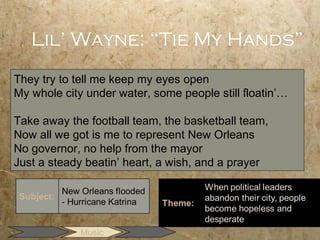
Lil’ Wayne: “Tie My Hands”
They try to tell me keep my eyes open
My whole city under water, some people still floatin’…

Take away the football team, the basketball team,
Now all we got is me to represent New Orleans
No governor, no help from the mayor
Just a steady beatin’ heart, a wish, and a prayer


             Music
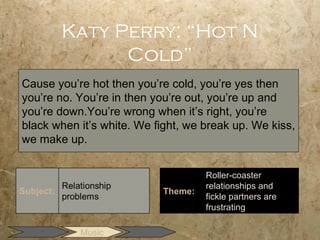
Katy Perry: “Hot N
             Cold”
Cause you’re hot then you’re cold, you’re yes then
you’re no. You’re in then you’re out, you’re up and
you’re down.You’re wrong when it’s right, you’re
black when it’s white. We fight, we break up. We kiss,
we make up.


                                    Roller-coaster
                                    relationships and
                           Theme:
                                    fickle partners are
                                    frustrating

           Music
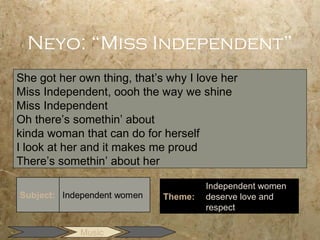
Neyo: “Miss Independent”
She got her own thing, that’s why I love her
Miss Independent, oooh the way we shine
Miss Independent
Oh there’s somethin’ about
kinda woman that can do for herself
I look at her and it makes me proud
There’s somethin’ about her

                                      Independent women
                             Theme:   deserve love and
                                      respect

            Music
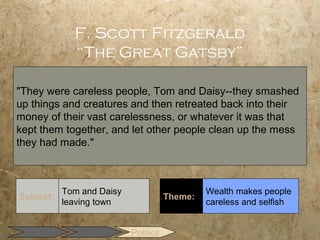
F. Scott Fitzgerald
             “The Great Gatsby”

"They were careless people, Tom and Daisy--they smashed
up things and creatures and then retreated back into their
money of their vast carelessness, or whatever it was that
kept them together, and let other people clean up the mess
they had made."


           Tom and Daisy                       Wealth makes people
Subject:                              Theme:
           leaving town                        careless and selfish


                           Politics
Your Turn
Gallery Walk (10 min):
      On the back table, there are pages with the
essential questions of Antigone. As you walk, jot down
your thoughts about how we see this in the play, and
any beginning thoughts of themes that may be
connected to it.

                                  Noise level = silence

                                  Let everyone concentrate!
                     Literature
Essential Question
        #1


Is it more important to
be right than to be
happy?
Essential Question
        #2


Is it our responsibility
to rebel against and
break an unjust law?
Essential Question
         #3

 What price should a
 person be willing to
 pay if he/she breaks
 an unjust law?

What would you have done if
 you were antigone?
Essential Question
         #4

 Can a leader show
 uncertainty and
 maintain leadership?

What would you have done if
 you were Creon?
Essential Question
         #5

What point is Sophocles
 trying to make about
 pride? How does
 Hubris affect both
 creon and antigone?
Essential Question
        #6

Who decides which “laws”
 are to be obeyed? What
 are the differences
 between the laws of the
 gods and the laws of man?

Intro to greek_drama_ppt

  • 1.
    Greek Drama Background forOedipus rex and Antigone A greek play by Sophocles
  • 2.
    Why does Ms.List love Ancient Greece so much? Because she studied the classics in college and they Rule!!
  • 3.
    The Basics  Greekdrama occurred during the “Golden Age” of Greece: 500 to 300 B.C.  Tragedies were produced as part of a religious festival for Dionysus (god of wine and fertility) every year in Athens.  Awards were given to the playwright who presented the best series of three dramas (we still have festivals like this! Sundance Film Festival, for example)
  • 4.
    Greek Tragedy  Involvesintense emotion, a horrible truth that leads to catharsis – the cleansing or getting rid of bad emtions  In a tragic play, the hero is brought to his downfall by a flaw in his character – the tragic Flaw!  The tragic flaw is also called hamartia, the error in judgement or the critical mistake  Hubris=excessive pride (sound familiar?)
  • 5.
    Greek comedy  Alwaysinvolves a happy ending where things are resolved  In contrast, tragedies always have a very sad ending
  • 6.
    The tragic Hero Oedipus and Antigone are our tragic heroes – we feel sorry for them because they suffer and fear because what happened to him is part of the human condition  The tragic hero usually ends in death or destruction
  • 7.
    Dramatic irony  Oneof the most  (Irony is a important elements in this play is contrast dramatic irony – between what where the audience is expected, knows something that the and what characters don’t actually  Watch for this as happens) we read!
  • 8.
    So Who isthis Sophocles guy?  Sophocles was one of 3 great Greek tragic playwrights (b. 496 B.C.)  Wrote over 100 plays  Awarded first prize about 20 times… never lower than second place  First to add a third actor to cast
  • 9.
    Quick notes onoedipus rex  First in a series of three plays (Antigone & Oedipus at colonus)  Takes place in Thebes (greece)  depict the curse of Oedipus  Sophocles did not come up with the story on his own, it was an ancient greek myth
  • 10.
    Oedipus Cast  Oedipus(King)  Jocasta (wife)  Tiresias (prophet) Creon (brother)  Senators  Messenger  Old man
  • 11.
    Structure of GreekTragedy and the Role of the Chorus What you need to know when reading Oedipus Rex
  • 12.
  • 13.
     Plays wereperformed in HUGE outdoor amphitheatres that could seat 40,000 people (Yankee Stadium seats 52, 325)  No microphones! But you can hear a penny drop from all the way at the top!
  • 14.
    Cast And action All actors were men. They wore masks to depict which characters they were.  There were no scene changes (no backstage!)  The audience knew the story ahead of time. The emotion of the characters was what they came to see.  Violent action took place offstage (I.e. audience had to imagine it). Messengers then told the audience what happened.
  • 15.
    Unity of Time,Place, and Action  Greek plays were much different from the films we are used to:  The unity of action: Play follows one main storyline with no or few subplots.  The unity of place: play occurs in a single place and does not change setting (the stage represents one place)  The unity of time: the action in a play should take place over no more than 24 hours.
  • 16.
    So what isthe chorus?  The chorus was a group of 12-15 men who sang and danced during the plays.  They often represent the community’s thoughts but not necessarily the poet’s thoughts.  In Oedipus Rex, the chorus is made of senators – wise old guys!
  • 17.
  • 18.
  • 19.
    The Role ofthe Chorus  To set the mood of the play and tell us the themes  To interpret the action in relation to the law of the state and the law of the Olympian gods  To divide the action and offer reflection on events  To give background information  (Think of it like you have all your grandparents, aunts, and uncles sitting around commenting on your life)
  • 20.
    Structure of Tragedy A Greek Tragedy alternates between odes and episodes  It goes: Ode-->Episode-->Ode-->Episode-- >Ode….you get it  Odes are songs sung by the chorus to comment on the action  Episodes are when characters talk together (Dialogue)
  • 21.
    In more detail… Prologue: The first part of the play that give background information.  Strophe: Chorus sings while walking Right to Left  Antistrophe: Chorus sings while walking Left to Right  Choral Ode: At the end of each episode, the other characters leave the stage and the chorus sings!
  • 22.
    The End  Exodos:At the end of play, the chorus exits singing a processional song which usually offers words of wisdom related to the actions and outcome of the play.  This is the “moral” of the story where the chorus tells us what we were have supposed to learn from the characters
  • 23.
    Oedipus Rex =Tragic Hero  “ Man of high standard who falls from that high because of a flaw that has affected many ” -
  • 24.
    The Tragic Hero A dynamic (round) character others respect and admire  Nearly perfect
  • 25.
    Tragic FlawWho hasshe been sleeping The hero is nearly with? perfect-  Has one flaw or weakness  Tragic flaw  Hubris  Flaw brings hero down  Reversal of fortune
  • 26.
    Catharsis  Audience’s purging of emotions through pity and fear.  The spectator is purged as a result of watching the hero fall.
  • 27.
    Before you read Prologue – pg 158  2nd episode – pg 188  1st ode – pg 168  Choral Dialogue – pg 197  1st Episode – pg 171  3rd Ode – pg 209  2nd ode – pg 186
  • 30.
    Riddle:  What walks on four legs in the morning, two legs at noon, and three legs in the evening?
  • 31.
    Oedipus Rex  Kingof thebes, Prophecy  Plague on the city: whoever killed last king Laius has to leave or die  Oedipus accused by tiresias  Oedipus suspicious of creon  Jocasta says prophecies are stupid
  • 32.
    Oedipus Continued  Messengercomes to say Polybus is dead  Polybus = Not the father  Jocasta realizes the prophecy is true!  How will it all turn out when your mom is your wife and you’ve killed your dad?
  • 33.
    The Oedipus Family Tree More Like the Family Stick!
  • 34.
    King Oedipus married QueenJocasta (his mother- ewww!) They had 4 children (Eww): -Eteocles -Antigone -Polynices -Ismene / / Sons Daughters (O’s brothers?) (O’s sisters?) Fight for Thebes Go back to Thebes Cursed by dying father Kill each other
  • 35.
    King Creon ofThebes married Queen Eurydice Creon is Oedipus’ uncle, Jocasta’s brother (also Oedipus’ brother- in-law) They have two sons: Megareus Haemon / / dies during betrothed to Antigone, siege of Thebes his cousin
  • 37.
  • 39.
    Exit Slip!  How is a tragedy different from a comedy?  What is dramatic irony?  Who is our tragic hero? Why is he tragic?  Where does our story take place?  Challenge: what is catharsis?
  • 40.
    Enduring Understanding To what degree will you go to preserve self-interest versus acting on behalf of the common good?
  • 41.
    Do Now  AnswerJournal questions 5 and 6 in your packet
  • 42.
    Objective  Swbat definetheme  SWBAT analyze the themes of antigone by discussing enduring questions  Product: A written statement of at least one theme in Antigone
  • 43.
    Agenda  Do Now  Group Reading  New material – Theme  Gallery Walk – The me s o f A o ne ntig  Independent Practice – Write yo ur o wn the me o f A o ne ntig
  • 44.
    Theme - Definition - A truth about human nature  Expressed in 1 sentence  Derived From (pulled from) the literature
  • 45.
    Definition Ex: Music Ex: Politics
  • 46.
    How to findyour subjects and themes Subject Single word, idea in the story Question 1: Does a character state the theme? Question 2: Look at the title Theme Question 3: Use the subjects and symbols as a starting point: What is the author trying to say about this subject? What does the symbol represent? Question 4: Look at the main conflict. What forces are pitted against one another? Why? How is the conflict resolved? What can we learn from that? Question 5: What happens to the main character? How do his decisions and actions affect his life? What can we learn from that?
  • 47.
    Prove it!  Youmust check yourself:  Can you prove that the theme applies to the whole text?  Can you find specific examples in the text that help prove your theme?  Prove it = 2-3 sentences that give evidence for your theme!
  • 48.
    Lil’ Wayne: “TieMy Hands” They try to tell me keep my eyes open My whole city under water, some people still floatin’… Take away the football team, the basketball team, Now all we got is me to represent New Orleans No governor, no help from the mayor Just a steady beatin’ heart, a wish, and a prayer Music
  • 49.
    Katy Perry: “HotN Cold” Cause you’re hot then you’re cold, you’re yes then you’re no. You’re in then you’re out, you’re up and you’re down.You’re wrong when it’s right, you’re black when it’s white. We fight, we break up. We kiss, we make up. Roller-coaster relationships and Theme: fickle partners are frustrating Music
  • 50.
    Neyo: “Miss Independent” Shegot her own thing, that’s why I love her Miss Independent, oooh the way we shine Miss Independent Oh there’s somethin’ about kinda woman that can do for herself I look at her and it makes me proud There’s somethin’ about her Independent women Theme: deserve love and respect Music
  • 51.
    F. Scott Fitzgerald “The Great Gatsby” "They were careless people, Tom and Daisy--they smashed up things and creatures and then retreated back into their money of their vast carelessness, or whatever it was that kept them together, and let other people clean up the mess they had made." Tom and Daisy Wealth makes people Subject: Theme: leaving town careless and selfish Politics
  • 52.
    Your Turn Gallery Walk(10 min): On the back table, there are pages with the essential questions of Antigone. As you walk, jot down your thoughts about how we see this in the play, and any beginning thoughts of themes that may be connected to it. Noise level = silence Let everyone concentrate! Literature
  • 53.
    Essential Question #1 Is it more important to be right than to be happy?
  • 54.
    Essential Question #2 Is it our responsibility to rebel against and break an unjust law?
  • 55.
    Essential Question #3 What price should a person be willing to pay if he/she breaks an unjust law? What would you have done if you were antigone?
  • 56.
    Essential Question #4 Can a leader show uncertainty and maintain leadership? What would you have done if you were Creon?
  • 57.
    Essential Question #5 What point is Sophocles trying to make about pride? How does Hubris affect both creon and antigone?
  • 58.
    Essential Question #6 Who decides which “laws” are to be obeyed? What are the differences between the laws of the gods and the laws of man?