Next Generation
          of Critical Pedagogues:
Insights to Transform Schools and Society
                                 Kurt Love, Ph.D.
                       Central Connecticut State University
           Annual Meeting of the Conference for Social Justice and Equity
           March 26, 2011 - The Richard Stockton College of New Jersey
                                lovekua@ccsu.edu
What is
     Transformative Learning?

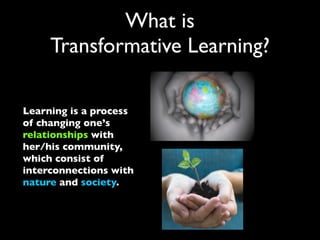
Learning is a process
of changing one’s
relationships with
her/his community,
which consist of
interconnections with
nature and society.
Thinking
Divergent Thinking -
Explore many paths in authentic settings with questions
that have no predetermined answer.

               Transformative
                                              New         New
Thought                                      Thought   Relationship

                      Critical Communities
              Info   Questioning

                                              New         New
Thought                                      Thought   Relationship
TEACHER-AS-MEDIATOR


Main target is not a predetermined answer

  Students are not facilitated or scaffolded to the
  “right” answer

  Students are not discovering what the teacher
  already knows and calls “truth”
TEACHER-AS-MEDIATOR
Main target:
Divergent thinking in a context of community of diverse voices

  Students critically question information in curriculum using
  various lenses of analysis

     Examples: critical social theory, critical race theory, feminism,
     ecojustice, queer theory, indigenous theory)

  Students investigate authentic and/or unresolved issues,
  knowledges, histories, and practices in community (local through
  global)

  Teacher mediates so that students can do authentic research based
  in communities
“Thick Description”
Superficial
             Mainstream
              Message        These two might
                              set up a binary
                Null
               Message
                                 These two
             Relationships    generally show a
                               complexity not
               Tensions      binary “packaged”
  Deep                              info
“Thick Description”
❖   Avoid binaries
    (including the binary relationship between mainstream and null content)

❖   The “Who” matters: Students should be able to articulate knowledge and
    understandings from different social, cultural, and political frames.

❖   Include null content, relationships and tensions.

❖   Relationships are the ways in which the actions and discourse of various
    groups affect and interact with each other, who benefits, who is privileged,
    who experiences oppression, who is burdened

❖   Tensions are the ways in which specific groups could be disproportionately
    burdened by change, even change that initially seems like it is motivated by
    social justice concerns
Community Involvement
          Stage 1
     Researching the Community
❖   Interviews                                   ❖   Ethnography
    (family, friends, members of                     (cultural thick description)
    organizations, leaders, veterans, artists,
    scientists, lawyers)                         ❖   Participatory Research (reporting on
                                                     their experiences)
❖   Observations
    (the mall, school, sporting event,           ❖   Demographic Research (census, state
    school dance, playground, on the                 dept websites)
    internet via social network sites,
    environment)                                 ❖   Literature Research
                                                     (local newspapers, internet)
❖   Case Study
    (focus on one person, group, location,       ❖   Field Trips as sites for all of these
    ecology)
Community Involvement
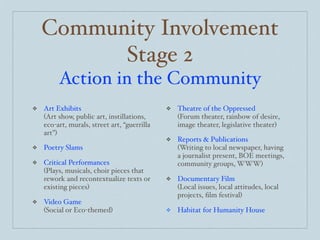
          Stage 2
         Action in the Community
❖   Art Exhibits                              ❖   Theatre of the Oppressed
    (Art show, public art, instillations,         (Forum theater, rainbow of desire,
    eco-art, murals, street art, “guerrilla       image theater, legislative theater)
    art”)
                                              ❖   Reports & Publications
❖   Poetry Slams                                  (Writing to local newspaper, having
                                                  a journalist present, BOE meetings,
❖   Critical Performances                         community groups, WWW)
    (Plays, musicals, choir pieces that
    rework and recontextualize texts or       ❖   Documentary Film
    existing pieces)                              (Local issues, local attitudes, local
                                                  projects, film festival)
❖   Video Game
    (Social or Eco-themed)                    ❖   Habitat for Humanity House
Clash of the Pedagogies
❖   Bowers vs. McLaren (2004 & 2005)

❖   Bowers (2004, 2005) argued that critical
    pedagogy is anthropocentric and
    destined to create double binds that
    further enclose nature

❖   McLaren & Houston (2005) argued that
    Bowers romanticizes a noble savage and
    has political amnesia

❖   Greunewald (2005) stated that we can
    benefit from both McLaren’s and
    Bowers’ work, but that we should start
    by recognizing that they are arguing
    with two different units of analyses,
    which provides the tensions and
    disagreements (and negative attitudes?)
Units of Analysis
❖   Critical pedagogy = Socioeconomics

❖   Ecojustice pedagogy = Cultural commons

❖   Feminist pedagogy = Patriarchy

❖   Queer pedagogy = Social norms

❖   Aesthetic pedagogy = Social imagination

❖   Red pedagogy = Indigenous sovereignty

❖   Peace education = Conflict resolution

❖   Place-based education = Local knowledges, local voices, cultural commons
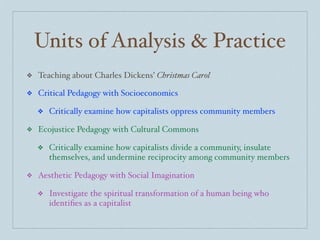
Units of Analysis & Practice
❖   Teaching about Charles Dickens’ Christmas Carol

❖   Critical Pedagogy with Socioeconomics

    ❖   Critically examine how capitalists oppress community members

❖   Ecojustice Pedagogy with Cultural Commons

    ❖   Critically examine how capitalists divide a community, insulate
        themselves, and undermine reciprocity among community members

❖   Aesthetic Pedagogy with Social Imagination

    ❖   Investigate the spiritual transformation of a human being who
        identifies as a capitalist
Thick Description of
A Christmas Carol Using a Critical Lens
❖   Mainstream curriculum = Ebenezer Scrooge changes from a self-centered old
    miser to a caring person because of the spirit of Christmas

❖   Hidden curriculum = Individualism, Privilege, Affluence, Industrialization,
    Capitalism, Hegemony, Passivity

❖   Null curriculum = Critique on capitalism and Christmas is used merely as a
    context to have that critical exploration

❖   Relationships = Voices of the various characters describing the consequences of
    the social structure that Scrooge perpetuates

❖   Tensions = Dickens advocates for a “better” capitalism with moral and ethical
    treatment, but he does not describe a reality whereby capitalism is dismantled
    or one with a significant shift of power. Also, Bob Cratchet is a character that
    embodies hegemony.
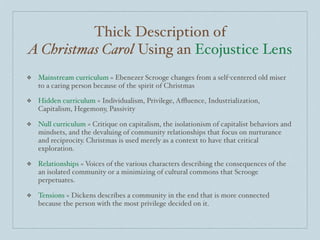
Thick Description of
A Christmas Carol Using an Ecojustice Lens
❖   Mainstream curriculum = Ebenezer Scrooge changes from a self-centered old miser
    to a caring person because of the spirit of Christmas

❖   Hidden curriculum = Individualism, Privilege, Affluence, Industrialization,
    Capitalism, Hegemony, Passivity

❖   Null curriculum = Critique on capitalism, the isolationism of capitalist behaviors and
    mindsets, and the devaluing of community relationships that focus on nurturance
    and reciprocity. Christmas is used merely as a context to have that critical
    exploration.

❖   Relationships = Voices of the various characters describing the consequences of the
    an isolated community or a minimizing of cultural commons that Scrooge
    perpetuates.

❖   Tensions = Dickens describes a community in the end that is more connected
    because the person with the most privilege decided on it.
Thick Description of
A Christmas Carol Using an Aesthetic Lens
❖   Mainstream curriculum = Ebenezer Scrooge changes from a self-centered old
    miser to a caring person because of the spirit of Christmas

❖   Hidden curriculum = Individualism, Privilege, Affluence, Industrialization,
    Capitalism, Hegemony, Passivity

❖   Null curriculum = Personal transformation occurred because of Ebenezer’s
    forced experience of having to see the perspectives of others as well as to see
    the burdens that his decisions have on people throughout the community

❖   Relationships = Voices of the various characters describing the consequences
    of the material poverty and emotional turmoil that Scrooge perpetuates

❖   Tensions = Dickens advocates for a shift in consciousness, but it only comes
    because of supernatural beings guiding Scrooge
Community Involvement
Stage 1 with A Christmas Carol
❖   Interview workers, day laborers, middle managers, CEOs, business professors, social workers,
    etc.

❖   Observe people in a workplace, identifying patriarchal practices, class elitism, materialism, and
    interpersonal relationships overall

❖   Research treatment of workers in various contexts

❖   Case study of entry level workers

❖   Attend a performance of Ebeneeza by the HartBeat Ensemble

❖   Personal narratives of people who live in homeless shelters, rely upon soup kitchens, and/or
    often feel crushed by a capitalistic society

❖   Investigate relationships in one’s community that seem to be strained by practices of capitalism
    creating more isolation, insulation, and individualism

❖   Interview people who do charity work during the holiday season
Community Involvement
Stage 2 with A Christmas Carol
❖   Perform a play that is a more contemporary version of A
    Christmas Carol that incorporates critical views of capitalism in
    their own communities

❖   Have a film festival exclusively of student-made films that
    present excerpts of A Christmas Carol as it connects to their
    own communities

❖   Have a poetry night with a theme of capitalism and Christmas

❖   Have a choir perform “Christmas carols” with the words
    rewritten to question social issues as connected to capitalism

Transformative Teaching Practices

  • 1.
    Next Generation of Critical Pedagogues: Insights to Transform Schools and Society Kurt Love, Ph.D. Central Connecticut State University Annual Meeting of the Conference for Social Justice and Equity March 26, 2011 - The Richard Stockton College of New Jersey lovekua@ccsu.edu
  • 2.
    What is Transformative Learning? Learning is a process of changing one’s relationships with her/his community, which consist of interconnections with nature and society.
  • 3.
    Thinking Divergent Thinking - Exploremany paths in authentic settings with questions that have no predetermined answer. Transformative New New Thought Thought Relationship Critical Communities Info Questioning New New Thought Thought Relationship
  • 4.
    TEACHER-AS-MEDIATOR Main target isnot a predetermined answer Students are not facilitated or scaffolded to the “right” answer Students are not discovering what the teacher already knows and calls “truth”
  • 5.
    TEACHER-AS-MEDIATOR Main target: Divergent thinkingin a context of community of diverse voices Students critically question information in curriculum using various lenses of analysis Examples: critical social theory, critical race theory, feminism, ecojustice, queer theory, indigenous theory) Students investigate authentic and/or unresolved issues, knowledges, histories, and practices in community (local through global) Teacher mediates so that students can do authentic research based in communities
  • 6.
    “Thick Description” Superficial Mainstream Message These two might set up a binary Null Message These two Relationships generally show a complexity not Tensions binary “packaged” Deep info
  • 7.
    “Thick Description” ❖ Avoid binaries (including the binary relationship between mainstream and null content) ❖ The “Who” matters: Students should be able to articulate knowledge and understandings from different social, cultural, and political frames. ❖ Include null content, relationships and tensions. ❖ Relationships are the ways in which the actions and discourse of various groups affect and interact with each other, who benefits, who is privileged, who experiences oppression, who is burdened ❖ Tensions are the ways in which specific groups could be disproportionately burdened by change, even change that initially seems like it is motivated by social justice concerns
  • 8.
    Community Involvement Stage 1 Researching the Community ❖ Interviews ❖ Ethnography (family, friends, members of (cultural thick description) organizations, leaders, veterans, artists, scientists, lawyers) ❖ Participatory Research (reporting on their experiences) ❖ Observations (the mall, school, sporting event, ❖ Demographic Research (census, state school dance, playground, on the dept websites) internet via social network sites, environment) ❖ Literature Research (local newspapers, internet) ❖ Case Study (focus on one person, group, location, ❖ Field Trips as sites for all of these ecology)
  • 9.
    Community Involvement Stage 2 Action in the Community ❖ Art Exhibits ❖ Theatre of the Oppressed (Art show, public art, instillations, (Forum theater, rainbow of desire, eco-art, murals, street art, “guerrilla image theater, legislative theater) art”) ❖ Reports & Publications ❖ Poetry Slams (Writing to local newspaper, having a journalist present, BOE meetings, ❖ Critical Performances community groups, WWW) (Plays, musicals, choir pieces that rework and recontextualize texts or ❖ Documentary Film existing pieces) (Local issues, local attitudes, local projects, film festival) ❖ Video Game (Social or Eco-themed) ❖ Habitat for Humanity House
  • 10.
    Clash of thePedagogies ❖ Bowers vs. McLaren (2004 & 2005) ❖ Bowers (2004, 2005) argued that critical pedagogy is anthropocentric and destined to create double binds that further enclose nature ❖ McLaren & Houston (2005) argued that Bowers romanticizes a noble savage and has political amnesia ❖ Greunewald (2005) stated that we can benefit from both McLaren’s and Bowers’ work, but that we should start by recognizing that they are arguing with two different units of analyses, which provides the tensions and disagreements (and negative attitudes?)
  • 11.
    Units of Analysis ❖ Critical pedagogy = Socioeconomics ❖ Ecojustice pedagogy = Cultural commons ❖ Feminist pedagogy = Patriarchy ❖ Queer pedagogy = Social norms ❖ Aesthetic pedagogy = Social imagination ❖ Red pedagogy = Indigenous sovereignty ❖ Peace education = Conflict resolution ❖ Place-based education = Local knowledges, local voices, cultural commons
  • 12.
    Units of Analysis& Practice ❖ Teaching about Charles Dickens’ Christmas Carol ❖ Critical Pedagogy with Socioeconomics ❖ Critically examine how capitalists oppress community members ❖ Ecojustice Pedagogy with Cultural Commons ❖ Critically examine how capitalists divide a community, insulate themselves, and undermine reciprocity among community members ❖ Aesthetic Pedagogy with Social Imagination ❖ Investigate the spiritual transformation of a human being who identifies as a capitalist
  • 13.
    Thick Description of AChristmas Carol Using a Critical Lens ❖ Mainstream curriculum = Ebenezer Scrooge changes from a self-centered old miser to a caring person because of the spirit of Christmas ❖ Hidden curriculum = Individualism, Privilege, Affluence, Industrialization, Capitalism, Hegemony, Passivity ❖ Null curriculum = Critique on capitalism and Christmas is used merely as a context to have that critical exploration ❖ Relationships = Voices of the various characters describing the consequences of the social structure that Scrooge perpetuates ❖ Tensions = Dickens advocates for a “better” capitalism with moral and ethical treatment, but he does not describe a reality whereby capitalism is dismantled or one with a significant shift of power. Also, Bob Cratchet is a character that embodies hegemony.
  • 14.
    Thick Description of AChristmas Carol Using an Ecojustice Lens ❖ Mainstream curriculum = Ebenezer Scrooge changes from a self-centered old miser to a caring person because of the spirit of Christmas ❖ Hidden curriculum = Individualism, Privilege, Affluence, Industrialization, Capitalism, Hegemony, Passivity ❖ Null curriculum = Critique on capitalism, the isolationism of capitalist behaviors and mindsets, and the devaluing of community relationships that focus on nurturance and reciprocity. Christmas is used merely as a context to have that critical exploration. ❖ Relationships = Voices of the various characters describing the consequences of the an isolated community or a minimizing of cultural commons that Scrooge perpetuates. ❖ Tensions = Dickens describes a community in the end that is more connected because the person with the most privilege decided on it.
  • 15.
    Thick Description of AChristmas Carol Using an Aesthetic Lens ❖ Mainstream curriculum = Ebenezer Scrooge changes from a self-centered old miser to a caring person because of the spirit of Christmas ❖ Hidden curriculum = Individualism, Privilege, Affluence, Industrialization, Capitalism, Hegemony, Passivity ❖ Null curriculum = Personal transformation occurred because of Ebenezer’s forced experience of having to see the perspectives of others as well as to see the burdens that his decisions have on people throughout the community ❖ Relationships = Voices of the various characters describing the consequences of the material poverty and emotional turmoil that Scrooge perpetuates ❖ Tensions = Dickens advocates for a shift in consciousness, but it only comes because of supernatural beings guiding Scrooge
  • 16.
    Community Involvement Stage 1with A Christmas Carol ❖ Interview workers, day laborers, middle managers, CEOs, business professors, social workers, etc. ❖ Observe people in a workplace, identifying patriarchal practices, class elitism, materialism, and interpersonal relationships overall ❖ Research treatment of workers in various contexts ❖ Case study of entry level workers ❖ Attend a performance of Ebeneeza by the HartBeat Ensemble ❖ Personal narratives of people who live in homeless shelters, rely upon soup kitchens, and/or often feel crushed by a capitalistic society ❖ Investigate relationships in one’s community that seem to be strained by practices of capitalism creating more isolation, insulation, and individualism ❖ Interview people who do charity work during the holiday season
  • 17.
    Community Involvement Stage 2with A Christmas Carol ❖ Perform a play that is a more contemporary version of A Christmas Carol that incorporates critical views of capitalism in their own communities ❖ Have a film festival exclusively of student-made films that present excerpts of A Christmas Carol as it connects to their own communities ❖ Have a poetry night with a theme of capitalism and Christmas ❖ Have a choir perform “Christmas carols” with the words rewritten to question social issues as connected to capitalism