Business vs. Workers Working conditions and the growth of unions in the Gilded Age
The Changing Face of Labor In the pre-Civil War era, most factory workers were skilled laborers…this changed starting in the 1870s! Mechanized mass production did not require as much skilled labor Cities attract rural Americans in search of work and opportunity (growth of cities =  urbanization ) Result: workforce increasingly made up of women, immigrants, and children
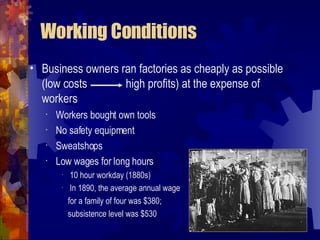
Working Conditions Business owners ran factories as cheaply as possible (low costs  high profits) at the expense of workers Workers bought own tools No safety equipment Sweatshops  Low wages for long hours 10 hour workday (1880s) In 1890, the average annual  wage for a family of four was  $380; subsistence level was  $530
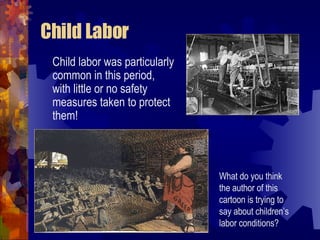
Child Labor Child labor was particularly common in this period, with little or no safety measures taken to protect them! - 1910 – 25% of all American children had full-time jobs in factories What do you think the author of this cartoon is trying to say about children’s labor conditions?
Labor Unions Result of workers’ discontent = labor unions Idea of a labor union not new…so what made the unions of the Gilded Age different? National organizations Knights of Labor (1869) American Federation of Labor (1886) More workers allowed to join Goals of labor unions: negotiate for better wages and working conditions
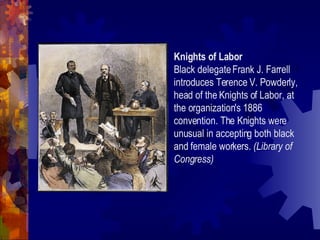
Knights of Labor v. AFL Founded by Samuel Gompers in 1886 National labor union Membership open to skilled workers only Goal: reform working conditions. Less concerned about reforming society Methods included strikes and boycotts Still around today Founded by Uriah Stephens in 1869 First national labor union Membership open to almost all workers.  Management, unskilled workers, women, blacks all welcome. Goal: reform working conditions and society at large  Methods included strikes and protests American Federation of Labor Knights of Labor
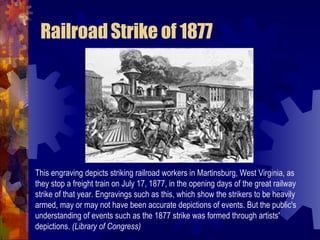
Workers take action! Why did President Hayes call in the federal troops to stop the strike? Strike failed, but signified growing power of unions 1884-1885: other strikes by workers on the Union Pacific Railroad triggers growth in membership of Knights of Labor Depression after  Panic of 1873  prompted railroads to cut pay of workers, resulting in the  Railroad Strike of 1877
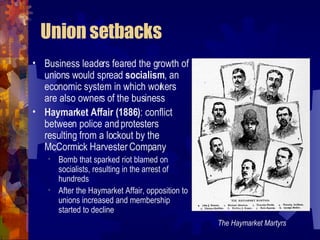
Union setbacks Business leaders feared the growth of unions would spread  socialism , an economic system in which workers are also owners of the business Haymarket Affair (1886) : conflict between police and protesters resulting from a lockout by the McCormick Harvester Company Bomb that sparked riot blamed on the Knights of Labor, socialists, and anarchists, resulting in the arrest of hundreds After the Haymarket Affair, opposition to unions increased and membership of the Knights of Labor started to decline The Haymarket Martyrs
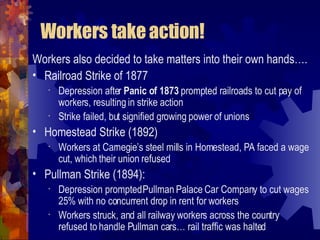
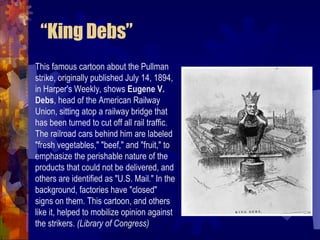
Other (less successful) strikes Homestead Strike (1892) Workers at Carnegie’s steel mills in Homestead, PA faced a wage cut, which their union refused Four month struggle that also included armed conflict Eventually the strike was broken, weakening the union Pullman Strike (1894):  Depression prompted Pullman Palace Car Company to cut wages 25% with no concurrent drop in rent for workers Workers struck, and all railway workers across the country refused to handle Pullman cars… rail traffic was halted President Cleveland had to send in troops to break strike Public opinion turned against them

Business vs Workers

  • 1.
    Business vs. WorkersWorking conditions and the growth of unions in the Gilded Age
  • 2.
    The Changing Faceof Labor In the pre-Civil War era, most factory workers were skilled laborers…this changed starting in the 1870s! Mechanized mass production did not require as much skilled labor Cities attract rural Americans in search of work and opportunity (growth of cities = urbanization ) Result: workforce increasingly made up of women, immigrants, and children
  • 3.
    Working Conditions Businessowners ran factories as cheaply as possible (low costs high profits) at the expense of workers Workers bought own tools No safety equipment Sweatshops Low wages for long hours 10 hour workday (1880s) In 1890, the average annual wage for a family of four was $380; subsistence level was $530
  • 4.
    Child Labor Childlabor was particularly common in this period, with little or no safety measures taken to protect them! - 1910 – 25% of all American children had full-time jobs in factories What do you think the author of this cartoon is trying to say about children’s labor conditions?
  • 5.
    Labor Unions Resultof workers’ discontent = labor unions Idea of a labor union not new…so what made the unions of the Gilded Age different? National organizations Knights of Labor (1869) American Federation of Labor (1886) More workers allowed to join Goals of labor unions: negotiate for better wages and working conditions
  • 6.
    Knights of Laborv. AFL Founded by Samuel Gompers in 1886 National labor union Membership open to skilled workers only Goal: reform working conditions. Less concerned about reforming society Methods included strikes and boycotts Still around today Founded by Uriah Stephens in 1869 First national labor union Membership open to almost all workers. Management, unskilled workers, women, blacks all welcome. Goal: reform working conditions and society at large Methods included strikes and protests American Federation of Labor Knights of Labor
  • 7.
    Workers take action!Why did President Hayes call in the federal troops to stop the strike? Strike failed, but signified growing power of unions 1884-1885: other strikes by workers on the Union Pacific Railroad triggers growth in membership of Knights of Labor Depression after Panic of 1873 prompted railroads to cut pay of workers, resulting in the Railroad Strike of 1877
  • 8.
    Union setbacks Businessleaders feared the growth of unions would spread socialism , an economic system in which workers are also owners of the business Haymarket Affair (1886) : conflict between police and protesters resulting from a lockout by the McCormick Harvester Company Bomb that sparked riot blamed on the Knights of Labor, socialists, and anarchists, resulting in the arrest of hundreds After the Haymarket Affair, opposition to unions increased and membership of the Knights of Labor started to decline The Haymarket Martyrs
  • 9.
    Other (less successful)strikes Homestead Strike (1892) Workers at Carnegie’s steel mills in Homestead, PA faced a wage cut, which their union refused Four month struggle that also included armed conflict Eventually the strike was broken, weakening the union Pullman Strike (1894): Depression prompted Pullman Palace Car Company to cut wages 25% with no concurrent drop in rent for workers Workers struck, and all railway workers across the country refused to handle Pullman cars… rail traffic was halted President Cleveland had to send in troops to break strike Public opinion turned against them