Implementing High-Impact Nutrition
Interventions At Scale:
The ENA Framework
2014
Understanding the ENA Framework
Pre-session CORE Group. May 5th, 2014
Agnes Guyon, MD, MPH
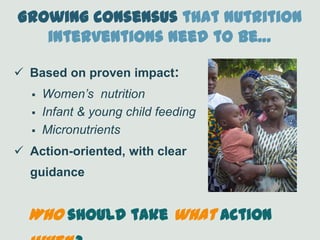
 Based on proven impact:
 Women’s nutrition
 Infant & young child feeding
 Micronutrients
 Action-oriented, with clear
guidance
Who should take what action
Growing consensus that nutrition
interventions need to be…
The High-Impact Nutrition
Interventions
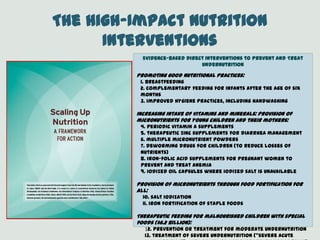
Evidence-Based Direct Interventions to Prevent and Treat
Undernutrition
Promoting good nutritional practices:
1. breastfeeding
2. complementary feeding for infants after the age of six
months
3. improved hygiene practices, including handwashing
Increasing intake of vitamins and minerals: Provision of
micronutrients for young children and their mothers:
4. periodic vitamin A supplements
5. therapeutic zinc supplements for diarrhea management
6. multiple micronutrient powders
7. deworming drugs for children (to reduce losses of
nutrients)
8. iron-folic acid supplements for pregnant women to
prevent and treat anemia
9. iodized oil capsules where iodized salt is unavailable
Provision of micronutrients through food fortification for
all:
10. salt iodization
11. iron fortification of staple foods
Therapeutic feeding for malnourished children with special
foods ($6.2 billion):
12. prevention or treatment for moderate undernutrition
13. treatment of severe undernutrition (‚severe acute
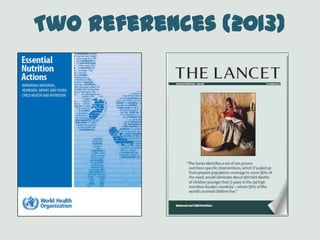
Two References (2013)
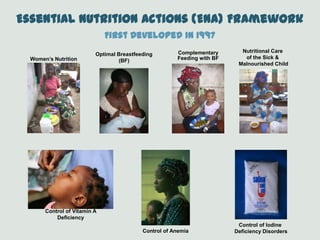
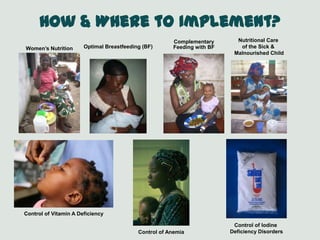
Control of Iodine
Deficiency Disorders
Control of Vitamin A
Deficiency
Optimal Breastfeeding
(BF)
Nutritional Care
of the Sick &
Malnourished Child
Complementary
Feeding with BFWomen’s Nutrition
Control of Anemia
Essential Nutrition Actions (ENA) Framework
First Developed in 1997
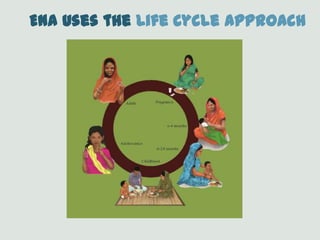
ENA Uses the Life Cycle Approach
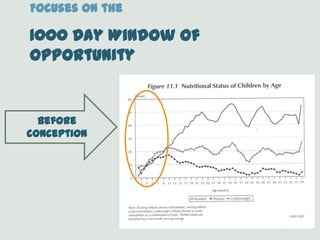
Focuses on the
1000 Day Window of
Opportunity
Before
conception
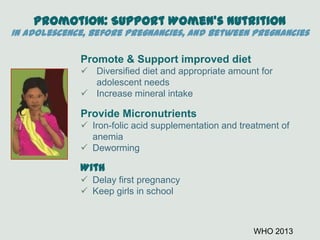
Promotion: Support Women’s Nutrition
In Adolescence, Before Pregnancies, and Between Pregnancies
Promote & Support improved diet
 Diversified diet and appropriate amount for
adolescent needs
 Increase mineral intake
Provide Micronutrients
 Iron-folic acid supplementation and treatment of
anemia
 Deworming
With
 Delay first pregnancy
 Keep girls in school
WHO 2013
Promotion: Support Women’s Nutrition (1)
During Pregnancy & Lactation
Promote & Support Improved Diet
 Diversified diet
 Increased food and MN intakes
 1 extra meal/day when pregnant (550 Kcal/day)
 2 extra meals/day when lactating (650 Kcal/day)
 Consumption of iodized salt
 Sleep under insecticide-treated nets
With
 Spacing of Pregnancy
 Cessation of smoking, alcohol or other substances
Women’s nutrition in the context of HIV and emergencies
WHO ENA, 2013
Promotion: Support Women’s Nutrition (2)
During Pregnancy and Lactation
* Countries with anemia < 20%
** Countries with night blinder>5%
*** Countries with low calcium
intake
**** Countries with < 20% iodized
salt
Provide Micronutrients
 Daily iron-folic acid(30-60/0.4mg)
or
 Weekly 2-3 intermittent iron-folic acid (120/2.8mg) for non-anemic*
 Daily (10 000IU) or Weekly (25 000IU) vitamin A**
 Daily (1.5 gr) Calcium***
 Daily or annual iodine****
With
 Intermittent Preventive Treatment (ITP) of malaria
 Deworming during pregnancy (twice)
 Treatment of anemia
 Timely cord clamping
Protection-Promotion-Support
Breastfeeding < 6 months
Protect Breastfeeding
 Legislation & enforcement of breastmilk substitutes code
Promote & Support key practices
 Immediate initiation of breastfeeding
 Exclusive breastfeeding for 6 months
 Correct positioning & attachment
 Breastfeed day and night at least 10 times
 Empty one breast before switching to the other (Fore-milk vs hind milk)
 Infant feeding in the context of HIV and emergencies
Other practices (control & prevention of anemia)
 Timely cord clamping
WHO ENA 2013
Protection-Promotion-Support (1)
Complementary Feeding with Breastfeeding 6-24 Months
Promote & support Improved Diet
 Introduce appropriate CF at 6 months
 Continue breastfeeding until 24 months & more
 Frequency:
 Amount adapted to age
 6-8 months: 200 kcal/day
 9-11 months: 300 kcal/day;
 12-23 months: 550 kcal/day
 Diversity (fruits, vegetables, animal source, MNP, fortified CF, iodized salt)
 Density: from mashed to family food
 Utilization (handwashing, clean water, food & utensils)
 Active feeding
Protect CF
Codex Alimentarius & Marketing of complementary food
WHO ENA 2013
 6-8 months: 2-3 meals/day
 9-23 months: 3-4 meals/day, 1-2 snacks/day
Protection-Promotion-Support (2)
Control & Prevention of MN Deficiencies
WHO ENA 2013
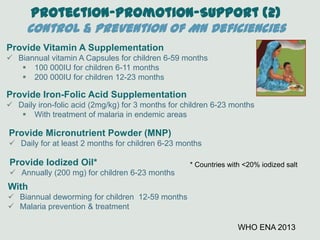
Provide Vitamin A Supplementation
 Biannual vitamin A Capsules for children 6-59 months
 100 000IU for children 6-11 months
 200 000IU for children 12-23 months
Provide Iron-Folic Acid Supplementation
 Daily iron-folic acid (2mg/kg) for 3 months for children 6-23 months
 With treatment of malaria in endemic areas
Provide Micronutrient Powder (MNP)
 Daily for at least 2 months for children 6-23 months
Provide Iodized Oil*
 Annually (200 mg) for children 6-23 months
* Countries with <20% iodized salt
With
 Biannual deworming for children 12-59 months
 Malaria prevention & treatment
Nutritional Care
Sick Child & Management of Acute Malnutrition
Promote & Support of Improved Diet
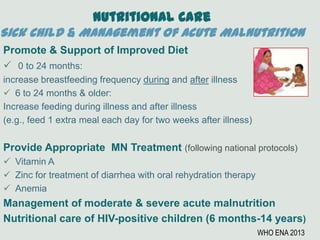
 0 to 24 months:
increase breastfeeding frequency during and after illness
 6 to 24 months & older:
Increase feeding during illness and after illness
(e.g., feed 1 extra meal each day for two weeks after illness)
Provide Appropriate MN Treatment (following national protocols)
 Vitamin A
 Zinc for treatment of diarrhea with oral rehydration therapy
 Anemia
Management of moderate & severe acute malnutrition
Nutritional care of HIV-positive children (6 months-14 years)
WHO ENA 2013
Promotion-Support
Nutrition-Sensitive
WHO ENA 2013
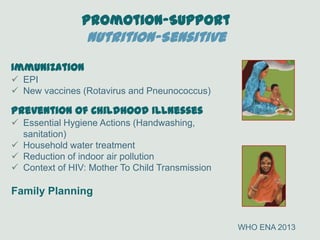
Immunization
 EPI
 New vaccines (Rotavirus and Pneunococcus)
Prevention of Childhood Illnesses
 Essential Hygiene Actions (Handwashing,
sanitation)
 Household water treatment
 Reduction of indoor air pollution
 Context of HIV: Mother To Child Transmission
Family Planning
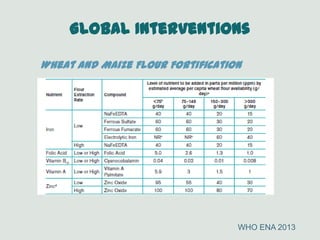
Global Interventions
Wheat and Maize Flour Fortification
WHO ENA 2013
How & Where to Implement?
Control of Iodine
Deficiency Disorders
Control of Vitamin A Deficiency
Optimal Breastfeeding (BF)
Nutritional Care
of the Sick &
Malnourished Child
Complementary
Feeding with BFWomen’s Nutrition
Control of Anemia
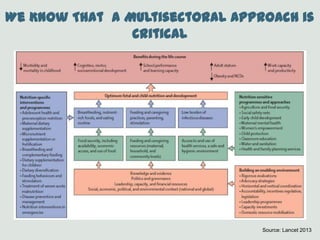
We Know That a Multisectoral Approach is
Critical
Source: Lancet 2013
 A framework to operationalize the
implementation of existing nutrition
programs that:
 pulls together existing vertical programs in a
sensible 'action-oriented' way
 greatly expands coverage to multi-contacts and
multi-platforms.
 Provides an excellent training
framework on which to train service
providers and community members:
 Simple
 Uses existing structures.
The ENA Framework
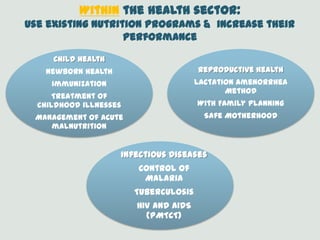
Within the health sector:
Use existing nutrition programs & increase their
performance
Child Health
Newborn health
Immunization
Treatment of
childhood illnesses
Management of acute
malnutrition
Reproductive Health
Lactation Amenorrhea
Method
With Family Planning
Safe Motherhood
Infectious Diseases
Control of
Malaria
Tuberculosis
HIV and AIDS
(PMTCT)
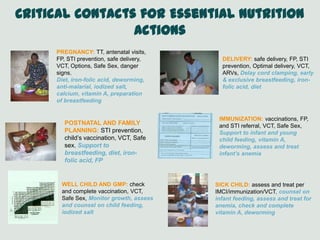
DELIVERY: safe delivery, FP, STI
prevention, Optimal delivery, VCT,
ARVs, Delay cord clamping, early
& exclusive breastfeeding, iron-
folic acid, diet
PREGNANCY: TT, antenatal visits,
FP, STI prevention, safe delivery,
VCT, Options, Safe Sex, danger
signs,
Diet, iron-folic acid, deworming,
anti-malarial, iodized salt,
calcium, vitamin A, preparation
of breastfeeding
POSTNATAL AND FAMILY
PLANNING: STI prevention,
child’s vaccination, VCT, Safe
sex, Support to
breastfeeding, diet, iron-
folic acid, FP
WELL CHILD AND GMP: check
and complete vaccination, VCT,
Safe Sex, Monitor growth, assess
and counsel on child feeding,
iodized salt
SICK CHILD: assess and treat per
IMCI/immunization/VCT, counsel on
infant feeding, assess and treat for
anemia, check and complete
vitamin A, deworming
IMMUNIZATION: vaccinations, FP,
and STI referral, VCT, Safe Sex,
Support to infant and young
child feeding, vitamin A,
deworming, assess and treat
infant’s anemia
Critical Contacts for Essential Nutrition
Actions
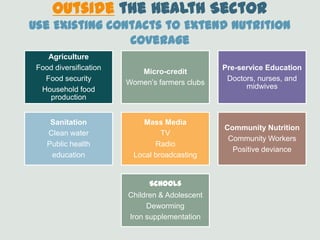
Outside the Health Sector
Use Existing Contacts to Extend Nutrition
Coverage
Agriculture
Food diversification
Food security
Household food
production
Micro-credit
Women’s farmers clubs
Pre-service Education
Doctors, nurses, and
midwives
Sanitation
Clean water
Public health
education
Mass Media
TV
Radio
Local broadcasting
Community Nutrition
Community Workers
Positive deviance
Schools
Children & Adolescent
Deworming
Iron supplementation
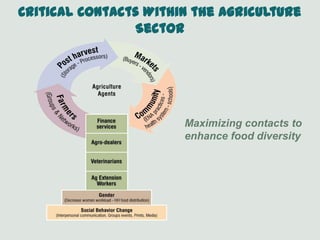
Maximizing contacts to
enhance food diversity
Critical Contacts Within the Agriculture
Sector
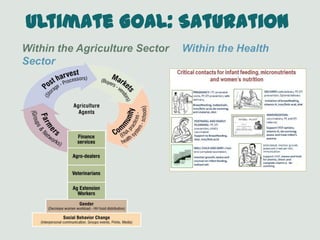
Ultimate Goal: Saturation
Within the Agriculture Sector Within the Health
Sector
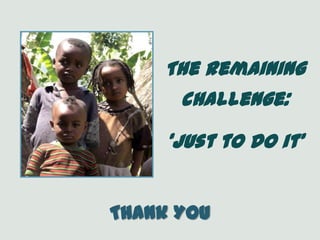
The remaining
challenge:
‘just to do it’
Thank You

Understanding the Essential Nutrition Actions Framework_Agnes Guyon_5.5.14

  • 1.
    Implementing High-Impact Nutrition InterventionsAt Scale: The ENA Framework 2014 Understanding the ENA Framework Pre-session CORE Group. May 5th, 2014 Agnes Guyon, MD, MPH
  • 2.
     Based onproven impact:  Women’s nutrition  Infant & young child feeding  Micronutrients  Action-oriented, with clear guidance Who should take what action Growing consensus that nutrition interventions need to be…
  • 3.
    The High-Impact Nutrition Interventions Evidence-BasedDirect Interventions to Prevent and Treat Undernutrition Promoting good nutritional practices: 1. breastfeeding 2. complementary feeding for infants after the age of six months 3. improved hygiene practices, including handwashing Increasing intake of vitamins and minerals: Provision of micronutrients for young children and their mothers: 4. periodic vitamin A supplements 5. therapeutic zinc supplements for diarrhea management 6. multiple micronutrient powders 7. deworming drugs for children (to reduce losses of nutrients) 8. iron-folic acid supplements for pregnant women to prevent and treat anemia 9. iodized oil capsules where iodized salt is unavailable Provision of micronutrients through food fortification for all: 10. salt iodization 11. iron fortification of staple foods Therapeutic feeding for malnourished children with special foods ($6.2 billion): 12. prevention or treatment for moderate undernutrition 13. treatment of severe undernutrition (‚severe acute
  • 4.
  • 5.
    Control of Iodine DeficiencyDisorders Control of Vitamin A Deficiency Optimal Breastfeeding (BF) Nutritional Care of the Sick & Malnourished Child Complementary Feeding with BFWomen’s Nutrition Control of Anemia Essential Nutrition Actions (ENA) Framework First Developed in 1997
  • 6.
    ENA Uses theLife Cycle Approach
  • 7.
    Focuses on the 1000Day Window of Opportunity Before conception
  • 8.
    Promotion: Support Women’sNutrition In Adolescence, Before Pregnancies, and Between Pregnancies Promote & Support improved diet  Diversified diet and appropriate amount for adolescent needs  Increase mineral intake Provide Micronutrients  Iron-folic acid supplementation and treatment of anemia  Deworming With  Delay first pregnancy  Keep girls in school WHO 2013
  • 9.
    Promotion: Support Women’sNutrition (1) During Pregnancy & Lactation Promote & Support Improved Diet  Diversified diet  Increased food and MN intakes  1 extra meal/day when pregnant (550 Kcal/day)  2 extra meals/day when lactating (650 Kcal/day)  Consumption of iodized salt  Sleep under insecticide-treated nets With  Spacing of Pregnancy  Cessation of smoking, alcohol or other substances Women’s nutrition in the context of HIV and emergencies WHO ENA, 2013
  • 10.
    Promotion: Support Women’sNutrition (2) During Pregnancy and Lactation * Countries with anemia < 20% ** Countries with night blinder>5% *** Countries with low calcium intake **** Countries with < 20% iodized salt Provide Micronutrients  Daily iron-folic acid(30-60/0.4mg) or  Weekly 2-3 intermittent iron-folic acid (120/2.8mg) for non-anemic*  Daily (10 000IU) or Weekly (25 000IU) vitamin A**  Daily (1.5 gr) Calcium***  Daily or annual iodine**** With  Intermittent Preventive Treatment (ITP) of malaria  Deworming during pregnancy (twice)  Treatment of anemia  Timely cord clamping
  • 11.
    Protection-Promotion-Support Breastfeeding < 6months Protect Breastfeeding  Legislation & enforcement of breastmilk substitutes code Promote & Support key practices  Immediate initiation of breastfeeding  Exclusive breastfeeding for 6 months  Correct positioning & attachment  Breastfeed day and night at least 10 times  Empty one breast before switching to the other (Fore-milk vs hind milk)  Infant feeding in the context of HIV and emergencies Other practices (control & prevention of anemia)  Timely cord clamping WHO ENA 2013
  • 12.
    Protection-Promotion-Support (1) Complementary Feedingwith Breastfeeding 6-24 Months Promote & support Improved Diet  Introduce appropriate CF at 6 months  Continue breastfeeding until 24 months & more  Frequency:  Amount adapted to age  6-8 months: 200 kcal/day  9-11 months: 300 kcal/day;  12-23 months: 550 kcal/day  Diversity (fruits, vegetables, animal source, MNP, fortified CF, iodized salt)  Density: from mashed to family food  Utilization (handwashing, clean water, food & utensils)  Active feeding Protect CF Codex Alimentarius & Marketing of complementary food WHO ENA 2013  6-8 months: 2-3 meals/day  9-23 months: 3-4 meals/day, 1-2 snacks/day
  • 13.
    Protection-Promotion-Support (2) Control &Prevention of MN Deficiencies WHO ENA 2013 Provide Vitamin A Supplementation  Biannual vitamin A Capsules for children 6-59 months  100 000IU for children 6-11 months  200 000IU for children 12-23 months Provide Iron-Folic Acid Supplementation  Daily iron-folic acid (2mg/kg) for 3 months for children 6-23 months  With treatment of malaria in endemic areas Provide Micronutrient Powder (MNP)  Daily for at least 2 months for children 6-23 months Provide Iodized Oil*  Annually (200 mg) for children 6-23 months * Countries with <20% iodized salt With  Biannual deworming for children 12-59 months  Malaria prevention & treatment
  • 14.
    Nutritional Care Sick Child& Management of Acute Malnutrition Promote & Support of Improved Diet  0 to 24 months: increase breastfeeding frequency during and after illness  6 to 24 months & older: Increase feeding during illness and after illness (e.g., feed 1 extra meal each day for two weeks after illness) Provide Appropriate MN Treatment (following national protocols)  Vitamin A  Zinc for treatment of diarrhea with oral rehydration therapy  Anemia Management of moderate & severe acute malnutrition Nutritional care of HIV-positive children (6 months-14 years) WHO ENA 2013
  • 15.
    Promotion-Support Nutrition-Sensitive WHO ENA 2013 Immunization EPI  New vaccines (Rotavirus and Pneunococcus) Prevention of Childhood Illnesses  Essential Hygiene Actions (Handwashing, sanitation)  Household water treatment  Reduction of indoor air pollution  Context of HIV: Mother To Child Transmission Family Planning
  • 16.
    Global Interventions Wheat andMaize Flour Fortification WHO ENA 2013
  • 17.
    How & Whereto Implement? Control of Iodine Deficiency Disorders Control of Vitamin A Deficiency Optimal Breastfeeding (BF) Nutritional Care of the Sick & Malnourished Child Complementary Feeding with BFWomen’s Nutrition Control of Anemia
  • 18.
    We Know Thata Multisectoral Approach is Critical Source: Lancet 2013
  • 19.
     A frameworkto operationalize the implementation of existing nutrition programs that:  pulls together existing vertical programs in a sensible 'action-oriented' way  greatly expands coverage to multi-contacts and multi-platforms.  Provides an excellent training framework on which to train service providers and community members:  Simple  Uses existing structures. The ENA Framework
  • 20.
    Within the healthsector: Use existing nutrition programs & increase their performance Child Health Newborn health Immunization Treatment of childhood illnesses Management of acute malnutrition Reproductive Health Lactation Amenorrhea Method With Family Planning Safe Motherhood Infectious Diseases Control of Malaria Tuberculosis HIV and AIDS (PMTCT)
  • 21.
    DELIVERY: safe delivery,FP, STI prevention, Optimal delivery, VCT, ARVs, Delay cord clamping, early & exclusive breastfeeding, iron- folic acid, diet PREGNANCY: TT, antenatal visits, FP, STI prevention, safe delivery, VCT, Options, Safe Sex, danger signs, Diet, iron-folic acid, deworming, anti-malarial, iodized salt, calcium, vitamin A, preparation of breastfeeding POSTNATAL AND FAMILY PLANNING: STI prevention, child’s vaccination, VCT, Safe sex, Support to breastfeeding, diet, iron- folic acid, FP WELL CHILD AND GMP: check and complete vaccination, VCT, Safe Sex, Monitor growth, assess and counsel on child feeding, iodized salt SICK CHILD: assess and treat per IMCI/immunization/VCT, counsel on infant feeding, assess and treat for anemia, check and complete vitamin A, deworming IMMUNIZATION: vaccinations, FP, and STI referral, VCT, Safe Sex, Support to infant and young child feeding, vitamin A, deworming, assess and treat infant’s anemia Critical Contacts for Essential Nutrition Actions
  • 22.
    Outside the HealthSector Use Existing Contacts to Extend Nutrition Coverage Agriculture Food diversification Food security Household food production Micro-credit Women’s farmers clubs Pre-service Education Doctors, nurses, and midwives Sanitation Clean water Public health education Mass Media TV Radio Local broadcasting Community Nutrition Community Workers Positive deviance Schools Children & Adolescent Deworming Iron supplementation
  • 23.
    Maximizing contacts to enhancefood diversity Critical Contacts Within the Agriculture Sector
  • 24.
    Ultimate Goal: Saturation Withinthe Agriculture Sector Within the Health Sector
  • 25.

Editor's Notes

  • #5 We have today two key references from renown institutions (World Health organizations and the Lancet series) to guide donors, governments, and program managers in scaling up high impact nutrition interventions
  • #19 SUN takes a multi-sectoral approach to scale up nutrition specific interventions and put nutrition-sensitive policies into all key sectors