Interviewing Techniques
made by
psychologist
stella
Interview Format
• Planning the Interview:
– Fully Structured
– Semi structured
– Unstructured
• When any case is referred to FP, the forensic
interview is the first step in the investigation.
• A forensic interview is a sensitive and legally
sound method of gathering factual
information regarding allegations of abuse or
exposure to violence. This interview is
conducted by a competently trained, neutral
professional utilizing research and practice-
informed techniques as part of a larger
investigative process.
Questions
• Open ended
• Close ended
• Probing Questions: A probing question is a
question that follows up on the answers to
previous questions.
• These can be used to:
• Clarify or search for reasons behind previous
answers
• Search for inconsistencies
• Help the respondent deal with a topic that
has been difficult to speak about
• Revisit responses from earlier in the interview
• Clarifying: Can you tell me more about it
• Expending: What happened next
• Checking: You said……
• Revision: “Let’s go back to what you told
me before about… In the light of what you
told me later, can you now tell me more
about…?”
• There are a number of forensic interviewing
models, all consist of sequential phases or
stages and include the following:
• Rapport building:
• Substantive phase:
• Closure:
• Building Rapport:
– Non Judgmental attitude
– Non Verbal Cues
– Empathic Listening
– Reflecting
– Clarifying
– Summarizing
Therapy‐Interfering Behavior (TIB)
• It is exactly what it sounds like!
– Behaviors that interfere with effective therapy
– Can be done by clients and therapists
Therapy‐Interfering Behavior (TIB)
• Client behaviors that interfere with
receiving therapy:
– Coming late, missing sessions, or last minute
cancellations
– Not doing homework in between sessions
– Not participating in session (e.g., not talking,
daydreaming, dissociating, lying, saying “I
don’t know” a lot)
Therapy‐Interfering Behavior (TIB)
• Client behaviors that burn out therapists:
– Not engaging or accepting treatment
strategies therapist believes are essential
– Phoning or emailing therapist too much
– Demanding solutions / assistance / resources
therapist cannot offer
– Being disrespectful / hostile / critical towards
therapist and therapy
– Not paying for services in a timely manner
Therapy‐Interfering Behavior (TIB)
• Can have a range of emotional and
cognitive responses
• And therefore may…
– Ignore client TIB
– Respond assertively to client TIB
– Respond aggressively to client TIB
Therapy‐Interfering Behavior (TIB)
• Therapist does not recognize client TIB is
occurring
• Therapist is unclear how to understand /
conceptualize client TIB
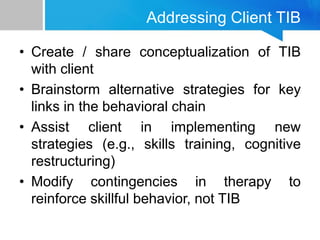
Addressing Client TIB
• Create / share conceptualization of TIB
with client
• Brainstorm alternative strategies for key
links in the behavioral chain
• Assist client in implementing new
strategies (e.g., skills training, cognitive
restructuring)
• Modify contingencies in therapy to
reinforce skillful behavior, not TIB
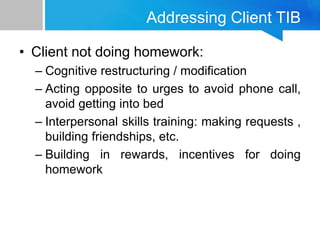
Addressing Client TIB
• Client not doing homework:
– Cognitive restructuring / modification
– Acting opposite to urges to avoid phone call,
avoid getting into bed
– Interpersonal skills training: making requests ,
building friendships, etc.
– Building in rewards, incentives for doing
homework
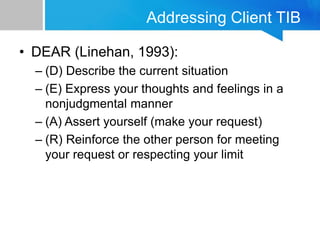
Addressing Client TIB
• DEAR (Linehan, 1993):
– (D) Describe the current situation
– (E) Express your thoughts and feelings in a
nonjudgmental manner
– (A) Assert yourself (make your request)
– (R) Reinforce the other person for meeting
your request or respecting your limit

Interviewing Techniques in Forensics

  • 1.
  • 2.
    Interview Format • Planningthe Interview: – Fully Structured – Semi structured – Unstructured
  • 3.
    • When anycase is referred to FP, the forensic interview is the first step in the investigation. • A forensic interview is a sensitive and legally sound method of gathering factual information regarding allegations of abuse or exposure to violence. This interview is conducted by a competently trained, neutral professional utilizing research and practice- informed techniques as part of a larger investigative process.
  • 4.
  • 5.
    • Probing Questions:A probing question is a question that follows up on the answers to previous questions. • These can be used to: • Clarify or search for reasons behind previous answers • Search for inconsistencies • Help the respondent deal with a topic that has been difficult to speak about • Revisit responses from earlier in the interview
  • 6.
    • Clarifying: Canyou tell me more about it • Expending: What happened next • Checking: You said…… • Revision: “Let’s go back to what you told me before about… In the light of what you told me later, can you now tell me more about…?”
  • 7.
    • There area number of forensic interviewing models, all consist of sequential phases or stages and include the following: • Rapport building: • Substantive phase: • Closure:
  • 8.
    • Building Rapport: –Non Judgmental attitude – Non Verbal Cues – Empathic Listening – Reflecting – Clarifying – Summarizing
  • 9.
    Therapy‐Interfering Behavior (TIB) •It is exactly what it sounds like! – Behaviors that interfere with effective therapy – Can be done by clients and therapists
  • 10.
    Therapy‐Interfering Behavior (TIB) •Client behaviors that interfere with receiving therapy: – Coming late, missing sessions, or last minute cancellations – Not doing homework in between sessions – Not participating in session (e.g., not talking, daydreaming, dissociating, lying, saying “I don’t know” a lot)
  • 11.
    Therapy‐Interfering Behavior (TIB) •Client behaviors that burn out therapists: – Not engaging or accepting treatment strategies therapist believes are essential – Phoning or emailing therapist too much – Demanding solutions / assistance / resources therapist cannot offer – Being disrespectful / hostile / critical towards therapist and therapy – Not paying for services in a timely manner
  • 12.
    Therapy‐Interfering Behavior (TIB) •Can have a range of emotional and cognitive responses • And therefore may… – Ignore client TIB – Respond assertively to client TIB – Respond aggressively to client TIB
  • 13.
    Therapy‐Interfering Behavior (TIB) •Therapist does not recognize client TIB is occurring • Therapist is unclear how to understand / conceptualize client TIB
  • 14.
    Addressing Client TIB •Create / share conceptualization of TIB with client • Brainstorm alternative strategies for key links in the behavioral chain • Assist client in implementing new strategies (e.g., skills training, cognitive restructuring) • Modify contingencies in therapy to reinforce skillful behavior, not TIB
  • 15.
    Addressing Client TIB •Client not doing homework: – Cognitive restructuring / modification – Acting opposite to urges to avoid phone call, avoid getting into bed – Interpersonal skills training: making requests , building friendships, etc. – Building in rewards, incentives for doing homework
  • 16.
    Addressing Client TIB •DEAR (Linehan, 1993): – (D) Describe the current situation – (E) Express your thoughts and feelings in a nonjudgmental manner – (A) Assert yourself (make your request) – (R) Reinforce the other person for meeting your request or respecting your limit