

Tolentino, Diane M. 
BSBA 3 
Immaculate Conception College
An interview is a conversation 
between two or more people 
where questions are asked by the 
interviewer to elicit facts or 
statements from the interviewee.
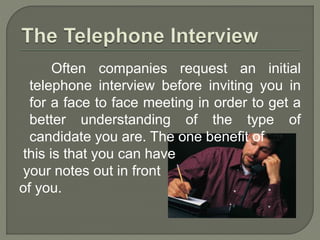
Often companies request an initial 
telephone interview before inviting you in 
for a face to face meeting in order to get a 
better understanding of the type of 
candidate you are. The one benefit of 
this is that you can have 
your notes out in front 
of you.
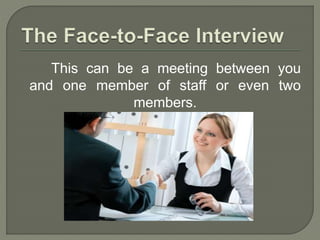
This can be a meeting between you 
and one member of staff or even two 
members.
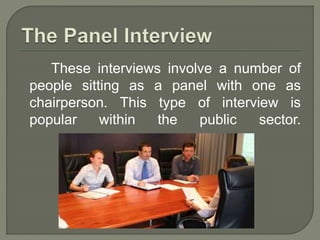
These interviews involve a number of 
people sitting as a panel with one as 
chairperson. This type of interview is 
popular within the public sector.
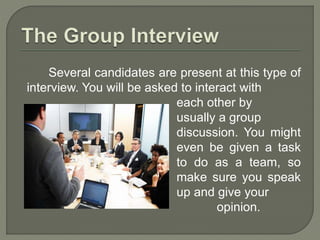
Several candidates are present at this type of 
interview. You will be asked to interact with 
each other by 
usually a group 
discussion. You might 
even be given a task 
to do as a team, so 
make sure you speak 
up and give your 
opinion.
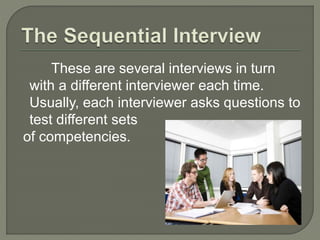
These are several interviews in turn 
with a different interviewer each time. 
Usually, each interviewer asks questions to 
test different sets 
of competencies.
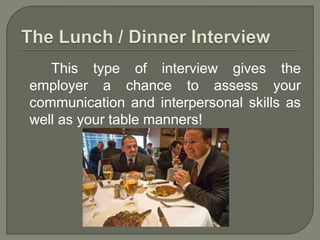
This type of interview gives the 
employer a chance to assess your 
communication and interpersonal skills as 
well as your table manners!
Though the candidate's resume, 
cover letter and job application give 
interviewers an overview of her 
background and skills, the interview 
may be the best chance the candidate 
has to make a favorable impression.
The job interview serves as a two-way 
street for the exchange of information. 
The interviewer has the opportunity to 
learn more about the candidate's 
background and can also impart more 
in-depth information about the 
company and the various duties the 
job entails.
The interview provides a selling 
opportunity for the organization as 
well as the candidate. The interviewer 
can highlight the positive aspects of 
working for the company, such as how 
plans for growth can lead to future 
opportunities or how the company is 
recognized as an industry leader.
In situations where companies receive a 
heavy volume of applicants for a job 
opening, interviews are a valuable tool for 
narrowing the field. In particular, a round of 
preliminary interviews helps the company 
to weed out unsuitable candidates so it 
can then pay closer attention to the "cream 
of the crop" in subsequent interviews.
Communicate information about 
yourself, your experience and your 
abilities 
Seek further information about the 
position and the organization 
Evaluate the match between your 
needs and what the job offers
 Interview preparation - interest in and 
knowledge of the industry, the position 
and the organization 
Communication skills - oral presentation 
skills and the ability to interact with 
others
 Qualifications - academic, work, 
volunteer and other experience 
 Leadership potential and teamwork - 
demonstrated ability to work with 
others and to get others to work 
together
 Clear and realistic career goals - 
future plans and awareness of career 
paths 
 Self awareness - realistic appraisal of 
self
 Motivation and success potential - 
enthusiasm for the position; 
demonstrated patterns of 
accomplishment 
 Work ethic - acceptance of 
responsibility, ability to keep 
commitments and attitude of the 
importance of work
Preparation 
 Practice 
Presentation 
Perseverance
1. RESEARCH 
You’ll want to make sure that you understand 
exactly what that company specializes in, 
what kind of industry they are, who they 
typically employ, where they are what is the 
history of the company, who is the 
president/CEO/owner, how many employees 
do they have, etc. An important piece of 
information to find out is what the 
company’s MISSION and VALUES are.
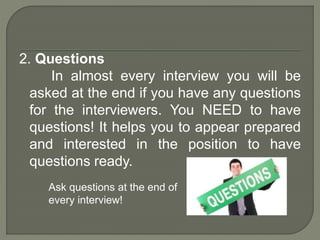
2. Questions 
In almost every interview you will be 
asked at the end if you have any questions 
for the interviewers. You NEED to have 
questions! It helps you to appear prepared 
and interested in the position to have 
questions ready. 
Ask questions at the end of 
every interview!
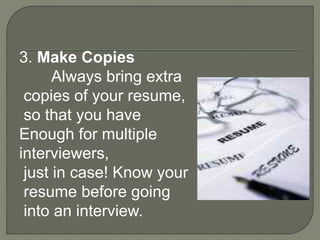
3. Make Copies 
Always bring extra 
copies of your resume, 
so that you have 
Enough for multiple 
interviewers, 
just in case! Know your 
resume before going 
into an interview.
4. Drive-By 
you must do a simple drive-by where 
your interview is taking place.
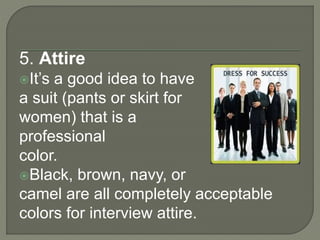
5. Attire 
It’s a good idea to have 
a suit (pants or skirt for 
women) that is a 
professional 
color. 
Black, brown, navy, or 
camel are all completely acceptable 
colors for interview attire.
INTERVIEW ATTIRE
When in doubt, always go the 
conservative route. You want YOU to 
stand out, not the clothing, jewelry or 
makeup you wear.
Ensure you’re well-groomed before an 
interview. This means having clean and 
manicured nails, showering, wearing 
deodorant/anti-perspirant, brushing your 
teeth and neatly styling your hair.
Whether male or female, your jewelry 
should be understated and should 
complement your outfit. Men should 
stick to no more than a wedding band 
and a watch, while women should 
choose conservative jewelry.
Bring a briefcase, portfolio or 
simple tote bag to carry your work 
samples, a notepad, pens, 
research materials, etc.
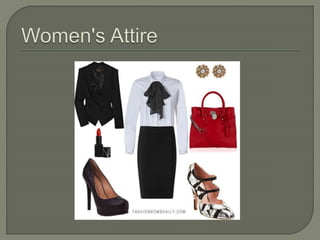
Pants or skirt suits are acceptable. 
Skirt suits should be no longer or 
shorter than knee-length. 
A sweater set with a knee-length skirt 
or dress pants is also acceptable. 
Hosiery (neutral nylons or tights, 
depending on the season) is a must.
Shoes should be sensible pumps or 
low-heeled dress shoes. 
Natural-looking makeup. 
Hair should be out of your face. A 
neatly placed bun is a good way to 
ensure hair isn’t distracting.
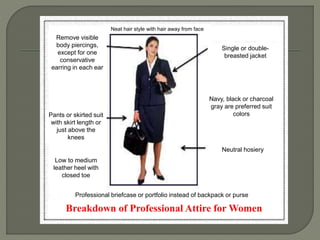
Neat hair style with hair away from face 
Remove visible 
body piercings, 
except for one 
conservative 
earring in each ear 
Pants or skirted suit 
with skirt length or 
just above the 
knees 
Low to medium 
leather heel with 
closed toe 
Single or double-breasted 
jacket 
Navy, black or charcoal 
gray are preferred suit 
colors 
Neutral hosiery 
Professional briefcase or portfolio instead of backpack or purse 
Breakdown of Professional Attire for Women
A tie that coordinates with your 
suit and that avoids wild colors 
and patterns is necessary. 
Dark socks should be worn and 
should be long enough to cover 
legs fully at all times.
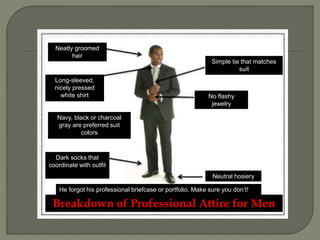
Neatly groomed 
hair 
Long-sleeved, 
nicely pressed 
white shirt 
Navy, black or charcoal 
gray are preferred suit 
colors 
Dark socks that 
coordinate with outfit 
Simple tie that matches 
suit 
No flashy 
jewelry 
Neutral hosiery 
He forgot his professional briefcase or portfolio. Make sure you don’t! 
Breakdown of Professional Attire for Men
Well-tailored, clean, pressed suit in 
conservative shades, such as navy 
blue, gray or brown. 
Pressed white or light-colored, long-sleeved 
shirt underneath suit. 
Shoes should be plain black or brown 
leather and should coordinate with 
outfit.
 Low-cut necklines 
 Mini-skirts 
 Loud prints and patterns 
 Open-toed shoes and spike heels 
 Dramatic makeup 
 Fragrance of any kind 
 Excessive or flashy jewelry
 Baseball or any other kind of hat 
 Low-cut necklines 
 Sleeveless tops and sheer fabrics 
 Mini-skirts 
 Loud prints and patterns
Open-toed shoes 
Dramatic makeup 
Excessive or flashy jewelry 
Gum, mints or other objects 
Flaunting designer labels too much
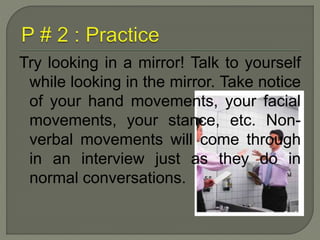
Try looking in a mirror! Talk to yourself 
while looking in the mirror. Take notice 
of your hand movements, your facial 
movements, your stance, etc. Non-verbal 
movements will come through 
in an interview just as they do in 
normal conversations.
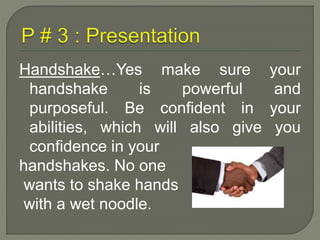
Handshake…Yes make sure your 
handshake is powerful and 
purposeful. Be confident in your 
abilities, which will also give you 
confidence in your 
handshakes. No one 
wants to shake hands 
with a wet noodle.
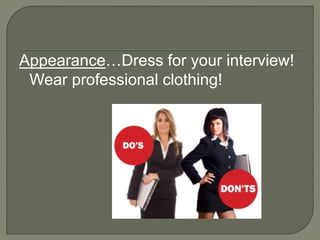
Appearance…Dress for your interview! 
Wear professional clothing!
Non-Verbal & Verbal Habits… 
Try to control your leg shaking, 
nail biting, hair twirling, “umm’s”, 
“well’s”, “like’s”, and “and’s”.
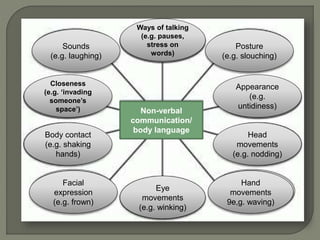
Sounds 
(e.g. laughing) 
Ways of talking 
(e.g. pauses, 
stress on 
words) 
Posture 
(e.g. slouching) 
Appearance 
(e.g. 
untidiness) 
Head 
movements 
(e.g. nodding) 
Hand 
movements 
9e,g. waving) 
space’) Non-verbal 
Eye 
movements 
(e.g. winking) 
Closeness 
(e.g. ‘invading 
someone’s 
Body contact 
(e.g. shaking 
hands) 
Facial 
expression 
(e.g. frown) 
communication/ 
body language
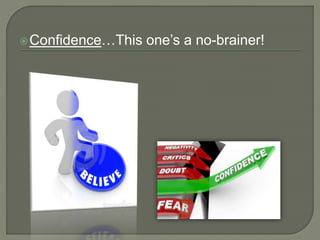
Confidence…This one’s a no-brainer!
After any interview you should always send 
a THANK YOU email to your interviewers.
You should also send FOLLOW-UP emails if 
you haven’t heard anything after 2 weeks.
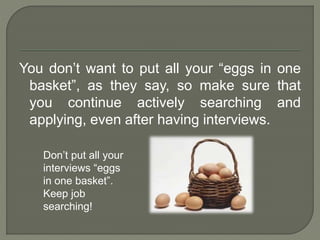
You don’t want to put all your “eggs in one 
basket”, as they say, so make sure that 
you continue actively searching and 
applying, even after having interviews. 
Don’t put all your 
interviews “eggs 
in one basket”. 
Keep job 
searching!
You need to have a short 
statement prepared in your mind. 
Limit it to work-related items unless 
instructed otherwise. Talk about things 
you have done and jobs you have 
held that relate to the position you are 
interviewing for. Start with the item 
farthest back and work up to the 
present.
Stay positive regardless of the 
circumstances. Never refer to a major 
problem with management and never 
speak ill of supervisors, co-workers or 
the organization.
Keep smiling and talk about leaving for a 
positive reason such as an opportunity, a 
chance to do something special or other 
forward-looking reasons.
Speak about specifics that relate to 
the position you are applying for. If 
you do not have specific experience, 
get as close as you can.
"5 years is a long time, I would like to 
learn more about banking industry 
and perhaps be in a position of 
responsibility in this field."
You may say that you thrive under 
certain types of pressure. Give an 
example that relates to the type of 
position applied for.
This question is one reason to do 
some research on the organization 
before the interview. Find out where 
they have been and where they are 
going. What are the current issues 
and who are the major players?
This may take some thought and 
certainly, should be based on the 
research you have done on the 
organization. Sincerity is extremely 
important here and will easily be sensed. 
Relate it to your long-term career goals.
A loaded question. A nasty little game that 
you will probably lose if you answer first. 
So, do not answer it. Instead, say 
something like, That’s a tough question. 
Can you tell me the range for this position? 
In most cases, the interviewer, taken off 
guard, will tell you. If not, say that it can 
depend on the details of the job. Then give 
a wide range.
Specifics here are not good. 
Something like this should work: I’d 
like it to be a long time. Or As long as 
we both feel I’m doing a good job.
Point out how your assets meet 
what the organization needs. Do not 
mention any other candidates to make 
a comparison.
Numerous answers are good, just 
stay positive. A few good examples: 
Your ability to prioritize, Your problem-solving 
skills, Your ability to work under 
pressure, Your ability to focus on 
projects, Your professional expertise, 
Your leadership skills, Your positive 
attitude
Be honest. If you are comfortable in 
different roles, point that out.
Interview

Interview

  • 1.
    Tolentino, Diane M. BSBA 3 Immaculate Conception College
  • 2.
    An interview isa conversation between two or more people where questions are asked by the interviewer to elicit facts or statements from the interviewee.
  • 4.
    Often companies requestan initial telephone interview before inviting you in for a face to face meeting in order to get a better understanding of the type of candidate you are. The one benefit of this is that you can have your notes out in front of you.
  • 5.
    This can bea meeting between you and one member of staff or even two members.
  • 6.
    These interviews involvea number of people sitting as a panel with one as chairperson. This type of interview is popular within the public sector.
  • 7.
    Several candidates arepresent at this type of interview. You will be asked to interact with each other by usually a group discussion. You might even be given a task to do as a team, so make sure you speak up and give your opinion.
  • 8.
    These are severalinterviews in turn with a different interviewer each time. Usually, each interviewer asks questions to test different sets of competencies.
  • 9.
    This type ofinterview gives the employer a chance to assess your communication and interpersonal skills as well as your table manners!
  • 11.
    Though the candidate'sresume, cover letter and job application give interviewers an overview of her background and skills, the interview may be the best chance the candidate has to make a favorable impression.
  • 12.
    The job interviewserves as a two-way street for the exchange of information. The interviewer has the opportunity to learn more about the candidate's background and can also impart more in-depth information about the company and the various duties the job entails.
  • 13.
    The interview providesa selling opportunity for the organization as well as the candidate. The interviewer can highlight the positive aspects of working for the company, such as how plans for growth can lead to future opportunities or how the company is recognized as an industry leader.
  • 14.
    In situations wherecompanies receive a heavy volume of applicants for a job opening, interviews are a valuable tool for narrowing the field. In particular, a round of preliminary interviews helps the company to weed out unsuitable candidates so it can then pay closer attention to the "cream of the crop" in subsequent interviews.
  • 16.
    Communicate information about yourself, your experience and your abilities Seek further information about the position and the organization Evaluate the match between your needs and what the job offers
  • 17.
     Interview preparation- interest in and knowledge of the industry, the position and the organization Communication skills - oral presentation skills and the ability to interact with others
  • 18.
     Qualifications -academic, work, volunteer and other experience  Leadership potential and teamwork - demonstrated ability to work with others and to get others to work together
  • 19.
     Clear andrealistic career goals - future plans and awareness of career paths  Self awareness - realistic appraisal of self
  • 20.
     Motivation andsuccess potential - enthusiasm for the position; demonstrated patterns of accomplishment  Work ethic - acceptance of responsibility, ability to keep commitments and attitude of the importance of work
  • 22.
    Preparation  Practice Presentation Perseverance
  • 23.
    1. RESEARCH You’llwant to make sure that you understand exactly what that company specializes in, what kind of industry they are, who they typically employ, where they are what is the history of the company, who is the president/CEO/owner, how many employees do they have, etc. An important piece of information to find out is what the company’s MISSION and VALUES are.
  • 24.
    2. Questions Inalmost every interview you will be asked at the end if you have any questions for the interviewers. You NEED to have questions! It helps you to appear prepared and interested in the position to have questions ready. Ask questions at the end of every interview!
  • 25.
    3. Make Copies Always bring extra copies of your resume, so that you have Enough for multiple interviewers, just in case! Know your resume before going into an interview.
  • 26.
    4. Drive-By youmust do a simple drive-by where your interview is taking place.
  • 27.
    5. Attire It’sa good idea to have a suit (pants or skirt for women) that is a professional color. Black, brown, navy, or camel are all completely acceptable colors for interview attire.
  • 28.
  • 30.
    When in doubt,always go the conservative route. You want YOU to stand out, not the clothing, jewelry or makeup you wear.
  • 31.
    Ensure you’re well-groomedbefore an interview. This means having clean and manicured nails, showering, wearing deodorant/anti-perspirant, brushing your teeth and neatly styling your hair.
  • 32.
    Whether male orfemale, your jewelry should be understated and should complement your outfit. Men should stick to no more than a wedding band and a watch, while women should choose conservative jewelry.
  • 33.
    Bring a briefcase,portfolio or simple tote bag to carry your work samples, a notepad, pens, research materials, etc.
  • 34.
    Pants or skirtsuits are acceptable. Skirt suits should be no longer or shorter than knee-length. A sweater set with a knee-length skirt or dress pants is also acceptable. Hosiery (neutral nylons or tights, depending on the season) is a must.
  • 35.
    Shoes should besensible pumps or low-heeled dress shoes. Natural-looking makeup. Hair should be out of your face. A neatly placed bun is a good way to ensure hair isn’t distracting.
  • 37.
    Neat hair stylewith hair away from face Remove visible body piercings, except for one conservative earring in each ear Pants or skirted suit with skirt length or just above the knees Low to medium leather heel with closed toe Single or double-breasted jacket Navy, black or charcoal gray are preferred suit colors Neutral hosiery Professional briefcase or portfolio instead of backpack or purse Breakdown of Professional Attire for Women
  • 38.
    A tie thatcoordinates with your suit and that avoids wild colors and patterns is necessary. Dark socks should be worn and should be long enough to cover legs fully at all times.
  • 39.
    Neatly groomed hair Long-sleeved, nicely pressed white shirt Navy, black or charcoal gray are preferred suit colors Dark socks that coordinate with outfit Simple tie that matches suit No flashy jewelry Neutral hosiery He forgot his professional briefcase or portfolio. Make sure you don’t! Breakdown of Professional Attire for Men
  • 40.
    Well-tailored, clean, pressedsuit in conservative shades, such as navy blue, gray or brown. Pressed white or light-colored, long-sleeved shirt underneath suit. Shoes should be plain black or brown leather and should coordinate with outfit.
  • 41.
     Low-cut necklines  Mini-skirts  Loud prints and patterns  Open-toed shoes and spike heels  Dramatic makeup  Fragrance of any kind  Excessive or flashy jewelry
  • 42.
     Baseball orany other kind of hat  Low-cut necklines  Sleeveless tops and sheer fabrics  Mini-skirts  Loud prints and patterns
  • 43.
    Open-toed shoes Dramaticmakeup Excessive or flashy jewelry Gum, mints or other objects Flaunting designer labels too much
  • 44.
    Try looking ina mirror! Talk to yourself while looking in the mirror. Take notice of your hand movements, your facial movements, your stance, etc. Non-verbal movements will come through in an interview just as they do in normal conversations.
  • 45.
    Handshake…Yes make sureyour handshake is powerful and purposeful. Be confident in your abilities, which will also give you confidence in your handshakes. No one wants to shake hands with a wet noodle.
  • 46.
    Appearance…Dress for yourinterview! Wear professional clothing!
  • 47.
    Non-Verbal & VerbalHabits… Try to control your leg shaking, nail biting, hair twirling, “umm’s”, “well’s”, “like’s”, and “and’s”.
  • 48.
    Sounds (e.g. laughing) Ways of talking (e.g. pauses, stress on words) Posture (e.g. slouching) Appearance (e.g. untidiness) Head movements (e.g. nodding) Hand movements 9e,g. waving) space’) Non-verbal Eye movements (e.g. winking) Closeness (e.g. ‘invading someone’s Body contact (e.g. shaking hands) Facial expression (e.g. frown) communication/ body language
  • 49.
  • 50.
    After any interviewyou should always send a THANK YOU email to your interviewers.
  • 51.
    You should alsosend FOLLOW-UP emails if you haven’t heard anything after 2 weeks.
  • 52.
    You don’t wantto put all your “eggs in one basket”, as they say, so make sure that you continue actively searching and applying, even after having interviews. Don’t put all your interviews “eggs in one basket”. Keep job searching!
  • 54.
    You need tohave a short statement prepared in your mind. Limit it to work-related items unless instructed otherwise. Talk about things you have done and jobs you have held that relate to the position you are interviewing for. Start with the item farthest back and work up to the present.
  • 55.
    Stay positive regardlessof the circumstances. Never refer to a major problem with management and never speak ill of supervisors, co-workers or the organization.
  • 56.
    Keep smiling andtalk about leaving for a positive reason such as an opportunity, a chance to do something special or other forward-looking reasons.
  • 57.
    Speak about specificsthat relate to the position you are applying for. If you do not have specific experience, get as close as you can.
  • 58.
    "5 years isa long time, I would like to learn more about banking industry and perhaps be in a position of responsibility in this field."
  • 59.
    You may saythat you thrive under certain types of pressure. Give an example that relates to the type of position applied for.
  • 60.
    This question isone reason to do some research on the organization before the interview. Find out where they have been and where they are going. What are the current issues and who are the major players?
  • 61.
    This may takesome thought and certainly, should be based on the research you have done on the organization. Sincerity is extremely important here and will easily be sensed. Relate it to your long-term career goals.
  • 62.
    A loaded question.A nasty little game that you will probably lose if you answer first. So, do not answer it. Instead, say something like, That’s a tough question. Can you tell me the range for this position? In most cases, the interviewer, taken off guard, will tell you. If not, say that it can depend on the details of the job. Then give a wide range.
  • 63.
    Specifics here arenot good. Something like this should work: I’d like it to be a long time. Or As long as we both feel I’m doing a good job.
  • 64.
    Point out howyour assets meet what the organization needs. Do not mention any other candidates to make a comparison.
  • 65.
    Numerous answers aregood, just stay positive. A few good examples: Your ability to prioritize, Your problem-solving skills, Your ability to work under pressure, Your ability to focus on projects, Your professional expertise, Your leadership skills, Your positive attitude
  • 66.
    Be honest. Ifyou are comfortable in different roles, point that out.