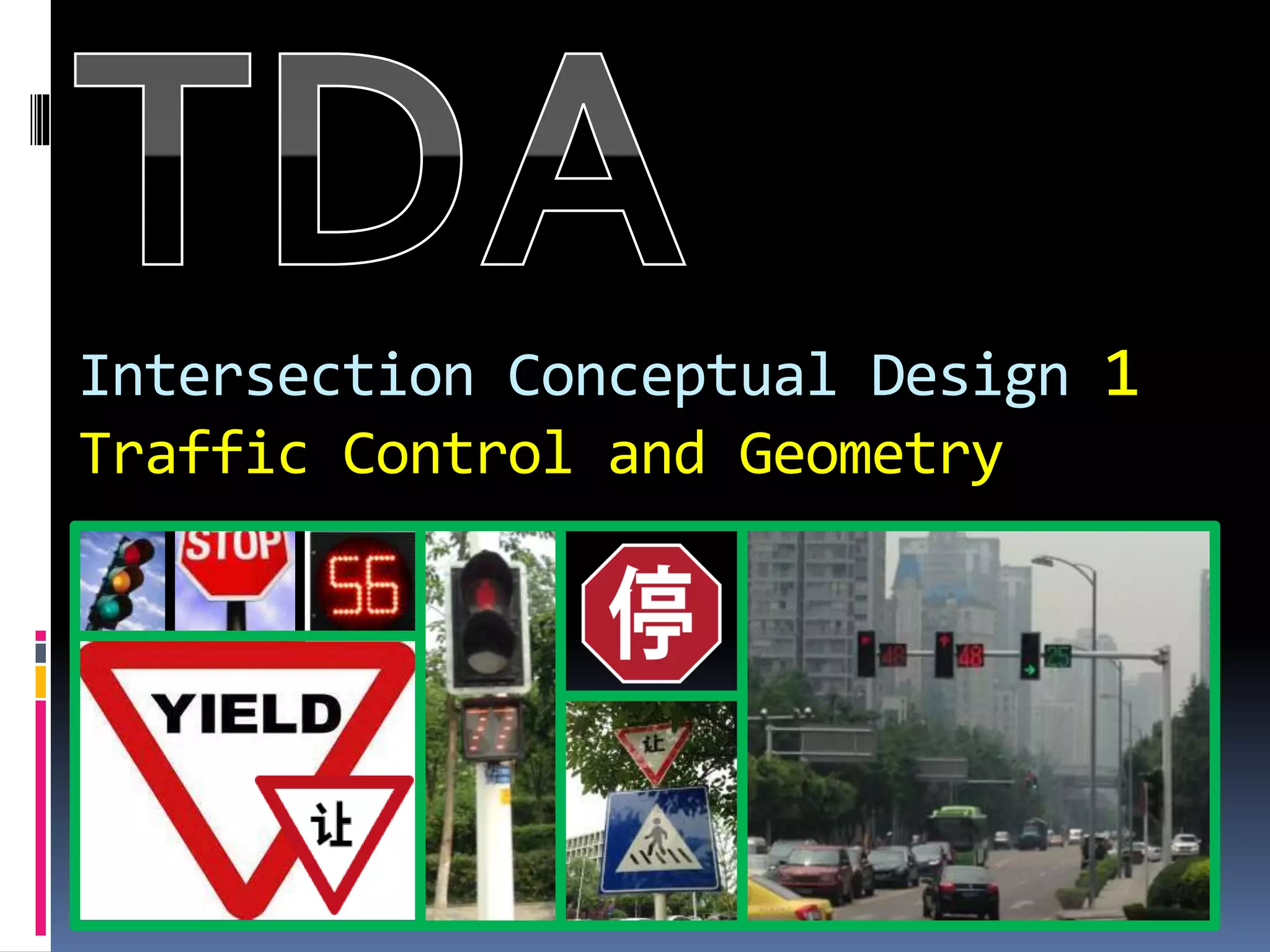
Intersection Conceptual Design 1
Traffic Control and Geometry
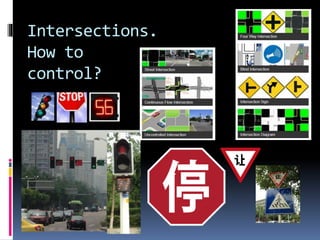
Intersections.
How to
control?
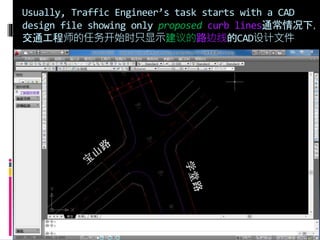
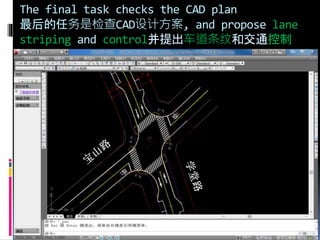
Usually, Traffic Engineer’s task starts with a CAD
design file showing only proposed curb lines通常情况下,
交通工程师的任务开始时只显示建议的路边线的CAD设计文件
The final task checks the CAD plan
最后的任务是检查CAD设计方案, and propose lane
striping and control并提出车道条纹和交通控制
WHY are Traffic Signals
Needed? 为什么需要交通信号?
 They are needed if the following less expensive options don’t
solve the traffic impact need.
 Without a traffic signal, an intersection is
没有交通信号,一个路口是:
1. Uncontrolled 不受控制的
2. Has aYield Sign Control on side street 支路有让行标志
3. Has a Stop Sign Control on side street 支路有停车让行标志
4. Has a Four-Way Stop Sign Control 四个方向停车让行标志
5. Has No LeftTurn or RightTurn Only Signs 有禁左或者只允许
右转标志
6. Has aTraffic Officer Control 需要有现场指挥人员
7. Has a Roundabout Control 有环岛控制
Advantage of Traffic Signal
交通信号的好处
 Orderly flow of traffic
 交通有序通行
 Safety forVehicles and Peds to Cross Road
 车辆和行人过街安全
 Cheaper than a traffic police officer
 比交通警察更便宜 节省力成本
 Reduces accidents (such as broadside accident)
 降低了事故(如擦挂事故)
 Traffic Speed Control
 交通速度控制
Disadvantage of Traffic Signal
交通信号的缺点 Why NOT to install…
 Major StreetTraffic Delay Increases
 干道交通延误增加
 Interrupt Major StreetTraffic Flow
 中断干道交通流
 Can Reduce Capacity of Major Street
 导致干道的通行能力减少
 Rear End Accidents Usually Increase
 追尾事故通常会增加
 False Sense of Security During Green Light
 绿灯时间的盲目安全感
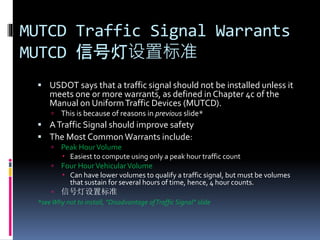
MUTCD Traffic Signal Warrants
MUTCD 信号灯设置标准
 USDOT says that a traffic signal should not be installed unless it
meets one or more warrants, as defined in Chapter 4c of the
Manual on UniformTraffic Devices (MUTCD).
 This is because of reasons in previous slide*
 ATraffic Signal should improve safety
 The Most Common Warrants include:
 Peak HourVolume
 Easiest to compute using only a peak hour traffic count
 Four HourVehicularVolume
 Can have lower volumes to qualify a traffic signal, but must be volumes
that sustain for several hours of time, hence, 4 hour counts.
 信号灯设置标准
*seeWhy not to install, “Disadvantage ofTraffic Signal” slide
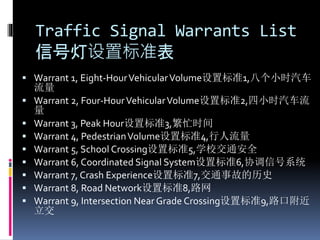
Traffic Signal Warrants List
信号灯设置标准表
 Warrant 1, Eight-HourVehicularVolume设置标准1,八个小时汽车
流量
 Warrant 2, Four-HourVehicularVolume设置标准2,四小时汽车流
量
 Warrant 3, Peak Hour设置标准3,繁忙时间
 Warrant 4, PedestrianVolume设置标准4,行人流量
 Warrant 5, School Crossing设置标准5,学校交通安全
 Warrant 6, Coordinated Signal System设置标准6,协调信号系统
 Warrant 7, Crash Experience设置标准7,交通事故的历史
 Warrant 8, Road Network设置标准8,路网
 Warrant 9, Intersection Near Grade Crossing设置标准9,路口附近
立交
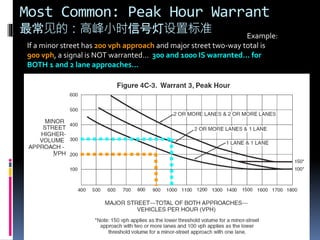
Most Common: Peak Hour Warrant
最常见的:高峰小时信号灯设置标准 Example:
If a minor street has 200 vph approach and major street two-way total is
900 vph, a signal is NOT warranted… 300 and 1000 IS warranted… for
BOTH 1 and 2 lane approaches…
if
Design Considerations for the
Intersection 交叉口的设计考虑
 What is the surrounding environment? 什么是周围的环境呢?
 Does the needed mitigation FIT the location?
是交通解决方案与环境兼容?
 Is it better to consider changing: 它更好地考虑改变?
1. The land use? 土地使用
2. The specific project concept? 项目的概念
3. The access road locations? 通路位置
 Is the resulting street system developed in Synchro compatible
with CAD plans and expectations?
 Careful! Its easy to recommend the biggest mitigation (i.e. a tunnel
or a bridge), but this may change the whole surrounding
environment to something that is not visually desirable. It also may
kill a project. Seek economical. Seek LOS D.
 Challenge: recommending improvements with minimum
environmental impacts, and have them also be pedestrian friendly.
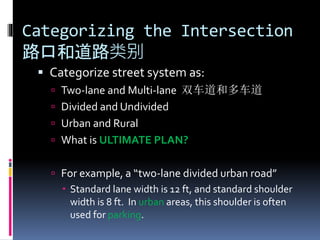
Categorizing the Intersection
路口和道路类别
 Categorize street system as:
 Two-lane and Multi-lane 双车道和多车道
 Divided and Undivided
 Urban and Rural
 What is ULTIMATE PLAN?
 For example, a “two-lane divided urban road”
 Standard lane width is 12 ft, and standard shoulder
width is 8 ft. In urban areas, this shoulder is often
used for parking.
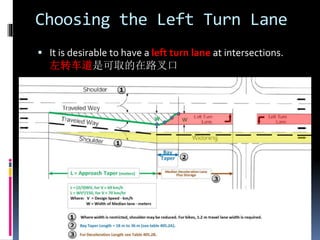
Choosing the Left Turn Lane
 It is desirable to have a left turn lane at intersections.
左转车道是可取的在路叉口
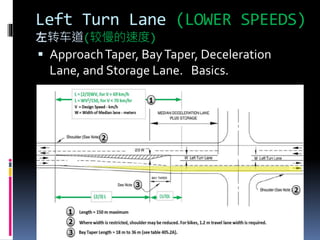
Left Turn Lane (LOWER SPEEDS)
左转车道(较慢的速度)
 ApproachTaper, BayTaper, Deceleration
Lane, and Storage Lane. Basics.
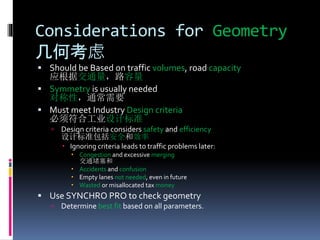
Considerations for Geometry
几何考虑
 Should be Based on traffic volumes, road capacity
应根据交通量,路容量
 Symmetry is usually needed
对称性,通常需要
 Must meet Industry Design criteria
必须符合工业设计标准
 Design criteria considers safety and efficiency
设计标准包括安全和效率
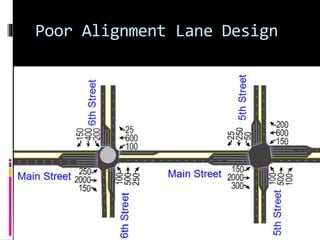
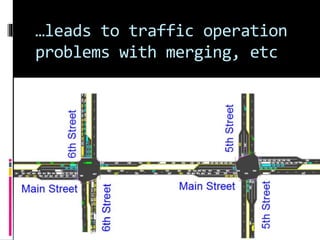
 Ignoring criteria leads to traffic problems later:
 Congestion and excessive merging
交通堵塞和
 Accidents and confusion
 Empty lanes not needed, even in future
 Wasted or misallocated tax money
 Use SYNCHRO PRO to check geometry
 Determine best fit based on all parameters.
Poor Alignment Lane Design
…leads to traffic operation
problems with merging, etc
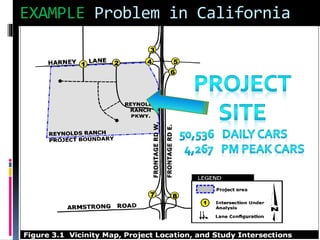
EXAMPLE Problem in California
Known CONSTRAINTS / QUESTIONS
1. Project is Large (over 4000 cars/hour)
2. Local Freeway Interchange is small
 Not scheduled to improve until many years later.
3. Can Project be built without negatively
impacting freeway traffic?
 Caltrans (government agency for state owned
roads) needs to be convinced this is OK.
4. City wants project, for taxes.
5. Caltrans (State Govt) is not sure if this is OK.
 Study proves whether it can work.
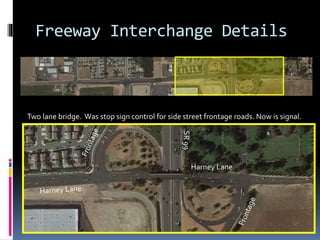
Freeway Interchange Details
Two lane bridge. Was stop sign control for side street frontage roads. Now is signal.
Harney Lane
SR99
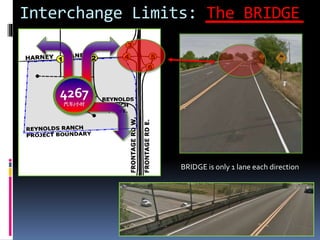
Interchange Limits: The BRIDGE
4267
汽车/小时
BRIDGE is only 1 lane each direction
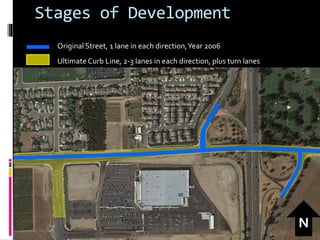
Stages of Development
Ultimate Curb Line, 2-3 lanes in each direction, plus turn lanes
Original Street, 1 lane in each direction,Year 2006
N
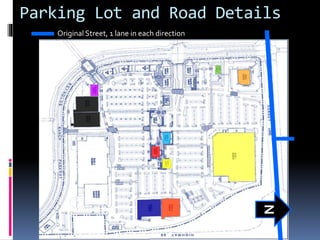
Parking Lot and Road Details
N
Original Street, 1 lane in each direction
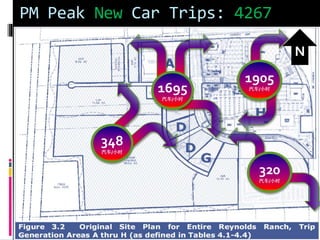
PM Peak New Car Trips: 4267
N
1695
汽车/小时
1905
汽车/小时
320
汽车/小时
348
汽车/小时
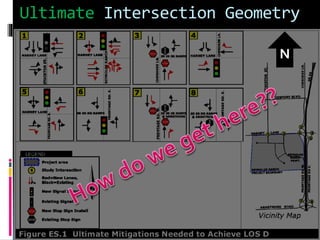
Ultimate Intersection Geometry
N
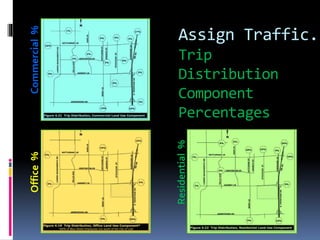
Assign Traffic.
Trip
Distribution
Component
Percentages
Office%Commercial%
Residential%
Create the Synchro Model
 Code basic roads into Synchro street system
1. Enter basic minimum intersection lanes at each
intersection.
2. Match the CAD file dimensions.
3. Enter the traffic volumes from ASSIGNMENT
4. Check Level of Service at each intersection
5. Where LOS E or worse conditions occur:
1. Propose a mitigation:
1. Add more lanes to heavy traffic movements, etc.
2. Signalize, etc.
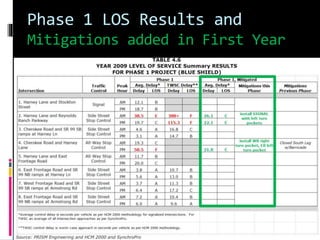
Phase 1 LOS Results and
Mitigations added in First Year
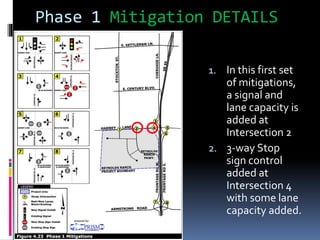
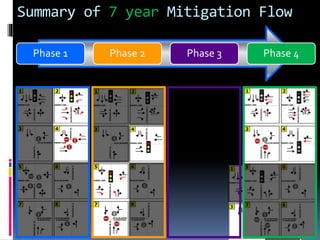
Phase 1 Mitigation DETAILS
1. In this first set
of mitigations,
a signal and
lane capacity is
added at
Intersection 2
2. 3-way Stop
sign control
added at
Intersection 4
with some lane
capacity added.
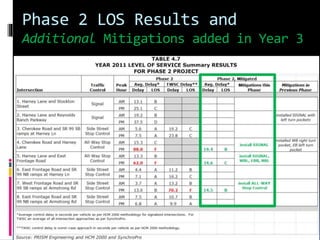
Phase 2 LOS Results and
Additional Mitigations added in Year 3
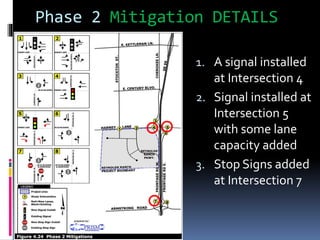
Phase 2 Mitigation DETAILS
1. A signal installed
at Intersection 4
2. Signal installed at
Intersection 5
with some lane
capacity added
3. Stop Signs added
at Intersection 7
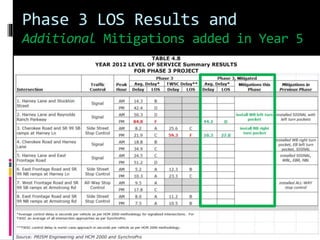
Phase 3 LOS Results and
Additional Mitigations added in Year 5
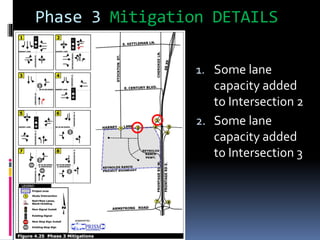
Phase 3 Mitigation DETAILS
1. Some lane
capacity added
to Intersection 2
2. Some lane
capacity added
to Intersection 3
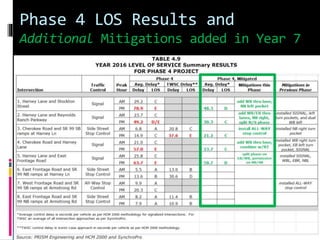
Phase 4 LOS Results and
Additional Mitigations added in Year 7
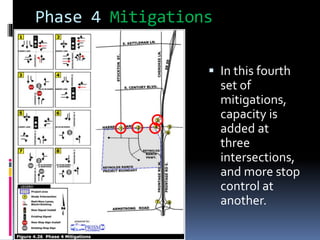
Phase 4 Mitigations
 In this fourth
set of
mitigations,
capacity is
added at
three
intersections,
and more stop
control at
another.
Summary of 7 year Mitigation Flow
Phase 1 Phase 2 Phase 3 Phase 4
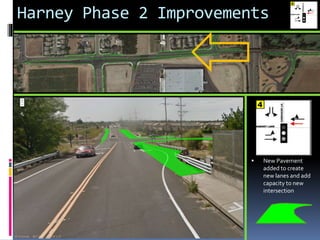
Harney Phase 2 Improvements
 New Pavement
added to create
new lanes and add
capacity to new
intersection
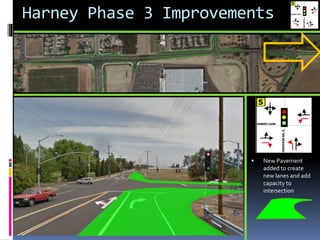
Harney Phase 3 Improvements
 New Pavement
added to create
new lanes and add
capacity to
intersection
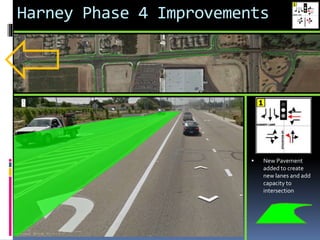
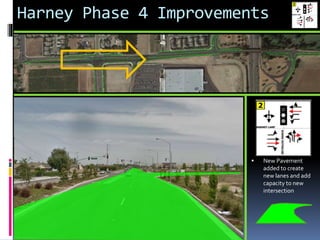
Harney Phase 4 Improvements
 New Pavement
added to create
new lanes and add
capacity to
intersection
Harney Phase 4 Improvements
 New Pavement
added to create
new lanes and add
capacity to new
intersection
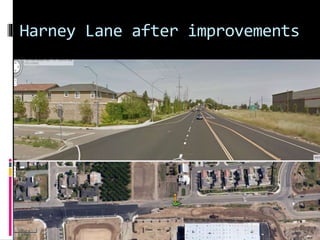
Harney Lane after improvements
Channelizing Design Principles
 Wrong-way movements prevented by
appropriate channelization
 Islands, medians, striping, proper alignment
 Clearly define vehicle paths
 Striping, curbs, edge lines
 Encourage SAFE speeds by design
 Separate points of conflict
 Traffic cross at right angles. Merge flat angles
 Facilitate high priority movements
Alignment Design Principles
 Goal: Roads meet at 90-degree angles
 Maximizes sight distance
 Minimize exposure times (accident potential)
 60-degree angle intersections are:
 Less safe. Operational challenged.
 Approach grades should be flat as practical
 Less than 3% grade for approach
 No more than 6% grade under any circumstance
Cross Section Design
 Turn Lanes at least 3.0 meters wide
 Same width asTHRU lanes, if possible.
 Curb Radius depends on “design vehicle”
 Use of turn templates
 Traffic Island
 Area between lanes. Controls movements.
 Separate conflicts
 Protect pedestrians
 Provide definition to drivers for channels

Intersection CONCEPTUAL DESIGN Methodology, by Grant Johnson PE PTOE

  • 1.
    Intersection Conceptual Design1 Traffic Control and Geometry
  • 2.
  • 3.
    Usually, Traffic Engineer’stask starts with a CAD design file showing only proposed curb lines通常情况下, 交通工程师的任务开始时只显示建议的路边线的CAD设计文件
  • 4.
    The final taskchecks the CAD plan 最后的任务是检查CAD设计方案, and propose lane striping and control并提出车道条纹和交通控制
  • 5.
    WHY are TrafficSignals Needed? 为什么需要交通信号?  They are needed if the following less expensive options don’t solve the traffic impact need.  Without a traffic signal, an intersection is 没有交通信号,一个路口是: 1. Uncontrolled 不受控制的 2. Has aYield Sign Control on side street 支路有让行标志 3. Has a Stop Sign Control on side street 支路有停车让行标志 4. Has a Four-Way Stop Sign Control 四个方向停车让行标志 5. Has No LeftTurn or RightTurn Only Signs 有禁左或者只允许 右转标志 6. Has aTraffic Officer Control 需要有现场指挥人员 7. Has a Roundabout Control 有环岛控制
  • 6.
    Advantage of TrafficSignal 交通信号的好处  Orderly flow of traffic  交通有序通行  Safety forVehicles and Peds to Cross Road  车辆和行人过街安全  Cheaper than a traffic police officer  比交通警察更便宜 节省力成本  Reduces accidents (such as broadside accident)  降低了事故(如擦挂事故)  Traffic Speed Control  交通速度控制
  • 7.
    Disadvantage of TrafficSignal 交通信号的缺点 Why NOT to install…  Major StreetTraffic Delay Increases  干道交通延误增加  Interrupt Major StreetTraffic Flow  中断干道交通流  Can Reduce Capacity of Major Street  导致干道的通行能力减少  Rear End Accidents Usually Increase  追尾事故通常会增加  False Sense of Security During Green Light  绿灯时间的盲目安全感
  • 8.
    MUTCD Traffic SignalWarrants MUTCD 信号灯设置标准  USDOT says that a traffic signal should not be installed unless it meets one or more warrants, as defined in Chapter 4c of the Manual on UniformTraffic Devices (MUTCD).  This is because of reasons in previous slide*  ATraffic Signal should improve safety  The Most Common Warrants include:  Peak HourVolume  Easiest to compute using only a peak hour traffic count  Four HourVehicularVolume  Can have lower volumes to qualify a traffic signal, but must be volumes that sustain for several hours of time, hence, 4 hour counts.  信号灯设置标准 *seeWhy not to install, “Disadvantage ofTraffic Signal” slide
  • 9.
    Traffic Signal WarrantsList 信号灯设置标准表  Warrant 1, Eight-HourVehicularVolume设置标准1,八个小时汽车 流量  Warrant 2, Four-HourVehicularVolume设置标准2,四小时汽车流 量  Warrant 3, Peak Hour设置标准3,繁忙时间  Warrant 4, PedestrianVolume设置标准4,行人流量  Warrant 5, School Crossing设置标准5,学校交通安全  Warrant 6, Coordinated Signal System设置标准6,协调信号系统  Warrant 7, Crash Experience设置标准7,交通事故的历史  Warrant 8, Road Network设置标准8,路网  Warrant 9, Intersection Near Grade Crossing设置标准9,路口附近 立交
  • 10.
    Most Common: PeakHour Warrant 最常见的:高峰小时信号灯设置标准 Example: If a minor street has 200 vph approach and major street two-way total is 900 vph, a signal is NOT warranted… 300 and 1000 IS warranted… for BOTH 1 and 2 lane approaches… if
  • 11.
    Design Considerations forthe Intersection 交叉口的设计考虑  What is the surrounding environment? 什么是周围的环境呢?  Does the needed mitigation FIT the location? 是交通解决方案与环境兼容?  Is it better to consider changing: 它更好地考虑改变? 1. The land use? 土地使用 2. The specific project concept? 项目的概念 3. The access road locations? 通路位置  Is the resulting street system developed in Synchro compatible with CAD plans and expectations?  Careful! Its easy to recommend the biggest mitigation (i.e. a tunnel or a bridge), but this may change the whole surrounding environment to something that is not visually desirable. It also may kill a project. Seek economical. Seek LOS D.  Challenge: recommending improvements with minimum environmental impacts, and have them also be pedestrian friendly.
  • 12.
    Categorizing the Intersection 路口和道路类别 Categorize street system as:  Two-lane and Multi-lane 双车道和多车道  Divided and Undivided  Urban and Rural  What is ULTIMATE PLAN?  For example, a “two-lane divided urban road”  Standard lane width is 12 ft, and standard shoulder width is 8 ft. In urban areas, this shoulder is often used for parking.
  • 13.
    Choosing the LeftTurn Lane  It is desirable to have a left turn lane at intersections. 左转车道是可取的在路叉口
  • 14.
    Left Turn Lane(LOWER SPEEDS) 左转车道(较慢的速度)  ApproachTaper, BayTaper, Deceleration Lane, and Storage Lane. Basics.
  • 15.
    Considerations for Geometry 几何考虑 Should be Based on traffic volumes, road capacity 应根据交通量,路容量  Symmetry is usually needed 对称性,通常需要  Must meet Industry Design criteria 必须符合工业设计标准  Design criteria considers safety and efficiency 设计标准包括安全和效率  Ignoring criteria leads to traffic problems later:  Congestion and excessive merging 交通堵塞和  Accidents and confusion  Empty lanes not needed, even in future  Wasted or misallocated tax money  Use SYNCHRO PRO to check geometry  Determine best fit based on all parameters.
  • 16.
  • 17.
    …leads to trafficoperation problems with merging, etc
  • 18.
  • 19.
    Known CONSTRAINTS /QUESTIONS 1. Project is Large (over 4000 cars/hour) 2. Local Freeway Interchange is small  Not scheduled to improve until many years later. 3. Can Project be built without negatively impacting freeway traffic?  Caltrans (government agency for state owned roads) needs to be convinced this is OK. 4. City wants project, for taxes. 5. Caltrans (State Govt) is not sure if this is OK.  Study proves whether it can work.
  • 20.
    Freeway Interchange Details Twolane bridge. Was stop sign control for side street frontage roads. Now is signal. Harney Lane SR99
  • 21.
    Interchange Limits: TheBRIDGE 4267 汽车/小时 BRIDGE is only 1 lane each direction
  • 22.
    Stages of Development UltimateCurb Line, 2-3 lanes in each direction, plus turn lanes Original Street, 1 lane in each direction,Year 2006 N
  • 23.
    Parking Lot andRoad Details N Original Street, 1 lane in each direction
  • 24.
    PM Peak NewCar Trips: 4267 N 1695 汽车/小时 1905 汽车/小时 320 汽车/小时 348 汽车/小时
  • 25.
  • 26.
  • 27.
    Create the SynchroModel  Code basic roads into Synchro street system 1. Enter basic minimum intersection lanes at each intersection. 2. Match the CAD file dimensions. 3. Enter the traffic volumes from ASSIGNMENT 4. Check Level of Service at each intersection 5. Where LOS E or worse conditions occur: 1. Propose a mitigation: 1. Add more lanes to heavy traffic movements, etc. 2. Signalize, etc.
  • 28.
    Phase 1 LOSResults and Mitigations added in First Year
  • 29.
    Phase 1 MitigationDETAILS 1. In this first set of mitigations, a signal and lane capacity is added at Intersection 2 2. 3-way Stop sign control added at Intersection 4 with some lane capacity added.
  • 30.
    Phase 2 LOSResults and Additional Mitigations added in Year 3
  • 31.
    Phase 2 MitigationDETAILS 1. A signal installed at Intersection 4 2. Signal installed at Intersection 5 with some lane capacity added 3. Stop Signs added at Intersection 7
  • 32.
    Phase 3 LOSResults and Additional Mitigations added in Year 5
  • 33.
    Phase 3 MitigationDETAILS 1. Some lane capacity added to Intersection 2 2. Some lane capacity added to Intersection 3
  • 34.
    Phase 4 LOSResults and Additional Mitigations added in Year 7
  • 35.
    Phase 4 Mitigations In this fourth set of mitigations, capacity is added at three intersections, and more stop control at another.
  • 36.
    Summary of 7year Mitigation Flow Phase 1 Phase 2 Phase 3 Phase 4
  • 37.
    Harney Phase 2Improvements  New Pavement added to create new lanes and add capacity to new intersection
  • 38.
    Harney Phase 3Improvements  New Pavement added to create new lanes and add capacity to intersection
  • 39.
    Harney Phase 4Improvements  New Pavement added to create new lanes and add capacity to intersection
  • 40.
    Harney Phase 4Improvements  New Pavement added to create new lanes and add capacity to new intersection
  • 41.
    Harney Lane afterimprovements
  • 42.
    Channelizing Design Principles Wrong-way movements prevented by appropriate channelization  Islands, medians, striping, proper alignment  Clearly define vehicle paths  Striping, curbs, edge lines  Encourage SAFE speeds by design  Separate points of conflict  Traffic cross at right angles. Merge flat angles  Facilitate high priority movements
  • 43.
    Alignment Design Principles Goal: Roads meet at 90-degree angles  Maximizes sight distance  Minimize exposure times (accident potential)  60-degree angle intersections are:  Less safe. Operational challenged.  Approach grades should be flat as practical  Less than 3% grade for approach  No more than 6% grade under any circumstance
  • 44.
    Cross Section Design Turn Lanes at least 3.0 meters wide  Same width asTHRU lanes, if possible.  Curb Radius depends on “design vehicle”  Use of turn templates  Traffic Island  Area between lanes. Controls movements.  Separate conflicts  Protect pedestrians  Provide definition to drivers for channels

Editor's Notes

  • #2 Origin Destination Surveys OD调查 diào chá investigation; inquiry; to investigate; to survey; survey; (opinion) poll; CL:項|项[xiang4],個|个[ge4] HSK4
  • #27 The project was divided into three different components so that the various land use categories could have traffic assigned logically to differing areas of the city. Residential primarily to north and south, commercial primarily to the north, and office primarily to the south.