Interoperable Provisioning in a Distributed World
Mark Diodati, Burton Group
Ramesh Nagappan, Sun Microsystems
Sampo Kellomaki, SymLabs
02/08/07 – IAM 302
Contacts
• Mark Diodati (mdiodati@burtongroup.com)
• Ramesh Nagappan (Ramesh.Nagappan@Sun.COM)
• Sampo Kellomaki (sampo@symlabs.com)
References
• OASIS PSTC SPML 2.0 Specifications
— http://docs.oasis-open.org/provision/spml-2.0-cd-01/pstc-spml2-cd-01.pdf
• OpenSPML 1.0 Toolkit
— www.openspml.org
• JAX-WS 2.0 Reference Implementation
— https://jax-ws.dev.java.net/
• Identity provisioning with SPML – Patterns and Best practices.
— www.coresecuritypatterns.com
• Sun Java System Identity Manager (Supports SPML 2.0)
— Download at http://www.sun.com/download/products.xml?id=453fe041
• SPML: Gaining Maturity (Burton Group research document)
— www.burtongroup.com/spml
Agenda
• Presentation – Mark Diodati
• Presentation – Ramesh Nagappan
• Presentation – Sampo Kellomaki
• References
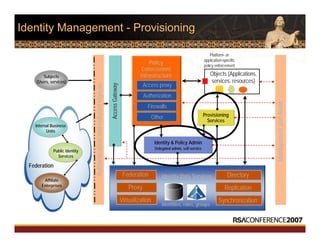
Identity Management - Provisioning
Identity Data Services
Identities, roles, groups
Provisioning
Services
AccessGateway
Policy
Enforcement
Infrastructure
Identity & Policy Admin
Delegated admin, self-service
Federation
Public Identity
Services
Affiliate
Enterprises
Subjects
(Users, services)
Internal Business
Units
Platform- or
application-specific
policy enforcement
Federation
Proxy
Virtualization
Directory
Replication
Synchronization
Objects (Applications,
services, resources)
ManagementandAudit
Authenticationandreducedsign-on
Access proxy
Authorization
Firewalls
Other
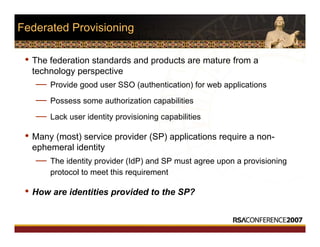
Federated Provisioning
• The federation standards and products are mature from a
technology perspective
— Provide good user SSO (authentication) for web applications
— Possess some authorization capabilities
— Lack user identity provisioning capabilities
• Many (most) service provider (SP) applications require a non-
ephemeral identity
— The identity provider (IdP) and SP must agree upon a provisioning
protocol to meet this requirement
• How are identities provided to the SP?
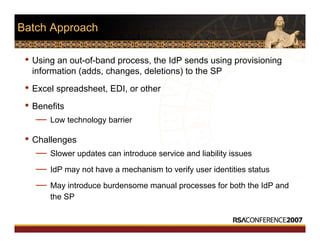
Batch Approach
• Using an out-of-band process, the IdP sends using provisioning
information (adds, changes, deletions) to the SP
• Excel spreadsheet, EDI, or other
• Benefits
— Low technology barrier
• Challenges
— Slower updates can introduce service and liability issues
— IdP may not have a mechanism to verify user identities status
— May introduce burdensome manual processes for both the IdP and
the SP
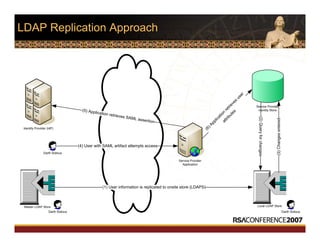
LDAP Replication Approach
Service Provider
Identity Store
Local LDAP StoreMaster LDAP Store
(1) User information is replicated to onsite store (LDAPS)
Darth Sidious
Darth Sidious
Service Provider
Application
(4) User with SAML artifact attempts access
Darth Sidious
(6) Application
retrieves
user
attributes
Identity Provider (IdP)
(5) Application retrieves SAML assertion
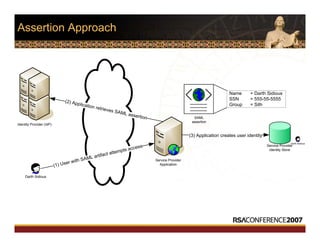
Assertion Approach
Identity Provider (IdP)
Service Provider
Identity Store
Darth Sidious
Service Provider
Application(1) User with SAML artifact attempts access
(2) Application retrieves SAML assertion
(3) Application creates user identity
SAML
assertion
Name = Darth Sidious
SSN = 555-55-5555
Group = Sith
Darth Sidious
Services Provisioning Markup Language (SPML)
• SPML v1 approved in 2003
— Some “Essential” operations were not included (had to be customized)
— Some errors in XML schema
• SPML v2 OASIS standard approved in spring of 2006
— “Essential” functions included
• Three profiles
— DSML (most commonly used and existed in v1)
— XSD (new in v2, from WS-Provisioning proposal)
— SAML (currently in development) to provide tighter integration of user attributes
• Good provisioning vendor support
— Widely adopted by the provisioning vendors (Sun, CA, BMC, HP, Oracle, Siemens)
• Improving target vendor support
— Citrix, SAP, MaxWare
SPML
• Benefits
— Interoperable provisioning (no custom connectors required)
— Reliability
— Some auditing and correlation
• Challenges
— Requires a separate channel for federated provisioning
— User schema will likely require pre-agreement
— Does not provide protocol security (by intent)
• Authentication and confidentiality - use HTTPS and/or WS-Security
2004
• Authorization – may be achieved via certificate trust list or may require
more advanced authorization features in the future
Provisioning tools can provide authorization capabilities
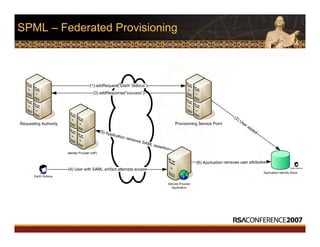
SPML – Federated Provisioning
(2) User added
Agenda
• Presentation – Mark Diodati
• Presentation – Ramesh Nagappan
• Presentation – Sampo Kellomaki
• References
The State of SPML 2.0
• SPML 2.0 has been ratified as an OASIS standard.
• Builds on the concepts of SPML 1.0 specifications.
— Maintains the core protocol, basic roles, operations, data types and elements.
— Core protocol enables interoperability among Provisioning service providers.
• Defines modal mechanisms for executing provisioning synchronously or
asynchronously.
• Defines the notion of SPML Profiles.
— Profiles define the agreement protocol between requestor and service provider.
— SPML v2 XSD Profile and DSML v2 Profile
• DSML v2 profile provides the backward compatibility with SPML 1.0 and to support LDAP
and X.500 directory services
— SPML v2 SAML 2.0 Profile is on its way !
• SPML 2.0 supports extended operations as “Capabilities”.
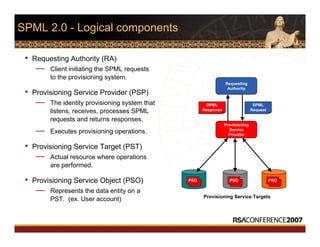
SPML 2.0 - Logical components
• Requesting Authority (RA)
— Client initiating the SPML requests
to the provisioning system.
• Provisioning Service Provider (PSP)
— The identity provisioning system that
listens, receives, processes SPML
requests and returns responses.
— Executes provisioning operations.
• Provisioning Service Target (PST)
— Actual resource where operations
are performed.
• Provisioning Service Object (PSO)
— Represents the data entity on a
PST. (ex. User account)
Requesting
Authority
Provisioning
Service
Provider
SPML
Response
SPML
Request
PSOPSO PSO
Provisioning Service Targets
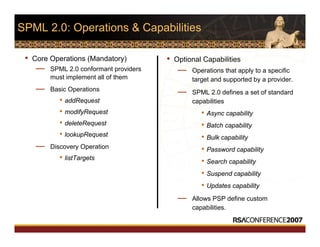
SPML 2.0: Operations & Capabilities
• Core Operations (Mandatory)
— SPML 2.0 conformant providers
must implement all of them
— Basic Operations
• addRequest
• modifyRequest
• deleteRequest
• lookupRequest
— Discovery Operation
• listTargets
• Optional Capabilities
— Operations that apply to a specific
target and supported by a provider.
— SPML 2.0 defines a set of standard
capabilities
• Async capability
• Batch capability
• Bulk capability
• Password capability
• Search capability
• Suspend capability
• Updates capability
— Allows PSP define custom
capabilities.
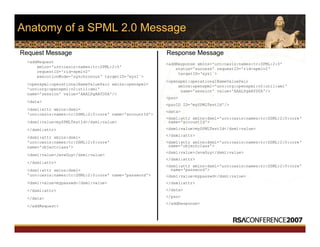
Anatomy of a SPML 2.0 Message
Request Message Response Message
</addRequest>
</data>
</dsml:attr>
<dsml:value>mypasswd</dsml:value>
<dsml:attr xmlns:dsml=
'urn:oasis:names:tc:DSML:2:0:core' name=‘password'>
</dsml:attr>
<dsml:value>JavaGuy</dsml:value>
<dsml:attr xmlns:dsml=
'urn:oasis:names:tc:DSML:2:0:core'
name='objectclass'>
</dsml:attr>
<dsml:value>mySPMLTestId</dsml:value>
<dsml:attr xmlns:dsml=
'urn:oasis:names:tc:DSML:2:0:core' name='accountId'>
<data>
<openspml:operationalNameValuePair xmlns:openspml=
'urn:org:openspml:v2:util:xml'
name='session' value='AAALPgAAYD0A'/>
<addRequest
xmlns='urn:oasis:names:tc:SPML:2:0'
requestID='rid-spmlv2'
executionMode='synchronous‘ targetID=‘xyz1`>
</addResponse>
</pso>
</data>
</dsml:attr>
<dsml:value>mypasswd</dsml:value>
<dsml:attr xmlns:dsml='urn:oasis:names:tc:DSML:2:0:core'
name=‘password'>
</dsml:attr>
<dsml:value>JavaGuy</dsml:value>
<dsml:attr xmlns:dsml='urn:oasis:names:tc:DSML:2:0:core‘
name='objectclass'>
</dsml:attr>
<dsml:value>mySPMLTestId</dsml:value>
<dsml:attr xmlns:dsml='urn:oasis:names:tc:DSML:2:0:core‘
name='accountId'>
<data>
<psoID ID=‘mySPMLTestId'/>
<pso>
<openspml:operationalNameValuePair
xmlns:openspml='urn:org:openspml:v2:util:xml'
name='session' value='AAALPgAAYD0A'/>
<addResponse xmlns='urn:oasis:names:tc:SPML:2:0'
status='success' requestID='rid-spmlv2‘
targetID=‘xyz1`>
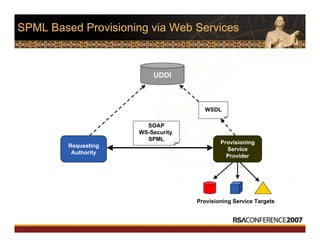
SPML Based Provisioning via Web Services
Requesting
Authority
Provisioning
Service
Provider
WSDL
Provisioning Service Targets
SOAP
WS-Security
SPML
UDDI
SPML Relationship with WS-Security and SAML
• SPML recommends the use of SSL/TLS protocols and WS-Security for ensuring
Transport-layer and Message-layer security.
— SPML can take advantage of SOAP/HTTPS transport provisioning requests and
responses.
— XML Encryption and XML Digital Signature allows to ensure SPML message/element-
level confidentiality and integrity.
— WS-Security tokens (X.509, SAML Token) to authenticate provisioning service
providers.
• SPML supports the principles of using SAML 2.0 and Project Liberty Alliance
standards.
— SPML requests and responses can make use of SAML assertions as a authentication
context between the requesting authority and provisioning systems.
— SAML assertions from an Identity provider can be used to qualify a subject on a
provisioning target.
Role of SPML in Identity Federation (Liberty ID-FF)
IdentityIdentity
ProviderProvider
Service ProvidersService Providers
(Out(Out--sourced)sourced)
IDID--FF: Circle of TrustFF: Circle of Trust
ServiceService
ProviderProvider
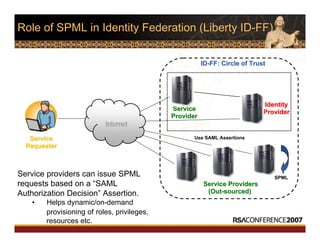
Service providers can issue SPML
requests based on a “SAML
Authorization Decision” Assertion.
• Helps dynamic/on-demand
provisioning of roles, privileges,
resources etc.
ServiceService
RequesterRequester
InternetInternet
SPML
Use SAML Assertions
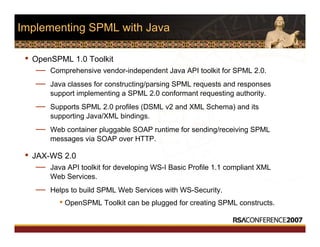
Implementing SPML with Java
• OpenSPML 1.0 Toolkit
— Comprehensive vendor-independent Java API toolkit for SPML 2.0.
— Java classes for constructing/parsing SPML requests and responses
support implementing a SPML 2.0 conformant requesting authority.
— Supports SPML 2.0 profiles (DSML v2 and XML Schema) and its
supporting Java/XML bindings.
— Web container pluggable SOAP runtime for sending/receiving SPML
messages via SOAP over HTTP.
• JAX-WS 2.0
— Java API toolkit for developing WS-I Basic Profile 1.1 compliant XML
Web Services.
— Helps to build SPML Web Services with WS-Security.
• OpenSPML Toolkit can be plugged for creating SPML constructs.
Agenda
• Presentation – Mark Diodati
• Presentation – Ramesh Nagappan
• Presentation – Sampo Kellomaki
• References
Liberty Provisioning Initiatives
• For avoidance of doubt
— Trusted Module provisioning (liberty-idwsf-prov-v1.0-02.pdf)
— Very specific target: Advanced Clients and Trusted Modules
•Not applicable in this domain
— General provisioning
•Some marketing requirement floated
•No specific approach chosen
•SPML, enhanced with ID-WSF, could be an option
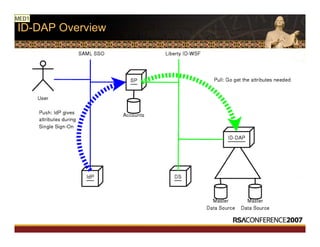
ID-DAP Overview
MED1
Slide 24
MED1 If this is not a specification or a standard, we cannot discuss in detail, since it breaks interoperability.
Mark Diodati, 1/26/2007
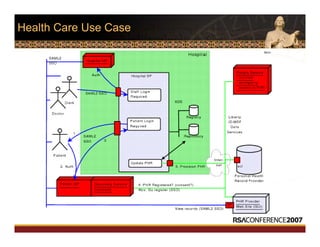
Health Care Use Case
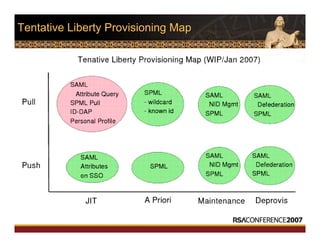
Tentative Liberty Provisioning Map
Panel Discussion

Interoperable Provisioning in a distributed world

  • 1.
    Interoperable Provisioning ina Distributed World Mark Diodati, Burton Group Ramesh Nagappan, Sun Microsystems Sampo Kellomaki, SymLabs 02/08/07 – IAM 302
  • 2.
    Contacts • Mark Diodati(mdiodati@burtongroup.com) • Ramesh Nagappan (Ramesh.Nagappan@Sun.COM) • Sampo Kellomaki (sampo@symlabs.com)
  • 3.
    References • OASIS PSTCSPML 2.0 Specifications — http://docs.oasis-open.org/provision/spml-2.0-cd-01/pstc-spml2-cd-01.pdf • OpenSPML 1.0 Toolkit — www.openspml.org • JAX-WS 2.0 Reference Implementation — https://jax-ws.dev.java.net/ • Identity provisioning with SPML – Patterns and Best practices. — www.coresecuritypatterns.com • Sun Java System Identity Manager (Supports SPML 2.0) — Download at http://www.sun.com/download/products.xml?id=453fe041 • SPML: Gaining Maturity (Burton Group research document) — www.burtongroup.com/spml
  • 4.
    Agenda • Presentation –Mark Diodati • Presentation – Ramesh Nagappan • Presentation – Sampo Kellomaki • References
  • 5.
    Identity Management -Provisioning Identity Data Services Identities, roles, groups Provisioning Services AccessGateway Policy Enforcement Infrastructure Identity & Policy Admin Delegated admin, self-service Federation Public Identity Services Affiliate Enterprises Subjects (Users, services) Internal Business Units Platform- or application-specific policy enforcement Federation Proxy Virtualization Directory Replication Synchronization Objects (Applications, services, resources) ManagementandAudit Authenticationandreducedsign-on Access proxy Authorization Firewalls Other
  • 6.
    Federated Provisioning • Thefederation standards and products are mature from a technology perspective — Provide good user SSO (authentication) for web applications — Possess some authorization capabilities — Lack user identity provisioning capabilities • Many (most) service provider (SP) applications require a non- ephemeral identity — The identity provider (IdP) and SP must agree upon a provisioning protocol to meet this requirement • How are identities provided to the SP?
  • 7.
    Batch Approach • Usingan out-of-band process, the IdP sends using provisioning information (adds, changes, deletions) to the SP • Excel spreadsheet, EDI, or other • Benefits — Low technology barrier • Challenges — Slower updates can introduce service and liability issues — IdP may not have a mechanism to verify user identities status — May introduce burdensome manual processes for both the IdP and the SP
  • 8.
    LDAP Replication Approach ServiceProvider Identity Store Local LDAP StoreMaster LDAP Store (1) User information is replicated to onsite store (LDAPS) Darth Sidious Darth Sidious Service Provider Application (4) User with SAML artifact attempts access Darth Sidious (6) Application retrieves user attributes Identity Provider (IdP) (5) Application retrieves SAML assertion
  • 9.
    Assertion Approach Identity Provider(IdP) Service Provider Identity Store Darth Sidious Service Provider Application(1) User with SAML artifact attempts access (2) Application retrieves SAML assertion (3) Application creates user identity SAML assertion Name = Darth Sidious SSN = 555-55-5555 Group = Sith Darth Sidious
  • 10.
    Services Provisioning MarkupLanguage (SPML) • SPML v1 approved in 2003 — Some “Essential” operations were not included (had to be customized) — Some errors in XML schema • SPML v2 OASIS standard approved in spring of 2006 — “Essential” functions included • Three profiles — DSML (most commonly used and existed in v1) — XSD (new in v2, from WS-Provisioning proposal) — SAML (currently in development) to provide tighter integration of user attributes • Good provisioning vendor support — Widely adopted by the provisioning vendors (Sun, CA, BMC, HP, Oracle, Siemens) • Improving target vendor support — Citrix, SAP, MaxWare
  • 11.
    SPML • Benefits — Interoperableprovisioning (no custom connectors required) — Reliability — Some auditing and correlation • Challenges — Requires a separate channel for federated provisioning — User schema will likely require pre-agreement — Does not provide protocol security (by intent) • Authentication and confidentiality - use HTTPS and/or WS-Security 2004 • Authorization – may be achieved via certificate trust list or may require more advanced authorization features in the future Provisioning tools can provide authorization capabilities
  • 12.
    SPML – FederatedProvisioning (2) User added
  • 13.
    Agenda • Presentation –Mark Diodati • Presentation – Ramesh Nagappan • Presentation – Sampo Kellomaki • References
  • 14.
    The State ofSPML 2.0 • SPML 2.0 has been ratified as an OASIS standard. • Builds on the concepts of SPML 1.0 specifications. — Maintains the core protocol, basic roles, operations, data types and elements. — Core protocol enables interoperability among Provisioning service providers. • Defines modal mechanisms for executing provisioning synchronously or asynchronously. • Defines the notion of SPML Profiles. — Profiles define the agreement protocol between requestor and service provider. — SPML v2 XSD Profile and DSML v2 Profile • DSML v2 profile provides the backward compatibility with SPML 1.0 and to support LDAP and X.500 directory services — SPML v2 SAML 2.0 Profile is on its way ! • SPML 2.0 supports extended operations as “Capabilities”.
  • 15.
    SPML 2.0 -Logical components • Requesting Authority (RA) — Client initiating the SPML requests to the provisioning system. • Provisioning Service Provider (PSP) — The identity provisioning system that listens, receives, processes SPML requests and returns responses. — Executes provisioning operations. • Provisioning Service Target (PST) — Actual resource where operations are performed. • Provisioning Service Object (PSO) — Represents the data entity on a PST. (ex. User account) Requesting Authority Provisioning Service Provider SPML Response SPML Request PSOPSO PSO Provisioning Service Targets
  • 16.
    SPML 2.0: Operations& Capabilities • Core Operations (Mandatory) — SPML 2.0 conformant providers must implement all of them — Basic Operations • addRequest • modifyRequest • deleteRequest • lookupRequest — Discovery Operation • listTargets • Optional Capabilities — Operations that apply to a specific target and supported by a provider. — SPML 2.0 defines a set of standard capabilities • Async capability • Batch capability • Bulk capability • Password capability • Search capability • Suspend capability • Updates capability — Allows PSP define custom capabilities.
  • 17.
    Anatomy of aSPML 2.0 Message Request Message Response Message </addRequest> </data> </dsml:attr> <dsml:value>mypasswd</dsml:value> <dsml:attr xmlns:dsml= 'urn:oasis:names:tc:DSML:2:0:core' name=‘password'> </dsml:attr> <dsml:value>JavaGuy</dsml:value> <dsml:attr xmlns:dsml= 'urn:oasis:names:tc:DSML:2:0:core' name='objectclass'> </dsml:attr> <dsml:value>mySPMLTestId</dsml:value> <dsml:attr xmlns:dsml= 'urn:oasis:names:tc:DSML:2:0:core' name='accountId'> <data> <openspml:operationalNameValuePair xmlns:openspml= 'urn:org:openspml:v2:util:xml' name='session' value='AAALPgAAYD0A'/> <addRequest xmlns='urn:oasis:names:tc:SPML:2:0' requestID='rid-spmlv2' executionMode='synchronous‘ targetID=‘xyz1`> </addResponse> </pso> </data> </dsml:attr> <dsml:value>mypasswd</dsml:value> <dsml:attr xmlns:dsml='urn:oasis:names:tc:DSML:2:0:core' name=‘password'> </dsml:attr> <dsml:value>JavaGuy</dsml:value> <dsml:attr xmlns:dsml='urn:oasis:names:tc:DSML:2:0:core‘ name='objectclass'> </dsml:attr> <dsml:value>mySPMLTestId</dsml:value> <dsml:attr xmlns:dsml='urn:oasis:names:tc:DSML:2:0:core‘ name='accountId'> <data> <psoID ID=‘mySPMLTestId'/> <pso> <openspml:operationalNameValuePair xmlns:openspml='urn:org:openspml:v2:util:xml' name='session' value='AAALPgAAYD0A'/> <addResponse xmlns='urn:oasis:names:tc:SPML:2:0' status='success' requestID='rid-spmlv2‘ targetID=‘xyz1`>
  • 18.
    SPML Based Provisioningvia Web Services Requesting Authority Provisioning Service Provider WSDL Provisioning Service Targets SOAP WS-Security SPML UDDI
  • 19.
    SPML Relationship withWS-Security and SAML • SPML recommends the use of SSL/TLS protocols and WS-Security for ensuring Transport-layer and Message-layer security. — SPML can take advantage of SOAP/HTTPS transport provisioning requests and responses. — XML Encryption and XML Digital Signature allows to ensure SPML message/element- level confidentiality and integrity. — WS-Security tokens (X.509, SAML Token) to authenticate provisioning service providers. • SPML supports the principles of using SAML 2.0 and Project Liberty Alliance standards. — SPML requests and responses can make use of SAML assertions as a authentication context between the requesting authority and provisioning systems. — SAML assertions from an Identity provider can be used to qualify a subject on a provisioning target.
  • 20.
    Role of SPMLin Identity Federation (Liberty ID-FF) IdentityIdentity ProviderProvider Service ProvidersService Providers (Out(Out--sourced)sourced) IDID--FF: Circle of TrustFF: Circle of Trust ServiceService ProviderProvider Service providers can issue SPML requests based on a “SAML Authorization Decision” Assertion. • Helps dynamic/on-demand provisioning of roles, privileges, resources etc. ServiceService RequesterRequester InternetInternet SPML Use SAML Assertions
  • 21.
    Implementing SPML withJava • OpenSPML 1.0 Toolkit — Comprehensive vendor-independent Java API toolkit for SPML 2.0. — Java classes for constructing/parsing SPML requests and responses support implementing a SPML 2.0 conformant requesting authority. — Supports SPML 2.0 profiles (DSML v2 and XML Schema) and its supporting Java/XML bindings. — Web container pluggable SOAP runtime for sending/receiving SPML messages via SOAP over HTTP. • JAX-WS 2.0 — Java API toolkit for developing WS-I Basic Profile 1.1 compliant XML Web Services. — Helps to build SPML Web Services with WS-Security. • OpenSPML Toolkit can be plugged for creating SPML constructs.
  • 22.
    Agenda • Presentation –Mark Diodati • Presentation – Ramesh Nagappan • Presentation – Sampo Kellomaki • References
  • 23.
    Liberty Provisioning Initiatives •For avoidance of doubt — Trusted Module provisioning (liberty-idwsf-prov-v1.0-02.pdf) — Very specific target: Advanced Clients and Trusted Modules •Not applicable in this domain — General provisioning •Some marketing requirement floated •No specific approach chosen •SPML, enhanced with ID-WSF, could be an option
  • 24.
  • 25.
    Slide 24 MED1 Ifthis is not a specification or a standard, we cannot discuss in detail, since it breaks interoperability. Mark Diodati, 1/26/2007
  • 26.
  • 27.
  • 28.