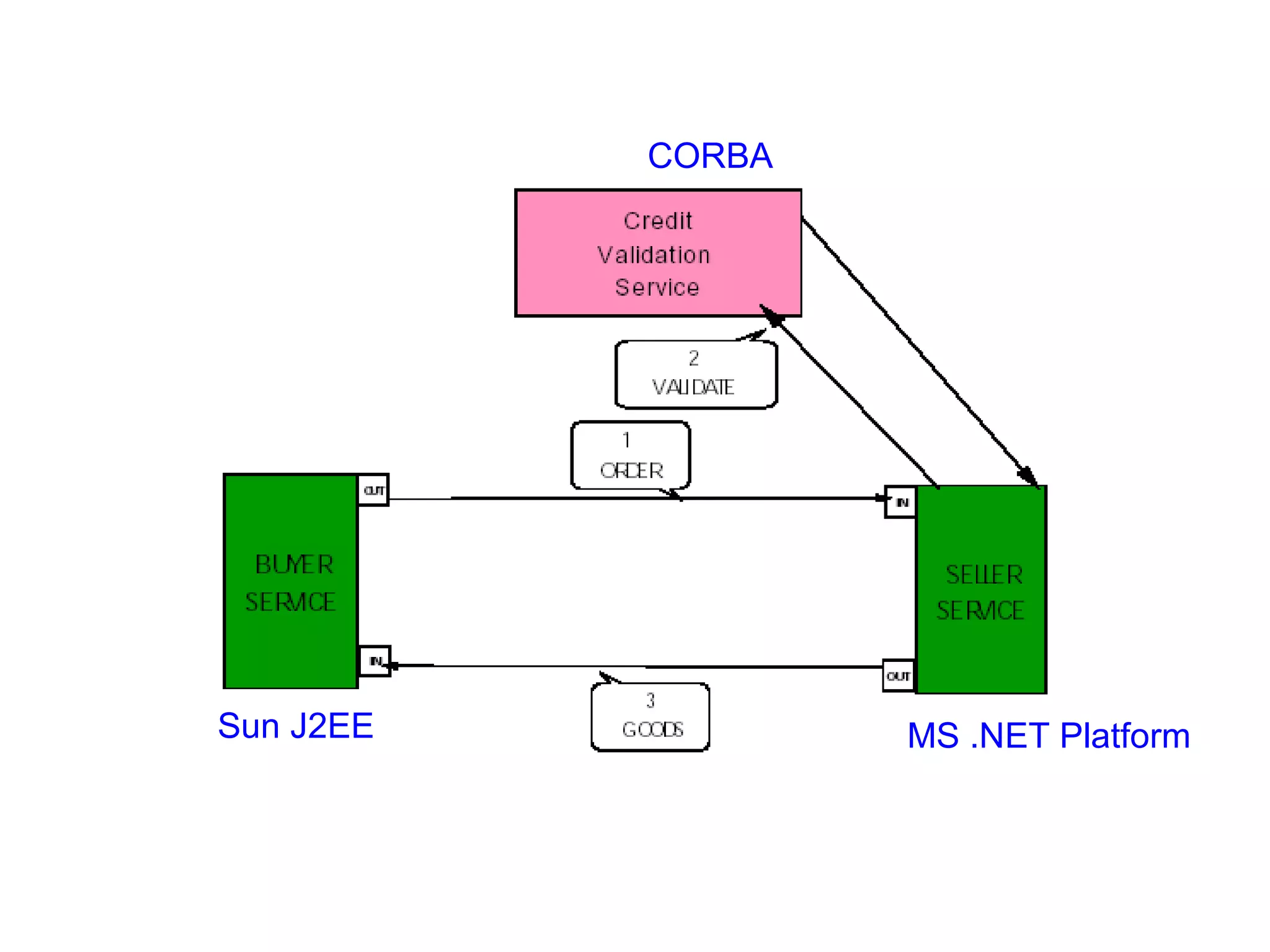
The document provides an overview of web service architecture, including definitions of key concepts like SOAP, WSDL, and UDDI. SOAP defines the message format for web services communication. WSDL describes web services interfaces and operations. UDDI provides a registry for businesses to publish and discover web services. The architecture supports publishing services, finding services, and binding/invoking services at runtime.
An overview of web service architecture and its key components, including a table of contents for the presentation.
Definitions from W3C, Microsoft, IBM, and SUN on web services, highlighting their role in e-business integration and communication.
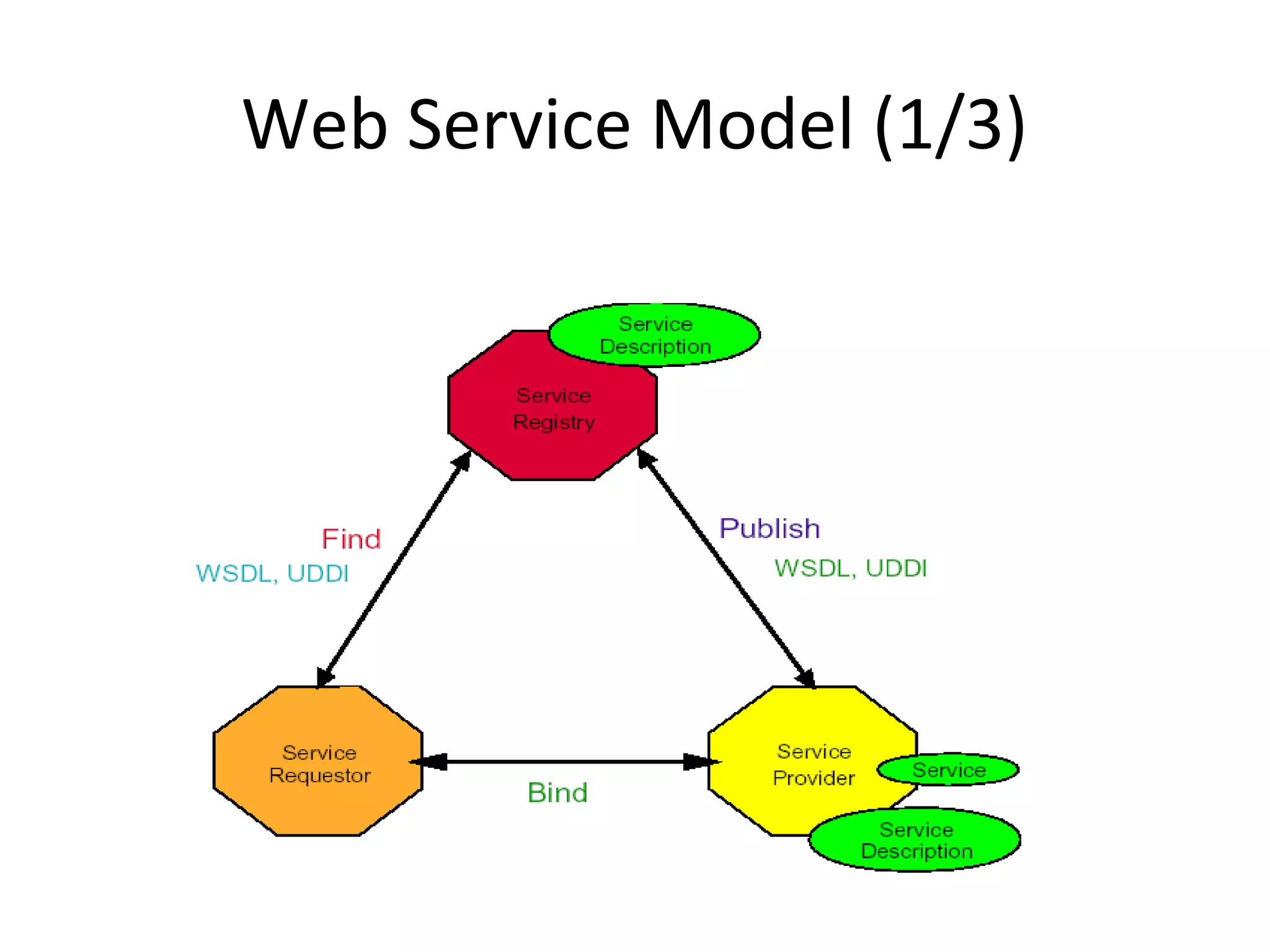
Description of the web service model focusing on roles of service providers, requestors, and registries, along with key operations like publish, find, and bind.
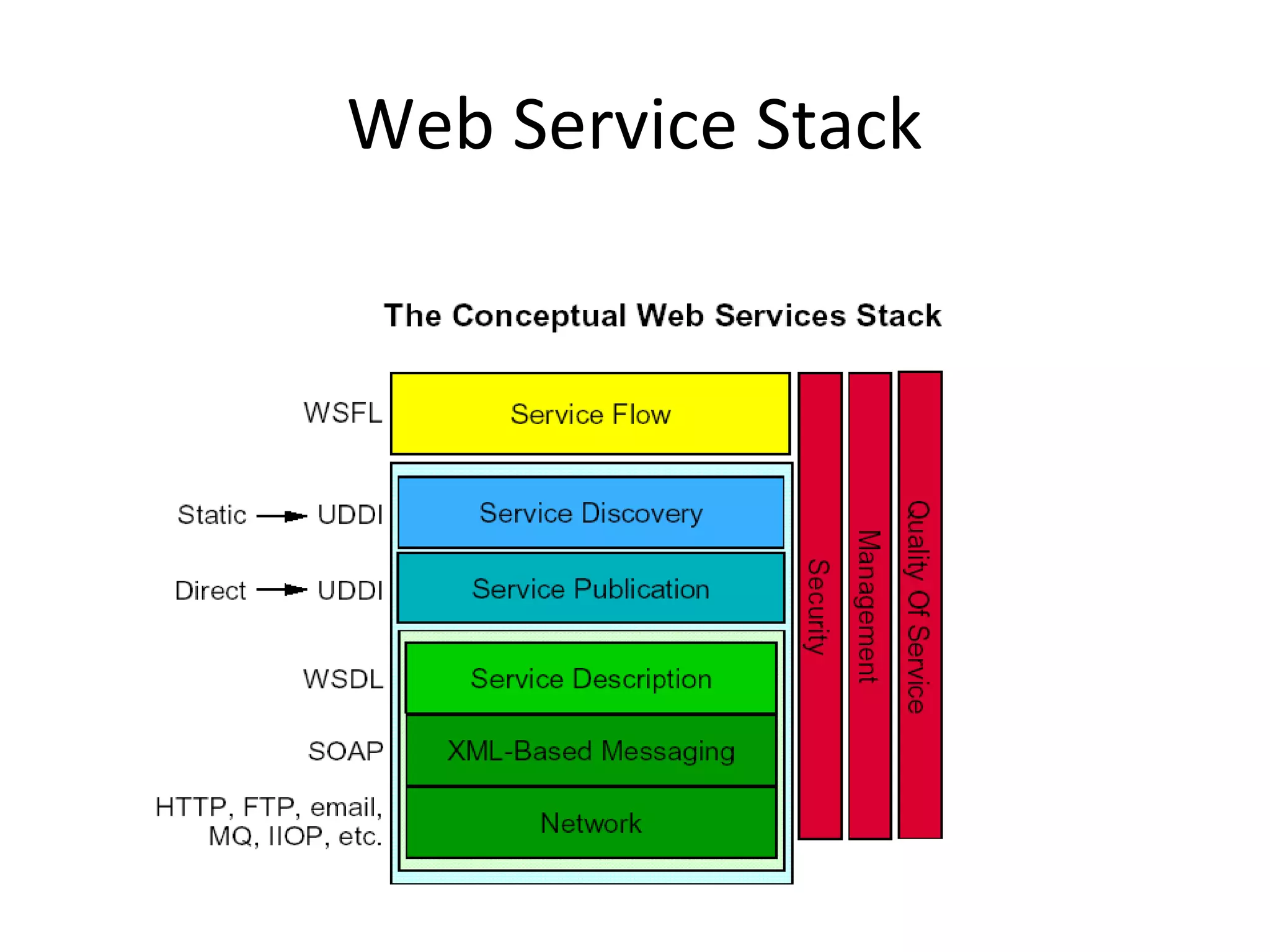
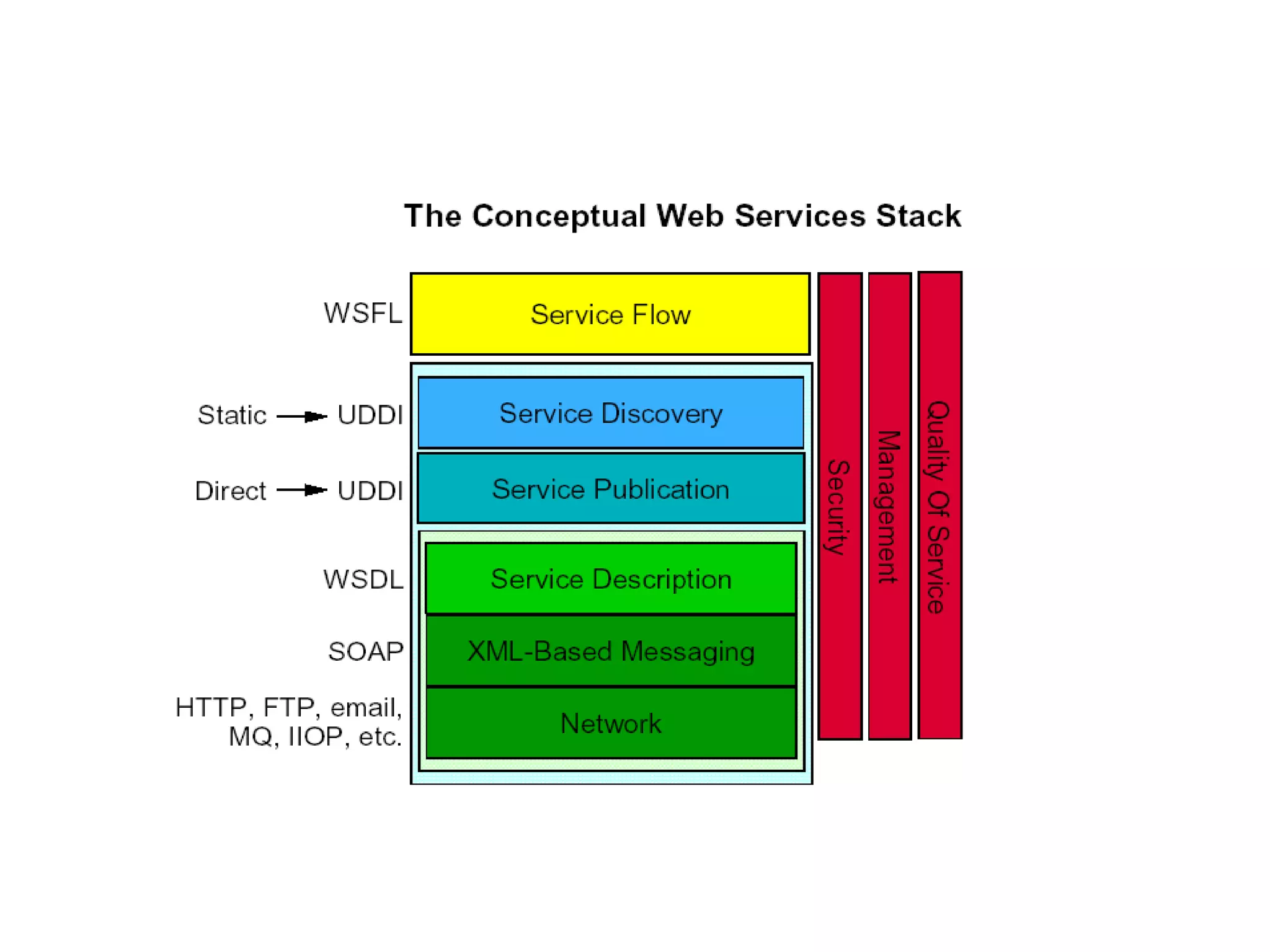
Introduction to the web service stack and an explanation of SOAP as a communication protocol for application interaction.
Detailed information regarding SOAP versions and functionality, including message structure and its light-weight nature for communication.Explanation of WSDL, its XML structure, document elements defining services, and how it aids in service description and location.
Overview of UDDI as a directory service for web service registration and interactions, highlighting its operational benefits.
Description of various UDDI node types focusing on internal enterprise applications, external partnerships, and e-marketplaces.
Final remarks on web services as alternatives to traditional distributed computing, mentioning security and transaction management needs.
Table of Contents
•What’s Web Service?
• Web Service Model
• Architecture Overview
– SOAP
– WSDL
– UDDI
• Conclusion
3.
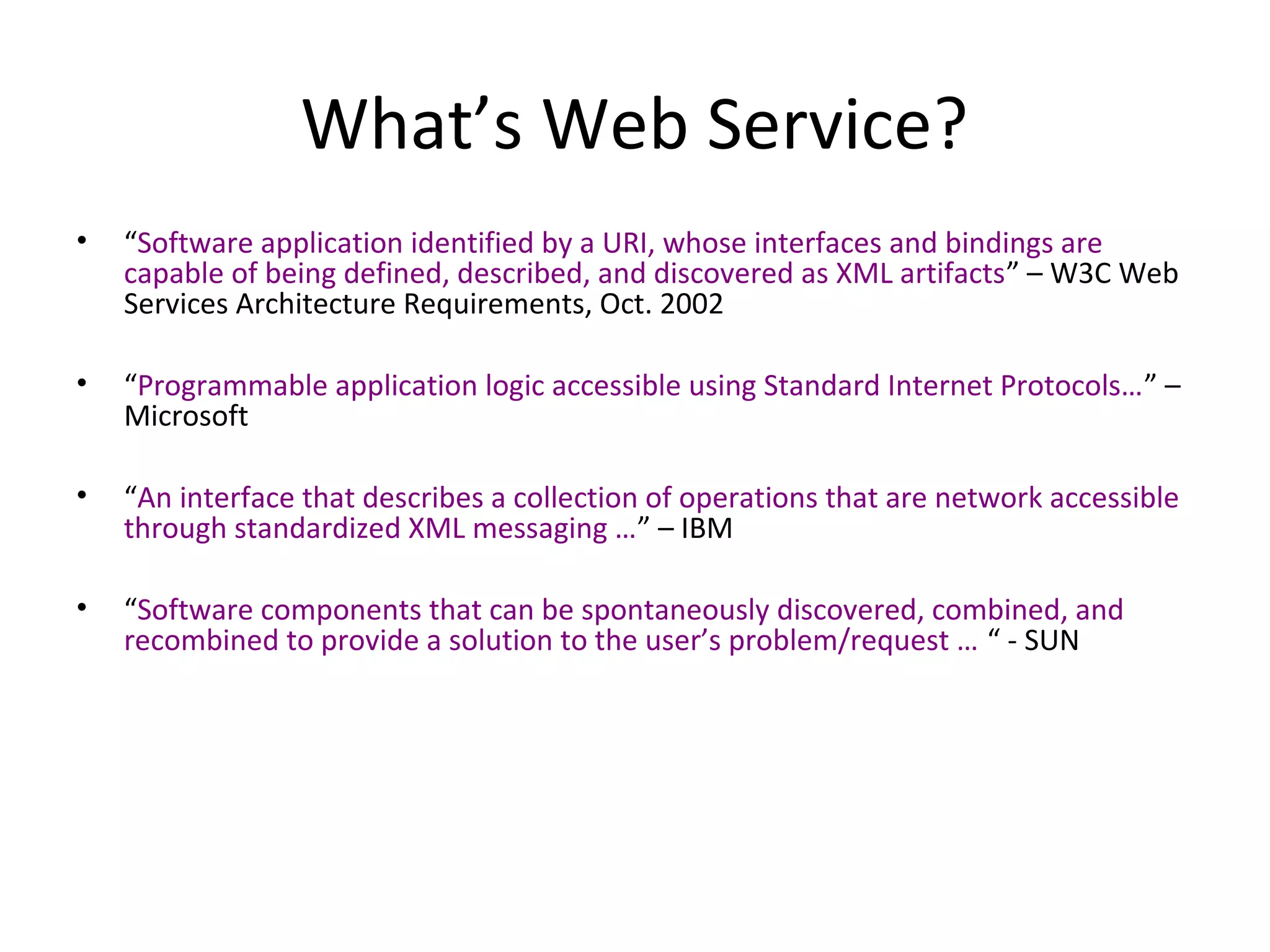
What’s Web Service?
•“Software application identified by a URI, whose interfaces and bindings are
capable of being defined, described, and discovered as XML artifacts” – W3C Web
Services Architecture Requirements, Oct. 2002
• “Programmable application logic accessible using Standard Internet Protocols…” –
Microsoft
• “An interface that describes a collection of operations that are network accessible
through standardized XML messaging …” – IBM
• “Software components that can be spontaneously discovered, combined, and
recombined to provide a solution to the user’s problem/request … “ - SUN
4.
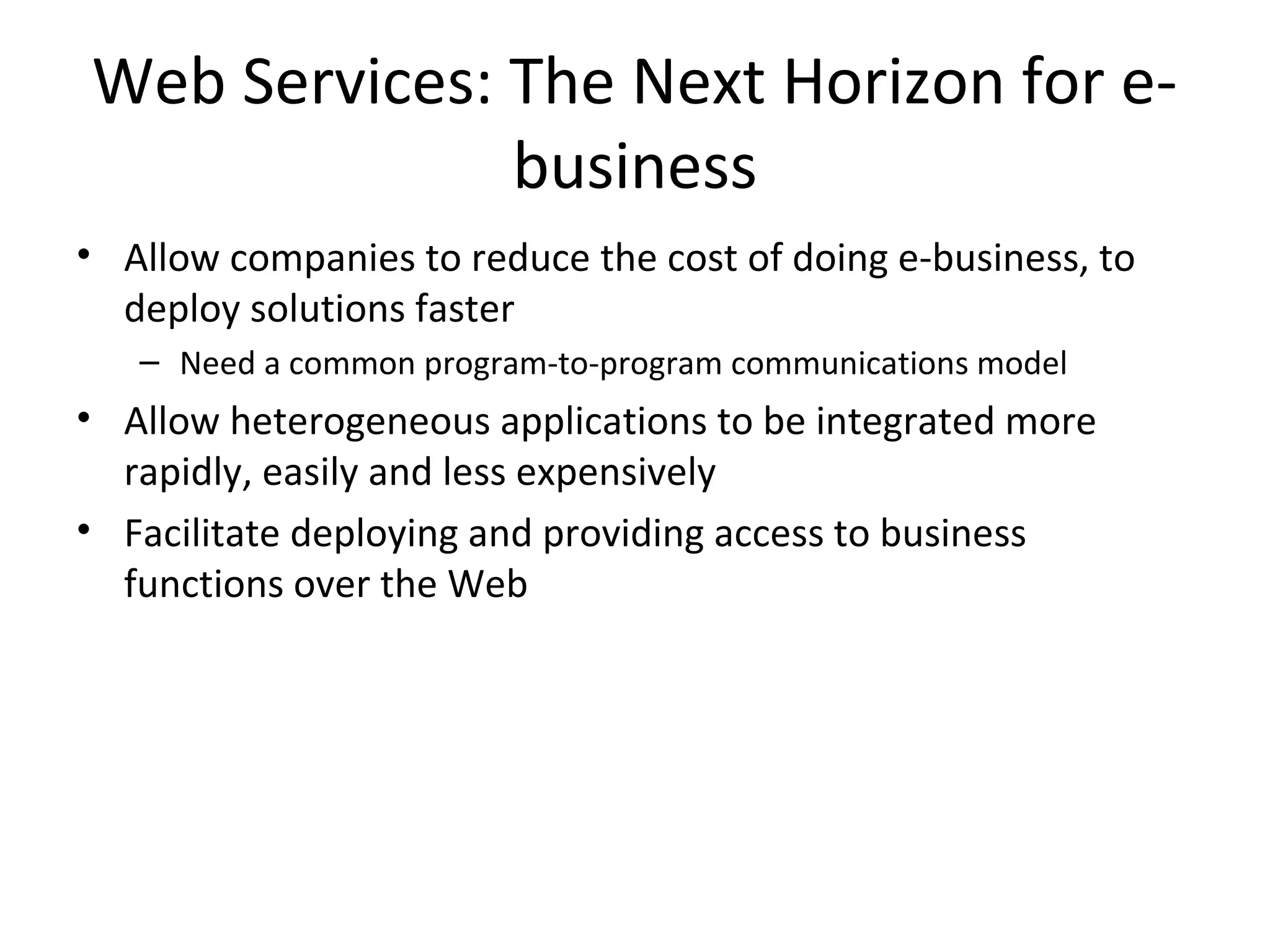
Web Services: TheNext Horizon for e-
business
• Allow companies to reduce the cost of doing e-business, to
deploy solutions faster
– Need a common program-to-program communications model
• Allow heterogeneous applications to be integrated more
rapidly, easily and less expensively
• Facilitate deploying and providing access to business
functions over the Web
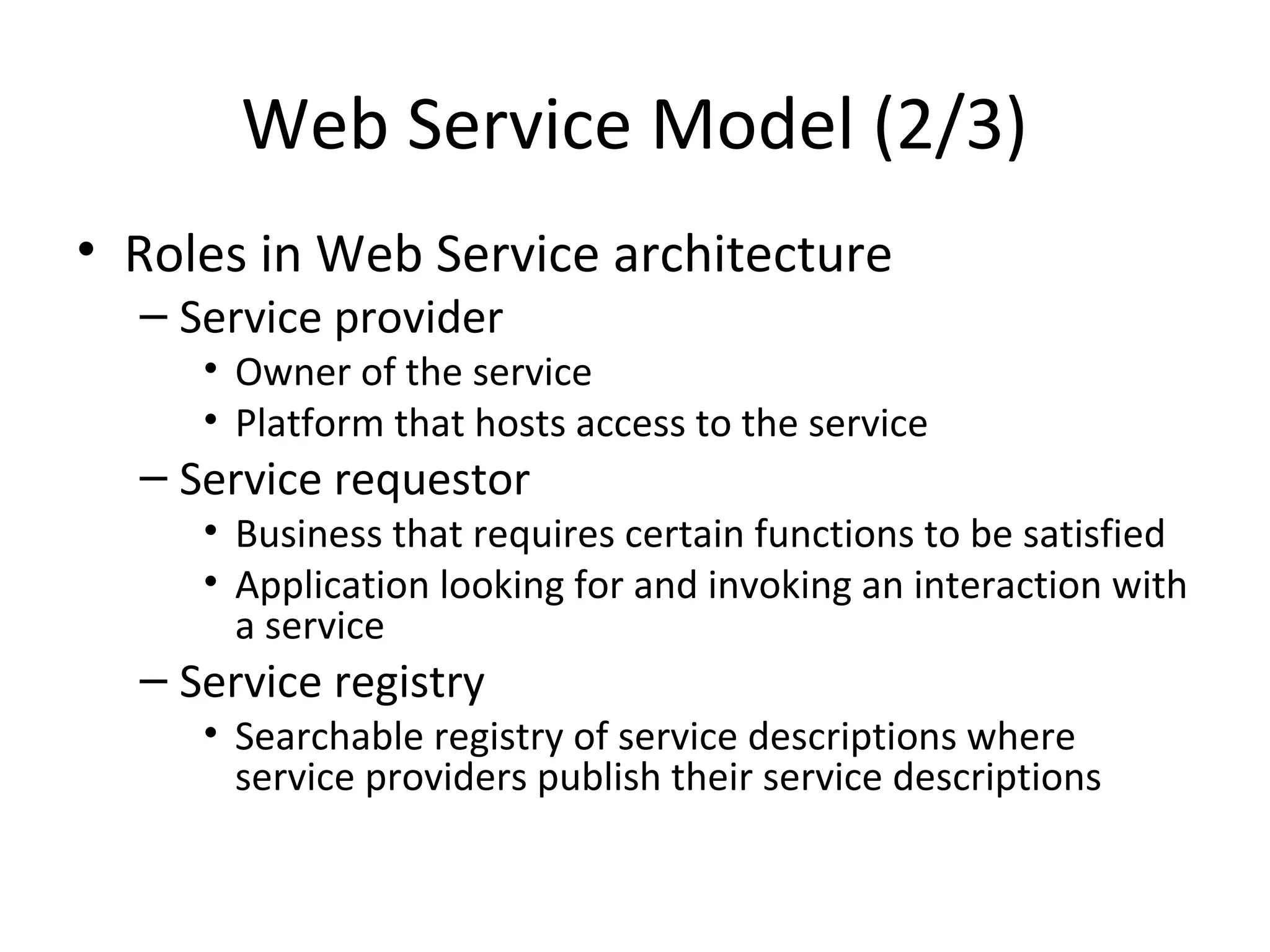
Web Service Model(2/3)
• Roles in Web Service architecture
– Service provider
• Owner of the service
• Platform that hosts access to the service
– Service requestor
• Business that requires certain functions to be satisfied
• Application looking for and invoking an interaction with
a service
– Service registry
• Searchable registry of service descriptions where
service providers publish their service descriptions
9.
Web Service Model(3/3)
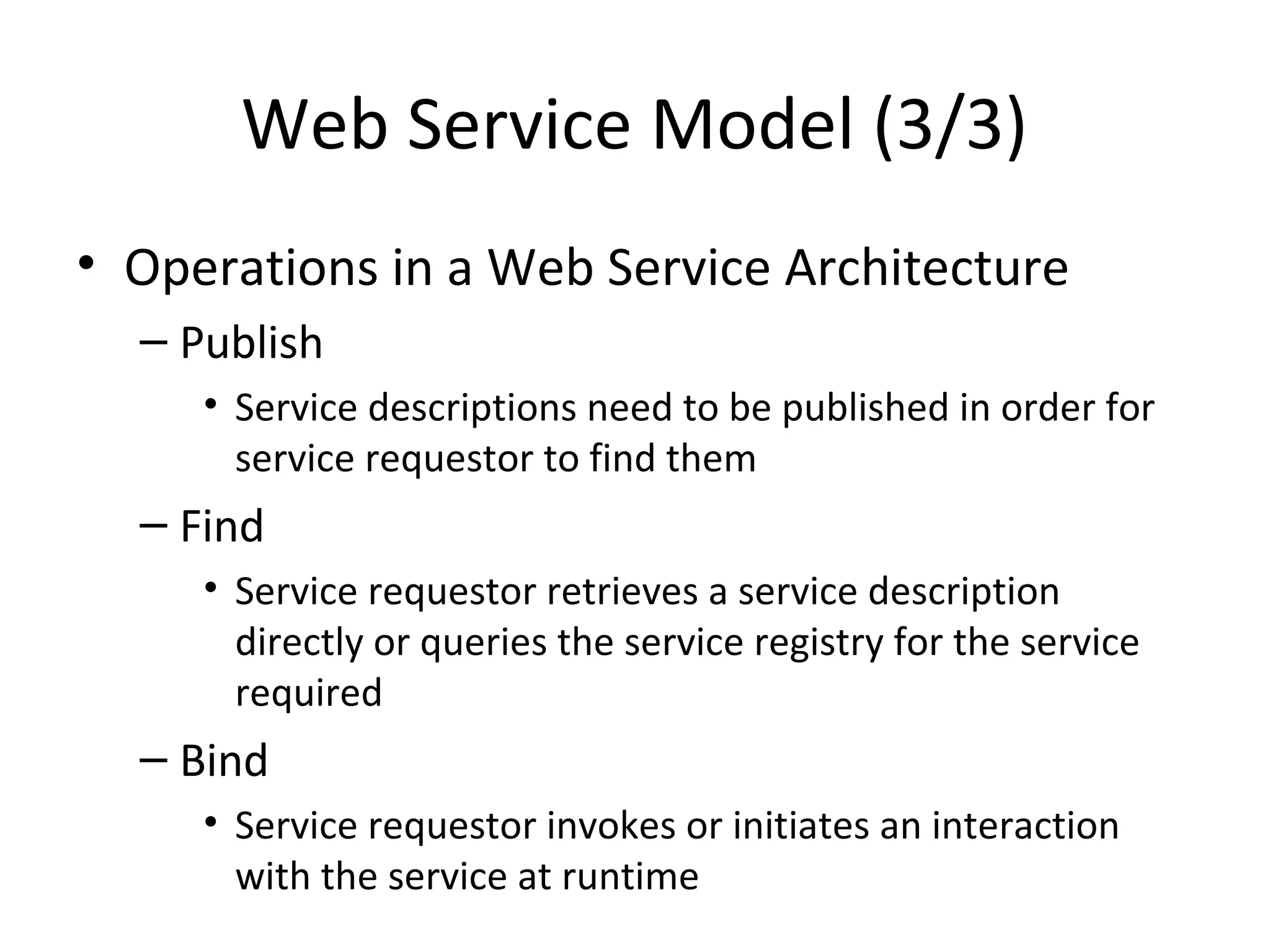
• Operations in a Web Service Architecture
– Publish
• Service descriptions need to be published in order for
service requestor to find them
– Find
• Service requestor retrieves a service description
directly or queries the service registry for the service
required
– Bind
• Service requestor invokes or initiates an interaction
with the service at runtime
10.
Table of Contents
•What’s Web Service?
• Web Service Model
• Architecture Overview
– SOAP
– WSDL
– UDDI
• Conclusion
SOAP: Simple Object
AccessProtocol
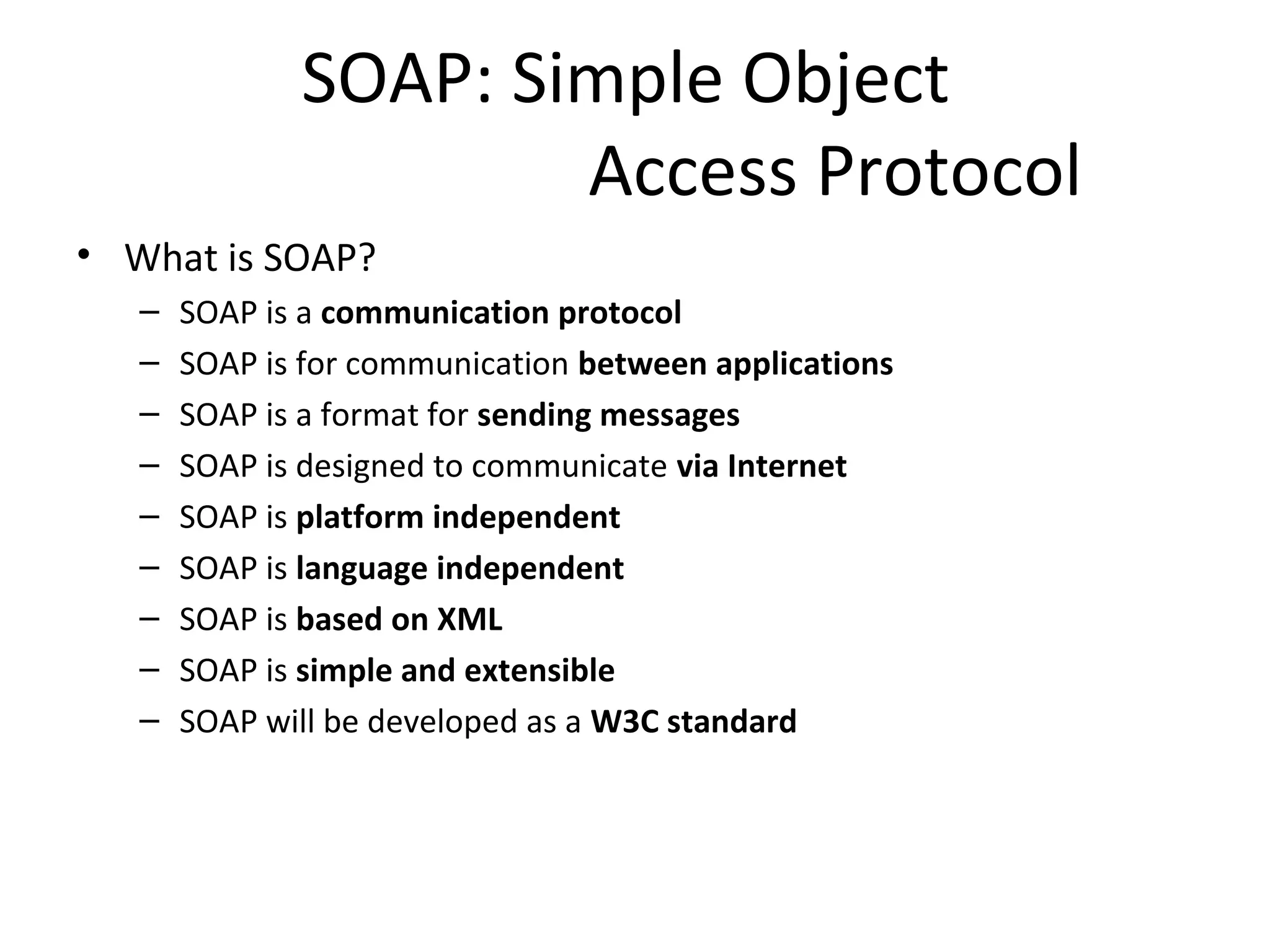
• What is SOAP?
– SOAP is a communication protocol
– SOAP is for communication between applications
– SOAP is a format for sending messages
– SOAP is designed to communicate via Internet
– SOAP is platform independent
– SOAP is language independent
– SOAP is based on XML
– SOAP is simple and extensible
– SOAP will be developed as a W3C standard
13.
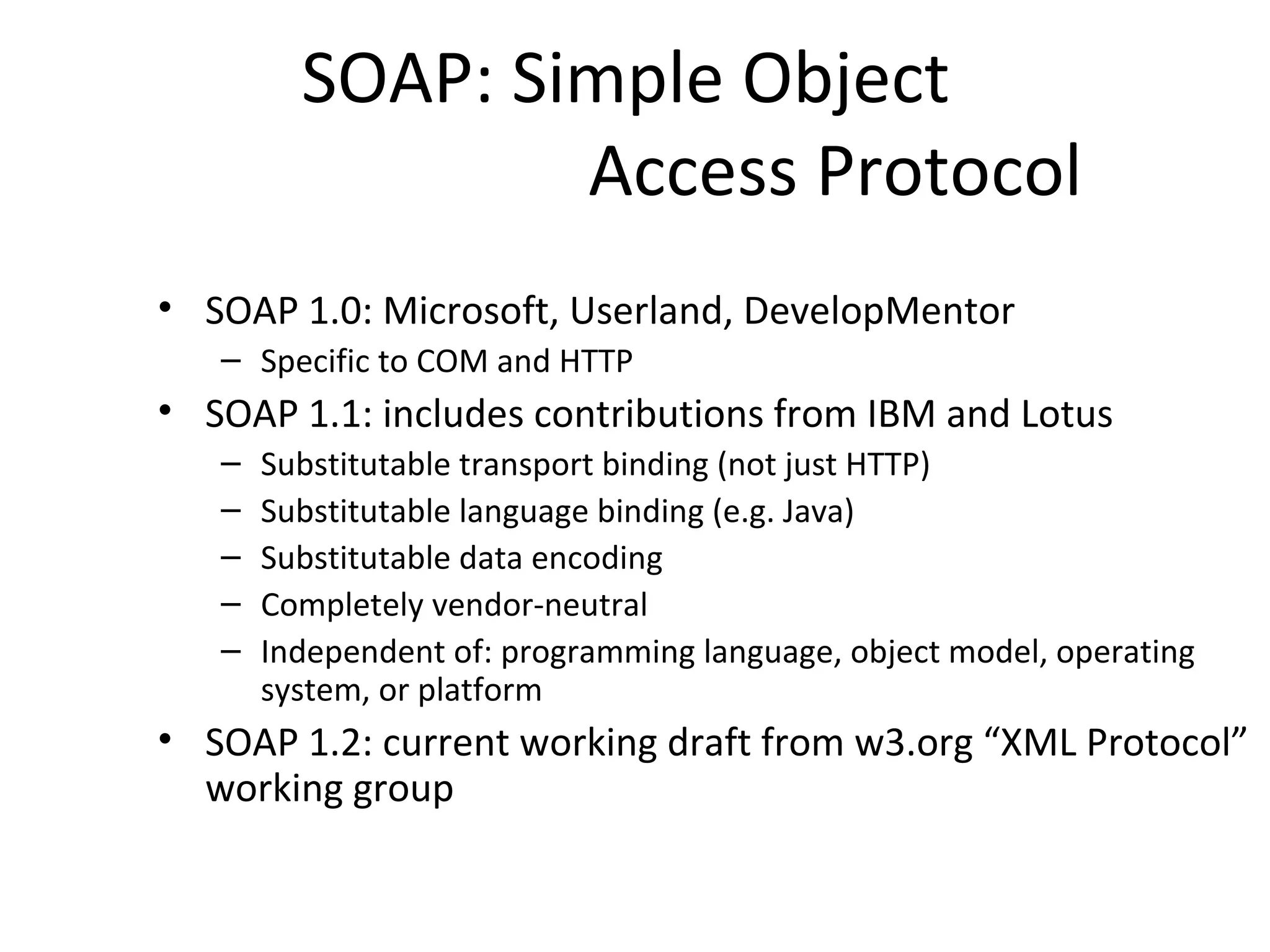
SOAP: Simple Object
AccessProtocol
• SOAP 1.0: Microsoft, Userland, DevelopMentor
– Specific to COM and HTTP
• SOAP 1.1: includes contributions from IBM and Lotus
– Substitutable transport binding (not just HTTP)
– Substitutable language binding (e.g. Java)
– Substitutable data encoding
– Completely vendor-neutral
– Independent of: programming language, object model, operating
system, or platform
• SOAP 1.2: current working draft from w3.org “XML Protocol”
working group
14.
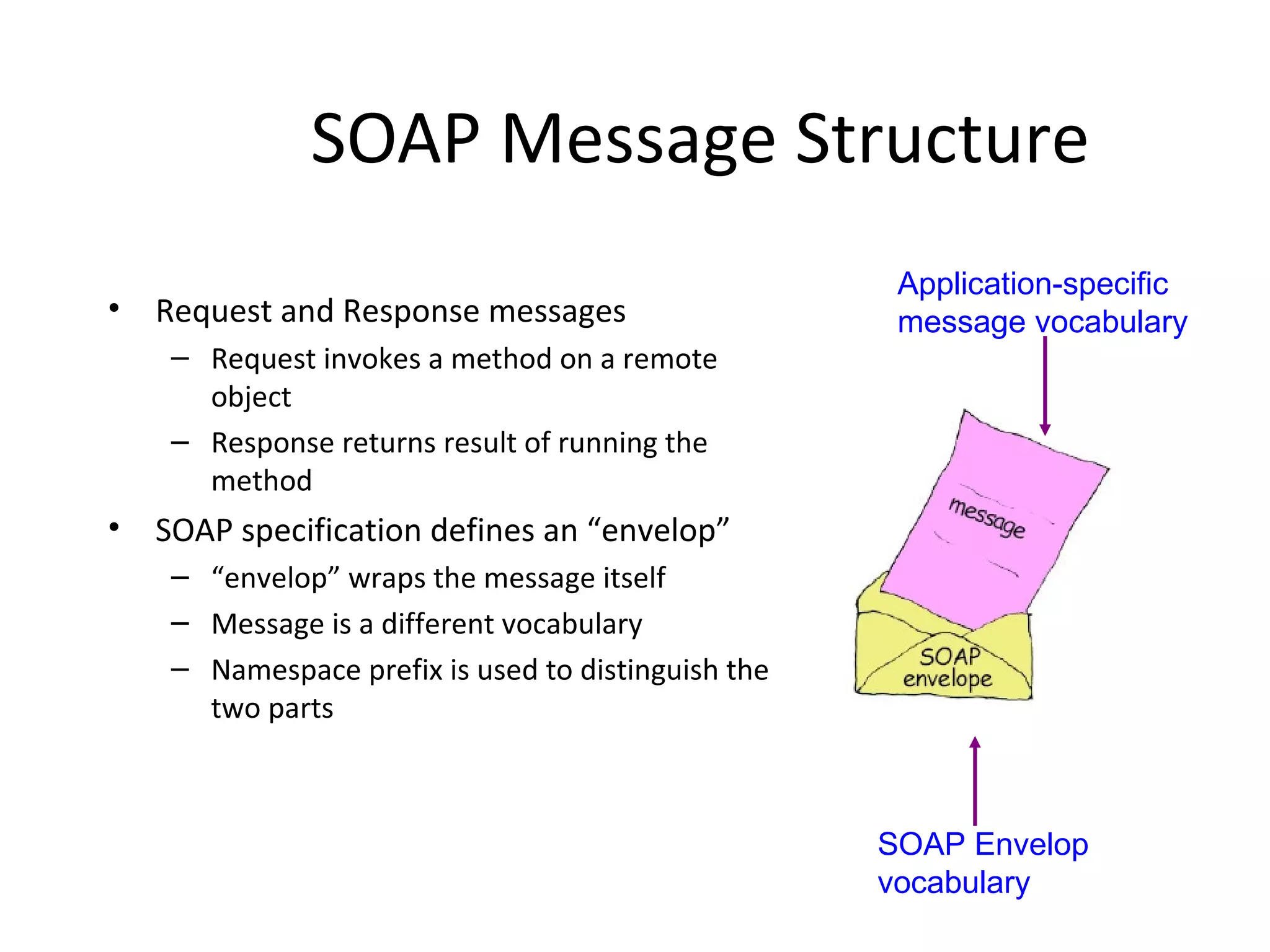
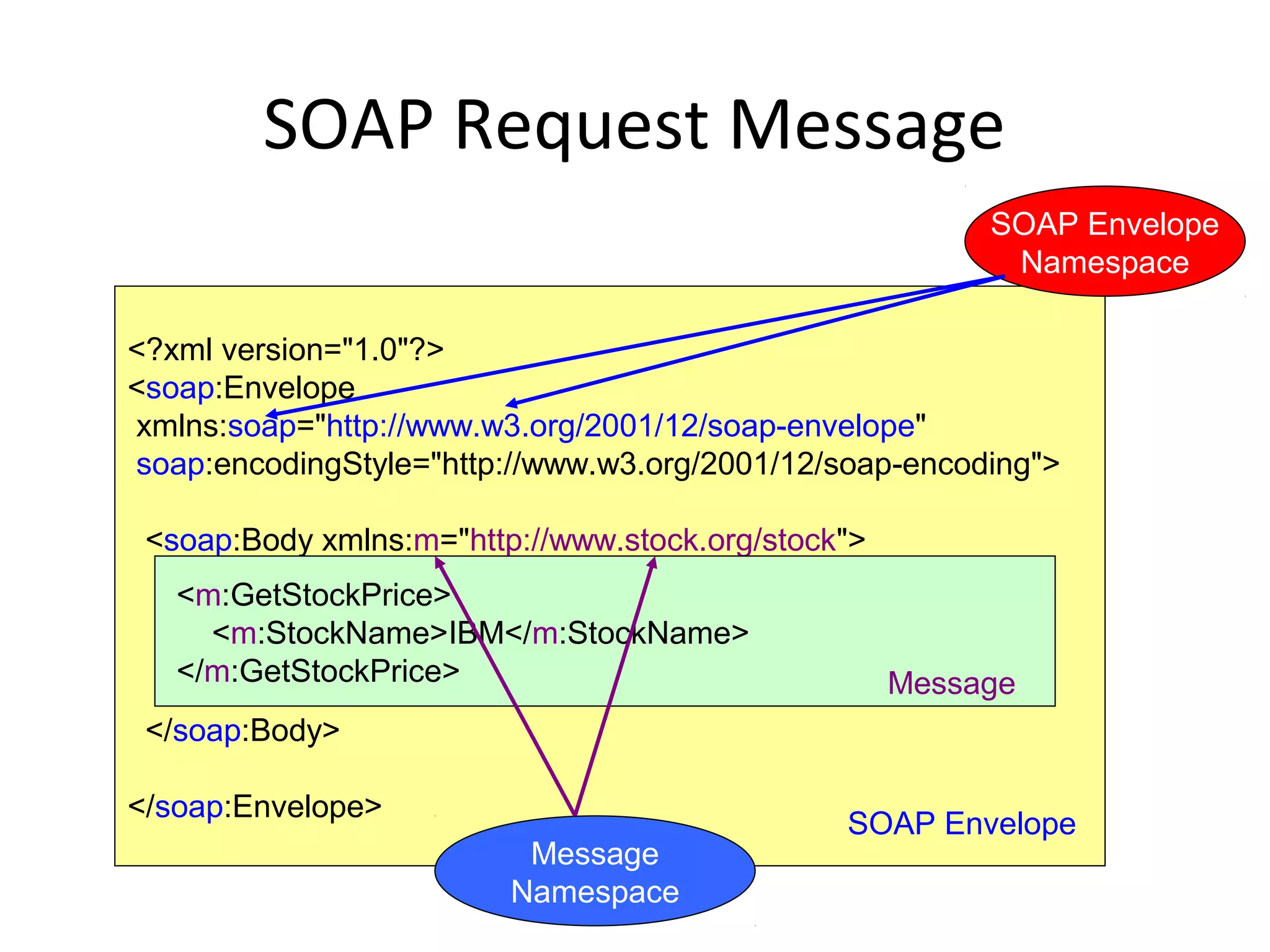
SOAP Message Structure
•Request and Response messages
– Request invokes a method on a remote
object
– Response returns result of running the
method
• SOAP specification defines an “envelop”
– “envelop” wraps the message itself
– Message is a different vocabulary
– Namespace prefix is used to distinguish the
two parts
Application-specific
message vocabulary
SOAP Envelop
vocabulary
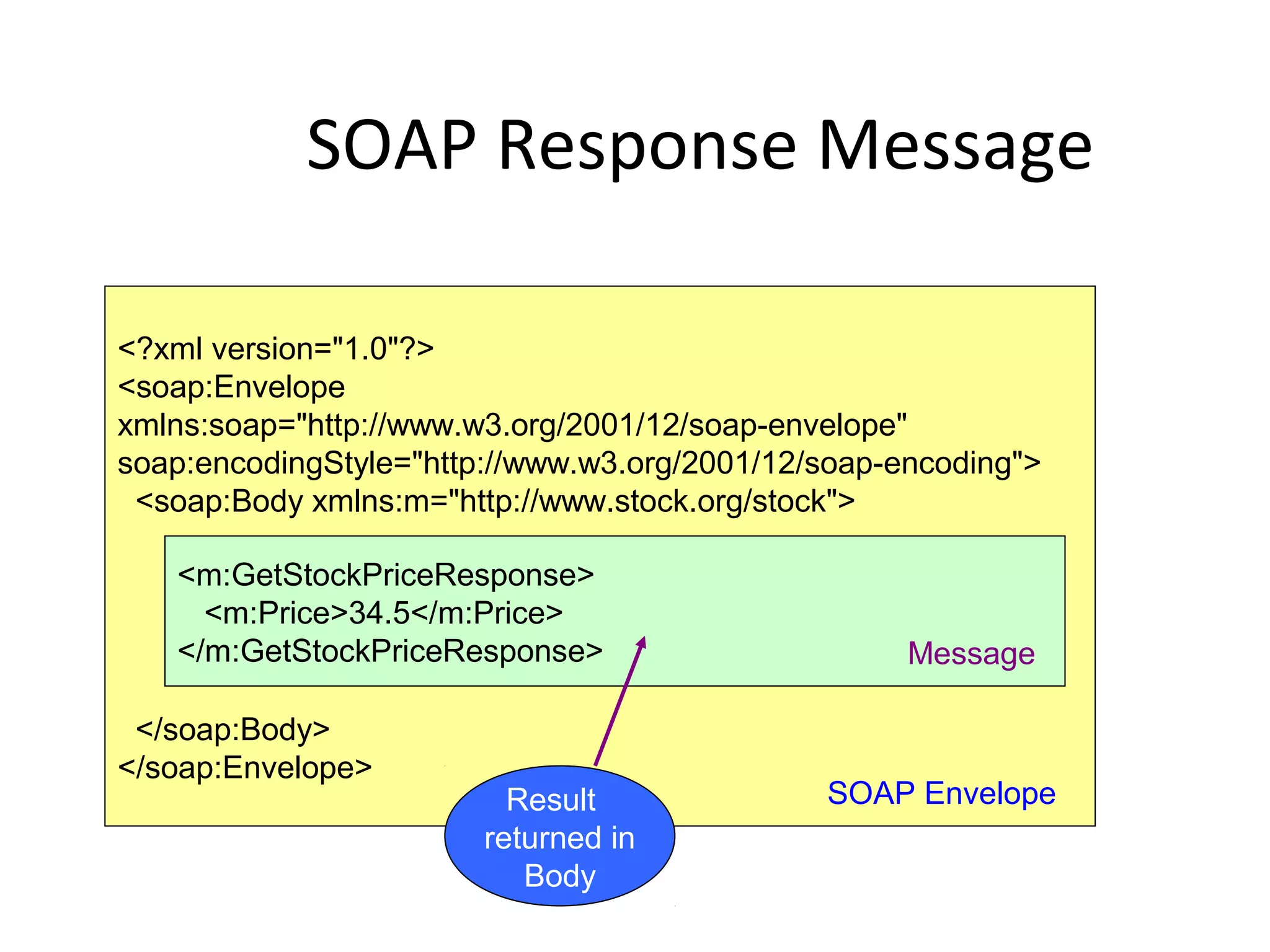
SOAP Response Message
<?xmlversion="1.0"?>
<soap:Envelope
xmlns:soap="http://www.w3.org/2001/12/soap-envelope"
soap:encodingStyle="http://www.w3.org/2001/12/soap-encoding">
<soap:Body xmlns:m="http://www.stock.org/stock">
</soap:Body>
</soap:Envelope>
<m:GetStockPriceResponse>
<m:Price>34.5</m:Price>
</m:GetStockPriceResponse>
SOAP Envelope
Message
Result
returned in
Body
17.
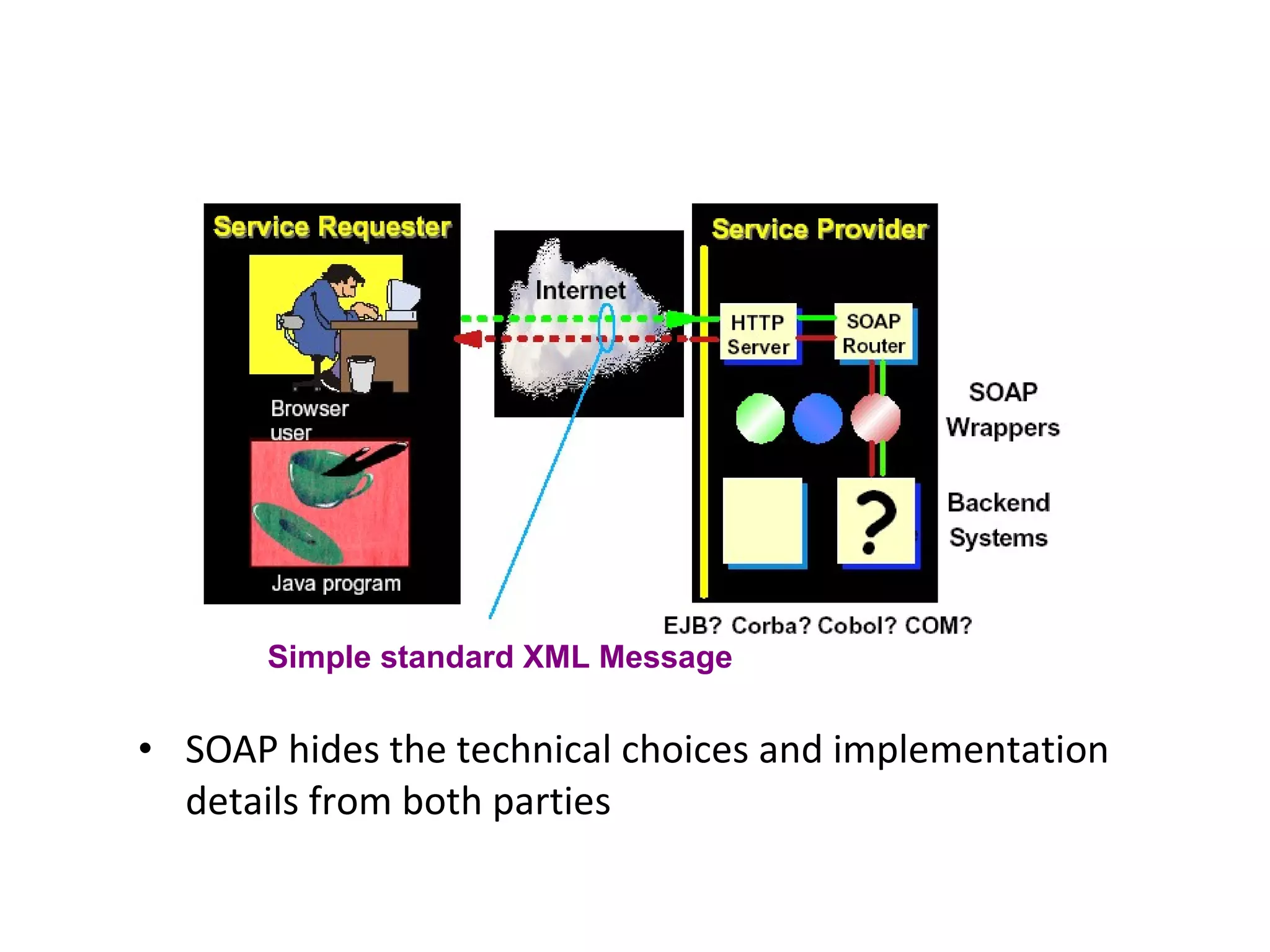
• SOAP hidesthe technical choices and implementation
details from both parties
Simple standard XML Message
18.
Why SOAP?
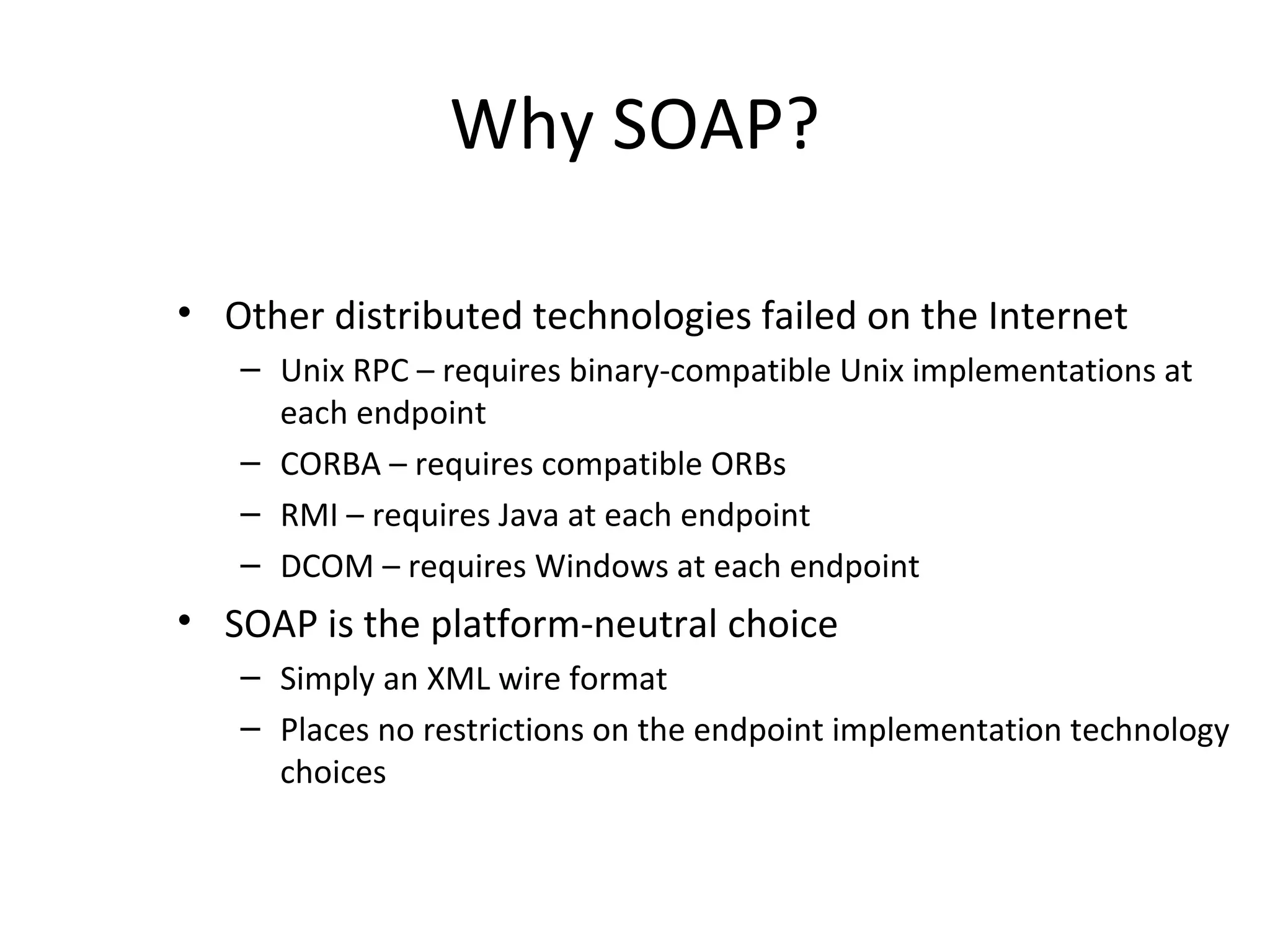
• Otherdistributed technologies failed on the Internet
– Unix RPC – requires binary-compatible Unix implementations at
each endpoint
– CORBA – requires compatible ORBs
– RMI – requires Java at each endpoint
– DCOM – requires Windows at each endpoint
• SOAP is the platform-neutral choice
– Simply an XML wire format
– Places no restrictions on the endpoint implementation technology
choices
19.
SOAP Usage Models
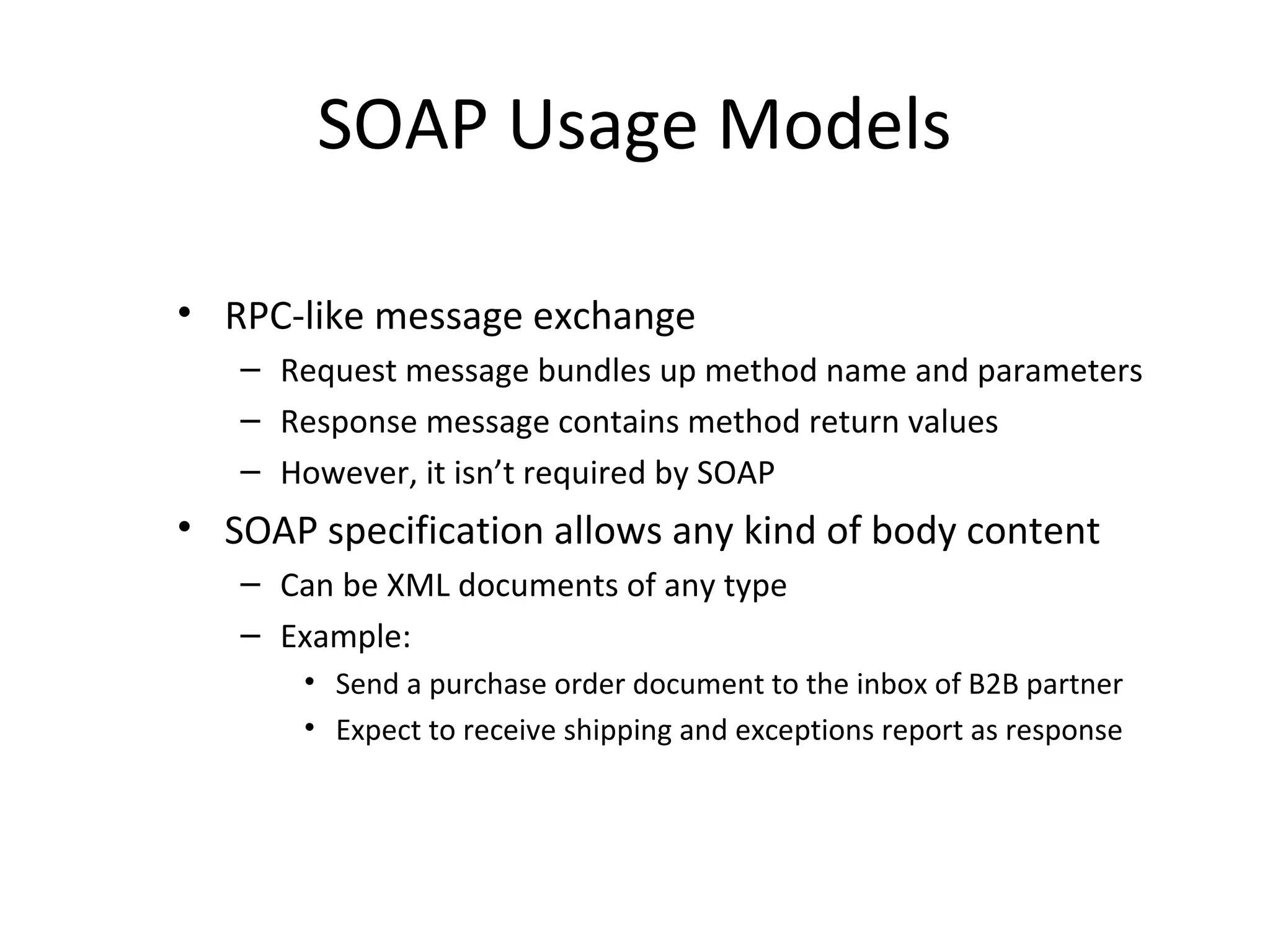
•RPC-like message exchange
– Request message bundles up method name and parameters
– Response message contains method return values
– However, it isn’t required by SOAP
• SOAP specification allows any kind of body content
– Can be XML documents of any type
– Example:
• Send a purchase order document to the inbox of B2B partner
• Expect to receive shipping and exceptions report as response
20.
Web Services DescriptionLanguage
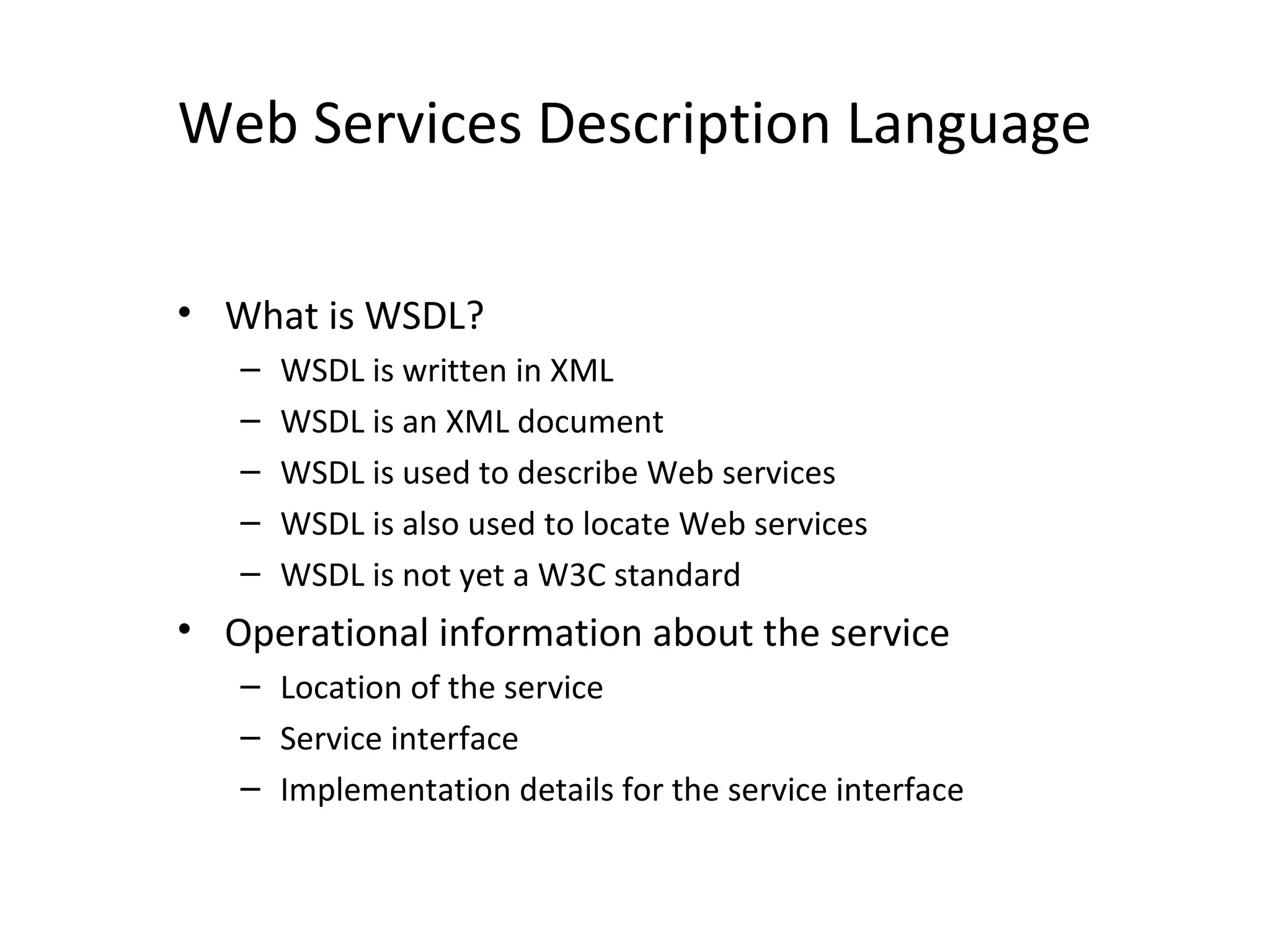
• What is WSDL?
– WSDL is written in XML
– WSDL is an XML document
– WSDL is used to describe Web services
– WSDL is also used to locate Web services
– WSDL is not yet a W3C standard
• Operational information about the service
– Location of the service
– Service interface
– Implementation details for the service interface
21.
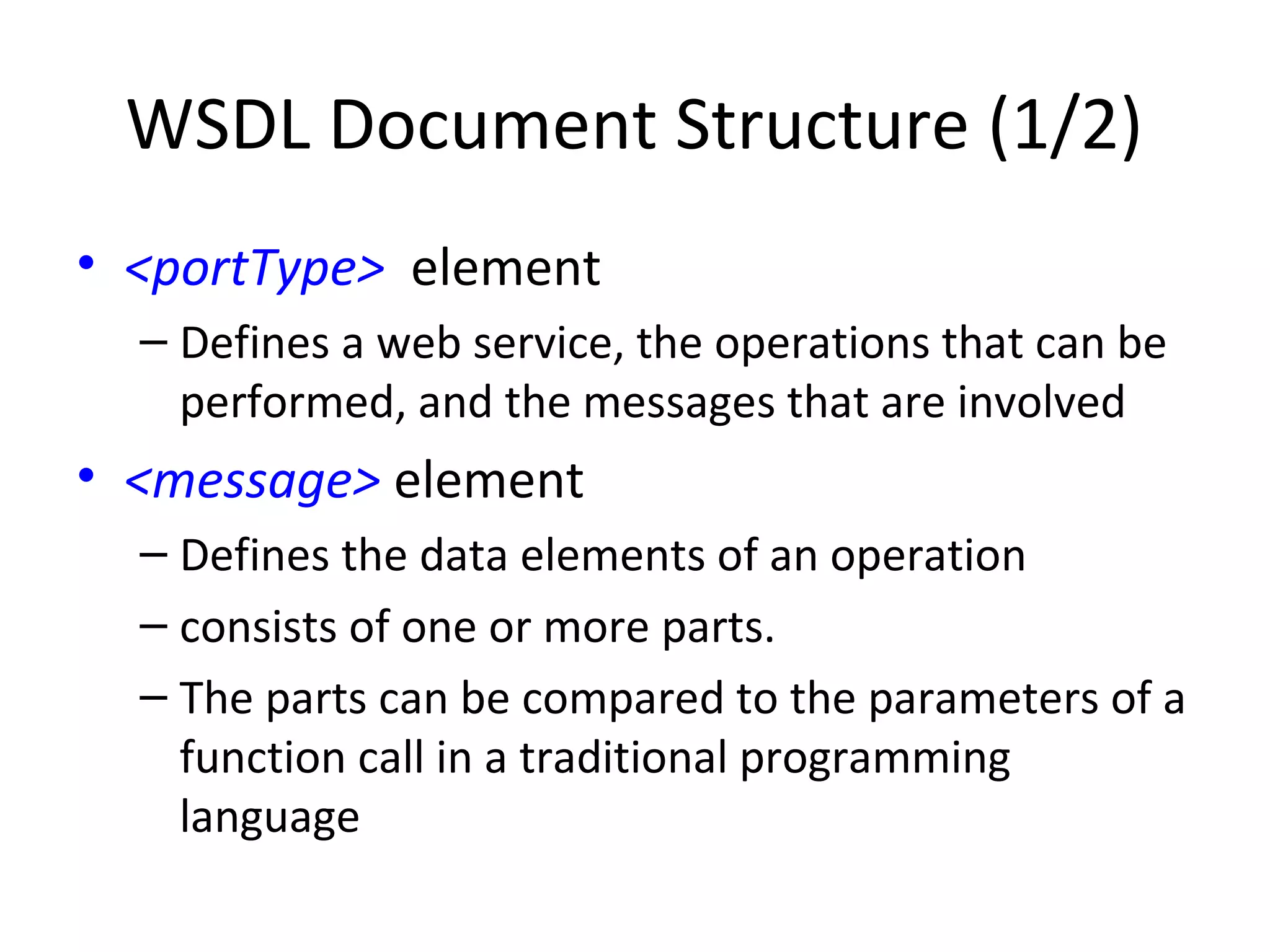
WSDL Document Structure(1/2)
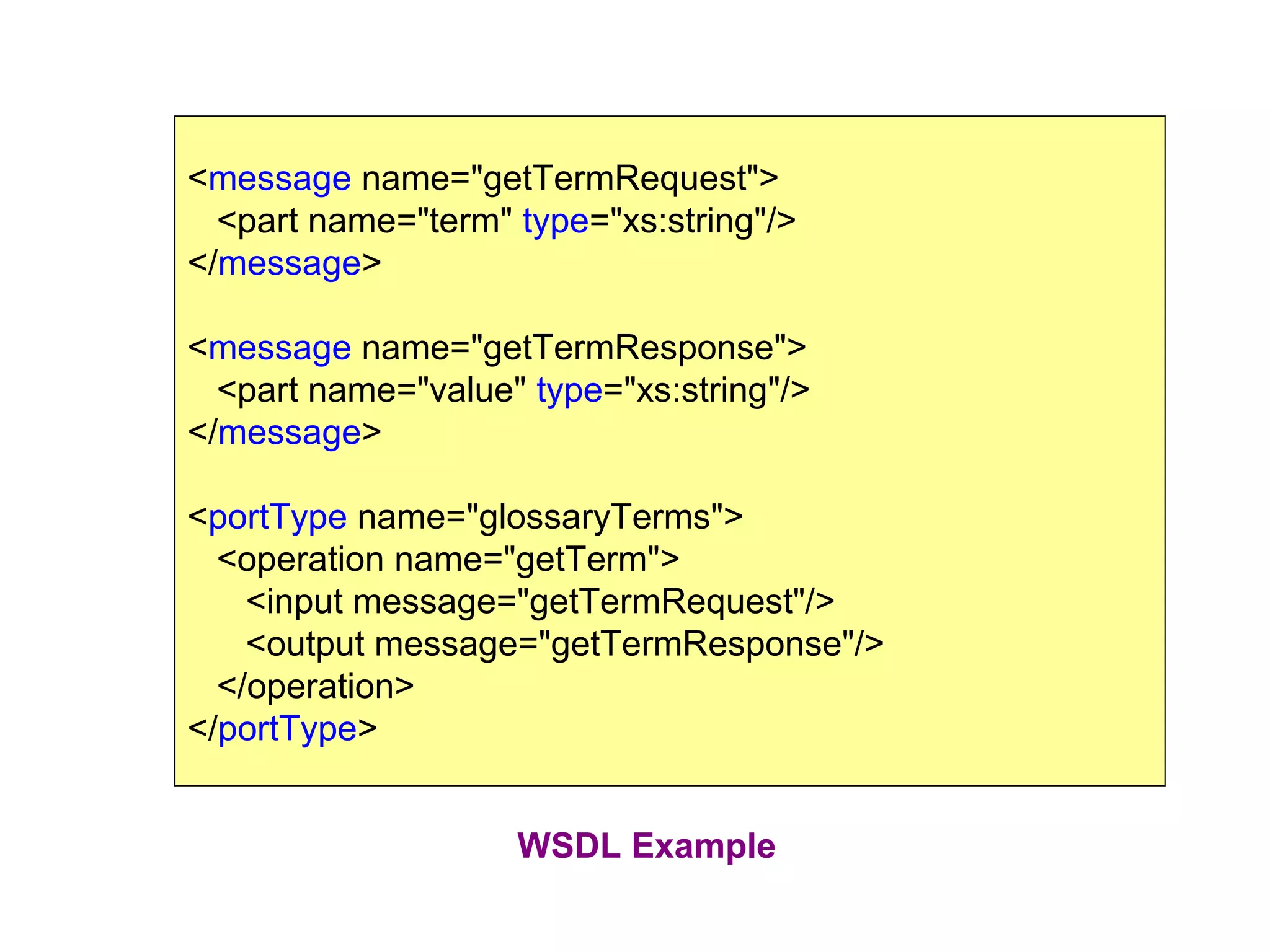
• <portType> element
– Defines a web service, the operations that can be
performed, and the messages that are involved
• <message> element
– Defines the data elements of an operation
– consists of one or more parts.
– The parts can be compared to the parameters of a
function call in a traditional programming
language
22.
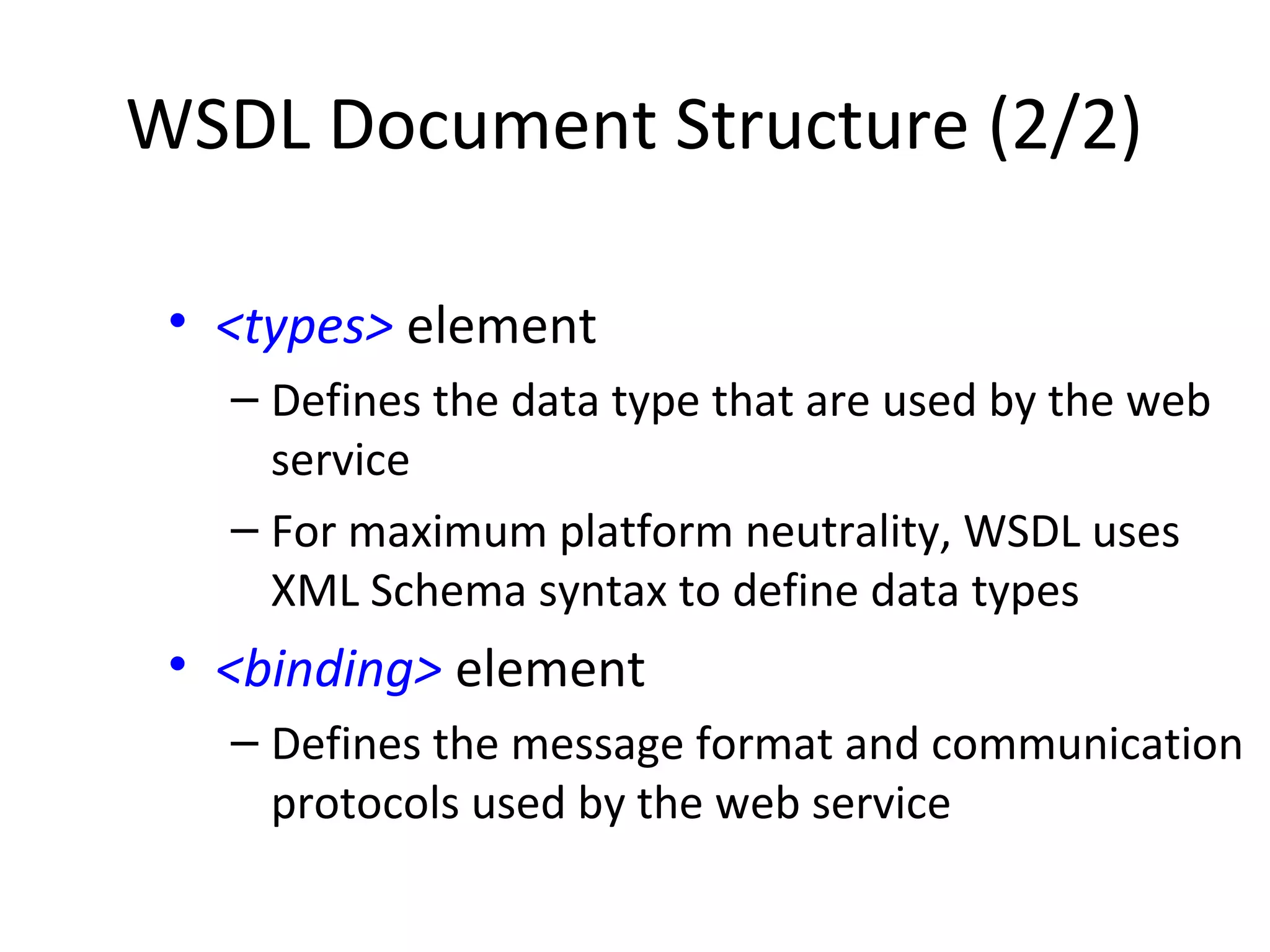
WSDL Document Structure(2/2)
• <types> element
– Defines the data type that are used by the web
service
– For maximum platform neutrality, WSDL uses
XML Schema syntax to define data types
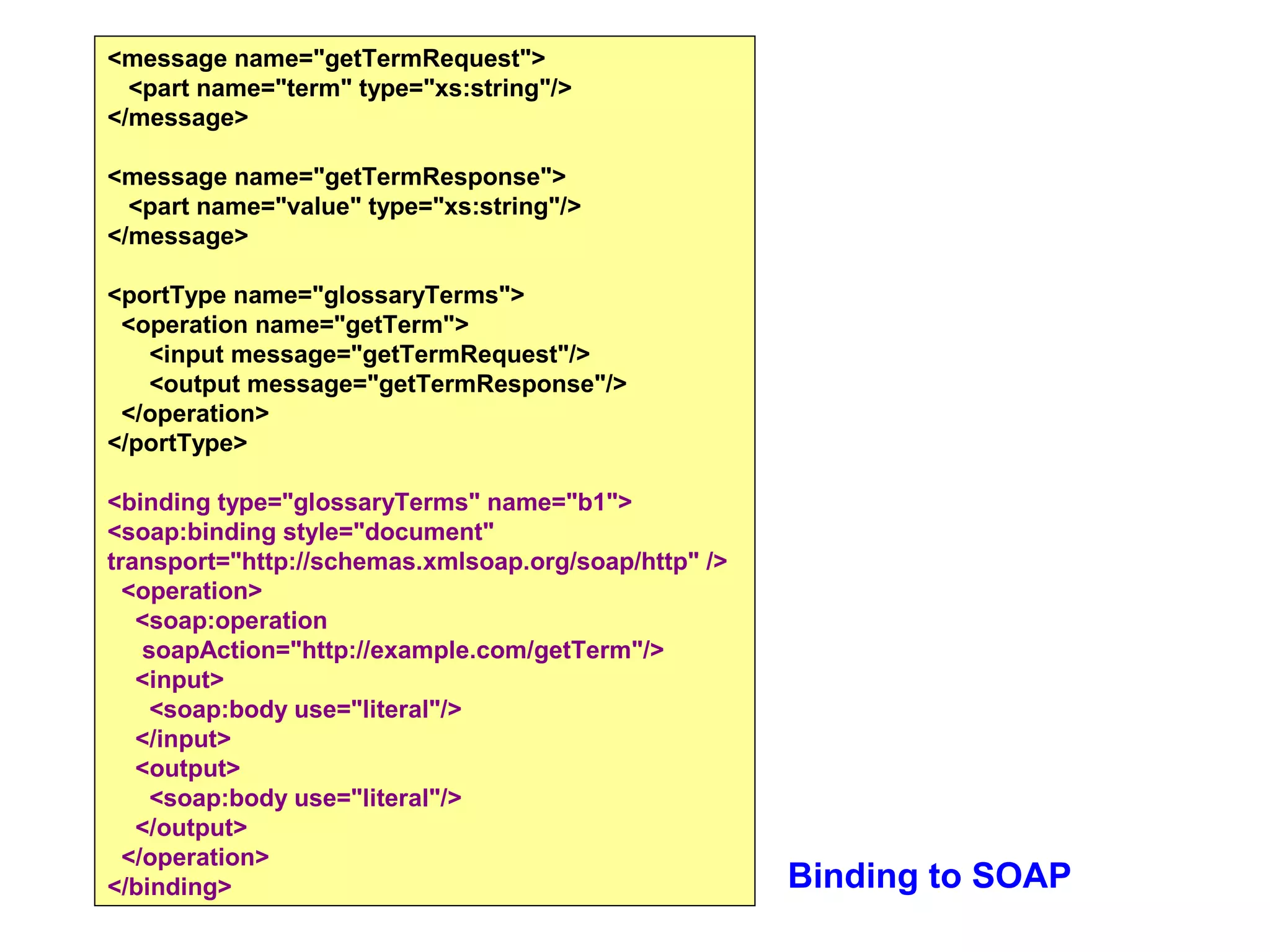
• <binding> element
– Defines the message format and communication
protocols used by the web service
Universal Description, Discovery
andIntegration (UDDI)
• What is UDDI?
– Directory service where businesses can register and search for Web
services
• Directory for storing information about web services
• Directory of web service interfaces described by WSDL
– UDDI communicates via SOAP
• What is UDDI Based On?
– Uses W3C Internet standards such as XML, HTTP, and DNS protocols
– UDDI uses WSDL to describe interfaces to web services
26.
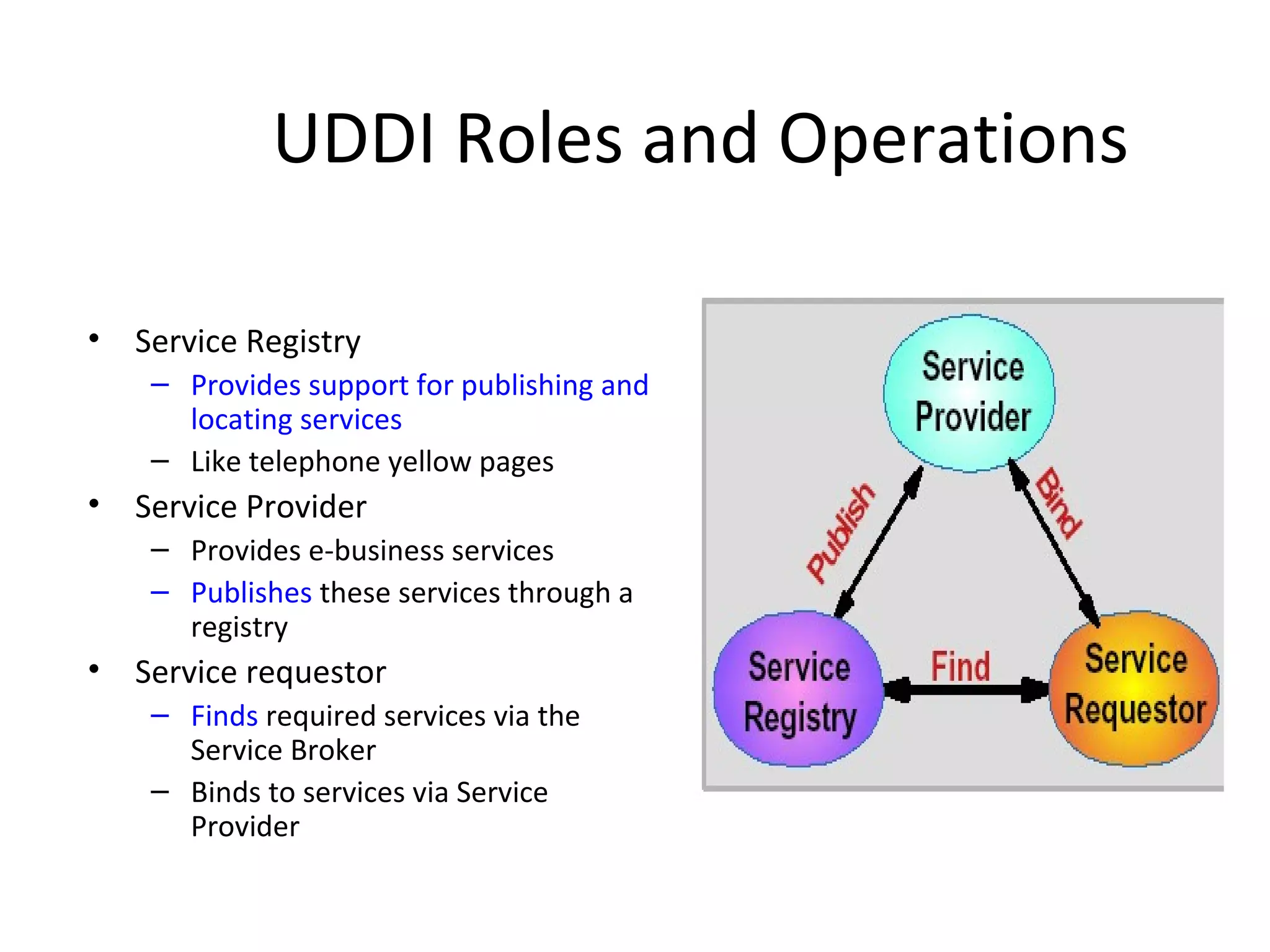
UDDI Roles andOperations
• Service Registry
– Provides support for publishing and
locating services
– Like telephone yellow pages
• Service Provider
– Provides e-business services
– Publishes these services through a
registry
• Service requestor
– Finds required services via the
Service Broker
– Binds to services via Service
Provider
UDDI Benefits
• Makingit possible to discover the right
business from the millions currently online
• Defining how to enable commerce once the
preferred business is discovered
• Reaching new customers and increasing
access to current customers
• Expanding offerings and extending market
reach
29.
Types of UDDInodes (1/3)
• Internal Enterprise Application UDDI node
– Web Services for use within a company for
internal enterprise application integration
– The scope can be single application,
departmental, corporate
– Sit behind the firewall
– Allow the service providers more control over
their service registry and its accessibility
30.
Types of UDDInodes (2/3)
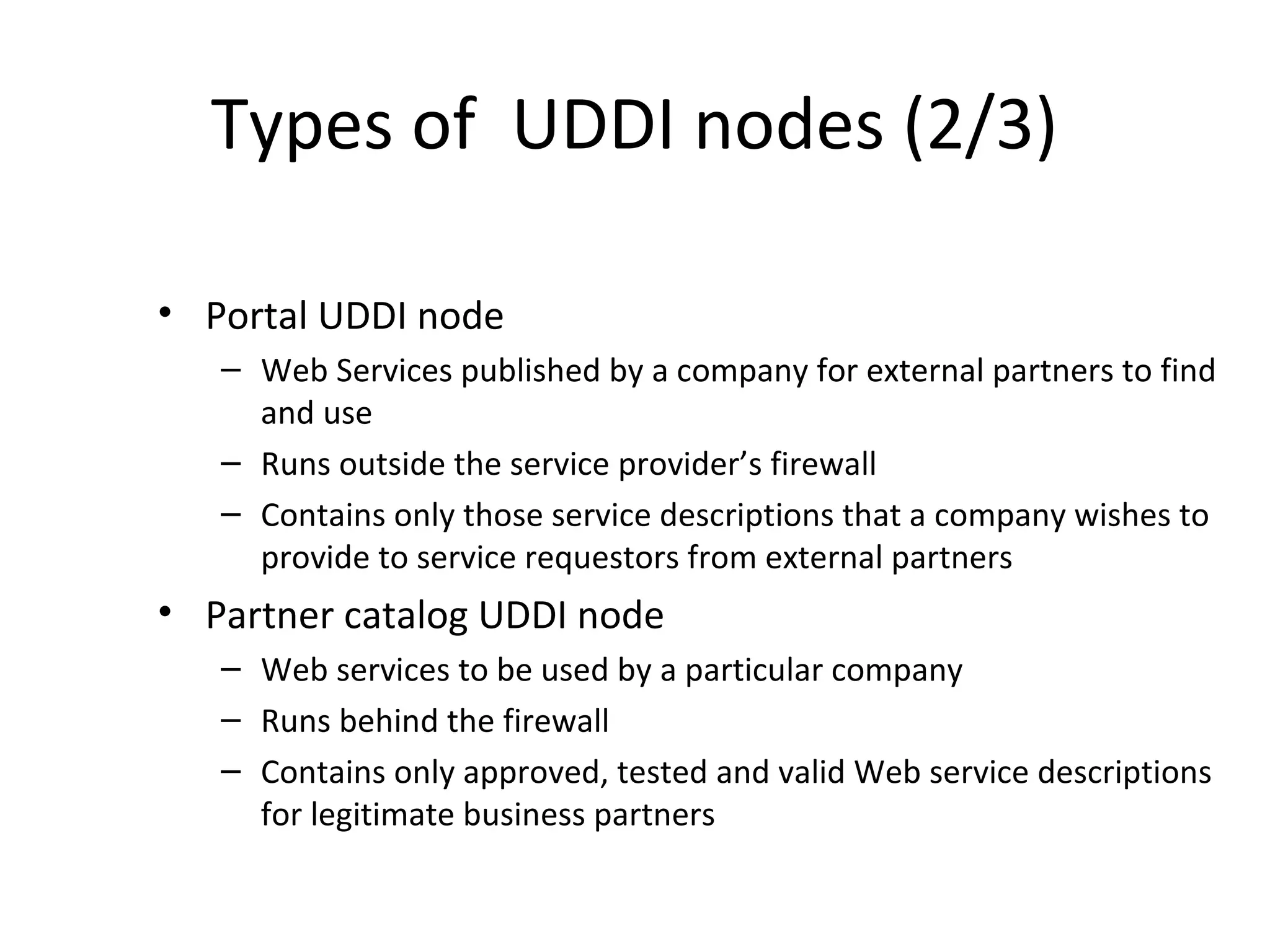
• Portal UDDI node
– Web Services published by a company for external partners to find
and use
– Runs outside the service provider’s firewall
– Contains only those service descriptions that a company wishes to
provide to service requestors from external partners
• Partner catalog UDDI node
– Web services to be used by a particular company
– Runs behind the firewall
– Contains only approved, tested and valid Web service descriptions
for legitimate business partners
31.
Types of UDDInodes (3/3)
• E-Marketplace UDDI node
– Web Services that the service provider intends to
compete for requestors’ business with other Web
Services
– Hosted by an industry standards organization or
consortium
– Contains service descriptions from businesses in a
particular industry
33.
Conclusion
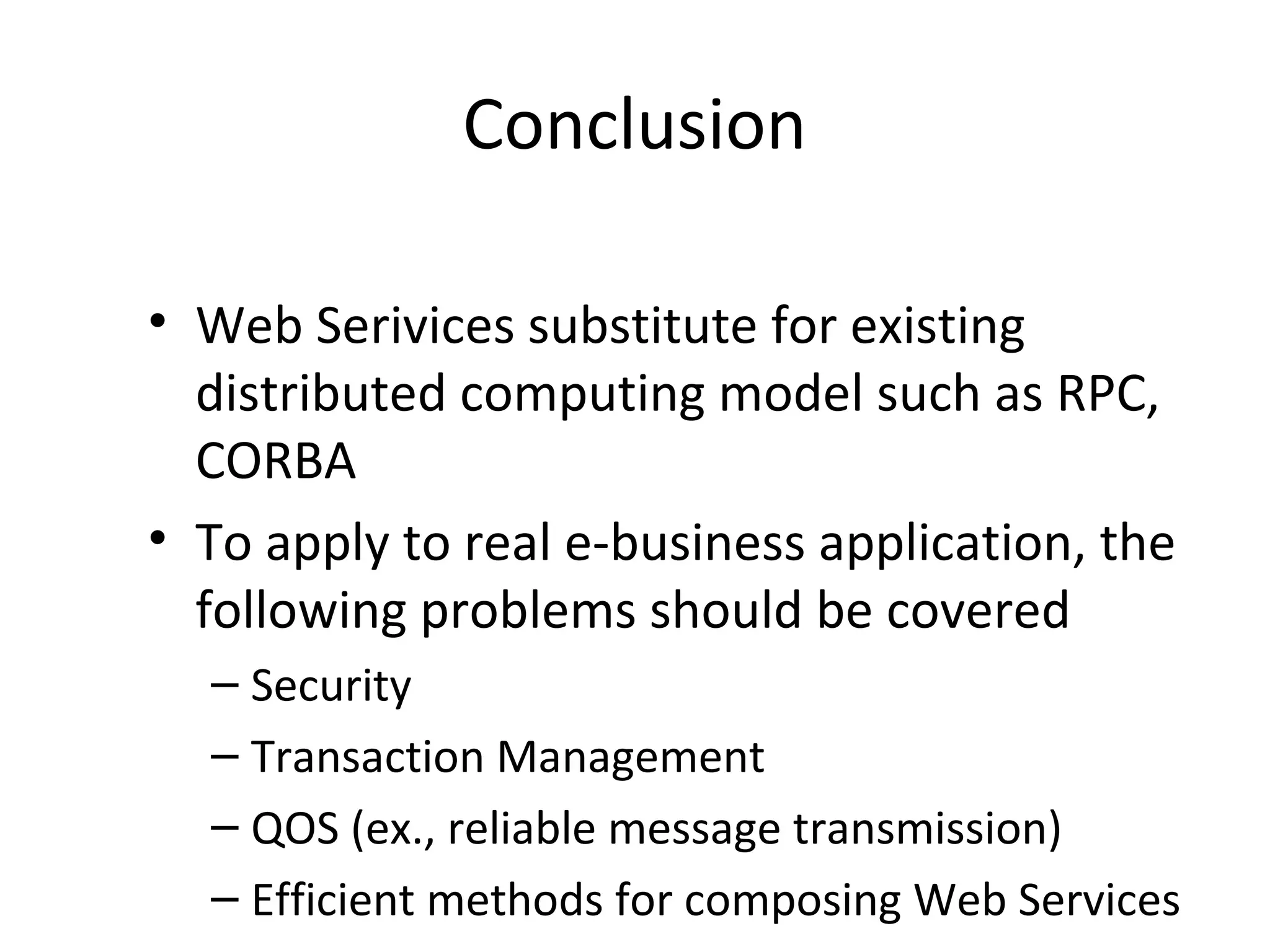
• Web Serivicessubstitute for existing
distributed computing model such as RPC,
CORBA
• To apply to real e-business application, the
following problems should be covered
– Security
– Transaction Management
– QOS (ex., reliable message transmission)
– Efficient methods for composing Web Services