Done by:
Esha Jiwanmall
11SJCCC260
Intern Guide:
Mrs. Veena Anand
Declaration:
I, Esha Jiwanmall, student of St. Joseph’s College of Commerce, Bangalore, register number
11SJCC260 of B.COM batch 2011-2014, hereby declare that I have completed my internship as
a summer analyst from 15th April 2013 to the 7th June 3013 at GOLDMAN SACHS Embassy
Golf Links, Business Park, Off Intermediate Ring Road, Domlur, Bangalore, Karnataka 560071
under the Operations Division. I interned in GSAM (Goldman Sachs Asset Management) with
the team PCA Derivatives for this tenure as parts of the Operations division.
I hereby declare that this internship report includes the results of my own internship work,
pursued under the guidance of Mrs. Veena Anand, St Joseph’s College of Commerce, Bangalore
and further declare that it has not been submitted earlier to any other university or institution for
the award of any diploma or degree/certificate or published any time before.
Acknowledgement:
I would like to thank our college, St. Josephs College of Commerce, for giving us opportunities
to intern in a prestigious company like Goldman Sachs through campus recruitments.
I would like to thank Goldman Sachs (OPS) for teaching and taking in interns for such an
amazing opportunity.
I would like to thank my manager Mrs. Aruna Prathiban for all her guidance and my intern
buddy Ms. Shalini for all the patience as well as the rest of my colleagues in team PCA
Derivatives.
I would like to thank our intern guide Mrs. Veena Anand, for helping us with any doubts that we
had.
Finally and most importantly, I would like to thank God, for helping me throughout the process
of two months in Goldman Sachs.
Table of contents:
Serial
No. Content Page No.
I. Introduction: 6 -8
a) Focus 6
b) Objectives 7
c) Scope and limitations 8
d) Periodof the study 8
II. Profile of the Company: 9 - 18
a) CompanyHistory 9 - 11
b) Products/Services 12 -13
c) OrganizationChart 14 -15
d) Achievements/Awards 16 -18
III. Work experience: 19
IV. Conclusion: 20
a) FindingsandRecommendations 20
V. Bibliography: 21
I. Introduction:
a) Focus:
As a summer analyst working with the team PCA Derivatives, our main focus was to step into
the corporate world while learning the culture and ethics of Goldman Sachs. Being an intern in
Goldman Sachs resulted in a smooth transition from college campus to a business environment.
From day one at our Orientation, we were put through training sessions, as our prime focus was
to learn as much as possible about the company and its processes, enabling us to be better future
employees.
We were required to sit with our managers and colleagues and see on a first hand basis, what a
full time day is like in Goldman Sachs. Once our training was complete, we had our own day to
day check list to complete which was crucial to the team and company.
At end of our hard-worked 8 weeks, we were asked to present a project to the organization to
depict our progress and growth in knowledge of the company and the environment it works in.
b) Objectives:
Being a summer analyst in Goldman Sachs had not just the basic objectives of getting a glimpse
into the corporate jungle, but to also transform us into being ready for it.
To go through several trainings, to have a deeper understanding of the trade and
investment banking world.
To increase our base of knowledge on products like forwards, futures, options, put/call
combinations and swaps. To look up and learn the various systems used by Goldman
Sachs as well as other banks.
To not just attend but invite and hold meetings, with other interns, colleagues, teams,
managers and vice-presidents.
To build up our confidence in speaking to managers and clients whether on a face to face
basis or through emails or on telephone conversations. To understand that communication
and correspondence is key to any organization.
To learn an intermediate level of Microsoft Excel enabling us to do our day to day work
on a quicker and more efficient manner.
To learn how to prepare presentations and data in a manner that is easily understood and
effective. To deliver them to people on a much higher level, without the fear of public
speaking.
c) Scope and Limitations:
Being a Goldman summer analyst let me experience, first-hand, the kind of work that goes on in
this particular field of finance, trade and investment banking. It's was a great opportunity to
figure out what my interests are and to further motivate myself in a direction in helping you think
about career choices and future plans.
This internship was touted as a way of:
getting experience
building a contact list and networking
taking advantage of the opportunity to kick-start a career
The few limitations that we faced being interns were;
being unable to send data out of the company due to restricted access
having limited knowledge as to processes due to a higher education not being fulfilled
having lack of clarity as to our purpose and objective within the organization for the first
few days
d) Period of the study:
Our period of study in Goldman Sachs was a total of 8 weeks, from 15th April 2013 to the 7th
June 2013. We worked a minimum of 8 hours per day, up to ten hours when our work or projects
so required.
II. Profile of the Company:
a) History:
Starting 1869
Goldman Sachs was founded in New York in 1869 by the German-born Marcus Goldman. In
1882, Goldman's son-in-law Samuel Sachs joined the firm. In 1885, Goldman took his son Henry
and his son-in-law Ludwig Dreyfuss into the business and the firm adopted its present name,
Goldman Sachs & Co. The company made a name for itself pioneering the use of commercial
paper for entrepreneurs and was invited to join the New York Stock Exchange (NYSE) in 1896.
In the early 20th century, Goldman was a player in establishing the initial public offering (IPO)
market. It managed one of the largest IPOs to date, that of Sears, Roebuck and Company in
1906. It also became one of the first companies to heavily recruit those with MBA degrees from
leading business schools, a practice that still continues today.
On December 4, 1928, it launched the Goldman Sachs Trading Corp. a closed-end fund. The
fund failed as a result of the Stock Market Crash of 1929, hurting the firm's reputation for several
years afterward. Of this case and others like Blue Ridge Corporation and Shenandoah
Corporation John Kenneth Galbraith wrote: "The Autumn of 1929 was, perhaps, the first
occasion when men succeeded on a large scale in swindling themselves."
1930–1980
In 1930, Sidney Weinberg assumed the role of senior partner and shifted Goldman's focus away
from trading and towards investment banking. It was Weinberg's actions that helped to restore
some of Goldman's tarnished reputation. On the back of Weinberg, Goldman was lead advisor on
the Ford Motor Company's IPO in 1956, which at the time was a major coup on Wall Street.
Under Weinberg's reign the firm also started an investment research division and a municipal
bond department. It also was at this time that the firm became an early innovator in risk
arbitrage.
Gus Levy joined the firm in the 1950s as a securities trader, which started a trend at Goldman
where there would be two powers generally vying for supremacy, one from investment banking
and one from securities trading. For most of the 1950s and 1960s, this would be Weinberg and
Levy. Levy was a pioneer in block trading and the firm established this trend under his guidance.
Due to Weinberg's heavy influence at the firm, it formed an investment banking division in 1956
in an attempt to spread around influence and not focus it all on Weinberg.
In 1969, Levy took over as Senior Partner from Weinberg, and built Goldman's trading franchise
once again. It is Levy who is credited with Goldman's famous philosophy of being "long-term
greedy", which implied that as long as money is made over the long term; trading losses in the
short term were not to be worried about. At the same time, partners reinvested almost all of their
earnings in the firm, so the focus was always on the future. That same year, Weinberg retired
from the firm.
Another financial crisis for the firm occurred in 1970, when the Penn Central Transportation
Company went bankrupt with over $80 million in commercial paper outstanding, most of it
issued through Goldman Sachs. The bankruptcy was large, and the resulting lawsuits, notably by
the SEC, threatened the partnership capital, life and reputation of the firm. It was this bankruptcy
that resulted in credit ratings being created for every issuer of commercial paper today by several
credit rating services.
During the 1970s, the firm also expanded in several ways. Under the direction of Senior Partner
Stanley R. Miller, it opened its first international office in London in 1970, and created a private
wealth division along with a fixed income division in 1972. It also pioneered the "white knight"
strategy in 1974 during its attempts to defend Electric Storage Battery against a hostile takeover
bid from International Nickel and Goldman's rival Morgan Stanley. This action would boost the
firm's reputation as an investment advisor because it pledged to no longer participate in hostile
takeovers.
John L. Weinberg (the son of Sidney Weinberg), and John C. Whitehead assumed roles of co-
senior partners in 1976, once again emphasizing the co-leadership at the firm. One of their
initiatives was the establishment of 14 business principles that the firm still claims to apply.
1980–1999
On November 16, 1981, the firm acquired J. Aron & Company, a commodities trading firm
which merged with the Fixed Income division to become known as Fixed Income, Currencies,
and Commodities. J. Aron was a player in the coffee and gold markets, and the current CEO of
Goldman, Lloyd Blankfein, joined the firm as a result of this merger. In 1985 it underwrote the
public offering of the Real Estate Investment Trust that owned Rockefeller Center, then the
largest REIT offering in history. In accordance with the beginning of the dissolution of the
Soviet Union, the firm also became involved in facilitating the global privatization movement by
advising companies that were spinning off from their parent governments.
In 1986, the firm formed Goldman Sachs Asset Management, which manages the majority of its
mutual funds and hedge funds today. In the same year, the firm also underwrote the IPO of
Microsoft, advised General Electric on its acquisition of RCA and joined the London and Tokyo
stock exchanges. 1986 also was the year when Goldman became the first United States bank to
rank in the top 10 of mergers and acquisitions in the United Kingdom. During the 1980s the firm
became the first bank to distribute its investment research electronically and created the first
public offering of original issue deep-discount bond.
Robert Rubin and Stephen Friedman assumed the Co-Senior Partnership in 1990 and pledged to
focus on globalization of the firm and strengthening the Merger & Acquisition and Trading
business lines. During their reign, the firm introduced paperless trading to the New York Stock
Exchange and lead-managed the first-ever global debt offering by a U.S. corporation. It also
launched the Goldman Sachs Commodity Index (GSCI) and opened a Beijing office in 1994.
Also in 1994, Jon Corzine assumed leadership of the firm as CEO, following the departure of
Rubin and Friedman.
Another momentous event in Goldman's history was the Mexican bailout of 1995. Rubin drew
criticism in Congress for using a Treasury Department account under his personal control to
distribute $20 billion to bail out Mexican bonds, of which Goldman was a key distributor.[17] On
November 22, 1994, the Mexican Bolsa stock market had admitted Goldman Sachs and one
other firm to operate on that market. The 1994 economic crisis in Mexico threatened to wipe out
the value of Mexico's bonds held by Goldman Sachs.
The firm joined David Rockefeller and partners in a 50–50 joint ownership of Rockefeller Center
during 1994, but later sold the shares to Tishman Speyer in 2000. In 1996, Goldman was lead
underwriter of the Yahoo! IPO and in 1998 it was global coordinator of the NTT DoCoMo IPO.
In 1999, Henry Paulson took over as Senior Partner.
Since 1999
One of the largest events in the firm's history was its own IPO in 1999. The decision to go public
was one that the partners debated for decades. In the end, Goldman decided to offer only a small
portion of the company to the public, with some 48% still held by the partnership pool. 22% of
the company was held by non-partner employees, and 18% was held by retired Goldman partners
and two longtime investors, Sumitomo Bank Ltd. and Hawaii's Kamehameha Activities Assn
(the investing arm of Kamehameha Schools). This left approximately 12% of the company as
being held by the public. With the firm's 1999 IPO, Paulson became Chairman and Chief
Executive Officer of the firm. As of 2009, after further stock offerings to the public, Goldman is
67% owned by institutions (such as pension funds and other banks).
In 1999, Goldman acquired Hull Trading Company, one of the world's premier market-making
firms, for $531 million. More recently, the firm has been busy both in investment banking and in
trading activities. It purchased Spear, Leeds, & Kellogg, one of the largest specialist firms on the
New York Stock Exchange, for $6.3 billion in September 2000. It also advised on a debt offering
for the Government of China and the first electronic offering for the World Bank. In 2003 it took
a 45% stake in a joint venture with JBWere, the Australian investment bank. In 2009 The Private
Wealth Management arm of JBWere was sold into a joint venture with National Australia Bank.
Goldman opened a full-service broker-dealer in Brazil in 2007, after having set up an investment
banking office in 1996. It expanded its investments in companies to include Burger King,
McJunkin Corporation, and in January 2007, Alliance Atlantis alongside CanWest Global
Communications to own sole broadcast rights to the all three CSI series. The firm is also heavily
involved in energy trading, including oil, on both a principal and agent basis.
b) Products:
Investment banking
Investment banking is divided into two divisions and includes Financial Advisory (mergers and
acquisitions, investitures, corporate defense activities, restructuring and spin-offs) and
Underwriting (public offerings and private placements of equity, equity-related and debt
instruments). Goldman Sachs is one of the leading M&A advisory firms, often topping the
league tables in terms of transaction size. The firm gained a reputation as a white knight in the
mergers and acquisitions sector by advising clients on how to avoid hostile takeovers, moves
generally viewed as unfriendly to shareholders of targeted companies. Goldman Sachs, for a long
time during the 1980s, was the only major investment bank with a strict policy against helping to
initiate a hostile takeover, which increased the firm's reputation immensely among sitting
management teams at the time. The investment banking segment accounts for around 17 percent
of Goldman Sachs' revenues.
The firm has been involved in brokering deals to privatize major highways by selling them to
foreign investors, in addition to advising state and local governments – including Indiana, Texas,
and Chicago – on privatization projects.
Trading and principal investments
Trading and Principal Investments is the largest of the three segments, and is the company's
profit center. The segment is divided into four divisions and includes Fixed Income (The trading
of interest rate and credit products, mortgage-backed securities, insurance-linked securities and
structured and derivative products), Currency and Commodities (The trading of currencies and
commodities), Equities (The trading of equities, equity derivatives, structured products, options,
and futures contracts), and Principal Investments (merchant banking investments and funds).
This segment consists of the revenues and profit gained from the Bank's trading activities, both
on behalf of its clients (known as flow trading) and for its own account (known as proprietary
trading).
Most trading done by Goldman is not speculative, but rather an attempt to profit from bid-ask
spreads in the process of acting as a market maker. On average, around 68 percent of Goldman's
revenues and profits are derived from trading. Upon its IPO, Goldman predicted that this
segment would not grow as fast as its Investment Banking division and would be responsible for
a shrinking proportion of earnings. The opposite has been true however, resulting in now-CEO
Blankfein's appointment to President and Chief Operating Officer after John Thain's departure to
run the NYSE and John L. Thornton's departure for an academic position in China.
Asset management and securities services
As the name suggests, the firm's Asset Management and Securities Services segment is divided
into two components: Asset Management and Securities Services. The Asset Management
division provides investment advisory and financial planning services and offers investment
products (primarily through separately managed accounts and commingled vehicles) across all
major asset classes to a diverse group of institutions and individuals worldwide. The unit
primarily generates revenues in the form of management and incentive fees. The Securities
Services division provides clearing, financing, custody, securities lending, and reporting services
to institutional clients, including hedge funds, mutual funds, and pension funds. The division
generates revenues primarily in the form of interest rate spreads or fees.
In 2009, the Goldman Sachs Asset Management hedge fund was the 9th largest in the United
States, with $20.58 billion under management. This was down from $32.5 billion in 2007, after
client redemptions and weaker investment performance.
On September 14, 2011, Goldman Sachs stated it was shutting down the Global Alpha fund,
once the firm's largest hedge fund. The announcement followed a reported decline in fund
balances to less than $1.7 billion in June 2011 from $11 billion in 2007. The decline was caused
by investors withdrawing from the fund following earlier substantial market losses. The firm said
it expected most of the fund assets to be liquidated by mid-October 2011.
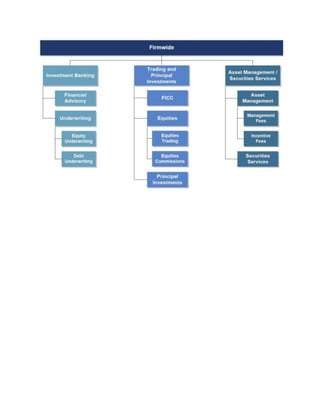
c) Organizational Structure:
Goldman Sachs provides a range of investment banking, investment management and
securities services for our clients. These services are delivered by teams working across
multiple divisions.
Executive Office- Is responsible for communicating with the firm’s key constituents,
including the media, investors, policy makers, alumni and the wider public.
Finance- Manages the firm's liquidity, capital and risk, and provides the overall financial
control and reporting function.
Global Compliance- Dedicated to protecting the reputation of the firm, managing risk
across all business areas.
Global Investment Research- Delivers client-focused research in the equity, fixed
income, currency and commodities markets.
Human Capital Management- Responsible for attracting, developing and managing the
firm's biggest asset: our people.
Internal Audit- Assesses the firm's internal control structure, advises management on
developing control solutions, and monitors the implementation of these measures.
Investment Banking- Aspires to be the leading trusted advisor and financier to our clients.
Investment Management- Works with clients to develop advanced portfolio management
strategies.
Legal- Performs an essential role in the formulation and implementation of the strategy of
Goldman Sachs.
Merchant Banking- Invests in corporate, real estate and infrastructure investments
worldwide.
Operations- For every trade agreed, new product launched, market entered, and
transaction completed, Operations enables business to flow.
Realty Management- The Realty Management Division (RMD) provides real estate
investment services and asset management to investments.
Securities- Enables our clients to buy and sell financial products, raise funding and
manage risk.
Services- Provides essential advisory and management services to the people of Goldman
Sachs.
Technology- Envisions, builds and deploys industry-leading innovations that drive our
business and extend boundaries.
d) Awards:
Asia Money: Country Deal Awards (January 2012)
Included on 3 of the 4 country awards: India, Hong Kong and China
Asia Money Japan: Deals of the Year (February 2012)
Recognized in four categories:
Best Securitization
Best Local Currency Bond
Best Equity Offering
Best M&A
Asia Money: Deals of the Year Awards (December 2012)
Named Best Equity Arranger
Named Best Investment Bank
Best M&A Transaction
Best IPO Transaction
Best Equity Offering
The Banker: Deals of the Year (May 2012)
Recognized for our role in the following deals:
Americas: Corporate Bonds
Americas: Bonds SSA
Americas: Infrastructure and Project Finance
Americas: M&A
Asia Pacific: FIG Capital Raising
Asia Pacific: M&A
Europe: Corporate Bonds
Europe: Bonds SSA
Europe: Equities
The Banker: Top 1000 Banks (July 2012)
#20 overall
Euromoney: Awards for Excellence (June 2012)
Named Best M&A House in the Middle East
Euromoney: Deals of the Year (February 2012)
Best Global Markets Deals
Best Latin America Deal
Best Emerging Europe Deals
Best Asia Deals
Best Middle East and Africa Deal
Euromoney: Regional and Country Awards for Excellence (July 2012)
Goldman Sachs honored with 17 awards
House Awards: (1) Best Global M&A House (2) Best Global Emerging Markets Equity
House
EMEA Awards:
Best M&A House in Russia
Best M&A House in Central Eastern Europe
Best M&A House in Africa
Best M&A House in the Nordic and Baltics
Best Investment Bank in Ireland
Best Investment Bank in Belgium
Best Investment Bank in Sweden
Best Investment Bank in Norway
Best Equity House in the Nordic and Baltics
Asia Awards:
Best M&A House in Asia
Best M&A House in Hong Kong
Best M&A House in Australia
FinanceAsia: Country Awards (June 2012)
Best Foreign Investment Bank in China (Third consecutive year)
Best Foreign Investment Bank in Malaysia
Best Foreign Investment Bank in Korea
FORTUNE 500: Annual Survey (May 2012)
#80
#6 in Commercial Banks category
Global Finance: World’s Best Investment Banks (February 2012)
Named the Best Investment Bank and best M&A Bank
Sector Awards – Named best in Oil & Gas
Country Awards – Named best in the US
Region Awards – North America: Best Investment Bank and Best M&A Bank; Western
Europe: Best M&A Bank; Central and Eastern Europe: Best Investment Bank and Best
Equity Bank; Middle East & Africa: Best M&A Bank
Hedge Fund Intelligence: Prime Broker Survey (October 2012)
Named ‘Leading Prime Broker’
JMoney: Annual Awards (April 2012)
Ranked in the top five across three categories: M&A House (#2), Cross Border M&A
House (#1) and Best
Securitization House (#5)
International Financing Review: Annual Awards (December 2012)
EMEA Equity House
Structured Equity House
International Financing Review Asia: Annual Awards (December 2012)
Bank of the Year
Institutional Investor: 300 Ranking (July 2012)
GSAM ranked #9 on the Top 10 Managers list; second year in a row
GSAM ranked #16 among tax-exempt managers
Project Finance: 2011 Deals of the Year (March 2012)
North American Deal of the Year in the Transport Category
III. Work experience:
Being a summer analyst in Goldman Sachs provided the opportunity to apply classroom theory
to "real world" situations thus enhancing my academic and career goals. Our Internship program
was primarily split up into two portions. The first 5 weeks, involved training and carrying out
daily work, whereas, the last 3 weeks, saw lots of work on our final project.
1. Seminars and Training:
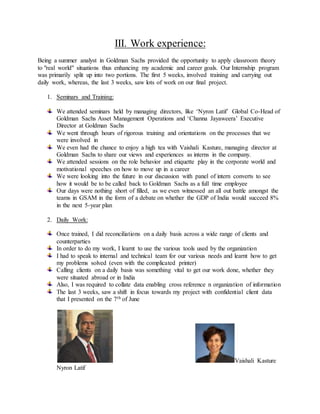
We attended seminars held by managing directors, like ‘Nyron Latif’ Global Co-Head of
Goldman Sachs Asset Management Operations and ‘Channa Jayaweera’ Executive
Director at Goldman Sachs
We went through hours of rigorous training and orientations on the processes that we
were involved in
We even had the chance to enjoy a high tea with Vaishali Kasture, managing director at
Goldman Sachs to share our views and experiences as interns in the company.
We attended sessions on the role behavior and etiquette play in the corporate world and
motivational speeches on how to move up in a career
We were looking into the future in our discussion with panel of intern converts to see
how it would be to be called back to Goldman Sachs as a full time employee
Our days were nothing short of filled, as we even witnessed an all out battle amongst the
teams in GSAM in the form of a debate on whether the GDP of India would succeed 8%
in the next 5-year plan
2. Daily Work:
Once trained, I did reconciliations on a daily basis across a wide range of clients and
counterparties
In order to do my work, I learnt to use the various tools used by the organization
I had to speak to internal and technical team for our various needs and learnt how to get
my problems solved (even with the complicated printer)
Calling clients on a daily basis was something vital to get our work done, whether they
were situated abroad or in India
Also, I was required to collate data enabling cross reference n organization of information
The last 3 weeks, saw a shift in focus towards my project with confidential client data
that I presented on the 7th of June
Vaishali Kasture
Nyron Latif
IV. Conclusion:
Findings and Recommendations:
Overall, I had an incredible experience of a journey over these 8 weeks, which helped me to
grow and learn by leaps and bounds. This internship has benefited me in more ways than one and
I would recommend it to any other student looking for an internship:
Gained Valuable Work Experience- This internship provided the opportunity to gain
hands on work experience that I just can’t get in the classroom.
Having an Edge in the Job Market- Employers are usually more concerned with our work
experience than our qualifications and internships are often the only way to get the work
experience we need to secure a job, so they're a vital part of our resume and are essential
as it sets us apart from the others
Transition into a Job- Employers see interns as prospective employees and many finish
their internships at Goldman Sachs and continue working with the company full time. It’s
like a really long interview, after which we’ve proved that we are capable and
hardworking. Just as we’re giving the industry and the company a trial run, they’re doing
the same for us
Helps decide if this is the Right Career for me- I wasn’t sure if this was the right career
for me, and so doing an internship was a great way to try it out
Networking Opportunities- Internships are a great way to meet people in the same field.
By finding the right contacts, it could help in landing a job in the future
Apply Classroom Knowledge- This internship can be seen as the pinnacle of my
undergraduate education and gives me the chance to use the skills that I've learned in the
classroom in a real-world setting. It’s a chance to prove to myself that I’m worthy of my
qualifications and that I can perform in the role that I’m given
Gaining Confidence- Getting experience was a great way to build my confidence. After
this internship, if an interviewer asks if me know how to do something, I won’t say “um,
yes, I think I would be able to do that”• but I can say “absolutely” and supplement my
assertion with examples
V) Bibliography:
www.wikipedia.com
www.goldmansachs.com
internship project

internship project

  • 1.
  • 2.
    Declaration: I, Esha Jiwanmall,student of St. Joseph’s College of Commerce, Bangalore, register number 11SJCC260 of B.COM batch 2011-2014, hereby declare that I have completed my internship as a summer analyst from 15th April 2013 to the 7th June 3013 at GOLDMAN SACHS Embassy Golf Links, Business Park, Off Intermediate Ring Road, Domlur, Bangalore, Karnataka 560071 under the Operations Division. I interned in GSAM (Goldman Sachs Asset Management) with the team PCA Derivatives for this tenure as parts of the Operations division. I hereby declare that this internship report includes the results of my own internship work, pursued under the guidance of Mrs. Veena Anand, St Joseph’s College of Commerce, Bangalore and further declare that it has not been submitted earlier to any other university or institution for the award of any diploma or degree/certificate or published any time before.
  • 3.
    Acknowledgement: I would liketo thank our college, St. Josephs College of Commerce, for giving us opportunities to intern in a prestigious company like Goldman Sachs through campus recruitments. I would like to thank Goldman Sachs (OPS) for teaching and taking in interns for such an amazing opportunity. I would like to thank my manager Mrs. Aruna Prathiban for all her guidance and my intern buddy Ms. Shalini for all the patience as well as the rest of my colleagues in team PCA Derivatives. I would like to thank our intern guide Mrs. Veena Anand, for helping us with any doubts that we had. Finally and most importantly, I would like to thank God, for helping me throughout the process of two months in Goldman Sachs.
  • 4.
    Table of contents: Serial No.Content Page No. I. Introduction: 6 -8 a) Focus 6 b) Objectives 7 c) Scope and limitations 8 d) Periodof the study 8 II. Profile of the Company: 9 - 18 a) CompanyHistory 9 - 11 b) Products/Services 12 -13 c) OrganizationChart 14 -15 d) Achievements/Awards 16 -18 III. Work experience: 19 IV. Conclusion: 20 a) FindingsandRecommendations 20 V. Bibliography: 21
  • 5.
    I. Introduction: a) Focus: Asa summer analyst working with the team PCA Derivatives, our main focus was to step into the corporate world while learning the culture and ethics of Goldman Sachs. Being an intern in Goldman Sachs resulted in a smooth transition from college campus to a business environment. From day one at our Orientation, we were put through training sessions, as our prime focus was to learn as much as possible about the company and its processes, enabling us to be better future employees. We were required to sit with our managers and colleagues and see on a first hand basis, what a full time day is like in Goldman Sachs. Once our training was complete, we had our own day to day check list to complete which was crucial to the team and company. At end of our hard-worked 8 weeks, we were asked to present a project to the organization to depict our progress and growth in knowledge of the company and the environment it works in.
  • 6.
    b) Objectives: Being asummer analyst in Goldman Sachs had not just the basic objectives of getting a glimpse into the corporate jungle, but to also transform us into being ready for it. To go through several trainings, to have a deeper understanding of the trade and investment banking world. To increase our base of knowledge on products like forwards, futures, options, put/call combinations and swaps. To look up and learn the various systems used by Goldman Sachs as well as other banks. To not just attend but invite and hold meetings, with other interns, colleagues, teams, managers and vice-presidents. To build up our confidence in speaking to managers and clients whether on a face to face basis or through emails or on telephone conversations. To understand that communication and correspondence is key to any organization. To learn an intermediate level of Microsoft Excel enabling us to do our day to day work on a quicker and more efficient manner. To learn how to prepare presentations and data in a manner that is easily understood and effective. To deliver them to people on a much higher level, without the fear of public speaking.
  • 7.
    c) Scope andLimitations: Being a Goldman summer analyst let me experience, first-hand, the kind of work that goes on in this particular field of finance, trade and investment banking. It's was a great opportunity to figure out what my interests are and to further motivate myself in a direction in helping you think about career choices and future plans. This internship was touted as a way of: getting experience building a contact list and networking taking advantage of the opportunity to kick-start a career The few limitations that we faced being interns were; being unable to send data out of the company due to restricted access having limited knowledge as to processes due to a higher education not being fulfilled having lack of clarity as to our purpose and objective within the organization for the first few days d) Period of the study: Our period of study in Goldman Sachs was a total of 8 weeks, from 15th April 2013 to the 7th June 2013. We worked a minimum of 8 hours per day, up to ten hours when our work or projects so required.
  • 8.
    II. Profile ofthe Company: a) History: Starting 1869 Goldman Sachs was founded in New York in 1869 by the German-born Marcus Goldman. In 1882, Goldman's son-in-law Samuel Sachs joined the firm. In 1885, Goldman took his son Henry and his son-in-law Ludwig Dreyfuss into the business and the firm adopted its present name, Goldman Sachs & Co. The company made a name for itself pioneering the use of commercial paper for entrepreneurs and was invited to join the New York Stock Exchange (NYSE) in 1896. In the early 20th century, Goldman was a player in establishing the initial public offering (IPO) market. It managed one of the largest IPOs to date, that of Sears, Roebuck and Company in 1906. It also became one of the first companies to heavily recruit those with MBA degrees from leading business schools, a practice that still continues today. On December 4, 1928, it launched the Goldman Sachs Trading Corp. a closed-end fund. The fund failed as a result of the Stock Market Crash of 1929, hurting the firm's reputation for several years afterward. Of this case and others like Blue Ridge Corporation and Shenandoah Corporation John Kenneth Galbraith wrote: "The Autumn of 1929 was, perhaps, the first occasion when men succeeded on a large scale in swindling themselves." 1930–1980 In 1930, Sidney Weinberg assumed the role of senior partner and shifted Goldman's focus away from trading and towards investment banking. It was Weinberg's actions that helped to restore some of Goldman's tarnished reputation. On the back of Weinberg, Goldman was lead advisor on the Ford Motor Company's IPO in 1956, which at the time was a major coup on Wall Street. Under Weinberg's reign the firm also started an investment research division and a municipal bond department. It also was at this time that the firm became an early innovator in risk arbitrage. Gus Levy joined the firm in the 1950s as a securities trader, which started a trend at Goldman where there would be two powers generally vying for supremacy, one from investment banking and one from securities trading. For most of the 1950s and 1960s, this would be Weinberg and Levy. Levy was a pioneer in block trading and the firm established this trend under his guidance. Due to Weinberg's heavy influence at the firm, it formed an investment banking division in 1956 in an attempt to spread around influence and not focus it all on Weinberg.
  • 9.
    In 1969, Levytook over as Senior Partner from Weinberg, and built Goldman's trading franchise once again. It is Levy who is credited with Goldman's famous philosophy of being "long-term greedy", which implied that as long as money is made over the long term; trading losses in the short term were not to be worried about. At the same time, partners reinvested almost all of their earnings in the firm, so the focus was always on the future. That same year, Weinberg retired from the firm. Another financial crisis for the firm occurred in 1970, when the Penn Central Transportation Company went bankrupt with over $80 million in commercial paper outstanding, most of it issued through Goldman Sachs. The bankruptcy was large, and the resulting lawsuits, notably by the SEC, threatened the partnership capital, life and reputation of the firm. It was this bankruptcy that resulted in credit ratings being created for every issuer of commercial paper today by several credit rating services. During the 1970s, the firm also expanded in several ways. Under the direction of Senior Partner Stanley R. Miller, it opened its first international office in London in 1970, and created a private wealth division along with a fixed income division in 1972. It also pioneered the "white knight" strategy in 1974 during its attempts to defend Electric Storage Battery against a hostile takeover bid from International Nickel and Goldman's rival Morgan Stanley. This action would boost the firm's reputation as an investment advisor because it pledged to no longer participate in hostile takeovers. John L. Weinberg (the son of Sidney Weinberg), and John C. Whitehead assumed roles of co- senior partners in 1976, once again emphasizing the co-leadership at the firm. One of their initiatives was the establishment of 14 business principles that the firm still claims to apply. 1980–1999 On November 16, 1981, the firm acquired J. Aron & Company, a commodities trading firm which merged with the Fixed Income division to become known as Fixed Income, Currencies, and Commodities. J. Aron was a player in the coffee and gold markets, and the current CEO of Goldman, Lloyd Blankfein, joined the firm as a result of this merger. In 1985 it underwrote the public offering of the Real Estate Investment Trust that owned Rockefeller Center, then the largest REIT offering in history. In accordance with the beginning of the dissolution of the Soviet Union, the firm also became involved in facilitating the global privatization movement by advising companies that were spinning off from their parent governments. In 1986, the firm formed Goldman Sachs Asset Management, which manages the majority of its mutual funds and hedge funds today. In the same year, the firm also underwrote the IPO of Microsoft, advised General Electric on its acquisition of RCA and joined the London and Tokyo stock exchanges. 1986 also was the year when Goldman became the first United States bank to rank in the top 10 of mergers and acquisitions in the United Kingdom. During the 1980s the firm became the first bank to distribute its investment research electronically and created the first public offering of original issue deep-discount bond.
  • 10.
    Robert Rubin andStephen Friedman assumed the Co-Senior Partnership in 1990 and pledged to focus on globalization of the firm and strengthening the Merger & Acquisition and Trading business lines. During their reign, the firm introduced paperless trading to the New York Stock Exchange and lead-managed the first-ever global debt offering by a U.S. corporation. It also launched the Goldman Sachs Commodity Index (GSCI) and opened a Beijing office in 1994. Also in 1994, Jon Corzine assumed leadership of the firm as CEO, following the departure of Rubin and Friedman. Another momentous event in Goldman's history was the Mexican bailout of 1995. Rubin drew criticism in Congress for using a Treasury Department account under his personal control to distribute $20 billion to bail out Mexican bonds, of which Goldman was a key distributor.[17] On November 22, 1994, the Mexican Bolsa stock market had admitted Goldman Sachs and one other firm to operate on that market. The 1994 economic crisis in Mexico threatened to wipe out the value of Mexico's bonds held by Goldman Sachs. The firm joined David Rockefeller and partners in a 50–50 joint ownership of Rockefeller Center during 1994, but later sold the shares to Tishman Speyer in 2000. In 1996, Goldman was lead underwriter of the Yahoo! IPO and in 1998 it was global coordinator of the NTT DoCoMo IPO. In 1999, Henry Paulson took over as Senior Partner. Since 1999 One of the largest events in the firm's history was its own IPO in 1999. The decision to go public was one that the partners debated for decades. In the end, Goldman decided to offer only a small portion of the company to the public, with some 48% still held by the partnership pool. 22% of the company was held by non-partner employees, and 18% was held by retired Goldman partners and two longtime investors, Sumitomo Bank Ltd. and Hawaii's Kamehameha Activities Assn (the investing arm of Kamehameha Schools). This left approximately 12% of the company as being held by the public. With the firm's 1999 IPO, Paulson became Chairman and Chief Executive Officer of the firm. As of 2009, after further stock offerings to the public, Goldman is 67% owned by institutions (such as pension funds and other banks). In 1999, Goldman acquired Hull Trading Company, one of the world's premier market-making firms, for $531 million. More recently, the firm has been busy both in investment banking and in trading activities. It purchased Spear, Leeds, & Kellogg, one of the largest specialist firms on the New York Stock Exchange, for $6.3 billion in September 2000. It also advised on a debt offering for the Government of China and the first electronic offering for the World Bank. In 2003 it took a 45% stake in a joint venture with JBWere, the Australian investment bank. In 2009 The Private Wealth Management arm of JBWere was sold into a joint venture with National Australia Bank. Goldman opened a full-service broker-dealer in Brazil in 2007, after having set up an investment banking office in 1996. It expanded its investments in companies to include Burger King, McJunkin Corporation, and in January 2007, Alliance Atlantis alongside CanWest Global Communications to own sole broadcast rights to the all three CSI series. The firm is also heavily involved in energy trading, including oil, on both a principal and agent basis.
  • 11.
    b) Products: Investment banking Investmentbanking is divided into two divisions and includes Financial Advisory (mergers and acquisitions, investitures, corporate defense activities, restructuring and spin-offs) and Underwriting (public offerings and private placements of equity, equity-related and debt instruments). Goldman Sachs is one of the leading M&A advisory firms, often topping the league tables in terms of transaction size. The firm gained a reputation as a white knight in the mergers and acquisitions sector by advising clients on how to avoid hostile takeovers, moves generally viewed as unfriendly to shareholders of targeted companies. Goldman Sachs, for a long time during the 1980s, was the only major investment bank with a strict policy against helping to initiate a hostile takeover, which increased the firm's reputation immensely among sitting management teams at the time. The investment banking segment accounts for around 17 percent of Goldman Sachs' revenues. The firm has been involved in brokering deals to privatize major highways by selling them to foreign investors, in addition to advising state and local governments – including Indiana, Texas, and Chicago – on privatization projects. Trading and principal investments Trading and Principal Investments is the largest of the three segments, and is the company's profit center. The segment is divided into four divisions and includes Fixed Income (The trading of interest rate and credit products, mortgage-backed securities, insurance-linked securities and structured and derivative products), Currency and Commodities (The trading of currencies and commodities), Equities (The trading of equities, equity derivatives, structured products, options, and futures contracts), and Principal Investments (merchant banking investments and funds). This segment consists of the revenues and profit gained from the Bank's trading activities, both on behalf of its clients (known as flow trading) and for its own account (known as proprietary trading). Most trading done by Goldman is not speculative, but rather an attempt to profit from bid-ask spreads in the process of acting as a market maker. On average, around 68 percent of Goldman's revenues and profits are derived from trading. Upon its IPO, Goldman predicted that this segment would not grow as fast as its Investment Banking division and would be responsible for a shrinking proportion of earnings. The opposite has been true however, resulting in now-CEO Blankfein's appointment to President and Chief Operating Officer after John Thain's departure to run the NYSE and John L. Thornton's departure for an academic position in China.
  • 12.
    Asset management andsecurities services As the name suggests, the firm's Asset Management and Securities Services segment is divided into two components: Asset Management and Securities Services. The Asset Management division provides investment advisory and financial planning services and offers investment products (primarily through separately managed accounts and commingled vehicles) across all major asset classes to a diverse group of institutions and individuals worldwide. The unit primarily generates revenues in the form of management and incentive fees. The Securities Services division provides clearing, financing, custody, securities lending, and reporting services to institutional clients, including hedge funds, mutual funds, and pension funds. The division generates revenues primarily in the form of interest rate spreads or fees. In 2009, the Goldman Sachs Asset Management hedge fund was the 9th largest in the United States, with $20.58 billion under management. This was down from $32.5 billion in 2007, after client redemptions and weaker investment performance. On September 14, 2011, Goldman Sachs stated it was shutting down the Global Alpha fund, once the firm's largest hedge fund. The announcement followed a reported decline in fund balances to less than $1.7 billion in June 2011 from $11 billion in 2007. The decline was caused by investors withdrawing from the fund following earlier substantial market losses. The firm said it expected most of the fund assets to be liquidated by mid-October 2011.
  • 13.
    c) Organizational Structure: GoldmanSachs provides a range of investment banking, investment management and securities services for our clients. These services are delivered by teams working across multiple divisions. Executive Office- Is responsible for communicating with the firm’s key constituents, including the media, investors, policy makers, alumni and the wider public. Finance- Manages the firm's liquidity, capital and risk, and provides the overall financial control and reporting function. Global Compliance- Dedicated to protecting the reputation of the firm, managing risk across all business areas. Global Investment Research- Delivers client-focused research in the equity, fixed income, currency and commodities markets. Human Capital Management- Responsible for attracting, developing and managing the firm's biggest asset: our people. Internal Audit- Assesses the firm's internal control structure, advises management on developing control solutions, and monitors the implementation of these measures. Investment Banking- Aspires to be the leading trusted advisor and financier to our clients. Investment Management- Works with clients to develop advanced portfolio management strategies. Legal- Performs an essential role in the formulation and implementation of the strategy of Goldman Sachs. Merchant Banking- Invests in corporate, real estate and infrastructure investments worldwide. Operations- For every trade agreed, new product launched, market entered, and transaction completed, Operations enables business to flow. Realty Management- The Realty Management Division (RMD) provides real estate investment services and asset management to investments. Securities- Enables our clients to buy and sell financial products, raise funding and manage risk. Services- Provides essential advisory and management services to the people of Goldman Sachs. Technology- Envisions, builds and deploys industry-leading innovations that drive our business and extend boundaries.
  • 15.
    d) Awards: Asia Money:Country Deal Awards (January 2012) Included on 3 of the 4 country awards: India, Hong Kong and China Asia Money Japan: Deals of the Year (February 2012) Recognized in four categories: Best Securitization Best Local Currency Bond Best Equity Offering Best M&A Asia Money: Deals of the Year Awards (December 2012) Named Best Equity Arranger Named Best Investment Bank Best M&A Transaction Best IPO Transaction Best Equity Offering The Banker: Deals of the Year (May 2012) Recognized for our role in the following deals: Americas: Corporate Bonds Americas: Bonds SSA Americas: Infrastructure and Project Finance Americas: M&A Asia Pacific: FIG Capital Raising Asia Pacific: M&A Europe: Corporate Bonds Europe: Bonds SSA Europe: Equities The Banker: Top 1000 Banks (July 2012) #20 overall Euromoney: Awards for Excellence (June 2012) Named Best M&A House in the Middle East Euromoney: Deals of the Year (February 2012) Best Global Markets Deals Best Latin America Deal Best Emerging Europe Deals
  • 16.
    Best Asia Deals BestMiddle East and Africa Deal Euromoney: Regional and Country Awards for Excellence (July 2012) Goldman Sachs honored with 17 awards House Awards: (1) Best Global M&A House (2) Best Global Emerging Markets Equity House EMEA Awards: Best M&A House in Russia Best M&A House in Central Eastern Europe Best M&A House in Africa Best M&A House in the Nordic and Baltics Best Investment Bank in Ireland Best Investment Bank in Belgium Best Investment Bank in Sweden Best Investment Bank in Norway Best Equity House in the Nordic and Baltics Asia Awards: Best M&A House in Asia Best M&A House in Hong Kong Best M&A House in Australia FinanceAsia: Country Awards (June 2012) Best Foreign Investment Bank in China (Third consecutive year) Best Foreign Investment Bank in Malaysia Best Foreign Investment Bank in Korea FORTUNE 500: Annual Survey (May 2012) #80 #6 in Commercial Banks category Global Finance: World’s Best Investment Banks (February 2012) Named the Best Investment Bank and best M&A Bank Sector Awards – Named best in Oil & Gas Country Awards – Named best in the US Region Awards – North America: Best Investment Bank and Best M&A Bank; Western Europe: Best M&A Bank; Central and Eastern Europe: Best Investment Bank and Best Equity Bank; Middle East & Africa: Best M&A Bank
  • 17.
    Hedge Fund Intelligence:Prime Broker Survey (October 2012) Named ‘Leading Prime Broker’ JMoney: Annual Awards (April 2012) Ranked in the top five across three categories: M&A House (#2), Cross Border M&A House (#1) and Best Securitization House (#5) International Financing Review: Annual Awards (December 2012) EMEA Equity House Structured Equity House International Financing Review Asia: Annual Awards (December 2012) Bank of the Year Institutional Investor: 300 Ranking (July 2012) GSAM ranked #9 on the Top 10 Managers list; second year in a row GSAM ranked #16 among tax-exempt managers Project Finance: 2011 Deals of the Year (March 2012) North American Deal of the Year in the Transport Category
  • 18.
    III. Work experience: Beinga summer analyst in Goldman Sachs provided the opportunity to apply classroom theory to "real world" situations thus enhancing my academic and career goals. Our Internship program was primarily split up into two portions. The first 5 weeks, involved training and carrying out daily work, whereas, the last 3 weeks, saw lots of work on our final project. 1. Seminars and Training: We attended seminars held by managing directors, like ‘Nyron Latif’ Global Co-Head of Goldman Sachs Asset Management Operations and ‘Channa Jayaweera’ Executive Director at Goldman Sachs We went through hours of rigorous training and orientations on the processes that we were involved in We even had the chance to enjoy a high tea with Vaishali Kasture, managing director at Goldman Sachs to share our views and experiences as interns in the company. We attended sessions on the role behavior and etiquette play in the corporate world and motivational speeches on how to move up in a career We were looking into the future in our discussion with panel of intern converts to see how it would be to be called back to Goldman Sachs as a full time employee Our days were nothing short of filled, as we even witnessed an all out battle amongst the teams in GSAM in the form of a debate on whether the GDP of India would succeed 8% in the next 5-year plan 2. Daily Work: Once trained, I did reconciliations on a daily basis across a wide range of clients and counterparties In order to do my work, I learnt to use the various tools used by the organization I had to speak to internal and technical team for our various needs and learnt how to get my problems solved (even with the complicated printer) Calling clients on a daily basis was something vital to get our work done, whether they were situated abroad or in India Also, I was required to collate data enabling cross reference n organization of information The last 3 weeks, saw a shift in focus towards my project with confidential client data that I presented on the 7th of June Vaishali Kasture Nyron Latif
  • 19.
    IV. Conclusion: Findings andRecommendations: Overall, I had an incredible experience of a journey over these 8 weeks, which helped me to grow and learn by leaps and bounds. This internship has benefited me in more ways than one and I would recommend it to any other student looking for an internship: Gained Valuable Work Experience- This internship provided the opportunity to gain hands on work experience that I just can’t get in the classroom. Having an Edge in the Job Market- Employers are usually more concerned with our work experience than our qualifications and internships are often the only way to get the work experience we need to secure a job, so they're a vital part of our resume and are essential as it sets us apart from the others Transition into a Job- Employers see interns as prospective employees and many finish their internships at Goldman Sachs and continue working with the company full time. It’s like a really long interview, after which we’ve proved that we are capable and hardworking. Just as we’re giving the industry and the company a trial run, they’re doing the same for us Helps decide if this is the Right Career for me- I wasn’t sure if this was the right career for me, and so doing an internship was a great way to try it out Networking Opportunities- Internships are a great way to meet people in the same field. By finding the right contacts, it could help in landing a job in the future Apply Classroom Knowledge- This internship can be seen as the pinnacle of my undergraduate education and gives me the chance to use the skills that I've learned in the classroom in a real-world setting. It’s a chance to prove to myself that I’m worthy of my qualifications and that I can perform in the role that I’m given Gaining Confidence- Getting experience was a great way to build my confidence. After this internship, if an interviewer asks if me know how to do something, I won’t say “um, yes, I think I would be able to do that”• but I can say “absolutely” and supplement my assertion with examples
  • 20.