By Rafael Medina and  Alejandro Montoya
The following presentation is what we have accomplished in this fabulous summer internship at SPAWAR SSC San Diego Rafael Medina Alejandro Montoya.
Group Work and Friendship. How To Use Mat-lab Fiber Optics  How natural light can be sent through fiber optic cable Laser Comm kit.
Awe Inspiring views
Small but effective Melting pot of ideas Where anything is possible
Group Work and friendship
a high-performance language. an interactive system for matrix based computation designed for scientific and engineering use.  can handle differential equations, polynomials, signal procession, and other applications. includes integrated computation, visualization an easy to use program where problems and solutions can be expressed in mathematical notation.
Continuing Efforts on 2007 Internship Project
Continuing Efforts
Gaining partners
Goal: to understand and learn how to operate the Laser Comm kit. The LaserComm kit consists of a Laser diode transmitter,  microphone, laser receiver, power supply and loudspeaker hooked up to a video camera and television  to allow viewing and transmission of video.
The LaserCom modulates the amplitude and length of  the laser light and sends it to the receiver which decodes the signal and passes it to either a speaker or television or both.
Laser Comm Kit(…Continued)
Pitching a project Flexible light http://www.ecogeek.org/content/view/246/83/
Laser light can be sent through a fiber optic cable with little loss, proving that a concentrated beam can be transmitted, similarly, it should be possible to send concentrated natural light indoors.
Flexible light (…Continued) Natural light  sent through fiberoptics can potentailly be used indoors  without having to do expensive  modifications to building structure Saving not only electricity  but lessening  the carbon footprint of our facilities.
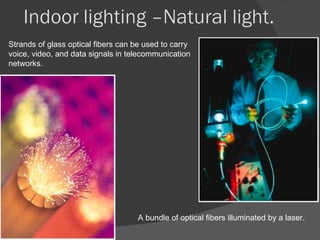
A bundle of optical fibers illuminated by a laser. Strands of glass optical fibers can be used to carry voice, video, and data signals in telecommunication networks.
Fiber Optics can send signals down hair-thin strands of glass or plastic fiber The light is "guided" down the center of the fiber or  "core".  The core is surrounded by optical material or "cladding" that traps the light in the core using an optical technique called "total internal reflection.”
The core and cladding are  made of ultra-pure glass, plastic or a glass core and plastic cladding.  The fiber is coated with a protective plastic covering called the "primary buffer coating" that protects it from moisture and other damage.  More protection is provided by the "cable" which has the fibers and strength members inside an outer covering called a "jacket".
AUVSI Competition
Information can be sent through Light and through optical fiber  and that it is possible to introduce natural light indoors to help minimize cost and improve workspace. there is a significant loss of information over long distances with light, but it can be made to go around corners with reflection and focused for longer distances. The beam must be focused on to the receiver with a focal lens to be able to receive the most information possible. It is very hard to pass light onto optical fiber, it must be concentrated and focused before entering the fiber.
This work was funded by the Office of Naval Research,  under the Internal Applied Research (IAR) Program at  SPAWAR Systems Center San Diego. The National Science Foundation (NSF) The LIPP Family Foundation. We would also like to Thank everybody at MESA, SPAWAR, our mentors: Brian Williams and Matt Boss  Especially Mr. Ayax Ramirez and Dr. Raga Bakhiet , for making  these life changing internships possible for their unwavering, faith and commitment to the Southwestern College SPAWAR internships and for their dedication to us students.
Goodbye Dave

Internship Presentation

  • 1.
    By Rafael Medinaand Alejandro Montoya
  • 2.
    The following presentationis what we have accomplished in this fabulous summer internship at SPAWAR SSC San Diego Rafael Medina Alejandro Montoya.
  • 3.
    Group Work andFriendship. How To Use Mat-lab Fiber Optics How natural light can be sent through fiber optic cable Laser Comm kit.
  • 4.
  • 5.
    Small but effectiveMelting pot of ideas Where anything is possible
  • 6.
    Group Work andfriendship
  • 7.
    a high-performance language.an interactive system for matrix based computation designed for scientific and engineering use. can handle differential equations, polynomials, signal procession, and other applications. includes integrated computation, visualization an easy to use program where problems and solutions can be expressed in mathematical notation.
  • 8.
    Continuing Efforts on2007 Internship Project
  • 9.
  • 10.
  • 11.
    Goal: to understandand learn how to operate the Laser Comm kit. The LaserComm kit consists of a Laser diode transmitter, microphone, laser receiver, power supply and loudspeaker hooked up to a video camera and television to allow viewing and transmission of video.
  • 12.
    The LaserCom modulatesthe amplitude and length of the laser light and sends it to the receiver which decodes the signal and passes it to either a speaker or television or both.
  • 13.
  • 14.
  • 15.
    Pitching a projectFlexible light http://www.ecogeek.org/content/view/246/83/
  • 16.
    Laser light canbe sent through a fiber optic cable with little loss, proving that a concentrated beam can be transmitted, similarly, it should be possible to send concentrated natural light indoors.
  • 17.
    Flexible light (…Continued)Natural light sent through fiberoptics can potentailly be used indoors without having to do expensive modifications to building structure Saving not only electricity but lessening the carbon footprint of our facilities.
  • 18.
    A bundle ofoptical fibers illuminated by a laser. Strands of glass optical fibers can be used to carry voice, video, and data signals in telecommunication networks.
  • 19.
    Fiber Optics cansend signals down hair-thin strands of glass or plastic fiber The light is "guided" down the center of the fiber or "core". The core is surrounded by optical material or "cladding" that traps the light in the core using an optical technique called "total internal reflection.”
  • 20.
    The core andcladding are made of ultra-pure glass, plastic or a glass core and plastic cladding. The fiber is coated with a protective plastic covering called the "primary buffer coating" that protects it from moisture and other damage. More protection is provided by the "cable" which has the fibers and strength members inside an outer covering called a "jacket".
  • 21.
  • 22.
    Information can besent through Light and through optical fiber and that it is possible to introduce natural light indoors to help minimize cost and improve workspace. there is a significant loss of information over long distances with light, but it can be made to go around corners with reflection and focused for longer distances. The beam must be focused on to the receiver with a focal lens to be able to receive the most information possible. It is very hard to pass light onto optical fiber, it must be concentrated and focused before entering the fiber.
  • 23.
    This work wasfunded by the Office of Naval Research, under the Internal Applied Research (IAR) Program at SPAWAR Systems Center San Diego. The National Science Foundation (NSF) The LIPP Family Foundation. We would also like to Thank everybody at MESA, SPAWAR, our mentors: Brian Williams and Matt Boss Especially Mr. Ayax Ramirez and Dr. Raga Bakhiet , for making these life changing internships possible for their unwavering, faith and commitment to the Southwestern College SPAWAR internships and for their dedication to us students.
  • 24.