IoT
Afif Al Mamun
Contents
ď‚§ Introduction to IoT
ď‚§ Key Characteristics
ď‚§ Technologies Used
 Security of IoT & It’s Necessity
ď‚§ Threats & Countermeasures
ď‚§ Few Applications
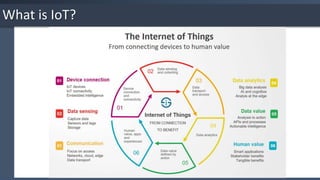
What is IoT?
Key Characteristics
• Intelligence: Intelligence in IoT is only
concerned as means of interaction
between devices
• Connectivity: Connectivity empowers
Internet of Things by bringing together
everyday objects.
• Dynamic Nature: The primary activity of
Internet of Things is to collect data from
its environment, this is achieved with the
dynamic changes that take place around
the devices.
Key Characteristics
• Sensing: Sensing technologies provide the
means to create capabilities that reflect a
true awareness of the physical world and the
people in it.
• Heterogeneity: Ability to interact with
other devices/platform through different
networks.
• Security: Secures data from external world.
Technologies Used
• Interoperability standards
1. Sensors
2. Network & applications own ability
• Wireless protocols
1. Range of connectivity
2. Networking topology
• BLE - Bluetooth Low Energy & BS - Bluetooth Smart
1. Frequency: 2.4GHz
2. Range: less than 150m
3. Data Rates: 1Mbps
• Zigbee
1. Frequency: 2.4GHz
2. Range: Less than 100m
3. Data Rates: 250kbps
Technologies Used
• LPWAN
1. Low range
2. Low power
• WiFi
1. Frequency: 2.4GHz
2. Range: Approximately 50m
3. Data Rates: Up to 1Gbps
Technologies Used
• Cellular
1. Frequency: 900, 1800, 1900, 2100MHz
2. Range: 35km max for GSM, 200km max for HSPA
3. Data Rates: Less than 170kps GPRS, less than
384kbps EDGE, less than 2Mbps UMTS,
less than 10Mbps HSP, 3-10Mbps LTE
Technologies Used
• IoT network security
• IoT authentication
• IoT encryption
IoT Security
• IoT PKI:
Vendors: HPE, Symantec
• IoT security analytics:
Vendors: Cisco, Kaspersky
• IoT API security:
IoT Security
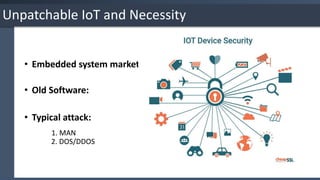
• Embedded system market:
• Old Software:
• Typical attack:
1. MAN
2. DOS/DDOS
Unpatchable IoT and Necessity
Threats & Countermeasures
• Insecure Web Interface
1. Weak Default Credentials
2. SQL – Injection
3. Session Management
• Countermeasures:
1. Changing default username/password during setup
2. Ensuring credentials are not exposed in internal or
external network traffic.
3. Account locking after 3 – 5 failed attempts.
• Insecure Network Authorization
1. Vulnerable Services
2. Exploitable UDP Services
3. Denial-of-Service(DoS)
• Countermeasures:
1. Ensuring Services are not vulnerable to DoS attacks.
2. Ensuring only necessary ports are exposed and available.
3. Ensuring network ports are not exposed to the internet .
Threats & Countermeasures
• Insecure Software/Firmware
1. Encryption Not Used to Fetch Updates
2. Update File not Encrypted
3. Firmware Contains Sensitive Information
• Countermeasures:
1. Ensuring device update ability.
2. Ensuring update file is encrypted as well as the
connection.
3. Ensuring update does not expose sensitive data.
Threats & Countermeasures
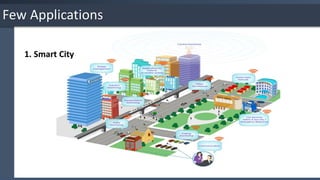
Few Applications
1. Smart City
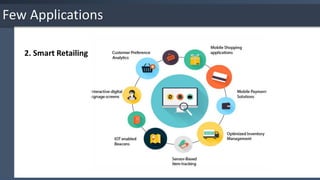
2. Smart Retailing
Few Applications
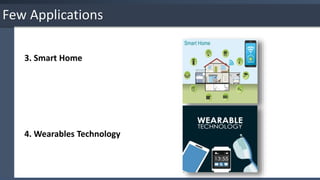
3. Smart Home
4. Wearables Technology
Few Applications
Thank You!

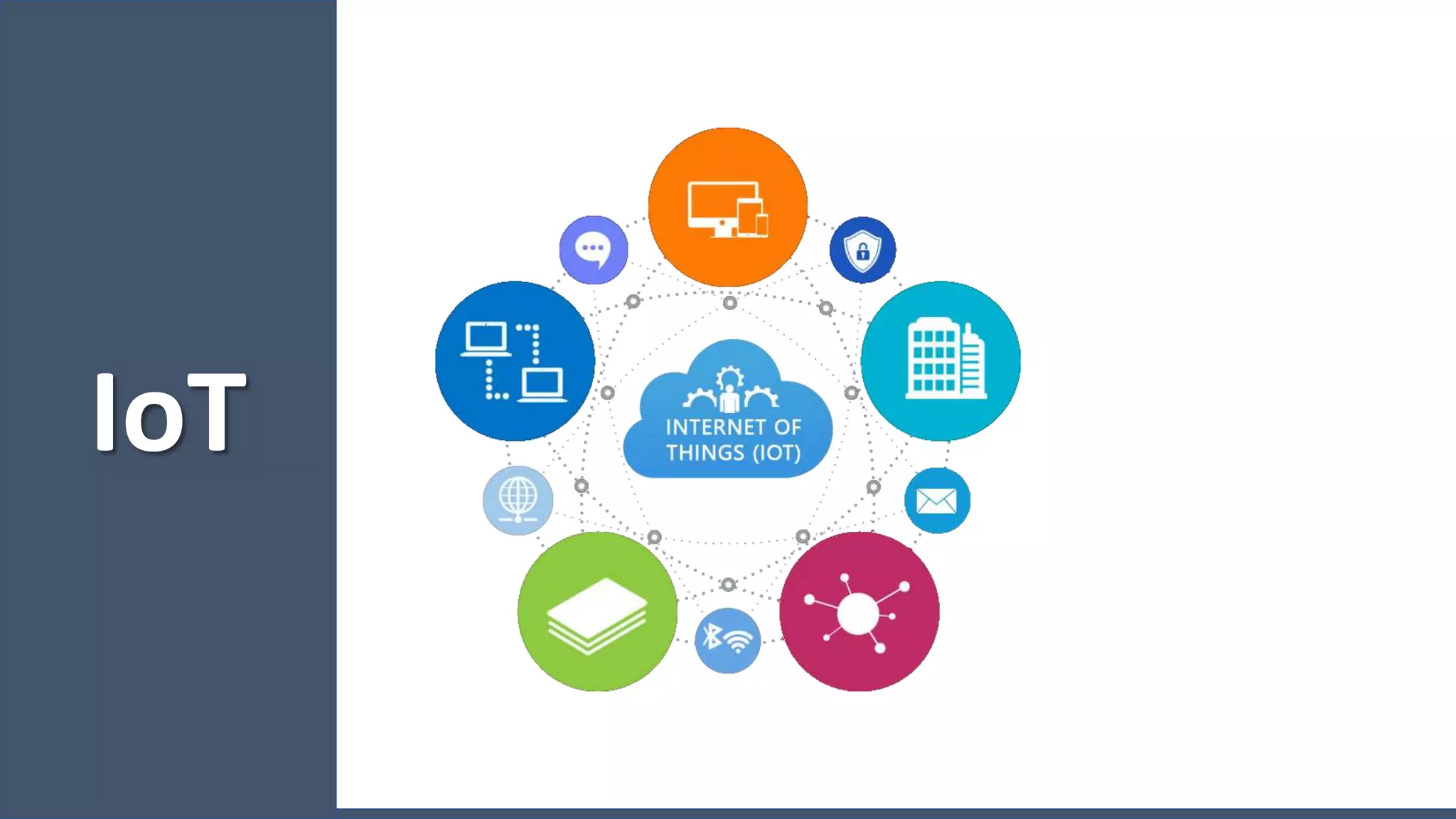
Internet of Things(IoT)

  • 1.
  • 2.
  • 3.
    Contents  Introduction toIoT  Key Characteristics  Technologies Used  Security of IoT & It’s Necessity  Threats & Countermeasures  Few Applications
  • 4.
  • 5.
    Key Characteristics • Intelligence:Intelligence in IoT is only concerned as means of interaction between devices • Connectivity: Connectivity empowers Internet of Things by bringing together everyday objects. • Dynamic Nature: The primary activity of Internet of Things is to collect data from its environment, this is achieved with the dynamic changes that take place around the devices.
  • 6.
    Key Characteristics • Sensing:Sensing technologies provide the means to create capabilities that reflect a true awareness of the physical world and the people in it. • Heterogeneity: Ability to interact with other devices/platform through different networks. • Security: Secures data from external world.
  • 7.
    Technologies Used • Interoperabilitystandards 1. Sensors 2. Network & applications own ability • Wireless protocols 1. Range of connectivity 2. Networking topology
  • 8.
    • BLE -Bluetooth Low Energy & BS - Bluetooth Smart 1. Frequency: 2.4GHz 2. Range: less than 150m 3. Data Rates: 1Mbps • Zigbee 1. Frequency: 2.4GHz 2. Range: Less than 100m 3. Data Rates: 250kbps Technologies Used
  • 9.
    • LPWAN 1. Lowrange 2. Low power • WiFi 1. Frequency: 2.4GHz 2. Range: Approximately 50m 3. Data Rates: Up to 1Gbps Technologies Used
  • 10.
    • Cellular 1. Frequency:900, 1800, 1900, 2100MHz 2. Range: 35km max for GSM, 200km max for HSPA 3. Data Rates: Less than 170kps GPRS, less than 384kbps EDGE, less than 2Mbps UMTS, less than 10Mbps HSP, 3-10Mbps LTE Technologies Used
  • 11.
    • IoT networksecurity • IoT authentication • IoT encryption IoT Security
  • 12.
    • IoT PKI: Vendors:HPE, Symantec • IoT security analytics: Vendors: Cisco, Kaspersky • IoT API security: IoT Security
  • 13.
    • Embedded systemmarket: • Old Software: • Typical attack: 1. MAN 2. DOS/DDOS Unpatchable IoT and Necessity
  • 14.
    Threats & Countermeasures •Insecure Web Interface 1. Weak Default Credentials 2. SQL – Injection 3. Session Management • Countermeasures: 1. Changing default username/password during setup 2. Ensuring credentials are not exposed in internal or external network traffic. 3. Account locking after 3 – 5 failed attempts.
  • 15.
    • Insecure NetworkAuthorization 1. Vulnerable Services 2. Exploitable UDP Services 3. Denial-of-Service(DoS) • Countermeasures: 1. Ensuring Services are not vulnerable to DoS attacks. 2. Ensuring only necessary ports are exposed and available. 3. Ensuring network ports are not exposed to the internet . Threats & Countermeasures
  • 16.
    • Insecure Software/Firmware 1.Encryption Not Used to Fetch Updates 2. Update File not Encrypted 3. Firmware Contains Sensitive Information • Countermeasures: 1. Ensuring device update ability. 2. Ensuring update file is encrypted as well as the connection. 3. Ensuring update does not expose sensitive data. Threats & Countermeasures
  • 17.
  • 18.
  • 19.
    3. Smart Home 4.Wearables Technology Few Applications
  • 20.