LOGO
Internet of Things
Dodi Saputra
Manajemen Informatika A
Semester 2
Politeknik Negeri Lampung
Daftar pustaka
http://www.slideshare.net/rams8055/the-internet-of-
things-31895956?related=1
UPM E.U.I.T. Diatel
Xi Chen scotor317@gmail.com
Contents of Introduction
What’s Internet of Things
: Apa Internet of Things1
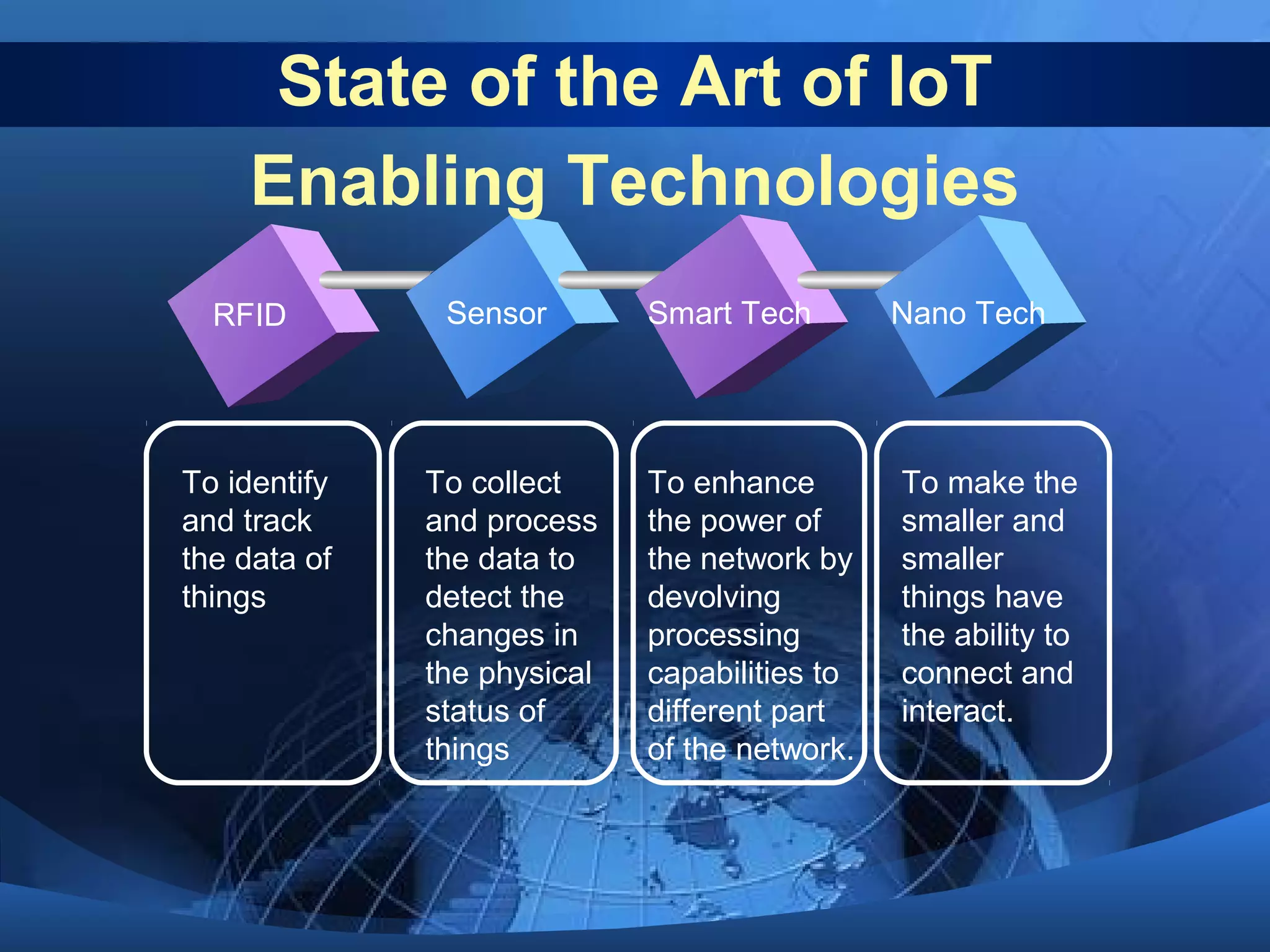
State of the Art of IoT
: Negara Seni IOT2
Challenges and Limitation of IoT
: Tantangan dan Batasan IOT3
Future of IoT
: Masa Depan IOT4
What’s the Internet of Things
 Definition
(1) The Internet of Things, also called The Internet of
Objects, refers to a wireless network between objects,
usually the network will be wireless and self-
configuring, such as household appliances.
------Wikipedia
(2) By embedding short-range mobile transceivers
into a wide array of additional gadgets and everyday
items, enabling new forms of communication between
people and things, and between things themselves.
------WSIS 2005
What’s the Internet of Things
 Definition
(3) The term "Internet of Things" has come to
describe a number of technologies and research
disciplines that enable the Internet to reach out into
the real world of physical objects.
------IoT 2008
(4) “Things having identities and virtual personalities
operating in smart spaces using intelligent interfaces
to connect and communicate within social,
environmental, and user contexts”.
-------IoT in 2020
What’s the Internet of Things
 History
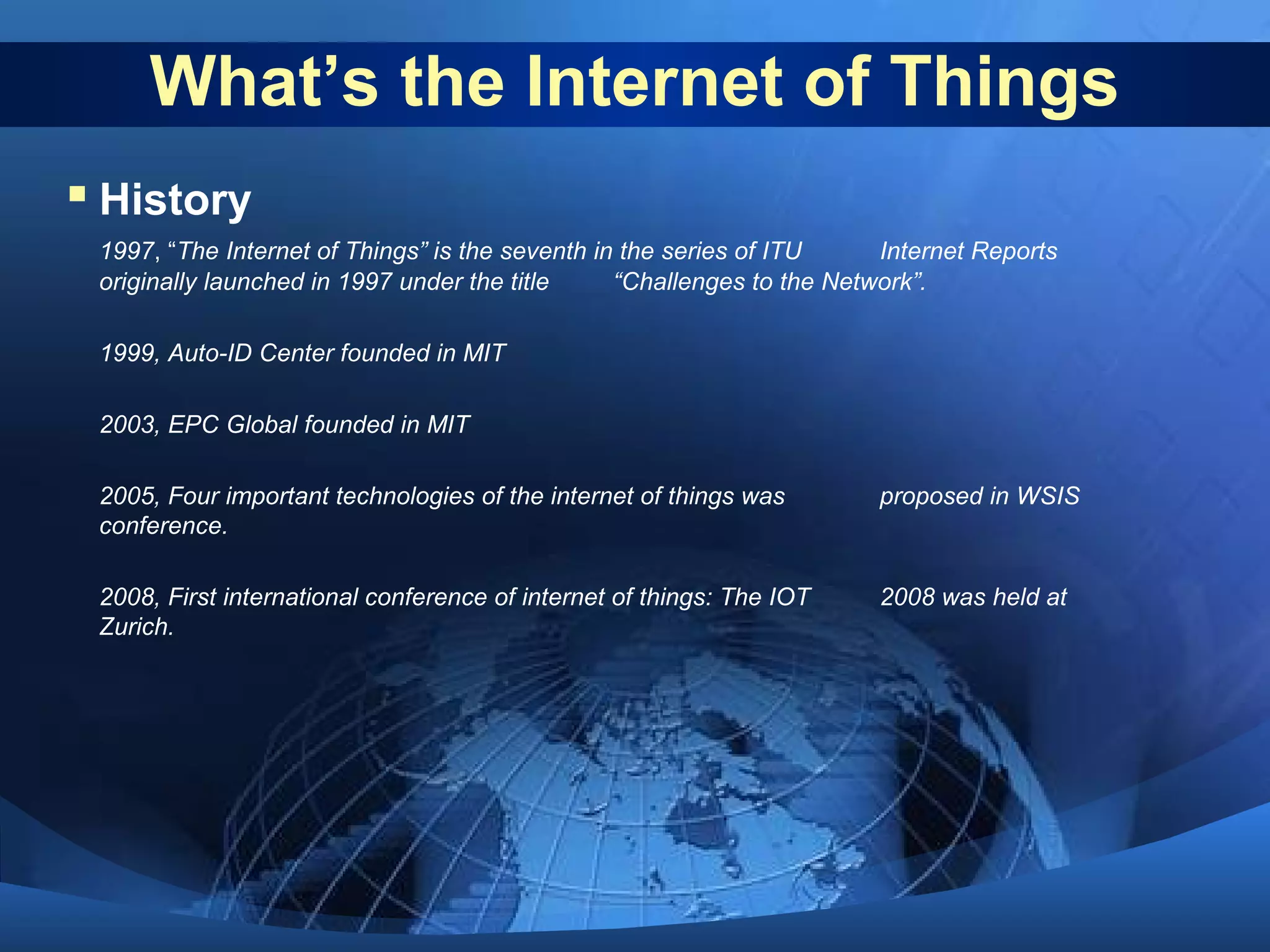
1997, “The Internet of Things” is the seventh in the series of ITU Internet Reports
originally launched in 1997 under the title “Challenges to the Network”.
1999, Auto-ID Center founded in MIT
2003, EPC Global founded in MIT
2005, Four important technologies of the internet of things was proposed in WSIS
conference.
2008, First international conference of internet of things: The IOT 2008 was held at
Zurich.
What’s the Internet of Things
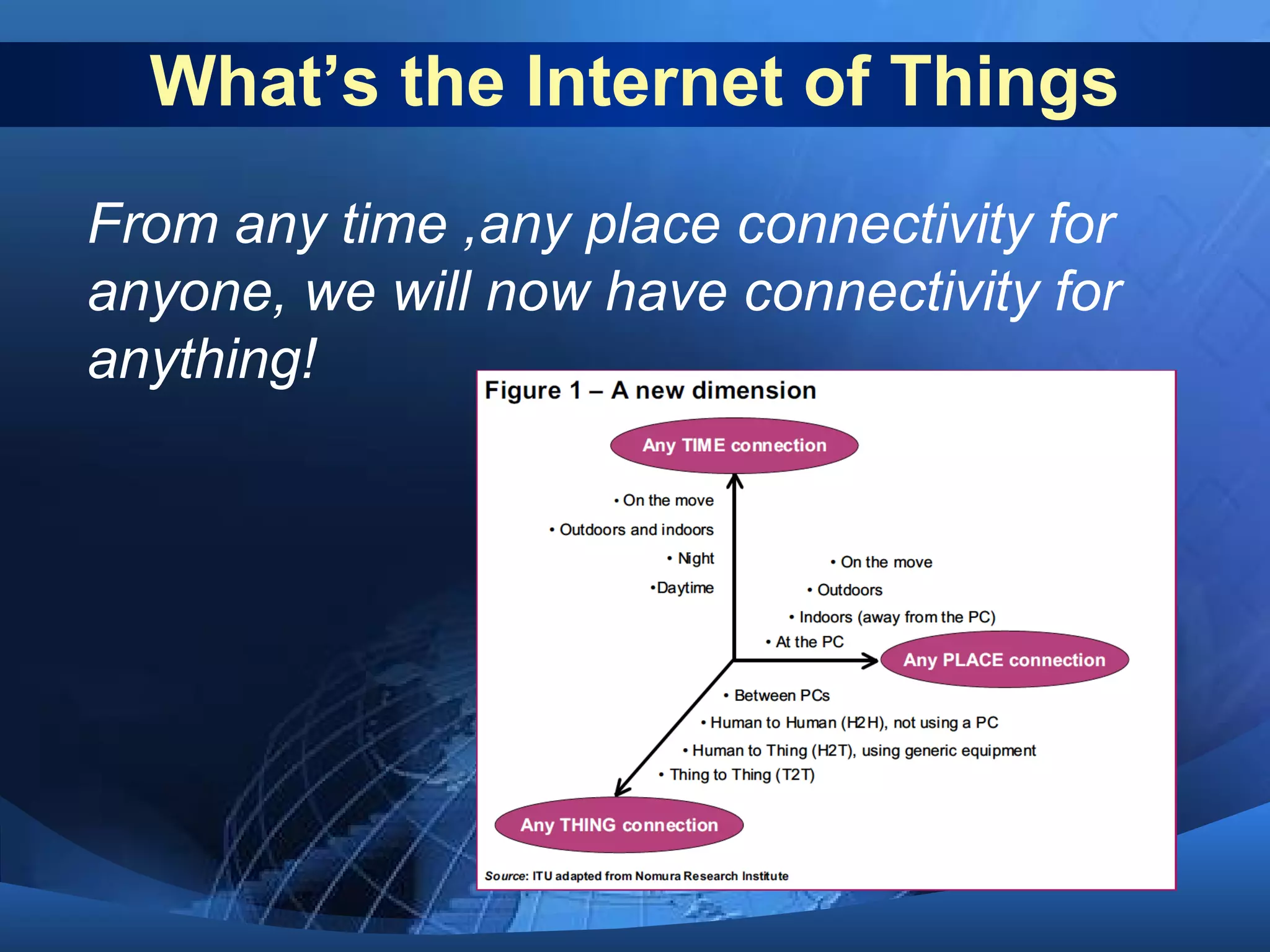
From any time ,any place connectivity for
anyone, we will now have connectivity for
anything!
What’s the Internet of Things
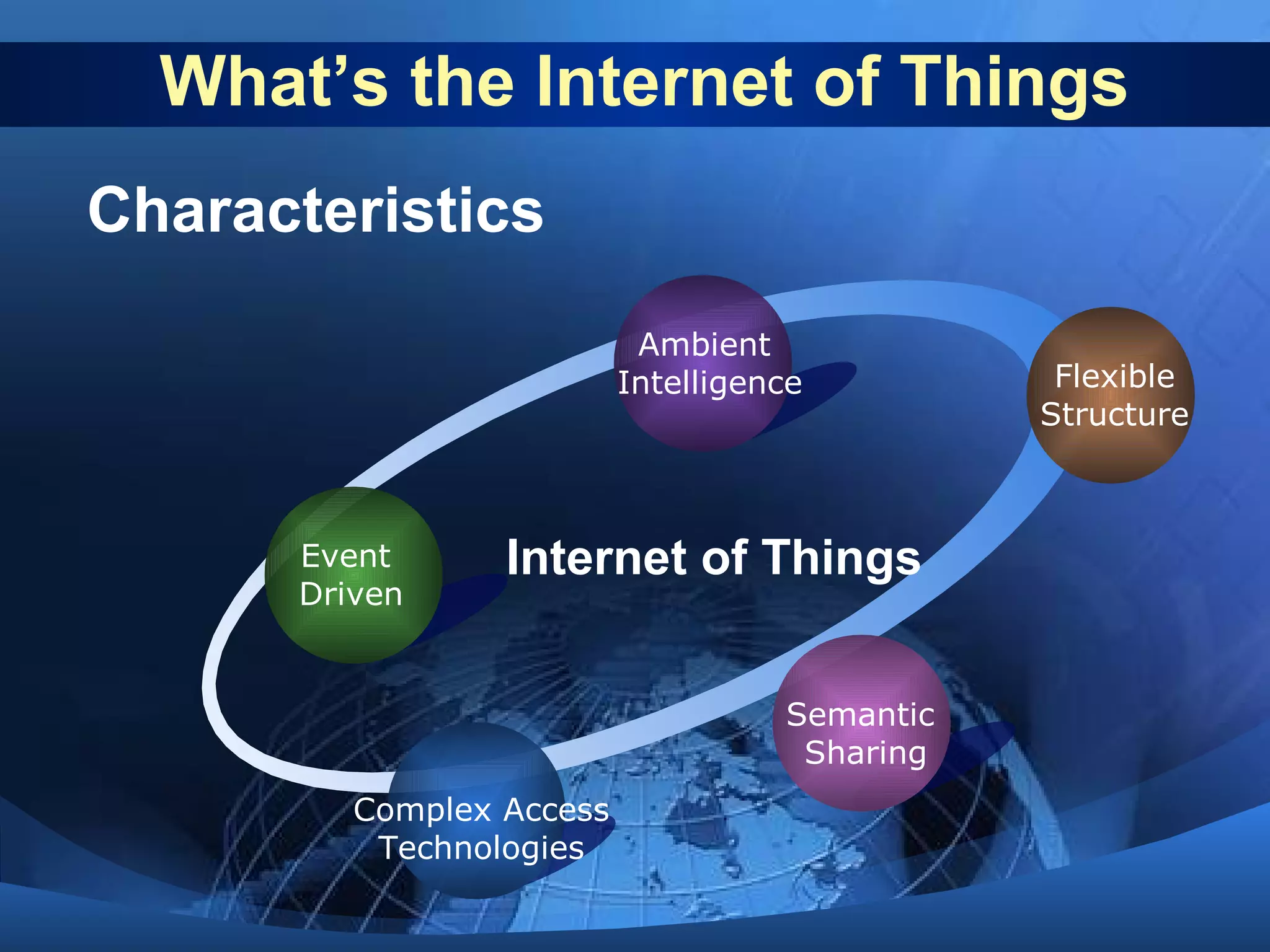
Event
Driven
Ambient
Intelligence Flexible
Structure
Semantic
Sharing
Complex Access
Technologies
Internet of Things
Characteristics
Why Internet of Things
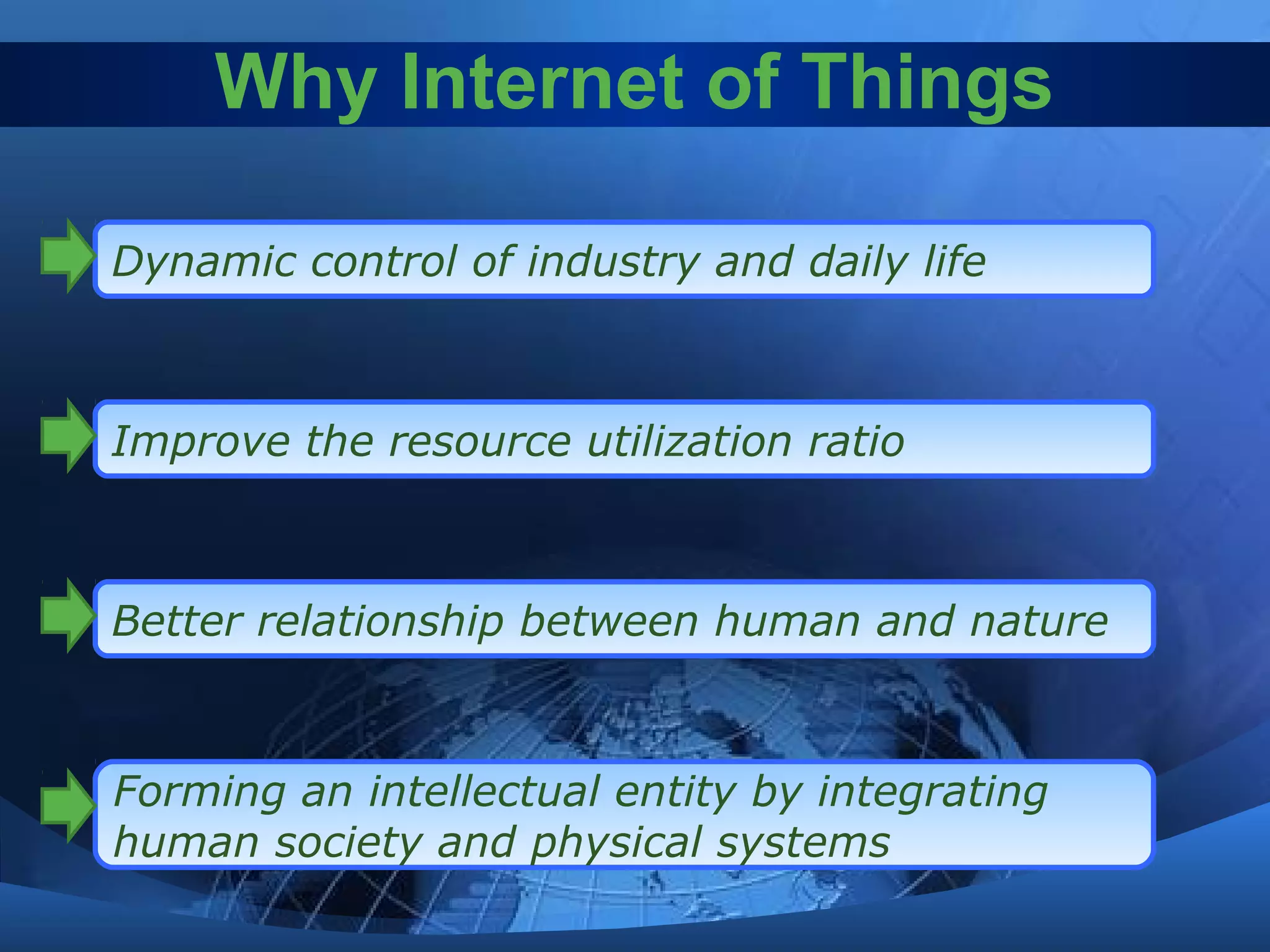
Dynamic control of industry and daily life
Improve the resource utilization ratio
Better relationship between human and nature
Forming an intellectual entity by integrating
human society and physical systems
Why Internet of Things (ii)
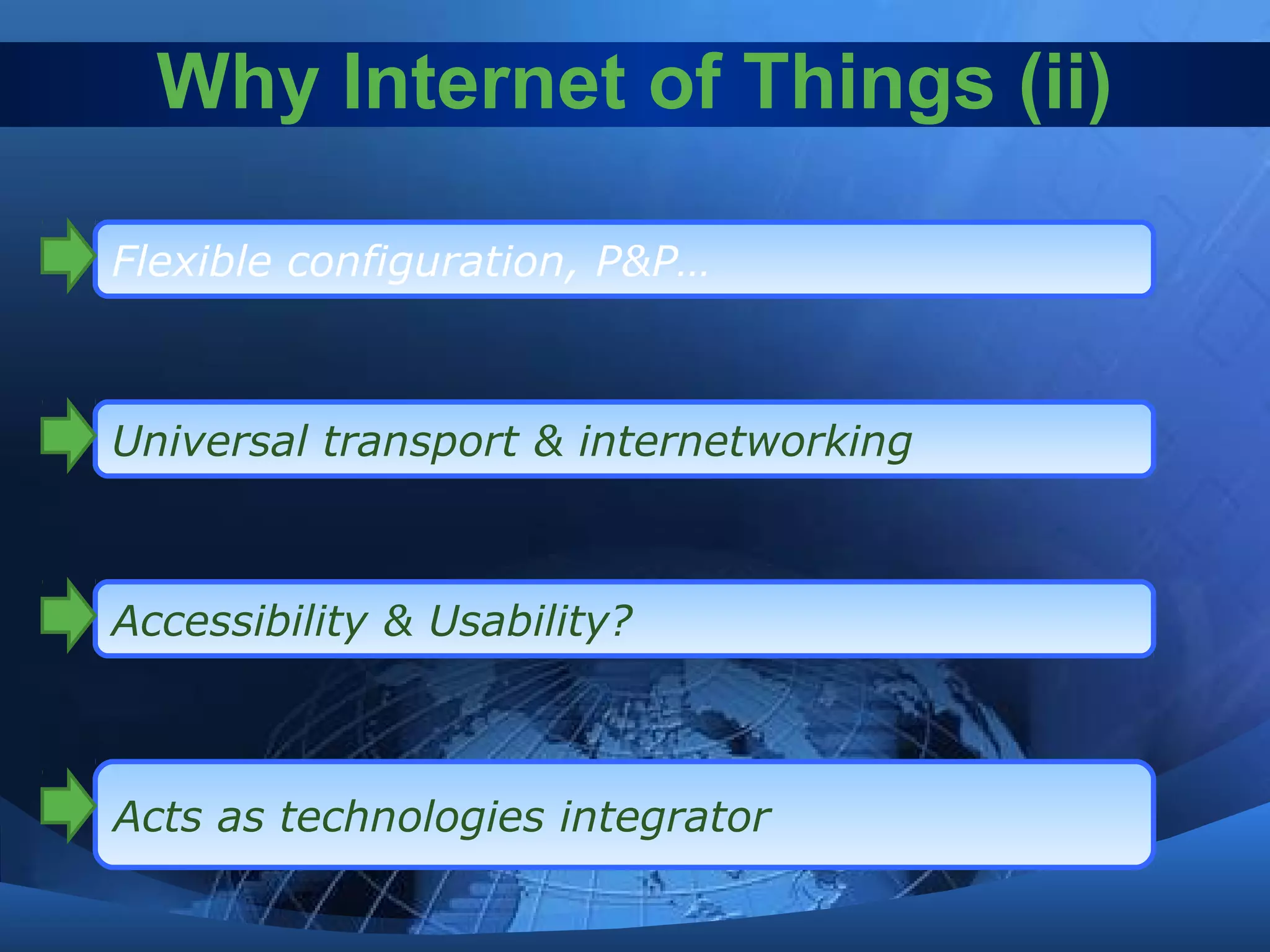
Flexible configuration, P&P…
Universal transport & internetworking
Accessibility & Usability?
Acts as technologies integrator
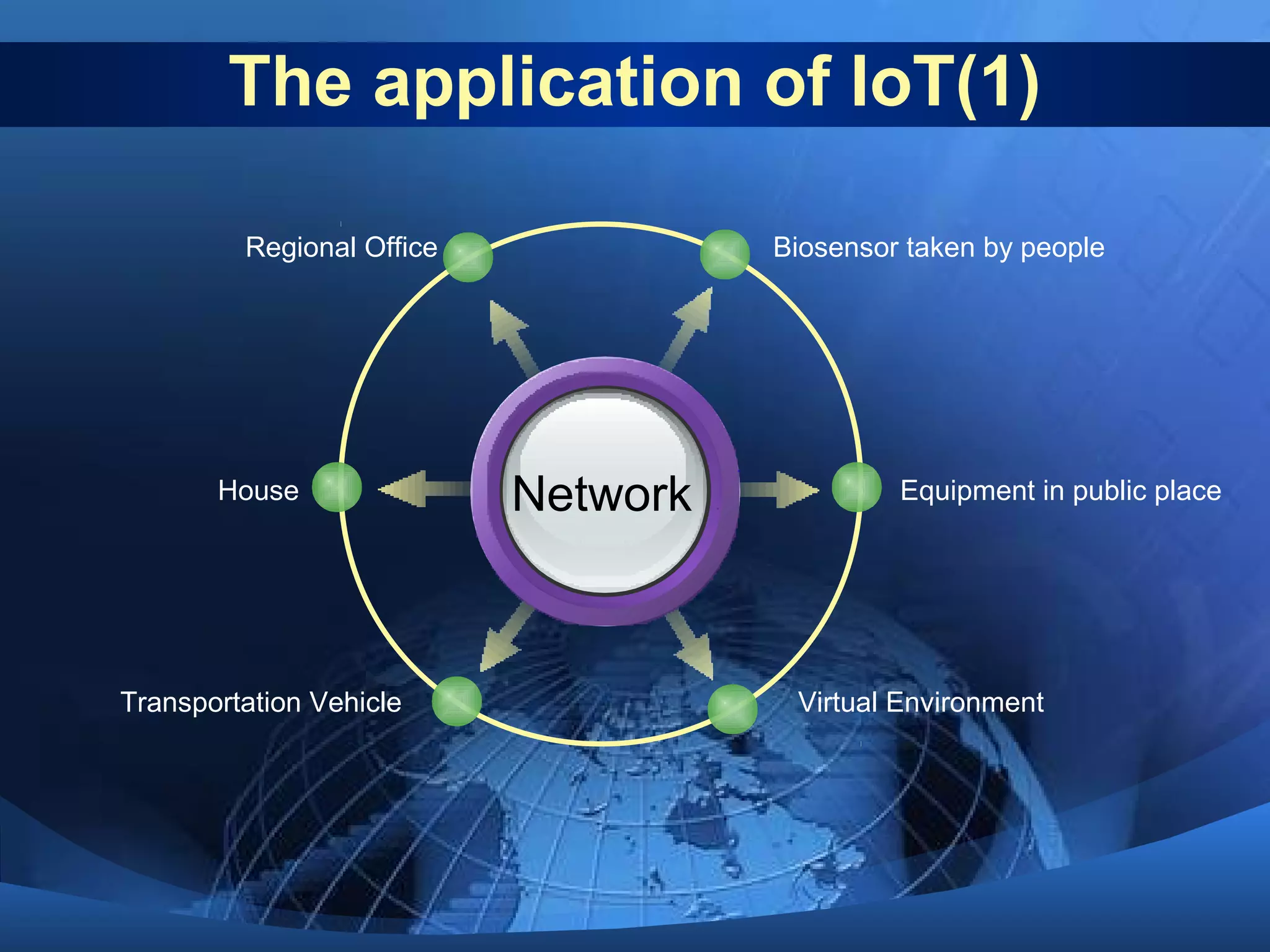
The application of IoT(1)
Network
Biosensor taken by people
Equipment in public placeHouse
Regional Office
Virtual EnvironmentTransportation Vehicle
The application of IoT(2)
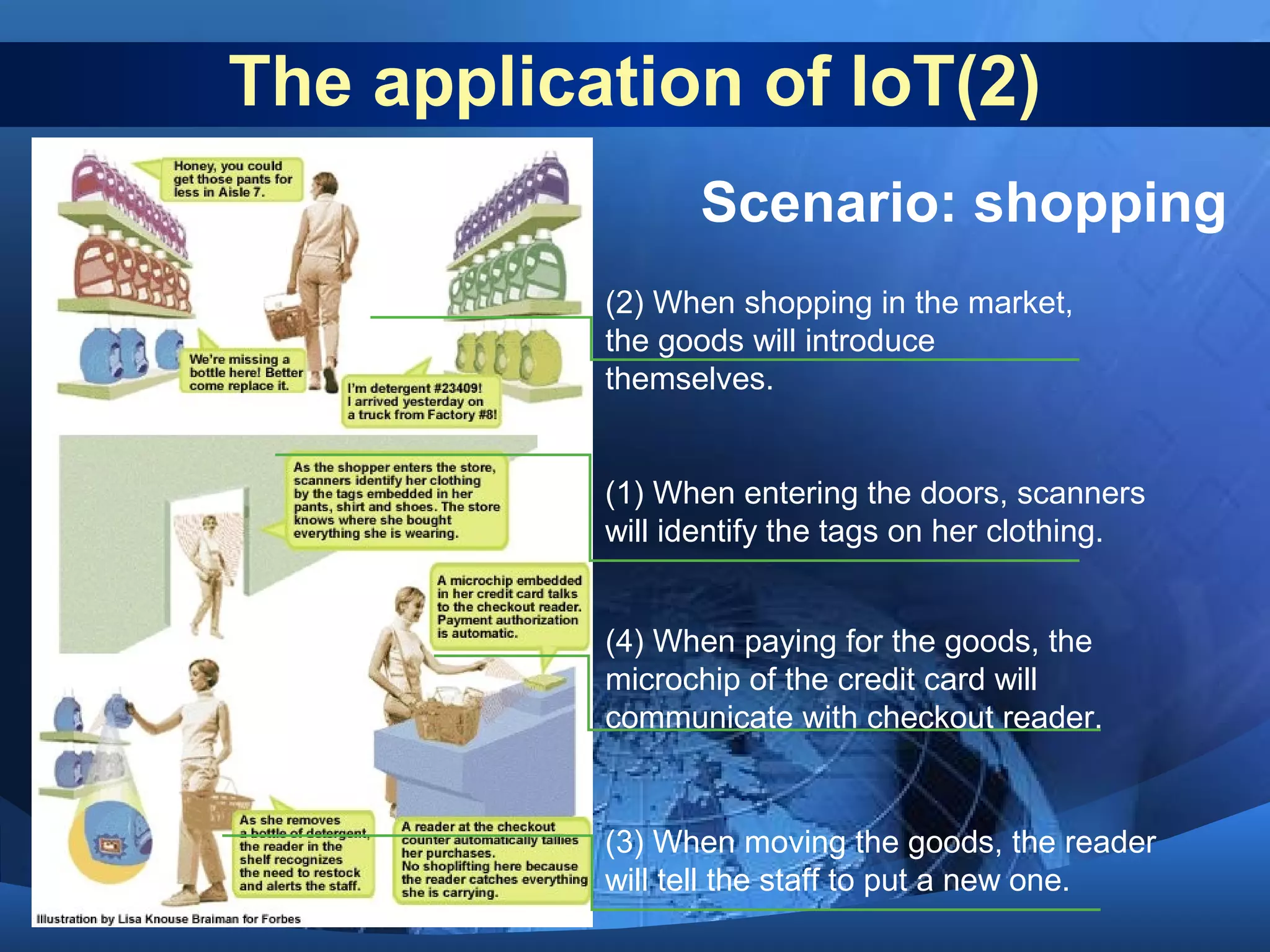
Scenario: shopping
(2) When shopping in the market,
the goods will introduce
themselves.
(1) When entering the doors, scanners
will identify the tags on her clothing.
(4) When paying for the goods, the
microchip of the credit card will
communicate with checkout reader.
(3) When moving the goods, the reader
will tell the staff to put a new one.
The application of IoT(3)
Scenario: Food
Nutrition
Scenario: Health Care
Scenario: Intelligent Home
Scenario: Transportation
State of the Art of IoT
RFID Sensor Smart Tech Nano Tech
To identify
and track
the data of
things
To collect
and process
the data to
detect the
changes in
the physical
status of
things
To enhance
the power of
the network by
devolving
processing
capabilities to
different part
of the network.
To make the
smaller and
smaller
things have
the ability to
connect and
interact.
Enabling Technologies
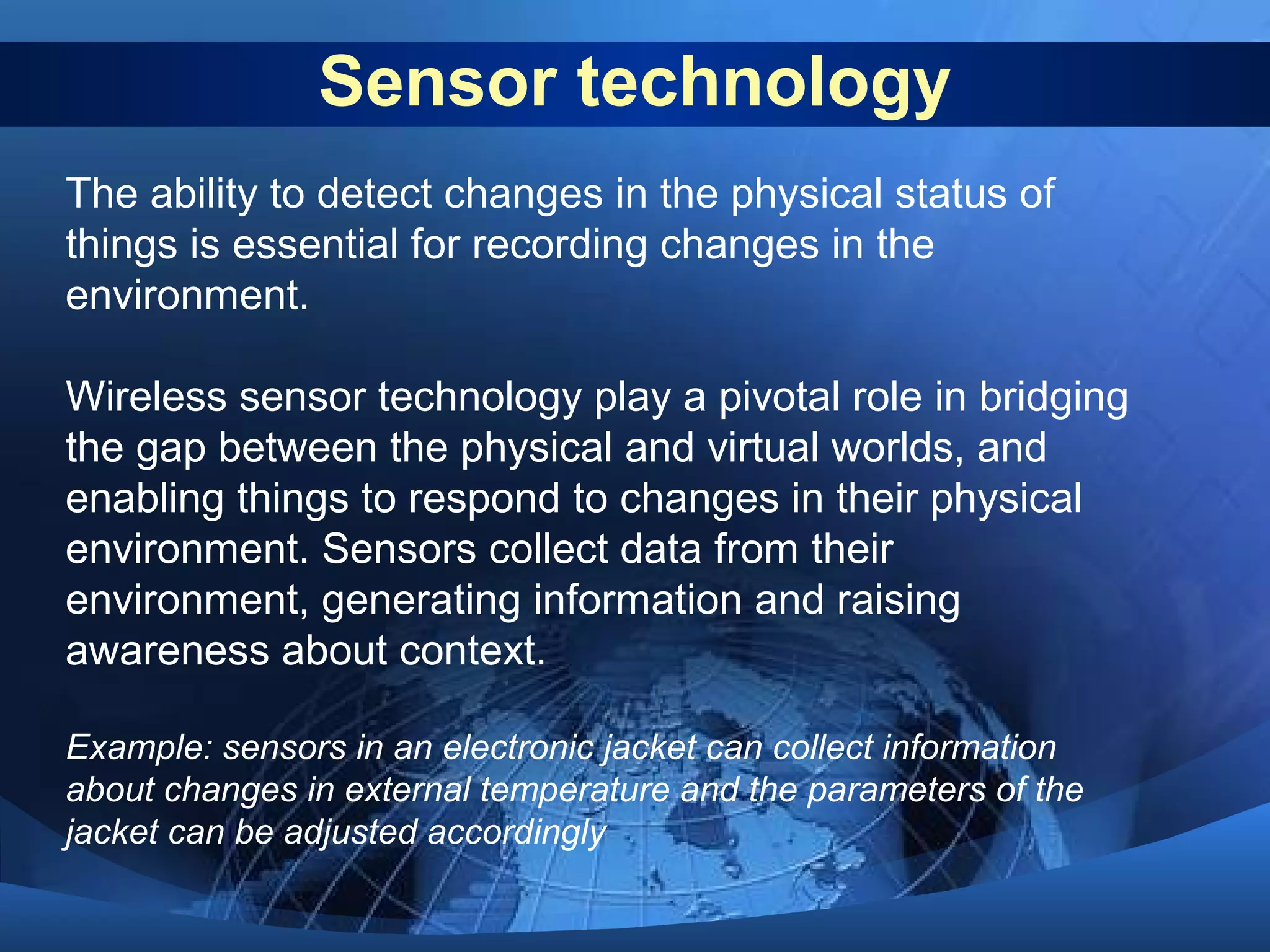
Sensor technology
The ability to detect changes in the physical status of
things is essential for recording changes in the
environment.
Wireless sensor technology play a pivotal role in bridging
the gap between the physical and virtual worlds, and
enabling things to respond to changes in their physical
environment. Sensors collect data from their
environment, generating information and raising
awareness about context.
Example: sensors in an electronic jacket can collect information
about changes in external temperature and the parameters of the
jacket can be adjusted accordingly
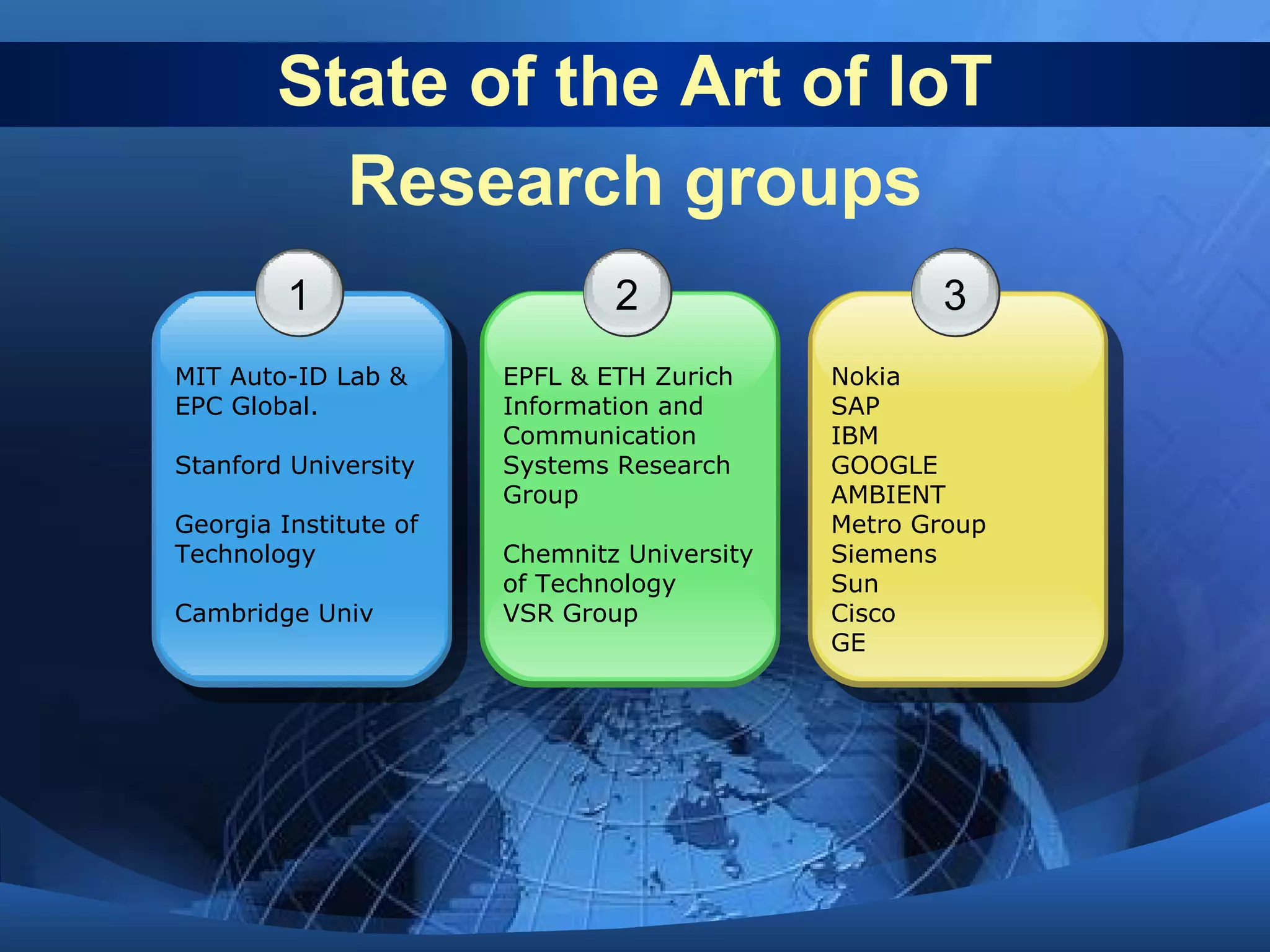
State of the Art of IoT
1
MIT Auto-ID Lab &
EPC Global.
Stanford University
Georgia Institute of
Technology
Cambridge Univ
3
Nokia
SAP
IBM
GOOGLE
AMBIENT
Metro Group
Siemens
Sun
Cisco
GE
2
EPFL & ETH Zurich
Information and
Communication
Systems Research
Group
Chemnitz University
of Technology
VSR Group
Research groups
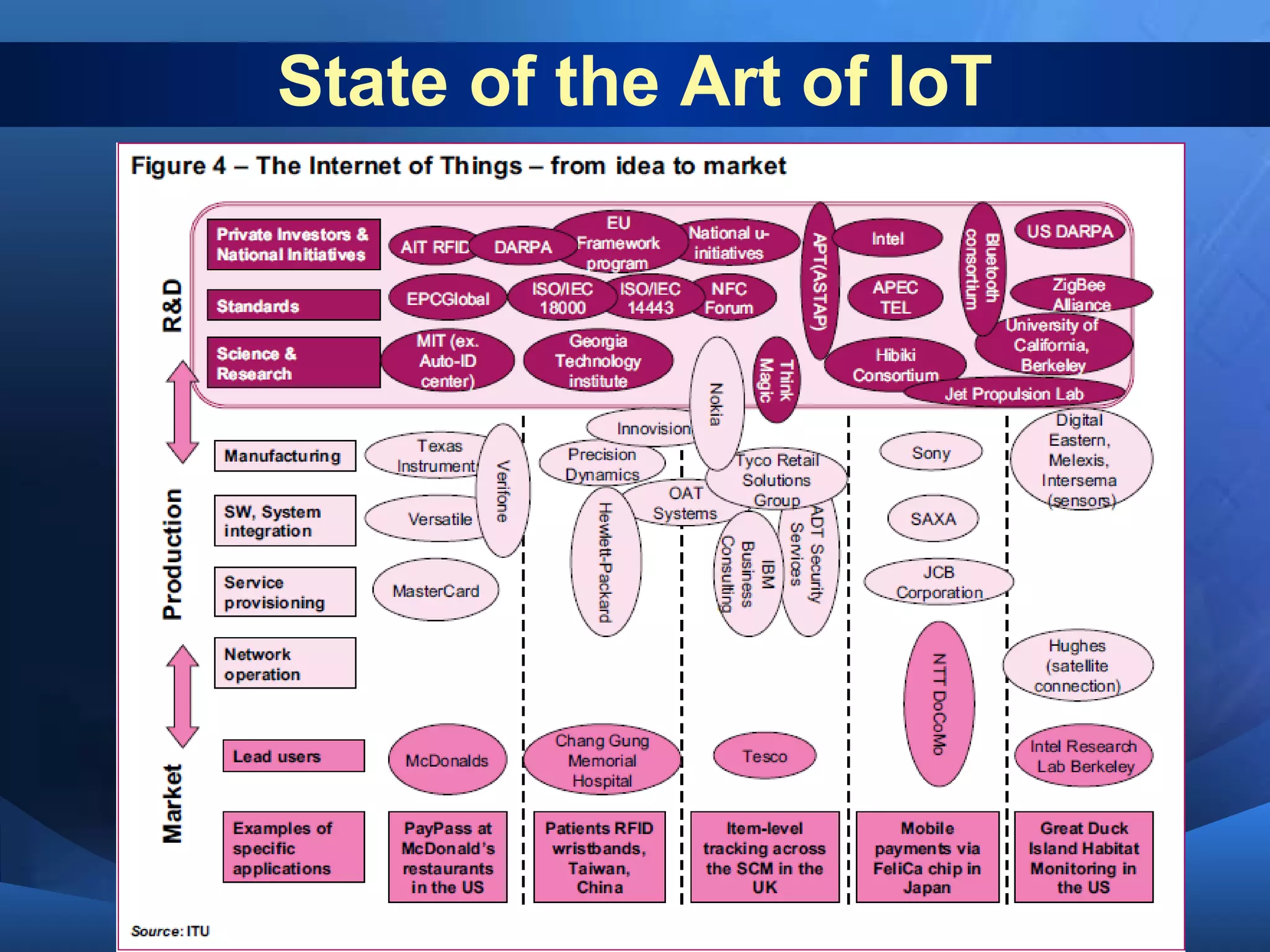
State of the Art of IoT
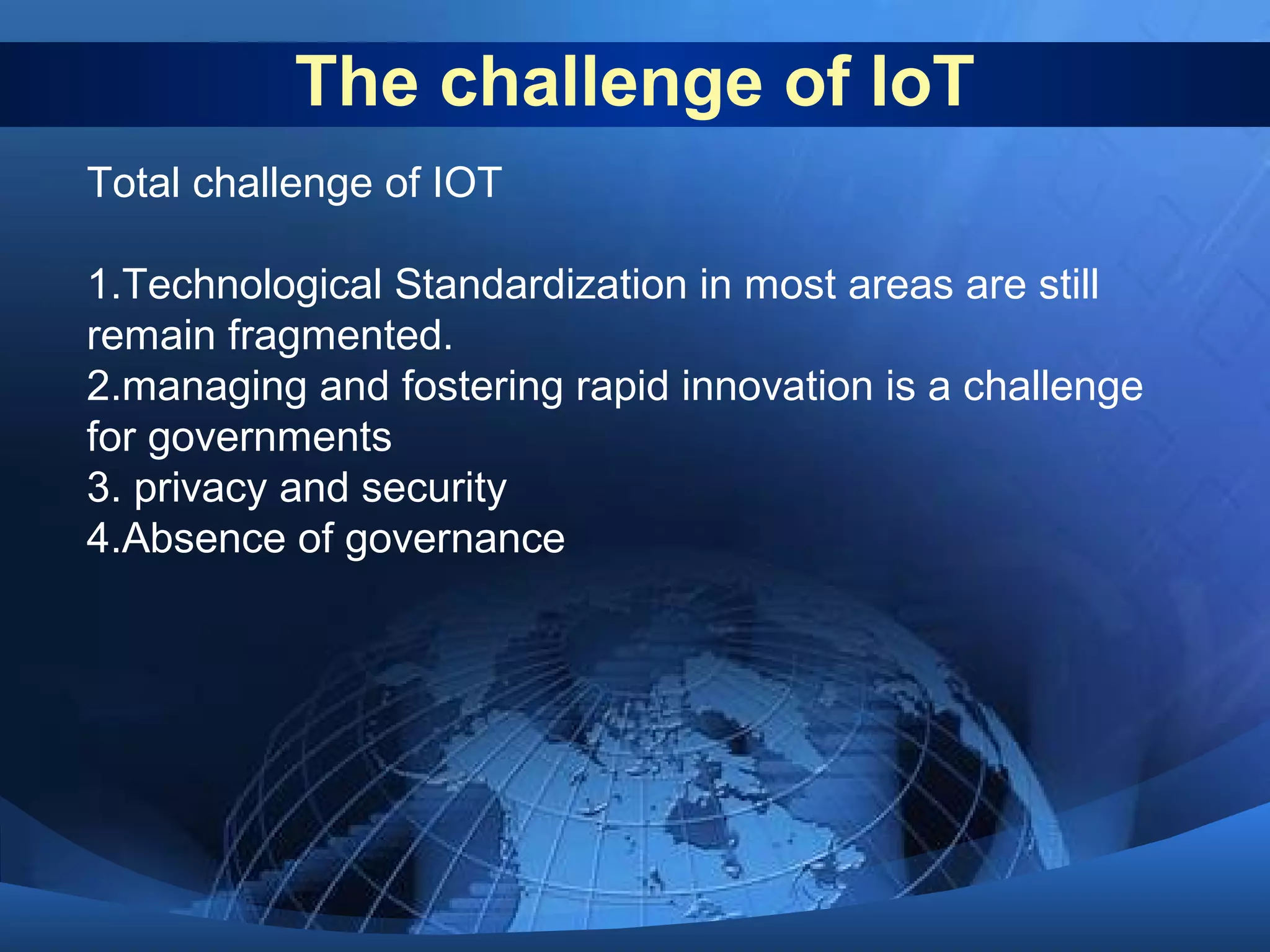
The challenge of IoT
Total challenge of IOT
1.Technological Standardization in most areas are still
remain fragmented.
2.managing and fostering rapid innovation is a challenge
for governments
3. privacy and security
4.Absence of governance
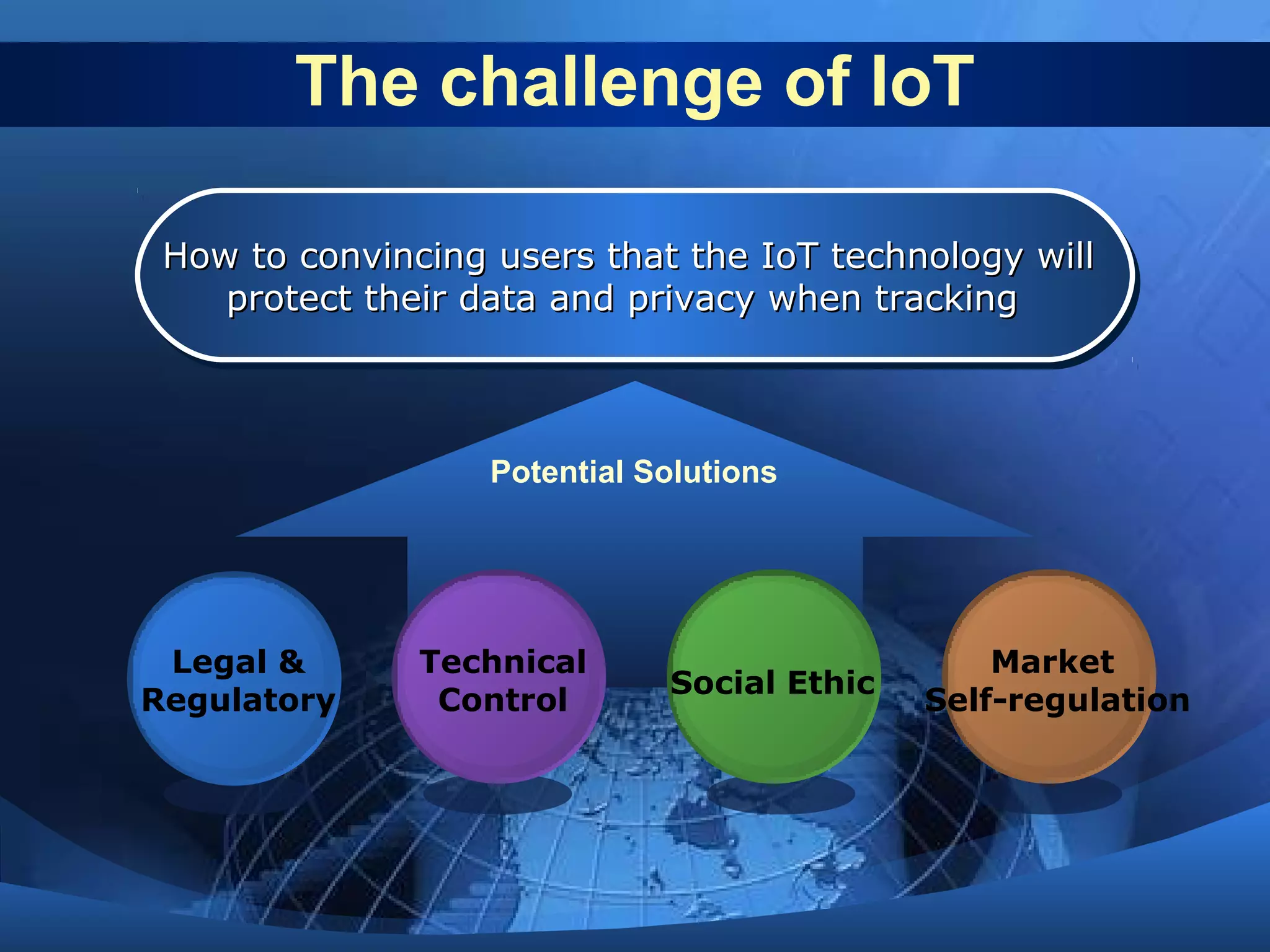
The challenge of IoT
How to convincing users that the IoT technology willHow to convincing users that the IoT technology will
protect their data and privacy when trackingprotect their data and privacy when tracking
How to convincing users that the IoT technology willHow to convincing users that the IoT technology will
protect their data and privacy when trackingprotect their data and privacy when tracking
Potential Solutions
Legal &
Regulatory
Technical
Control
Social Ethic
Market
Self-regulation
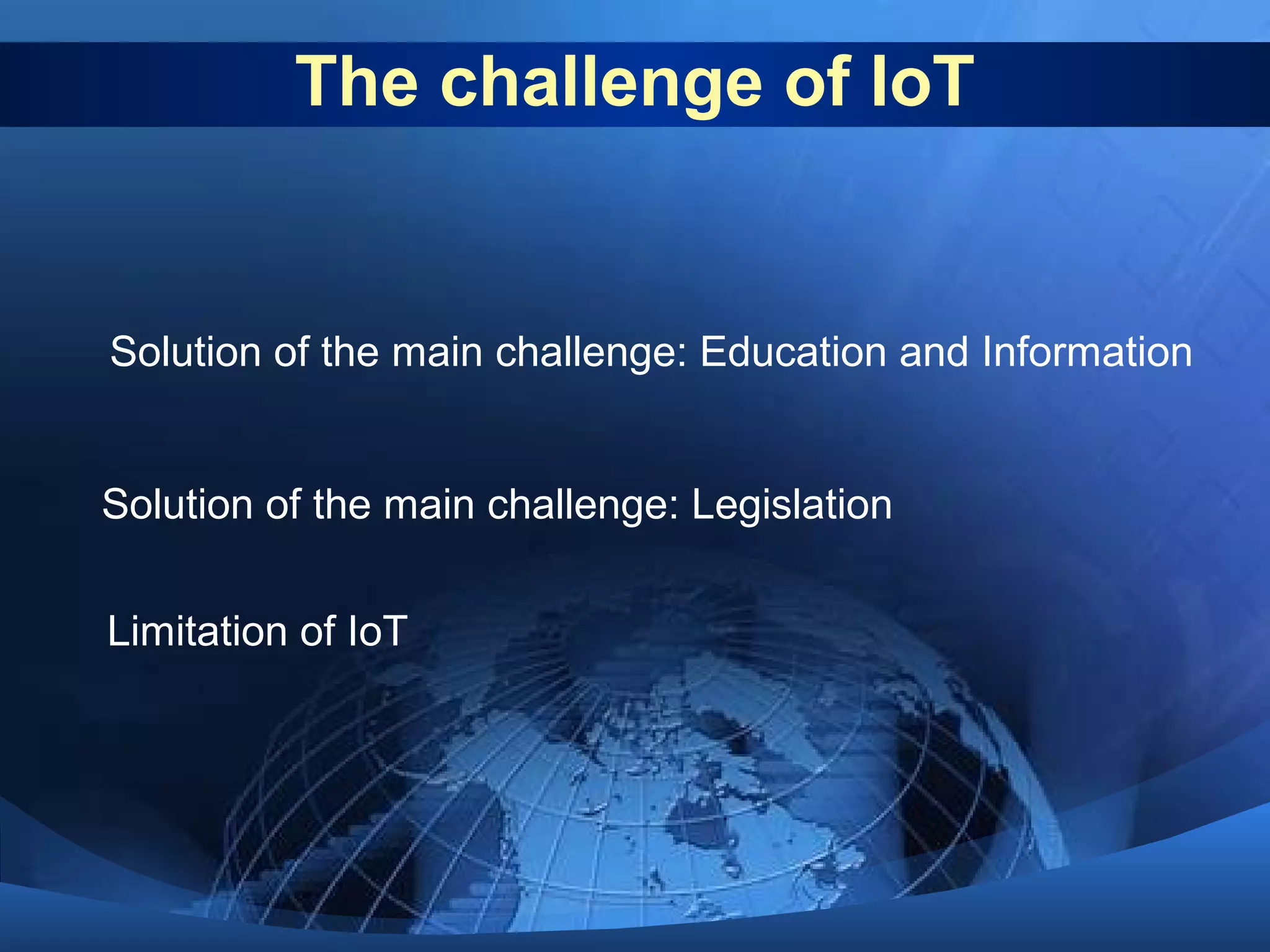
The challenge of IoT
Solution of the main challenge: Legislation
Solution of the main challenge: Education and Information
Limitation of IoT
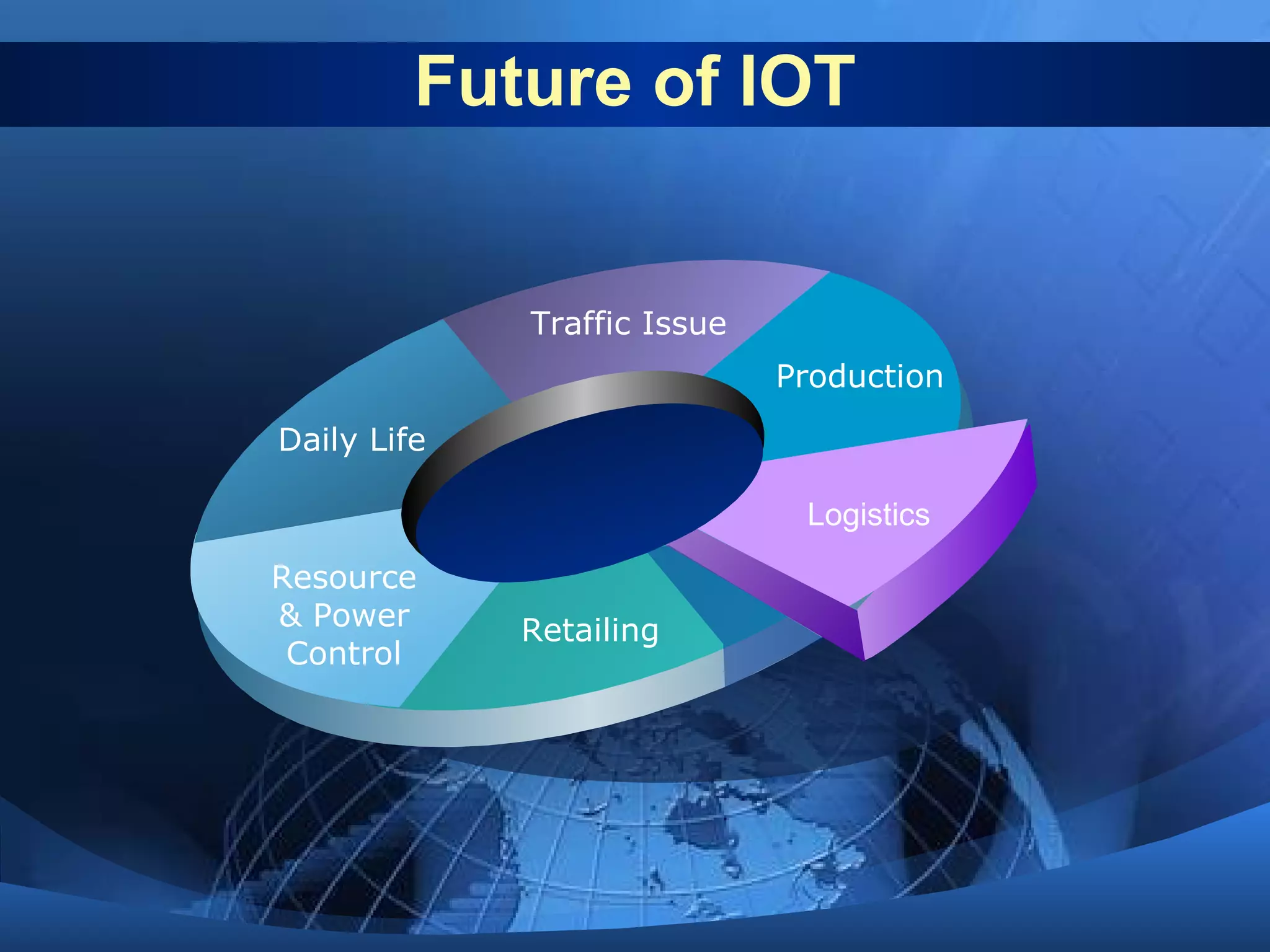
Future of IOT
Daily Life
Traffic Issue
Production
Logistics
Retailing
Resource
& Power
Control

Internet of Things

  • 1.
    LOGO Internet of Things DodiSaputra Manajemen Informatika A Semester 2 Politeknik Negeri Lampung Daftar pustaka http://www.slideshare.net/rams8055/the-internet-of- things-31895956?related=1 UPM E.U.I.T. Diatel Xi Chen scotor317@gmail.com
  • 2.
    Contents of Introduction What’sInternet of Things : Apa Internet of Things1 State of the Art of IoT : Negara Seni IOT2 Challenges and Limitation of IoT : Tantangan dan Batasan IOT3 Future of IoT : Masa Depan IOT4
  • 3.
    What’s the Internetof Things  Definition (1) The Internet of Things, also called The Internet of Objects, refers to a wireless network between objects, usually the network will be wireless and self- configuring, such as household appliances. ------Wikipedia (2) By embedding short-range mobile transceivers into a wide array of additional gadgets and everyday items, enabling new forms of communication between people and things, and between things themselves. ------WSIS 2005
  • 4.
    What’s the Internetof Things  Definition (3) The term "Internet of Things" has come to describe a number of technologies and research disciplines that enable the Internet to reach out into the real world of physical objects. ------IoT 2008 (4) “Things having identities and virtual personalities operating in smart spaces using intelligent interfaces to connect and communicate within social, environmental, and user contexts”. -------IoT in 2020
  • 5.
    What’s the Internetof Things  History 1997, “The Internet of Things” is the seventh in the series of ITU Internet Reports originally launched in 1997 under the title “Challenges to the Network”. 1999, Auto-ID Center founded in MIT 2003, EPC Global founded in MIT 2005, Four important technologies of the internet of things was proposed in WSIS conference. 2008, First international conference of internet of things: The IOT 2008 was held at Zurich.
  • 6.
    What’s the Internetof Things From any time ,any place connectivity for anyone, we will now have connectivity for anything!
  • 7.
    What’s the Internetof Things Event Driven Ambient Intelligence Flexible Structure Semantic Sharing Complex Access Technologies Internet of Things Characteristics
  • 8.
    Why Internet ofThings Dynamic control of industry and daily life Improve the resource utilization ratio Better relationship between human and nature Forming an intellectual entity by integrating human society and physical systems
  • 9.
    Why Internet ofThings (ii) Flexible configuration, P&P… Universal transport & internetworking Accessibility & Usability? Acts as technologies integrator
  • 10.
    The application ofIoT(1) Network Biosensor taken by people Equipment in public placeHouse Regional Office Virtual EnvironmentTransportation Vehicle
  • 11.
    The application ofIoT(2) Scenario: shopping (2) When shopping in the market, the goods will introduce themselves. (1) When entering the doors, scanners will identify the tags on her clothing. (4) When paying for the goods, the microchip of the credit card will communicate with checkout reader. (3) When moving the goods, the reader will tell the staff to put a new one.
  • 12.
    The application ofIoT(3) Scenario: Food Nutrition Scenario: Health Care Scenario: Intelligent Home Scenario: Transportation
  • 13.
    State of theArt of IoT RFID Sensor Smart Tech Nano Tech To identify and track the data of things To collect and process the data to detect the changes in the physical status of things To enhance the power of the network by devolving processing capabilities to different part of the network. To make the smaller and smaller things have the ability to connect and interact. Enabling Technologies
  • 14.
    Sensor technology The abilityto detect changes in the physical status of things is essential for recording changes in the environment. Wireless sensor technology play a pivotal role in bridging the gap between the physical and virtual worlds, and enabling things to respond to changes in their physical environment. Sensors collect data from their environment, generating information and raising awareness about context. Example: sensors in an electronic jacket can collect information about changes in external temperature and the parameters of the jacket can be adjusted accordingly
  • 15.
    State of theArt of IoT 1 MIT Auto-ID Lab & EPC Global. Stanford University Georgia Institute of Technology Cambridge Univ 3 Nokia SAP IBM GOOGLE AMBIENT Metro Group Siemens Sun Cisco GE 2 EPFL & ETH Zurich Information and Communication Systems Research Group Chemnitz University of Technology VSR Group Research groups
  • 16.
    State of theArt of IoT
  • 17.
    The challenge ofIoT Total challenge of IOT 1.Technological Standardization in most areas are still remain fragmented. 2.managing and fostering rapid innovation is a challenge for governments 3. privacy and security 4.Absence of governance
  • 18.
    The challenge ofIoT How to convincing users that the IoT technology willHow to convincing users that the IoT technology will protect their data and privacy when trackingprotect their data and privacy when tracking How to convincing users that the IoT technology willHow to convincing users that the IoT technology will protect their data and privacy when trackingprotect their data and privacy when tracking Potential Solutions Legal & Regulatory Technical Control Social Ethic Market Self-regulation
  • 19.
    The challenge ofIoT Solution of the main challenge: Legislation Solution of the main challenge: Education and Information Limitation of IoT
  • 20.
    Future of IOT DailyLife Traffic Issue Production Logistics Retailing Resource & Power Control

Editor's Notes

  • #3 1. What’s IoT part includes the Definition of IoT, the history of IoT, the features of IoT, why IoT, and at last propose different application scenarios of IoT to better recognize it. 2. In the State of the Art part, I would firstly introduce several enabling technologies of IoT and also more detail about the wireless sensor network and IPv6 of IoT, on which are what we focus now. Then the ongoing research project and research groups, universities and companies will be mentioned. At last, the economic system and overall diagram of marketing and R&D of IoT will be discussed. 3. In this part, two main challenges and several other challenges of IoT will be discussed and also the limitation of IoT will be preliminarily proposed. 4. The last part is the Future of IoT, I will discuss the areas which will potentially be implemented by IoT, and also the open issue of IoT. At last, I will discuss about the future technologies that may be affect the development of IoT.
  • #4 WSIS: World Summit on the Information Society, it’s a pair of conference about information society
  • #5 The semantic origin of the expression is composed by two words and concepts: “Internet” and “Thing”, where “Internet” can be defined as “The world-wide network of interconnected computer networks, based on a standard communication protocol, the Internet suite (TCP/IP)”, while “Thing” is “an object not precisely identifiable” Therefore, semantically, “Internet of Things” means “a world-wide network of interconnected objects uniquely addressable, based on standard
  • #6 Auto-ID Center focus on EPC-IOT, EPC is Electric Product Code, It’s a family of coding schemes created as a low-cost method of tracking goods using RFID Technology, it generated Auto-ID Lab and EPCGlobal, former one is to do R&D and second one is to set standard and run marketing. Four important technologies are nano tech , wireless sensor, RFID and smart tech
  • #7 An interesting conclusion
  • #8 This part need to be discussed again AI: the autonomous and intelligent entities will act in full interoperability & will be able to auto-organize themselves depending on the context, circumstances or environment. ED is to design the scheme depending on the need FS means that hundreds and thousands of nodes will be disable and will be set to run. CAT means that there’s several kinds of media such as vehicle stone that they need different access technologies. SS is the machine can rend and send by themselves. No need to tell humanbeings
  • #9 1 and 2 factors are about Resource Efficiency, Energy conservation is a prerequisite for the Internet of Things. Therefore research producing new knowledge on how to develop more energy efficient electronics will influence the design of all electronics. Concept of energy harvesting will enable larger and larger portions of the consumed energy to be generated by ambient renewable sources available locally thus reducing the losses in long distance energy distribution. Similar effects will be experienced by road transport and cars. Already today there are hybrid cars available harvesting the kinetic energy of the drive. This, in combination with better and more environmentally friendly energy storage in the future will make electrical vehicles achieve longer range and become more attractive alternatives. Abundant sensory information will enable unprecedented energy optimised control. Climate control is the most energy consuming activity in modern buildings. The house could adjust the room temperatures according to the personal preferences of those in the room, and avoid heating or cooling rooms excessively without benefits to the inhabitants. 3. is the pollution and disaster avoidance 4.
  • #10 1 and 2 factors are about Resource Efficiency, Energy conservation is a prerequisite for the Internet of Things. Therefore research producing new knowledge on how to develop more energy efficient electronics will influence the design of all electronics. Concept of energy harvesting will enable larger and larger portions of the consumed energy to be generated by ambient renewable sources available locally thus reducing the losses in long distance energy distribution. Similar effects will be experienced by road transport and cars. Already today there are hybrid cars available harvesting the kinetic energy of the drive. This, in combination with better and more environmentally friendly energy storage in the future will make electrical vehicles achieve longer range and become more attractive alternatives. Abundant sensory information will enable unprecedented energy optimised control. Climate control is the most energy consuming activity in modern buildings. The house could adjust the room temperatures according to the personal preferences of those in the room, and avoid heating or cooling rooms excessively without benefits to the inhabitants. 3. is the pollution and disaster avoidance 4.
  • #11 Application area should be divided by that two
  • #13 Europe is traditionally spoiled with excellent food and wine where the quest for the perfect taste has been ongoing for centuries. French law pioneered the idea of protecting produce of a limited geographical origin, and similar laws have since been established in many European countries. Traceable identities will help the consumers to verify the origins of the products and help Europe to preserve agricultural diversity and rural lifestyles. traceability may provide market feedback to the producers in a sector where the production is often planned well in advance according to wholesale dealers’ prediction of the market for certain produce and the producers’ flexibility is limited by long term contracts and politically decided production subsidies. The recent global food crisis highlighted that the feedback mechanisms in food market do not work as well as in other commodity markets making the food availability oscillate between periods of overproduction and shortage. All the major food producers in the world could have augmented their production had they only seen the increase demand earlier.
  • #14 More than four several technologies machine-to-machine interfaces and protocols of electronic communication microcontrollers wireless communication RFID Energy harvesting technologies sensor technology Location technology Software IPv6
  • #15 Add more sensor technology
  • #16 Need to improve about the research groups and projects
  • #17 Diagram of the whole system of IoT business and R&D Add some content of economic system of IoT and what it related with other part of society
  • #18 Absence of governance is the first main challenge One major barrier for the widespread adoption of the Internet of Things technology is the absence of governance. Without an impartial governing authority it will be impossible to have a truly global “Internet of Things”, accepted by states, companies, trade organizations and the common people. Today there is not a unique universal numbering scheme as just described: PCglobal and the Ubiquitous Networking Lab propose two different, non- compatible ways of identifying objects, and there is the risk to have them competing in the coming future over the global market. There is also the need of keeping governance as generic as possible, as having one authority per application field will certainly lead to overlap, confusion and competition between standards. Objects can have different identities in different contexts so having multiple authorities would create a kind of multi-homing, which can lead to disastrous results.
  • #19 Privacy and security In order to have a widespread adoption of any object identification system, there is a need to have a technically sound solution to guarantee privacy and the security of the customers. While in many cases the security has been done as an add-on feature, it is the feeling that the public acceptance for the IoT will happen only when the strong security and privacy solution are in place. This could be hybrid security mechanisms that for example combine hardware security with key diversification to deliver superior security that makes attacks significantly more difficult or even impossible. The selection of ssecurity features and mechanisms will continue to be determined by the impact on business processes; and trade-offs will be made between chip size, cost, functionality, interoperability, security, and privacy. The security and privacy issues should be addressed by the forthcoming standards which must define different security features to provide confidentiality, integrity, or availability services. There are also a range of issues related to the identity of people. These must be dealt with in politics and legislation, and they are of crucial importance for the efficient public administrations of the future. Although many of the proposed technologies are based on RFID or smart systems, they will not be discussed in this report whose focus is on objects and things and the related technological and application challenges.
  • #20 Second solution to challenge Legislation When moving towards the Internet of Things it is mandatory that policy keeps up with technology so that citizens gain confidence in the new technology and will accept to live in the “Internet of Things”. When bar codes were introduced they received public uprising and rejection. Attempts to introduce electronic health cards have been unsuccessful based on public fear for information misuse. RFID tags have seen a similar resistance leading to tags that can be erased when clients leave the supermarket, or temporarily disabled, or just be read by trusted readers. In addition to research of current concerns, it is important to engage the wider public in a political debate and dialogue about the Internet of Things. People’s momentarily context and roles can determine their attitudes towards new technology: as an example, an employee will resist his boss' access to his or her mailbox while the same person may demand the same insight into the mailboxes of subordinates.
  • #21 Different areas that would be implement, this part should be improved