1
Internet of Things (IOT)
Mrs. Shailja Kumari
Assistant Professor
Computer Science
Govt.P.G.College,Panchkula
To Be Discussed(IOT)
• Introduction of IOT
• Why it is important ?
• History
• Component
• Best examples of IOT Device
• Working
• Application
• Advantage
• Challenges
• Impact On Environment
• Future Of IOT
• Conclusion
2
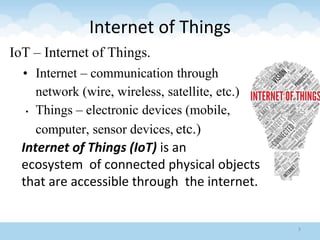
Internet of Things
IoT – Internet of Things.
• Internet – communication through
network (wire, wireless, satellite, etc.)
• Things – electronic devices (mobile,
computer, sensor devices, etc.)
Internet of Things (IoT) is an
ecosystem of connected physical objects
that are accessible through the internet.
3
Why IoT ?
• Dynamic control of industry and daily life.
• Improves the resource utilization ratio.
• Integrating human society and physical
systems.
• Flexible configuration.
• Acts as technology integrator.
4
History
• The main concept of a network of smart devices was discussed
as early as 1982, with a modified Coca-Cola vending machine at
Carnegie Mellon University becoming the first Internet-
connected appliance, able to report its inventory and whether
newly loaded drinks were cold or not.
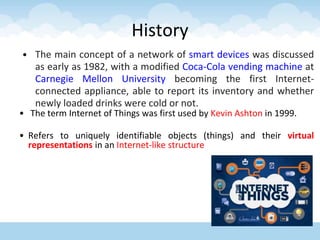
• The term Internet of Things was first used by Kevin Ashton in 1999.
• Refers to uniquely identifiable objects (things) and their virtual
representations in an Internet-like structure
Components of IoT
6
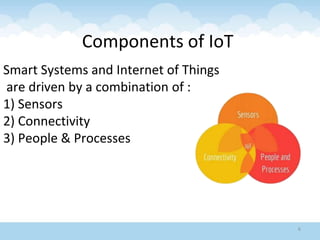
Smart Systems and Internet of Things
are driven by a combination of :
1) Sensors
2) Connectivity
3) People & Processes
7
Best examples of IOT device
● Smart appliances - Maintenance of temperature
of a fridge from a mobile phone
● Wearables - Health monitoring over watch and
exchange of data to a tablet or Personal
computer
8
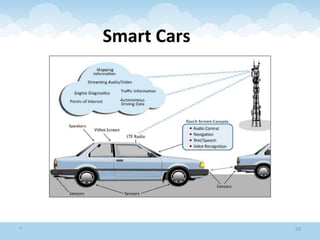
● Connected Car - Performing actions in a car from
a remote location like switching on/off air
conditioner
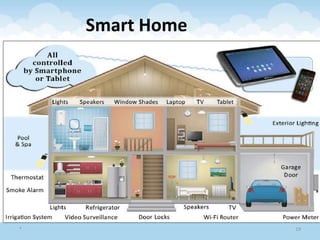
● Smart homes - Controlling the home and
equipments from office over mobile wifi -
Switching on security cameras
Best examples of IOT device
9
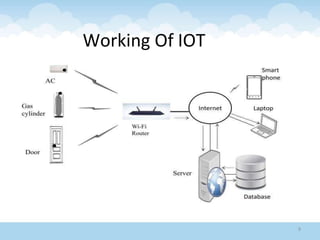
Working Of IOT
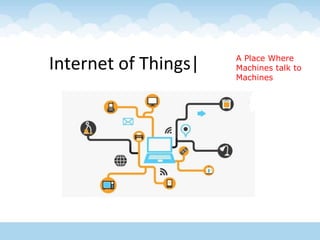
Internet of Things| A Place Where
Machines talk to
Machines
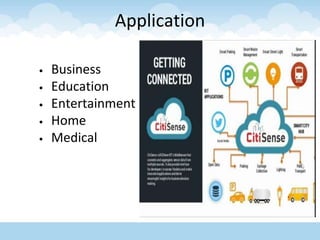
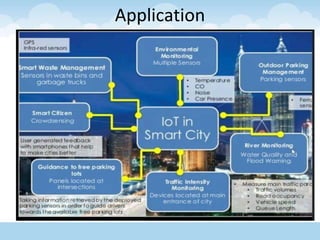
Application
• Business
• Education
• Entertainment
• Home
• Medical
Application
13
Advantage
● Access information from anywhere at any time
on any device
● Improved communication between connected
electronic devices
● Transferring data packets over a connected
network saving time and money
● Automating tasks helping to improve the quality
of a business's services
● Reducing the need for human intervention.
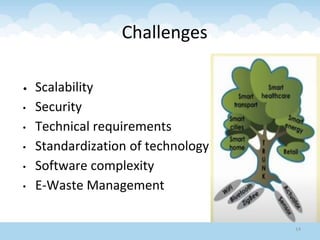
Challenges
• Scalability
• Security
• Technical requirements
• Standardization of technology
• Software complexity
• E-Waste Management
14
Impact on Environment
• Wastage of precious metals in production of the
electronics
• Release of greenhouse gases in the process of
production of new electronic goods.
• Release of toxic contents from electronics on their
decay.
15
Impact on Environment
• Recycling in informal sector focuses on recovering
precious metals like gold and not disposing off the
electronics in a nonpolluting way.
• Unused e-waste goes directly into landfills and
incinerators and lead to the leaching of lead into
the groundwater. E.g. The cadmium from one
mobile phone battery is enough to pollute 600 m3
of water.
16
17
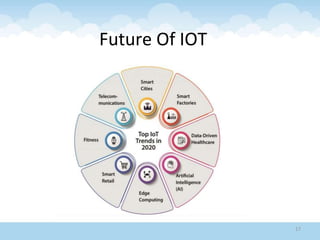
Future Of IOT
Essential Technologies-IoT
* 18
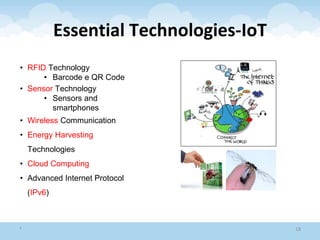
• RFID Technology
• Barcode e QR Code
• Sensor Technology
• Sensors and
smartphones
• Wireless Communication
• Energy Harvesting
Technologies
• Cloud Computing
• Advanced Internet Protocol
(IPv6)
Smart Home
* 19
Smart Cars
* 20
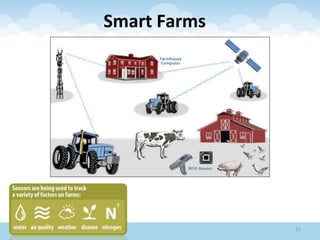
Smart Farms
* 21
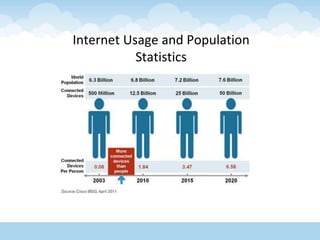
Internet Usage and Population
Statistics
Conclusion
We should improve productivity, Convenience,
Automation, Flexibility of resources in Controlled
Manner by keeping in mind about various
challenging Aspects and try to minimize impact
on Environment so that sustainability can
maintained.
References
▪ https://www.nebula.co.za/2016/11/11/risks-disadvantages-iot-overcome/
▪ https://www.internetsociety.org/doc/iot-overview
▪ http://www.happiestminds.com/Insights/internet-of-things
http://www.webopedia.com/TERM/I/internet_of_things.html
▪ https://www.sap.com/india/solution/internet-of-things.html
25
Thank You

Internet of things

  • 1.
    1 Internet of Things(IOT) Mrs. Shailja Kumari Assistant Professor Computer Science Govt.P.G.College,Panchkula
  • 2.
    To Be Discussed(IOT) •Introduction of IOT • Why it is important ? • History • Component • Best examples of IOT Device • Working • Application • Advantage • Challenges • Impact On Environment • Future Of IOT • Conclusion 2
  • 3.
    Internet of Things IoT– Internet of Things. • Internet – communication through network (wire, wireless, satellite, etc.) • Things – electronic devices (mobile, computer, sensor devices, etc.) Internet of Things (IoT) is an ecosystem of connected physical objects that are accessible through the internet. 3
  • 4.
    Why IoT ? •Dynamic control of industry and daily life. • Improves the resource utilization ratio. • Integrating human society and physical systems. • Flexible configuration. • Acts as technology integrator. 4
  • 5.
    History • The mainconcept of a network of smart devices was discussed as early as 1982, with a modified Coca-Cola vending machine at Carnegie Mellon University becoming the first Internet- connected appliance, able to report its inventory and whether newly loaded drinks were cold or not. • The term Internet of Things was first used by Kevin Ashton in 1999. • Refers to uniquely identifiable objects (things) and their virtual representations in an Internet-like structure
  • 6.
    Components of IoT 6 SmartSystems and Internet of Things are driven by a combination of : 1) Sensors 2) Connectivity 3) People & Processes
  • 7.
    7 Best examples ofIOT device ● Smart appliances - Maintenance of temperature of a fridge from a mobile phone ● Wearables - Health monitoring over watch and exchange of data to a tablet or Personal computer
  • 8.
    8 ● Connected Car- Performing actions in a car from a remote location like switching on/off air conditioner ● Smart homes - Controlling the home and equipments from office over mobile wifi - Switching on security cameras Best examples of IOT device
  • 9.
  • 10.
    Internet of Things|A Place Where Machines talk to Machines
  • 11.
    Application • Business • Education •Entertainment • Home • Medical
  • 12.
  • 13.
    13 Advantage ● Access informationfrom anywhere at any time on any device ● Improved communication between connected electronic devices ● Transferring data packets over a connected network saving time and money ● Automating tasks helping to improve the quality of a business's services ● Reducing the need for human intervention.
  • 14.
    Challenges • Scalability • Security •Technical requirements • Standardization of technology • Software complexity • E-Waste Management 14
  • 15.
    Impact on Environment •Wastage of precious metals in production of the electronics • Release of greenhouse gases in the process of production of new electronic goods. • Release of toxic contents from electronics on their decay. 15
  • 16.
    Impact on Environment •Recycling in informal sector focuses on recovering precious metals like gold and not disposing off the electronics in a nonpolluting way. • Unused e-waste goes directly into landfills and incinerators and lead to the leaching of lead into the groundwater. E.g. The cadmium from one mobile phone battery is enough to pollute 600 m3 of water. 16
  • 17.
  • 18.
    Essential Technologies-IoT * 18 •RFID Technology • Barcode e QR Code • Sensor Technology • Sensors and smartphones • Wireless Communication • Energy Harvesting Technologies • Cloud Computing • Advanced Internet Protocol (IPv6)
  • 19.
  • 20.
  • 21.
  • 22.
    Internet Usage andPopulation Statistics
  • 23.
    Conclusion We should improveproductivity, Convenience, Automation, Flexibility of resources in Controlled Manner by keeping in mind about various challenging Aspects and try to minimize impact on Environment so that sustainability can maintained.
  • 24.
    References ▪ https://www.nebula.co.za/2016/11/11/risks-disadvantages-iot-overcome/ ▪ https://www.internetsociety.org/doc/iot-overview ▪http://www.happiestminds.com/Insights/internet-of-things http://www.webopedia.com/TERM/I/internet_of_things.html ▪ https://www.sap.com/india/solution/internet-of-things.html
  • 25.