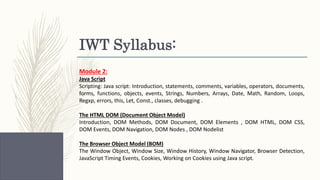
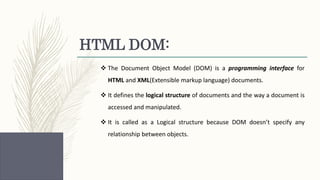
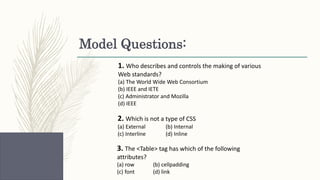
The document discusses HTML DOM (Document Object Model) and JavaScript. It defines DOM as a programming interface that defines the logical structure of HTML and XML documents and allows programs to access and manipulate them. It notes that DOM has three parts: Core DOM, XML DOM, and HTML DOM. It then lists some of the main DOM objects like the Window, Document, Form, and anchor objects. It provides examples of using DOM to represent an HTML table and asks some multiple choice questions about DOM, CSS, and HTML.





![Internet and Web Technology (CLASS-8) [jQuery and JSON] | NIC/NIELIT Web Tech...](https://cdn.slidesharecdn.com/ss_thumbnails/iwtclass-8-200721165112-thumbnail.jpg?width=640&height=640&fit=bounds)
![Internet and Web Technology (CLASS-6) [BOM]](https://cdn.slidesharecdn.com/ss_thumbnails/iwtclass-6-200715195259-thumbnail.jpg?width=640&height=640&fit=bounds)
![Internet and Web Technology (CLASS-7) [XML and AJAX] | NIC/NIELIT Web Technology](https://cdn.slidesharecdn.com/ss_thumbnails/iwtclass-7-200720175014-thumbnail.jpg?width=640&height=640&fit=bounds)
![Internet and Web Technology (CLASS-3) [HTML & CSS]](https://cdn.slidesharecdn.com/ss_thumbnails/iwtclass-3-200708180746-thumbnail.jpg?width=640&height=640&fit=bounds)
![Internet and Web Technology (CLASS-2) [HTTP & HTML]](https://cdn.slidesharecdn.com/ss_thumbnails/iwtclass-2-200707112703-thumbnail.jpg?width=640&height=640&fit=bounds)
![Internet and Web Technology (CLASS-4) [CSS & JS]](https://cdn.slidesharecdn.com/ss_thumbnails/iwtclass-4-200713163814-thumbnail.jpg?width=640&height=640&fit=bounds)


![Internet and Web Technology (CLASS-16) [Basic Elements of Java Program] | NIC...](https://cdn.slidesharecdn.com/ss_thumbnails/iwtclass-16-200811210335-thumbnail.jpg?width=640&height=640&fit=bounds)
![Internet and Web Technology (CLASS-15) [JAVA Basics] | NIC/NIELIT Web Technol...](https://cdn.slidesharecdn.com/ss_thumbnails/iwtclass-15-200811210151-thumbnail.jpg?width=640&height=640&fit=bounds)
![Internet and Web Technology (CLASS-14) [JSP] | NIC/NIELIT Web Technology](https://cdn.slidesharecdn.com/ss_thumbnails/iwtclass-14-200809204913-thumbnail.jpg?width=640&height=640&fit=bounds)
![Internet and Web Technology (CLASS-10) [Node.js] | NIC/NIELIT Web Technology](https://cdn.slidesharecdn.com/ss_thumbnails/iwtclass-10-200727152931-thumbnail.jpg?width=640&height=640&fit=bounds)
![Internet and Web Technology (CLASS-9) [React.js] | NIC/NIELIT Web Technology](https://cdn.slidesharecdn.com/ss_thumbnails/iwtclass-9-200722155940-thumbnail.jpg?width=640&height=640&fit=bounds)
![Internet and Web Technology (CLASS-1) [Introduction]](https://cdn.slidesharecdn.com/ss_thumbnails/iwt-200706091032-thumbnail.jpg?width=640&height=640&fit=bounds)


