Internet for Parents
    Jordi Duran i Batidor
    Iwith.org Foundation
Iwith.org

Non profit foundation.

Help to other non-profits with IT problems.

Iwith.org's mission is to promote information
and communication technologies as tools for
     solidarity and progress in society.
We are NOT!


We are not specialized in:

  Internet Child protection.

  Child Education, Pedagogy.

  Psychology, ...
We are


We are in Internet since long time ago.

We have experience on how to use internet.

We are always early adopters and beta-
testers of new technologies.
Online Predators, SPAM, SCAM,
Phishing, Pornography, Identity
   Theft, Privacy, Pedophilia,
Cyberbulling, Social Networks,
      Facebook, Twitter...
   Just some of the many issues and dangers
   on the Internet.
Not the same

The most Dangerous
        vs
The most Frequent.
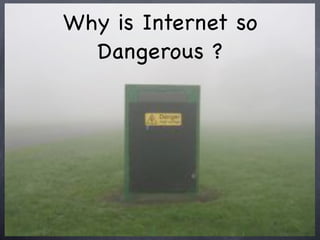
Why is Internet so
  Dangerous ?
First
Thanks to Internet
Bad guys can hide & do
   what they want!
       FALSE!

 Well,... not TRUE ;-)
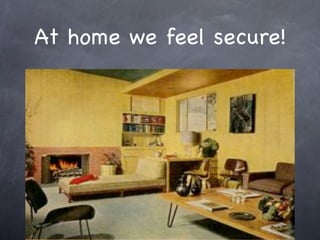
At home we feel secure!
And
we do not pay attention!
How many of you have
  done some illegal
   activity online ?

     Piracy ?

 and in Real world ?
Second!
Automation

Ex: Thanks to automation, a “kid”
can steal thousands of credit
cards numbers, and charge a
amount that will not be perceived
by the card holder.
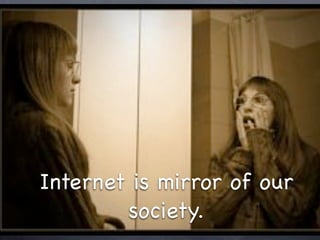
Internet is mirror of our
        society.
Definitions
Online Predators
An online predator is an adult
 Internet user who exploits
vulnerable teens, usually for
       sexual purposes.
Online Predators
Easy to occur.

Easy to prevent.

  Do not talk with “strangers”.

  Never Share personal information.

Main risks.

  Break Heart, adults language, nude
  pictures, in-person meeting ...
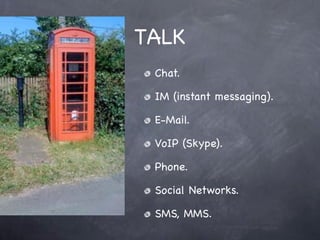
TALK
 Chat.

 IM (instant messaging).

 E-Mail.

 VoIP (Skype).

 Phone.

 Social Networks.

 SMS, MMS.
SPAM
Spam is the abuse of electronic
 messaging systems (including
 most broadcast media, digital
   delivery systems) to send
   unsolicited bulk messages
        indiscriminately.
SPAM
Easy to occur.

Difficult to solve.

Easy to prevent (?).

  do not share your email address.

Main risk.

  Products (Viagra, diploma, ...).

  Identity Thief, Credit card, Worms.
SCAM
A confidence trick or confidence
game, is an attempt to defraud a
person or group by gaining their
           confidence.
SCAM

Easy to occur.

Easy to prevent.

  do not Trust anybody.

Main risk.

  Economical damage, legal problems.
Phishing
Phishing is the criminally fraudulent
  process of attempting to acquire
    sensitive information such as
 usernames, passwords and credit
 card details by masquerading as a
trustworthy entity in an electronic
            communication.
Phishing
Easy to occur.

Easy to prevent.

  Never click on links in emails.

Main risk.

  Economical damage.

  Identity Thief.
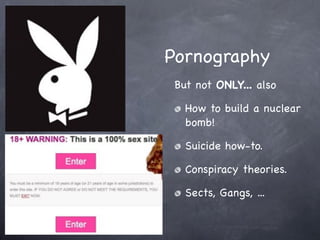
Pornography
 But not ONLY... also

   How to build a nuclear
   bomb!

   Suicide how-to.

   Conspiracy theories.

   Sects, Gangs, ...
Pornography
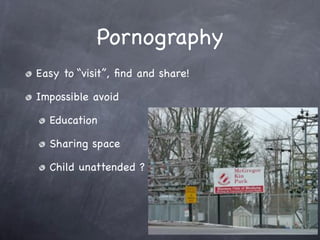
Easy to “visit”, find and share!

Impossible avoid

  Education

  Sharing space

  Child unattended ?
Pornography

PARENTING CONTROLS (tools).

  White listing.

    Only that ?

  Black listing.

    Sure everything bad is out ?
Pornography

When you get access to
pornographic material ?

Was it difficult ?

What was the main
source for that material ?
It’s a lost war!

If for us it was easy to get access to those
materials.

For them (our children) it will be also easy,
no internet parenting tool will block access
to that content.

As source will be their friends, ...
Identity Theft
Identity theft is a crime used to
   refer to fraud that involves
    someone pretending to be
 someone else in order to steal
  money or get other benefits.
Identity Theft
Easy to occur if we don’t take measures.

Easy to prevent.

  Strong password, no dictionary, no date of
  birth, pet name, or baby name.

  A password per service (SORRY for THAT).

  Never enter recovery password questions.

  Never share it.
Identity Theft


What they can do.

  Empty my bank account.

  Ask for a credit card.

  Post a message as me (Social shame).
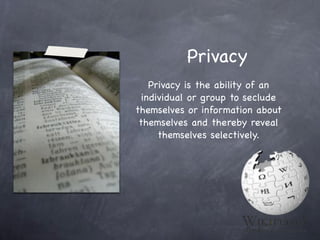
Privacy
    Privacy is the ability of an
  individual or group to seclude
themselves or information about
 themselves and thereby reveal
      themselves selectively.
Privacy


Control what you are sharing.

  recruiters are watching you.

Default settings are enough for you ?

Do you want to share “this picture” with your
friends or with “everybody”.
Syndication


Check if your status is sent OUTSIDE,
because then the privacy rules are the ones
of the external website.
Pedophilia
  As a medical diagnosis, it is
   defined as a psychological
   disorder in which an adult
experiences a sexual preference
   for prepubescent children.
Pedophilia

Link: Online Predators.

A man have been arrested for taking
pictures of young children on a beach.

  He was “sick”.

  Are you posting the pictures of your
  children in the beach ?

  If so, with which privacy setting ?
Cyberbulling
 Cyber-bullying involves the use of
   information and communication
 technologies to support deliberate,
repeated, and hostile behavior by an
individual or group, that is intended
           to harm others.
Cyberbulling

Do we need to distinguish between bulling
and cyberbulling ?

  I don’t think so.

  Parents & Educators have to pay attention
  to both in order to prevent and damage
  control it.
Social Networks
 A social network service focuses on
 building online communities of people
 who share interests and/or activities,
or who are interested in exploring the
   interests and activities of others.
Social Networks

By offering a closed environment they feel
more secure.

They are again a society, and inside we can
find the same problems we can face in
Internet and in real live.

So, we have to take the same measures.
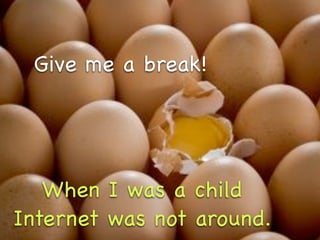
Give me a break!


   When I was a child
Internet was not around.
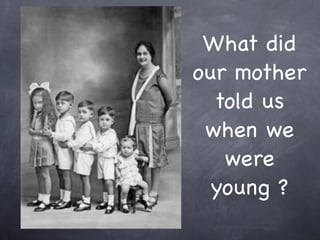
What did
our mother
  told us
 when we
   were
  young ?
My mother recipe.

At the park, never left child unattended.

Do not talk with “strangers”.

Never accept candies.

Do not discuss family “secrets” with your
friends.
My mother recipe.

Be good with other kids.

Report any wrong doing you see.

Don’t be afraid or too ashamed to tell me
the truth.


ENJOY!
My approach!
My recipe.


At the park, never left child unattended.

  Computer is always in a shared space.

  Children can be online, if an adult is in the
  room.
My recipe.

Do not talk with “strangers”.

  Never accept “invitations” to connect if you
  don’t know who they are.

  Privacy options for IM set to only accept
  messages from people in my Address Book.
My recipe.


Never accept candies.

 Nothing is free... never click on banners or
 reply to messages claiming free something.
My recipe.

Do not discuss family “secrets” with your
friends.

  Never give personal data online.

     Name, address, phone, car brand, credit
     card, bank info...
My recipe.


Be good with other kids.

  Don’t blame your friends.

  Don’t send bulling messages, emails, sms.

  Don’t impersonate ...
My recipe.

Report any wrong doing you see.

  If you see something “strange” tell me.

  If you have questions, ask me.

  If you want to learn something let me
  know.
My recipe.

Don’t be afraid or too ashamed to tell me
the truth.

  Everybody makes mistakes... I DO.

  Bad things happen, but are easy to pass
  with support.
ASAP

As young as they are...

  Easy to get their attention.

  I normally will have more knowledge than
  them.

  Some things that are easier to discuss
  with less hormones...
When they grow


They will have acquired the basic rules.

They will have experience.

It will be natural to ask, share, discuss the
problems or questions with us.
Conclusion

Internet is there, and our children will use
it... better if they are prepared.

Internet is not good or bad, it’s a tool used
by other people and there are good and bad
people out there.

When you are connected, you are not “at
home”, you are in the middle of the street.
To learn more

Wild Web Woods: A game by the Council of
Europe based on the Internet Literacy
Handbook. http://www.wildwebwoods.org/

INHOPE: The International Association of
Internet Hotlines. https://www.inhope.org/

Protecting Children Online: An ECPAT Guide.
http://www.ecpat.net/EI/ICT_Publications.asp
iwith.org Foundation
           11, Rue de la Porcelaine
           1260, Nyon
           Switzerland
           T:+41 22 362 58 69
           F:+41 22 362 58 67


           Cucurulla, 9, 2n
           08002, Barcelona
           Spain
           T:+34 93 380 49 75
           F:+34 93 304 23 53


http://www.iwith.org/
    info@iwith.org

Internet 4 Parents

  • 1.
    Internet for Parents Jordi Duran i Batidor Iwith.org Foundation
  • 3.
    Iwith.org Non profit foundation. Helpto other non-profits with IT problems. Iwith.org's mission is to promote information and communication technologies as tools for solidarity and progress in society.
  • 5.
    We are NOT! Weare not specialized in: Internet Child protection. Child Education, Pedagogy. Psychology, ...
  • 6.
    We are We arein Internet since long time ago. We have experience on how to use internet. We are always early adopters and beta- testers of new technologies.
  • 8.
    Online Predators, SPAM,SCAM, Phishing, Pornography, Identity Theft, Privacy, Pedophilia, Cyberbulling, Social Networks, Facebook, Twitter... Just some of the many issues and dangers on the Internet.
  • 10.
    Not the same Themost Dangerous vs The most Frequent.
  • 11.
    Why is Internetso Dangerous ?
  • 12.
  • 14.
    Thanks to Internet Badguys can hide & do what they want! FALSE! Well,... not TRUE ;-)
  • 15.
    At home wefeel secure!
  • 16.
    And we do notpay attention!
  • 17.
    How many ofyou have done some illegal activity online ? Piracy ? and in Real world ?
  • 18.
  • 20.
    Automation Ex: Thanks toautomation, a “kid” can steal thousands of credit cards numbers, and charge a amount that will not be perceived by the card holder.
  • 21.
    Internet is mirrorof our society.
  • 22.
  • 23.
    Online Predators An onlinepredator is an adult Internet user who exploits vulnerable teens, usually for sexual purposes.
  • 24.
    Online Predators Easy tooccur. Easy to prevent. Do not talk with “strangers”. Never Share personal information. Main risks. Break Heart, adults language, nude pictures, in-person meeting ...
  • 25.
    TALK Chat. IM(instant messaging). E-Mail. VoIP (Skype). Phone. Social Networks. SMS, MMS.
  • 26.
    SPAM Spam is theabuse of electronic messaging systems (including most broadcast media, digital delivery systems) to send unsolicited bulk messages indiscriminately.
  • 27.
    SPAM Easy to occur. Difficultto solve. Easy to prevent (?). do not share your email address. Main risk. Products (Viagra, diploma, ...). Identity Thief, Credit card, Worms.
  • 28.
    SCAM A confidence trickor confidence game, is an attempt to defraud a person or group by gaining their confidence.
  • 29.
    SCAM Easy to occur. Easyto prevent. do not Trust anybody. Main risk. Economical damage, legal problems.
  • 30.
    Phishing Phishing is thecriminally fraudulent process of attempting to acquire sensitive information such as usernames, passwords and credit card details by masquerading as a trustworthy entity in an electronic communication.
  • 31.
    Phishing Easy to occur. Easyto prevent. Never click on links in emails. Main risk. Economical damage. Identity Thief.
  • 32.
    Pornography But notONLY... also How to build a nuclear bomb! Suicide how-to. Conspiracy theories. Sects, Gangs, ...
  • 33.
    Pornography Easy to “visit”,find and share! Impossible avoid Education Sharing space Child unattended ?
  • 34.
    Pornography PARENTING CONTROLS (tools). White listing. Only that ? Black listing. Sure everything bad is out ?
  • 35.
    Pornography When you getaccess to pornographic material ? Was it difficult ? What was the main source for that material ?
  • 37.
    It’s a lostwar! If for us it was easy to get access to those materials. For them (our children) it will be also easy, no internet parenting tool will block access to that content. As source will be their friends, ...
  • 38.
    Identity Theft Identity theftis a crime used to refer to fraud that involves someone pretending to be someone else in order to steal money or get other benefits.
  • 39.
    Identity Theft Easy tooccur if we don’t take measures. Easy to prevent. Strong password, no dictionary, no date of birth, pet name, or baby name. A password per service (SORRY for THAT). Never enter recovery password questions. Never share it.
  • 40.
    Identity Theft What theycan do. Empty my bank account. Ask for a credit card. Post a message as me (Social shame).
  • 41.
    Privacy Privacy is the ability of an individual or group to seclude themselves or information about themselves and thereby reveal themselves selectively.
  • 42.
    Privacy Control what youare sharing. recruiters are watching you. Default settings are enough for you ? Do you want to share “this picture” with your friends or with “everybody”.
  • 44.
    Syndication Check if yourstatus is sent OUTSIDE, because then the privacy rules are the ones of the external website.
  • 45.
    Pedophilia Asa medical diagnosis, it is defined as a psychological disorder in which an adult experiences a sexual preference for prepubescent children.
  • 46.
    Pedophilia Link: Online Predators. Aman have been arrested for taking pictures of young children on a beach. He was “sick”. Are you posting the pictures of your children in the beach ? If so, with which privacy setting ?
  • 47.
    Cyberbulling Cyber-bullying involvesthe use of information and communication technologies to support deliberate, repeated, and hostile behavior by an individual or group, that is intended to harm others.
  • 48.
    Cyberbulling Do we needto distinguish between bulling and cyberbulling ? I don’t think so. Parents & Educators have to pay attention to both in order to prevent and damage control it.
  • 49.
    Social Networks Asocial network service focuses on building online communities of people who share interests and/or activities, or who are interested in exploring the interests and activities of others.
  • 50.
    Social Networks By offeringa closed environment they feel more secure. They are again a society, and inside we can find the same problems we can face in Internet and in real live. So, we have to take the same measures.
  • 51.
    Give me abreak! When I was a child Internet was not around.
  • 52.
    What did our mother told us when we were young ?
  • 53.
    My mother recipe. Atthe park, never left child unattended. Do not talk with “strangers”. Never accept candies. Do not discuss family “secrets” with your friends.
  • 54.
    My mother recipe. Begood with other kids. Report any wrong doing you see. Don’t be afraid or too ashamed to tell me the truth. ENJOY!
  • 55.
  • 56.
    My recipe. At thepark, never left child unattended. Computer is always in a shared space. Children can be online, if an adult is in the room.
  • 57.
    My recipe. Do nottalk with “strangers”. Never accept “invitations” to connect if you don’t know who they are. Privacy options for IM set to only accept messages from people in my Address Book.
  • 58.
    My recipe. Never acceptcandies. Nothing is free... never click on banners or reply to messages claiming free something.
  • 59.
    My recipe. Do notdiscuss family “secrets” with your friends. Never give personal data online. Name, address, phone, car brand, credit card, bank info...
  • 60.
    My recipe. Be goodwith other kids. Don’t blame your friends. Don’t send bulling messages, emails, sms. Don’t impersonate ...
  • 61.
    My recipe. Report anywrong doing you see. If you see something “strange” tell me. If you have questions, ask me. If you want to learn something let me know.
  • 62.
    My recipe. Don’t beafraid or too ashamed to tell me the truth. Everybody makes mistakes... I DO. Bad things happen, but are easy to pass with support.
  • 64.
    ASAP As young asthey are... Easy to get their attention. I normally will have more knowledge than them. Some things that are easier to discuss with less hormones...
  • 65.
    When they grow Theywill have acquired the basic rules. They will have experience. It will be natural to ask, share, discuss the problems or questions with us.
  • 66.
    Conclusion Internet is there,and our children will use it... better if they are prepared. Internet is not good or bad, it’s a tool used by other people and there are good and bad people out there. When you are connected, you are not “at home”, you are in the middle of the street.
  • 67.
    To learn more WildWeb Woods: A game by the Council of Europe based on the Internet Literacy Handbook. http://www.wildwebwoods.org/ INHOPE: The International Association of Internet Hotlines. https://www.inhope.org/ Protecting Children Online: An ECPAT Guide. http://www.ecpat.net/EI/ICT_Publications.asp
  • 68.
    iwith.org Foundation 11, Rue de la Porcelaine 1260, Nyon Switzerland T:+41 22 362 58 69 F:+41 22 362 58 67 Cucurulla, 9, 2n 08002, Barcelona Spain T:+34 93 380 49 75 F:+34 93 304 23 53 http://www.iwith.org/ info@iwith.org