International Hygienic Standards  MEDICLEAN ® Christoph Löhner
International Hygienic Standards  MEDICLEAN ® Christoph Löhner Clean Enviroment in the Industry to prevent contamination of the product
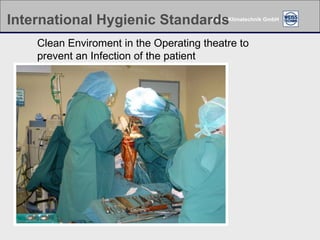
International Hygienic Standards  MEDICLEAN ® Christoph Löhner Clean Enviroment in the Operating theatre to prevent an Infection of the patient
Lidwell-Study ( Correlation of CFU and Infection rate) - 7500 surgeries  - 19 Hospitals - 5 ½ years - Finished in 1980
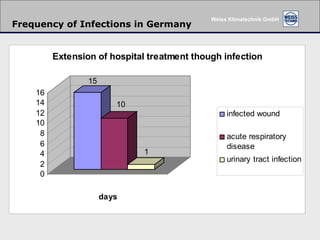
Frequency of Infections in Germany
Tasks of Hygienic Air Conditioning: Prevention of Air Born Infections during Surgery Management of thermal loads Reduction of content of harmful narcotic gases Maintenance of a comfortable climate in the OT 6
Clean Room Class ISO 5/6 Rate of Turbulence  Or Measurements by protection degree Acceptance Test Not specified  ≤  48 dB (A) Sound pressure level F7 + F9 + H14 Min F5 + F9 + H13 Three stage supply air filtration 2,1 m above floor level 2,0 m above floor level Air Curtain Yes, no figure Yes, no figure Overflow into adjoining rooms ? 0,24 – 0,3 m/s 9.000-11.000 m³/h ≥  0,23 m/s,  8.800 m³/h Supply air velocity Total Air Volume Yes (min. 100 m³/h x person) Yes  (1.200 m 3 /h Fresh Air) Recirculation ? Fresh Air Amount Min. 9 m2 3,2 x 3,2 m Size of Laminar Flow Ceiling Russian GOST R Since 21.04.2006 German DIN Dec. 2008 Room Class  I(a) Table of Various Standards and Design Indices  Velocity/Validation ≤  55 dB (A) G3 + min. F9 + min. H 10 2 m above floor level Yes, no figure (close to ceiling recommended) 0,38 m/s on 2 m height 11.900 m³/h Yes (AC/hr 25,  min.2700 m³/h fresh air) 2,8 m x 2,8 m  Rec 3,2 m x 3,2 m English HTM 03-01 Since 2007
Rate of Turbulence  Or Measurements by protection degree Acceptance Test Not specified  ≤  48 dB (A) Sound pressure level 2 Filters (8, 17) (2 could be HEPA filter) Min F5 + F9 + H13 Three stage supply air filtration Not specified 2,0 m above floor level Air Curtain Yes, with pressure monitoring Yes, no figure Overflow into adjoining rooms ? Not specified 2.000-2.700 m³/h depending on size of OT  ≥  0,23 m/s,  8.800 m³/h Supply air velocity Total Air Volume Yes (20 AC/hr) Fresh air 4 AC/hr Yes  (1.200 m 3 /h) Fresh air Recirculation ? No information (laminar airflow “interest”) 3,2 x 3,2 m 2 Size of Air Diffusor ASHRAE 2007 German DIN Dec. 2008 Room Class  I(a) Designing - Main Topics
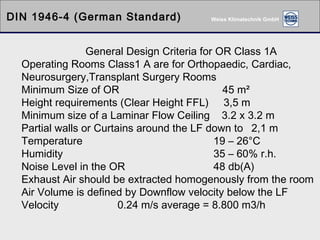
DIN 1946-4 (German Standard) General Design Criteria for OR Class 1A Operating Rooms Class1 A are for Orthopaedic, Cardiac, Neurosurgery,Transplant Surgery Rooms Minimum Size of OR   45 m² Height requirements (Clear Height FFL)  3,5 m  Minimum size of a Laminar Flow Ceiling  3.2 x 3.2 m Partial walls or Curtains around the LF down to   2,1 m  Temperature  19 – 26°C Humidity  35 – 60% r.h. Noise Level in the OR 48 db(A) Exhaust Air should be extracted homogenously from the room Air Volume is defined by Downflow velocity below the LF  Velocity  0.24 m/s average = 8.800 m3/h
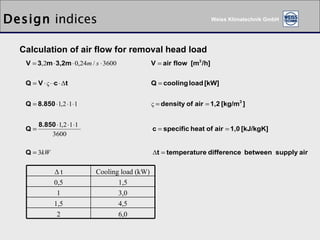
Design  indices Calculation of air flow for removal head load  6,0 2 4,5 1,5 3,0 1 1,5 0,5 Cooling load (kW) ∆  t
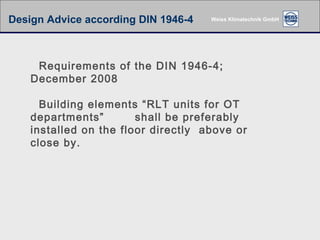
Requirements of the DIN 1946-4; December 2008 Building elements “RLT units for OT departments” shall be preferably installed on the floor directly  above or close by. Design Advice according DIN 1946-4
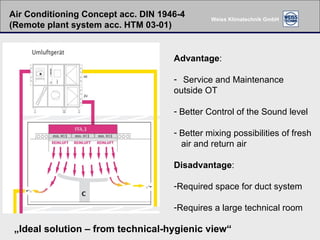
Advantage : Service and Maintenance outside OT Better Control of the Sound level Better mixing possibilities of fresh air and return air  Disadvantage : Required space for duct system Requires a large technical room  Air Conditioning Concept acc. DIN 1946-4 (Remote plant system acc. HTM 03-01) „ Ideal solution – from technical-hygienic view“
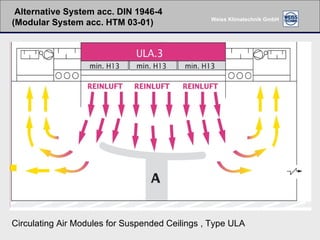
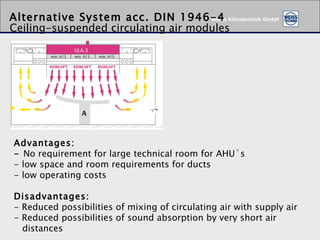
Circulating Air Modules for Suspended Ceilings , Type ULA Alternative System acc. DIN 1946-4 (Modular System acc. HTM 03-01)
Advantages: -  No requirement for large technical room for AHU`s - low space and room requirements for ducts - low operating costs Disadvantages: - Reduced possibilities of mixing of circulating air with supply air - Reduced possibilities of sound absorption by very short air   distances Ceiling-suspended circulating air modules Alternative System acc. DIN 1946-4
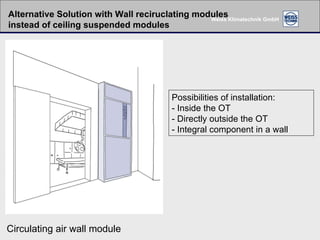
Alternative Solution with Wall reciruclating modules instead of ceiling suspended modules
Circulating air wall module Possibilities of installation: - Inside the OT - Directly outside the OT - Integral component in a wall Alternative Solution with Wall reciruclating modules instead of ceiling suspended modules
Plant scheme Mediclean 120.3 DXU FFA 32/32
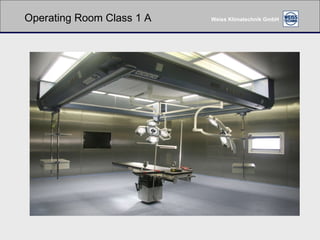
Operating Room Class 1 A
Operating Room Class 1 A Media  Supply Bridges (MVB )
Alternative- Solution to normal Pendents:
Advantages with an example: - Inspection possible from adjoining room -  Integral component of a wall Circulating air wall module Operating Room 1 A with    Wall Recirculating Module
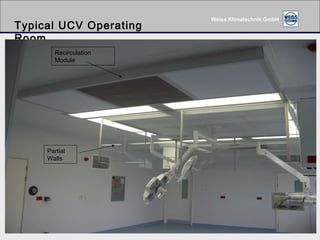
New HTM 03-01 (British Standard) General Design Criteria for UCV UCV (Ultra clean ventilation)  Theatres for Orthopaedic, Cardiac Transplant, Neurosurgery Minimum Size of OR 55 m² Minimum Clear Room Height 3,5 m ( better 3,8 m) Minimum size of a UCV Canopy  2.8 x 2.8 m or 3.2 x 3.2 m in case of bigger OR`s(Distance between UCV Ceiling and perimeterial wall minimum 1 m) Partial walls around the UCV down to   2 m  Temperature  19 – 23°C Humidity  35 – 60% r.h. Noise Level in the OR 55 db(A) Exhaust Air via Pressure Relief Dampers to the adjoining  Rooms (normally no exhaust air in the OR) Air Volume is defined by Downflow velocity over the UCV  At 2 metres  0.38 m/s average = 11.900 m3/h
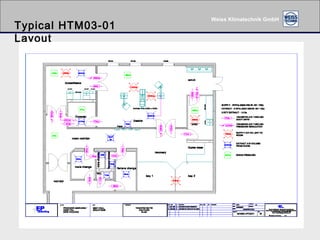
Typical HTM03-01 Layout
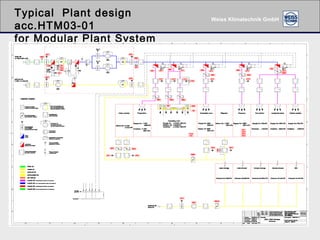
Typical  Plant design acc.HTM03-01 for Modular Plant System
Typical UCV Operating Room Partial Walls Recirculation Module
Typical UCV Operating Room Pressure Relief Damper
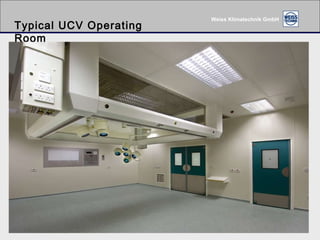
Typical UCV Operating Room
Main Design Mistakes 1. The design of the Air Flow is done according Ashrae and  does not match the requirements for a Laminar Flow  Ceiling Example: Operating room with the dimensions 5 x 6 meters and an internal room height of 3 meters would require according American ASHRAE 20 Air changes per hour which would result in a total Air Volume of 1.800 m³/h A Laminar flow Ceiling with the dimensions 3 x 3 meters would require a minimum Air Flow Volume of 7.776 m3/h Size of ceiling x 0,24 Velocity (m/s) x 3.600 seconds = m³/h Ceiling (3 x 3 m) =9 m² x 0,24 m/s x 3.600= 7.776 m³/h
Main Design Mistakes 2. The design of the Room temperature and the Supply Air temperature is not matching because the Air Flow is not sufficient to provide a drought free enviroment when you have internal heat loads (light, monitors,staff) Example: Operating room with an Internal heat load of 3,0 KW and a total Air Volume of 1.800 m³/h would mean keeping a room temperature of 20°C the supply air temperature has to be 15°C (∆ t = 5 K) Consequences: In a combination with a Laminar Flow Ceiling this will lead to droughts and turbulences as well as to a reduction of the clean area at the height of the Operating table
Summary  1.  Detailed knowledge of standards is important. It will be profitable to include hygienists in due time. 3.  Increasing requirements at operating theatres shall be considered duly. Integrated strategy of architecture, room air technology, medicine technology and lighting Highest possible safety for the hygiene acceptance MEDICLEAN ®

International standards in comparison

  • 1.
    International Hygienic Standards MEDICLEAN ® Christoph Löhner
  • 2.
    International Hygienic Standards MEDICLEAN ® Christoph Löhner Clean Enviroment in the Industry to prevent contamination of the product
  • 3.
    International Hygienic Standards MEDICLEAN ® Christoph Löhner Clean Enviroment in the Operating theatre to prevent an Infection of the patient
  • 4.
    Lidwell-Study ( Correlationof CFU and Infection rate) - 7500 surgeries - 19 Hospitals - 5 ½ years - Finished in 1980
  • 5.
  • 6.
  • 7.
  • 8.
  • 9.
    Tasks of HygienicAir Conditioning: Prevention of Air Born Infections during Surgery Management of thermal loads Reduction of content of harmful narcotic gases Maintenance of a comfortable climate in the OT 6
  • 10.
    Clean Room ClassISO 5/6 Rate of Turbulence Or Measurements by protection degree Acceptance Test Not specified ≤ 48 dB (A) Sound pressure level F7 + F9 + H14 Min F5 + F9 + H13 Three stage supply air filtration 2,1 m above floor level 2,0 m above floor level Air Curtain Yes, no figure Yes, no figure Overflow into adjoining rooms ? 0,24 – 0,3 m/s 9.000-11.000 m³/h ≥ 0,23 m/s, 8.800 m³/h Supply air velocity Total Air Volume Yes (min. 100 m³/h x person) Yes (1.200 m 3 /h Fresh Air) Recirculation ? Fresh Air Amount Min. 9 m2 3,2 x 3,2 m Size of Laminar Flow Ceiling Russian GOST R Since 21.04.2006 German DIN Dec. 2008 Room Class I(a) Table of Various Standards and Design Indices Velocity/Validation ≤ 55 dB (A) G3 + min. F9 + min. H 10 2 m above floor level Yes, no figure (close to ceiling recommended) 0,38 m/s on 2 m height 11.900 m³/h Yes (AC/hr 25, min.2700 m³/h fresh air) 2,8 m x 2,8 m Rec 3,2 m x 3,2 m English HTM 03-01 Since 2007
  • 11.
    Rate of Turbulence Or Measurements by protection degree Acceptance Test Not specified ≤ 48 dB (A) Sound pressure level 2 Filters (8, 17) (2 could be HEPA filter) Min F5 + F9 + H13 Three stage supply air filtration Not specified 2,0 m above floor level Air Curtain Yes, with pressure monitoring Yes, no figure Overflow into adjoining rooms ? Not specified 2.000-2.700 m³/h depending on size of OT ≥ 0,23 m/s, 8.800 m³/h Supply air velocity Total Air Volume Yes (20 AC/hr) Fresh air 4 AC/hr Yes (1.200 m 3 /h) Fresh air Recirculation ? No information (laminar airflow “interest”) 3,2 x 3,2 m 2 Size of Air Diffusor ASHRAE 2007 German DIN Dec. 2008 Room Class I(a) Designing - Main Topics
  • 12.
    DIN 1946-4 (GermanStandard) General Design Criteria for OR Class 1A Operating Rooms Class1 A are for Orthopaedic, Cardiac, Neurosurgery,Transplant Surgery Rooms Minimum Size of OR 45 m² Height requirements (Clear Height FFL) 3,5 m Minimum size of a Laminar Flow Ceiling 3.2 x 3.2 m Partial walls or Curtains around the LF down to 2,1 m Temperature 19 – 26°C Humidity 35 – 60% r.h. Noise Level in the OR 48 db(A) Exhaust Air should be extracted homogenously from the room Air Volume is defined by Downflow velocity below the LF Velocity 0.24 m/s average = 8.800 m3/h
  • 13.
    Design indicesCalculation of air flow for removal head load 6,0 2 4,5 1,5 3,0 1 1,5 0,5 Cooling load (kW) ∆ t
  • 14.
    Requirements of theDIN 1946-4; December 2008 Building elements “RLT units for OT departments” shall be preferably installed on the floor directly above or close by. Design Advice according DIN 1946-4
  • 15.
    Advantage : Serviceand Maintenance outside OT Better Control of the Sound level Better mixing possibilities of fresh air and return air Disadvantage : Required space for duct system Requires a large technical room Air Conditioning Concept acc. DIN 1946-4 (Remote plant system acc. HTM 03-01) „ Ideal solution – from technical-hygienic view“
  • 16.
    Circulating Air Modulesfor Suspended Ceilings , Type ULA Alternative System acc. DIN 1946-4 (Modular System acc. HTM 03-01)
  • 17.
    Advantages: - No requirement for large technical room for AHU`s - low space and room requirements for ducts - low operating costs Disadvantages: - Reduced possibilities of mixing of circulating air with supply air - Reduced possibilities of sound absorption by very short air distances Ceiling-suspended circulating air modules Alternative System acc. DIN 1946-4
  • 18.
    Alternative Solution withWall reciruclating modules instead of ceiling suspended modules
  • 19.
    Circulating air wallmodule Possibilities of installation: - Inside the OT - Directly outside the OT - Integral component in a wall Alternative Solution with Wall reciruclating modules instead of ceiling suspended modules
  • 20.
    Plant scheme Mediclean120.3 DXU FFA 32/32
  • 21.
  • 22.
    Operating Room Class1 A Media Supply Bridges (MVB )
  • 23.
    Alternative- Solution tonormal Pendents:
  • 24.
    Advantages with anexample: - Inspection possible from adjoining room - Integral component of a wall Circulating air wall module Operating Room 1 A with Wall Recirculating Module
  • 25.
    New HTM 03-01(British Standard) General Design Criteria for UCV UCV (Ultra clean ventilation) Theatres for Orthopaedic, Cardiac Transplant, Neurosurgery Minimum Size of OR 55 m² Minimum Clear Room Height 3,5 m ( better 3,8 m) Minimum size of a UCV Canopy 2.8 x 2.8 m or 3.2 x 3.2 m in case of bigger OR`s(Distance between UCV Ceiling and perimeterial wall minimum 1 m) Partial walls around the UCV down to 2 m Temperature 19 – 23°C Humidity 35 – 60% r.h. Noise Level in the OR 55 db(A) Exhaust Air via Pressure Relief Dampers to the adjoining Rooms (normally no exhaust air in the OR) Air Volume is defined by Downflow velocity over the UCV At 2 metres 0.38 m/s average = 11.900 m3/h
  • 26.
  • 27.
    Typical Plantdesign acc.HTM03-01 for Modular Plant System
  • 28.
    Typical UCV OperatingRoom Partial Walls Recirculation Module
  • 29.
    Typical UCV OperatingRoom Pressure Relief Damper
  • 30.
  • 31.
    Main Design Mistakes1. The design of the Air Flow is done according Ashrae and does not match the requirements for a Laminar Flow Ceiling Example: Operating room with the dimensions 5 x 6 meters and an internal room height of 3 meters would require according American ASHRAE 20 Air changes per hour which would result in a total Air Volume of 1.800 m³/h A Laminar flow Ceiling with the dimensions 3 x 3 meters would require a minimum Air Flow Volume of 7.776 m3/h Size of ceiling x 0,24 Velocity (m/s) x 3.600 seconds = m³/h Ceiling (3 x 3 m) =9 m² x 0,24 m/s x 3.600= 7.776 m³/h
  • 32.
    Main Design Mistakes2. The design of the Room temperature and the Supply Air temperature is not matching because the Air Flow is not sufficient to provide a drought free enviroment when you have internal heat loads (light, monitors,staff) Example: Operating room with an Internal heat load of 3,0 KW and a total Air Volume of 1.800 m³/h would mean keeping a room temperature of 20°C the supply air temperature has to be 15°C (∆ t = 5 K) Consequences: In a combination with a Laminar Flow Ceiling this will lead to droughts and turbulences as well as to a reduction of the clean area at the height of the Operating table
  • 33.
    Summary 1. Detailed knowledge of standards is important. It will be profitable to include hygienists in due time. 3. Increasing requirements at operating theatres shall be considered duly. Integrated strategy of architecture, room air technology, medicine technology and lighting Highest possible safety for the hygiene acceptance MEDICLEAN ®