International Research Journal of Engineering and Technology (IRJET) e-ISSN: 2395-0056
Volume: 07 Issue: 03 | Mar 2020 www.irjet.net p-ISSN: 2395-0072
© 2020, IRJET | Impact Factor value: 7.34 | ISO 9001:2008 Certified Journal | Page 1506
A Survey on Biometric Voting System using Iris Recognition
Jayapriya J1, Roghini M2, Jayanthi S
1UG Student, Department of CSE, Agni College of Technology, Tamil Nadu, India
3Assistant Professor, Dept of Computer Science and Engineering, Agni College of Technology, Tamil Nadu, India
------------------------------------------------------------------------***----------------------------------------------------------------------
Abstract - In every election ,he election commission isfacinga
lot of troubles and different type of problems throughout the
election. The most familiar issue faced by the election
commission is inappropriate confirmation with respect to the
arrangement of casting thevotes, duplicationor illegalcasting
of votes. In this paper, a secure and new voting system is
developed to improve the existing voting system using iris
recognition. Iris one of the most secure biometric of person
identification. The main goal of this article is to avoid
duplication of casting votes.
Key Words: - Iris, Recognition, Data mining ,feature
extraction algorithms, matching.
1. INTRODUCTION
Voting System is the government electionprocessesinevery
democratic nation. Democracy is to allow people to vote on
their interest and it is right of every individual of a
democratic nation. The democratic government depends on
the results of the election.
Today’s world is an era of internet and technology, internet
and electronics are increasing day by day. It is unavoidable
to upgrade the traditional voting system and protect the
security of it. The main intention of thisarticleistodevelopa
new idea about voting system and also ensure security of it.
To safeguard the security of voting system, We use iris
recognition in proposed system. Iris recognition is used
since it is highly unique, stable, cannot be duplicated and
easily captured.
Many types of voting system have been used around the
world. Paper ballot voting system is an old and unsecure
voting system where it is possible to fling multiple votes
from same person. It runs to fling the vote with a ballot
paper and a stamp.
Fig. 1. Traditional voting system
In electronic voting system, the process of election data is
recorded, stored and preceded as digital information .
Electronic voting system is used to fling vote as well as
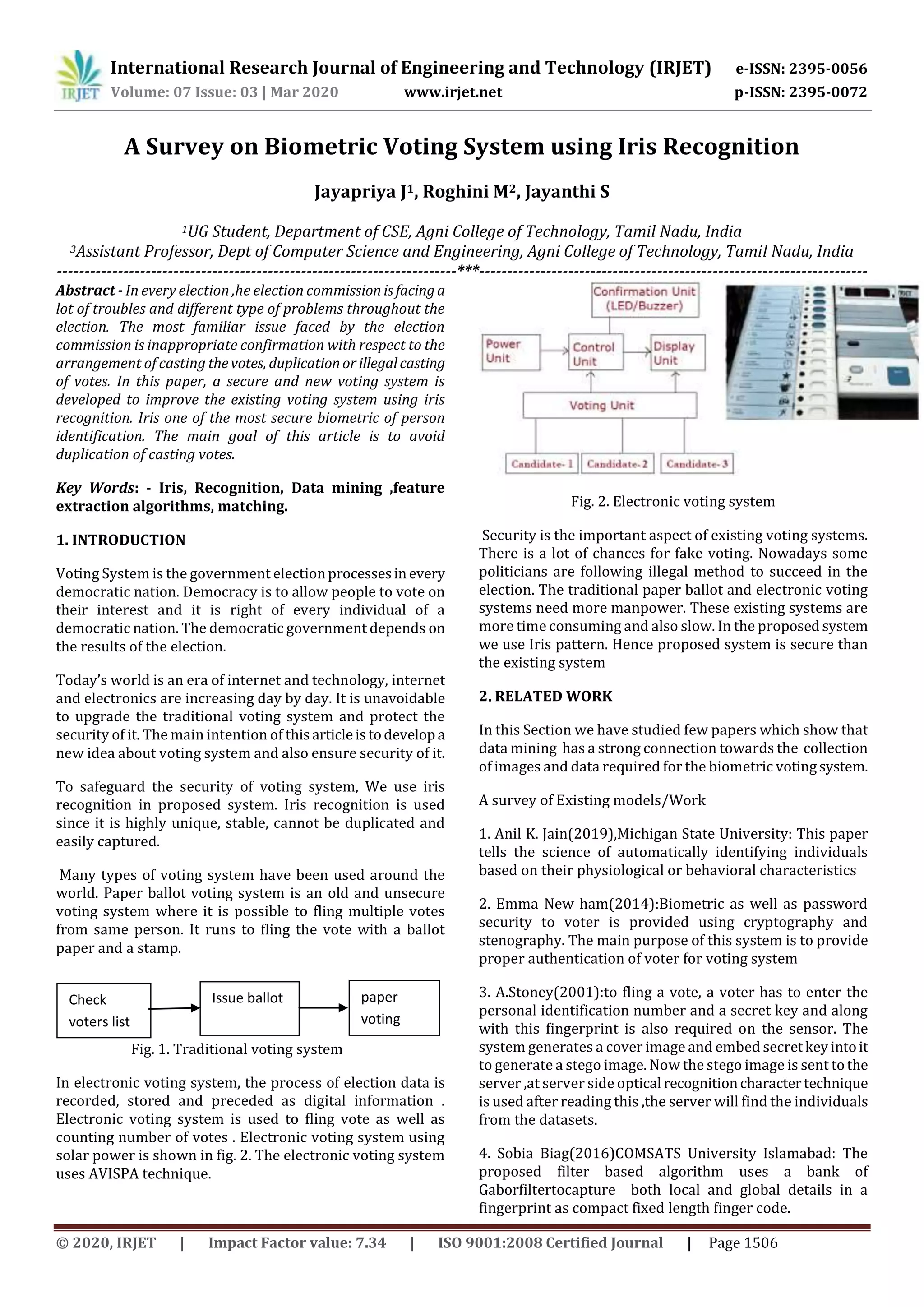
counting number of votes . Electronic voting system using
solar power is shown in fig. 2. The electronic voting system
uses AVISPA technique.
Fig. 2. Electronic voting system
Security is the important aspect of existing voting systems.
There is a lot of chances for fake voting. Nowadays some
politicians are following illegal method to succeed in the
election. The traditional paper ballot and electronic voting
systems need more manpower. These existing systems are
more time consuming and also slow. In the proposedsystem
we use Iris pattern. Hence proposed system is secure than
the existing system
2. RELATED WORK
In this Section we have studied few papers which show that
data mining has a strong connection towards the collection
of images and data required for the biometric votingsystem.
A survey of Existing models/Work
1. Anil K. Jain(2019),Michigan State University: This paper
tells the science of automatically identifying individuals
based on their physiological or behavioral characteristics
2. Emma New ham(2014):Biometric as well as password
security to voter is provided using cryptography and
stenography. The main purpose of this system is to provide
proper authentication of voter for voting system
3. A.Stoney(2001):to fling a vote, a voter has to enter the
personal identification number and a secret key and along
with this fingerprint is also required on the sensor. The
system generates a cover image and embed secretkeyintoit
to generate a stego image. Now the stego image is sent tothe
server ,at server side optical recognitioncharactertechnique
is used after reading this ,the server will find the individuals
from the datasets.
4. Sobia Biag(2016)COMSATS University Islamabad: The
proposed filter based algorithm uses a bank of
Gaborfiltertocapture both local and global details in a
fingerprint as compact fixed length finger code.
Check
voters list
Issue ballot paper
voting
International Research Journal of Engineering and Technology (IRJET) e-ISSN: 2395-0056
Volume: 07 Issue: 03 | Mar 2020 www.irjet.net p-ISSN: 2395-0072
© 2020, IRJET | Impact Factor value: 7.34 | ISO 9001:2008 Certified Journal | Page 1507
5. Sonia Hof(2008)University of Linz ,Austria: In this paper
biometrics is used to identify individuals using face ,iris,
retina, palm-print ,etc.
6. Shanu Agarwal(2018): In this the system uses thumb
impression for voter identification. The fingerprint is
matched with the database if a match is available the person
is permitted to fling a vote.
3. DATASETS
Before creating the database, All that have to be done is to
collect the appropriate data sets from the user. It takes the
following process.
A. Collect various iris images of theentirecitizenusing
the CASIA database.
B. Collect the details of the parties who are all
participating in the election process.
4. PROPOSED SYSTEM
The main intention of the article is to develop a new idea
about voting system and also ensure the security of the
system. To ensure the security of the voting system iris
recognition is used in the proposed system. The concept of
iris recognition is used since every individual has a unique
iris. The image of iris can be easily captured. The two main
stages are iris verification and iris identification. Iris
verification verifies the identity of a person while iris
identification establish the identity of the person.
4.1. RELATED CONCEPTS:
The voting system has to be improved in order to avoid the
duplication of votes and voting by an unauthorized person
without proper verification.
4.2. FRONT END
It collects the details such as candidate information ,iris
image, and sends the details to the PHP to access the results
from database. Front end is designed using HTML, CSS, Java
Scripting languages.
4.3. BACK END
SERVER :It collects the details from the front end
DATA BASE :
1) Collect the iris image of all the citizens iris image is
collected from CASIA database.
2) Collect the details of the candidateswhoarecompeting
in the election
4.4. TECHNIQUES APPROACHED:
Iris recognition process consists of five major stepstheyare:
4.4.1 Image acquisition
4.4.2 Segmentation
4.4.3 Normalization
4.4.4 Feature extraction
4.4.5 Matching
4.4.1 IMAGE ACQUISITION:
The image of an iris cannot be acquired by camera as it is
small in size and also because of the light reflection in the
camera. Hence acquiring good image has some difficulties.
We are using CASIA(Institute of Automation Chinese
Academy of Sciences)iris image database version 4.0.
4.4.2 SEGMENTATION:
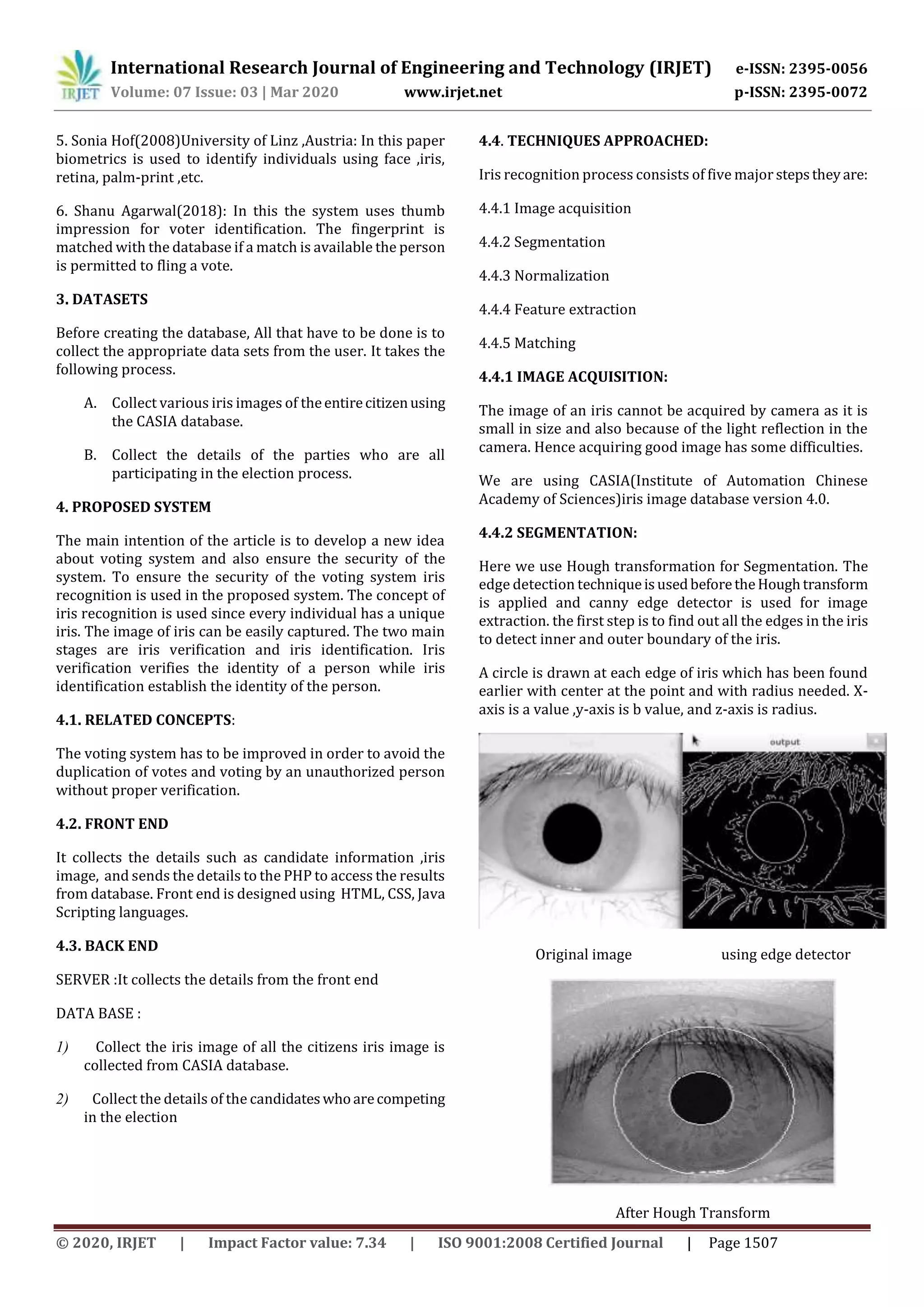
Here we use Hough transformation for Segmentation. The
edge detection techniqueisusedbeforetheHoughtransform
is applied and canny edge detector is used for image
extraction. the first step is to find out all the edges in the iris
to detect inner and outer boundary of the iris.
A circle is drawn at each edge of iris which has been found
earlier with center at the point and with radius needed. X-
axis is a value ,y-axis is b value, and z-axis is radius.
Original image using edge detector
After Hough Transform
International Research Journal of Engineering and Technology (IRJET) e-ISSN: 2395-0056
Volume: 07 Issue: 03 | Mar 2020 www.irjet.net p-ISSN: 2395-0072
© 2020, IRJET | Impact Factor value: 7.34 | ISO 9001:2008 Certified Journal | Page 1508
4.4.3 IRIS NORMALIZATION:
Dough man’s rubber sheet model is used for normalization
of iris. The segmented iris is converted from Cartesian to
polar coordinates.
4.4.4 FEATURE EXTRACTION:
In this 1D log Gabor Wavelet is used to create a template
representing pattern information.
Feature extraction is implemented by the normalized iris
pattern which has been convoluted with 1D log-
gaborwavelet. First step of the process is breaking down of
the 2D normalized iris pattern into number of 1D signal.
Each row corresponds to a circular ring on iris region[14].
After encoding the process producesa bitwisetemplatewith
a number of bits of information, a noise mask that
communicate the area which are corrupted within the iris
pattern and mark the corrupted bits .
4.4.5 MATCHING:
In this article matching is done using hamming distance.
hamming distance of to templates is calculated by shifting
one template left and right bitwise. The successive shifts are
used in calculating number of hamming distance
Image of shifting process
5. ARCHITECTURE:
6. RESULT OF SEGMENTATION:
images in the database has been segmented accurately.
Only sum of the images in database cannot be segmented
accurately.
Circle iris and circle pupil is used to calculate the
segmentation value of iris image, this can be done using
Hough transform .
7. RESULT OF MATCHING:
There are total of 54,607 iris images are present in the
CASIA-Iris V4 which were collected from more than 1800
genuine subjects and 1000 from virtual subjects. The main
advantage of CASIA database is that it does not produce any
light reflection. The image can viewed clearly .
8. CONCLUSION:
There is a constant increase in the population of our nation
day to day, therefore improvement in the voting system is a
mandatory thing. Even though there are many biometric
techniques we have implemented iris recognition concept
for providing high accuracy and this technique also reduces
time required. And the important use of this is there is no
chance of invalid vote.
9. REFERENCES
[1]. K. Ramya Devi and J. V. Vidhya , ”SURVEY ON SECURE
ELECTRONIC VOTING SYSTEM”,International Journal of
Pharmacy &Technology(IJPT),Vol.9,April-2017
[2]Asif Ahmed Anik, Rayees Jameel, Abul Farah Anik,
NowrozeAkter, ”Design of a solar piwer Electronic Voting
Machine”, Proceedings of 2017 International Conference on
Networking, Systems and Security(NSysS), 5-8
jan.2017,Dhaka,Bangladsh
[3]Htet Ne Oo, Aye Moe Aung, “Design and formal analysisof
electronic voting protocol using AVISPA”, Proceedings of
International Research Journal of Engineering and Technology (IRJET) e-ISSN: 2395-0056
Volume: 07 Issue: 03 | Mar 2020 www.irjet.net p-ISSN: 2395-0072
© 2020, IRJET | Impact Factor value: 7.34 | ISO 9001:2008 Certified Journal | Page 1509
2017 2nd International Conference for Convergence in
Technology(12CT), 7-9 April 2017, Mumbai, India
[4] John, K. A., and Kofi S. A. M. (2014). IJCSI International
Journal of Computer Science Issues. A Trustworthy
Architectural Framework for the AdministrationofE-voting,
11 (30, 97.
[5]ZuyinaAyuningSapturi, AmangSudarsonos,MikeYuliana,
“E-voting security system for the election of EEPIS BEM
president”, 2017 International Electronics Symposium on
Knowledge Creation andIntelligent Co putting (IES-KCIC),
26-27 Sept. 2017, Surbaya, Indonesia.
[6]NoureddineCherabit, Fatma Zohra Chelali, Amar Djeradi,
“Circular hough Transform for Iris localization” Science and
Technology, PISSN: 2163-2669, e-ISSN: 2163-2677, 2(5):
114-121, 2012.
[7]Krzysztof Misztal, Emil Saeed, Jacek Tabor, and Khalid
Saeed, “Iris Pattern Recognition with a New Mathematical
Model to Its Rotation Detection”, Human Identification by
Vascular Pattern (pp.43-65), November 2012.
[8] Caroline Houston, “Iris Segmentation and Recognition
Using Circular Hough Transform and Wavelets Features”,
Rochester Institute of technology.
[9] Richard Yew Fatt Ng, Yong Haur Tay, Kai Ming Mok, “A
Review of Iris Recognition Algorithms”, 2008 International
Symosium on Information Technology, Volume: 2, ITSim
2008.
[10] Libor Masek, “Recognition of Human Iris Patterns for
Biometric Identification”, The University of Western
Australia, 2003.
[11] K. Seetharaman, R. Ragupathy, “Iris Recognition for
Personal Identification System”, ICMOC-2012,India
[12] Z. Zainal Abidin, M. Manaf, A. S. Shibghatullah, S.H. A.
MohdYunos,S.Anawar, Z. Ayop, “Iris Segmentation Analysis
using Integro-Differential Operator andHoughTransform in
BiometricSystem”, Journal ofTelecommunication,Electronic
and Computer Engineering, ISSN:2180-1843Vol.4No.2July
-December 2012.
[13] U T Tania, S M AMotakabber and M I Ibrahimy, “Edge
Detection Techniques for Iris Recognition System”, IOP
Conference Series: Materials Sciences and Engineering,
Volume 53, conference 1, 2013.
[14] K. Seetharaman, R. Ragupathu, “Iris Recognition for
Identification System”, Procedia Engineering, Volium 38

IRJET - A Survey on Biometric Voting System using Iris Recognition

  • 1.
    International Research Journalof Engineering and Technology (IRJET) e-ISSN: 2395-0056 Volume: 07 Issue: 03 | Mar 2020 www.irjet.net p-ISSN: 2395-0072 © 2020, IRJET | Impact Factor value: 7.34 | ISO 9001:2008 Certified Journal | Page 1506 A Survey on Biometric Voting System using Iris Recognition Jayapriya J1, Roghini M2, Jayanthi S 1UG Student, Department of CSE, Agni College of Technology, Tamil Nadu, India 3Assistant Professor, Dept of Computer Science and Engineering, Agni College of Technology, Tamil Nadu, India ------------------------------------------------------------------------***---------------------------------------------------------------------- Abstract - In every election ,he election commission isfacinga lot of troubles and different type of problems throughout the election. The most familiar issue faced by the election commission is inappropriate confirmation with respect to the arrangement of casting thevotes, duplicationor illegalcasting of votes. In this paper, a secure and new voting system is developed to improve the existing voting system using iris recognition. Iris one of the most secure biometric of person identification. The main goal of this article is to avoid duplication of casting votes. Key Words: - Iris, Recognition, Data mining ,feature extraction algorithms, matching. 1. INTRODUCTION Voting System is the government electionprocessesinevery democratic nation. Democracy is to allow people to vote on their interest and it is right of every individual of a democratic nation. The democratic government depends on the results of the election. Today’s world is an era of internet and technology, internet and electronics are increasing day by day. It is unavoidable to upgrade the traditional voting system and protect the security of it. The main intention of thisarticleistodevelopa new idea about voting system and also ensure security of it. To safeguard the security of voting system, We use iris recognition in proposed system. Iris recognition is used since it is highly unique, stable, cannot be duplicated and easily captured. Many types of voting system have been used around the world. Paper ballot voting system is an old and unsecure voting system where it is possible to fling multiple votes from same person. It runs to fling the vote with a ballot paper and a stamp. Fig. 1. Traditional voting system In electronic voting system, the process of election data is recorded, stored and preceded as digital information . Electronic voting system is used to fling vote as well as counting number of votes . Electronic voting system using solar power is shown in fig. 2. The electronic voting system uses AVISPA technique. Fig. 2. Electronic voting system Security is the important aspect of existing voting systems. There is a lot of chances for fake voting. Nowadays some politicians are following illegal method to succeed in the election. The traditional paper ballot and electronic voting systems need more manpower. These existing systems are more time consuming and also slow. In the proposedsystem we use Iris pattern. Hence proposed system is secure than the existing system 2. RELATED WORK In this Section we have studied few papers which show that data mining has a strong connection towards the collection of images and data required for the biometric votingsystem. A survey of Existing models/Work 1. Anil K. Jain(2019),Michigan State University: This paper tells the science of automatically identifying individuals based on their physiological or behavioral characteristics 2. Emma New ham(2014):Biometric as well as password security to voter is provided using cryptography and stenography. The main purpose of this system is to provide proper authentication of voter for voting system 3. A.Stoney(2001):to fling a vote, a voter has to enter the personal identification number and a secret key and along with this fingerprint is also required on the sensor. The system generates a cover image and embed secretkeyintoit to generate a stego image. Now the stego image is sent tothe server ,at server side optical recognitioncharactertechnique is used after reading this ,the server will find the individuals from the datasets. 4. Sobia Biag(2016)COMSATS University Islamabad: The proposed filter based algorithm uses a bank of Gaborfiltertocapture both local and global details in a fingerprint as compact fixed length finger code. Check voters list Issue ballot paper voting
  • 2.
    International Research Journalof Engineering and Technology (IRJET) e-ISSN: 2395-0056 Volume: 07 Issue: 03 | Mar 2020 www.irjet.net p-ISSN: 2395-0072 © 2020, IRJET | Impact Factor value: 7.34 | ISO 9001:2008 Certified Journal | Page 1507 5. Sonia Hof(2008)University of Linz ,Austria: In this paper biometrics is used to identify individuals using face ,iris, retina, palm-print ,etc. 6. Shanu Agarwal(2018): In this the system uses thumb impression for voter identification. The fingerprint is matched with the database if a match is available the person is permitted to fling a vote. 3. DATASETS Before creating the database, All that have to be done is to collect the appropriate data sets from the user. It takes the following process. A. Collect various iris images of theentirecitizenusing the CASIA database. B. Collect the details of the parties who are all participating in the election process. 4. PROPOSED SYSTEM The main intention of the article is to develop a new idea about voting system and also ensure the security of the system. To ensure the security of the voting system iris recognition is used in the proposed system. The concept of iris recognition is used since every individual has a unique iris. The image of iris can be easily captured. The two main stages are iris verification and iris identification. Iris verification verifies the identity of a person while iris identification establish the identity of the person. 4.1. RELATED CONCEPTS: The voting system has to be improved in order to avoid the duplication of votes and voting by an unauthorized person without proper verification. 4.2. FRONT END It collects the details such as candidate information ,iris image, and sends the details to the PHP to access the results from database. Front end is designed using HTML, CSS, Java Scripting languages. 4.3. BACK END SERVER :It collects the details from the front end DATA BASE : 1) Collect the iris image of all the citizens iris image is collected from CASIA database. 2) Collect the details of the candidateswhoarecompeting in the election 4.4. TECHNIQUES APPROACHED: Iris recognition process consists of five major stepstheyare: 4.4.1 Image acquisition 4.4.2 Segmentation 4.4.3 Normalization 4.4.4 Feature extraction 4.4.5 Matching 4.4.1 IMAGE ACQUISITION: The image of an iris cannot be acquired by camera as it is small in size and also because of the light reflection in the camera. Hence acquiring good image has some difficulties. We are using CASIA(Institute of Automation Chinese Academy of Sciences)iris image database version 4.0. 4.4.2 SEGMENTATION: Here we use Hough transformation for Segmentation. The edge detection techniqueisusedbeforetheHoughtransform is applied and canny edge detector is used for image extraction. the first step is to find out all the edges in the iris to detect inner and outer boundary of the iris. A circle is drawn at each edge of iris which has been found earlier with center at the point and with radius needed. X- axis is a value ,y-axis is b value, and z-axis is radius. Original image using edge detector After Hough Transform
  • 3.
    International Research Journalof Engineering and Technology (IRJET) e-ISSN: 2395-0056 Volume: 07 Issue: 03 | Mar 2020 www.irjet.net p-ISSN: 2395-0072 © 2020, IRJET | Impact Factor value: 7.34 | ISO 9001:2008 Certified Journal | Page 1508 4.4.3 IRIS NORMALIZATION: Dough man’s rubber sheet model is used for normalization of iris. The segmented iris is converted from Cartesian to polar coordinates. 4.4.4 FEATURE EXTRACTION: In this 1D log Gabor Wavelet is used to create a template representing pattern information. Feature extraction is implemented by the normalized iris pattern which has been convoluted with 1D log- gaborwavelet. First step of the process is breaking down of the 2D normalized iris pattern into number of 1D signal. Each row corresponds to a circular ring on iris region[14]. After encoding the process producesa bitwisetemplatewith a number of bits of information, a noise mask that communicate the area which are corrupted within the iris pattern and mark the corrupted bits . 4.4.5 MATCHING: In this article matching is done using hamming distance. hamming distance of to templates is calculated by shifting one template left and right bitwise. The successive shifts are used in calculating number of hamming distance Image of shifting process 5. ARCHITECTURE: 6. RESULT OF SEGMENTATION: images in the database has been segmented accurately. Only sum of the images in database cannot be segmented accurately. Circle iris and circle pupil is used to calculate the segmentation value of iris image, this can be done using Hough transform . 7. RESULT OF MATCHING: There are total of 54,607 iris images are present in the CASIA-Iris V4 which were collected from more than 1800 genuine subjects and 1000 from virtual subjects. The main advantage of CASIA database is that it does not produce any light reflection. The image can viewed clearly . 8. CONCLUSION: There is a constant increase in the population of our nation day to day, therefore improvement in the voting system is a mandatory thing. Even though there are many biometric techniques we have implemented iris recognition concept for providing high accuracy and this technique also reduces time required. And the important use of this is there is no chance of invalid vote. 9. REFERENCES [1]. K. Ramya Devi and J. V. Vidhya , ”SURVEY ON SECURE ELECTRONIC VOTING SYSTEM”,International Journal of Pharmacy &Technology(IJPT),Vol.9,April-2017 [2]Asif Ahmed Anik, Rayees Jameel, Abul Farah Anik, NowrozeAkter, ”Design of a solar piwer Electronic Voting Machine”, Proceedings of 2017 International Conference on Networking, Systems and Security(NSysS), 5-8 jan.2017,Dhaka,Bangladsh [3]Htet Ne Oo, Aye Moe Aung, “Design and formal analysisof electronic voting protocol using AVISPA”, Proceedings of
  • 4.
    International Research Journalof Engineering and Technology (IRJET) e-ISSN: 2395-0056 Volume: 07 Issue: 03 | Mar 2020 www.irjet.net p-ISSN: 2395-0072 © 2020, IRJET | Impact Factor value: 7.34 | ISO 9001:2008 Certified Journal | Page 1509 2017 2nd International Conference for Convergence in Technology(12CT), 7-9 April 2017, Mumbai, India [4] John, K. A., and Kofi S. A. M. (2014). IJCSI International Journal of Computer Science Issues. A Trustworthy Architectural Framework for the AdministrationofE-voting, 11 (30, 97. [5]ZuyinaAyuningSapturi, AmangSudarsonos,MikeYuliana, “E-voting security system for the election of EEPIS BEM president”, 2017 International Electronics Symposium on Knowledge Creation andIntelligent Co putting (IES-KCIC), 26-27 Sept. 2017, Surbaya, Indonesia. [6]NoureddineCherabit, Fatma Zohra Chelali, Amar Djeradi, “Circular hough Transform for Iris localization” Science and Technology, PISSN: 2163-2669, e-ISSN: 2163-2677, 2(5): 114-121, 2012. [7]Krzysztof Misztal, Emil Saeed, Jacek Tabor, and Khalid Saeed, “Iris Pattern Recognition with a New Mathematical Model to Its Rotation Detection”, Human Identification by Vascular Pattern (pp.43-65), November 2012. [8] Caroline Houston, “Iris Segmentation and Recognition Using Circular Hough Transform and Wavelets Features”, Rochester Institute of technology. [9] Richard Yew Fatt Ng, Yong Haur Tay, Kai Ming Mok, “A Review of Iris Recognition Algorithms”, 2008 International Symosium on Information Technology, Volume: 2, ITSim 2008. [10] Libor Masek, “Recognition of Human Iris Patterns for Biometric Identification”, The University of Western Australia, 2003. [11] K. Seetharaman, R. Ragupathy, “Iris Recognition for Personal Identification System”, ICMOC-2012,India [12] Z. Zainal Abidin, M. Manaf, A. S. Shibghatullah, S.H. A. MohdYunos,S.Anawar, Z. Ayop, “Iris Segmentation Analysis using Integro-Differential Operator andHoughTransform in BiometricSystem”, Journal ofTelecommunication,Electronic and Computer Engineering, ISSN:2180-1843Vol.4No.2July -December 2012. [13] U T Tania, S M AMotakabber and M I Ibrahimy, “Edge Detection Techniques for Iris Recognition System”, IOP Conference Series: Materials Sciences and Engineering, Volume 53, conference 1, 2013. [14] K. Seetharaman, R. Ragupathu, “Iris Recognition for Identification System”, Procedia Engineering, Volium 38