Dr.(Mrs.) K.T.K.M. De Silva
Department of Mechanical and Manufacturing Engineering
ME2201 – FUNDAMENTALS
OF ENGINEERING
THERMODYNAMICS
INTERNAL ENERGY AND
ENTHALPY
THERMODYNAMIC WORK
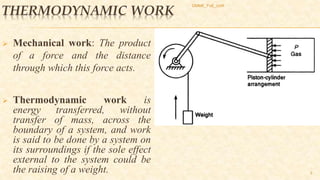
 Thermodynamic work is
energy transferred, without
transfer of mass, across the
boundary of a system, and work
is said to be done by a system on
its surroundings if the sole effect
external to the system could be
the raising of a weight.
DMME_FoE_UoR
3
 Mechanical work: The product
of a force and the distance
through which this force acts.
INTERNAL ENERGY OF IDEAL GASES
DMME_FoE_UoR
4
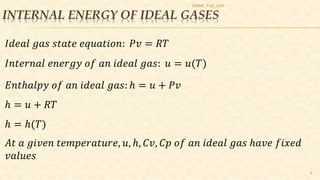
𝐼𝑑𝑒𝑎𝑙 𝑔𝑎𝑠 𝑠𝑡𝑎𝑡𝑒 𝑒𝑞𝑢𝑎𝑡𝑖𝑜𝑛: 𝑃𝑣 = 𝑅𝑇
𝐼𝑛𝑡𝑒𝑟𝑛𝑎𝑙 𝑒𝑛𝑒𝑟𝑔𝑦 𝑜𝑓 𝑎𝑛 𝑖𝑑𝑒𝑎𝑙 𝑔𝑎𝑠: 𝑢 = 𝑢(𝑇)
𝐸𝑛𝑡ℎ𝑎𝑙𝑝𝑦 𝑜𝑓 𝑎𝑛 𝑖𝑑𝑒𝑎𝑙 𝑔𝑎𝑠: ℎ = 𝑢 + 𝑃𝑣
ℎ = 𝑢 + 𝑅𝑇
ℎ = ℎ(𝑇)
𝐴𝑡 𝑎 𝑔𝑖𝑣𝑒𝑛 𝑡𝑒𝑚𝑝𝑒𝑟𝑎𝑡𝑢𝑟𝑒, 𝑢, ℎ, 𝐶𝑣, 𝐶𝑝 𝑜𝑓 𝑎𝑛 𝑖𝑑𝑒𝑎𝑙 𝑔𝑎𝑠 ℎ𝑎𝑣𝑒 𝑓𝑖𝑥𝑒𝑑
𝑣𝑎𝑙𝑢𝑒𝑠
INTERNAL ENERGY OF IDEAL GASES…
DMME_FoE_UoR
5
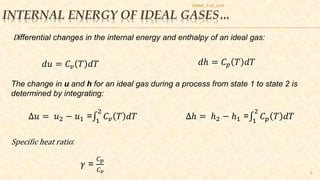
𝑑𝑢 = 𝐶𝑣 𝑇 𝑑𝑇 𝑑ℎ = 𝐶𝑝 𝑇 𝑑𝑇
∆𝑢 = 𝑢2 − 𝑢1 = 1
2
𝐶𝑣 𝑇 𝑑𝑇 ∆ℎ = ℎ2 − ℎ1 = 1
2
𝐶𝑝 𝑇 𝑑𝑇
Differential changes in the internal energy and enthalpy of an ideal gas:
The change in u and h for an ideal gas during a process from state 1 to state 2 is
determined by integrating:
Specific heat ratio:
𝛾 =
𝐶𝑝
𝐶𝑣
INTERNAL ENERGY OF LIQUID AND SOLID
DMME_FoE_UoR
6
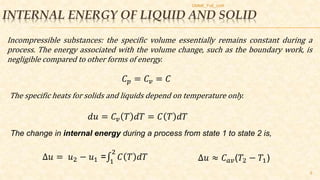
Incompressible substances: the specific volume essentially remains constant during a
process. The energy associated with the volume change, such as the boundary work, is
negligible compared to other forms of energy.
𝐶𝑝 = 𝐶𝑣 = 𝐶
The specific heats for solids and liquids depend on temperature only.
𝑑𝑢 = 𝐶𝑣 𝑇 𝑑𝑇 = 𝐶 𝑇 𝑑𝑇
The change in internal energy during a process from state 1 to state 2 is,
∆𝑢 = 𝑢2 − 𝑢1 = 1
2
𝐶 𝑇 𝑑𝑇 ∆𝑢 ≈ 𝐶𝑎𝑣(𝑇2 − 𝑇1)
INTERNAL ENERGY OF LIQUID AND SOLID…
DMME_FoE_UoR
7
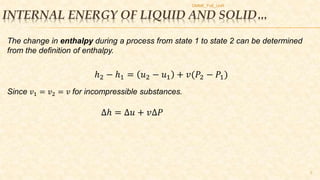
The change in enthalpy during a process from state 1 to state 2 can be determined
from the definition of enthalpy.
ℎ2 − ℎ1 = 𝑢2 − 𝑢1 + 𝑣(𝑃2 − 𝑃1)
Since 𝑣1 = 𝑣2 = 𝑣 for incompressible substances.
∆ℎ = ∆𝑢 + 𝑣∆𝑃
EXAMPLE 01
DMME_FoE_UoR
8
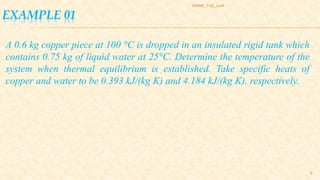
A 0.6 kg copper piece at 100 °C is dropped in an insulated rigid tank which
contains 0.75 kg of liquid water at 25°C. Determine the temperature of the
system when thermal equilibrium is established. Take specific heats of
copper and water to be 0.393 kJ/(kg K) and 4.184 kJ/(kg K), respectively.
EXAMPLE 02
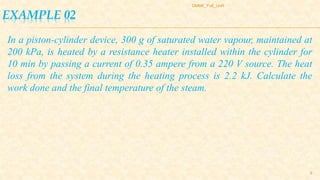
In a piston-cylinder device, 300 g of saturated water vapour, maintained at
200 kPa, is heated by a resistance heater installed within the cylinder for
10 min by passing a current of 0.35 ampere from a 220 V source. The heat
loss from the system during the heating process is 2.2 kJ. Calculate the
work done and the final temperature of the steam.
DMME_FoE_UoR
9

Internal Energy and Enthalpy .pptx

  • 1.
    Dr.(Mrs.) K.T.K.M. DeSilva Department of Mechanical and Manufacturing Engineering ME2201 – FUNDAMENTALS OF ENGINEERING THERMODYNAMICS
  • 2.
  • 3.
    THERMODYNAMIC WORK  Thermodynamicwork is energy transferred, without transfer of mass, across the boundary of a system, and work is said to be done by a system on its surroundings if the sole effect external to the system could be the raising of a weight. DMME_FoE_UoR 3  Mechanical work: The product of a force and the distance through which this force acts.
  • 4.
    INTERNAL ENERGY OFIDEAL GASES DMME_FoE_UoR 4 𝐼𝑑𝑒𝑎𝑙 𝑔𝑎𝑠 𝑠𝑡𝑎𝑡𝑒 𝑒𝑞𝑢𝑎𝑡𝑖𝑜𝑛: 𝑃𝑣 = 𝑅𝑇 𝐼𝑛𝑡𝑒𝑟𝑛𝑎𝑙 𝑒𝑛𝑒𝑟𝑔𝑦 𝑜𝑓 𝑎𝑛 𝑖𝑑𝑒𝑎𝑙 𝑔𝑎𝑠: 𝑢 = 𝑢(𝑇) 𝐸𝑛𝑡ℎ𝑎𝑙𝑝𝑦 𝑜𝑓 𝑎𝑛 𝑖𝑑𝑒𝑎𝑙 𝑔𝑎𝑠: ℎ = 𝑢 + 𝑃𝑣 ℎ = 𝑢 + 𝑅𝑇 ℎ = ℎ(𝑇) 𝐴𝑡 𝑎 𝑔𝑖𝑣𝑒𝑛 𝑡𝑒𝑚𝑝𝑒𝑟𝑎𝑡𝑢𝑟𝑒, 𝑢, ℎ, 𝐶𝑣, 𝐶𝑝 𝑜𝑓 𝑎𝑛 𝑖𝑑𝑒𝑎𝑙 𝑔𝑎𝑠 ℎ𝑎𝑣𝑒 𝑓𝑖𝑥𝑒𝑑 𝑣𝑎𝑙𝑢𝑒𝑠
  • 5.
    INTERNAL ENERGY OFIDEAL GASES… DMME_FoE_UoR 5 𝑑𝑢 = 𝐶𝑣 𝑇 𝑑𝑇 𝑑ℎ = 𝐶𝑝 𝑇 𝑑𝑇 ∆𝑢 = 𝑢2 − 𝑢1 = 1 2 𝐶𝑣 𝑇 𝑑𝑇 ∆ℎ = ℎ2 − ℎ1 = 1 2 𝐶𝑝 𝑇 𝑑𝑇 Differential changes in the internal energy and enthalpy of an ideal gas: The change in u and h for an ideal gas during a process from state 1 to state 2 is determined by integrating: Specific heat ratio: 𝛾 = 𝐶𝑝 𝐶𝑣
  • 6.
    INTERNAL ENERGY OFLIQUID AND SOLID DMME_FoE_UoR 6 Incompressible substances: the specific volume essentially remains constant during a process. The energy associated with the volume change, such as the boundary work, is negligible compared to other forms of energy. 𝐶𝑝 = 𝐶𝑣 = 𝐶 The specific heats for solids and liquids depend on temperature only. 𝑑𝑢 = 𝐶𝑣 𝑇 𝑑𝑇 = 𝐶 𝑇 𝑑𝑇 The change in internal energy during a process from state 1 to state 2 is, ∆𝑢 = 𝑢2 − 𝑢1 = 1 2 𝐶 𝑇 𝑑𝑇 ∆𝑢 ≈ 𝐶𝑎𝑣(𝑇2 − 𝑇1)
  • 7.
    INTERNAL ENERGY OFLIQUID AND SOLID… DMME_FoE_UoR 7 The change in enthalpy during a process from state 1 to state 2 can be determined from the definition of enthalpy. ℎ2 − ℎ1 = 𝑢2 − 𝑢1 + 𝑣(𝑃2 − 𝑃1) Since 𝑣1 = 𝑣2 = 𝑣 for incompressible substances. ∆ℎ = ∆𝑢 + 𝑣∆𝑃
  • 8.
    EXAMPLE 01 DMME_FoE_UoR 8 A 0.6kg copper piece at 100 °C is dropped in an insulated rigid tank which contains 0.75 kg of liquid water at 25°C. Determine the temperature of the system when thermal equilibrium is established. Take specific heats of copper and water to be 0.393 kJ/(kg K) and 4.184 kJ/(kg K), respectively.
  • 9.
    EXAMPLE 02 In apiston-cylinder device, 300 g of saturated water vapour, maintained at 200 kPa, is heated by a resistance heater installed within the cylinder for 10 min by passing a current of 0.35 ampere from a 220 V source. The heat loss from the system during the heating process is 2.2 kJ. Calculate the work done and the final temperature of the steam. DMME_FoE_UoR 9