INTERNALASSIGNMENTNO-2
PAPERCODE: PAPERMBA-208
PAPERTITLE: STETEGIC MANAGEMENT
Question1- Answerall these question:
(i) What were the twodimensionsusedunderBCGmatrix?
ANS- The 2 Dimensions of the BCG-Matrix
To understand the BCG-Matrix, you need to understand how market
share and market growth interrelate.
Market share is the percentage of the total market that is being serviced by
a specific company, measured either in revenue terms or unit volume
terms. The higher the market share, the higher the proportion of the
market a company controls
This is where market growth comes into play. Market growth is used as a
measure of a market’s attractiveness. Markets experiencing high growth are
ones where the total market is expanding, meaning that it’s relatively easy
for businesses to grow their profits, even if their market share remains
stable.
(ii) What do youmeanby turnaroundstrategy?
ANS- Turnaround Strategy
Definition: The Turnaround Strategy is a retrenchment strategy followed by
an organization when it feels that the decision made earlier is wrong and
needs to be undone before it damages the profitability of the company.
Simply, turnaround strategy is backing out or retreating from the decision
wrongly made earlier and transforming from a loss making company to a profit
making company.
(III) Define core competence
ANS- Core Competencies
Core competencies are the resources and capabilities that comprise the strategic
advantages of a business. A modern management theory argues that a business
must define, cultivate, and exploit its core competencies in order to succeed
against the competition.
A variation of the principle that has emerged in recent years recommends that
job seekers focus on their personal core competencies in order to stand out from
the crowd. These positive characteristics may be developed and listed on
a resume. Some personal core competencies include analytical abilities, creating
thinking, and problem resolution skills.
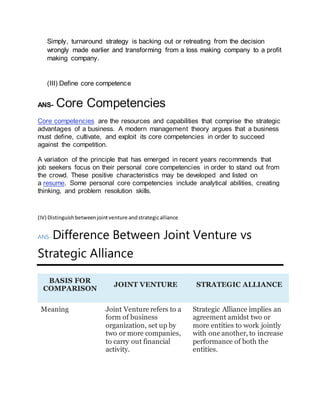
(IV) Distinguishbetweenjointventure andstrategicalliance
ANS- Difference Between Joint Venture vs
Strategic Alliance
BASIS FOR
COMPARISON
JOINT VENTURE STRATEGIC ALLIANCE
Meaning Joint Venture refers to a
form of business
organization, set up by
two or more companies,
to carry out financial
activity.
Strategic Alliance implies an
agreement amidst two or
more entities to work jointly
with one another, to increase
performance of both the
entities.
BASIS FOR
COMPARISON
JOINT VENTURE STRATEGIC ALLIANCE
Independent
Organization
The entities which come
together in a joint
venture, do not continue
to operate as
independent companies.
The entities which come
together in a strategic
alliance, continue to operate
as independent companies.
Contract Exist May or may not exist
Form of Strategic Alliance Collaboration or corporate
partnering
Separate legal
entity
Yes No
Objective Risk limitation Reward maximization
Management Bilateral Delegated
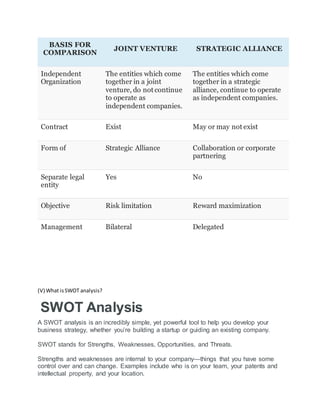
(V) What isSWOT analysis?
SWOT Analysis
A SWOT analysis is an incredibly simple, yet powerful tool to help you develop your
business strategy, whether you’re building a startup or guiding an existing company.
SWOT stands for Strengths, Weaknesses, Opportunities, and Threats.
Strengths and weaknesses are internal to your company—things that you have some
control over and can change. Examples include who is on your team, your patents and
intellectual property, and your location.
ANS-2 – Discuss the types if generic strategies given by Michael Porter.
ANS- Porter's Generic Strategies
Generic Strategies
The Generic Strategies can be used to determine the direction (strategy) of your
organisation. Michael Porter uses 4 strategies that an organisation can choose from. He
believes that a company must choose a clear course in order to be able to beat the
competition.
The four strategies to choose from are:
1. Cost Leadership
2. Differentiation
3. Cost Focus
Michael Porter described the theory in his 1985 book ‘Competitive Advantage: Creating and
Sustaining Superior Performance’. The basis was formed by three strategies, namely cost
leadership, differentiation and focus. He divided the latter into cost
focus and differentiation focus.
Porter's generic strategies describe howa company pursues competitive advantage across its
chosen market scope. There are three/four generic strategies, either lower cost, differentiated, or
focus. A company chooses to pursue one of two types of competitive advantage, either via lower
costs than its competition or by differentiating itself along dimensions valued by customers to
command a higher price. A company also chooses one of two types of scope, either focus (offering
its products to selected segments of the market) or industry-wide, offering its product across many
market segments. The generic strategy reflects the choices made regarding both the type of
competitive advantage and the scope. The concept was described by Michael Porter in 1980.[1]
According to Michael Porter there are four Generic strategies:
Cost Leadership
You target a broad market (large demand) and offer the lowest possible price. There are 2
options within this course. You can opt to keep costs as low as possible; or ensure that you
have a larger market share with average prices. In both cases, the point is to keep the company
costs as low as possible. The consumer price is a different story.
Organisations that apply this strategy successfully usually have substantial investment capital at
their disposal, efficient logistics and low costs when it comes to materials and labour. The
organisation is generally focused on internal processes.
Differentiation
You target a broad market (high demand), but your product or service has unique features. With
this strategy, you make your product as exclusive as possible, making it more attractive than
comparable products offered by the competition. Succeeding using this strategy requires good
research & development, innovation and the ability to deliver high quality. Effective marketing is
important, so that the market understands the benefits of your unique product. It’s important to
be flexible and to be able to adapt quickly in a changing market, or you risk the competition
beating you at it. Such an organisation is focused on the outside world and has a creative
approach.
Cost Focus
You target a niche market (little competition, ‘focused market’) and offer the lowest
possible price. In this strategy, you choose to target a clear niche market and through
understanding the dynamics of the market and the wishes of the consumers, you can
ensure that the costs remain low.
Differentiation Focus
You target a niche market (little competition, ‘focused market’) and your product or
service has unique features. This strategy often involves strong brand loyalty among
consumers. It’s very important to ensure that your product remains unique, in order to
stay ahead of possible competition.
In order to choose the right strategy for your organisation, it’s important be aware of the
competencies and strengths of your company.
ANS-3 Explain the importance of strategic management in managing todays
organization.
ANS- Importance Of Strategic Management
Planning or designing a strategy involves a great deal of risk and resource assessment,
ways to counter the risks, and effective utilization of resources all while trying to
achieve a significant purpose.
An organization is generally established with a goal in mind, and this goal defines the
purpose for its existence. All of the work carried out by the organization revolves
around this particular goal, and it has to align its internal resources and external
environment in a way that the goal is achieved in rational expected time.
Undoubtedly, since an organization is a big entity with probably a huge underlying
investment, strategizing becomes a necessary factor for successful working internally,
as well as to get feasible returns on the expended money.
Strategic Management on a corporate level normally incorporates preparation for
future opportunities, risks and market trends. This makes way for the firms to analyze,
examine and execute administration in a manner that is most likely to achieve the set
aims. As such, strategizing or planning must be covered as the deciding administration
factor.
Strategic Management and the role it plays in the accomplishments of firms has been
a subject of thorough research and study for an extensive period of time now.
Strategic Management in an organization ensures that goals are set, primary issues are
outlined, time and resources are pivoted, functioning is consolidated, internal
environment is set towards achieving the objectives, consequences and results are
concurred upon, and the organization remains flexible towards any external changes.
As more and more organizations have started to realize that strategic planning is the
fundamental aspect in successfully assisting them through any sudden contingencies,
either internally or externally, they have started to absorb strategy management
starting from the most basic administration levels. In actuality, strategy management
is the essence of an absolute administration plan. For large organizations, with a
complex organizational structure and extreme regimentation, strategizing is embedded
at every tier.
Keeping in mind the long-term benefits to organizations, strategic planning drives
them to focus on the internal environment, through encouraging and setting challenges
for employees, helping them achieve personal as well as organizational objectives. At
the same time, it is also ensured that external challenges are taken care of, adverse
situations are tackled and threats are analyzed to turn them into probable
opportunities.

Internal assignment no 2(MBA208)BY ANIL KUMAR

  • 1.
    INTERNALASSIGNMENTNO-2 PAPERCODE: PAPERMBA-208 PAPERTITLE: STETEGICMANAGEMENT Question1- Answerall these question: (i) What were the twodimensionsusedunderBCGmatrix? ANS- The 2 Dimensions of the BCG-Matrix To understand the BCG-Matrix, you need to understand how market share and market growth interrelate. Market share is the percentage of the total market that is being serviced by a specific company, measured either in revenue terms or unit volume terms. The higher the market share, the higher the proportion of the market a company controls This is where market growth comes into play. Market growth is used as a measure of a market’s attractiveness. Markets experiencing high growth are ones where the total market is expanding, meaning that it’s relatively easy for businesses to grow their profits, even if their market share remains stable. (ii) What do youmeanby turnaroundstrategy? ANS- Turnaround Strategy Definition: The Turnaround Strategy is a retrenchment strategy followed by an organization when it feels that the decision made earlier is wrong and needs to be undone before it damages the profitability of the company.
  • 2.
    Simply, turnaround strategyis backing out or retreating from the decision wrongly made earlier and transforming from a loss making company to a profit making company. (III) Define core competence ANS- Core Competencies Core competencies are the resources and capabilities that comprise the strategic advantages of a business. A modern management theory argues that a business must define, cultivate, and exploit its core competencies in order to succeed against the competition. A variation of the principle that has emerged in recent years recommends that job seekers focus on their personal core competencies in order to stand out from the crowd. These positive characteristics may be developed and listed on a resume. Some personal core competencies include analytical abilities, creating thinking, and problem resolution skills. (IV) Distinguishbetweenjointventure andstrategicalliance ANS- Difference Between Joint Venture vs Strategic Alliance BASIS FOR COMPARISON JOINT VENTURE STRATEGIC ALLIANCE Meaning Joint Venture refers to a form of business organization, set up by two or more companies, to carry out financial activity. Strategic Alliance implies an agreement amidst two or more entities to work jointly with one another, to increase performance of both the entities.
  • 3.
    BASIS FOR COMPARISON JOINT VENTURESTRATEGIC ALLIANCE Independent Organization The entities which come together in a joint venture, do not continue to operate as independent companies. The entities which come together in a strategic alliance, continue to operate as independent companies. Contract Exist May or may not exist Form of Strategic Alliance Collaboration or corporate partnering Separate legal entity Yes No Objective Risk limitation Reward maximization Management Bilateral Delegated (V) What isSWOT analysis? SWOT Analysis A SWOT analysis is an incredibly simple, yet powerful tool to help you develop your business strategy, whether you’re building a startup or guiding an existing company. SWOT stands for Strengths, Weaknesses, Opportunities, and Threats. Strengths and weaknesses are internal to your company—things that you have some control over and can change. Examples include who is on your team, your patents and intellectual property, and your location.
  • 4.
    ANS-2 – Discussthe types if generic strategies given by Michael Porter. ANS- Porter's Generic Strategies Generic Strategies The Generic Strategies can be used to determine the direction (strategy) of your organisation. Michael Porter uses 4 strategies that an organisation can choose from. He believes that a company must choose a clear course in order to be able to beat the competition. The four strategies to choose from are: 1. Cost Leadership 2. Differentiation 3. Cost Focus Michael Porter described the theory in his 1985 book ‘Competitive Advantage: Creating and Sustaining Superior Performance’. The basis was formed by three strategies, namely cost leadership, differentiation and focus. He divided the latter into cost focus and differentiation focus. Porter's generic strategies describe howa company pursues competitive advantage across its chosen market scope. There are three/four generic strategies, either lower cost, differentiated, or focus. A company chooses to pursue one of two types of competitive advantage, either via lower costs than its competition or by differentiating itself along dimensions valued by customers to command a higher price. A company also chooses one of two types of scope, either focus (offering its products to selected segments of the market) or industry-wide, offering its product across many market segments. The generic strategy reflects the choices made regarding both the type of competitive advantage and the scope. The concept was described by Michael Porter in 1980.[1]
  • 5.
    According to MichaelPorter there are four Generic strategies: Cost Leadership You target a broad market (large demand) and offer the lowest possible price. There are 2 options within this course. You can opt to keep costs as low as possible; or ensure that you have a larger market share with average prices. In both cases, the point is to keep the company costs as low as possible. The consumer price is a different story. Organisations that apply this strategy successfully usually have substantial investment capital at their disposal, efficient logistics and low costs when it comes to materials and labour. The organisation is generally focused on internal processes. Differentiation You target a broad market (high demand), but your product or service has unique features. With this strategy, you make your product as exclusive as possible, making it more attractive than comparable products offered by the competition. Succeeding using this strategy requires good research & development, innovation and the ability to deliver high quality. Effective marketing is important, so that the market understands the benefits of your unique product. It’s important to be flexible and to be able to adapt quickly in a changing market, or you risk the competition beating you at it. Such an organisation is focused on the outside world and has a creative approach. Cost Focus You target a niche market (little competition, ‘focused market’) and offer the lowest possible price. In this strategy, you choose to target a clear niche market and through understanding the dynamics of the market and the wishes of the consumers, you can ensure that the costs remain low.
  • 6.
    Differentiation Focus You targeta niche market (little competition, ‘focused market’) and your product or service has unique features. This strategy often involves strong brand loyalty among consumers. It’s very important to ensure that your product remains unique, in order to stay ahead of possible competition. In order to choose the right strategy for your organisation, it’s important be aware of the competencies and strengths of your company. ANS-3 Explain the importance of strategic management in managing todays organization. ANS- Importance Of Strategic Management Planning or designing a strategy involves a great deal of risk and resource assessment, ways to counter the risks, and effective utilization of resources all while trying to achieve a significant purpose. An organization is generally established with a goal in mind, and this goal defines the purpose for its existence. All of the work carried out by the organization revolves around this particular goal, and it has to align its internal resources and external environment in a way that the goal is achieved in rational expected time. Undoubtedly, since an organization is a big entity with probably a huge underlying investment, strategizing becomes a necessary factor for successful working internally, as well as to get feasible returns on the expended money. Strategic Management on a corporate level normally incorporates preparation for future opportunities, risks and market trends. This makes way for the firms to analyze, examine and execute administration in a manner that is most likely to achieve the set aims. As such, strategizing or planning must be covered as the deciding administration factor.
  • 7.
    Strategic Management andthe role it plays in the accomplishments of firms has been a subject of thorough research and study for an extensive period of time now. Strategic Management in an organization ensures that goals are set, primary issues are outlined, time and resources are pivoted, functioning is consolidated, internal environment is set towards achieving the objectives, consequences and results are concurred upon, and the organization remains flexible towards any external changes. As more and more organizations have started to realize that strategic planning is the fundamental aspect in successfully assisting them through any sudden contingencies, either internally or externally, they have started to absorb strategy management starting from the most basic administration levels. In actuality, strategy management is the essence of an absolute administration plan. For large organizations, with a complex organizational structure and extreme regimentation, strategizing is embedded at every tier. Keeping in mind the long-term benefits to organizations, strategic planning drives them to focus on the internal environment, through encouraging and setting challenges for employees, helping them achieve personal as well as organizational objectives. At the same time, it is also ensured that external challenges are taken care of, adverse situations are tackled and threats are analyzed to turn them into probable opportunities.