CHAPTER 6 Corporate-Level Strategy
The Role of Diversification Diversification strategies play a major role in the behavior of large firms. Product diversification concerns: The scope of the industries and markets in which the firm competes. How managers buy, create and sell different businesses to match skills and strengths with opportunities presented to the firm.
Two Strategy Levels Business-level Strategy (Competitive) Each business unit in a diversified firm chooses a business-level strategy as its means of competing in individual product markets. Corporate-level Strategy (Companywide) Specifies actions taken by the firm to gain a competitive advantage by selecting and managing a group of different businesses competing in several industries and product markets.
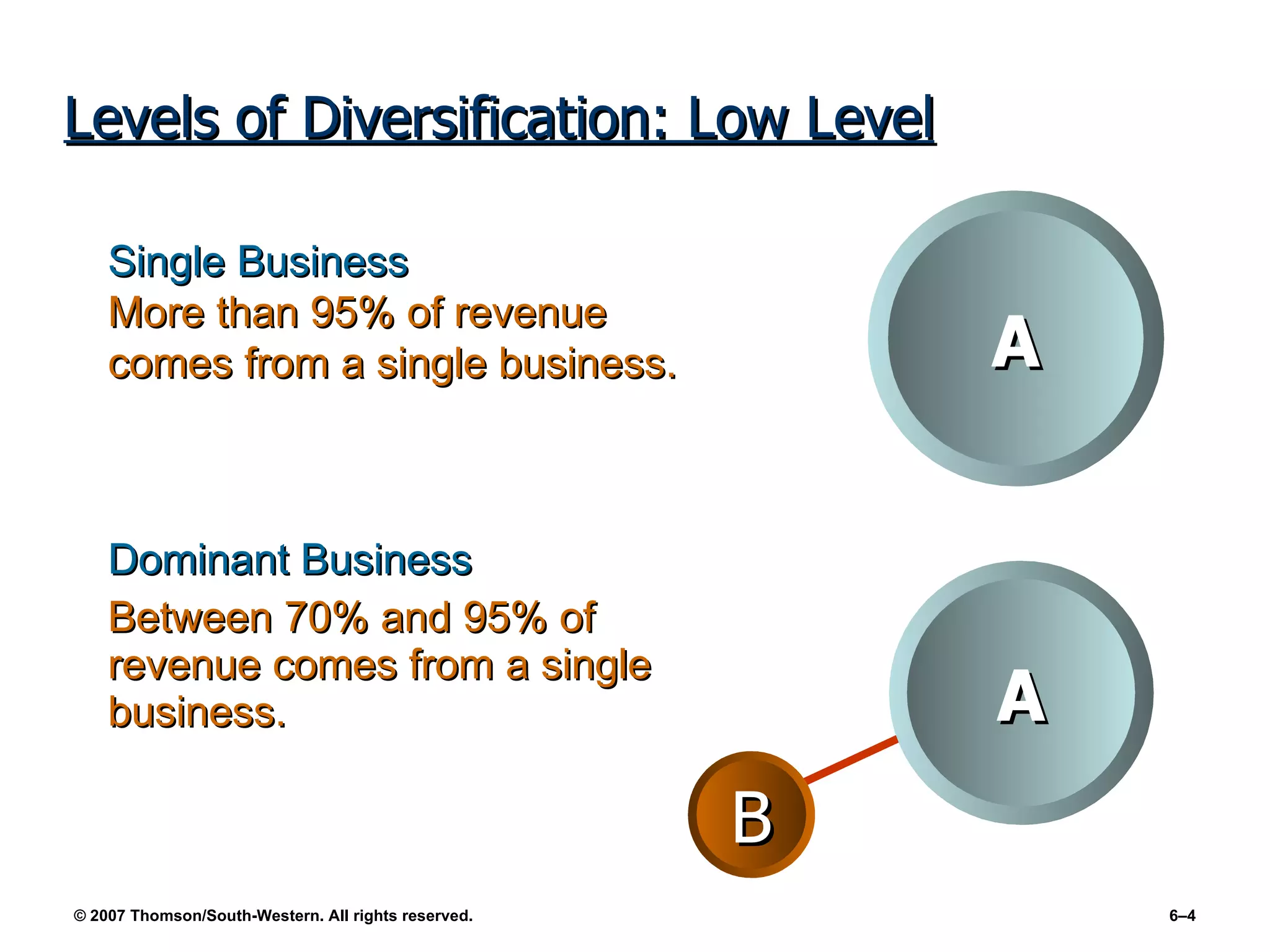
Levels of Diversification: Low Level Dominant Business Between 70% and 95% of revenue comes from a single business. Single Business More than 95% of revenue comes from a single business. A A B
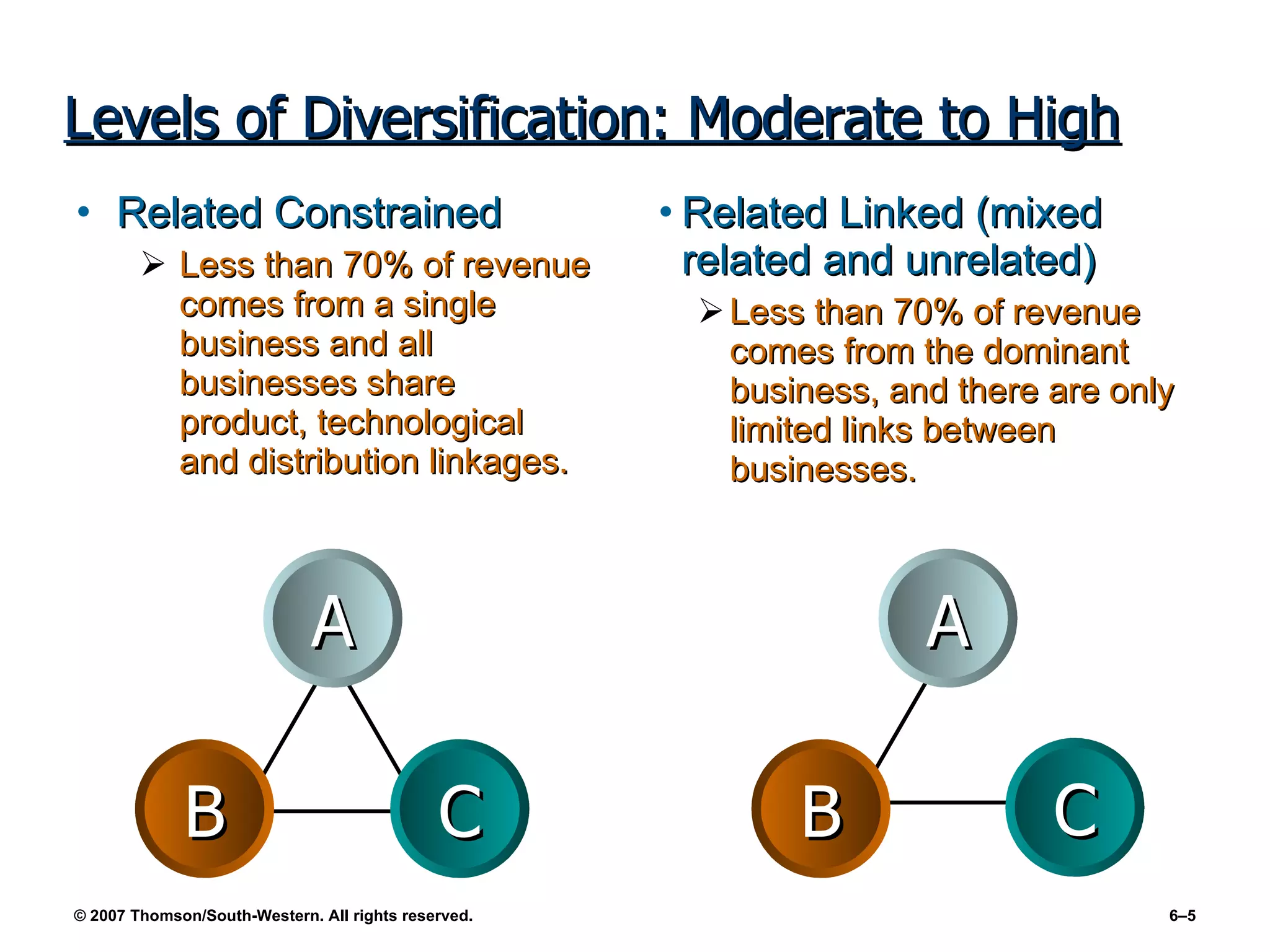
Levels of Diversification: Moderate to High Related Constrained Less than 70% of revenue comes from a single business and all businesses share product, technological and distribution linkages. Related Linked (mixed related and unrelated) Less than 70% of revenue comes from the dominant business, and there are only limited links between businesses. C A B C A B
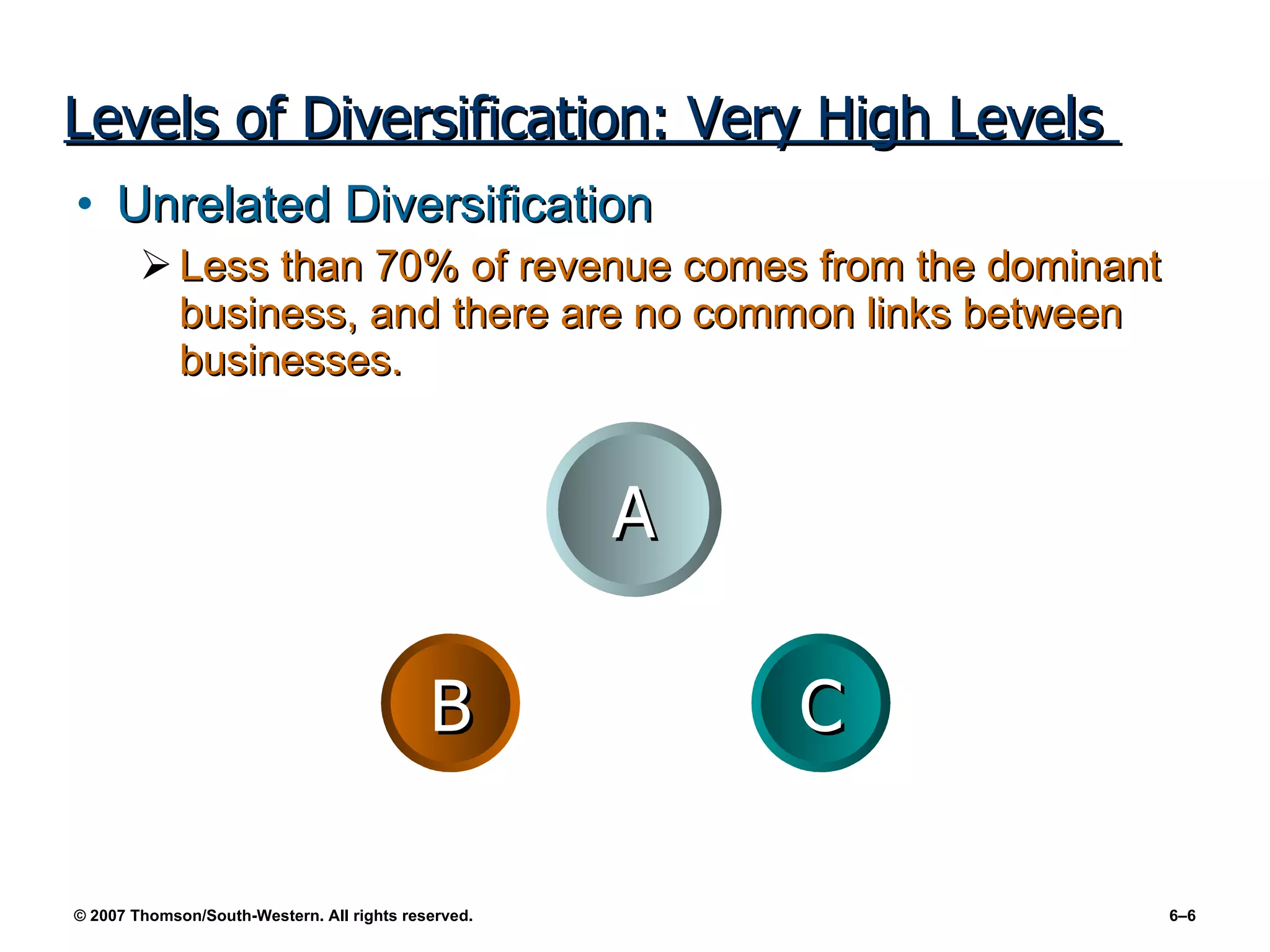
Levels of Diversification: Very High Levels  Unrelated Diversification Less than 70% of revenue comes from the dominant business, and there are no common links between businesses. C B A
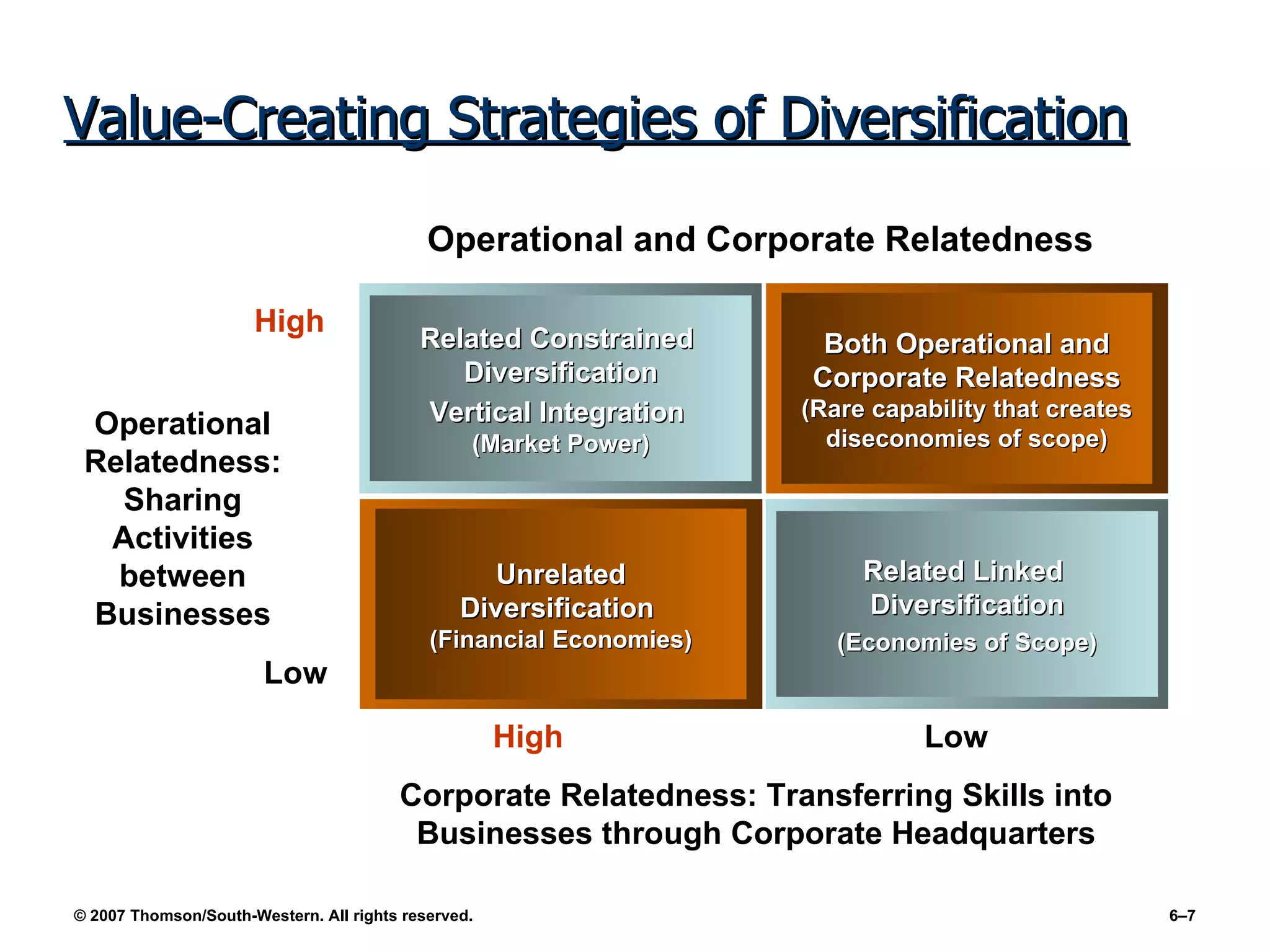
Value-Creating Strategies of Diversification High Low Operational and Corporate Relatedness Corporate Relatedness: Transferring Skills into Businesses through Corporate Headquarters Operational Relatedness: Sharing Activities between Businesses High Low Related Constrained  Diversification Vertical Integration  (Market Power) Unrelated Diversification  (Financial Economies) Related Linked  Diversification (Economies of Scope) Both Operational and Corporate Relatedness (Rare capability that creates diseconomies of scope)
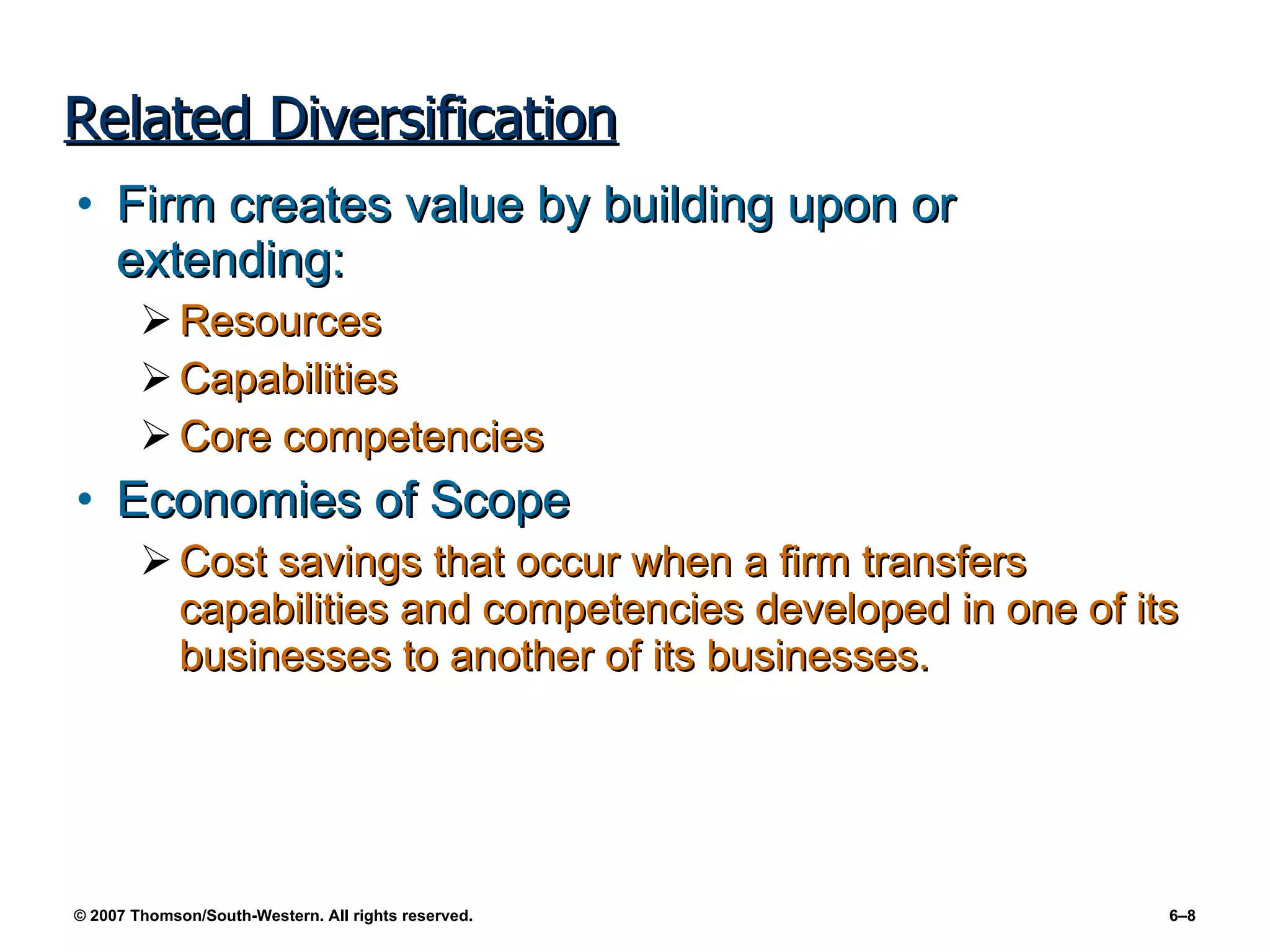
Related Diversification Firm creates value by building upon or extending: Resources Capabilities Core competencies Economies of Scope Cost savings that occur when a firm transfers capabilities and competencies developed in one of its businesses to another of its businesses.
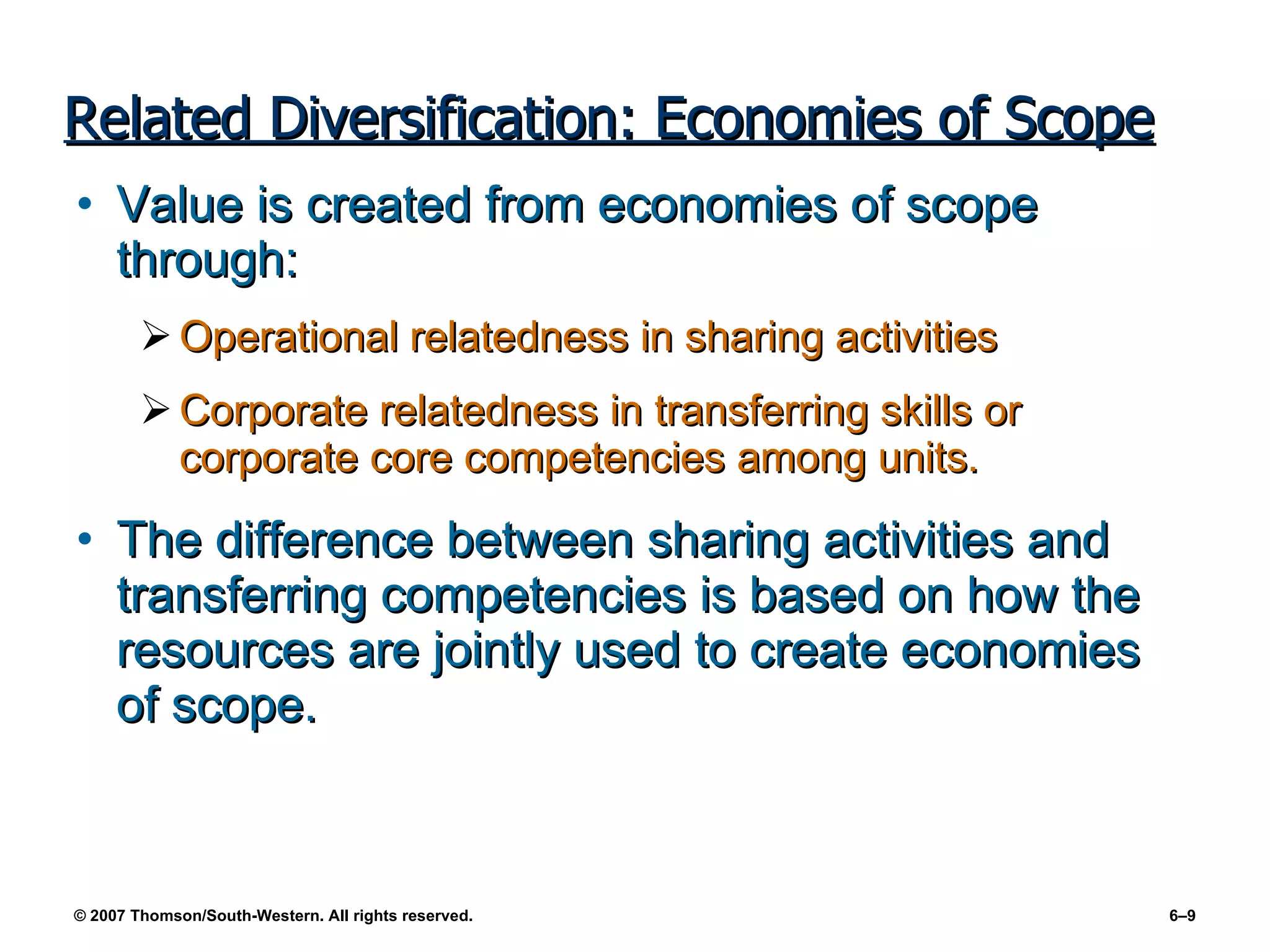
Related Diversification: Economies of Scope Value is created from economies of scope through: Operational relatedness in sharing activities Corporate relatedness in transferring skills or corporate core competencies among units. The difference between sharing activities and transferring competencies is based on how the resources are jointly used to create economies of scope.
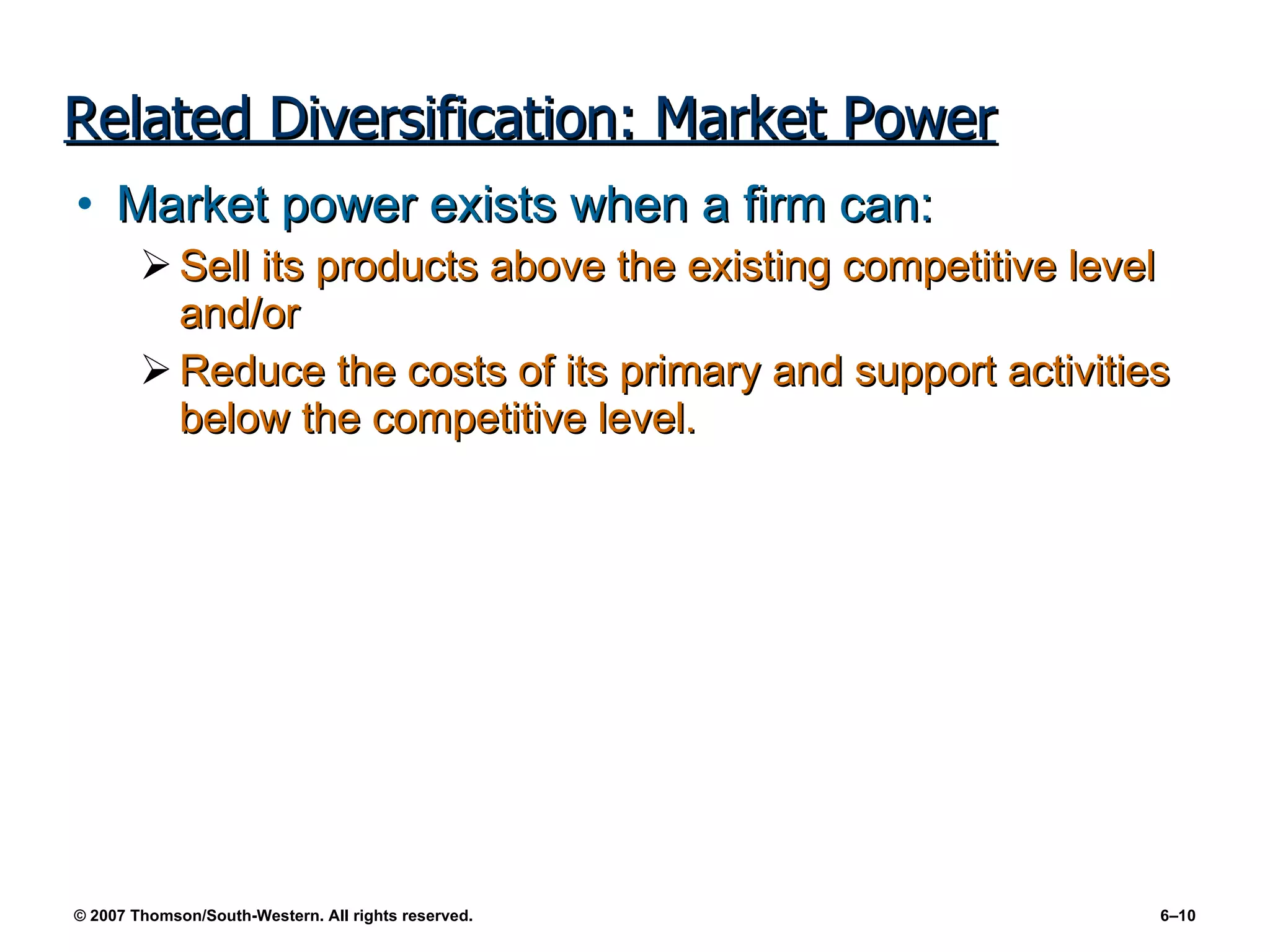
Related Diversification: Market Power Market power exists when a firm can: Sell its products above the existing competitive level and/or  Reduce the costs of its primary and support activities below the competitive level.
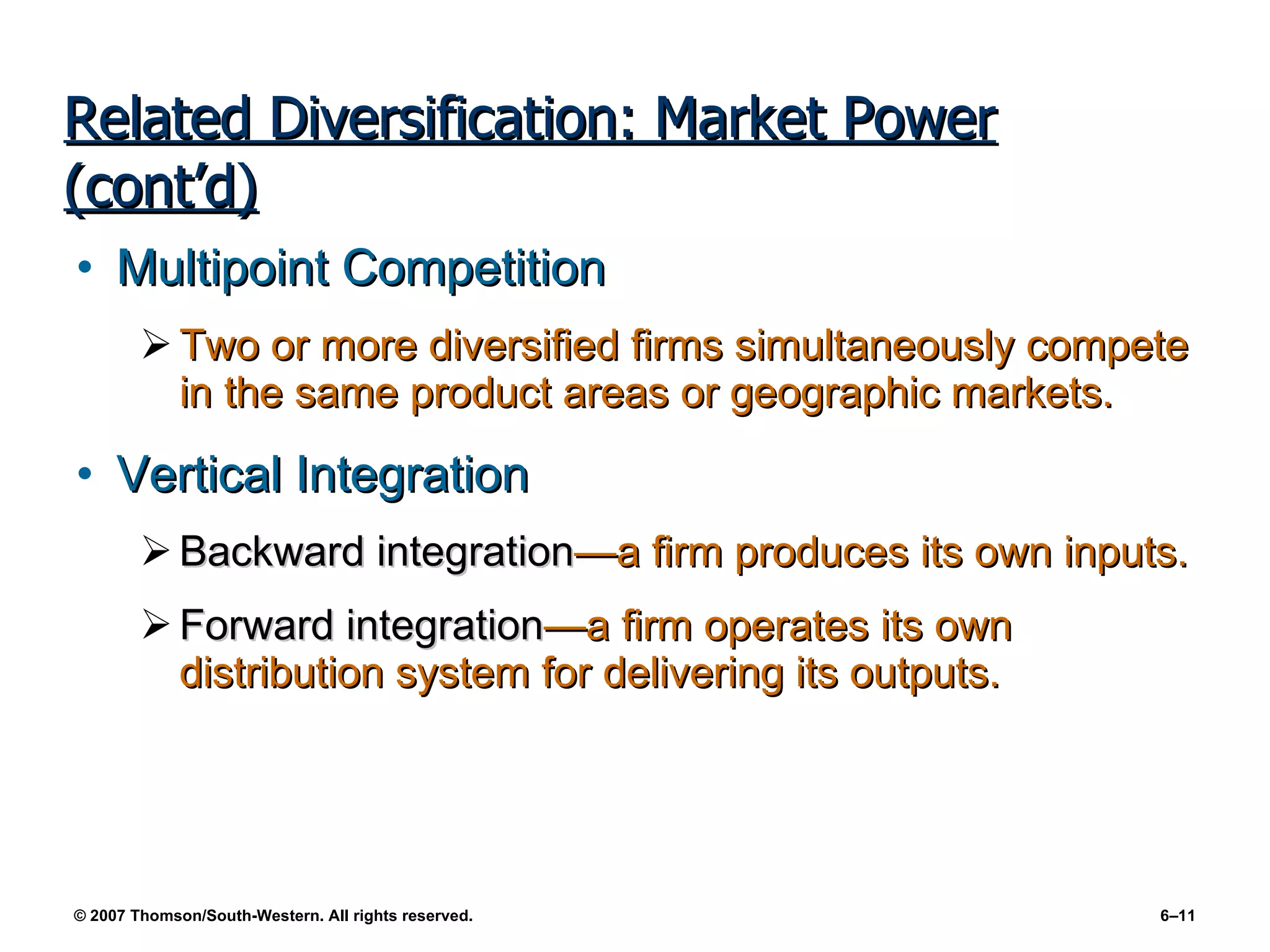
Related Diversification: Market Power (cont’d) Multipoint Competition Two or more diversified firms simultaneously compete in the same product areas or geographic markets. Vertical Integration Backward integration —a firm produces its own inputs. Forward integration —a firm operates its own distribution system for delivering its outputs.
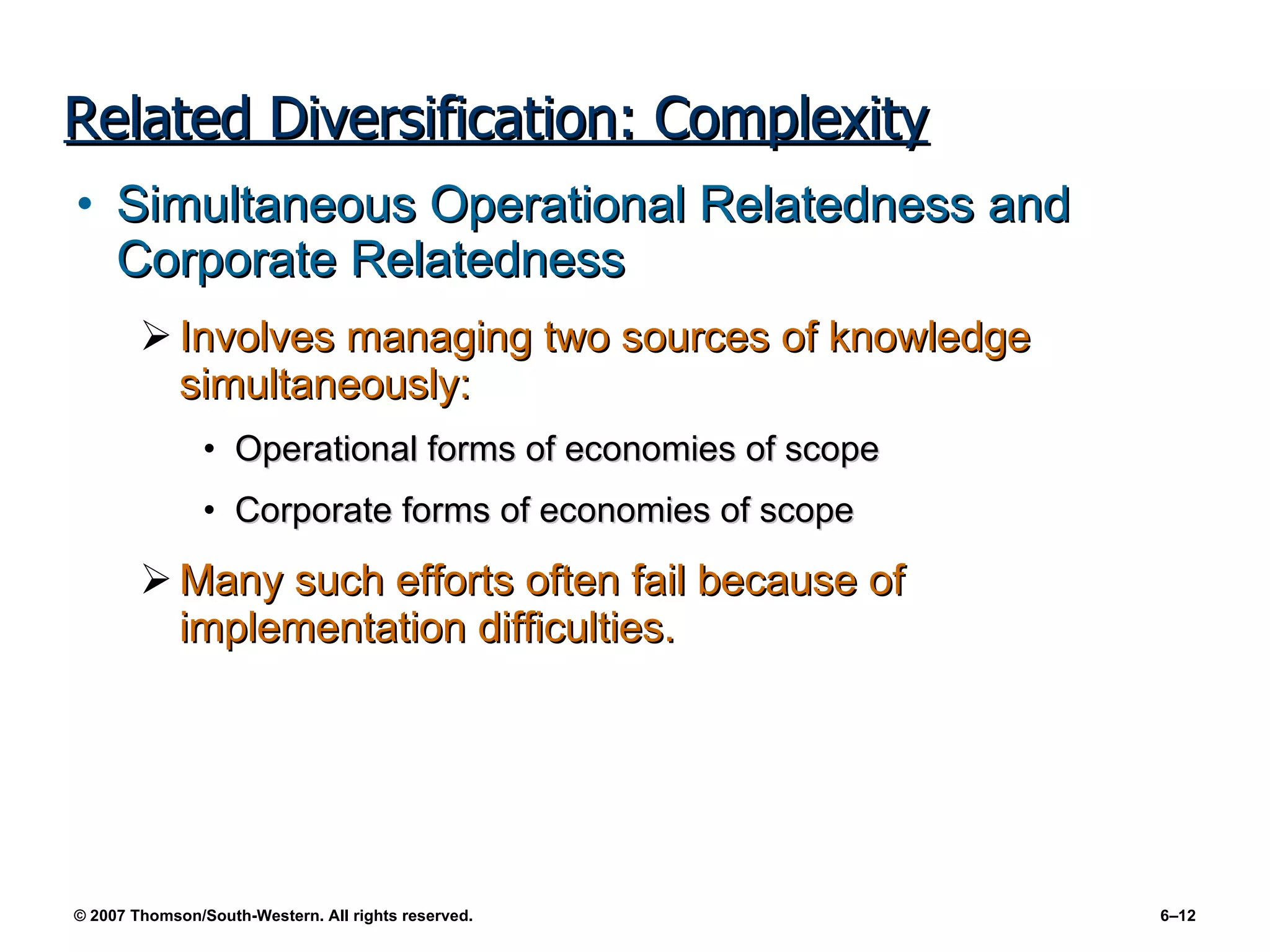
Related Diversification: Complexity Simultaneous Operational Relatedness and Corporate Relatedness Involves managing two sources of knowledge simultaneously: Operational forms of economies of scope Corporate forms of economies of scope Many such efforts often fail because of implementation difficulties.
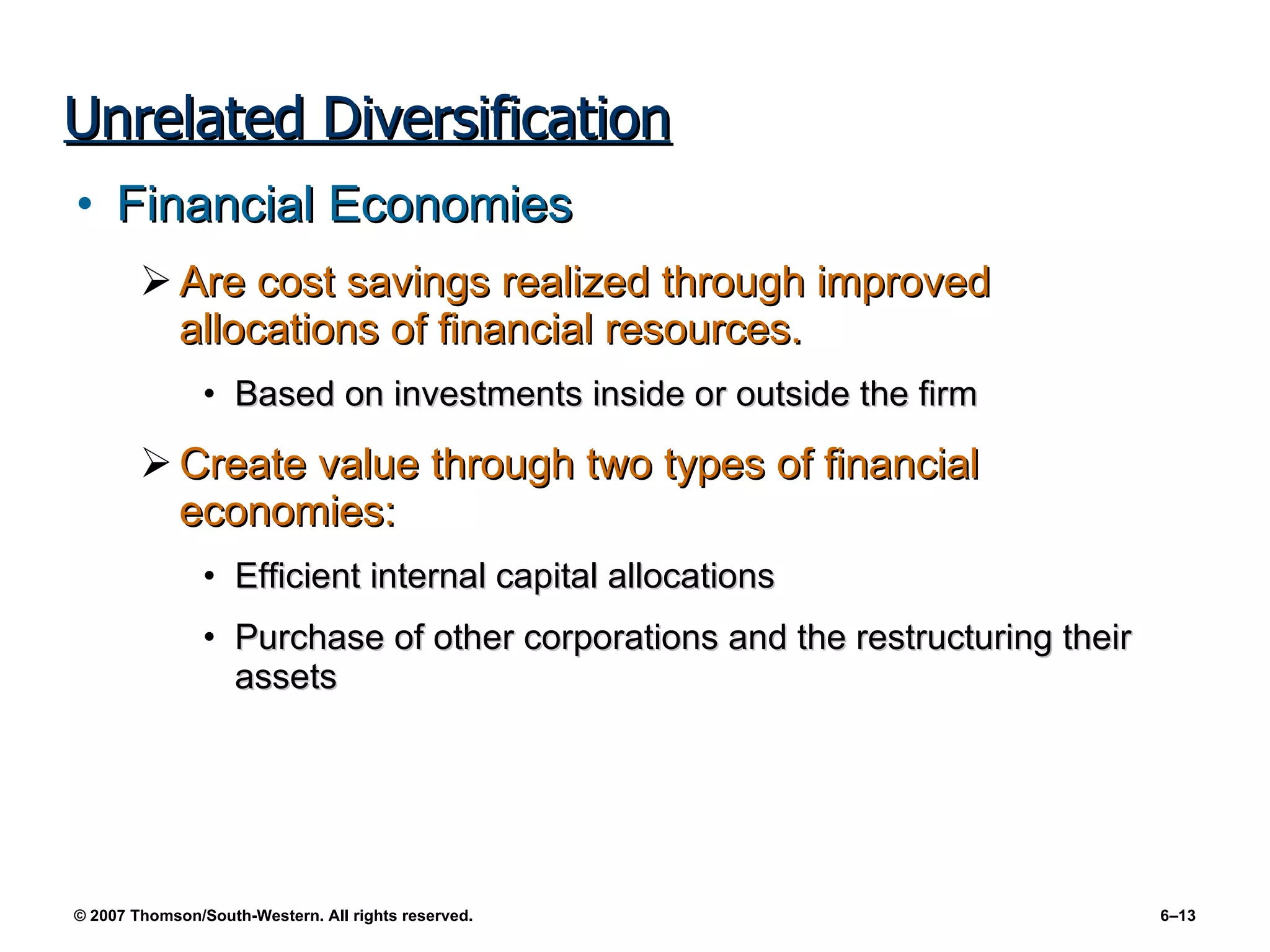
Unrelated Diversification Financial Economies Are cost savings realized through improved allocations of financial resources. Based on investments inside or outside the firm Create value through two types of financial economies: Efficient internal capital allocations Purchase of other corporations and the restructuring their assets
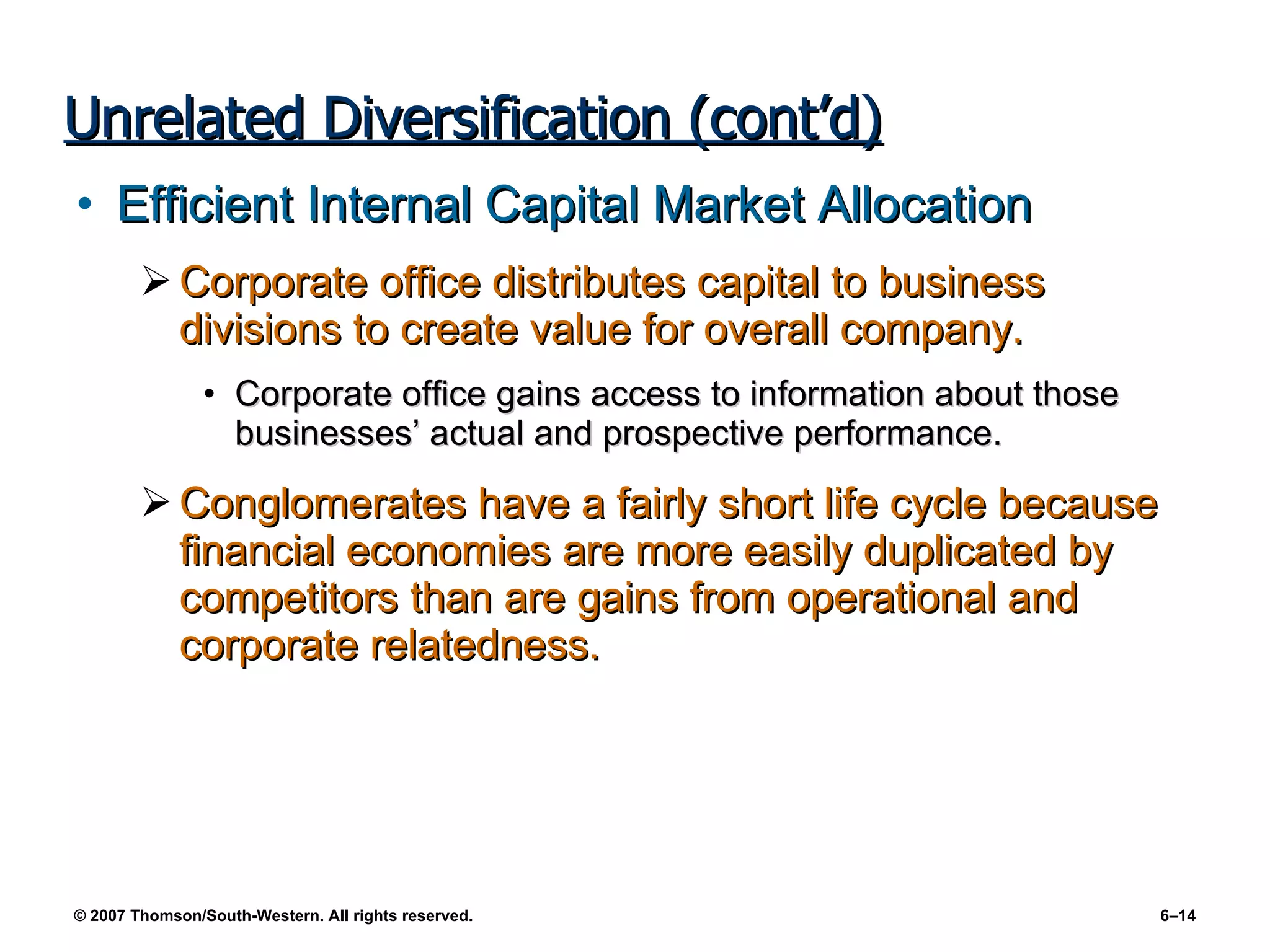
Unrelated Diversification (cont’d) Efficient Internal Capital Market Allocation Corporate office distributes capital to business divisions to create value for overall company. Corporate office gains access to information about those businesses’ actual and prospective performance. Conglomerates have a fairly short life cycle because financial economies are more easily duplicated by competitors than are gains from operational and corporate relatedness.
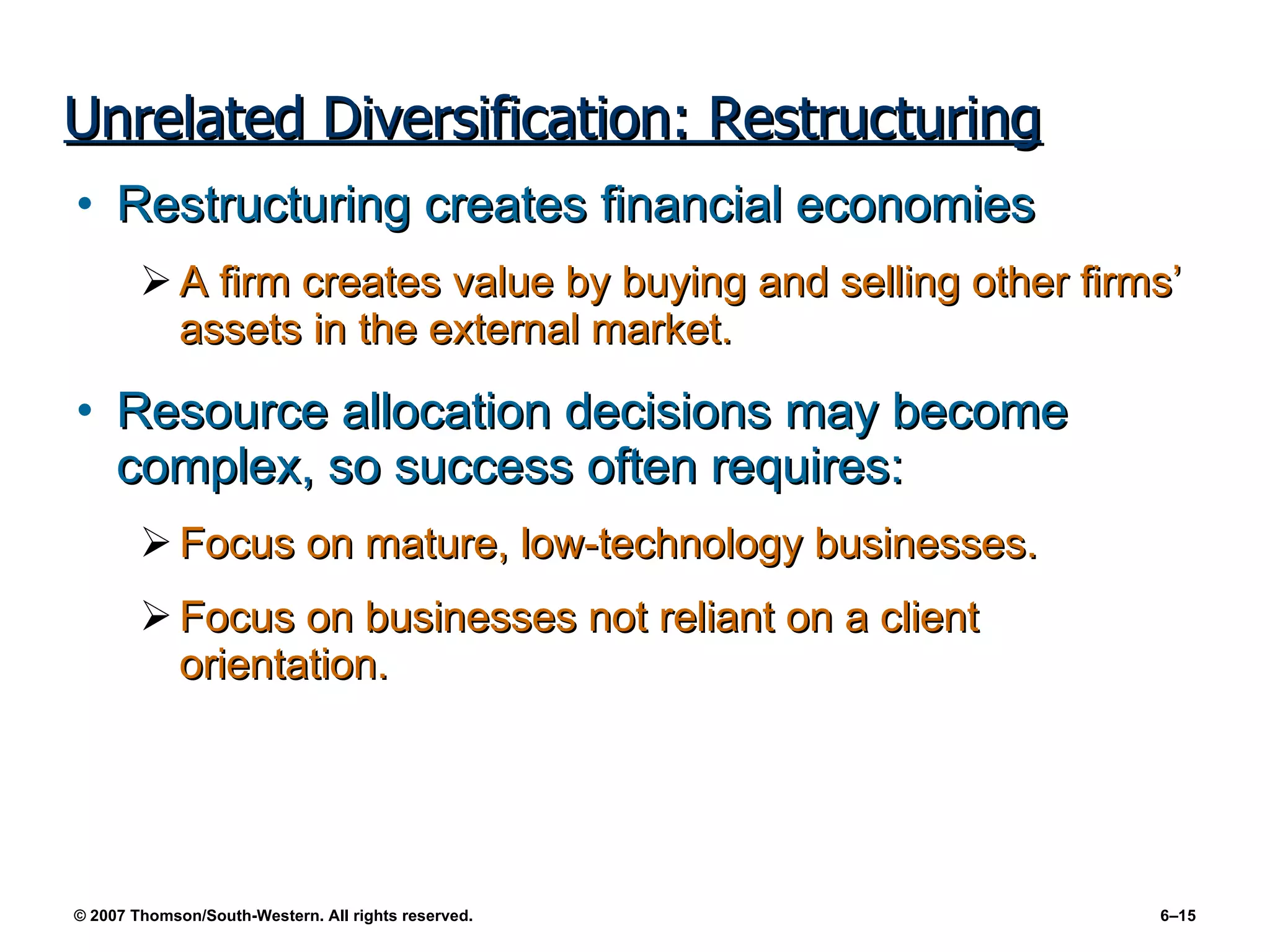
Unrelated Diversification: Restructuring Restructuring creates financial economies A firm creates value by buying and selling other firms’ assets in the external market. Resource allocation decisions may become complex, so success often requires: Focus on mature, low-technology businesses. Focus on businesses not reliant on a client orientation.
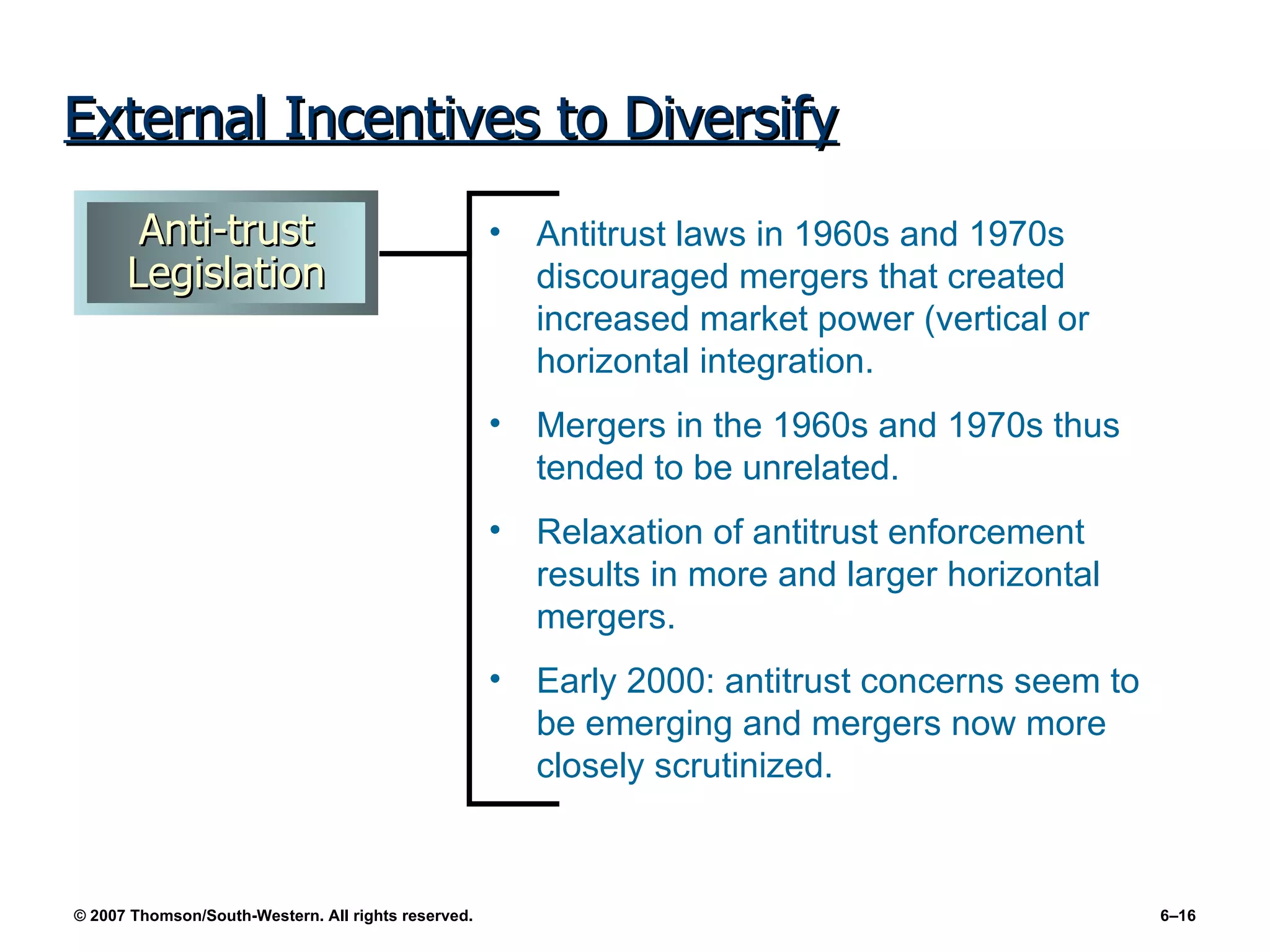
External Incentives to Diversify Antitrust laws in 1960s and 1970s discouraged mergers that created increased market power (vertical or horizontal integration. Mergers in the 1960s and 1970s thus tended to be unrelated. Relaxation of antitrust enforcement results in more and larger horizontal mergers. Early 2000: antitrust concerns seem to be emerging and mergers now more closely scrutinized. Anti-trust Legislation
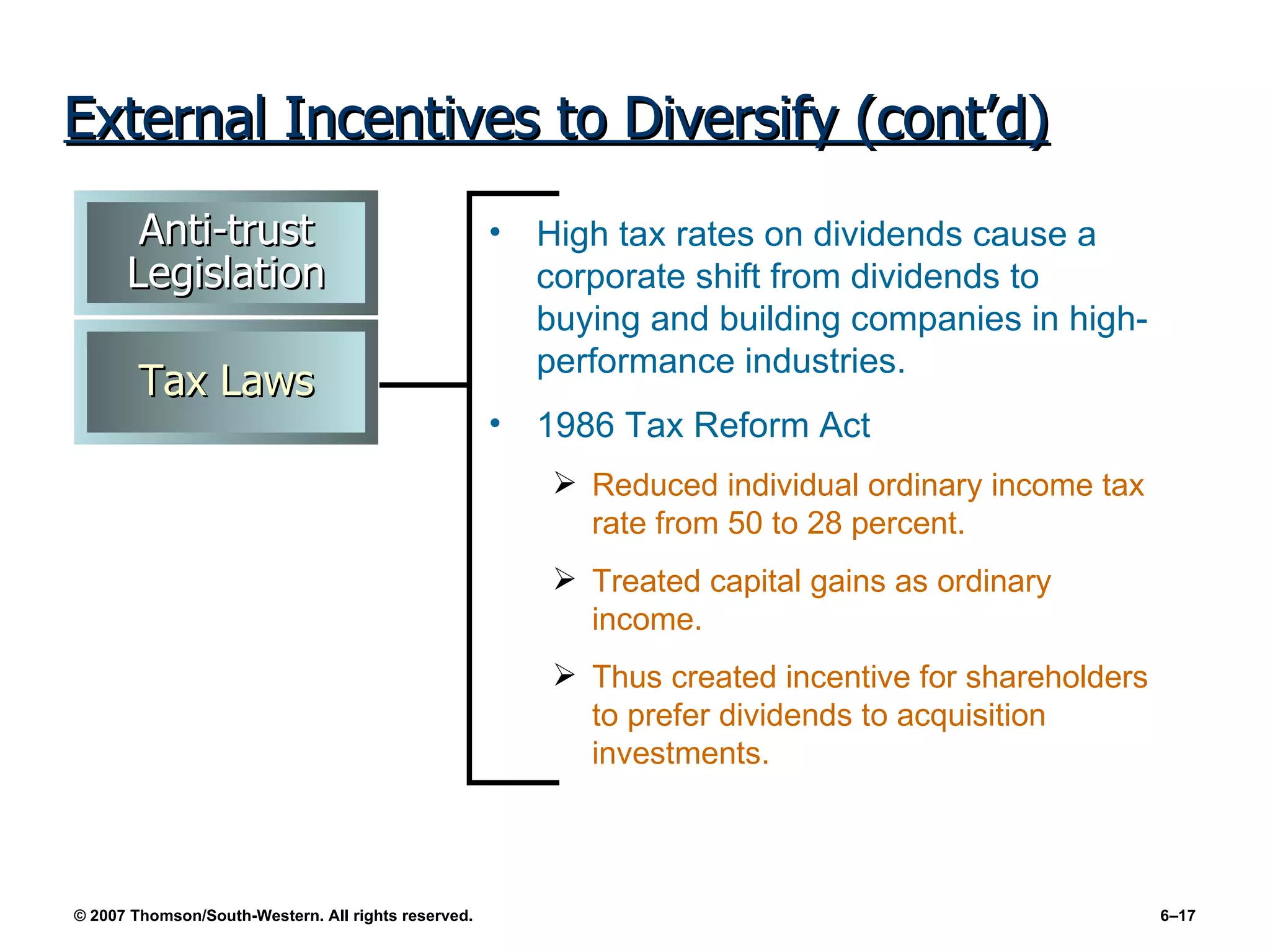
External Incentives to Diversify (cont’d) High tax rates on dividends cause a corporate shift from dividends to buying and building companies in high-performance industries. 1986 Tax Reform Act Reduced individual ordinary income tax rate from 50 to 28 percent. Treated capital gains as ordinary income.  Thus created incentive for shareholders to prefer dividends to acquisition investments. Anti-trust Legislation Tax Laws
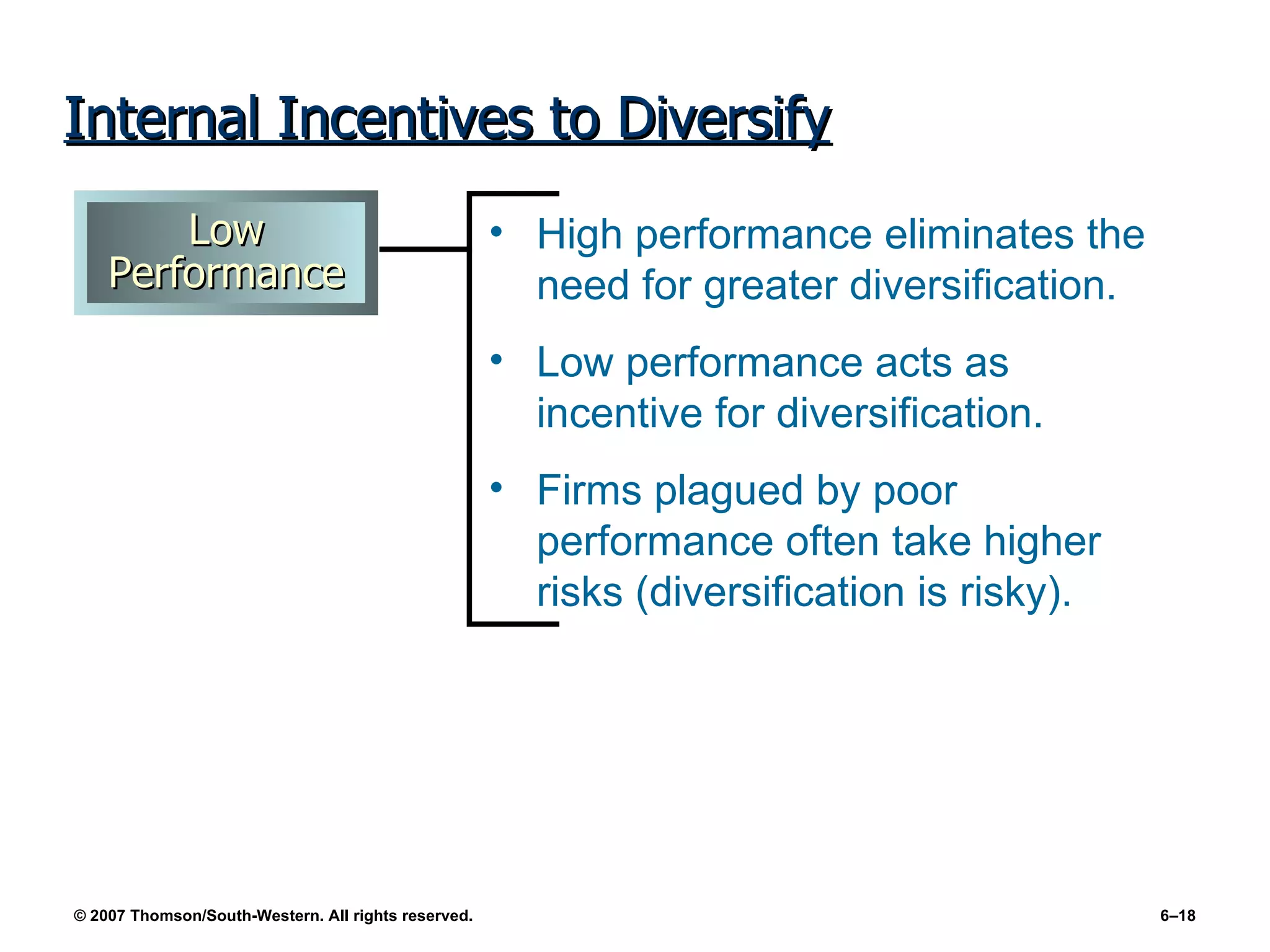
Internal Incentives to Diversify High performance eliminates the need for greater diversification. Low performance acts as incentive for diversification. Firms plagued by poor performance often take higher risks (diversification is risky). Low Performance
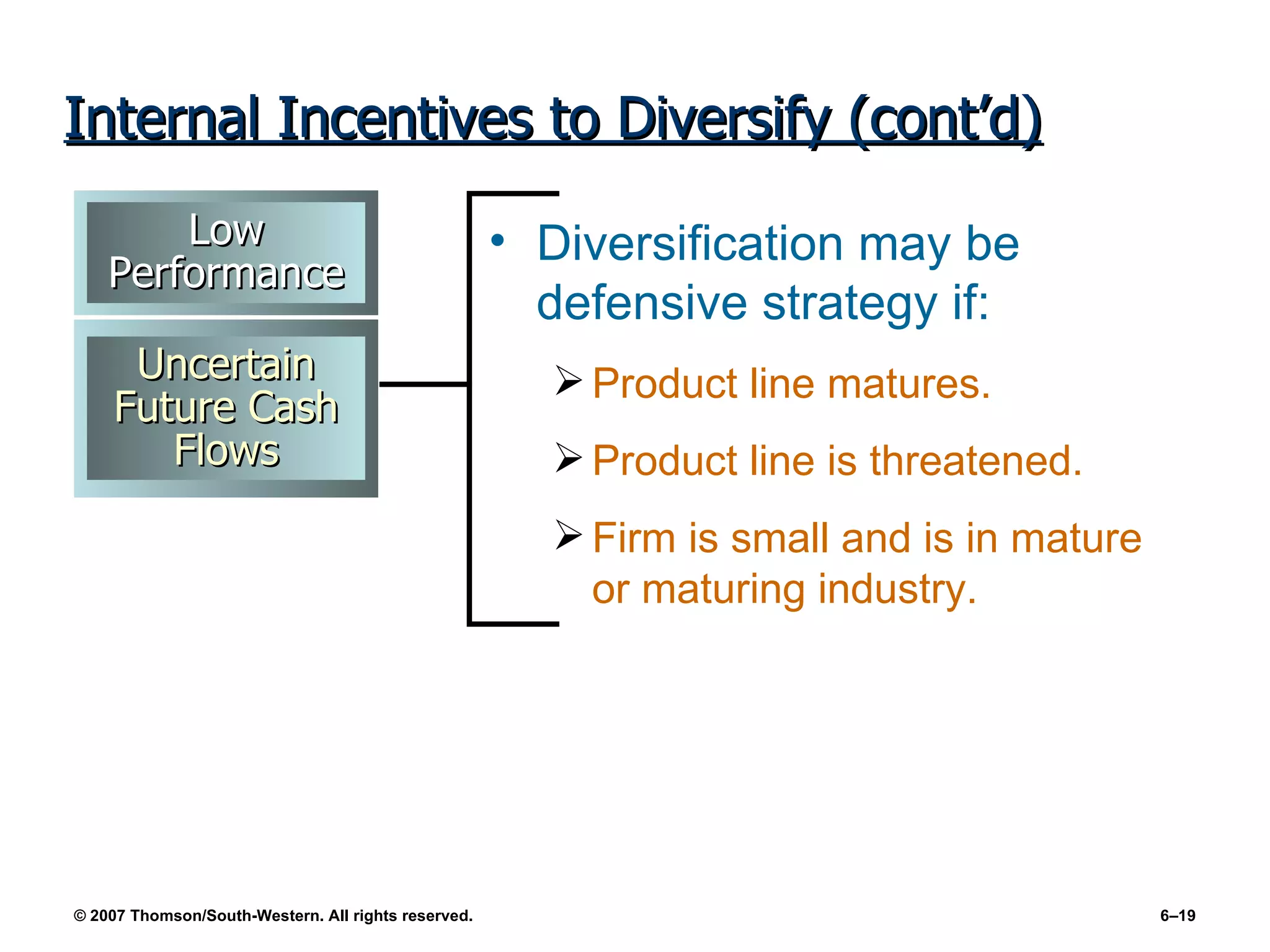
Internal Incentives to Diversify (cont’d) Diversification may be defensive strategy if: Product line matures. Product line is threatened. Firm is small and is in mature or maturing industry. Low Performance Uncertain Future Cash Flows
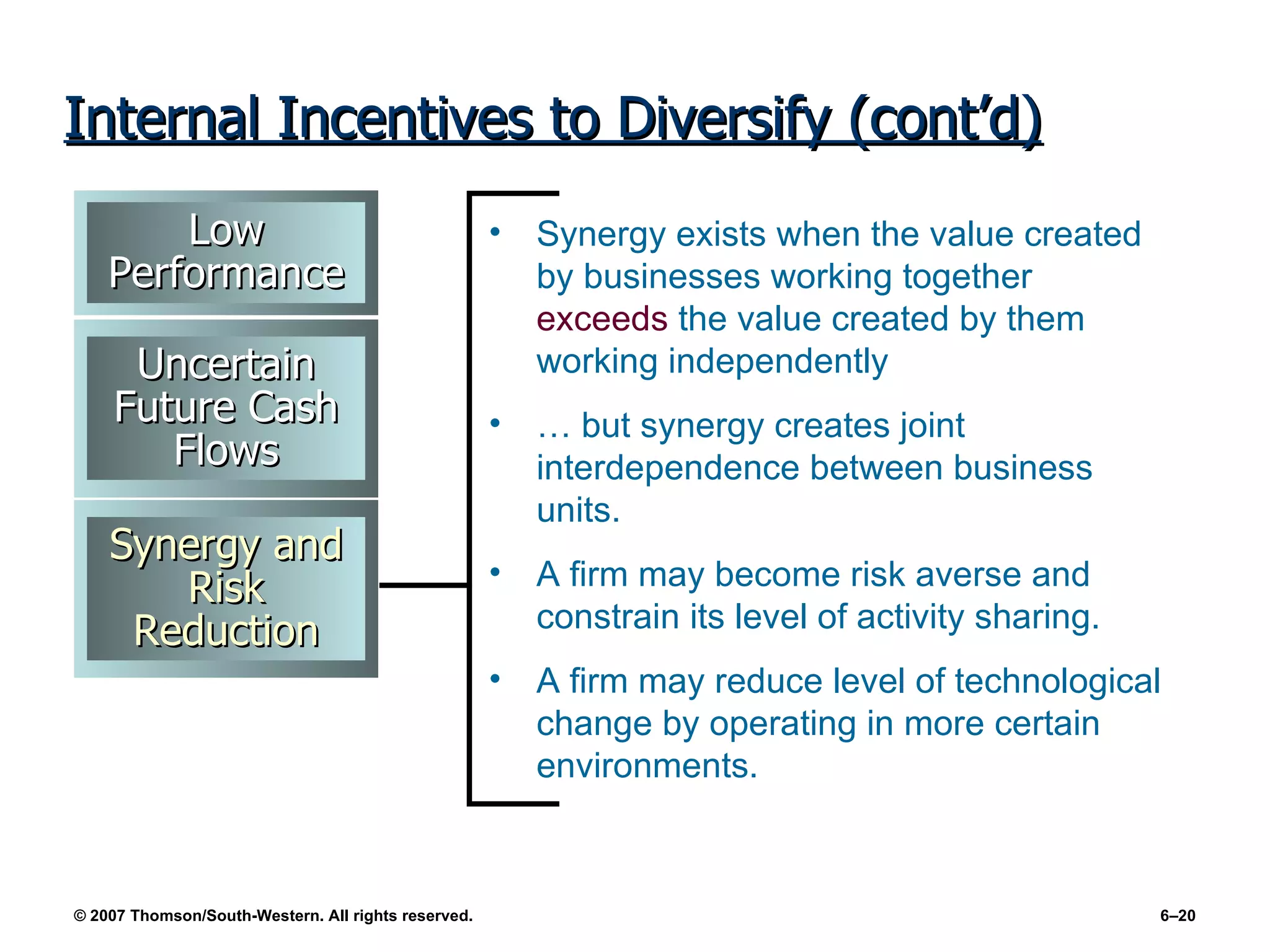
Internal Incentives to Diversify (cont’d) Synergy exists when the value created by businesses working together  exceeds  the value created by them working independently …  but synergy creates joint interdependence between business units. A firm may become risk averse and constrain its level of activity sharing. A firm may reduce level of technological change by operating in more certain environments. Low Performance Uncertain Future Cash Flows Synergy and Risk Reduction

Business Policy and Strategy

  • 1.
  • 2.
    The Role ofDiversification Diversification strategies play a major role in the behavior of large firms. Product diversification concerns: The scope of the industries and markets in which the firm competes. How managers buy, create and sell different businesses to match skills and strengths with opportunities presented to the firm.
  • 3.
    Two Strategy LevelsBusiness-level Strategy (Competitive) Each business unit in a diversified firm chooses a business-level strategy as its means of competing in individual product markets. Corporate-level Strategy (Companywide) Specifies actions taken by the firm to gain a competitive advantage by selecting and managing a group of different businesses competing in several industries and product markets.
  • 4.
    Levels of Diversification:Low Level Dominant Business Between 70% and 95% of revenue comes from a single business. Single Business More than 95% of revenue comes from a single business. A A B
  • 5.
    Levels of Diversification:Moderate to High Related Constrained Less than 70% of revenue comes from a single business and all businesses share product, technological and distribution linkages. Related Linked (mixed related and unrelated) Less than 70% of revenue comes from the dominant business, and there are only limited links between businesses. C A B C A B
  • 6.
    Levels of Diversification:Very High Levels Unrelated Diversification Less than 70% of revenue comes from the dominant business, and there are no common links between businesses. C B A
  • 7.
    Value-Creating Strategies ofDiversification High Low Operational and Corporate Relatedness Corporate Relatedness: Transferring Skills into Businesses through Corporate Headquarters Operational Relatedness: Sharing Activities between Businesses High Low Related Constrained Diversification Vertical Integration (Market Power) Unrelated Diversification (Financial Economies) Related Linked Diversification (Economies of Scope) Both Operational and Corporate Relatedness (Rare capability that creates diseconomies of scope)
  • 8.
    Related Diversification Firmcreates value by building upon or extending: Resources Capabilities Core competencies Economies of Scope Cost savings that occur when a firm transfers capabilities and competencies developed in one of its businesses to another of its businesses.
  • 9.
    Related Diversification: Economiesof Scope Value is created from economies of scope through: Operational relatedness in sharing activities Corporate relatedness in transferring skills or corporate core competencies among units. The difference between sharing activities and transferring competencies is based on how the resources are jointly used to create economies of scope.
  • 10.
    Related Diversification: MarketPower Market power exists when a firm can: Sell its products above the existing competitive level and/or Reduce the costs of its primary and support activities below the competitive level.
  • 11.
    Related Diversification: MarketPower (cont’d) Multipoint Competition Two or more diversified firms simultaneously compete in the same product areas or geographic markets. Vertical Integration Backward integration —a firm produces its own inputs. Forward integration —a firm operates its own distribution system for delivering its outputs.
  • 12.
    Related Diversification: ComplexitySimultaneous Operational Relatedness and Corporate Relatedness Involves managing two sources of knowledge simultaneously: Operational forms of economies of scope Corporate forms of economies of scope Many such efforts often fail because of implementation difficulties.
  • 13.
    Unrelated Diversification FinancialEconomies Are cost savings realized through improved allocations of financial resources. Based on investments inside or outside the firm Create value through two types of financial economies: Efficient internal capital allocations Purchase of other corporations and the restructuring their assets
  • 14.
    Unrelated Diversification (cont’d)Efficient Internal Capital Market Allocation Corporate office distributes capital to business divisions to create value for overall company. Corporate office gains access to information about those businesses’ actual and prospective performance. Conglomerates have a fairly short life cycle because financial economies are more easily duplicated by competitors than are gains from operational and corporate relatedness.
  • 15.
    Unrelated Diversification: RestructuringRestructuring creates financial economies A firm creates value by buying and selling other firms’ assets in the external market. Resource allocation decisions may become complex, so success often requires: Focus on mature, low-technology businesses. Focus on businesses not reliant on a client orientation.
  • 16.
    External Incentives toDiversify Antitrust laws in 1960s and 1970s discouraged mergers that created increased market power (vertical or horizontal integration. Mergers in the 1960s and 1970s thus tended to be unrelated. Relaxation of antitrust enforcement results in more and larger horizontal mergers. Early 2000: antitrust concerns seem to be emerging and mergers now more closely scrutinized. Anti-trust Legislation
  • 17.
    External Incentives toDiversify (cont’d) High tax rates on dividends cause a corporate shift from dividends to buying and building companies in high-performance industries. 1986 Tax Reform Act Reduced individual ordinary income tax rate from 50 to 28 percent. Treated capital gains as ordinary income. Thus created incentive for shareholders to prefer dividends to acquisition investments. Anti-trust Legislation Tax Laws
  • 18.
    Internal Incentives toDiversify High performance eliminates the need for greater diversification. Low performance acts as incentive for diversification. Firms plagued by poor performance often take higher risks (diversification is risky). Low Performance
  • 19.
    Internal Incentives toDiversify (cont’d) Diversification may be defensive strategy if: Product line matures. Product line is threatened. Firm is small and is in mature or maturing industry. Low Performance Uncertain Future Cash Flows
  • 20.
    Internal Incentives toDiversify (cont’d) Synergy exists when the value created by businesses working together exceeds the value created by them working independently … but synergy creates joint interdependence between business units. A firm may become risk averse and constrain its level of activity sharing. A firm may reduce level of technological change by operating in more certain environments. Low Performance Uncertain Future Cash Flows Synergy and Risk Reduction