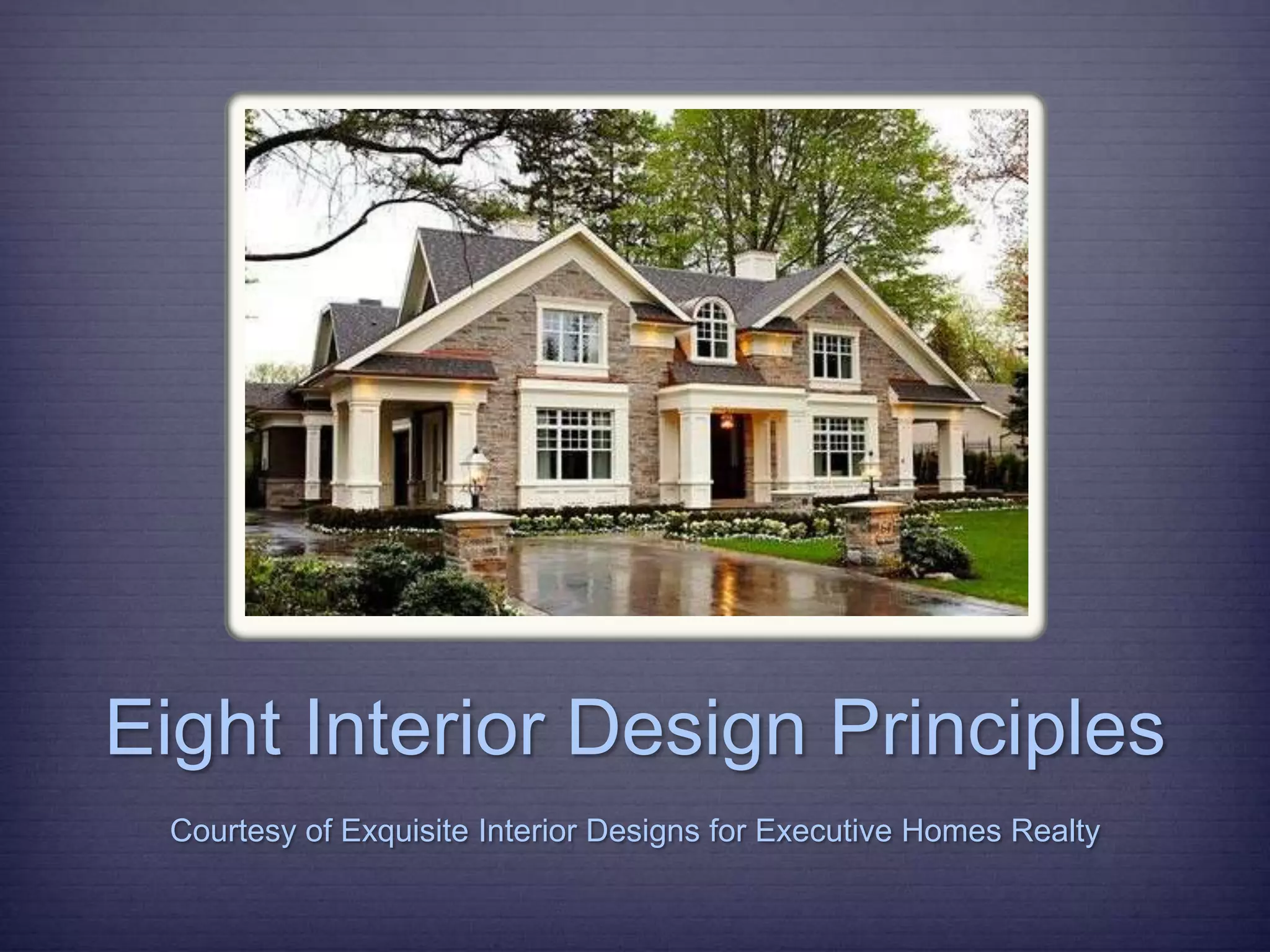
Eight Interior Design Principles
Courtesy of Exquisite Interior Designs for Executive Homes Realty
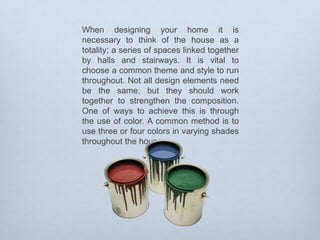
When designing your home it is
necessary to think of the house as a
totality; a series of spaces linked together
by halls and stairways. It is vital to
choose a common theme and style to run
throughout. Not all design elements need
be the same, but they should work
together to strengthen the composition.
One of ways to achieve this is through
the use of color. A common method is to
use three or four colors in varying shades
throughout the house.
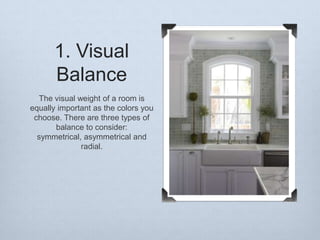
1. Visual
Balance
The visual weight of a room is
equally important as the colors you
choose. There are three types of
balance to consider:
symmetrical, asymmetrical and
radial.
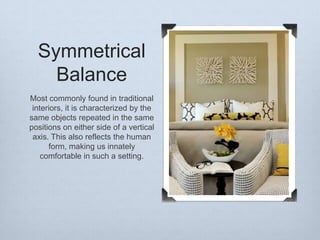
Symmetrical
Balance
Most commonly found in traditional
interiors, it is characterized by the
same objects repeated in the same
positions on either side of a vertical
axis. This also reflects the human
form, making us innately
comfortable in such a setting.
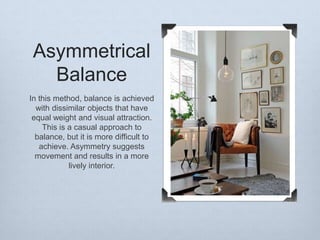
Asymmetrical
Balance
In this method, balance is achieved
with dissimilar objects that have
equal weight and visual attraction.
This is a casual approach to
balance, but it is more difficult to
achieve. Asymmetry suggests
movement and results in a more
lively interior.
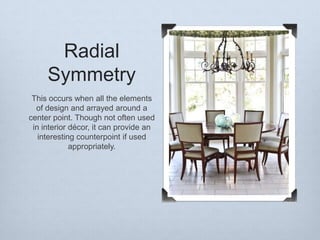
Radial
Symmetry
This occurs when all the elements
of design and arrayed around a
center point. Though not often used
in interior décor, it can provide an
interesting counterpoint if used
appropriately.
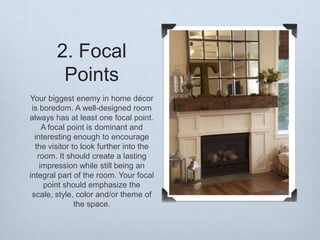
2. Focal
Points
Your biggest enemy in home décor
is boredom. A well-designed room
always has at least one focal point.
A focal point is dominant and
interesting enough to encourage
the visitor to look further into the
room. It should create a lasting
impression while still being an
integral part of the room. Your focal
point should emphasize the
scale, style, color and/or theme of
the space.
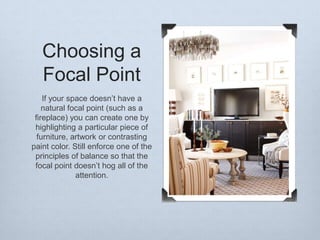
Choosing a
Focal Point
If your space doesn’t have a
natural focal point (such as a
fireplace) you can create one by
highlighting a particular piece of
furniture, artwork or contrasting
paint color. Still enforce one of the
principles of balance so that the
focal point doesn’t hog all of the
attention.
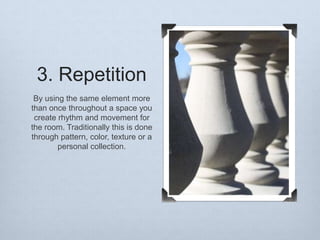
3. Repetition
By using the same element more
than once throughout a space you
create rhythm and movement for
the room. Traditionally this is done
through pattern, color, texture or a
personal collection.
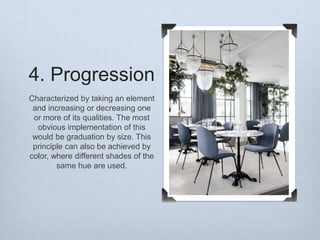
4. Progression
Characterized by taking an element
and increasing or decreasing one
or more of its qualities. The most
obvious implementation of this
would be graduation by size. This
principle can also be achieved by
color, where different shades of the
same hue are used.
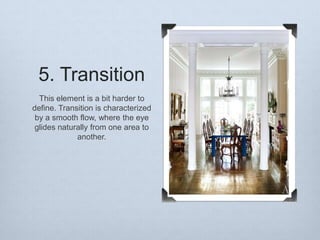
5. Transition
This element is a bit harder to
define. Transition is characterized
by a smooth flow, where the eye
glides naturally from one area to
another.
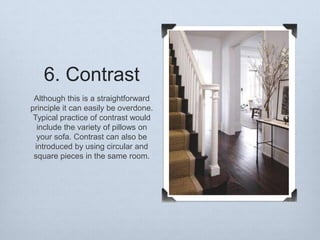
6. Contrast
Although this is a straightforward
principle it can easily be overdone.
Typical practice of contrast would
include the variety of pillows on
your sofa. Contrast can also be
introduced by using circular and
square pieces in the same room.
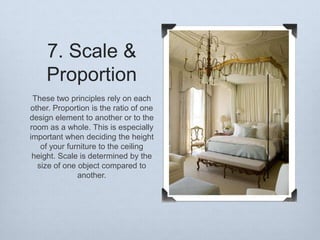
7. Scale &
Proportion
These two principles rely on each
other. Proportion is the ratio of one
design element to another or to the
room as a whole. This is especially
important when deciding the height
of your furniture to the ceiling
height. Scale is determined by the
size of one object compared to
another.
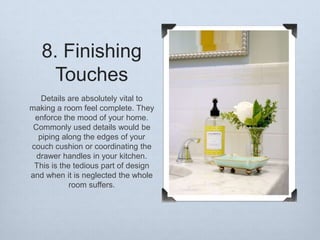
8. Finishing
Touches
Details are absolutely vital to
making a room feel complete. They
enforce the mood of your home.
Commonly used details would be
piping along the edges of your
couch cushion or coordinating the
drawer handles in your kitchen.
This is the tedious part of design
and when it is neglected the whole
room suffers.
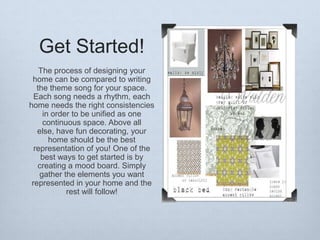
Get Started!
The process of designing your
home can be compared to writing
the theme song for your space.
Each song needs a rhythm, each
home needs the right consistencies
in order to be unified as one
continuous space. Above all
else, have fun decorating, your
home should be the best
representation of you! One of the
best ways to get started is by
creating a mood board. Simply
gather the elements you want
represented in your home and the
rest will follow!

The Ultimate How-To for Interior Design

  • 1.
    Eight Interior DesignPrinciples Courtesy of Exquisite Interior Designs for Executive Homes Realty
  • 2.
    When designing yourhome it is necessary to think of the house as a totality; a series of spaces linked together by halls and stairways. It is vital to choose a common theme and style to run throughout. Not all design elements need be the same, but they should work together to strengthen the composition. One of ways to achieve this is through the use of color. A common method is to use three or four colors in varying shades throughout the house.
  • 3.
    1. Visual Balance The visualweight of a room is equally important as the colors you choose. There are three types of balance to consider: symmetrical, asymmetrical and radial.
  • 4.
    Symmetrical Balance Most commonly foundin traditional interiors, it is characterized by the same objects repeated in the same positions on either side of a vertical axis. This also reflects the human form, making us innately comfortable in such a setting.
  • 5.
    Asymmetrical Balance In this method,balance is achieved with dissimilar objects that have equal weight and visual attraction. This is a casual approach to balance, but it is more difficult to achieve. Asymmetry suggests movement and results in a more lively interior.
  • 6.
    Radial Symmetry This occurs whenall the elements of design and arrayed around a center point. Though not often used in interior décor, it can provide an interesting counterpoint if used appropriately.
  • 7.
    2. Focal Points Your biggestenemy in home décor is boredom. A well-designed room always has at least one focal point. A focal point is dominant and interesting enough to encourage the visitor to look further into the room. It should create a lasting impression while still being an integral part of the room. Your focal point should emphasize the scale, style, color and/or theme of the space.
  • 8.
    Choosing a Focal Point Ifyour space doesn’t have a natural focal point (such as a fireplace) you can create one by highlighting a particular piece of furniture, artwork or contrasting paint color. Still enforce one of the principles of balance so that the focal point doesn’t hog all of the attention.
  • 9.
    3. Repetition By usingthe same element more than once throughout a space you create rhythm and movement for the room. Traditionally this is done through pattern, color, texture or a personal collection.
  • 10.
    4. Progression Characterized bytaking an element and increasing or decreasing one or more of its qualities. The most obvious implementation of this would be graduation by size. This principle can also be achieved by color, where different shades of the same hue are used.
  • 11.
    5. Transition This elementis a bit harder to define. Transition is characterized by a smooth flow, where the eye glides naturally from one area to another.
  • 12.
    6. Contrast Although thisis a straightforward principle it can easily be overdone. Typical practice of contrast would include the variety of pillows on your sofa. Contrast can also be introduced by using circular and square pieces in the same room.
  • 13.
    7. Scale & Proportion Thesetwo principles rely on each other. Proportion is the ratio of one design element to another or to the room as a whole. This is especially important when deciding the height of your furniture to the ceiling height. Scale is determined by the size of one object compared to another.
  • 14.
    8. Finishing Touches Details areabsolutely vital to making a room feel complete. They enforce the mood of your home. Commonly used details would be piping along the edges of your couch cushion or coordinating the drawer handles in your kitchen. This is the tedious part of design and when it is neglected the whole room suffers.
  • 15.
    Get Started! The processof designing your home can be compared to writing the theme song for your space. Each song needs a rhythm, each home needs the right consistencies in order to be unified as one continuous space. Above all else, have fun decorating, your home should be the best representation of you! One of the best ways to get started is by creating a mood board. Simply gather the elements you want represented in your home and the rest will follow!