INTERIM
RESTORATIONS
Presented by : Dr Safiullah malakzay
Department of endodontics and restorative
dentistry
Year : 2022
CONTENTS
introduction
Objectives of interim Restorations
Requirements of interim Restoration
Purposes of interim Restoration
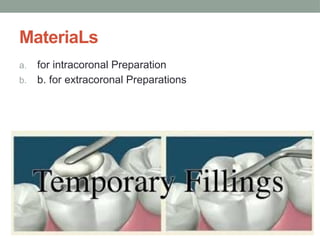
Materials
For intracoronal Preparations
For Extracoronal Preparations
introduction
The word interim means established for the time being a
permanent restoration is placed. Whatever the intended
length of time of treatment, an interim restoration must be
able to maintain patient’s health.
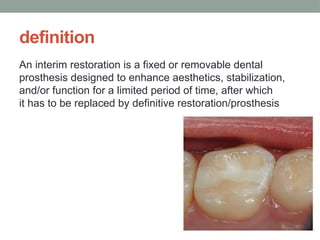
definition
An interim restoration is a fixed or removable dental
prosthesis designed to enhance aesthetics, stabilization,
and/or function for a limited period of time, after which
it has to be replaced by definitive restoration/prosthesis
objectives of interim restorations
Maintain aesthetics
Act as space maintainer
◆
Allow the tooth to function
◆
Act as a diagnostic tool to determine occlusion
◆
Establish function and phonetics
◆
Allow the development of the gingival contour
◆
Seal and insulate the prepared tooth from the oral
◆
environment, thereby protecting the underlying pulp
Prevent passive tooth eruption and mesial drift.
◆
requirements of interim
restoration
◆ Have good marginal adaptation
Have optimal strength and durability
◆
Maintain physiologic contours and embrasures
◆
Have smooth plaque resistant surface
◆
Be able to satisfy mechanical, biological, and aesthetic
◆
criteria
Be economical
◆
Have easy and quick manipulation, placement, and
◆
removal
Be insoluble in oral fluids
◆
Be dimensionally stable
◆
Be sedative to pulp and periodontium
◆
Be aesthetically acceptable.
◆
PurPoses of interim restoration
◆ Protects the pulp by sealing and insulating the prepared
tooth from the oral environment
Sedative for hyperactive pulp due to tooth preparation
◆
Maintains tooth position and prevents occlusal changes
◆
Acts as an indirect pulp cap as it creates a favorable
◆
biological environment
Protects the gingival tissue inflammation
◆
Protects the tooth structure weakened during tooth
◆
preparation
Maintains the aesthetics
◆
MateriaLs
a. for intracoronal Preparation
b. b. for extracoronal Preparations
for intracoronal Preparation
1. Gutta-percha
2. Dental cements:
i. Zinc oxide-eugenol and its modifications
ii. Zinc phosphate cement
iii. Zinc silicophosphate cement
iv. Calcium hydroxide
v. Zinc polycarboxylate cement
vi. Glass ionomer cement
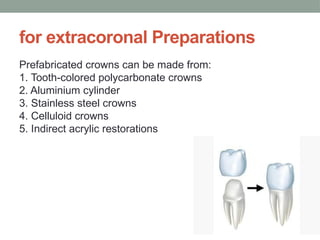
for extracoronal Preparations
Prefabricated crowns can be made from:
1. Tooth-colored polycarbonate crowns
2. Aluminium cylinder
3. Stainless steel crowns
4. Celluloid crowns
5. Indirect acrylic restorations
for intracoronaL PreParations
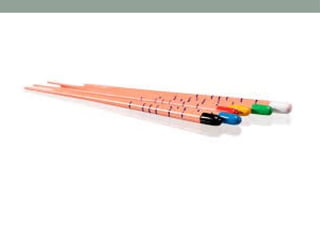
Gutta-Percha stick Interim Interim
Composition of Gutta-percha
Matrix—gutta-percha 20% (organic)
◆
Filler—zinc oxide 66% (inorganic)
◆
Radio-opacifiers—heavy metal sulfates 11% (inorganic)
◆
Plasticizers—waxes or resins 3% (organic)
◆
Advantages
◆ Compatibility allows it to easily adapt to preparation
walls
Inertness of this material makes it nonreactive
◆
Dimensionally stable
◆
Tissue tolerance
◆
Radiopacity makes it easily recognizable on radiograph
◆
Plasticity on heating helps it to mold according to
◆
preparation walls
Disadvantages
◆ Lack of rigidity
Easily displaced by pressure
◆
Lacks adhesive quality.
◆
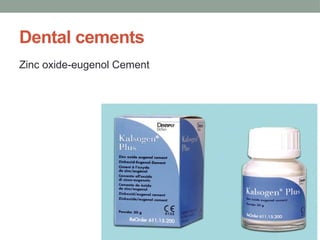
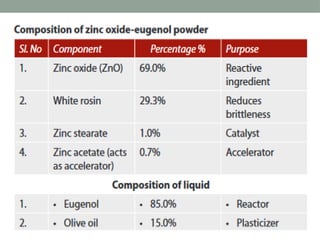
Dental cements
Zinc oxide-eugenol Cement
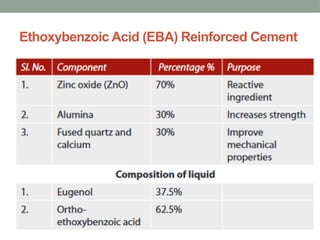
Ethoxybenzoic Acid (EBA) Reinforced Cement
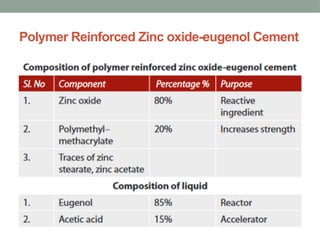
Polymer Reinforced Zinc oxide-eugenol Cement
For extracoronaL PreParations
Various types of prefabricated crowns are available
(made of plastic or metal), along with self-cured or light-
cured resins for extracoronal preparations. Crown forms
in anatomic shapes are most useful because of their
simulation to the tooth structure.
Crown forms
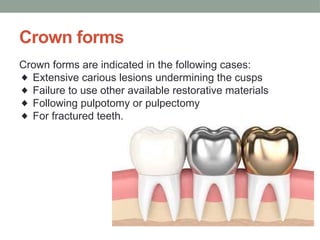
Crown forms are indicated in the following cases:
Extensive carious lesions undermining the cusps
◆
Failure to use other available restorative materials
◆
Following pulpotomy or pulpectomy
◆
For fractured teeth.
◆
Criteria of Using Crowns
◆ Surface of crown should be smooth and polished
Crown margins should be closely adapted to the tooth
◆
Contact with adjacent teeth should be proper
◆
Crown should be in proper occlusion
◆
Crown should facilitate the patient to adequately
◆
maintain oral hygiene
References
• Operative dentistry Nisha Garg and Amit Garg
• Internet
Interim Restorations.pptxInterim Restorations.pptx

Interim Restorations.pptxInterim Restorations.pptx

  • 1.
    INTERIM RESTORATIONS Presented by :Dr Safiullah malakzay Department of endodontics and restorative dentistry Year : 2022
  • 2.
    CONTENTS introduction Objectives of interimRestorations Requirements of interim Restoration Purposes of interim Restoration Materials For intracoronal Preparations For Extracoronal Preparations
  • 3.
    introduction The word interimmeans established for the time being a permanent restoration is placed. Whatever the intended length of time of treatment, an interim restoration must be able to maintain patient’s health.
  • 4.
    definition An interim restorationis a fixed or removable dental prosthesis designed to enhance aesthetics, stabilization, and/or function for a limited period of time, after which it has to be replaced by definitive restoration/prosthesis
  • 5.
    objectives of interimrestorations Maintain aesthetics Act as space maintainer ◆ Allow the tooth to function ◆ Act as a diagnostic tool to determine occlusion ◆ Establish function and phonetics ◆ Allow the development of the gingival contour ◆ Seal and insulate the prepared tooth from the oral ◆ environment, thereby protecting the underlying pulp Prevent passive tooth eruption and mesial drift. ◆
  • 6.
    requirements of interim restoration ◆Have good marginal adaptation Have optimal strength and durability ◆ Maintain physiologic contours and embrasures ◆ Have smooth plaque resistant surface ◆ Be able to satisfy mechanical, biological, and aesthetic ◆ criteria Be economical ◆ Have easy and quick manipulation, placement, and ◆ removal Be insoluble in oral fluids ◆ Be dimensionally stable ◆ Be sedative to pulp and periodontium ◆ Be aesthetically acceptable. ◆
  • 7.
    PurPoses of interimrestoration ◆ Protects the pulp by sealing and insulating the prepared tooth from the oral environment Sedative for hyperactive pulp due to tooth preparation ◆ Maintains tooth position and prevents occlusal changes ◆ Acts as an indirect pulp cap as it creates a favorable ◆ biological environment Protects the gingival tissue inflammation ◆ Protects the tooth structure weakened during tooth ◆ preparation Maintains the aesthetics ◆
  • 8.
    MateriaLs a. for intracoronalPreparation b. b. for extracoronal Preparations
  • 9.
    for intracoronal Preparation 1.Gutta-percha 2. Dental cements: i. Zinc oxide-eugenol and its modifications ii. Zinc phosphate cement iii. Zinc silicophosphate cement iv. Calcium hydroxide v. Zinc polycarboxylate cement vi. Glass ionomer cement
  • 10.
    for extracoronal Preparations Prefabricatedcrowns can be made from: 1. Tooth-colored polycarbonate crowns 2. Aluminium cylinder 3. Stainless steel crowns 4. Celluloid crowns 5. Indirect acrylic restorations
  • 11.
  • 12.
    Composition of Gutta-percha Compositionof Gutta-percha Matrix—gutta-percha 20% (organic) ◆ Filler—zinc oxide 66% (inorganic) ◆ Radio-opacifiers—heavy metal sulfates 11% (inorganic) ◆ Plasticizers—waxes or resins 3% (organic) ◆
  • 13.
    Advantages ◆ Compatibility allowsit to easily adapt to preparation walls Inertness of this material makes it nonreactive ◆ Dimensionally stable ◆ Tissue tolerance ◆ Radiopacity makes it easily recognizable on radiograph ◆ Plasticity on heating helps it to mold according to ◆ preparation walls
  • 15.
    Disadvantages ◆ Lack ofrigidity Easily displaced by pressure ◆ Lacks adhesive quality. ◆
  • 16.
  • 18.
    Ethoxybenzoic Acid (EBA)Reinforced Cement
  • 19.
    Polymer Reinforced Zincoxide-eugenol Cement
  • 20.
    For extracoronaL PreParations Varioustypes of prefabricated crowns are available (made of plastic or metal), along with self-cured or light- cured resins for extracoronal preparations. Crown forms in anatomic shapes are most useful because of their simulation to the tooth structure.
  • 21.
    Crown forms Crown formsare indicated in the following cases: Extensive carious lesions undermining the cusps ◆ Failure to use other available restorative materials ◆ Following pulpotomy or pulpectomy ◆ For fractured teeth. ◆
  • 22.
    Criteria of UsingCrowns Criteria of Using Crowns ◆ Surface of crown should be smooth and polished Crown margins should be closely adapted to the tooth ◆ Contact with adjacent teeth should be proper ◆ Crown should be in proper occlusion ◆ Crown should facilitate the patient to adequately ◆ maintain oral hygiene
  • 23.
    References • Operative dentistryNisha Garg and Amit Garg • Internet