A REPORT 
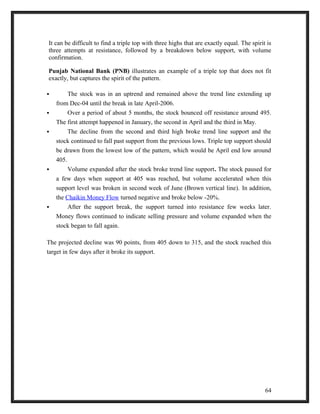
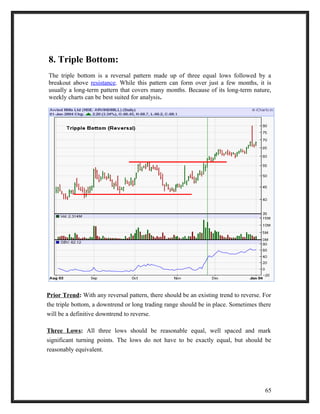
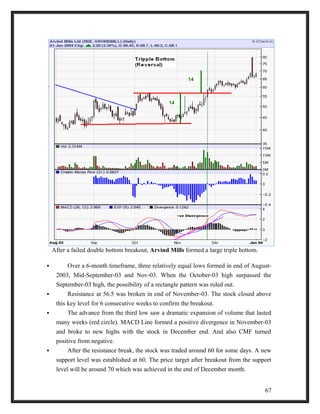
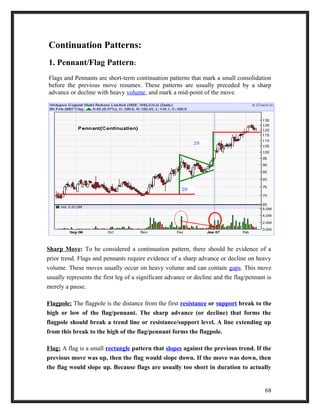
ON 
“BASICS OF TECHNICAL 
ANALYSIS” 
By 
UMANG BHAVSAR 
INTERFACE BROKERAGE & RESEARCH LTD
A REPORT 
ON 
“BASICS OF TECHNICAL 
ANALYSIS” 
By 
UMANG BHAVSAR 
A Report submitted in partial fulfillment of 
The requirements of 
2
MBA Programme of 
GUJARAT UNIVERSITY 
Acknowledgement 
First of all I would like to thank Mr. Himal Parikh (Director, Interface 
Brokerage & Research Ltd.) for providing me an opportunity to work in 
their team as summer trainee. 
I would also like to thank Ms. Binny Vora, Ms. Heta Jani, Ms. Megha 
Shah and Mr. Hitesh Patel; employees of the company working in 
research department for their invaluable guidance, cooperation and 
encouragement which helped me lot in my Summer Training. 
I am also thankful to Prof. Mayank Joshipura for his guidance and 
valuable inputs and advice during my project. 
At the last, I would like to thank each individual who some or other 
way helped me to complete my project. 
3
Table of Contents 
Abstract 6 
Introduction 7 
Company Profile 9 
The Philosophy of Technical Analysis 10 
Dow Theory 14 
Charts 18 
Support & Resistance 23 
Trend lines & Channels 28 
Chart Pattern Analysis 36 
Reversal Patterns 
1. Double Top 37 
2. Head & Shoulder Top 41 
3. Head & Shoulder Bottom 45 
4. Falling Wedge. 48 
5. Rising Wedge 52 
6. Rounding Bottom 55 
7. Triple Top. 59 
8. Triple Bottom 62 
Continuation Patterns 
1. Pennant/Flag. 65 
2. Symmetric Triangle 68 
3. Ascending Triangle 72 
4. Descending Triangle 76 
5. Rectangle 80 
4
6. Price Channel 84 
Technical Indicators 87 
Trend Indicators 
1. Moving Averages 88 
2. MACD 92 
-MACD Histogram 96 
3. ADX 98 
Momentum Indicators 
1. Rate Of Change (ROC) 99 
2. RSI. 100 
3. William’s % R 102 
Bombay Stock Exchange (BSE) 104 
National Stock Exchange (NSE) 113 
Leading Stocks’ Short term & Medium Term Analysis 118 
Report Summery 125 
References 126 
5
Abstract 
Technical analysis is study of predicting prices of securities for future. The main aim of 
Technical analysis is to generate returns by letting person decide when to enter and 
when to exit in the security. Bottom line is to buy at tough (deep decline) and to sell at 
peak to get substantial amount of return/profit. By study of technical analysis person 
will be able to take decision of his trades/investments. 
Technical analysis uses various charts for analysis. This project throws lights on various 
basic aspects of technical analysis. It is not possible to cover each and every aspect of 
technical analysis. But I have tried to cover main and basics of technical analysis. As 
today in stock market decisions are very important and most of the people make 
investment on advises of brokers. Through this report any person who doesn’t know 
anything about Technical Analysis can also study it easily and make decisions on his 
own. 
In this final report I have covered different various types of charts, various formations of 
chart patterns, some theories related to technical analysis, technical indicators for better 
analysis. I have covered as much examples of various charts and indicators as possible 
so that one can understand them. In terms of charts I have used mostly candlestick 
charts amongst all three charts for analysis of security as they give clear picture of price 
movements during particular period. 
I have referred some of the books on technical analysis and some of the Websites for 
charts. At last I have analyzed price movements of various Leading Stocks of Indian 
stock market through their charts using technical analysis and with the use of available 
data I have set short to medium term targets. 
6
Introduction 
Technical Analysis is the forecasting of future price movements based on study of past 
price movements. It may not give you the absolute predictions but it can give you 
general idea of the price movement which is likely to be in future. Technical Analysis is 
applicable to stocks, commodities, indices, futures or tradable instruments where the 
prices are influenced by force of demand and supply. Price refers to any combination of 
open, low, close, and high of any stock over a specific period of time. Time frame can 
be intraday (daily), weekly, monthly or yearly. Technical analysis is focused directly on 
the bottom line i.e. what is the price? , where has it been? , and what can it be in the 
future? It is used to make investment decisions by analyzing strengths and weaknesses 
of any stock with use of various chart patterns and other indicators. 
In technical analysis various types of charts are used. For any investor or people who are 
involved in the stock market it is very important to know what will happen to prices of 
stocks tomorrow. Technical Analysis is one of the ways to forecast future price 
movements. By studying the basics of Technical Analysis one can know that when to 
exit and when to enter in the markets. 
There are four types of charts. 
1. Line Charts 
2. Bar Charts 
3. Candle Stick Charts 
4. Point and Figure Charts 
Chart patterns analysis can be used to make short term or long term forecasts. There are 
generally two types of chart patterns 
1. Reversal Chart Patterns 
2. Continuation chart patterns. 
Some different types of chart patterns are as follows. 
 Double Top (Reversal) 
 Double Bottom (Reversal) 
 Head and Shoulders Top (Reversal) 
 Head and Shoulders Bottom (Reversal) 
7
 Falling Wedge (Reversal) 
 Rising Wedge (Reversal) 
 Rounding Bottom (Reversal) 
 Triple Top (Reversal) 
 Triple Bottom (Reversal) 
 Bump and Run Reversal (Reversal) 
 Flag, Pennant (Continuation) 
 Symmetrical Triangle (Continuation) 
 Ascending Triangle (Continuation) 
 Descending Triangle (Continuation) 
 Rectangle (Continuation) 
 Price Channel (Continuation) 
Chart patterns are used along with the market and technical indicators to study the 
price movements and historical data. Market indicators are presentation of the 
historical data in a line form.. Volume as an indicator also plays very important role. 
Each and every indicator has its own meaning and interpretation. But to be more 
accurate in analysis one should use more than one indicator to confirm the price trend or 
movements. There are many technical indicators and chart overlays which can be used 
for analysis. Some of them are as follows: 
 Average Directional Index (ADX) - A technical indicator system that attempts to 
quantify how strongly a stock is trending. 
 Moving Average Convergence/Divergence (MACD) - A technical indicator 
system that combines several moving averages to better show a stock's trend and 
momentum. 
 Moving Averages – Different types of moving averages. 
 Rate of Change (ROC) and Momentum - A technical indicator that shows the 
speed at which a stock's price is changing. 
 Relative Strength Index (RSI) - A technical indicator that tries to quantify a 
stock's current direction and strength. 
 Williams %R - A technical indicator that uses Stochastics to determine 
overbought and oversold levels. 
8
I have analyzed the charts of leading stocks of Indian Stock Market indices using 
technical analysis and some of the indicators. 
COMPANY PROFILE 
INTERFACE BROKERAGE & RESEARCH LTD 
Interface Group is in Finance business since 1988. The group is well diversified into 
various activities viz. Operations into Primary Market and Secondary Market in the 
Stock Market, intermediary in the Debt Market, Fund based activities under the flagship 
company the Interface Financial Services Ltd. 
Interface Group has a Corporate Membership of Ahmedabad Stock Exchange, National 
Stock Exchange of India for Capital Market Segment and Dealership on OTC Exchange 
of India. 
Interface Group has achieved remarkable growth as Broker Underwriter and has 
established its presence as a leading Primary Market Player at National Level. 
Interface Group is engaged in fund based activities such as lease Hire Purchase, Car 
Finance, securitization, ICD, Loan against shares etc. 
Interface group is also engaged in the field of Marketing Financial Instruments and 
Marketing Fixed Deposits of state as well as National Level reputed Manufacturing 
And finance companies, States and central Government Undertakings, private sector 
Banks. The Group is acting as Managers for the Fixed Deposits of several corporate of 
repute. The group is also acting as Direct Brokers for more than 50 companies for 
mobilizing their fixed deposits. The group is also marketing RBI Tax Free Relief Bonds, 
Mutual Funds of reputed AMCs, UTI Schemes etc. and mobilizing huge amount. 
Interface group is actively engaged in the Money Market and doing good business in 
Central as well as State Government Dated Securities and is registered Money Market 
Broker with RBI. Besides the group is also dealing in Rated Bonds of Public Sector, 
Private sector as well as Nationalized Banks. 
Interface Group has large network of Sub-brokers in all most major centers of the state 
for Primary Market, Fixed Deposits Mobilization, and Mutual Funds etc. Besides the 
group has a very good relationship with high net worth clients all over Gujarat. 
9
The Philosophy of Technical Analysis 
Introduction: 
The methods used to analyze and predict the performance of a company's stock fall 
into two broad categories: 
1) Fundamental Analysis 
2) Technical Analysis 
Those who use technical analysis look for peaks, bottoms, trends, patterns and other 
factors affecting a stock's price movement and then make buy/sell decisions based on 
those factors. It is a technique many people attempt, but few are truly successful at it. 
The world of technical analysis is huge today. There are literally hundreds of different 
patterns and indicators that investors claim to have success with. 
The term “technical” in its application to the stock market has come to have a very 
special meaning, quite different from its ordinary dictionary definition. It refers to the 
study of the market itself as opposed to the study of the goods in which the market 
deals. Technical Analysis is the science of recording, usually in graphic form, the 
actual history of trading (price changes, volume of transactions, etc.) in a certain stock 
or in “the Averages” and then deducing from that pictured history the probable future 
trend. 
Some History of Technical Analysis: 
The term “technical analysis” is a complicated-sounding name for a very basic 
approach to investing. Simply put, technical analysis is the study of prices, with charts 
being the primary tool. 
The roots of modern-day technical analysis stem from the Dow Theory, developed 
around 1900 by Charles Dow. Stemming either directly or indirectly from the Dow 
Theory, these roots include such principles as the trending nature of prices, prices 
discounting all known information, confirmation and divergence, volume-mirroring 
changes in price, and support/resistance. 
10
Technical analysis is the study of specific securities and the overall market based on 
demand/supply relationship. 
A technician is a person who uses technical analysis to make investment decisions. The 
technical analyst bases market forecasting on price movement and other indicators. 
Technical analysis approaches should be tied to the individual investor’s perspective, 
temperament, personality, and risk profile. 
What Is Technical Analysis? 
Technical Analysis is the science of recording, usually in graphic form, the actual 
history of trading (price changes, volume of transactions, etc.) in a certain stock or in 
“the Averages” and then deducing from that pictured history the probable future trend. 
Technical analysis is a method of evaluating securities by analyzing statistics generated 
by market activity, past prices and volume. Technical analysts do not attempt to 
measure a security's intrinsic value; instead they look at stock charts for patterns and 
indicators that will determine a stock's future performance. 
Technical analysis has become increasingly popular over the past several years, as 
more and more people believe that the historical performance of a stock is a strong 
indication of future performance. The use of past performance should come as no 
surprise. People using fundamental analysis have always looked at the past 
performance of companies by comparing fiscal data from previous quarters and years 
to determine future growth. The difference lies in the technical analyst's belief that 
securities move according to very predictable trends and patterns. These trends 
continue until something happens to change the trend, and until this change occurs, 
price levels are predictable. There are many instances of investors successfully trading 
a security using only their knowledge of the security's chart, without even 
understanding what the company does. 
However, although technical analysis is a terrific tool, most agree it is much more 
effective when used in combination with fundamental analysis. 
The Basic Assumptions: 
The field of technical analysis is based on three assumptions: 
1. The market discounts everything. 
2. Price moves in trends. 
3. History tends to repeat itself. 
1. The Market Discounts Everything 
11
A major criticism of technical analysis is that it only considers price movement, 
ignoring the fundamental factors of the company. However, technical analysis 
assumes that, at any given time, a stock's price reflects everything that has or 
could affect the company - including fundamental factors. Technical analysts 
believe that the company's fundamentals, along with broader economic factors 
and market psychology, are all priced into the stock, removing the need to 
actually consider these factors separately. This only leaves the analysis of price 
movement, which technical theory views as a product of the supply and demand 
for a particular stock in the market. 
2. Price Moves in Trends 
In technical analysis, price movements are believed to follow trends. This 
means that after a trend has been established, the future price movement is 
more likely to be in the same direction as the trend than to be against it. Most 
technical trading strategies are based on this assumption. 
3. History Tends To Repeat Itself 
Another important idea in technical analysis is that history tends to repeat itself, 
mainly in terms of price movement. The repetitive nature of price movements is 
attributed to market psychology; in other words, market participants tend to 
provide a consistent reaction to similar market stimuli over time. Technical 
analysis uses chart patterns to analyze market movements and understand 
trends. Although many of these charts have been used for more than 100 years, 
they are still believed to be relevant because they illustrate patterns in price 
movements that often repeat themselves. 
Adaptability to Different Markets and Investment Time Horizons: 
The beauty of technical analysis is that it can be applied effectively to virtually any 
trading medium and investment time horizon. A technician can analyze stocks, bonds, 
options, mutual funds, commodities, and many other forms of investment for buy or 
sell opportunities. And one can do so by examining tic-by-tic, intraday, daily, weekly, 
monthly, or some other interval of data to use technical analysis for a wide range of 
time horizons- from very short-term to very long-term perspectives. 
The best manner in which to use technical analysis depends on one’s approach to the 
market. Everyone invests differently. We all have different levels of stress, different 
temperaments, and different amounts of capital. It is important to apply technical 
analysis in a manner that complement’s one’s own personality and individual 
investments philosophy. Obviously, those whose time, nerves, and capital are limited 
will want to pass up very short-term trading opportunities (such as intraday trading of 
stock index futures) and, perhaps, use longer-term technical analysis derived buy and 
sell signals for stocks or mutual funds. By recognizing one’s individual investment 
12
strengths and weakness, users of technical analysis can find the trading medium and 
time horizons that are best for their individual investment situations. 
Technical analysis is done from four important view points which are as follows: 
Price: Changes in price reflect changes in investor attitude and demand 
for and supply of securities. 
Time: The longer time price takes for a reversal in trend, the greater the 
price change that would follow. 
Volume: The intensity of price change is reflected in the volume of 
transactions. An increase in price supported by low volumes indicates that the 
change in the price is not so strong 
. 
Breadth: Breadth of the market indicates the extent to which price changes 
have taken place in the market in accordance with the overall market trend. It 
indicates that whether a change in trend of prices spread across the most sectors 
or it is concentrated in only few types of scrip. 
Technical analysis is subjective as the interpretation of the analysis varies from person 
to person for the same stock because it depends on the style of individual investors. 
13
DOW THEORY 
The basic principles of the Technical Analysis originated form the Dow Theory. Dow 
Theory only describes the direction of market trends, and does not attempt to forecast 
future price movements or measures size of such market trends. 
The five basic tenets of the Dow Theory are as follows: 
1. The Average Discounts Everything: 
The share prices that are determined in the market evolved out of a discounting 
process that takes all known and predictable factors into account. 
2. The Market has three types of Movements: 
Primary Movements 
Primary movements, which last from about a year to several years, represent 
the major market trends. It can either be a rising (bull) trend or a falling trend 
(bear). 
Primary trends are long term movements in prices, interrupted by swings in the 
opposite direction. 
Secondary Movements 
A secondary movement is defined as an important decline in a bull market, or 
advance in a bear market lasting from three weeks to as many months. When 
reaction is more than 50% of the preceding primary trend, it is difficult to say 
whether the reaction is secondary or it signals a new primary trend in the 
opposite direction. 
Minor Movements 
14
Movements in prices that form only a part of a primary trend or a secondary 
movement are called Minor Movements. Generally intraday movements are 
called minor movements. 
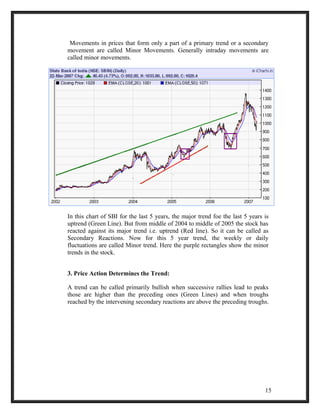
In this chart of SBI for the last 5 years, the major trend foe the last 5 years is 
uptrend (Green Line). But from middle of 2004 to middle of 2005 the stock has 
reacted against its major trend i.e. uptrend (Red line). So it can be called as 
Secondary Reactions. Now for this 5 year trend, the weekly or daily 
fluctuations are called Minor trend. Here the purple rectangles show the minor 
trends in the stock. 
3. Price Action Determines the Trend: 
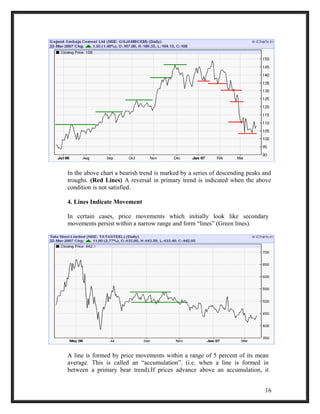
A trend can be called primarily bullish when successive rallies lead to peaks 
those are higher than the preceding ones (Green Lines) and when troughs 
reached by the intervening secondary reactions are above the preceding troughs. 
15
In the above chart a bearish trend is marked by a series of descending peaks and 
troughs. (Red Lines) A reversal in primary trend is indicated when the above 
condition is not satisfied. 
4. Lines Indicate Movement 
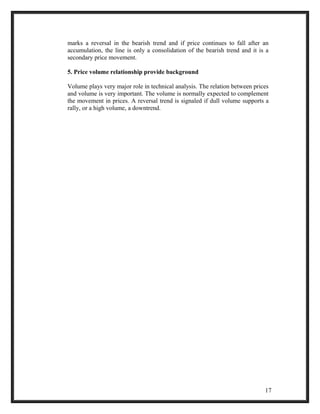
In certain cases, price movements which initially look like secondary 
movements persist within a narrow range and form “lines” (Green lines). 
A line is formed by price movements within a range of 5 percent of its mean 
average. This is called an “accumulation”. (i.e. when a line is formed in 
between a primary bear trend).If prices advance above an accumulation, it 
16
marks a reversal in the bearish trend and if price continues to fall after an 
accumulation, the line is only a consolidation of the bearish trend and it is a 
secondary price movement. 
5. Price volume relationship provide background 
Volume plays very major role in technical analysis. The relation between prices 
and volume is very important. The volume is normally expected to complement 
the movement in prices. A reversal trend is signaled if dull volume supports a 
rally, or a high volume, a downtrend. 
17
Charts 
A price chart is a sequence of prices plotted over a specific time frame. Technical 
analysis is based on charts. Therefore sometimes technical Analysts are called Chartists. 
On the chart, the y-axis (vertical axis) represents the price scale and the x-axis 
(horizontal axis) represents the time scale. Prices are plotted from left to right across the 
x-axis with the most recent plot being the furthest right. 
A graphical historical record makes it easy to spot the effect of key events on a 
security's price, its performance over a period of time and whether it's trading near its 
highs, near its lows, or in between. 
There are basically four types of charts which are as follows: 
1. Line Charts 
2. Bar Charts 
3. Candle Stick Charts 
4. Point and Figure Charts 
But only first three of the charts are used very frequently for the analysis part. 
Line Charts: 
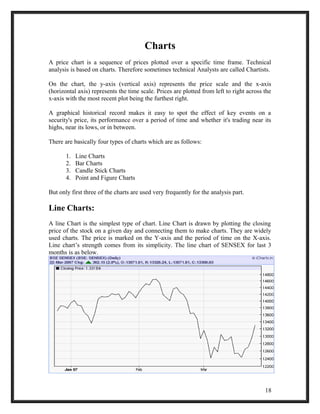
A line Chart is the simplest type of chart. Line Chart is drawn by plotting the closing 
price of the stock on a given day and connecting them to make charts. They are widely 
used charts. The price is marked on the Y-axis and the period of time on the X-axis. 
Line chart’s strength comes from its simplicity. The line chart of SENSEX for last 3 
months is as below. 
18
Bar Charts: 
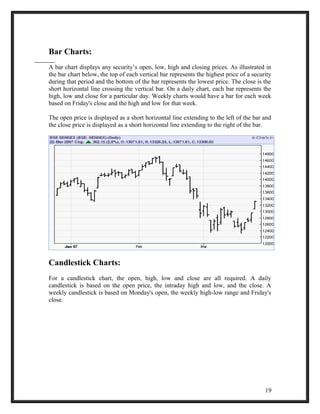
A bar chart displays any security’s open, low, high and closing prices. As illustrated in 
the bar chart below, the top of each vertical bar represents the highest price of a security 
during that period and the bottom of the bar represents the lowest price. The close is the 
short horizontal line crossing the vertical bar. On a daily chart, each bar represents the 
high, low and close for a particular day. Weekly charts would have a bar for each week 
based on Friday's close and the high and low for that week. 
The open price is displayed as a short horizontal line extending to the left of the bar and 
the close price is displayed as a short horizontal line extending to the right of the bar. 
Candlestick Charts: 
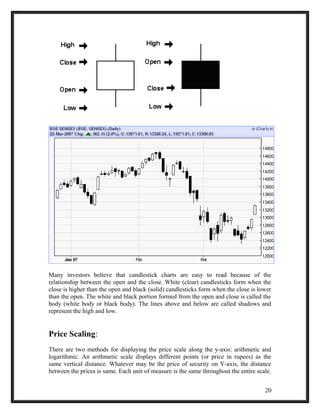
For a candlestick chart, the open, high, low and close are all required. A daily 
candlestick is based on the open price, the intraday high and low, and the close. A 
weekly candlestick is based on Monday's open, the weekly high-low range and Friday's 
close. 
19
Many investors believe that candlestick charts are easy to read because of the 
relationship between the open and the close. White (clear) candlesticks form when the 
close is higher than the open and black (solid) candlesticks form when the close is lower 
than the open. The white and black portion formed from the open and close is called the 
body (white body or black body). The lines above and below are called shadows and 
represent the high and low. 
Price Scaling: 
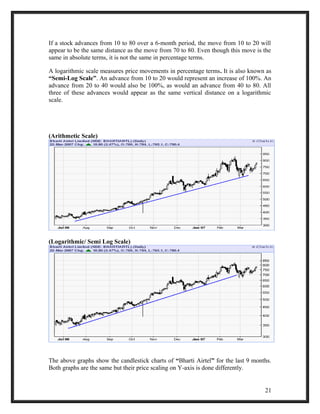
There are two methods for displaying the price scale along the y-axis: arithmetic and 
logarithmic. An arithmetic scale displays different points (or price in rupees) as the 
same vertical distance. Whatever may be the price of security on Y-axis, the distance 
between the prices is same. Each unit of measure is the same throughout the entire scale. 
20
If a stock advances from 10 to 80 over a 6-month period, the move from 10 to 20 will 
appear to be the same distance as the move from 70 to 80. Even though this move is the 
same in absolute terms, it is not the same in percentage terms. 
A logarithmic scale measures price movements in percentage terms. It is also known as 
“Semi-Log Scale”. An advance from 10 to 20 would represent an increase of 100%. An 
advance from 20 to 40 would also be 100%, as would an advance from 40 to 80. All 
three of these advances would appear as the same vertical distance on a logarithmic 
scale. 
(Arithmetic Scale) 
(Logarithmic/ Semi Log Scale) 
The above graphs show the candlestick charts of “Bharti Airtel” for the last 9 months. 
Both graphs are the same but their price scaling on Y-axis is done differently. 
21
Key points on the benefits of arithmetic and semi-log scales: 
Arithmetic scales are useful when the price range is confined within a relatively tight 
range. 
Arithmetic scales are useful for short-term charts and trading. Price movements 
(particularly for stocks) are shown in absolute rupee terms and reflect movements for 
each rupee. 
Semi-log scales are useful when the price has moved significantly, be it over a short or 
extended time frame 
Trend lines tend to match lows better on semi-log scales. 
Semi-log scales are useful for long-term charts to gauge the percentage movements over 
a long period of time. 
The choice of which charting method to use will depend on personal preferences and 
trading or investing styles. 
22
SUPPORT AND RESISTANCE 
In this section, the concepts of support and resistance will be more fully explained. In 
addition, two sophisticated applications of support and resistance, namely percentage 
retracements and speed resistance lines, will be examined. 
Support and Resistance: 
In the Wall Street environment, the terms support and resistance are almost synonymous 
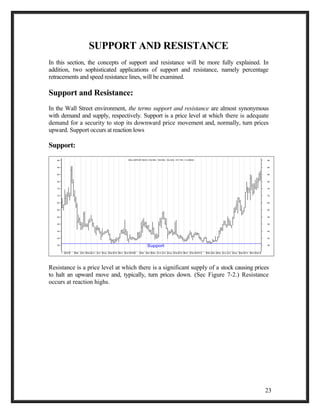
with demand and supply, respectively. Support is a price level at which there is adequate 
demand for a security to stop its downward price movement and, normally, turn prices 
upward. Support occurs at reaction lows 
Support: 
95 
90 
85 
80 
75 
70 
65 
60 
55 
50 
45 
40 
35 
95 
90 
85 
80 
75 
70 
65 
60 
55 
50 
45 
40 
35 
BALLARPUR INDS (104.900, 109.500, 104.500, 107.750, +3.45000) 
Support 
Nov Dec 2001 Mar Apr May Jun Jul Aug Sep Oct Nov Dec 2002 Mar Apr May Jun Jul Aug Sep Oct Nov Dec 2003 Mar Apr May Jun Jul Aug Sep Oct Nov Dec 2004 Feb 
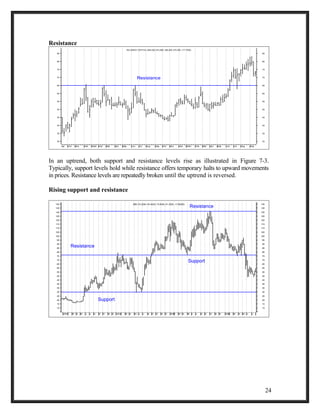
Resistance is a price level at which there is a significant supply of a stock causing prices 
to halt an upward move and, typically, turn prices down. (Sec Figure 7-2.) Resistance 
occurs at reaction highs. 
23
Resistance 
85 
80 
75 
70 
65 
60 
55 
50 
45 
40 
35 
30 
RELIANCE CAPITAL (594.000, 673.800, 594.000, 670.300, +77.7500) 
Aug Sep Oct Nov Dec 2002 Feb Mar Apr May Jun Jul Aug Sep Oct Nov Dec 2003 Feb Mar Apr May Jun Jul Aug Sep Oct 
85 
80 
75 
70 
65 
60 
55 
50 
45 
40 
35 
30 
Resistance 
In an uptrend, both support and resistance levels rise as illustrated in Figure 7-3. 
Typically, support levels hold while resistance offers temporary halts to upward movements 
in prices. Resistance levels are repeatedly broken until the uptrend is reversed. 
Rising support and resistance 
140 
135 
130 
125 
120 
115 
110 
105 
100 
95 
90 
85 
80 
75 
70 
65 
60 
55 
50 
45 
40 
35 
30 
25 
20 
15 
10 
140 
135 
130 
125 
120 
115 
110 
105 
100 
N D 2003 M A M J J A S O N D 2004 M A M J J A S O N D 2005 M A M J J A S O N D 2006 M A M J J A S 
95 
90 
85 
80 
75 
70 
65 
60 
55 
50 
45 
40 
35 
30 
25 
20 
15 
10 
Resistance 
Resistance 
Support 
Support 
IDBI (74.2000, 83.4000, 73.6000, 81.2500, +7.85000) 
24
Role Reversal 
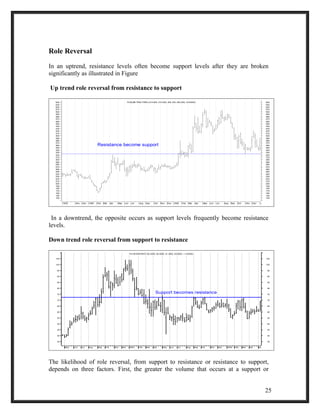
In an uptrend, resistance levels often become support levels after they are broken 
significantly as illustrated in Figure 
Up trend role reversal from resistance to support 
540 
530 
520 
510 
500 
490 
480 
470 
460 
450 
440 
430 
420 
410 
400 
390 
380 
370 
360 
350 
340 
330 
320 
310 
300 
290 
280 
270 
260 
250 
240 
230 
220 
210 
200 
190 
180 
170 
160 
150 
PUNJAB TRACTORS (314.000, 314.000, 305.100, 305.400, -6.55002) 
1997 Nov Dec 1998 Feb Mar Apr May Jun Jul Aug Sep Oct Nov Dec 1999 Feb Mar Apr May Jun Jul Aug Sep Oct Nov Dec 2000 Feb 
540 
530 
520 
510 
500 
490 
480 
470 
460 
450 
440 
430 
420 
410 
400 
390 
380 
370 
360 
350 
340 
330 
320 
310 
300 
290 
280 
270 
260 
250 
240 
230 
220 
210 
200 
190 
180 
170 
160 
150 
140 
140 
Resistance become support 
In a downtrend, the opposite occurs as support levels frequently become resistance 
levels. 
Down trend role reversal from support to resistance 
105 
100 
95 
90 
85 
80 
75 
70 
65 
60 
55 
50 
45 
40 
35 
105 
100 
95 
90 
85 
80 
75 
70 
65 
60 
55 
50 
45 
40 
35 
TN NEWSPRINT (82.0000, 86.5000, 81.2500, 83.6500, +1.45000) 
Support becomes resistance 
Mar Apr May Jun Jul Aug Sep Oct Nov Dec 2004 Feb Mar Apr May Jun Jul Aug Sep Oct Nov Dec 2005 Feb Mar Apr May Jun 
The likelihood of role reversal, from support to resistance or resistance to support, 
depends on three factors. First, the greater the volume that occurs at a support or 
25
resistance level, the more significant the level is and, thus, the more likely a candidate 
the level is for role reversal. Second, the longer that prices trade near the support or 
resistance level, the greater the chance of role reversal. For example, the probability of 
role reversal is enhanced if consolidation occurs near a support or resistance level for a 
few weeks rather than a few days. Finally, the more recently that trading occurred at 
the level, the fresher it is in traders' minds, and the more likely it is that role reversal will 
occur. 
Trend Reversals 
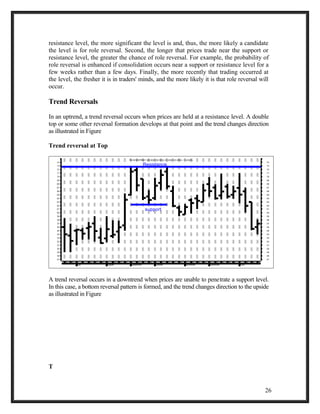
In an uptrend, a trend reversal occurs when prices are held at a resistance level. A double 
top or some other reversal formation develops at that point and the trend changes direction 
as illustrated in Figure 
Trend reversal at Top 
4J 
74 
73 
72 
71 
70 
69 
68 
67 
66 
65 
64 
63 
62 
61 
60 
59 
58 
57 
56 
55 
54 
53 
52 
51 
50 
49 
48 
une 
11 18 25 2 July 
9 16 23 30 6 13 
August 
TN NEWSPRINT (82.0000, 86.5000, 81.2500, 83.6500, +1.45000) 
20 27 3 10 
September 
Resistance 
17 24 1 9 
October 
15 21 29 5 12 
November 
19 25 3 10 
December 
17 24 31 7 14 
2005 
20 28 4 
74 
73 
72 
71 
70 
69 
68 
67 
66 
65 
64 
63 
62 
61 
60 
59 
58 
57 
56 
55 
54 
53 
52 
51 
50 
49 
48 
February 
47 
47 
support 
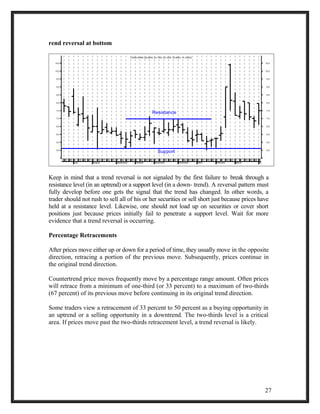
A trend reversal occurs in a downtrend when prices are unable to penetrate a support level. 
In this case, a bottom reversal pattern is formed, and the trend changes direction to the upside 
as illustrated in Figure 
T 
26
rend reversal at bottom 
10.5 
10.0 
1 8 
June 
15 22 29 6J 
uly 
13 20 27 3 10 
August 
17 24 31 7 14 21 
September 
DENA BANK (29.9000, 34.1500, 29.1000, 33.8000, +4.10000) 
28 5 12 
October 
Resistance 
19 25 2 9 15 
November 
23 29 7 14 21 
December 
28 4 11 
2002 
18 25 1 8 
February 
15 22 1 8 
March 
10.5 
10.0 
15 22 28 5 12 
April 
9.5 
9.0 
8.5 
8.0 
7.5 
7.0 
6.5 
6.0 
5.5 
19 
9.5 
9.0 
8.5 
8.0 
7.5 
7.0 
6.5 
6.0 
5.5 
5.0 
5.0 
Support 
Keep in mind that a trend reversal is not signaled by the first failure to break through a 
resistance level (in an uptrend) or a support level (in a down- trend). A reversal pattern must 
fully develop before one gets the signal that the trend has changed. In other words, a 
trader should not rush to sell all of his or her securities or sell short just because prices have 
held at a resistance level. Likewise, one should not load up on securities or cover short 
positions just because prices initially fail to penetrate a support level. Wait for more 
evidence that a trend reversal is occurring. 
Percentage Retracements 
After prices move either up or down for a period of time, they usually move in the opposite 
direction, retracing a portion of the previous move. Subsequently, prices continue in 
the original trend direction. 
Countertrend price moves frequently move by a percentage range amount. Often prices 
will retrace from a minimum of one-third (or 33 percent) to a maximum of two-thirds 
(67 percent) of its previous move before continuing in its original trend direction. 
Some traders view a retracement of 33 percent to 50 percent as a buying opportunity in 
an uptrend or a selling opportunity in a downtrend. The two-thirds level is a critical 
area. If prices move past the two-thirds retracement level, a trend reversal is likely. 
27
Trend lines and Channels 
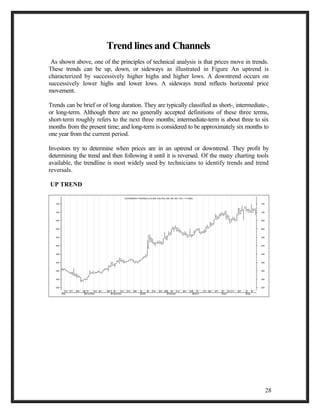
As shown above, one of the principles of technical analysis is that prices move in trends. 
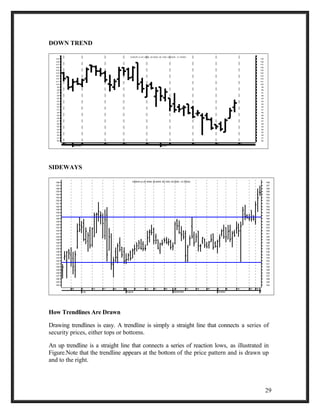
These trends can be up, down, or sideways as illustrated in Figure An uptrend is 
characterized by successively higher highs and higher lows. A downtrend occurs on 
successively lower highs and lower lows. A sideways trend reflects horizontal price 
movement. 
Trends can be brief or of long duration. They are typically classified as short-, intermediate-, 
or long-term. Although there are no generally accepted definitions of these three terms, 
short-term roughly refers to the next three months; intermediate-term is about three to six 
months from the present time; and long-term is considered to be approximately six months to 
one year from the current period. 
Investors try to determine when prices are in an uptrend or downtrend. They profit by 
determining the trend and then following it until it is reversed. Of the many charting tools 
available, the trendline is most widely used by technicians to identify trends and trend 
reversals. 
UP TREND 
750 
700 
650 
600 
550 
500 
450 
400 
350 
300 
26 3 10 
October 
17 24 31 7 14 
November 
21 28 5 12 
December 
19 26 2 
2006 
9 16 23 30 6 
February 
13 20 27 6 
March 
13 20 27 3 
April 
10 17 24 2 
May 
8 15 
250 
750 
700 
650 
600 
550 
500 
450 
400 
350 
300 
250 
AUROBINDO PHARMA (614.900, 635.000, 606.100, 627.100, +17.0000) 
28
DOWN TREND 
29 
February 
5 12 19 26 
March 
109 
108 
107 
106 
105 
104 
103 
102 
101 
100 
99 
98 
97 
96 
95 
94 
93 
92 
91 
90 
89 
88 
87 
86 
85 
84 
83 
82 
81 
5 12 19 26 2 
April 
109 
108 
107 
106 
105 
104 
103 
102 
101 
100 
99 
98 
97 
96 
95 
94 
93 
92 
91 
90 
89 
88 
87 
86 
85 
84 
83 
82 
81 
80 
80 
DABUR (I) (91.8500, 94.6000, 90.1000, 93.4000, +2.70000) 
SIDEWAYS 
158 
157 
156 
155 
154 
153 
152 
151 
150 
149 
148 
147 
146 
145 
144 
143 
142 
141 
140 
139 
138 
137 
136 
135 
134 
133 
132 
131 
130 
129 
128 
127 
126 
125 
19 26 3J 
uly 
10 17 24 31 
DABUR (I) (91.8500, 94.6000, 90.1000, 93.4000, +2.70000) 158 
August 
7 14 21 28 4 
September 
11 18 25 3 
October 
157 
156 
155 
154 
153 
152 
151 
150 
149 
148 
147 
146 
145 
144 
143 
142 
141 
140 
139 
138 
137 
136 
135 
134 
133 
132 
131 
130 
129 
128 
127 
126 
125 
9 16 23 30 6 
November 
124 
124 
How Trendlines Are Drawn 
Drawing trendlines is easy. A trendline is simply a straight line that connects a series of 
security prices, either tops or bottoms. 
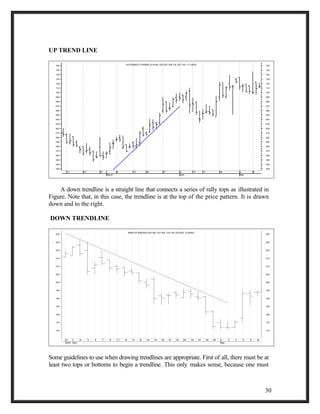
An up trendline is a straight line that connects a series of reaction lows, as illustrated in 
Figure.Note that the trendline appears at the bottom of the price pattern and is drawn up 
and to the right. 
29
UP TREND LINE 
February 
760 
750 
740 
730 
720 
710 
700 
690 
680 
670 
660 
650 
640 
630 
620 
610 
600 
590 
580 
570 
560 
550 
540 
6 13 20 27 
March 
AUROBINDO PHARMA (614.900, 635.000, 606.100, 627.100, +17.0000) 760 
6 13 20 27 3 
April 
10 17 24 2 
May 
750 
740 
730 
720 
710 
700 
690 
680 
670 
660 
650 
640 
630 
620 
610 
600 
590 
580 
570 
560 
550 
540 
8 15 
530 
530 
A down trendline is a straight line that connects a series of rally tops as illustrated in 
Figure. Note that, in this case, the trendline is at the top of the price pattern. It is drawn 
down and to the right. 
DOWN TRENDLINE 
31 
2005 
1 
April 
4 5 6 7 8 11 12 13 15 18 19 20 21 22 25 26 27 28 29 2 
May 
230 
225 
220 
215 
210 
205 
200 
195 
190 
185 
180 
175 
3 4 5 6 9 10 
230 
225 
220 
215 
210 
205 
200 
195 
190 
185 
180 
175 
170 
170 
BANK OF BARODA (224.000, 227.900, 219.150, 220.550, -6.20000) 
Some guidelines to use when drawing trendlines are appropriate. First of all, there must be at 
least two tops or bottoms to begin a trendline. This only makes sense, because one must 
30
have two points in order to draw a straight line (Second, after drawing a trendline based on 
two tops or bottoms, one will frequently find that a higher top or lower bottom has been 
made, requiring the trendline to be redrawn. 
SIGNIFICANCE OF A TRENDLINE 
The significance of a trendline is determined by two factors, namely the number of points 
(tops or bottoms) that the trendline goes, through and the length of time the trendline has 
persisted without being penetrated. 
Many technicians argue that although it only takes two points (tops or bottoms) to 
draw a trendline, connection to a third point (top or bottom) is required for the 
trendline to be confirmed as valid. Each time prices move back to the trendline and 
then renew their advance (in the case of an up trendline) or decline (in the case of a 
down trendline) the significance of the trendline is enhanced. 
The length of the trendline indicates the period of time that prices have remained above 
or below the trendline. Obviously, the longer that period is, the greater the significance 
of the trendline. For example, a trendline that has not been penetrated for 10 months is 
more significant than one that has held for 10 weeks or 10 days. 
I addition to the number of points that a trendline goes through and the length of time 
the trendline has persisted, some technicians feel the angle of the trendline adds to the 
significance of a trendline. In general, the closer to horizontal the trendline is, the 
greater the significance of any penetration through it. Very steep trendlines can easily 
be broken by brief sideways consolidation moves; trendlines that are less steep are not 
subject to many short-term price movements (that are often inconsistent with the 
current trend). 
VALIDITY OF TRENDLINE PENETRATION 
Once a trendline has been established, a change in the direction of the trend is signaled 
by prices breaking through the trendline. In the case of an up trend-line, this occurs as 
illustrated in Figure 6—4. Figure 6-5 shows the penetration of a down trendline. 
31
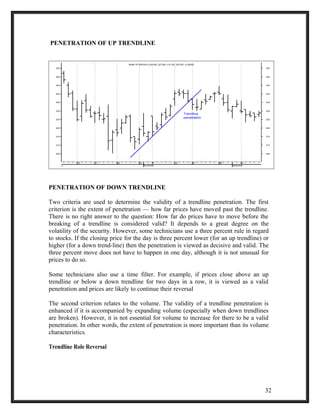
PENETRATION OF UP TRENDLINE 
255 
250 
245 
240 
235 
230 
225 
220 
215 
210 
3 
October 
BANK OF BARODA (224.000, 227.900, 219.150, 220.550, -6.20000) 
10 17 24 31 7 
November 
14 21 28 5 
December 
255 
250 
245 
240 
235 
230 
225 
220 
215 
210 
12 
205 
205 
Trendline 
penetration 
PENETRATION OF DOWN TRENDLINE 
Two criteria are used to determine the validity of a trendline penetration. The first 
criterion is the extent of penetration — how far prices have moved past the trendline. 
There is no right answer to the question: How far do prices have to move before the 
breaking of a trendline is considered valid? It depends to a great degree on the 
volatility of the security. However, some technicians use a three percent rule in regard 
to stocks. If the closing price for the day is three percent lower (for an up trendline) or 
higher (for a down trend-line) then the penetration is viewed as decisive and valid. The 
three percent move does not have to happen in one day, although it is not unusual for 
prices to do so. 
Some technicians also use a time filter. For example, if prices close above an up 
trendline or below a down trendline for two days in a row, it is viewed as a valid 
penetration and prices are likely to continue their reversal 
The second criterion relates to the volume. The validity of a trendline penetration is 
enhanced if it is accompanied by expanding volume (especially when down trendlines 
are broken). However, it is not essential for volume to increase for there to be a valid 
penetration. In other words, the extent of penetration is more important than its volume 
characteristics. 
Trendline Role Reversal 
32
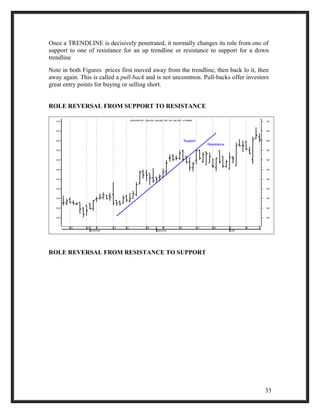
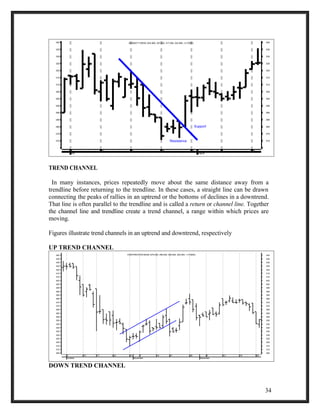
Once a TRENDLINE is decisively penetrated, it normally changes its role from one of 
support to one of resistance for an up trendline or resistance to support for a down 
trendline 
Note in both Figures prices first moved away from the trendline, then back lo it, then 
away again. This is called a pull-back and is not uncommon. Pull-backs offer investors 
great entry points for buying or selling short. 
ROLE REVERSAL FROM SUPPORT TO RESISTANCE 
170 
165 
160 
155 
150 
145 
140 
135 
130 
125 
17 24 31 7 
November 
14 21 28 5 
December 
12 19 26 22 
006 
9 16 
120 
170 
165 
160 
155 
150 
145 
140 
135 
130 
125 
120 
Support 
Resistance 
MPHASIS BFL (290.000, 295.850, 287.100, 290.300, +0.94998) 
ROLE REVERSAL FROM RESISTANCE TO SUPPORT 
33
3 July 
BHARAT FORGE (323.900, 327.000, 317.000, 322.950, +2.70001) 
10 17 24 31 
August 
7 14 
340 
335 
330 
325 
320 
315 
310 
305 
300 
295 
290 
285 
280 
275 
270 
340 
335 
330 
325 
320 
315 
310 
305 
300 
295 
290 
285 
280 
275 
270 
Support 
Resistance 
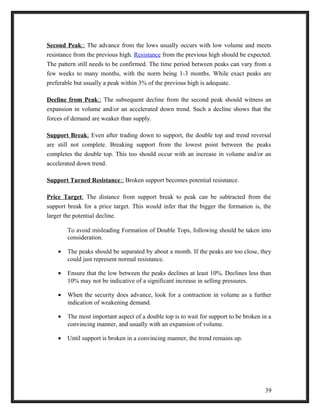
TREND CHANNEL 
In many instances, prices repeatedly move about the same distance away from a 
trendline before returning to the trendline. In these cases, a straight line can be drawn 
connecting the peaks of rallies in an uptrend or the bottoms of declines in a downtrend. 
That line is often parallel to the trendline and is called a return or channel line. Together 
the channel line and trendline create a trend channel, a range within which prices are 
moving. 
Figures illustrate trend channels in an uptrend and downtrend, respectively 
UP TREND CHANNEL 
440 
435 
430 
425 
420 
415 
410 
405 
400 
395 
390 
385 
380 
375 
370 
365 
360 
355 
350 
345 
340 
335 
330 
325 
320 
315 
310 
26 3 
October 
CORPORATION BANK (275.000, 298.500, 265.000, 292.000, +17.6000) 440 
10 17 24 31 7 
November 
14 21 28 5 
December 
12 19 26 
305 
435 
430 
425 
420 
415 
410 
405 
400 
395 
390 
385 
380 
375 
370 
365 
360 
355 
350 
345 
340 
335 
330 
325 
320 
315 
310 
305 
DOWN TREND CHANNEL 
34
1750 
1700 
1650 
1600 
1550 
1500 
1450 
1400 
1350 
12 19 26 3 July 
10 17 24 31 
August 
7 14 21 28 4 
September 
1300 
1750 
1700 
1650 
1600 
1550 
1500 
1450 
1400 
1350 
1300 
AVENTIS PHARMA (1,259.00, 1,275.00, 1,240.30, 1,258.40, -11.6000) 
Well defined trend channels appear most frequently in charts of actively traded securities. 
Thinly traded securities offer little opportunity for trend channels to develop. 
Trend channels can be used in many fashions. Novice technicians often use trend 
channels to determine good profit-taking levels. For example, in an uptrend, they will sell 
a stock when it reaches the upper level of its trend channel. 
More experienced technicians watch price movements within the two boundary lines of 
the trend channel looking for a warning signal that the trend direction is changing. If, in an 
upward trend channel, prices rally up from the trendline but fail to reach the upper channel 
line, it signals a deterioration of the trend and probability that the lower line will be 
broken. Frequently, the distance from the top of the failed rally to the channel line equals 
the distance by which the next move down penetrates the trendline. 
Similarly, in a downward trend channel, if prices drop from the trend-line but fail to reach 
the bottom channel line, it signals a deterioration of the trend and probability that the 
upper line will be broken. Likewise, the distance from the bottom of the failed attempt 
to reach the channel line to the channel line often is equal to the distance by which the 
next rally penetrates the trendline. 
Trend channels can be used in another way. If prices break through the upper line in an 
upward trend channel, an acceleration of the existing uptrend is signaled. At this point, 
some investors will buy additional positions. 
On the other hand, if prices move through the bottom line of a downward trend channel, 
the existing downtrend appears to be picking up pace. Short positions may be increased 
at this point. 
35
36
Chart Pattern Analysis 
Chart Patterns put all buying and selling into perspective by consolidating the forces of 
supply and demand into a concise picture. Chart patterns provide a framework to 
analyze the battle raging between bulls and bears. More importantly, chart patterns and 
technical analysis can help determine who is winning the battle (bear or bull) and allow 
traders and investors to position themselves accordingly. 
Chart patterns analysis can be used to make short term or long term forecasts. The data 
can be intraday, daily, weekly or monthly and the patterns can be as short as one day or 
as long as many years. 
There are generally two types of chart patterns 
1. Reversal Chart Patterns 
2. Continuation chart patterns. 
Reversal Patterns: 
 Double Top 
 Double Bottom 
 Head and Shoulders Top 
 Head and Shoulders Bottom 
 Falling Wedge 
 Rising Wedge 
 Rounding Bottom 
 Triple Top 
 Triple Bottom 
Continuation Patterns: 
 Flag, Pennant 
 Ascending Triangle 
 Descending Triangle 
 Rectangle 
 Price Channel 
37
Reversal Patterns: 
1. Double Top: 
The double top is a major reversal pattern that forms after an extended uptrend. As its 
name implies, the pattern is made up of two consecutive peaks that are roughly equal, 
with a moderate trough in-between. 
Although there can be variations, the classic double top pattern marks at least an 
intermediate change, if not long-term change, in trend from bullish to bearish. Many 
potential double tops can form along the way up, but until key support is broken, a 
reversal cannot be confirmed. 
Key Points in Formation of Double Top Reversal Pattern: 
Prior Trend : There must be an existing trend to reverse. A significant uptrend of 
several months should be in place. 
First Peak : The first peak should mark the highest point of the current trend. The first 
peak is fairly normal and the uptrend is not in question at this time. 
Trough : After the first peak, a decline takes place that typically ranges from 10 to 20%. 
Volume on the decline from the first peak is usually irrelevant. 
38
Second Peak :: The advance from the lows usually occurs with low volume and meets 
resistance from the previous high. Resistance from the previous high should be expected. 
The pattern still needs to be confirmed. The time period between peaks can vary from a 
few weeks to many months, with the norm being 1-3 months. While exact peaks are 
preferable but usually a peak within 3% of the previous high is adequate. 
Decline from Peak :: The subsequent decline from the second peak should witness an 
expansion in volume and/or an accelerated down trend. Such a decline shows that the 
forces of demand are weaker than supply. 
Support Break : Even after trading down to support, the double top and trend reversal 
are still not complete. Breaking support from the lowest point between the peaks 
completes the double top. This too should occur with an increase in volume and/or an 
accelerated down trend. 
Support Turned Resistance :: Broken support becomes potential resistance. 
Price Target : The distance from support break to peak can be subtracted from the 
support break for a price target. This would infer that the bigger the formation is, the 
larger the potential decline. 
To avoid misleading Formation of Double Tops, following should be taken into 
consideration. 
· The peaks should be separated by about a month. If the peaks are too close, they 
could just represent normal resistance. 
· Ensure that the low between the peaks declines at least 10%. Declines less than 
10% may not be indicative of a significant increase in selling pressures. 
· When the security does advance, look for a contraction in volume as a further 
indication of weakening demand. 
· The most important aspect of a double top is to wait for support to be broken in a 
convincing manner, and usually with an expansion of volume. 
· Until support is broken in a convincing manner, the trend remains up. 
39
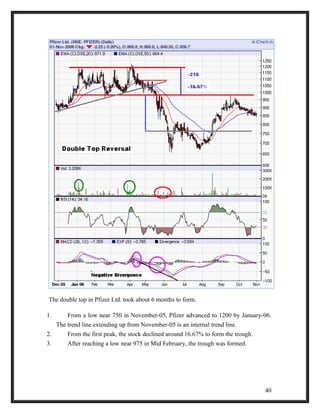
The double top in Pfizer Ltd. took about 6 months to form. 
1. From a low near 750 in November-05, Pfizer advanced to 1200 by January-06. 
The trend line extending up from November-05 is an internal trend line. 
2. From the first peak, the stock declined around 16.67% to form the trough. 
3. After reaching a low near 975 in Mid February, the trough was formed. 
40
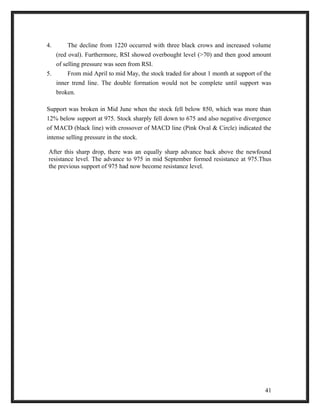
4. The decline from 1220 occurred with three black crows and increased volume 
(red oval). Furthermore, RSI showed overbought level (>70) and then good amount 
of selling pressure was seen from RSI. 
5. From mid April to mid May, the stock traded for about 1 month at support of the 
inner trend line. The double formation would not be complete until support was 
broken. 
Support was broken in Mid June when the stock fell below 850, which was more than 
12% below support at 975. Stock sharply fell down to 675 and also negative divergence 
of MACD (black line) with crossover of MACD line (Pink Oval & Circle) indicated the 
intense selling pressure in the stock. 
After this sharp drop, there was an equally sharp advance back above the newfound 
resistance level. The advance to 975 in mid September formed resistance at 975.Thus 
the previous support of 975 had now become resistance level. 
41
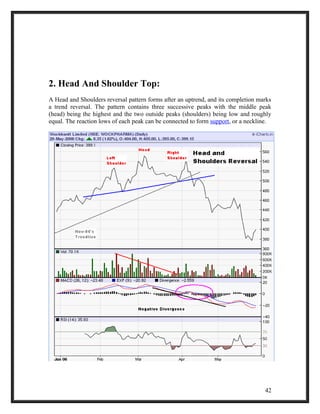
2. Head And Shoulder Top: 
A Head and Shoulders reversal pattern forms after an uptrend, and its completion marks 
a trend reversal. The pattern contains three successive peaks with the middle peak 
(head) being the highest and the two outside peaks (shoulders) being low and roughly 
equal. The reaction lows of each peak can be connected to form support, or a neckline. 
42
As its name implies, the Head and Shoulders reversal pattern is made up of a left 
shoulder, a head, a right shoulder, and a neckline. Other parts playing a role in the 
pattern are volume, the breakout, price target and support turned resistance. We will 
look at each part individually. 
Prior Trend : It is important to establish the existence of a prior uptrend for this to be a 
reversal pattern. 
Left Shoulder: While in an uptrend, the left shoulder forms a peak that marks the high 
point of the current trend. After making this peak, a decline ensures to complete the 
formation of the shoulder (1). The low of the decline usually remains above the trend 
line, keeping the uptrend intact. 
Head : From the low of the left shoulder, an advance begins that exceeds the previous 
high and marks the top of the head. After peaking, the low of the subsequent decline 
marks the second point of the neckline (2). The low of the decline usually breaks the 
uptrend line. 
Right Shoulder : The advance from the low of the head forms the right shoulder. This 
peak is lower than the head (a lower high) and usually in line with the high of the left 
shoulder. The decline from the peak of the right shoulder should break the neckline. 
Neckline : The neckline forms by connecting low points 1 and 2. Low point 1 marks the 
end of the left shoulder and the beginning of the head. Low point 2 marks the end of the 
head and the beginning of the right shoulder. Depending on the relationship between the 
two low points, the neckline can slope up, slope down or be horizontal. The slope of the 
neckline will affect the pattern's degree of bearishness: a downward slope is more bearish 
than an upward slope. Sometimes more than one low point can be used to form the 
neckline. 
Volume : As the Head and Shoulders pattern unfolds, volume plays an important role in 
confirmation. Volume can be measured as an indicator (OBV, Chaikin Money Flow) or 
simply by analyzing volume levels. Ideally, but not always, volume during the advance 
of the left shoulder should be higher than during the advance of the head. This decrease 
in volume and the new high of the head, together, serve as a warning sign. The next 
warning sign comes when volume increases on the decline from the peak of the head. 
43
Final confirmation comes when volume further increases during the decline of the right 
shoulder. 
Neckline Break : The head and shoulders pattern is not complete and the uptrend is not 
reversed until neckline support is broken. Ideally, this should also occur in a convincing 
manner, with an expansion in volume. 
Support Turned Resistance : Once support is broken, it is common for this same 
support level to turn into resistance. Sometimes, but certainly not always, the price will 
return to the support break, and offer a second chance to sell. 
Price Target : After breaking neckline support, the projected price decline is found by 
measuring the distance from the neckline to the top of the head. This distance is then 
subtracted from the neckline to reach a price target. Any price target should serve as a 
rough guide, and other factors should be considered as well. 
44
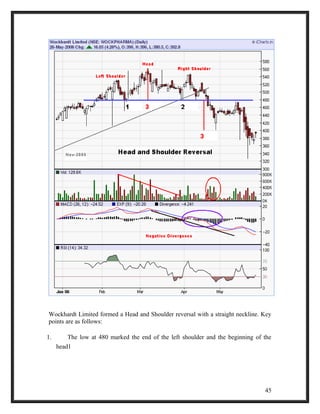
Wockhardt Limited formed a Head and Shoulder reversal with a straight neckline. Key 
points are as follows: 
1. The low at 480 marked the end of the left shoulder and the beginning of the 
head1 
45
2. During the advance to 560, volume was still high, but not as high as during the 
left shoulder advance. However, during the next advance to 545, volume tapered off 
significantly. 
3. Volume continued to decline until the breaking of the neckline. (Note red line on 
volume bars.) 
4. The decline from 560 to 480 formed the second low point (2). 
5. During the decline of the right shoulder and neckline break, volume expanded 
(red oval), and MACD formed negative divergence. 
6. After the initial decline, there was a return to the neckline break (black arrow). 
Even during this decline, MACD remained in negative divergence and RSI showed 
level of less than 30 i.e. stock was oversold. The subsequent decline took the stock 
below 360. 
7. The measurement from neckline to the top of the head was 80 (marked with red 
line and number-3). With the neckline break at 480, this would imply a move to 
around 400. The Mid May low was 400(long black candlestick). 
The head and shoulders pattern is one of the most common reversal formations. It is 
important to remember that it occurs after an uptrend and usually marks a major trend 
reversal when complete. While it is preferable that the left and right shoulders be 
symmetrical, it is not an absolute requirement. They can be different widths as well as 
different heights. 
Identification of neckline support and volume confirmation on the break can be the most 
critical factors. The support break indicates a new willingness to sell at lower prices. 
Lower prices combined with an increase in volume indicate an increase in supply. 
Measuring the expected length of the decline after the breakout can be helpful, but it may 
not be the exact target. 
3. Head And Shoulder Bottom: 
The Head and Shoulders bottom is also known as an Inverse Head and Shoulders. It 
relies more heavily on volume patterns for confirmation. 
46
The Head and Shoulders Bottom forms after a downtrend. The pattern contains three 
successive troughs with the middle trough (head) being the deepest and the two outside 
troughs (shoulders) being shallower. The two shoulders would be equal in height. The 
reaction highs in the middle of the pattern can be connected to form resistance, or a 
neckline. 
The price action forming both Head and Shoulders Top and Head and Shoulders Bottom 
patterns remains the same, but reversed. The difference between two of them is Volume. 
Volume plays a larger role in bottom formations than top formations. While an increase 
in volume on the neckline breakout for a Head and Shoulders Top is absolutely required 
for a bottom. 
Prior Trend: It is important to establish the existence of a prior downtrend for this to be 
a reversal pattern. Without a prior downtrend to reverse, there cannot be a Head and 
Shoulders Bottom formation. 
Left Shoulder: While in a downtrend, the left shoulder forms a trough that marks a new 
reaction low in the current trend. After forming this trough, an advance ensues to 
complete the formation of the left shoulder (1). 
Head : From the high of the left shoulder, a decline begins that exceeds the previous low 
and forms the low point of the head. After making a bottom, the high of the subsequent 
advance forms the second point of the neckline (2). 
Right Shoulder: The decline from the high of the head (neckline) begins to form the 
right shoulder. This low is always higher than the head, and it is usually in line with the 
low of the left shoulder. Sometimes the right shoulder will be higher, lower, wider, or 
narrower. When the advance from the low of the right shoulder breaks the neckline, the 
Head and Shoulders Bottom reversal is complete. 
Neckline : The neckline forms by connecting reaction highs 1 and 2. Reaction High 1 
marks the end of the left shoulder and the beginning of the head. Reaction High 2 marks 
the end of the head and the beginning of the right shoulder. The neckline can slope up, 
slope down, or be horizontal. An upward slope is more bullish than downward slope. 
Volume : Volume plays a crucial role in the Head and Shoulders Bottom. Without the 
proper expansion of volume, the validity of any breakout becomes suspect. 
47
Volume on the decline of the left shoulder is usually heavy and selling pressure quite 
intense. The intensity of selling can even continue during the decline that forms the low 
of the head. After this low, volume patterns should be watched carefully to look for 
expansion during the advances. 
The advance from the low of the head should show an increase in volume and/or better 
indicator readings, e.g., CMF > 0 or rise in OBV. With light volume on the pullback, 
indicators like CMF and OBV should remain strong. The most important moment for 
volume occurs on the advance from the low of the right shoulder. For a breakout to be 
considered valid, there needs to be an expansion of volume on the advance and during 
the breakout. 
1. Neckline Break : The Head and Shoulders Bottom pattern is not complete until 
neckline resistance is broken. A neckline break should occur with an expansion of 
volume. 
2. Resistance Turned Support : Once resistance is broken, same resistance level to 
turn into support. 
3. Price Target : After breaking neckline resistance, the projected advance is found 
by measuring the distance from the neckline to the bottom of the head. This distance 
is added to the neckline to reach a price target. 
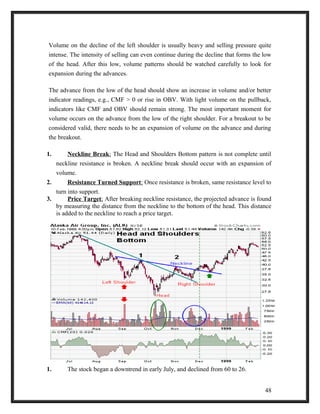
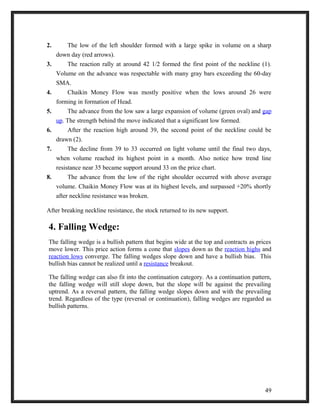
1. The stock began a downtrend in early July, and declined from 60 to 26. 
48
2. The low of the left shoulder formed with a large spike in volume on a sharp 
down day (red arrows). 
3. The reaction rally at around 42 1/2 formed the first point of the neckline (1). 
Volume on the advance was respectable with many gray bars exceeding the 60-day 
SMA. 
4. Chaikin Money Flow was mostly positive when the lows around 26 were 
forming in formation of Head. 
5. The advance from the low saw a large expansion of volume (green oval) and gap 
up. The strength behind the move indicated that a significant low formed. 
6. After the reaction high around 39, the second point of the neckline could be 
drawn (2). 
7. The decline from 39 to 33 occurred on light volume until the final two days, 
when volume reached its highest point in a month. Also notice how trend line 
resistance near 35 became support around 33 on the price chart. 
8. The advance from the low of the right shoulder occurred with above average 
volume. Chaikin Money Flow was at its highest levels, and surpassed +20% shortly 
after neckline resistance was broken. 
After breaking neckline resistance, the stock returned to its new support. 
4. Falling Wedge: 
The falling wedge is a bullish pattern that begins wide at the top and contracts as prices 
move lower. This price action forms a cone that slopes down as the reaction highs and 
reaction lows converge. The falling wedges slope down and have a bullish bias. This 
bullish bias cannot be realized until a resistance breakout. 
The falling wedge can also fit into the continuation category. As a continuation pattern, 
the falling wedge will still slope down, but the slope will be against the prevailing 
uptrend. As a reversal pattern, the falling wedge slopes down and with the prevailing 
trend. Regardless of the type (reversal or continuation), falling wedges are regarded as 
bullish patterns. 
49
Prior Trend: To qualify as a reversal pattern, there must be a prior trend to reverse. 
Ideally, the falling wedge will form after an extended downtrend and mark the final low. 
The pattern usually forms over a 3-6 month period and the preceding downtrend should 
be at least 3 months old. 
Upper Resistance Line: It takes at least two reaction highs to form the upper resistance 
line, ideally three. Each reaction high should be lower than the previous highs. 
Lower Support Line: At least two reaction lows are required to form the lower support 
line. Each reaction low should be lower than the previous lows. 
Contraction: The upper resistance line and lower support line converge to form a cone 
as the pattern matures. Shallower lows indicate a decrease in selling pressure and create a 
lower support line with less negative slope than the upper resistance line. 
50
Resistance Break: Bullish confirmation of the pattern does not come until the resistance 
line is broken. It is better to wait for a break above the previous reaction high for further 
confirmation. 
Volume : Volume is an essential ingredient to confirm a falling wedge breakout. 
Without an expansion of volume, the breakout will lack confirmation and it can lead to 
failure. 
When lower highs and lower lows form, as in a falling wedge, a security remains in a 
downtrend. The falling wedge is designed to indicate a decrease in downside momentum. 
Even though selling pressure may be diminishing, demand does not win out until 
resistance is broken. It is important to wait for a breakout and combine other aspects of 
technical analysis to confirm signals. 
51
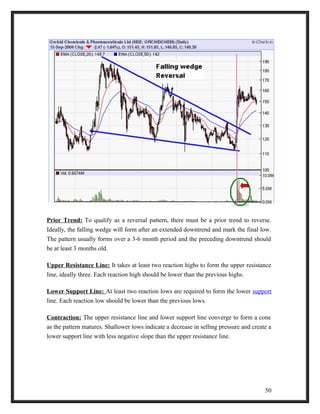
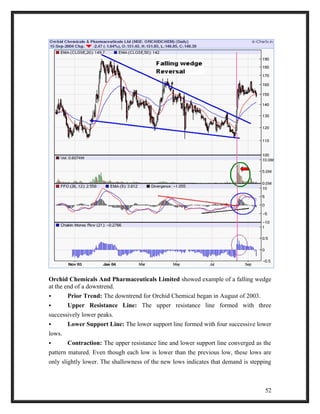
Orchid Chemicals And Pharmaceuticals Limited showed example of a falling wedge 
at the end of a downtrend. 
 Prior Trend: The downtrend for Orchid Chemical began in August of 2003. 
 Upper Resistance Line: The upper resistance line formed with three 
successively lower peaks. 
 Lower Support Line: The lower support line formed with four successive lower 
lows. 
 Contraction: The upper resistance line and lower support line converged as the 
pattern matured. Even though each low is lower than the previous low, these lows are 
only slightly lower. The shallowness of the new lows indicates that demand is stepping 
52
almost immediately after a new low is recorded. The slope of the upper resistance line is 
more negative than the lower support line. 
 Resistance Break: In contrast to the two previous lows, the mid July-2004 low 
was flat and consolidated just between 110 and 125 for a week. The subsequent 
breakout (pink vertical line) in Mid August occurred with a series of strong advances. In 
addition, there was a positive divergence in the PPO (Black Line) and also a crossover 
of PPO line (Blue Circle) 
 Volume: In Mid Deccember-2003, there is a good amount of volume at the start 
of formation of the pattern. But gradually it decreased. Average volume was there 
during these five months of pattern. In Mid August-2004 volume expanded (green circle 
and red arrow) significantly and the stock broke trend line resistance. Chaikin Money 
flows confirmed the strength by surpassing their positive increment and also Moving 
averages crossover confirmed the breakout of resistance level. 
After the trend line breakout, the stock advanced significantly and then it consolidated 
for about a week. 
53
5. Rising Wedge: 
The rising wedge is a bearish pattern that begins wide at the bottom and contracts as 
prices move higher and the trading range narrows. The rising wedges definitely slope up 
and have a bearish bias. 
The pattern can also fit into the continuation category. As a continuation pattern, the 
rising wedge will still slope up, but the slope will be against the prevailing downtrend. 
As a reversal pattern, the rising wedge will slope up and with the prevailing trend. 
Regardless of the type (reversal or continuation), rising wedges are bearish. 
Key Points to be considered: 
Prior Trend: In order to qualify as a reversal pattern, there must be a prior trend to 
reverse. The rising wedge usually forms over a 3-6 month period and can mark an 
intermediate or long-term trend reversal. Sometimes the current trend is totally 
contained within the rising wedge; other times the pattern will form after an extended 
advance. 
Upper Resistance Line: It takes at least two reaction highs to form the upper resistance 
line, ideally three. Each reaction high should be higher than the previous high. 
Lower Support Line: At least two reaction lows are required to form the lower support 
line. Each reaction low should be higher than the previous low. 
Contraction: The upper resistance line and lower support line converge as the pattern 
matures. The advances from the reaction lows (lower support line) become shorter and 
shorter, which makes the rallies unconvincing. This creates an upper resistance line that 
fails to keep pace with the slope of the lower support line and indicates a supply 
deceases as prices increase. 
Support Break: Bearish confirmation of the pattern does not come until the support 
line is broken in a convincing fashion. It is sometimes prudent to wait for a break of the 
previous reaction low. 
Volume: Ideally, volume will decline as prices rise and the wedge evolves. An 
expansion of volume on the support line break can taken as bearish confirmation. 
54
While the rising wedge is a consolidation formation, the loss of upside momentum on 
each successive high gives the pattern its bearish bias. However, the series of higher 
highs and higher lows keeps the trend bullish. The final break of support indicates that 
the forces of supply have finally won out and prices will be lower. There are no 
measuring techniques to estimate the decline – other aspects of technical analysis should 
be employed to forecast price targets. 
55
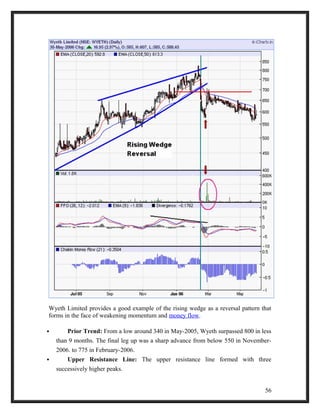
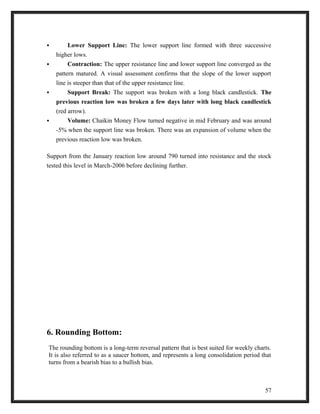
Wyeth Limited provides a good example of the rising wedge as a reversal pattern that 
forms in the face of weakening momentum and money flow. 
 Prior Trend: From a low around 340 in May-2005, Wyeth surpassed 800 in less 
than 9 months. The final leg up was a sharp advance from below 550 in November- 
2006. to 775 in February-2006. 
 Upper Resistance Line: The upper resistance line formed with three 
successively higher peaks. 
56
 Lower Support Line: The lower support line formed with three successive 
higher lows. 
 Contraction: The upper resistance line and lower support line converged as the 
pattern matured. A visual assessment confirms that the slope of the lower support 
line is steeper than that of the upper resistance line. 
 Support Break: The support was broken with a long black candlestick. The 
previous reaction low was broken a few days later with long black candlestick 
(red arrow). 
 Volume: Chaikin Money Flow turned negative in mid February and was around 
-5% when the support line was broken. There was an expansion of volume when the 
previous reaction low was broken. 
Support from the January reaction low around 790 turned into resistance and the stock 
tested this level in March-2006 before declining further. 
6. Rounding Bottom: 
The rounding bottom is a long-term reversal pattern that is best suited for weekly charts. 
It is also referred to as a saucer bottom, and represents a long consolidation period that 
turns from a bearish bias to a bullish bias. 
57
Prior Trend: In order to be a reversal pattern, there must be a prior trend to reverse. 
Ideally, the low of a rounding bottom will mark a new low or reaction low. In practice, 
there are occasions when the low is recorded many months earlier and the security trades 
flat before forming the pattern. When the rounding bottom does finally form, its low may 
not be the lowest low of the last few months. 
Decline: The first portion of the rounding bottom is the decline that leads to the low of 
the pattern. This decline can take on different forms: some are quite jagged with a 
number of reaction highs and lows, while others trade lower in different manner. 
Low: The low of the rounding bottom can resemble a "V' bottom, but should not be too 
sharp and should take a few weeks to form. Because prices are in a long-term decline, 
the possibility of a selling climax exists that could create a lower spike. 
58
Advance: The advance off of the lows forms the right half of the pattern and should take 
about the same amount of time as the prior decline. If the advance is too sharp, then the 
validity of a rounding bottom may be in question. 
Breakout: Bullish confirmation comes when the pattern breaks above the reaction high 
that marked the beginning of the decline at the start of the pattern. As with most 
resistance breakouts, this level can become support. 
Volume: In an ideal pattern, volume levels will track the shape of the rounding bottom: 
high at the beginning of the decline, low at the end of the decline and rising during the 
advance. Volume levels are not too important on the decline, but there should be an 
increase in volume on the advance and preferably on the breakout. 
A rounding bottom could be thought of as a head and shoulders bottom without readily 
identifiable shoulders. The head represents the low and is fairly central to the pattern. 
The volume patterns are similar and confirmation comes with a resistance breakout. 
While symmetry is preferable on the rounding bottom, the left and right side do not have 
to be equal in time or slope. 
59
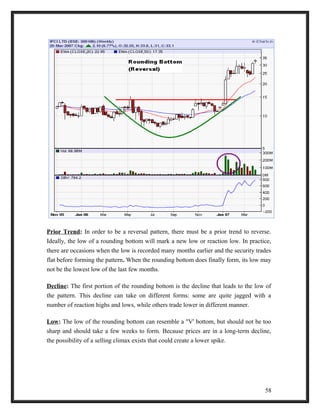
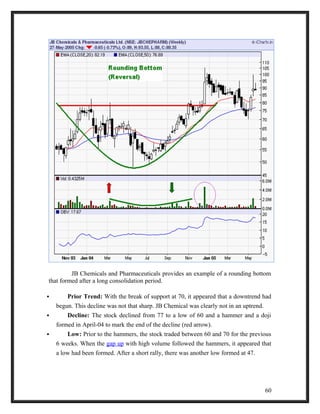
JB Chemicals and Pharmaceuticals provides an example of a rounding bottom 
that formed after a long consolidation period. 
 Prior Trend: With the break of support at 70, it appeared that a downtrend had 
begun. This decline was not that sharp. JB Chemical was clearly not in an uptrend. 
 Decline: The stock declined from 77 to a low of 60 and a hammer and a doji 
formed in April-04 to mark the end of the decline (red arrow). 
 Low: Prior to the hammers, the stock traded between 60 and 70 for the previous 
6 weeks. When the gap up with high volume followed the hammers, it appeared that 
a low had been formed. After a short rally, there was another low formed at 47. 
60
 Advance: From the low at 47, the advance began in earnest and volume started 
to increase. In Mid September and October, there was an advance with the highest 
volume in 4 months (green arrow). 
January-2004 resistance at 77 represented the confirmation line for the pattern. The stock 
broke resistance in December-2005 with a further expansion of volume. This breakout 
was also confirmed with a new high in OBV. 
After breaking resistance, the stock fell to 77 again and thus resistance confirmed into 
support. The stock had advanced from 50 to 77 in 7 months and some sort of pullback 
could have been expected. 
61
7. Triple Top: 
The triple top is a reversal pattern made up of three equal highs followed by a break 
below support. The triple tops usually form over a shorter time frame and typically 
range from 3 to 6 months. The bottoms take longer to form than tops. We will first 
examine the individual parts of the pattern and then look at an example. 
Prior Trend: With any reversal pattern, there should be an existing trend to reverse. In 
the case of the triple top, an uptrend or long trading range should be in place. Sometimes 
there will be a definitive uptrend to reverse. 
Three Highs: All three highs should be reasonable equal, well spaced and mark 
significant turning points. The highs do not have to be exactly equal, but should be 
reasonably equivalent to each other. 
Volume: As the triple top develops, overall volume levels usually decline. Volume 
sometimes increases near the highs. After the third high, an expansion of volume on the 
subsequent decline and at the support break greatly reinforces the soundness of the 
pattern. 
62
Support Break: As with many other reversal patterns, the triple top is not complete until 
a support break. The lowest point of the formation, which would be the lowest of the 
lows of pattern, marks this key support level. 
Support Turns Resistance: Broken support becomes potential resistance, and there is 
sometimes a test of this newfound resistance level with a subsequent reaction rally. 
Price Target: The distance from the support break to highs can be measured and 
subtracted from the support break for a price target. 
Before the third high forms, the pattern may look like a double top. Three equal highs 
can also be found in an ascending triangle or rectangle. Of these patterns mentioned, 
only the ascending triangle has bullish overtones; the others are neutral until a break 
occurs. The triple top should also be treated as a neutral pattern until a breakout occurs. 
If there is a sharp increase in volume and momentum, then the chances of a support 
break increase. 
63
It can be difficult to find a triple top with three highs that are exactly equal. The spirit is 
three attempts at resistance, followed by a breakdown below support, with volume 
confirmation. 
Punjab National Bank (PNB) illustrates an example of a triple top that does not fit 
exactly, but captures the spirit of the pattern. 
 The stock was in an uptrend and remained above the trend line extending up 
from Dec-04 until the break in late April-2006. 
 Over a period of about 5 months, the stock bounced off resistance around 495. 
The first attempt happened in January, the second in April and the third in May. 
 The decline from the second and third high broke trend line support and the 
stock continued to fall past support from the previous lows. Triple top support should 
be drawn from the lowest low of the pattern, which would be April end low around 
405. 
 Volume expanded after the stock broke trend line support. The stock paused for 
a few days when support at 405 was reached, but volume accelerated when this 
support level was broken in second week of June (Brown vertical line). In addition, 
the Chaikin Money Flow turned negative and broke below -20%. 
 After the support break, the support turned into resistance few weeks later. 
Money flows continued to indicate selling pressure and volume expanded when the 
stock began to fall again. 
The projected decline was 90 points, from 405 down to 315, and the stock reached this 
target in few days after it broke its support. 
64
8. Triple Bottom: 
The triple bottom is a reversal pattern made up of three equal lows followed by a 
breakout above resistance. While this pattern can form over just a few months, it is 
usually a long-term pattern that covers many months. Because of its long-term nature, 
weekly charts can be best suited for analysis. 
Prior Trend: With any reversal pattern, there should be an existing trend to reverse. For 
the triple bottom, a downtrend or long trading range should be in place. Sometimes there 
will be a definitive downtrend to reverse. 
Three Lows: All three lows should be reasonable equal, well spaced and mark 
significant turning points. The lows do not have to be exactly equal, but should be 
reasonably equivalent. 
65
Volume: As the triple bottom develops, overall volume levels usually decline. Volume 
sometimes increases near the lows. After the third low, an expansion of volume on the 
advance and at the resistance breakout greatly reinforces the soundness of the pattern. 
Resistance Break: As with many other reversal patterns, the triple bottom is not 
complete until a resistance breakout. The highest point of the formation, which would be 
the highest of the intermittent highs, marks resistance. 
Resistance Turns Support: Broken resistance becomes potential support. Because the 
triple bottom is a long-term pattern, the test of newfound support may occur many 
months later. 
Price Target: The distance from the resistance breakout to lows can be measured and 
added to the resistance break for a price target. The longer the pattern develops, the more 
significant is the ultimate breakout. Triple bottoms that are 6 or more months in duration 
represent major bottoms and a price target is less likely to be effective. 
As the triple bottom develops, it can start to resemble a number of patterns. Before the 
third low forms, the pattern may look like a double bottom. Three equal lows can also be 
found in a descending triangle or rectangle. Of these patterns mentioned, only the 
descending triangle has bearish overtones; the others are neutral until a breakout occurs. 
Similarly, the triple bottom should also be treated as a neutral pattern until a breakout 
occurs. If there is a sharp increase in volume and momentum, then the chances of a 
breakout increase. 
66
After a failed double bottom breakout, Arvind Mills formed a large triple bottom. 
 Over a 6-month timeframe, three relatively equal lows formed in end of August- 
2003, Mid-September-03 and Nov-03. When the October-03 high surpassed the 
September-03 high, the possibility of a rectangle pattern was ruled out. 
 Resistance at 56.5 was broken in end of November-03. The stock closed above 
this key level for 6 consecutive weeks to confirm the breakout. 
 The advance from the third low saw a dramatic expansion of volume that lasted 
many weeks (red circle). MACD Line formed a positive divergence in November-03 
and broke to new highs with the stock in December end. And also CMF turned 
positive from negative. 
 After the resistance break, the stock was traded around 60 for some days. A new 
support level was established at 60. The price target after breakout from the support 
level will be around 70 which was achieved in the end of December month. 
67
Continuation Patterns: 
1. Pennant/Flag Pattern: 
Flags and Pennants are short-term continuation patterns that mark a small consolidation 
before the previous move resumes. These patterns are usually preceded by a sharp 
advance or decline with heavy volume, and mark a mid-point of the move. 
Sharp Move: To be considered a continuation pattern, there should be evidence of a 
prior trend. Flags and pennants require evidence of a sharp advance or decline on heavy 
volume. These moves usually occur on heavy volume and can contain gaps. This move 
usually represents the first leg of a significant advance or decline and the flag/pennant is 
merely a pause. 
Flagpole: The flagpole is the distance from the first resistance or support break to the 
high or low of the flag/pennant. The sharp advance (or decline) that forms the 
flagpole should break a trend line or resistance/support level. A line extending up 
from this break to the high of the flag/pennant forms the flagpole. 
Flag: A flag is a small rectangle pattern that slopes against the previous trend. If the 
previous move was up, then the flag would slope down. If the move was down, then 
the flag would slope up. Because flags are usually too short in duration to actually 
68
have reaction highs and lows, the price action just needs to be contained within two 
parallel trend lines. 
Pennant: A pennant is a small symmetrical triangle that begins wide and converges as 
the pattern matures (like a cone). The slope is usually neutral. Sometimes there will not 
be specific reaction highs and lows from which to draw the trend lines and the price 
action should just be contained within the converging trend lines. 
Duration: Flags and pennants are short-term patterns that can last from 1 to 12 weeks. 
There is some debate on the timeframe and some consider 8 weeks to be pushing the 
limits for a reliable pattern. 
These patterns will form between 1 and 4 weeks. Once a flag becomes more than 12 
weeks old, it would be classified as a rectangle. A pennant more than 12 weeks old 
would turn into a symmetrical triangle. The reliability of patterns that fall between 8 and 
12 weeks is debatable. 
1. Break: For a bullish flag or pennant, a break above resistance signals that the 
previous advance has resumed. For a bearish flag or pennant, a break below support 
signals that the previous decline has resumed. 
2. Volume : Volume should be heavy during the advance or decline that forms the 
flagpole. Heavy volume provides legitimacy for the sudden and sharp move that 
creates the flagpole. An expansion of volume on the resistance (support) break lends 
credence to the validity of the formation and the likelihood of continuation. 
3. Targets: The length of the flagpole can be applied to the resistance break or 
support break of the flag/pennant to estimate the advance or decline. 
It is important that flags and pennants are preceded by a sharp advance or decline. 
Without a sharp move, the reliability of the formation becomes questionable and trading 
could carry added risk. Look for volume confirmation on the initial move and 
consolidation of the pattern. 
69
The above chart of NELCO Limited showed pattern of “Flag” formation. 
 Sharp Move : After consolidating for two months, NELCO Limited broke above 
resistance at 96 to begin further advance. The 12-November high and trend line 
marked resistance and the breakout occurred with a volume expansion. The stock 
advanced from 96 to 125 in a mere 4 weeks. 
 Flagpole : The distance from the breakout at 96 to the flag's high at 125 formed 
the flagpole. 
 Flag : Price action was contained within two parallel trend lines that sloped 
down. 
 Duration : From a high at 125 to the breakout at 112, the flag formed over a 29- 
day period. 
 Breakout: The first break above the flag's upper trend line occurred on 3- 
February with an expansion of volume. However, the stock formed long white 
candlesticks two days later and closed strong with above-average volume (red circle) 
 Volume : Volume expanded on the advance to form the flagpole, contracted 
during the flag's formation and expanded right after the resistance breakout. 
 Targets: The length of the flagpole measured 29 points and was applied to the 
resistance breakout at 113 to project a target of 127. Then another resistance level 
was formed at higher level. 
70
2. Symmetrical Triangle: 
The Symmetrical triangle, which can also be referred to as a coil, usually forms during a 
trend as a continuation pattern. The pattern contains at least two lower highs and two 
higher lows. When these points are connected, the lines converge as they are extended 
and the symmetrical triangle takes shape. You could also think of it as a contracting 
wedge, wide at the beginning and narrowing over time. 
Regardless of the nature of the pattern, continuation or reversal, the direction of the next 
major move can only be determined after a valid breakout. I will examine each part of 
the symmetrical triangle individually, and then provide an example of IFCI. 
Trend : In order to qualify as a continuation pattern, an established trend should exist. 
The trend should be at least a few months old. 
Four (4) Points: At least 2 points are required to form a trend line and 2 trend lines are 
required to form a symmetrical triangle. Therefore, a minimum of 4 points are required 
to begin considering a formation as a symmetrical triangle. The second high (2) should 
be lower than the first (1) and the upper line should slope down. The second low (2) 
should be higher than the first (1) and the lower line should slope up. Ideally, the pattern 
will form with 6 points (3 on each side) before a breakout occurs. 
Volume: As the symmetrical triangle extends and the trading range contracts, volume 
should start to diminish. This refers to the tightening consolidation before the breakout. 
Duration: The symmetrical triangle can extend for a few weeks or many months. If the 
pattern is less than 3 weeks, it is usually considered a pennant. Typically, the time 
duration is about 3 months. 
Breakout Time Frame: The ideal breakout point occurs 1/2 to 3/4 of the way through 
the pattern's development or time-span. The time-span of the pattern can be measured 
from the apex (convergence of upper and lower lines) back to the beginning of the lower 
trend line (base). 
Breakout Direction: The future direction of the breakout can only be determined after 
the break has occurred. The attempt of guessing the direction of the breakout can be 
dangerous. Even though a continuation pattern is supposed to breakout in the direction of 
the long-term trend, this is not always true. 
71
Breakout Confirmation: For a break to be considered valid, it should be on a closing 
basis. Some traders apply a price (3% break) or time (sustained for 3 days) filter to 
confirm validity. The breakout should occur with an expansion in volume, especially on 
upside breakouts. 
Return to Apex: After the breakout (up or down), the apex can turn into future support 
or resistance. The price sometimes returns to the apex or a support/resistance level 
around the breakout before continuing in the direction of the breakout. 
Price Target: There are two methods to estimate the extent of the move after the 
breakout. First, the widest distance of the symmetrical triangle can be measured and 
applied to the breakout point. Second, a trend line can be drawn parallel to the pattern's 
trend line that slopes (up or down) in the direction of the break. The extension of this line 
will mark a potential breakout target. 
One Technical Analyst sad that roughly 75% of symmetrical triangles are continuation 
patterns and the rest mark reversals. The reversal patterns can be especially difficult to 
analyze and often have false breakouts. I should not anticipate the direction of the 
breakout, but rather wait for it to happen. Confirmation is especially important for upside 
breakouts. 
Potential reward price targets found by measurement and parallel trend line extension are 
only meant to act as rough guidelines. Technical analysis is dynamic and ongoing 
assessment is required. 
72
IFCI formed a rather large symmetrical triangle over a 5-month period before breaking 
out on the downside. 
1. The stock advance from 8 in December-03 to 12 in April-04 before beginning to 
firm and consolidate. The long-term trend in IFCI was up and established for almost 
a year. 
2. After the first 6 points formed, the lines of the symmetrical triangle were draw. 
The stock traded within the boundaries for another 1 month to form the last 2 points. 
3. After the gap up from point 4 to point 5, volume slowed over the next few 
months. There was some increase in volume in late June, but the average volume was 
in a downtrend as the pattern took shape. 
4. After points 6 and 7 formed, the price action moved to the lower boundary of the 
pattern. At this point, the direction of the breakout was look like down trend. The 
break occurred with an increase in volume and accelerated price decline. Chaikin 
Money Flow declined past -20% and RSI was below 30 levels (oversold level) and 
then they are positive and volume was also expanded. 
5. After the increment from 9 ½ to 12 and stock again fell down to 10 but it did not 
sustain. It moved up to resistance level. 
73
6. The widest point on the pattern was estimated 3 points. With a break support at 9 
½, the measured increment was estimated to around 12 ½. By drawing a trend line 
parallel to the lower boundary of the pattern, the extension estimates an increment to 
around 13 to 14. 
74
3. Ascending Triangle: 
The ascending triangle is a bullish formation that usually forms during an uptrend as a 
continuation pattern. Regardless of where these patterns form, ascending triangles are 
bullish patterns that indicate accumulation. 
Because of its shape, the pattern can also be referred to as a right-angle triangle. Two or 
more equal highs form a horizontal line at the top. Two or more rising troughs form an 
ascending trend line that converges on the horizontal line as it rises. If both lines were 
extended right, the ascending trend line could act as the hypotenuse of a right triangle. If 
a perpendicular line were drawn extending down from the left end of the horizontal line, 
a right triangle would form. 
Trend: In order to qualify as a continuation pattern, an established trend should exist. 
However, because the ascending triangle is a bullish pattern, the length and duration of 
the current trend is not as important as the robustness of the formation, which is more 
important. 
75
Top Horizontal Line: At least 2 reaction highs are required to form the top horizontal 
line. The highs do not have to be exact, but they should be within reasonable proximity 
of each other. There should be some distance between the highs, and a reaction low 
between them. 
Lower Ascending Trend Line: At least two reaction lows are required to form the 
lower ascending trend line. These reaction lows should be successively higher, and there 
should be some distance between the lows. If a more recent reaction low is equal to or 
less than the previous reaction low, then the ascending triangle is not valid. 
Duration: The length of the pattern can range from a few weeks to many months with 
the average pattern lasting from 1-3 months. 
Volume: When the upside breakout occurs, there should be an expansion of volume to 
confirm the breakout. While volume confirmation is preferred, it is not always necessary. 
Return to Breakout: When the horizontal resistance line of the ascending triangle is 
broken, it turns into support. Sometimes there will be a return to this support level before 
stock move further. 
Target: Once the breakout has occurred, the price projection is found by measuring the 
widest distance of the pattern and applying it to the resistance breakout. 
An ascending triangle has a definitive bullish bias before the actual breakout. In the 
ascending triangle, the horizontal line represents overhead supply that prevents the 
security from moving past a certain level. It is as if a large sell order has been placed at 
this level and it is taking a number of weeks or months to execute, thus preventing the 
price from rising further. It is these higher lows that indicate increased buying pressure 
and give the ascending triangle its bullish bias. 
76
Praj Industries Limited formed an ascending triangle over a 5-month period before 
breaking resistance with an expansion of volume. 
 From a low of 110 in January-2006, the stock established an uptrend by forming 
a higher low at 118 and advancing to a new reaction high early March. (The 
beginning of the trend is not included on this chart.) After a few months, the stock 
met resistance at 190. 
 In June and august, the stock hit resistance at 170 twice. The stock bounced off 
190 three times in 5 months to form the horizontal resistance line. It was as if 
portions of a large block were being sold each time the stock neared 190. 
 The reaction lows were progressively higher, and formed an ascending trend 
line. The first low in Mid-June, 2006, occurred with a large spike down to 125. The 
ascending trend line could have been drawn to start at 125. The important thing is 
that there are at least two distinct reaction lows that are consecutively higher. 
77
 The duration of the pattern is around 5 months, which may seem a bit long. 
However, all the key ingredients for a robust pattern were in place. 
 Volume declined from late May until early October. There was a huge expansion 
when the stock was up from 160 (point 6) to 192 on four-five heavy trading days in 
October. In keeping with the ideal pattern, the next expansion of volume occurred in 
early January when the stock broke resistance at 255. The stock traded at above 
average. Chaikin Money Flow dragged a bit, but recovered to +20% five days after 
the breakout of newfound resistance level. 
 The stock advanced to 250 and then to 375. CMF at this level were found to be 
strongly positive which showed strength of the stock. 
The initial advance was projected to be 65 (190-125 = 65) points from the breakout at 
190, making a target of 255. This target was reached within 4 months. 
78
4. Descending Triangle: 
The descending triangle is a bearish formation that usually forms during a downtrend as 
a continuation pattern. Regardless of where this pattern forms, descending triangles are 
bearish patterns that indicate distribution. 
Because of its shape, the pattern can also be referred to as a right-angle 
triangle. Two or more comparable lows form a horizontal line at the bottom. Two 
or more declining peaks form a descending trend line above that converges with the 
horizontal line as it descends. If both lines were extended right, the descending trend 
line could act as the hypotenuse of a right triangle. If a perpendicular line were drawn 
extending up from the left end of the horizontal line, a right triangle would form. 
Trend: In order to qualify as a continuation pattern, an established trend should exist. 
The descending triangle is definitely a bearish pattern, the length and duration of the 
current trend is not as important. The robustness of the formation is more important. 
Lower Horizontal Line: At least 2 reaction lows are required to form the lower 
horizontal line. The lows do not have to be exact, but should be within reasonable 
proximity of each other. There should be some distance separating the lows and a 
reaction high between them. 
79
Upper Descending Trend Line: At least two reaction highs are required to form the 
upper descending trend line. These reaction highs should be successively lower and there 
should be some distance between the highs. If a more recent reaction high is equal to or 
greater than the previous reaction high, then the descending triangle is not valid. 
Duration: The length of the pattern can range from a few weeks to many months, with 
the average pattern lasting from 1-3 months. 
Volume: As the pattern develops, volume usually contracts. When the downside break 
occurs, there would ideally be an expansion of volume for confirmation. While volume 
confirmation is preferred, it is not always necessary. 
Return to Breakout: When the horizontal support line of the descending triangle is 
broken, it turns into resistance. Sometimes there will be a return to this newfound 
resistance level before the price moves further. 
Target: Once the breakout has occurred, the price projection is found by measuring the 
widest distance of the pattern and subtracting it from the resistance breakout. 
A descending triangle has a definite bearish bias before the actual break. For the 
descending triangle, the horizontal line represents demand that prevents the security from 
declining past a certain level. It is as if a large buy order has been placed at this level and 
it is taking a number of weeks or months to execute, thus preventing the price from 
declining further. Even though the price does not decline past this level, the reaction 
highs continue to decline. It is these lower highs that indicate increased selling pressure 
and give the descending triangle its bearish bias. 
80
After recording a lower high just below 265 in May-06, Sakhti Sugar Limited formed a 
descending triangle in May-end in 2006. In late August, the stock broke support with a 
long black candlestick and increase in volume to complete the formation. 
 The stock declined from above 260 to the low 100s before finding some support 
and mounting a reaction rally. The rally started just below 200 and a series of lower 
reaction highs began to form. The long-term trend was down and the resulting pattern 
was classified as continuation. 
 Support at 137 0r 138 was first established with a bounce in June. After that, the 
stock touched this level two more times before breaking down. After the second 
touch in July end (about a month later), the lower support line was drawn. 
81
 After each bounce off support, a lower high formed. The reaction highs at points 
1, 3 and 5 formed the descending trend line to mark the possible descending triangle 
pattern. 
 The duration of the pattern was approximately 4 months. 
 The last touch of support at 138 occurred in late August. The stock spiked down 
through support, but managed to close above this key level. The final break occurred 
a few days later with a considerable black candlestick and an expansion in volume. 
The way support is broken can offer insight into the general weakness of a security. 
Volume jumped to the second highest level in many months and money flows broke 
below -25%. 
 After falling from 140 to 130, the stock mounted a feeble reaction rally that only 
lasted fifteen-twenty days and new resistance level was confirmed. 
The initial decline was projected to be 70 points (208-138 = 70). If this is subtracted 
from the support break at 138, the downside projection is to around 68. And in 
February-2007 this target was achieved and stock fell up to 60. 
82
5. Rectangle: 
A Rectangle is a continuation pattern that forms as a trading range during a pause in the 
trend. The pattern is easily identifiable by two comparable highs and two comparable 
lows. The highs and lows can be connected to form two parallel lines that make up the 
top and bottom of a rectangle. Rectangles are sometimes referred to as trading ranges, 
consolidation zones or congestion areas. 
Trend: To qualify as a continuation pattern, a prior trend should exist. Ideally, the trend 
should be a few months old and not too mature. The more mature the trend, the less 
chance that the pattern marks a continuation. 
Four (4) Points: At least two equivalent reaction highs are required to form the upper 
resistance line and two equivalent reaction lows to form the lower support line. They do 
not have to be exactly equal, but should be within a reasonable proximity. Although not a 
prerequisite, it is preferable that the highs and lows alternate. 
Volume: Rectangles do not exhibit standard volume patterns. Sometimes volume will 
decline as the pattern develops. Other times volume will increase as the prices bounce 
between support and resistance. If volume declines, it is best to look for an expansion on 
83
the breakout for confirmation. Volume assessment can indicate the direction of the future 
breakout. 
Duration: Rectangles can extend for a few weeks or many months. If the pattern is less 
than 3 weeks, it is usually considered a flag, also a continuation pattern. Ideally, 
rectangles will develop over a 3-month period. Generally, the longer the pattern, the 
more significant the breakout. A 3-month pattern might be expected to fulfill its breakout 
projection. However, a 6-month pattern might be expected to exceed its breakout target. 
Breakout Direction: The direction of the next significant move can only be determined 
after the breakout has occurred. Rectangles are neutral patterns that are dependent on the 
direction of the future breakout. Volume patterns can give some clues. But there is no 
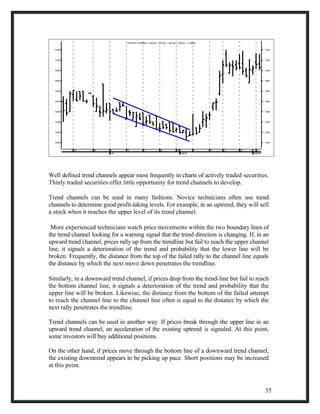
confirmation until an actual break above resistance or break below support. 
Breakout Confirmation: For a breakout to be considered valid, it should be on a closing 
basis. Some traders apply a filter to price (3%), time (3 days) or volume (expansion) for 
confirmation. 
Return to Breakout: After a break above resistance (below support), there is sometimes 
a return to test this newfound support level (resistance level). 
Target: The estimated move is found by measuring the height of the rectangle and 
applying it to the breakout. 
In rectangles as the price nears support, buyers step in and push the price higher. As the 
price nears resistance, bears take over and force the price lower. It is important to 
remember that rectangles have a neutral bias. It will not be clear until price forms 
breakout. 
84
Mastek Ltd. formed rectangle pattern in primary down trend. After meeting resistance 
around 370, the stock settled in a trading range between 340 and 370 to form a 
rectangle. 
 The prior intermediate trend was established as bearish. However, it was unclear 
at the time if this trading range would be a reversal or a continuation pattern. The 
horizontal resistance line at 370 can be extended back to the June, July-06 high and 
marked a serious resistance level. 
 The red resistance line at 370 was formed with three reaction highs. The first 
reaction high may be a bit suspect, but the second two are robust. The parallel 
support line at 340 was touched four times and established a solid support level. 
After the high at point 5 was reached, the rectangle was valid. 
 As the pattern developed, volume fluctuated and there was no clear indication 
(bullish or bearish break) until October. The first bearish clue came when the stock 
declined from 370 to 340 and Chaikin Money Flow was more than -20% (from pt 1 
to 2) and second clue comes when stock fell from 370 to 340 (from pt. 5 to 6) and 
CMF formed a straight negative divergence (red line). By the time the stock reached 
320 (surpassing its previous reaction low in the process), CMF was > -20%. 
85
 The duration of the pattern was 3 months. 
 The breakout occurred with a large expansion (more than its average) in volume 
and a huge move below its support level. 
 After the breakdown, there was a small rally at 330, but the volume behind the 
advance was not enough for breakout. 
The target advance of this breakout was 30 points, which was the width of the pattern. 
From its support level at 340 target was 310 which was achieved in Mid-December- 
2006.At that level new support was formed and sock moved up with some long 
candlesticks and formed rally. Stock broke its resistance of 340 in late December. 
86
6. Price Channel: 
A price channel is a continuation pattern that slopes up or down and is bound by an 
upper and lower trend line. The upper trend line marks resistance and the lower trend 
line marks support. Price channels with negative slopes (down) are considered bearish 
and those with positive slopes (up) bullish. A "bullish price channel" will refer to a 
channel with positive slope and a "bearish price channel" to a channel with negative 
slope. 
Main Trend Line: It takes at least two points to draw the main trend line. This line 
gives the tone for the trend and the slope. For a bullish price channel, the main trend line 
extends up and at least two reaction lows are required to draw it. For a bearish price 
channel, the main trend line extends down and at least two reaction highs are required to 
draw it. 
Channel Line: The line drawn parallel to the main trend line is called the channel line. 
Ideally, the channel line will be based off of two reaction highs or lows. The channel line 
marks support in a bearish price channel and resistance in a bullish price channel. 
87
Bullish Price Channel: As long as prices advance and trade within the channel, the 
trend is considered bullish. The first warning of a trend change occurs when prices fall 
short of channel line resistance. A subsequent break below main trend line support would 
provide further indication of a trend change. A break above channel line resistance 
would be bullish and indicate an acceleration of the advance. 
Bearish Price Channel: As long as prices decline and trade within the channel, the trend 
is considered bearish. The first warning of a trend change occurs when prices fail to 
reach channel line support. A subsequent break above main trend line resistance would 
provide indication of a trend change. A break below channel line support would be 
bearish and indicate an acceleration of the decline. 
Scaling: Trend fit best to reaction highs and lows when semi-log scales are used. Semi-log 
scales reflect price movements in percentage terms. A move from 50 to 100 will 
appear the same distance as a move from 100 to 200. 
In a bullish price channel, some traders look to buy when prices reach main trend line 
support. Conversely, some traders look to sell (or short) when prices reach main trend 
line resistance in a bearish price channel. 
A channel line that is exactly parallel to the main trend line is ideal. 
Sensex provides an example of a 5-month bullish price channel that developed in 2006. 
88
 Main Trend Line: The July and August reaction lows formed the beginning of 
the main trend line. Subsequent lows in September, October, November and 
December confirmed the main trend line. 
 Channel Line: Once the main trend line was in place, the channel line 
beginning from the August high was drawn. A visual assessment indicates that these 
trend lines look parallel. 
 Bullish Price Channel: Subsequent touches along the main trend line offered 
good buying opportunities in mid September, mid October and mid November. 
 The September high (blue arrow) fell short of channel line resistance, but only 
by a small margin that was probably insignificant. 
 The break below channel line resistance in Dec-06 marked a decline of the stock 
but the trend of the stock remained same. 
89
Indicators Used for Technical Analysis 
While selecting indicators for Technical analysis utmost care should be taken. 
Multicollinearity is a statistical term for a problem that is common in technical analysis. 
It means use of the same type of information more than once. Analysts need to be 
careful and not utilize technical indicators that reveal the same type of information. 
Multicollinearity is the multiple counting of the same information. The use of four 
different indicators all derived from the same series of closing prices is a perfect 
example of it." ` 
The multicollinearity is a problem because collinear variables contribute same 
information and can cause other variables to appear to be less important than they really 
are. Sometimes multicollinearity is difficult to spot. 
Technical indicators should be arranged in categories to keep them separate for using 
too many from the same category. Below is a table that categorizes dome of the 
indicators. 
Category Indicators 
Trend 
Moving Averages 
Moving Average Convergence Divergence (MACD) 
Average True Range (ATR) 
Wilder's DMI (ADX) 
Price Oscillator (PPO) 
Momentum 
Rate of Change (ROC) 
Stochastics (%K, %D) 
Relative Strength Index (RSI) 
Commodity Channel Index (CCI) 
Williams %R (Wm%R) 
StochRSI 
TRIX 
Ultimate Oscillator (ULT) 
Aroon 
Volume Accumulation Distribution 
90
Chaikin Money Flow (CMF) 
Volume Rate of Change 
Volume Oscillator (PVO) 
Demand Index 
On Balance Volume (OBV) 
Money Flow Index 
Trend indicators: 
1. Moving Averages: 
Moving averages are one of the easiest tools available for technical analysis. They 
smooth a data series and make it easier to mark trends which are very helpful in volatile 
markets. 
The two most popular types of moving averages are the Simple Moving Average (SMA) 
and the Exponential Moving Average (EMA). They are described in more detail below. 
1. Simple Moving Average: 
A simple moving average is formed by computing the average (mean) price of a security 
over a specified number of periods. While it is possible to create moving averages from 
the Open, the High, and the Low data points, most moving averages are created using 
the closing price. For example: a 5-day simple moving average is calculated by adding 
the closing prices for the last 5 days and dividing the total by 5. 
The calculation is repeated for each price bar on the chart. The averages are then joined 
to form a smooth curving line - the moving average line. 
91
In the example above, using closing price of a stock, day 10 is the first day possible to 
Calculate a 10-day simple moving average. As the calculation continues, the newest day 
is added and the oldest day is subtracted. The 10-day SMA for day 11 is calculated by 
adding the prices of day 2 through day 11 and dividing by 10. The averaging process 
then moves on to the next day where the 10-day SMA for day 12 is calculated by adding 
the prices of day 3 through day 12 and dividing by 10. 
92
This simple illustration highlights the fact that all moving averages are lagging 
indicators and will always be "behind" the price. The price of Nectar Lifescience 
Limited is trending up, but the simple moving average, which is based on the previous 
20 days of data, remains mostly below the price. Because moving averages are lagging 
indicators, they fit in the category of trend following indicators. When prices are 
trending, moving averages work well. 
2. Exponential Moving Averages: 
EMA's reduce the constraints by applying more weight to recent prices relative to older 
prices. The weighting applied to the most recent price depends on the specified period 

of the moving average. The shorter the EMA's period, the more weight that will be 
applied to the most recent price. For example: a 10-period exponential moving average 
weighs the most recent price 18.18% while a 20-period EMA weighs the most recent 
price 9.52%. 
The important thing to remember is that the exponential moving average puts more 
weight on recent prices. It will react quicker to recent price changes than a simple 
moving average. 
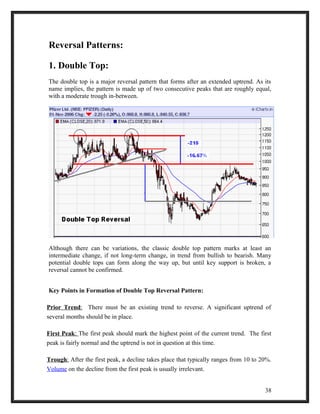
Exponential Moving Averages can be specified in two ways - as a percent-based EMA 
or as a period-based EMA. A percent-based EMA has a percentage as it is single 
parameter while a period-based EMA has a parameter that represents the duration of the 
EMA. 
93
In the above chart red line shows Exponential moving Average and blue line indicates 
Simple Moving Average for 20 days. 
Every previous closing price in the data set is used in the calculation of each EMA that 
makes up the EMA line. While the impact of older data points diminishes over time, it 
never fully disappears whatever may be the duration of the EMA. The effects of older 
data diminish rapidly for shorter EMAs than for longer ones but, again, they never 
completely disappear. 
EMA Vs SMA: 
The difference between an exponential moving average and a simple moving average is 
minimal. The exponential moving average is consistently closer to the actual price. On 
average, the EMA is 3/8 of a point closer to the actual price than the SMA. 
Sometimes exponential moving averages are used for shorter time periods to capture 
changes quicker. Sometimes simple moving averages are preferred for long time periods 
to identify long-term trend changes. Moving average type and length of time depends 
greatly on the individual security and how it has reacted in the past. 
The more sensitive an indicator is, the more signals that will be given. These signals 
may prove timely, but with increased sensitivity leads to an increase in false signals. 
The less sensitive an indicator is, the fewer signals that will be given. The less 
sensitivity leads to fewer and more reliable signals. Sometimes these signals can be late 
as well. 
94
The EMA, which is generally more sensitive than the SMA, is also likely to generate 
more signals. Longer moving averages will move slower and generate fewer signals. 
Because moving averages follow the trend, they work best when a security is trending 
and are ineffective when a security moves in a trading range. If price movements are 
choppy and volatile over an extended period of time, then a moving average is probably 
not the best choice for analysis. 
The more volatility there is, the more smoothing that will be required and hence the 
longer the moving average. Stocks that do not exhibit strong characteristics of trend may 
also require longer moving averages. There is no one set length, but some of the more 
popular lengths include 21, 50, 89, 150 and 200 days as well as 10, 30 and 40 weeks. 
Exponential moving averages are usually best for short-term situations. Simple moving 
averages work well for longer-term situations. 
Uses of Moving Averages: 
The three basic uses of moving averages are: 
1. Trend identification/confirmation 
There are three ways to identify the direction of the trend with moving averages: 
direction, location and crossovers. 
The first trend identification technique uses the direction of the moving average to 
determine the trend. If the moving average is rising, the trend is considered up. If the 
moving average is declining, the trend is considered down. 
The second technique for trend identification is price location. The location of the price 
relative to the moving average can be used to determine the basic trend. If the price is 
above the moving average, the trend is considered up. If the price is below the moving 
average, the trend is considered down. Buy and sell signals are generated by crosses 
above and below the moving average. 
The third technique for trend identification is based on the location of the shorter 
moving average relative to the longer moving average. If the shorter moving average is 
above the longer moving average, the trend is considered up. If the shorter moving 
average is below the longer moving average, the trend is considered down. 
2. Support and Resistance level identification/confirmation 
95
Another use is to identify support and resistance levels. This is usually 
accomplished with one moving average. As with trend identification, support and 
resistance level identification through moving averages works best in trending markets. 
2. Moving Average Convergence / Divergence: (MACD) 
Moving Average Convergence/Divergence (MACD) is one of the simplest and most 
reliable indicators available. MACD uses moving averages, which are lagging indicator. 
These lagging indicators are turned into a momentum oscillator by subtracting the 
longer moving average from the shorter moving average. The resulting plot forms a line 
that oscillates above and below zero, without any upper or lower limits. MACD is a 
centered oscillator. 
MACD is the difference between a security's 26-day and 12-day Exponential Moving 
Averages (EMAs). Using shorter moving averages will produce a quicker, more 
responsive indicator, while using longer moving averages will produce a slower 
indicator. 
Of the two moving averages that make up MACD, the 12-day EMA is the faster and the 
26-day EMA is the slower. Closing prices are used to form the moving averages. 
Usually, a 9-day EMA of MACD is plotted to act as a trigger line. A bullish crossover 
occurs when MACD moves above its 9-day EMA, and a bearish crossover occurs when 
MACD moves below its 9-day EMA. The histogram represents the difference between 
MACD and its 9-day EMA. The histogram is positive when MACD is above its 9-day 
EMA and negative when MACD is below its 9-day EMA. 
If MACD is positive and rising, then the gap between the 12-day EMA and the 26-day 
EMA is widening. This indicates that the rate-of-change of the faster moving average is 
higher than the rate-of-change for the slower moving average. 
If MACD is negative and declining further, then the negative gap between the faster 
moving average and the slower moving average is expanding. Downward momentum is 
increasing, indicating a bearish period of security. 
MACD centerline crossovers occur when the faster moving average crosses the slower 
moving average. 
MACD Bullish Signals: 
MACD generates three types of bullish signals: 
96
1. Positive Divergence 
2. Bullish Moving Average Crossover 
3. Bullish Centerline Crossover 
1. Positive Divergence: 
A Positive Divergence occurs when MACD begins to advance and the security 
is still in a downtrend and makes a lower reaction low. MACD can either form 
as a series of higher Lows or a second Low that is higher than the previous Low. 
Positive Divergences are usually the most reliable, and lead to the biggest 
moves. 
2. Bullish Moving Average Crossover: 
A Bullish Moving Average Crossover occurs when MACD moves above its 9- 
day EMA, or trigger line. Bullish Moving Average Crossovers are used 
occasionally to confirm a positive divergence. The second Low or higher Low of 
a positive divergence can be considered valid when it is followed by a Bullish 
Moving Average Crossover. 
Sometimes filters can be used with MACD. An example of a price filter would 
be to buy if MACD breaks above the 9-day EMA and remains above for three 
days. The buy signal would then commence at the end of the third day. 
3. Bullish Centerline Crossover: 
A Bullish Centerline Crossover occurs when MACD moves above the zero line 
and into positive territory. This is a clear indication that momentum has changed 
from negative to positive, or from bearish to bullish. After a Positive Divergence 
and Bullish Centerline Crossover, the Bullish Centerline Crossover can act as a 
confirmation signal. 
97
In the Sulzer (IND) example, all three bullish signals were present and the stock still 
advanced another 25%. The stock formed a lower Low in mid of March (red line), but 
MACD formed a higher Low, thus creating a potential Positive Divergence. MACD 
then formed a Bullish Moving Average Crossover by moving above its 9-day EMA. 
And finally, MACD traded above zero to form a Bullish Centerline Crossover. At the 
time of the Bullish Centerline Crossover, the stock was trading at 270 and went above 
360 immediately after that. In April, the stock traded above 360. 
MACD Bearish Signals: 
MACD generates three types of bearish signals. 
1. Negative Divergence 
2. Bearish Moving Average Crossover 
3. Bearish Centerline Crossover 
A Negative Divergence forms when the security advances or moves sideways, and the 
MACD declines. The Negative Divergence in MACD can take the form of either a 
lower High or a straight decline. 
98
There are two possible means of confirming a Negative Divergence. First, the indicator 
can form a lower Low. Second, a Bearish Moving Average Crossover can act to confirm 
a negative divergence. When MACD breaks below its 9-day EMA, it signals that the 
short-term trend for the indicator is weakening. A Bearish Moving Average Crossover 
occurs when MACD declines below its 9-day EMA. 
A Bearish Centerline Crossover occurs when MACD moves below zero and into 
negative territory. This is a clear indication that momentum has changed from positive 
to negative, or from bullish to bearish. The centerline crossover can act as an 
independent signal, or confirm a prior signal such as a moving average crossover or 
negative divergence. Once MACD crosses into negative territory, momentum, at least 
for the short term, has turned bearish. 
If MACD is positive for many weeks, begins to trend down, and then crosses into 
negative territory, it would be bearish. However, if MACD has been negative for a few 
months, breaks above zero, and then back below, it might be a correction. 
99
In 2006, DS Kulkarni dropped from above 440 to below 340 in a few months. Looking at 
the technical chart we can observe following: 
1. In December, a negative divergence formed in MACD. 
2. Chaikin Money Flow turned negative on December 27. 
3. Also in mid December, a Bearish Moving Average Crossover occurred in 
MACD (red line). 
4. A Bearish Centerline Crossover occurred in MACD on 15 Jan (green circle). 
5. On 12 February, support at 280 was broken. 
MACD Histogram: 
The MACD-Histogram represents the difference between the MACD and its trigger line, 
the 9-day EMA of MACD. The plot of this difference is presented as a histogram. 
A centerline crossover for the MACD-Histogram is the same as a moving average 
crossover for MACD. 
If the value of MACD is larger than the value of its 9-day EMA, then the value on the 
MACD-Histogram will be positive. Conversely, if the value of MACD is less than its 9- 
day EMA, then the value on the MACD-Histogram will be negative. 
Sharp increases in the MACD-Histogram indicate that MACD is rising faster than its 9- 
day EMA and bullish momentum is strengthening. Sharp declines in the MACD-Histogram 
indicate that MACD is falling faster than its 9-day EMA and bearish 
momentum is increasing. 
100
Usually a move in the MACD is preceded by a corresponding divergence in the MACD-Histogram. 
1. The first point shows a sharp positive divergence in the MACD-Histogram that 
preceded a Bullish Moving Average Crossover. 
2. On the second point, the MACD continued to new Highs but the MACD-Histogram 
formed two equal Highs. 
3. A Positive Divergence formed when the MACD-Histogram formed a higher 
Low and the MACD continued lower. 
4. A Negative Divergence formed when the MACD-Histogram formed a lower 
High and the MACD continued higher. 
The main signal generated by the MACD-Histogram is a divergence followed by a 
moving average crossover. A bullish signal is generated when a Positive Divergence 
forms and there is a Bullish Centerline Crossover. A bearish signal is generated when 
there is a Negative Divergence and a Bearish Centerline Crossover. Keep in mind that a 
centerline crossover for the MACD-Histogram represents a moving average crossover 
for the MACD. 
Divergences appear in the MACD-Histogram before MACD moving average crossovers 
do. 
101
3. Average directional Index (ADX): 
Average Directional Index (ADX) was established to evaluate the strength of a current 
trend, be it up or down. It's important to determine whether the market is trending or 
trading (moving sideways). 
The ADX is an oscillator that fluctuates between 0 and 100. Even though the scale is 
from 0 to 100, readings above 60 are relatively rare. Low readings, below 20, indicate a 
weak trend and high readings, above 40, indicate a strong trend. The indicator does not 
grade the trend as bullish or bearish, but only assesses the strength of the current trend. 
A reading above 40 can indicate a strong downtrend as well as a strong uptrend. 
When ADX begins to strengthen from below 20 and moves above 20, it is a sign that the 
trading range is ending and a trend is developing. 
When ADX begins to weaken from above 40 and moves below 40, it is a sign that the 
current trend is losing strength and a trading range could develop. 
Positive / Negative directional Indicators: 
The ADX is derived from two other indicators, called the Positive Directional Indicator 
(sometimes written +DI) and the Negative Directional Indicator (-DI). 
ADX is the thick black line with less fluctuation, +DI is green and -DI is red. +DI 
measures the force of the up moves and -DI measures the force of the down moves over 
a period. 
Buy and sell signals can be generated by +DI/-DI crosses. A buy signal occurs when 
+DI moves above -DI and a sell signal when -DI moves above the +DI. 
As ADX uses both +DI and -DI, ADX does not offer any indication of trend direction, 
just strength. Generally, readings above 40 indicate a strong trend and readings below 
20 a weak trend. 
102
Above chart of IFCI shows that current trend in stock strong and ADX moved above 40 
which is an indication of strong trend. 
Momentum Indicators: 
1. Rate Of Change (ROC): 
The Rate of Change (ROC) indicator is a momentum oscillator that measures the 
percent change in price from one period to the next. The ROC calculation compares the 
current price with the price n periods ago. 
ROC = ( (Today's close - Close n periods ago) / (Close n periods ago) ) * 100 
The plot forms an oscillator that fluctuates above and below the zero line as the Rate of 
Change moves from positive to negative. 
103
The chart of Tata Steel shows that negative divergence formed in Dec-06 and the ROC 
moved into negative territory just before the decline. Similarly a positive divergence 
was formed in mid Feb-07 which indicated rally in February. 
2. RSI (Relative Strength Index): 
Relative Strength Index (RSI) is one of the momentum oscillators. The RSI compares 
the magnitude of a stock's recent gains to the magnitude of its recent losses and turns 
that information into a number that ranges from 0 to 100. It takes only the number of 
time periods to use in the calculation. The RSI only needs one stock to be computed. 
104
When the Average Gain is greater than the Average Loss, the RSI rises because RS will 
be greater than 1. Conversely, when the average loss is greater than the average gain, the 
RSI declines because RS will be less than 1. The indicator oscillates between 0 and 100 
If the Average Loss ever becomes zero, RSI becomes 100 by definition. 
Use Of RSI: 
Overbought/ Oversold Levels: 
For RSI, 70 and 30 and overbought and oversold levels respectively. If the RSI 
rises above 30 it is considered bullish for the stock. If the RSI falls below 70, it 
is a bearish signal. 
Divergences: 
Buy and sell signals can also be generated by looking for positive and negative 
divergences between the RSI and the stock. For example, consider a falling stock 
whose RSI rises from a low point of (for example) 15 back up to say, 55. 
Because of how the RSI is constructed, the underlying stock will often reverse 
its direction soon after such a divergence. As in that example, divergences that 
occur after an overbought or oversold reading usually provide more reliable 
signals. 
Centerline Crossover: 
The centerline for RSI is 50. Readings above and below can give the indicator a 
bullish or bearish signal. A reading above 50 indicates that average gains are 
higher than average losses and a reading below 50 indicates that losses are 
winning the battle. Many traders/investors look for a move above 50 to confirm 
bullish signals or a move below 50 to confirm bearish signals. 
105
The Multi Arc example shows extreme readings as well as positive divergence. In Nov- 
06, RSI reached oversold levels to mark the low around 43. The next extreme reading 
(oversold) occurred in Feb-07. RSI reached oversold levels in late March-07 and moved 
below 35. A positive divergence with centerline crossover formed in February followed 
by a rally. 
3. Williams % R: 
Williams %R is a momentum indicator that works much like the Stochastic Oscillator. It 
is especially popular for measuring overbought and oversold levels. The scale ranges 
from 0 to -100 with readings from 0 to -20 considered overbought, and readings from 
-80 to -100 considered oversold. 
William %R, sometimes referred to as %R, shows the relationship of the close relative 
to the high-low range over a set period of time. The nearer the close is to the top of the 
range, the nearer to zero (higher) the indicator will be. The nearer the close is to the 
bottom of the range, the nearer to -100 (lower) the indicator will be. If the close equals 
the high of the high-low range, then the indicator will show 0 (the highest reading). If 
the close equals the low of the high-low range, then the result will be -100 (the lowest 
reading). 
%R = [(highest high over ? periods - close)/(highest high over ? periods - lowest low 
over ? periods)] * -100 
106
Williams %R is calculated using 14 periods and can be used on intraday, daily, weekly 
or monthly data. The time frame and number of periods can vary. 
It is important to remember that overbought does not necessarily imply time to sell and 
oversold does not necessarily imply time to buy. One method might be to wait for 
Williams %R to cross above or below -50 for confirmations. 
One method of using Williams %R might be to identify the trend and then look for 
trading opportunities in the direction of the trend. In an uptrend, traders should look to 
oversold readings to establish long positions. In a downtrend, traders should look to 
overbought readings to establish short positions. 
The chart of Sasken Communications with a 14-day and 28-day Williams %R illustrates 
some key points: 
 14-day %R appears quite choppy and prone to false signals. 
 28-day %R smoothed the data series and the signals became less frequent and 
more reliable. 
 When the 28-day %R moved to overbought or oversold levels, it typically 
remained there for an extended period and the stock continued its trend. 
107
 Some good entry signals were given with the 28-day %R by waiting for a move 
above or below -50 for confirmation. 
Bombay Stock Exchange(BSE): 
The BSE Sensex or Bombay Stock Exchange Sensitive Index is a value-weighted index 
composed of 30 stocks with the base April 1979 = 100. It consists of the 30 largest and 
most actively traded stocks, representative of various sectors, on the Bombay Stock 
Exchange. These companies account for around one-fifth of the market capitalization of 
the BSE. 
The base value of the Sensex is 100 on April 1, 1979 and the base year of BSE-SENSEX 
is 1978-79. 
At irregular intervals, the Bombay Stock Exchange (BSE) authorities review and modify 
its composition to make sure it reflects current market conditions. 
The Bombay Stock Exchange was established in 1875. There are around 3,500 Indian 
companies listed with the stock exchange, and has a significant trading volume. At 
October 2006, the market capitalization of the BSE was about Rs. 33.4 trillion (US $ 
730 billion). The BSE SENSEX (SENSitive indEX), also called the "BSE 30", is a 
widely used market index in India and Asia. As of 2005, it is among the five biggest 
stock exchanges in the world in terms of transactions volume. 
108
The abbreviated form "Sensex" was coined by Deepak Mohoni around 1990 while 
writing market analysis columns for some of the business newspapers and magazines. It 
gained popularity over the next year or two. 
Apart from BSE SENSEX, which is the most popular stock index in India, BSE uses 
other stock indices as well: 
• BSE 500 
• BSE 100 
• BSE 200 
• BSE PSU 
• BSE MIDCAP 
• BSE SMLCAP 
• BSE BANKEX 
• BSE Teck 
• BSE Auto 
• BSE Pharma 
• BSE Fast Moving Consumer Goods (FMCG) 
• BSE Consumer Durables 
• BSE Metal 
The index has increased by over ten times from June 1990 to today. Using information 
from April 1979 onwards, the long-run rate of return on the BSE Sensex can be 
estimated to be 0.52% per week (continuously compounded) with a standard deviation 
of 3.67%. This translates to 27% per annum, which translates to roughly 18% per 
annum after compensating for inflation. 
Sensex Milestones: 
The Sensex crossed the 1,000 mark on July 25, 1990; the 2,000 mark on January 15, 
1992; the 3,000 mark on February 29, 1992; the 4,000 mark on March 30, 1992; the 
5,000 mark on October 11, 1999; the 6,000 mark on January 2, 2004; the 7,000 mark on 
June 21, 2005; the 8,000 mark on September 8, 2005; the 9,000 mark on December 09, 
2005; and finally the historic 10,000 mark on February 7, 2006. It created another 
landmark when it touched 11,000 on March 27, 2006. The Sensex closed at a high of 
12,903 on 28 Oct 2006. To reach from the 11,000 mark to the 12,000 mark only took 19 
109
working days, the shortest time interval for a 1000 points climb in BSE Sensex history, 
surpassing the just set record of 29 days that it took to reach 11,000 from 10,000. 
· 1000, July 25, 1990 - On July 25, 1990, the Sensex touched the four-digit figure 
for the first time and closed at 1,001 in the wake of a good monsoon and 
excellent corporate results. 
· 2000, January 15, 1992 - On January 15, 1992, the Sensex crossed the 2,000- 
mark and closed at 2,020 followed by the liberal economic policy initiatives 
undertaken by the then finance minister and current Prime Minister Dr 
Manmohan Singh. 
· 3000, February 29, 1992 - On February 29, 1992, the Sensex surged past the 
3000 mark in the wake of the market-friendly Budget announced by the then 
Finance Minister, Dr Manmohan Singh. 
· 4000, March 30, 1992 - On March 30, 1992, the Sensex crossed the 4,000-mark 
and closed at 4,091 on the expectations of a liberal export-import policy. It was 
then that the Harshad Mehta scam hit the markets and Sensex witnessed 
unabated selling. 
· 5000, October 11, 1999 - On October 8, 1999, the Sensex crossed the 5,000- 
mark as the BJP-led coalition won the majority in the 13th Lok Sabha election. 
· 6000, February 11, 2000 - On February 11, 2000, the InfoTech boom helped the 
Sensex to cross the 6,000-mark and hit and all time high of 6,006. 
· 7000, June 21, 2005 - On June 20, 2005, the news of the settlement between the 
Ambani brothers boosted investor sentiments and the scrips of RIL, Reliance 
Energy, Reliance Capital and IPCL made huge gains. This helped the Sensex 
crossed 7,000 points for the first time. 
· 8000, September 8, 2005 - On September 8, 2005, the Bombay Stock 
Exchange's benchmark 30-share index -- the Sensex -- crossed the 8000 level 
following brisk buying by foreign and domestic funds in early trading. 
· 9000, December 09, 2005 - The Sensex on November 28, 2005 crossed 9000 to 
touch 9000.32 points during mid-session at the Bombay Stock Exchange on the 
back of frantic buying spree by foreign institutional investors and well supported 
by local operators as well as retail investors. 
· 10,000, February 7, 2006 - The Sensex on February 6, 2006 touched 10,003 
points during mid-session. The Sensex finally closed above the 10K-mark on 
February 7, 2006. 
110
· 11,000, March 27, 2006 - The Sensex on March 21, 2006 crossed 11,000 and 
touched a life-time peak of 11,001 points during mid-session at the Bombay 
Stock Exchange for the first time. However, it was on March 27, 2006 that the 
Sensex first closed at over 11,000 points. 
· 12,000, April 20, 2006 - The Sensex on April 20, 2006 crossed 12,000 and 
touched a life-time peak of 12,004 points during mid-session at the Bombay 
Stock Exchange for the first time. 
· 13,000, October 30, 2006 - The Sensex on October 30, 2006 crossed 13,000 and 
still riding high at the Bombay Stock Exchange for the first time. It took 135 
days to reach 13,000 from 12,000. And 124 days to reach 13,000 from 12,500. 
On 30th October 2006 it touched a peak of 13,039.36 & closed at 13,024.26. 
· 14,000, December 5, 2006 - The Sensex on December 5, 2006 crossed 14,000 
and touched a life-time peak of 14028 at 9.58AM (IST) while opening for the 
day December 5, 2006. 
· 15,000, July 06 2007 - The Sensex on July 05, 2007 crossed 15,000 and touched 
a life-time peak of 15,007in afternoon session 
On May 22, 2006, the Sensex plunged by a whopping 1100 points during intra-day 
trading, leading to the suspension of trading for the first time since May 17, 2004. 
The volatility of the Sensex had caused investors to lose Rs 6 lakh crore ($131 
billion) within seven trading sessions. The Finance Minister of India, P. 
Chidambaram, made an unscheduled press statement when trading was suspended to 
assure investors that nothing was wrong with the fundamentals of the economy, and 
advised retail investors to stay invested. When trading resumed after the 
reassurances of the Reserve Bank of India and the Securities and Exchange Board of 
India, the Sensex managed to move up 700 points, still 450 points in the red. This is 
the largest ever intra-day crash (in points terms) in the history of the Sensex.The 
Sensex eventually recovered from the volatility, and on October 16, 2006, the 
Sensex closed at an all-time high of 12,928.18 with an intra-day high of 12,953.76. 
This was a result of increased confidence in the economy and reports that India's 
manufacturing sector grew by 11.1% in August 2006. 
SENSEX Calculation Methodology: 
SENSEX is calculated using the "Free-float Market Capitalization" methodology. As 
per this methodology, the level of index at any point of time reflects the Free-float 
market value of 30 component stocks relative to a base period. The market capitalization 
of a company is determined by multiplying the price of its stock by the number of shares 
issued by the company. This market capitalization is further multiplied by the free-float 
factor to determine the free-float market capitalization. 
The base period of SENSEX is 1978-79 and the base value is 100 index points. This is 
often indicated by the notation 1978-79=100. The calculation of SENSEX involves 
111
dividing the Free-float market capitalization of 30 companies in the Index by a number 
called the Index Divisor. The Divisor is the only link to the original base period value of 
the SENSEX. It keeps the Index comparable over time and is the adjustment point for 
all Index adjustments arising out of corporate actions, replacement of scrips etc. During 
market hours, prices of the index scrips, at which latest trades are executed, are used by 
the trading system to calculate SENSEX every 15 seconds and disseminated in real 
time. 
SENSEX Constituents: 
(As of 10-Jul-07) 
Name Sector Adj.Factor 
ACC Ltd. Housing Related 0.60 
Bajaj Auto Ltd. Transport Equipments 0.70 
Bharat Heavy Electricals Ltd. Capital Goods 0.35 
Bharti Airtel Ltd. Telecom 0.35 
Cipla Ltd. Healthcare 0.65 
Dr Reddy's Laboratories Ltd. Healthcare 0.75 
Grasim Industries Ltd. Diversified 0.75 
Ambuja Cements Ltd. Housing Related 0.70 
HDFC Finance 0.90 
HDFC Bank Ltd. Finance 0.80 
Hindalco Industries Ltd. Metal,Metal Products & Mining 0.75 
Hindustan Unilever Ltd. FMCG 0.50 
ICICI Bank Ltd. Finance 1.00 
Infosys Technologies Ltd. Information Technology 0.85 
ITC Ltd. FMCG 0.70 
Larsen & Toubro Limited Capital Goods 0.90 
Mahindra & Mahindra Ltd. Transport Equipments 0.80 
Maruti Udyog Ltd. Transport Equipments 0.40 
NTPC Ltd. Power 0.15 
ONGC Ltd. Oil & Gas 0.20 
Ranbaxy Laboratories Ltd. Healthcare 0.70 
Reliance Communications Ltd Telecom 0.35 
Reliance Energy Ltd. Power 0.70 
Reliance Industries Ltd. Oil & Gas 0.50 
Satyam Computer Services Ltd. Information Technology 0.95 
State Bank of India Finance 0.45 
Tata Consultancy Services Ltd Information Technology 0.20 
Tata Motors Ltd. Transport Equipments 0.60 
Tata Steel Ltd. Metal,Metal Products & Mining 0.70 
Wipro Ltd. Information Technology 0.20 
112
Beta, R2 ,Volatility and Returns of SENSEX scrips for one year 
period 
(July 2006 - June 2007) 
Name Beta 
Value 
Co-efficient of 
determination 
(R2) 
Avg. 
Daily 
Volatility 
(%) 
Returns 
(1 Year) 
(%) 
Weightage 
(%) in 
SENSEX 
as on 
29/06/07 
Free-float 
Adj. 
Factor 
as on 
29/06/07 
A.C.C. 1.04 0.39 2.16 19.12 1.12 0.60 
BAJAJ AUTO 0.74 0.23 2.00 -22.22 1.61 0.70 
BHARTI 
TELEVENTURES 1.04 0.52 1.87 125.93 5.93 0.35 
BHEL 1.05 0.47 1.97 57.62 2.82 0.35 
CIPLA LTD. 0.82 0.30 1.96 -3.41 1.13 0.65 
DR.REDDY'S 0.71 0.28 1.72 2.97 0.88 0.75 
GRASIM IND. 0.88 0.36 1.91 36.45 1.94 0.75 
GUJARAT AMBUJA 
CEMENT 0.99 0.35 2.15 25.18 1.41 0.70 
HDFC 0.93 0.34 2.08 79.66 4.94 0.90 
HDFC BANK 1.03 0.41 2.08 44.61 3.13 0.80 
HERO HONDA 0.48 0.12 1.77 -12.96 0.74 0.50 
HINDALCO 0.93 0.30 2.20 -8.46 1.58 0.75 
HINDUSTAN LEVER 0.89 0.38 1.87 -17.57 2.23 0.50 
ICICI BANK 1.13 0.49 2.10 96.00 9.19 1.00 
INFOSYS 
TECHNOLOGIES 0.89 0.50 1.62 25.37 10.01 0.85 
ITC LTD. 0.78 0.34 1.73 -15.12 4.36 0.70 
LARSEN & TOUBRO 1.17 0.57 2.00 95.80 5.98 0.90 
MARUTI UDYOG 1.06 0.53 1.88 -6.83 0.92 0.40 
NATIONAL 
THERMAL POWER 0.63 0.23 1.68 37.19 2.01 0.15 
ONGC 0.84 0.39 1.74 22.07 4.13 0.20 
113
RANBAXY LAB. 0.74 0.26 1.87 -0.41 0.99 0.70 
RELIANCE 0.98 0.64 1.59 60.60 12.67 0.50 
RELIANCE ENERGY 0.83 0.31 1.95 35.34 1.05 0.70 
SATYAM 
COMPUTER 1.11 0.42 2.22 31.37 3.14 0.95 
STATE BANK OF 
INDIA 1.24 0.53 2.20 109.69 3.86 0.45 
TATA 
CONSULTANCY 0.98 0.52 1.76 32.43 2.40 0.20 
TATA MOTORS 1.17 0.51 2.12 -15.70 1.66 0.60 
RELIANCE 
COMMUNICATIONS 1.38 0.54 2.44 107.69 3.96 0.35 
TATA STEEL 1.09 0.37 2.31 11.98 2.60 0.70 
WIPRO LTD. 1.17 0.52 2.10 0.92 1.62 0.20 
114
The above chart is the daily chart of BSE Sensex for the last one year. Sensex has come down from 
14250 to 13600-13700. 
It has a strong support at 13700 and it has touched it. IT means if it maintains closing above this level 
then it can again cross 14000 to 14500. Sensex has resistance at 14500. 
But if it breaks down 13700 then it can come down to 13540, 13310 which are it strong support 
levels. 
Indicators like MACD and RSI are in favor of existing short term down trend. 
But if we look at Fast STO indicator then we can know that %K line (black) has crossed %D line 
(red line). And it has already near to level of 20. So one can see some upward from here as a reaction 
rally. 
115
If we look at weekly chart for the prediction of future of next 2-3 weeks, we can find that 
Sensex has strong support at 13500. And it has strong resistance at 14000. 
If we look at indicators then RSI is between 50 and 70. And there is a chance for upward 
movement from here. 
MACD Histogram also formed positive divergence and soon MACD line is going to cross 
trigger line which will be bullish signals for Index. 
For the next two weeks Sensex can go up to 14500 or it may cross 14500. 
116
National Stock Exchange(NSE): 
S & P CNX Nifty: 
S&P CNX Nifty: 
Nifty is also an adjective of 18th century American theatrical origin, possibly a 
shortening of "magnificant", and meaning "really good". 
The S&P CNX Nifty, or simply Nifty is the leading index for large companies on the 
National Stock Exchange of India. S&P CNX Nifty is a well diversified 50 stock index 
accounting for 22 sectors of the economy. It is used for a variety of purposes such as 
benchmarking fund portfolios, index based derivatives and index funds. 
Ownership and Management 
Nifty was developed by the economists Ajay Shah and Susan Thomas, then at IGIDR. 
Later on, it came to be owned and managed by India Index Services and Products 
Ltd. (IISL), which is a joint venture between NSE and CRISIL. IISL is India's first 
specialized company focused upon the index as a core product. IISL have a 
consulting and licensing agreement with Standard & Poor's (S&P), who are world 
leaders in index services. 
CNX stands for CRISIL NSE Indices. CNX ensures common branding of indices, to 
reflect the identities of both the promoters, i.e. NSE and CRISIL. Thus, 'C' stands for 
CRISIL, 'N' stands for NSE and X stands for Exchange or Index. The S&P prefix 
belongs to the US-based Standard & Poor's Financial Information Services. 
o The average total traded value for the last six months of all Nifty stocks 
is approximately 55.15% of the traded value of all stocks on the NSE. 
o Nifty stocks represent about 59.49% of the total market capitalization as 
on Sep 29, 2006. 
o Impact cost of the S&P CNX Nifty for a portfolio size of Rs.5 million is 
0.06% 
o S&P CNX Nifty is professionally maintained and is ideal for derivatives 
trading. It is quoted using the symbol NSEI. 
It is calculated as a weighted average, so changes in the share price of larger companies 
have more effect. The base is defined as 1000 at the price level of November 3, 1995, at 
which time the total capitalization was Rs.2,060,000 million. As on 3rd January 2007, 
Index's value is 4007.40 
117
Criteria for inclusion 
· Average market capitalization of Rs.5,000 million or more during the last six 
months. 
· Liquidity: Cost of transaction (impact cost) of less than 0.75% for more than 
90% of trades, over six months. 
· At least 12% floating stock (not held by promoters of the company or their 
associates). 
The Nifty has crossed 4500 as a record mark. 
Nifty components: 
This is a chart of companies listed in the S&P CNX Nifty index by market capitalization 
in Rs. Crores, Days weightage, P/E as of 16 July 2007. 
Company Market cap (Rs.Cr.) Days Weight PE 
NIFTY 2327773 100.00 21.65 
Reliance Ind 254713 10.94 23.4 
ONGC 195442 8.40 12.5 
Bharti Artl 164037 7.05 40.4 
Reliance Com 114785 4.93 36.3 
Tata Consult 113102 4.86 26.8 
Infosys Tech 110885 4.76 28.8 
ICICI Bank 103327 4.44 33.2 
SBI 83319 3.58 18.3 
BHEL 79224 3.40 32.8 
Wipro 73731 3.17 27.3 
SAIL 63340 2.72 10.2 
ITC 58577 2.52 21.7 
HDFC 52651 2.26 33.5 
118
Reliance Pet 51728 2.22 0.0 
Hind.Unileve 43445 1.87 24.1 
Suzlon Enrgy 42296 1.82 48.9 
HDFC Bank 38331 1.65 31.3 
Tata Steel 37708 1.62 9.0 
Sterl.Inds. 35510 1.53 8.1 
Satyam Comp 32684 1.40 23.3 
Tata Motors 28847 1.24 13.3 
Grasim Inds. 26168 1.12 13.3 
Maruti Udyog 23832 1.02 15.3 
ABB 22983 0.99 61.2 
Siemens 22685 0.97 56.8 
Bajaj Auto 22493 0.97 18.0 
HCL Techno. 22360 0.96 26.4 
Ambuja Cemen 20902 0.90 14.2 
ACC 20796 0.89 16.8 
Hindalco 20702 0.89 8.1 
Sun Pharma. 19805 0.85 25.6 
M&M 19572 0.84 18.3 
Pun.Nat.Bank 18089 0.78 11.7 
Cipla 16047 0.69 24.3 
Reliance Ene 16002 0.69 20.0 
Zee Entert.E 15828 0.68 72.1 
Hero Honda 13980 0.60 16.3 
VSNL 13681 0.59 29.2 
119
Tata Power 13211 0.57 19.0 
Ranbaxy Lab. 12901 0.55 22.6 
BPCL 12027 0.52 3.7 
Dr.Reddy's 11340 0.49 11.7 
IPCL 10946 0.47 10.6 
MTNL 10247 0.44 15.9 
Dabur (I) 9243 0.40 32.6 
HPCL 8765 0.38 5.6 
The Chart of NIFTY shows that currently the index is in down trend. 
120
It has strong support levels at 4020, 4000, 3970, 3900. 
The indicators also support the existing down trend. MACD and RSI are in favor of 
down trend. MACD had formed negative divergence. 
ADX indicator shows that –DI is soon going to cross +DI from below with good 
strength. This shows that the down trend will continue in NIFTY. 
Weekly chart of the NIFTY shows that the index is trading in a range of 3500 to 4250 
for the last 4 to 5 months. 
RSI is going to be negative. But ADX and MACD are in favor of up trend as MACD 
had formed positive divergence and ADX is strong in favor of up trend. 
I can’t say anything about the index for future as the direction of the index is not clear. 
So we will have to wait for the direction to be clear. 
121
Leading Stocks’ Short term & Medium Term Analysis 
Bharti Airtel Limited:(Medium Term) 
122
As shown in chart,Bharti is in uptrend in medium as well as in short term.The stock 
has good support at 20-day EMA at around 850-855, and It has very strong support at 
90-Day EMA at 800-810.. RSI trendline violation is cause of worry. Stock will 
consolidate between 850-900 before any further upmove. 
Bharti Airtel Limited:(Short Term) 
123
Bharti Airtel is in short term uptrend . It is facing strong resistance at 880-900. RSI 
trendline is in uptrend also MACA 12.22 & Divergence 4.576 is indicators of future 
upmove. Stock has good support at 13-day EMA around 860 . 
Infosys Technologies Ltd.(Short Term) 
124
The stock is in short term downtrend. Stock is making lower high n lower bottom. 
Infosys has broken downtrend line n also RSI-65.02 n MACD 1.972 indicates the short-term 
downtrend will reverse.. Stock has significantly crossed downtrend line. Infosys 
should touch 2120-1250 in near term 
Larson & Toubro Ltd. (Short term) 
125
Stock has moved a lot. The uptrend line slope is very steep. RSI indicates that stock has 
been highly overbought. LT should come down for consolidation. It has very good 
support at 13-day EMA 2280-2300. 
Larson & Toubro Ltd. (Medium term) 
126
The stock was in upward channel as shown in chart. It was moved away from channel n 
again came into mail channel. The short term channel is so steep also RSI,MACD 
indicators indicating stock overbought situation. The stock will consolidate. Stock has 
support at 2180-2200 n 1950-2000. 
Reliance Industries Ltd. (Medium term) 
After sharp up move during April- mid June, In medium term Reliance is uptrernd. 
Reliance is in consolidation...It has good support at 50-day EMA at 1660-1670.RSI & 
127
MACD are not indicating any clear bearish or bullish signals. Either way movement is 
possible. 
Reliance Industries Ltd. (Short term) 
128
Reliance is in short term chart is consolidating. It is moving narrowly between 1680- 
1730.It is moving in very small range.The triangle breakout on either side is possible. 
REPORT SUMMERY 
• Technical analysis can help investors in preserving capital and maximizing 
returns 
• Profitable chart patterns like head & shoulder top, Saucers, V bottom can 
help the investor in deciding appropriate time for buying and selling securities 
• All chart patterns are not followed in single chart 
• Technical analysis is more effective when used in combination with 
fundamental analysis. 
However, although technical analysis is a terrific tool, most agree it is much 
more effective when used in combination with fundamental analysis. 
129
References: 
Websites: 
www.bseindia.com 
www.nseindia.com 
www.stockcharts.com 
www.i-charts.com 
www.investopedia.com 
www.traderji.com 
www.wikipedia.com 
www.economictimes.com 
Books: 
Technical Analysis: ---Capital market Publication 
130
131
132

Interface brokerage and research ltd ; umang

  • 1.
    A REPORT ON “BASICS OF TECHNICAL ANALYSIS” By UMANG BHAVSAR INTERFACE BROKERAGE & RESEARCH LTD
  • 2.
    A REPORT ON “BASICS OF TECHNICAL ANALYSIS” By UMANG BHAVSAR A Report submitted in partial fulfillment of The requirements of 2
  • 3.
    MBA Programme of GUJARAT UNIVERSITY Acknowledgement First of all I would like to thank Mr. Himal Parikh (Director, Interface Brokerage & Research Ltd.) for providing me an opportunity to work in their team as summer trainee. I would also like to thank Ms. Binny Vora, Ms. Heta Jani, Ms. Megha Shah and Mr. Hitesh Patel; employees of the company working in research department for their invaluable guidance, cooperation and encouragement which helped me lot in my Summer Training. I am also thankful to Prof. Mayank Joshipura for his guidance and valuable inputs and advice during my project. At the last, I would like to thank each individual who some or other way helped me to complete my project. 3
  • 4.
    Table of Contents Abstract 6 Introduction 7 Company Profile 9 The Philosophy of Technical Analysis 10 Dow Theory 14 Charts 18 Support & Resistance 23 Trend lines & Channels 28 Chart Pattern Analysis 36 Reversal Patterns 1. Double Top 37 2. Head & Shoulder Top 41 3. Head & Shoulder Bottom 45 4. Falling Wedge. 48 5. Rising Wedge 52 6. Rounding Bottom 55 7. Triple Top. 59 8. Triple Bottom 62 Continuation Patterns 1. Pennant/Flag. 65 2. Symmetric Triangle 68 3. Ascending Triangle 72 4. Descending Triangle 76 5. Rectangle 80 4
  • 5.
    6. Price Channel84 Technical Indicators 87 Trend Indicators 1. Moving Averages 88 2. MACD 92 -MACD Histogram 96 3. ADX 98 Momentum Indicators 1. Rate Of Change (ROC) 99 2. RSI. 100 3. William’s % R 102 Bombay Stock Exchange (BSE) 104 National Stock Exchange (NSE) 113 Leading Stocks’ Short term & Medium Term Analysis 118 Report Summery 125 References 126 5
  • 6.
    Abstract Technical analysisis study of predicting prices of securities for future. The main aim of Technical analysis is to generate returns by letting person decide when to enter and when to exit in the security. Bottom line is to buy at tough (deep decline) and to sell at peak to get substantial amount of return/profit. By study of technical analysis person will be able to take decision of his trades/investments. Technical analysis uses various charts for analysis. This project throws lights on various basic aspects of technical analysis. It is not possible to cover each and every aspect of technical analysis. But I have tried to cover main and basics of technical analysis. As today in stock market decisions are very important and most of the people make investment on advises of brokers. Through this report any person who doesn’t know anything about Technical Analysis can also study it easily and make decisions on his own. In this final report I have covered different various types of charts, various formations of chart patterns, some theories related to technical analysis, technical indicators for better analysis. I have covered as much examples of various charts and indicators as possible so that one can understand them. In terms of charts I have used mostly candlestick charts amongst all three charts for analysis of security as they give clear picture of price movements during particular period. I have referred some of the books on technical analysis and some of the Websites for charts. At last I have analyzed price movements of various Leading Stocks of Indian stock market through their charts using technical analysis and with the use of available data I have set short to medium term targets. 6
  • 7.
    Introduction Technical Analysisis the forecasting of future price movements based on study of past price movements. It may not give you the absolute predictions but it can give you general idea of the price movement which is likely to be in future. Technical Analysis is applicable to stocks, commodities, indices, futures or tradable instruments where the prices are influenced by force of demand and supply. Price refers to any combination of open, low, close, and high of any stock over a specific period of time. Time frame can be intraday (daily), weekly, monthly or yearly. Technical analysis is focused directly on the bottom line i.e. what is the price? , where has it been? , and what can it be in the future? It is used to make investment decisions by analyzing strengths and weaknesses of any stock with use of various chart patterns and other indicators. In technical analysis various types of charts are used. For any investor or people who are involved in the stock market it is very important to know what will happen to prices of stocks tomorrow. Technical Analysis is one of the ways to forecast future price movements. By studying the basics of Technical Analysis one can know that when to exit and when to enter in the markets. There are four types of charts. 1. Line Charts 2. Bar Charts 3. Candle Stick Charts 4. Point and Figure Charts Chart patterns analysis can be used to make short term or long term forecasts. There are generally two types of chart patterns 1. Reversal Chart Patterns 2. Continuation chart patterns. Some different types of chart patterns are as follows.  Double Top (Reversal)  Double Bottom (Reversal)  Head and Shoulders Top (Reversal)  Head and Shoulders Bottom (Reversal) 7
  • 8.
     Falling Wedge(Reversal)  Rising Wedge (Reversal)  Rounding Bottom (Reversal)  Triple Top (Reversal)  Triple Bottom (Reversal)  Bump and Run Reversal (Reversal)  Flag, Pennant (Continuation)  Symmetrical Triangle (Continuation)  Ascending Triangle (Continuation)  Descending Triangle (Continuation)  Rectangle (Continuation)  Price Channel (Continuation) Chart patterns are used along with the market and technical indicators to study the price movements and historical data. Market indicators are presentation of the historical data in a line form.. Volume as an indicator also plays very important role. Each and every indicator has its own meaning and interpretation. But to be more accurate in analysis one should use more than one indicator to confirm the price trend or movements. There are many technical indicators and chart overlays which can be used for analysis. Some of them are as follows:  Average Directional Index (ADX) - A technical indicator system that attempts to quantify how strongly a stock is trending.  Moving Average Convergence/Divergence (MACD) - A technical indicator system that combines several moving averages to better show a stock's trend and momentum.  Moving Averages – Different types of moving averages.  Rate of Change (ROC) and Momentum - A technical indicator that shows the speed at which a stock's price is changing.  Relative Strength Index (RSI) - A technical indicator that tries to quantify a stock's current direction and strength.  Williams %R - A technical indicator that uses Stochastics to determine overbought and oversold levels. 8
  • 9.
    I have analyzedthe charts of leading stocks of Indian Stock Market indices using technical analysis and some of the indicators. COMPANY PROFILE INTERFACE BROKERAGE & RESEARCH LTD Interface Group is in Finance business since 1988. The group is well diversified into various activities viz. Operations into Primary Market and Secondary Market in the Stock Market, intermediary in the Debt Market, Fund based activities under the flagship company the Interface Financial Services Ltd. Interface Group has a Corporate Membership of Ahmedabad Stock Exchange, National Stock Exchange of India for Capital Market Segment and Dealership on OTC Exchange of India. Interface Group has achieved remarkable growth as Broker Underwriter and has established its presence as a leading Primary Market Player at National Level. Interface Group is engaged in fund based activities such as lease Hire Purchase, Car Finance, securitization, ICD, Loan against shares etc. Interface group is also engaged in the field of Marketing Financial Instruments and Marketing Fixed Deposits of state as well as National Level reputed Manufacturing And finance companies, States and central Government Undertakings, private sector Banks. The Group is acting as Managers for the Fixed Deposits of several corporate of repute. The group is also acting as Direct Brokers for more than 50 companies for mobilizing their fixed deposits. The group is also marketing RBI Tax Free Relief Bonds, Mutual Funds of reputed AMCs, UTI Schemes etc. and mobilizing huge amount. Interface group is actively engaged in the Money Market and doing good business in Central as well as State Government Dated Securities and is registered Money Market Broker with RBI. Besides the group is also dealing in Rated Bonds of Public Sector, Private sector as well as Nationalized Banks. Interface Group has large network of Sub-brokers in all most major centers of the state for Primary Market, Fixed Deposits Mobilization, and Mutual Funds etc. Besides the group has a very good relationship with high net worth clients all over Gujarat. 9
  • 10.
    The Philosophy ofTechnical Analysis Introduction: The methods used to analyze and predict the performance of a company's stock fall into two broad categories: 1) Fundamental Analysis 2) Technical Analysis Those who use technical analysis look for peaks, bottoms, trends, patterns and other factors affecting a stock's price movement and then make buy/sell decisions based on those factors. It is a technique many people attempt, but few are truly successful at it. The world of technical analysis is huge today. There are literally hundreds of different patterns and indicators that investors claim to have success with. The term “technical” in its application to the stock market has come to have a very special meaning, quite different from its ordinary dictionary definition. It refers to the study of the market itself as opposed to the study of the goods in which the market deals. Technical Analysis is the science of recording, usually in graphic form, the actual history of trading (price changes, volume of transactions, etc.) in a certain stock or in “the Averages” and then deducing from that pictured history the probable future trend. Some History of Technical Analysis: The term “technical analysis” is a complicated-sounding name for a very basic approach to investing. Simply put, technical analysis is the study of prices, with charts being the primary tool. The roots of modern-day technical analysis stem from the Dow Theory, developed around 1900 by Charles Dow. Stemming either directly or indirectly from the Dow Theory, these roots include such principles as the trending nature of prices, prices discounting all known information, confirmation and divergence, volume-mirroring changes in price, and support/resistance. 10
  • 11.
    Technical analysis isthe study of specific securities and the overall market based on demand/supply relationship. A technician is a person who uses technical analysis to make investment decisions. The technical analyst bases market forecasting on price movement and other indicators. Technical analysis approaches should be tied to the individual investor’s perspective, temperament, personality, and risk profile. What Is Technical Analysis? Technical Analysis is the science of recording, usually in graphic form, the actual history of trading (price changes, volume of transactions, etc.) in a certain stock or in “the Averages” and then deducing from that pictured history the probable future trend. Technical analysis is a method of evaluating securities by analyzing statistics generated by market activity, past prices and volume. Technical analysts do not attempt to measure a security's intrinsic value; instead they look at stock charts for patterns and indicators that will determine a stock's future performance. Technical analysis has become increasingly popular over the past several years, as more and more people believe that the historical performance of a stock is a strong indication of future performance. The use of past performance should come as no surprise. People using fundamental analysis have always looked at the past performance of companies by comparing fiscal data from previous quarters and years to determine future growth. The difference lies in the technical analyst's belief that securities move according to very predictable trends and patterns. These trends continue until something happens to change the trend, and until this change occurs, price levels are predictable. There are many instances of investors successfully trading a security using only their knowledge of the security's chart, without even understanding what the company does. However, although technical analysis is a terrific tool, most agree it is much more effective when used in combination with fundamental analysis. The Basic Assumptions: The field of technical analysis is based on three assumptions: 1. The market discounts everything. 2. Price moves in trends. 3. History tends to repeat itself. 1. The Market Discounts Everything 11
  • 12.
    A major criticismof technical analysis is that it only considers price movement, ignoring the fundamental factors of the company. However, technical analysis assumes that, at any given time, a stock's price reflects everything that has or could affect the company - including fundamental factors. Technical analysts believe that the company's fundamentals, along with broader economic factors and market psychology, are all priced into the stock, removing the need to actually consider these factors separately. This only leaves the analysis of price movement, which technical theory views as a product of the supply and demand for a particular stock in the market. 2. Price Moves in Trends In technical analysis, price movements are believed to follow trends. This means that after a trend has been established, the future price movement is more likely to be in the same direction as the trend than to be against it. Most technical trading strategies are based on this assumption. 3. History Tends To Repeat Itself Another important idea in technical analysis is that history tends to repeat itself, mainly in terms of price movement. The repetitive nature of price movements is attributed to market psychology; in other words, market participants tend to provide a consistent reaction to similar market stimuli over time. Technical analysis uses chart patterns to analyze market movements and understand trends. Although many of these charts have been used for more than 100 years, they are still believed to be relevant because they illustrate patterns in price movements that often repeat themselves. Adaptability to Different Markets and Investment Time Horizons: The beauty of technical analysis is that it can be applied effectively to virtually any trading medium and investment time horizon. A technician can analyze stocks, bonds, options, mutual funds, commodities, and many other forms of investment for buy or sell opportunities. And one can do so by examining tic-by-tic, intraday, daily, weekly, monthly, or some other interval of data to use technical analysis for a wide range of time horizons- from very short-term to very long-term perspectives. The best manner in which to use technical analysis depends on one’s approach to the market. Everyone invests differently. We all have different levels of stress, different temperaments, and different amounts of capital. It is important to apply technical analysis in a manner that complement’s one’s own personality and individual investments philosophy. Obviously, those whose time, nerves, and capital are limited will want to pass up very short-term trading opportunities (such as intraday trading of stock index futures) and, perhaps, use longer-term technical analysis derived buy and sell signals for stocks or mutual funds. By recognizing one’s individual investment 12
  • 13.
    strengths and weakness,users of technical analysis can find the trading medium and time horizons that are best for their individual investment situations. Technical analysis is done from four important view points which are as follows: Price: Changes in price reflect changes in investor attitude and demand for and supply of securities. Time: The longer time price takes for a reversal in trend, the greater the price change that would follow. Volume: The intensity of price change is reflected in the volume of transactions. An increase in price supported by low volumes indicates that the change in the price is not so strong . Breadth: Breadth of the market indicates the extent to which price changes have taken place in the market in accordance with the overall market trend. It indicates that whether a change in trend of prices spread across the most sectors or it is concentrated in only few types of scrip. Technical analysis is subjective as the interpretation of the analysis varies from person to person for the same stock because it depends on the style of individual investors. 13
  • 14.
    DOW THEORY Thebasic principles of the Technical Analysis originated form the Dow Theory. Dow Theory only describes the direction of market trends, and does not attempt to forecast future price movements or measures size of such market trends. The five basic tenets of the Dow Theory are as follows: 1. The Average Discounts Everything: The share prices that are determined in the market evolved out of a discounting process that takes all known and predictable factors into account. 2. The Market has three types of Movements: Primary Movements Primary movements, which last from about a year to several years, represent the major market trends. It can either be a rising (bull) trend or a falling trend (bear). Primary trends are long term movements in prices, interrupted by swings in the opposite direction. Secondary Movements A secondary movement is defined as an important decline in a bull market, or advance in a bear market lasting from three weeks to as many months. When reaction is more than 50% of the preceding primary trend, it is difficult to say whether the reaction is secondary or it signals a new primary trend in the opposite direction. Minor Movements 14
  • 15.
    Movements in pricesthat form only a part of a primary trend or a secondary movement are called Minor Movements. Generally intraday movements are called minor movements. In this chart of SBI for the last 5 years, the major trend foe the last 5 years is uptrend (Green Line). But from middle of 2004 to middle of 2005 the stock has reacted against its major trend i.e. uptrend (Red line). So it can be called as Secondary Reactions. Now for this 5 year trend, the weekly or daily fluctuations are called Minor trend. Here the purple rectangles show the minor trends in the stock. 3. Price Action Determines the Trend: A trend can be called primarily bullish when successive rallies lead to peaks those are higher than the preceding ones (Green Lines) and when troughs reached by the intervening secondary reactions are above the preceding troughs. 15
  • 16.
    In the abovechart a bearish trend is marked by a series of descending peaks and troughs. (Red Lines) A reversal in primary trend is indicated when the above condition is not satisfied. 4. Lines Indicate Movement In certain cases, price movements which initially look like secondary movements persist within a narrow range and form “lines” (Green lines). A line is formed by price movements within a range of 5 percent of its mean average. This is called an “accumulation”. (i.e. when a line is formed in between a primary bear trend).If prices advance above an accumulation, it 16
  • 17.
    marks a reversalin the bearish trend and if price continues to fall after an accumulation, the line is only a consolidation of the bearish trend and it is a secondary price movement. 5. Price volume relationship provide background Volume plays very major role in technical analysis. The relation between prices and volume is very important. The volume is normally expected to complement the movement in prices. A reversal trend is signaled if dull volume supports a rally, or a high volume, a downtrend. 17
  • 18.
    Charts A pricechart is a sequence of prices plotted over a specific time frame. Technical analysis is based on charts. Therefore sometimes technical Analysts are called Chartists. On the chart, the y-axis (vertical axis) represents the price scale and the x-axis (horizontal axis) represents the time scale. Prices are plotted from left to right across the x-axis with the most recent plot being the furthest right. A graphical historical record makes it easy to spot the effect of key events on a security's price, its performance over a period of time and whether it's trading near its highs, near its lows, or in between. There are basically four types of charts which are as follows: 1. Line Charts 2. Bar Charts 3. Candle Stick Charts 4. Point and Figure Charts But only first three of the charts are used very frequently for the analysis part. Line Charts: A line Chart is the simplest type of chart. Line Chart is drawn by plotting the closing price of the stock on a given day and connecting them to make charts. They are widely used charts. The price is marked on the Y-axis and the period of time on the X-axis. Line chart’s strength comes from its simplicity. The line chart of SENSEX for last 3 months is as below. 18
  • 19.
    Bar Charts: Abar chart displays any security’s open, low, high and closing prices. As illustrated in the bar chart below, the top of each vertical bar represents the highest price of a security during that period and the bottom of the bar represents the lowest price. The close is the short horizontal line crossing the vertical bar. On a daily chart, each bar represents the high, low and close for a particular day. Weekly charts would have a bar for each week based on Friday's close and the high and low for that week. The open price is displayed as a short horizontal line extending to the left of the bar and the close price is displayed as a short horizontal line extending to the right of the bar. Candlestick Charts: For a candlestick chart, the open, high, low and close are all required. A daily candlestick is based on the open price, the intraday high and low, and the close. A weekly candlestick is based on Monday's open, the weekly high-low range and Friday's close. 19
  • 20.
    Many investors believethat candlestick charts are easy to read because of the relationship between the open and the close. White (clear) candlesticks form when the close is higher than the open and black (solid) candlesticks form when the close is lower than the open. The white and black portion formed from the open and close is called the body (white body or black body). The lines above and below are called shadows and represent the high and low. Price Scaling: There are two methods for displaying the price scale along the y-axis: arithmetic and logarithmic. An arithmetic scale displays different points (or price in rupees) as the same vertical distance. Whatever may be the price of security on Y-axis, the distance between the prices is same. Each unit of measure is the same throughout the entire scale. 20
  • 21.
    If a stockadvances from 10 to 80 over a 6-month period, the move from 10 to 20 will appear to be the same distance as the move from 70 to 80. Even though this move is the same in absolute terms, it is not the same in percentage terms. A logarithmic scale measures price movements in percentage terms. It is also known as “Semi-Log Scale”. An advance from 10 to 20 would represent an increase of 100%. An advance from 20 to 40 would also be 100%, as would an advance from 40 to 80. All three of these advances would appear as the same vertical distance on a logarithmic scale. (Arithmetic Scale) (Logarithmic/ Semi Log Scale) The above graphs show the candlestick charts of “Bharti Airtel” for the last 9 months. Both graphs are the same but their price scaling on Y-axis is done differently. 21
  • 22.
    Key points onthe benefits of arithmetic and semi-log scales: Arithmetic scales are useful when the price range is confined within a relatively tight range. Arithmetic scales are useful for short-term charts and trading. Price movements (particularly for stocks) are shown in absolute rupee terms and reflect movements for each rupee. Semi-log scales are useful when the price has moved significantly, be it over a short or extended time frame Trend lines tend to match lows better on semi-log scales. Semi-log scales are useful for long-term charts to gauge the percentage movements over a long period of time. The choice of which charting method to use will depend on personal preferences and trading or investing styles. 22
  • 23.
    SUPPORT AND RESISTANCE In this section, the concepts of support and resistance will be more fully explained. In addition, two sophisticated applications of support and resistance, namely percentage retracements and speed resistance lines, will be examined. Support and Resistance: In the Wall Street environment, the terms support and resistance are almost synonymous with demand and supply, respectively. Support is a price level at which there is adequate demand for a security to stop its downward price movement and, normally, turn prices upward. Support occurs at reaction lows Support: 95 90 85 80 75 70 65 60 55 50 45 40 35 95 90 85 80 75 70 65 60 55 50 45 40 35 BALLARPUR INDS (104.900, 109.500, 104.500, 107.750, +3.45000) Support Nov Dec 2001 Mar Apr May Jun Jul Aug Sep Oct Nov Dec 2002 Mar Apr May Jun Jul Aug Sep Oct Nov Dec 2003 Mar Apr May Jun Jul Aug Sep Oct Nov Dec 2004 Feb Resistance is a price level at which there is a significant supply of a stock causing prices to halt an upward move and, typically, turn prices down. (Sec Figure 7-2.) Resistance occurs at reaction highs. 23
  • 24.
    Resistance 85 80 75 70 65 60 55 50 45 40 35 30 RELIANCE CAPITAL (594.000, 673.800, 594.000, 670.300, +77.7500) Aug Sep Oct Nov Dec 2002 Feb Mar Apr May Jun Jul Aug Sep Oct Nov Dec 2003 Feb Mar Apr May Jun Jul Aug Sep Oct 85 80 75 70 65 60 55 50 45 40 35 30 Resistance In an uptrend, both support and resistance levels rise as illustrated in Figure 7-3. Typically, support levels hold while resistance offers temporary halts to upward movements in prices. Resistance levels are repeatedly broken until the uptrend is reversed. Rising support and resistance 140 135 130 125 120 115 110 105 100 95 90 85 80 75 70 65 60 55 50 45 40 35 30 25 20 15 10 140 135 130 125 120 115 110 105 100 N D 2003 M A M J J A S O N D 2004 M A M J J A S O N D 2005 M A M J J A S O N D 2006 M A M J J A S 95 90 85 80 75 70 65 60 55 50 45 40 35 30 25 20 15 10 Resistance Resistance Support Support IDBI (74.2000, 83.4000, 73.6000, 81.2500, +7.85000) 24
  • 25.
    Role Reversal Inan uptrend, resistance levels often become support levels after they are broken significantly as illustrated in Figure Up trend role reversal from resistance to support 540 530 520 510 500 490 480 470 460 450 440 430 420 410 400 390 380 370 360 350 340 330 320 310 300 290 280 270 260 250 240 230 220 210 200 190 180 170 160 150 PUNJAB TRACTORS (314.000, 314.000, 305.100, 305.400, -6.55002) 1997 Nov Dec 1998 Feb Mar Apr May Jun Jul Aug Sep Oct Nov Dec 1999 Feb Mar Apr May Jun Jul Aug Sep Oct Nov Dec 2000 Feb 540 530 520 510 500 490 480 470 460 450 440 430 420 410 400 390 380 370 360 350 340 330 320 310 300 290 280 270 260 250 240 230 220 210 200 190 180 170 160 150 140 140 Resistance become support In a downtrend, the opposite occurs as support levels frequently become resistance levels. Down trend role reversal from support to resistance 105 100 95 90 85 80 75 70 65 60 55 50 45 40 35 105 100 95 90 85 80 75 70 65 60 55 50 45 40 35 TN NEWSPRINT (82.0000, 86.5000, 81.2500, 83.6500, +1.45000) Support becomes resistance Mar Apr May Jun Jul Aug Sep Oct Nov Dec 2004 Feb Mar Apr May Jun Jul Aug Sep Oct Nov Dec 2005 Feb Mar Apr May Jun The likelihood of role reversal, from support to resistance or resistance to support, depends on three factors. First, the greater the volume that occurs at a support or 25
  • 26.
    resistance level, themore significant the level is and, thus, the more likely a candidate the level is for role reversal. Second, the longer that prices trade near the support or resistance level, the greater the chance of role reversal. For example, the probability of role reversal is enhanced if consolidation occurs near a support or resistance level for a few weeks rather than a few days. Finally, the more recently that trading occurred at the level, the fresher it is in traders' minds, and the more likely it is that role reversal will occur. Trend Reversals In an uptrend, a trend reversal occurs when prices are held at a resistance level. A double top or some other reversal formation develops at that point and the trend changes direction as illustrated in Figure Trend reversal at Top 4J 74 73 72 71 70 69 68 67 66 65 64 63 62 61 60 59 58 57 56 55 54 53 52 51 50 49 48 une 11 18 25 2 July 9 16 23 30 6 13 August TN NEWSPRINT (82.0000, 86.5000, 81.2500, 83.6500, +1.45000) 20 27 3 10 September Resistance 17 24 1 9 October 15 21 29 5 12 November 19 25 3 10 December 17 24 31 7 14 2005 20 28 4 74 73 72 71 70 69 68 67 66 65 64 63 62 61 60 59 58 57 56 55 54 53 52 51 50 49 48 February 47 47 support A trend reversal occurs in a downtrend when prices are unable to penetrate a support level. In this case, a bottom reversal pattern is formed, and the trend changes direction to the upside as illustrated in Figure T 26
  • 27.
    rend reversal atbottom 10.5 10.0 1 8 June 15 22 29 6J uly 13 20 27 3 10 August 17 24 31 7 14 21 September DENA BANK (29.9000, 34.1500, 29.1000, 33.8000, +4.10000) 28 5 12 October Resistance 19 25 2 9 15 November 23 29 7 14 21 December 28 4 11 2002 18 25 1 8 February 15 22 1 8 March 10.5 10.0 15 22 28 5 12 April 9.5 9.0 8.5 8.0 7.5 7.0 6.5 6.0 5.5 19 9.5 9.0 8.5 8.0 7.5 7.0 6.5 6.0 5.5 5.0 5.0 Support Keep in mind that a trend reversal is not signaled by the first failure to break through a resistance level (in an uptrend) or a support level (in a down- trend). A reversal pattern must fully develop before one gets the signal that the trend has changed. In other words, a trader should not rush to sell all of his or her securities or sell short just because prices have held at a resistance level. Likewise, one should not load up on securities or cover short positions just because prices initially fail to penetrate a support level. Wait for more evidence that a trend reversal is occurring. Percentage Retracements After prices move either up or down for a period of time, they usually move in the opposite direction, retracing a portion of the previous move. Subsequently, prices continue in the original trend direction. Countertrend price moves frequently move by a percentage range amount. Often prices will retrace from a minimum of one-third (or 33 percent) to a maximum of two-thirds (67 percent) of its previous move before continuing in its original trend direction. Some traders view a retracement of 33 percent to 50 percent as a buying opportunity in an uptrend or a selling opportunity in a downtrend. The two-thirds level is a critical area. If prices move past the two-thirds retracement level, a trend reversal is likely. 27
  • 28.
    Trend lines andChannels As shown above, one of the principles of technical analysis is that prices move in trends. These trends can be up, down, or sideways as illustrated in Figure An uptrend is characterized by successively higher highs and higher lows. A downtrend occurs on successively lower highs and lower lows. A sideways trend reflects horizontal price movement. Trends can be brief or of long duration. They are typically classified as short-, intermediate-, or long-term. Although there are no generally accepted definitions of these three terms, short-term roughly refers to the next three months; intermediate-term is about three to six months from the present time; and long-term is considered to be approximately six months to one year from the current period. Investors try to determine when prices are in an uptrend or downtrend. They profit by determining the trend and then following it until it is reversed. Of the many charting tools available, the trendline is most widely used by technicians to identify trends and trend reversals. UP TREND 750 700 650 600 550 500 450 400 350 300 26 3 10 October 17 24 31 7 14 November 21 28 5 12 December 19 26 2 2006 9 16 23 30 6 February 13 20 27 6 March 13 20 27 3 April 10 17 24 2 May 8 15 250 750 700 650 600 550 500 450 400 350 300 250 AUROBINDO PHARMA (614.900, 635.000, 606.100, 627.100, +17.0000) 28
  • 29.
    DOWN TREND 29 February 5 12 19 26 March 109 108 107 106 105 104 103 102 101 100 99 98 97 96 95 94 93 92 91 90 89 88 87 86 85 84 83 82 81 5 12 19 26 2 April 109 108 107 106 105 104 103 102 101 100 99 98 97 96 95 94 93 92 91 90 89 88 87 86 85 84 83 82 81 80 80 DABUR (I) (91.8500, 94.6000, 90.1000, 93.4000, +2.70000) SIDEWAYS 158 157 156 155 154 153 152 151 150 149 148 147 146 145 144 143 142 141 140 139 138 137 136 135 134 133 132 131 130 129 128 127 126 125 19 26 3J uly 10 17 24 31 DABUR (I) (91.8500, 94.6000, 90.1000, 93.4000, +2.70000) 158 August 7 14 21 28 4 September 11 18 25 3 October 157 156 155 154 153 152 151 150 149 148 147 146 145 144 143 142 141 140 139 138 137 136 135 134 133 132 131 130 129 128 127 126 125 9 16 23 30 6 November 124 124 How Trendlines Are Drawn Drawing trendlines is easy. A trendline is simply a straight line that connects a series of security prices, either tops or bottoms. An up trendline is a straight line that connects a series of reaction lows, as illustrated in Figure.Note that the trendline appears at the bottom of the price pattern and is drawn up and to the right. 29
  • 30.
    UP TREND LINE February 760 750 740 730 720 710 700 690 680 670 660 650 640 630 620 610 600 590 580 570 560 550 540 6 13 20 27 March AUROBINDO PHARMA (614.900, 635.000, 606.100, 627.100, +17.0000) 760 6 13 20 27 3 April 10 17 24 2 May 750 740 730 720 710 700 690 680 670 660 650 640 630 620 610 600 590 580 570 560 550 540 8 15 530 530 A down trendline is a straight line that connects a series of rally tops as illustrated in Figure. Note that, in this case, the trendline is at the top of the price pattern. It is drawn down and to the right. DOWN TRENDLINE 31 2005 1 April 4 5 6 7 8 11 12 13 15 18 19 20 21 22 25 26 27 28 29 2 May 230 225 220 215 210 205 200 195 190 185 180 175 3 4 5 6 9 10 230 225 220 215 210 205 200 195 190 185 180 175 170 170 BANK OF BARODA (224.000, 227.900, 219.150, 220.550, -6.20000) Some guidelines to use when drawing trendlines are appropriate. First of all, there must be at least two tops or bottoms to begin a trendline. This only makes sense, because one must 30
  • 31.
    have two pointsin order to draw a straight line (Second, after drawing a trendline based on two tops or bottoms, one will frequently find that a higher top or lower bottom has been made, requiring the trendline to be redrawn. SIGNIFICANCE OF A TRENDLINE The significance of a trendline is determined by two factors, namely the number of points (tops or bottoms) that the trendline goes, through and the length of time the trendline has persisted without being penetrated. Many technicians argue that although it only takes two points (tops or bottoms) to draw a trendline, connection to a third point (top or bottom) is required for the trendline to be confirmed as valid. Each time prices move back to the trendline and then renew their advance (in the case of an up trendline) or decline (in the case of a down trendline) the significance of the trendline is enhanced. The length of the trendline indicates the period of time that prices have remained above or below the trendline. Obviously, the longer that period is, the greater the significance of the trendline. For example, a trendline that has not been penetrated for 10 months is more significant than one that has held for 10 weeks or 10 days. I addition to the number of points that a trendline goes through and the length of time the trendline has persisted, some technicians feel the angle of the trendline adds to the significance of a trendline. In general, the closer to horizontal the trendline is, the greater the significance of any penetration through it. Very steep trendlines can easily be broken by brief sideways consolidation moves; trendlines that are less steep are not subject to many short-term price movements (that are often inconsistent with the current trend). VALIDITY OF TRENDLINE PENETRATION Once a trendline has been established, a change in the direction of the trend is signaled by prices breaking through the trendline. In the case of an up trend-line, this occurs as illustrated in Figure 6—4. Figure 6-5 shows the penetration of a down trendline. 31
  • 32.
    PENETRATION OF UPTRENDLINE 255 250 245 240 235 230 225 220 215 210 3 October BANK OF BARODA (224.000, 227.900, 219.150, 220.550, -6.20000) 10 17 24 31 7 November 14 21 28 5 December 255 250 245 240 235 230 225 220 215 210 12 205 205 Trendline penetration PENETRATION OF DOWN TRENDLINE Two criteria are used to determine the validity of a trendline penetration. The first criterion is the extent of penetration — how far prices have moved past the trendline. There is no right answer to the question: How far do prices have to move before the breaking of a trendline is considered valid? It depends to a great degree on the volatility of the security. However, some technicians use a three percent rule in regard to stocks. If the closing price for the day is three percent lower (for an up trendline) or higher (for a down trend-line) then the penetration is viewed as decisive and valid. The three percent move does not have to happen in one day, although it is not unusual for prices to do so. Some technicians also use a time filter. For example, if prices close above an up trendline or below a down trendline for two days in a row, it is viewed as a valid penetration and prices are likely to continue their reversal The second criterion relates to the volume. The validity of a trendline penetration is enhanced if it is accompanied by expanding volume (especially when down trendlines are broken). However, it is not essential for volume to increase for there to be a valid penetration. In other words, the extent of penetration is more important than its volume characteristics. Trendline Role Reversal 32
  • 33.
    Once a TRENDLINEis decisively penetrated, it normally changes its role from one of support to one of resistance for an up trendline or resistance to support for a down trendline Note in both Figures prices first moved away from the trendline, then back lo it, then away again. This is called a pull-back and is not uncommon. Pull-backs offer investors great entry points for buying or selling short. ROLE REVERSAL FROM SUPPORT TO RESISTANCE 170 165 160 155 150 145 140 135 130 125 17 24 31 7 November 14 21 28 5 December 12 19 26 22 006 9 16 120 170 165 160 155 150 145 140 135 130 125 120 Support Resistance MPHASIS BFL (290.000, 295.850, 287.100, 290.300, +0.94998) ROLE REVERSAL FROM RESISTANCE TO SUPPORT 33
  • 34.
    3 July BHARATFORGE (323.900, 327.000, 317.000, 322.950, +2.70001) 10 17 24 31 August 7 14 340 335 330 325 320 315 310 305 300 295 290 285 280 275 270 340 335 330 325 320 315 310 305 300 295 290 285 280 275 270 Support Resistance TREND CHANNEL In many instances, prices repeatedly move about the same distance away from a trendline before returning to the trendline. In these cases, a straight line can be drawn connecting the peaks of rallies in an uptrend or the bottoms of declines in a downtrend. That line is often parallel to the trendline and is called a return or channel line. Together the channel line and trendline create a trend channel, a range within which prices are moving. Figures illustrate trend channels in an uptrend and downtrend, respectively UP TREND CHANNEL 440 435 430 425 420 415 410 405 400 395 390 385 380 375 370 365 360 355 350 345 340 335 330 325 320 315 310 26 3 October CORPORATION BANK (275.000, 298.500, 265.000, 292.000, +17.6000) 440 10 17 24 31 7 November 14 21 28 5 December 12 19 26 305 435 430 425 420 415 410 405 400 395 390 385 380 375 370 365 360 355 350 345 340 335 330 325 320 315 310 305 DOWN TREND CHANNEL 34
  • 35.
    1750 1700 1650 1600 1550 1500 1450 1400 1350 12 19 26 3 July 10 17 24 31 August 7 14 21 28 4 September 1300 1750 1700 1650 1600 1550 1500 1450 1400 1350 1300 AVENTIS PHARMA (1,259.00, 1,275.00, 1,240.30, 1,258.40, -11.6000) Well defined trend channels appear most frequently in charts of actively traded securities. Thinly traded securities offer little opportunity for trend channels to develop. Trend channels can be used in many fashions. Novice technicians often use trend channels to determine good profit-taking levels. For example, in an uptrend, they will sell a stock when it reaches the upper level of its trend channel. More experienced technicians watch price movements within the two boundary lines of the trend channel looking for a warning signal that the trend direction is changing. If, in an upward trend channel, prices rally up from the trendline but fail to reach the upper channel line, it signals a deterioration of the trend and probability that the lower line will be broken. Frequently, the distance from the top of the failed rally to the channel line equals the distance by which the next move down penetrates the trendline. Similarly, in a downward trend channel, if prices drop from the trend-line but fail to reach the bottom channel line, it signals a deterioration of the trend and probability that the upper line will be broken. Likewise, the distance from the bottom of the failed attempt to reach the channel line to the channel line often is equal to the distance by which the next rally penetrates the trendline. Trend channels can be used in another way. If prices break through the upper line in an upward trend channel, an acceleration of the existing uptrend is signaled. At this point, some investors will buy additional positions. On the other hand, if prices move through the bottom line of a downward trend channel, the existing downtrend appears to be picking up pace. Short positions may be increased at this point. 35
  • 36.
  • 37.
    Chart Pattern Analysis Chart Patterns put all buying and selling into perspective by consolidating the forces of supply and demand into a concise picture. Chart patterns provide a framework to analyze the battle raging between bulls and bears. More importantly, chart patterns and technical analysis can help determine who is winning the battle (bear or bull) and allow traders and investors to position themselves accordingly. Chart patterns analysis can be used to make short term or long term forecasts. The data can be intraday, daily, weekly or monthly and the patterns can be as short as one day or as long as many years. There are generally two types of chart patterns 1. Reversal Chart Patterns 2. Continuation chart patterns. Reversal Patterns:  Double Top  Double Bottom  Head and Shoulders Top  Head and Shoulders Bottom  Falling Wedge  Rising Wedge  Rounding Bottom  Triple Top  Triple Bottom Continuation Patterns:  Flag, Pennant  Ascending Triangle  Descending Triangle  Rectangle  Price Channel 37
  • 38.
    Reversal Patterns: 1.Double Top: The double top is a major reversal pattern that forms after an extended uptrend. As its name implies, the pattern is made up of two consecutive peaks that are roughly equal, with a moderate trough in-between. Although there can be variations, the classic double top pattern marks at least an intermediate change, if not long-term change, in trend from bullish to bearish. Many potential double tops can form along the way up, but until key support is broken, a reversal cannot be confirmed. Key Points in Formation of Double Top Reversal Pattern: Prior Trend : There must be an existing trend to reverse. A significant uptrend of several months should be in place. First Peak : The first peak should mark the highest point of the current trend. The first peak is fairly normal and the uptrend is not in question at this time. Trough : After the first peak, a decline takes place that typically ranges from 10 to 20%. Volume on the decline from the first peak is usually irrelevant. 38
  • 39.
    Second Peak ::The advance from the lows usually occurs with low volume and meets resistance from the previous high. Resistance from the previous high should be expected. The pattern still needs to be confirmed. The time period between peaks can vary from a few weeks to many months, with the norm being 1-3 months. While exact peaks are preferable but usually a peak within 3% of the previous high is adequate. Decline from Peak :: The subsequent decline from the second peak should witness an expansion in volume and/or an accelerated down trend. Such a decline shows that the forces of demand are weaker than supply. Support Break : Even after trading down to support, the double top and trend reversal are still not complete. Breaking support from the lowest point between the peaks completes the double top. This too should occur with an increase in volume and/or an accelerated down trend. Support Turned Resistance :: Broken support becomes potential resistance. Price Target : The distance from support break to peak can be subtracted from the support break for a price target. This would infer that the bigger the formation is, the larger the potential decline. To avoid misleading Formation of Double Tops, following should be taken into consideration. · The peaks should be separated by about a month. If the peaks are too close, they could just represent normal resistance. · Ensure that the low between the peaks declines at least 10%. Declines less than 10% may not be indicative of a significant increase in selling pressures. · When the security does advance, look for a contraction in volume as a further indication of weakening demand. · The most important aspect of a double top is to wait for support to be broken in a convincing manner, and usually with an expansion of volume. · Until support is broken in a convincing manner, the trend remains up. 39
  • 40.
    The double topin Pfizer Ltd. took about 6 months to form. 1. From a low near 750 in November-05, Pfizer advanced to 1200 by January-06. The trend line extending up from November-05 is an internal trend line. 2. From the first peak, the stock declined around 16.67% to form the trough. 3. After reaching a low near 975 in Mid February, the trough was formed. 40
  • 41.
    4. The declinefrom 1220 occurred with three black crows and increased volume (red oval). Furthermore, RSI showed overbought level (>70) and then good amount of selling pressure was seen from RSI. 5. From mid April to mid May, the stock traded for about 1 month at support of the inner trend line. The double formation would not be complete until support was broken. Support was broken in Mid June when the stock fell below 850, which was more than 12% below support at 975. Stock sharply fell down to 675 and also negative divergence of MACD (black line) with crossover of MACD line (Pink Oval & Circle) indicated the intense selling pressure in the stock. After this sharp drop, there was an equally sharp advance back above the newfound resistance level. The advance to 975 in mid September formed resistance at 975.Thus the previous support of 975 had now become resistance level. 41
  • 42.
    2. Head AndShoulder Top: A Head and Shoulders reversal pattern forms after an uptrend, and its completion marks a trend reversal. The pattern contains three successive peaks with the middle peak (head) being the highest and the two outside peaks (shoulders) being low and roughly equal. The reaction lows of each peak can be connected to form support, or a neckline. 42
  • 43.
    As its nameimplies, the Head and Shoulders reversal pattern is made up of a left shoulder, a head, a right shoulder, and a neckline. Other parts playing a role in the pattern are volume, the breakout, price target and support turned resistance. We will look at each part individually. Prior Trend : It is important to establish the existence of a prior uptrend for this to be a reversal pattern. Left Shoulder: While in an uptrend, the left shoulder forms a peak that marks the high point of the current trend. After making this peak, a decline ensures to complete the formation of the shoulder (1). The low of the decline usually remains above the trend line, keeping the uptrend intact. Head : From the low of the left shoulder, an advance begins that exceeds the previous high and marks the top of the head. After peaking, the low of the subsequent decline marks the second point of the neckline (2). The low of the decline usually breaks the uptrend line. Right Shoulder : The advance from the low of the head forms the right shoulder. This peak is lower than the head (a lower high) and usually in line with the high of the left shoulder. The decline from the peak of the right shoulder should break the neckline. Neckline : The neckline forms by connecting low points 1 and 2. Low point 1 marks the end of the left shoulder and the beginning of the head. Low point 2 marks the end of the head and the beginning of the right shoulder. Depending on the relationship between the two low points, the neckline can slope up, slope down or be horizontal. The slope of the neckline will affect the pattern's degree of bearishness: a downward slope is more bearish than an upward slope. Sometimes more than one low point can be used to form the neckline. Volume : As the Head and Shoulders pattern unfolds, volume plays an important role in confirmation. Volume can be measured as an indicator (OBV, Chaikin Money Flow) or simply by analyzing volume levels. Ideally, but not always, volume during the advance of the left shoulder should be higher than during the advance of the head. This decrease in volume and the new high of the head, together, serve as a warning sign. The next warning sign comes when volume increases on the decline from the peak of the head. 43
  • 44.
    Final confirmation comeswhen volume further increases during the decline of the right shoulder. Neckline Break : The head and shoulders pattern is not complete and the uptrend is not reversed until neckline support is broken. Ideally, this should also occur in a convincing manner, with an expansion in volume. Support Turned Resistance : Once support is broken, it is common for this same support level to turn into resistance. Sometimes, but certainly not always, the price will return to the support break, and offer a second chance to sell. Price Target : After breaking neckline support, the projected price decline is found by measuring the distance from the neckline to the top of the head. This distance is then subtracted from the neckline to reach a price target. Any price target should serve as a rough guide, and other factors should be considered as well. 44
  • 45.
    Wockhardt Limited formeda Head and Shoulder reversal with a straight neckline. Key points are as follows: 1. The low at 480 marked the end of the left shoulder and the beginning of the head1 45
  • 46.
    2. During theadvance to 560, volume was still high, but not as high as during the left shoulder advance. However, during the next advance to 545, volume tapered off significantly. 3. Volume continued to decline until the breaking of the neckline. (Note red line on volume bars.) 4. The decline from 560 to 480 formed the second low point (2). 5. During the decline of the right shoulder and neckline break, volume expanded (red oval), and MACD formed negative divergence. 6. After the initial decline, there was a return to the neckline break (black arrow). Even during this decline, MACD remained in negative divergence and RSI showed level of less than 30 i.e. stock was oversold. The subsequent decline took the stock below 360. 7. The measurement from neckline to the top of the head was 80 (marked with red line and number-3). With the neckline break at 480, this would imply a move to around 400. The Mid May low was 400(long black candlestick). The head and shoulders pattern is one of the most common reversal formations. It is important to remember that it occurs after an uptrend and usually marks a major trend reversal when complete. While it is preferable that the left and right shoulders be symmetrical, it is not an absolute requirement. They can be different widths as well as different heights. Identification of neckline support and volume confirmation on the break can be the most critical factors. The support break indicates a new willingness to sell at lower prices. Lower prices combined with an increase in volume indicate an increase in supply. Measuring the expected length of the decline after the breakout can be helpful, but it may not be the exact target. 3. Head And Shoulder Bottom: The Head and Shoulders bottom is also known as an Inverse Head and Shoulders. It relies more heavily on volume patterns for confirmation. 46
  • 47.
    The Head andShoulders Bottom forms after a downtrend. The pattern contains three successive troughs with the middle trough (head) being the deepest and the two outside troughs (shoulders) being shallower. The two shoulders would be equal in height. The reaction highs in the middle of the pattern can be connected to form resistance, or a neckline. The price action forming both Head and Shoulders Top and Head and Shoulders Bottom patterns remains the same, but reversed. The difference between two of them is Volume. Volume plays a larger role in bottom formations than top formations. While an increase in volume on the neckline breakout for a Head and Shoulders Top is absolutely required for a bottom. Prior Trend: It is important to establish the existence of a prior downtrend for this to be a reversal pattern. Without a prior downtrend to reverse, there cannot be a Head and Shoulders Bottom formation. Left Shoulder: While in a downtrend, the left shoulder forms a trough that marks a new reaction low in the current trend. After forming this trough, an advance ensues to complete the formation of the left shoulder (1). Head : From the high of the left shoulder, a decline begins that exceeds the previous low and forms the low point of the head. After making a bottom, the high of the subsequent advance forms the second point of the neckline (2). Right Shoulder: The decline from the high of the head (neckline) begins to form the right shoulder. This low is always higher than the head, and it is usually in line with the low of the left shoulder. Sometimes the right shoulder will be higher, lower, wider, or narrower. When the advance from the low of the right shoulder breaks the neckline, the Head and Shoulders Bottom reversal is complete. Neckline : The neckline forms by connecting reaction highs 1 and 2. Reaction High 1 marks the end of the left shoulder and the beginning of the head. Reaction High 2 marks the end of the head and the beginning of the right shoulder. The neckline can slope up, slope down, or be horizontal. An upward slope is more bullish than downward slope. Volume : Volume plays a crucial role in the Head and Shoulders Bottom. Without the proper expansion of volume, the validity of any breakout becomes suspect. 47
  • 48.
    Volume on thedecline of the left shoulder is usually heavy and selling pressure quite intense. The intensity of selling can even continue during the decline that forms the low of the head. After this low, volume patterns should be watched carefully to look for expansion during the advances. The advance from the low of the head should show an increase in volume and/or better indicator readings, e.g., CMF > 0 or rise in OBV. With light volume on the pullback, indicators like CMF and OBV should remain strong. The most important moment for volume occurs on the advance from the low of the right shoulder. For a breakout to be considered valid, there needs to be an expansion of volume on the advance and during the breakout. 1. Neckline Break : The Head and Shoulders Bottom pattern is not complete until neckline resistance is broken. A neckline break should occur with an expansion of volume. 2. Resistance Turned Support : Once resistance is broken, same resistance level to turn into support. 3. Price Target : After breaking neckline resistance, the projected advance is found by measuring the distance from the neckline to the bottom of the head. This distance is added to the neckline to reach a price target. 1. The stock began a downtrend in early July, and declined from 60 to 26. 48
  • 49.
    2. The lowof the left shoulder formed with a large spike in volume on a sharp down day (red arrows). 3. The reaction rally at around 42 1/2 formed the first point of the neckline (1). Volume on the advance was respectable with many gray bars exceeding the 60-day SMA. 4. Chaikin Money Flow was mostly positive when the lows around 26 were forming in formation of Head. 5. The advance from the low saw a large expansion of volume (green oval) and gap up. The strength behind the move indicated that a significant low formed. 6. After the reaction high around 39, the second point of the neckline could be drawn (2). 7. The decline from 39 to 33 occurred on light volume until the final two days, when volume reached its highest point in a month. Also notice how trend line resistance near 35 became support around 33 on the price chart. 8. The advance from the low of the right shoulder occurred with above average volume. Chaikin Money Flow was at its highest levels, and surpassed +20% shortly after neckline resistance was broken. After breaking neckline resistance, the stock returned to its new support. 4. Falling Wedge: The falling wedge is a bullish pattern that begins wide at the top and contracts as prices move lower. This price action forms a cone that slopes down as the reaction highs and reaction lows converge. The falling wedges slope down and have a bullish bias. This bullish bias cannot be realized until a resistance breakout. The falling wedge can also fit into the continuation category. As a continuation pattern, the falling wedge will still slope down, but the slope will be against the prevailing uptrend. As a reversal pattern, the falling wedge slopes down and with the prevailing trend. Regardless of the type (reversal or continuation), falling wedges are regarded as bullish patterns. 49
  • 50.
    Prior Trend: Toqualify as a reversal pattern, there must be a prior trend to reverse. Ideally, the falling wedge will form after an extended downtrend and mark the final low. The pattern usually forms over a 3-6 month period and the preceding downtrend should be at least 3 months old. Upper Resistance Line: It takes at least two reaction highs to form the upper resistance line, ideally three. Each reaction high should be lower than the previous highs. Lower Support Line: At least two reaction lows are required to form the lower support line. Each reaction low should be lower than the previous lows. Contraction: The upper resistance line and lower support line converge to form a cone as the pattern matures. Shallower lows indicate a decrease in selling pressure and create a lower support line with less negative slope than the upper resistance line. 50
  • 51.
    Resistance Break: Bullishconfirmation of the pattern does not come until the resistance line is broken. It is better to wait for a break above the previous reaction high for further confirmation. Volume : Volume is an essential ingredient to confirm a falling wedge breakout. Without an expansion of volume, the breakout will lack confirmation and it can lead to failure. When lower highs and lower lows form, as in a falling wedge, a security remains in a downtrend. The falling wedge is designed to indicate a decrease in downside momentum. Even though selling pressure may be diminishing, demand does not win out until resistance is broken. It is important to wait for a breakout and combine other aspects of technical analysis to confirm signals. 51
  • 52.
    Orchid Chemicals AndPharmaceuticals Limited showed example of a falling wedge at the end of a downtrend.  Prior Trend: The downtrend for Orchid Chemical began in August of 2003.  Upper Resistance Line: The upper resistance line formed with three successively lower peaks.  Lower Support Line: The lower support line formed with four successive lower lows.  Contraction: The upper resistance line and lower support line converged as the pattern matured. Even though each low is lower than the previous low, these lows are only slightly lower. The shallowness of the new lows indicates that demand is stepping 52
  • 53.
    almost immediately aftera new low is recorded. The slope of the upper resistance line is more negative than the lower support line.  Resistance Break: In contrast to the two previous lows, the mid July-2004 low was flat and consolidated just between 110 and 125 for a week. The subsequent breakout (pink vertical line) in Mid August occurred with a series of strong advances. In addition, there was a positive divergence in the PPO (Black Line) and also a crossover of PPO line (Blue Circle)  Volume: In Mid Deccember-2003, there is a good amount of volume at the start of formation of the pattern. But gradually it decreased. Average volume was there during these five months of pattern. In Mid August-2004 volume expanded (green circle and red arrow) significantly and the stock broke trend line resistance. Chaikin Money flows confirmed the strength by surpassing their positive increment and also Moving averages crossover confirmed the breakout of resistance level. After the trend line breakout, the stock advanced significantly and then it consolidated for about a week. 53
  • 54.
    5. Rising Wedge: The rising wedge is a bearish pattern that begins wide at the bottom and contracts as prices move higher and the trading range narrows. The rising wedges definitely slope up and have a bearish bias. The pattern can also fit into the continuation category. As a continuation pattern, the rising wedge will still slope up, but the slope will be against the prevailing downtrend. As a reversal pattern, the rising wedge will slope up and with the prevailing trend. Regardless of the type (reversal or continuation), rising wedges are bearish. Key Points to be considered: Prior Trend: In order to qualify as a reversal pattern, there must be a prior trend to reverse. The rising wedge usually forms over a 3-6 month period and can mark an intermediate or long-term trend reversal. Sometimes the current trend is totally contained within the rising wedge; other times the pattern will form after an extended advance. Upper Resistance Line: It takes at least two reaction highs to form the upper resistance line, ideally three. Each reaction high should be higher than the previous high. Lower Support Line: At least two reaction lows are required to form the lower support line. Each reaction low should be higher than the previous low. Contraction: The upper resistance line and lower support line converge as the pattern matures. The advances from the reaction lows (lower support line) become shorter and shorter, which makes the rallies unconvincing. This creates an upper resistance line that fails to keep pace with the slope of the lower support line and indicates a supply deceases as prices increase. Support Break: Bearish confirmation of the pattern does not come until the support line is broken in a convincing fashion. It is sometimes prudent to wait for a break of the previous reaction low. Volume: Ideally, volume will decline as prices rise and the wedge evolves. An expansion of volume on the support line break can taken as bearish confirmation. 54
  • 55.
    While the risingwedge is a consolidation formation, the loss of upside momentum on each successive high gives the pattern its bearish bias. However, the series of higher highs and higher lows keeps the trend bullish. The final break of support indicates that the forces of supply have finally won out and prices will be lower. There are no measuring techniques to estimate the decline – other aspects of technical analysis should be employed to forecast price targets. 55
  • 56.
    Wyeth Limited providesa good example of the rising wedge as a reversal pattern that forms in the face of weakening momentum and money flow.  Prior Trend: From a low around 340 in May-2005, Wyeth surpassed 800 in less than 9 months. The final leg up was a sharp advance from below 550 in November- 2006. to 775 in February-2006.  Upper Resistance Line: The upper resistance line formed with three successively higher peaks. 56
  • 57.
     Lower SupportLine: The lower support line formed with three successive higher lows.  Contraction: The upper resistance line and lower support line converged as the pattern matured. A visual assessment confirms that the slope of the lower support line is steeper than that of the upper resistance line.  Support Break: The support was broken with a long black candlestick. The previous reaction low was broken a few days later with long black candlestick (red arrow).  Volume: Chaikin Money Flow turned negative in mid February and was around -5% when the support line was broken. There was an expansion of volume when the previous reaction low was broken. Support from the January reaction low around 790 turned into resistance and the stock tested this level in March-2006 before declining further. 6. Rounding Bottom: The rounding bottom is a long-term reversal pattern that is best suited for weekly charts. It is also referred to as a saucer bottom, and represents a long consolidation period that turns from a bearish bias to a bullish bias. 57
  • 58.
    Prior Trend: Inorder to be a reversal pattern, there must be a prior trend to reverse. Ideally, the low of a rounding bottom will mark a new low or reaction low. In practice, there are occasions when the low is recorded many months earlier and the security trades flat before forming the pattern. When the rounding bottom does finally form, its low may not be the lowest low of the last few months. Decline: The first portion of the rounding bottom is the decline that leads to the low of the pattern. This decline can take on different forms: some are quite jagged with a number of reaction highs and lows, while others trade lower in different manner. Low: The low of the rounding bottom can resemble a "V' bottom, but should not be too sharp and should take a few weeks to form. Because prices are in a long-term decline, the possibility of a selling climax exists that could create a lower spike. 58
  • 59.
    Advance: The advanceoff of the lows forms the right half of the pattern and should take about the same amount of time as the prior decline. If the advance is too sharp, then the validity of a rounding bottom may be in question. Breakout: Bullish confirmation comes when the pattern breaks above the reaction high that marked the beginning of the decline at the start of the pattern. As with most resistance breakouts, this level can become support. Volume: In an ideal pattern, volume levels will track the shape of the rounding bottom: high at the beginning of the decline, low at the end of the decline and rising during the advance. Volume levels are not too important on the decline, but there should be an increase in volume on the advance and preferably on the breakout. A rounding bottom could be thought of as a head and shoulders bottom without readily identifiable shoulders. The head represents the low and is fairly central to the pattern. The volume patterns are similar and confirmation comes with a resistance breakout. While symmetry is preferable on the rounding bottom, the left and right side do not have to be equal in time or slope. 59
  • 60.
    JB Chemicals andPharmaceuticals provides an example of a rounding bottom that formed after a long consolidation period.  Prior Trend: With the break of support at 70, it appeared that a downtrend had begun. This decline was not that sharp. JB Chemical was clearly not in an uptrend.  Decline: The stock declined from 77 to a low of 60 and a hammer and a doji formed in April-04 to mark the end of the decline (red arrow).  Low: Prior to the hammers, the stock traded between 60 and 70 for the previous 6 weeks. When the gap up with high volume followed the hammers, it appeared that a low had been formed. After a short rally, there was another low formed at 47. 60
  • 61.
     Advance: Fromthe low at 47, the advance began in earnest and volume started to increase. In Mid September and October, there was an advance with the highest volume in 4 months (green arrow). January-2004 resistance at 77 represented the confirmation line for the pattern. The stock broke resistance in December-2005 with a further expansion of volume. This breakout was also confirmed with a new high in OBV. After breaking resistance, the stock fell to 77 again and thus resistance confirmed into support. The stock had advanced from 50 to 77 in 7 months and some sort of pullback could have been expected. 61
  • 62.
    7. Triple Top: The triple top is a reversal pattern made up of three equal highs followed by a break below support. The triple tops usually form over a shorter time frame and typically range from 3 to 6 months. The bottoms take longer to form than tops. We will first examine the individual parts of the pattern and then look at an example. Prior Trend: With any reversal pattern, there should be an existing trend to reverse. In the case of the triple top, an uptrend or long trading range should be in place. Sometimes there will be a definitive uptrend to reverse. Three Highs: All three highs should be reasonable equal, well spaced and mark significant turning points. The highs do not have to be exactly equal, but should be reasonably equivalent to each other. Volume: As the triple top develops, overall volume levels usually decline. Volume sometimes increases near the highs. After the third high, an expansion of volume on the subsequent decline and at the support break greatly reinforces the soundness of the pattern. 62
  • 63.
    Support Break: Aswith many other reversal patterns, the triple top is not complete until a support break. The lowest point of the formation, which would be the lowest of the lows of pattern, marks this key support level. Support Turns Resistance: Broken support becomes potential resistance, and there is sometimes a test of this newfound resistance level with a subsequent reaction rally. Price Target: The distance from the support break to highs can be measured and subtracted from the support break for a price target. Before the third high forms, the pattern may look like a double top. Three equal highs can also be found in an ascending triangle or rectangle. Of these patterns mentioned, only the ascending triangle has bullish overtones; the others are neutral until a break occurs. The triple top should also be treated as a neutral pattern until a breakout occurs. If there is a sharp increase in volume and momentum, then the chances of a support break increase. 63
  • 64.
    It can bedifficult to find a triple top with three highs that are exactly equal. The spirit is three attempts at resistance, followed by a breakdown below support, with volume confirmation. Punjab National Bank (PNB) illustrates an example of a triple top that does not fit exactly, but captures the spirit of the pattern.  The stock was in an uptrend and remained above the trend line extending up from Dec-04 until the break in late April-2006.  Over a period of about 5 months, the stock bounced off resistance around 495. The first attempt happened in January, the second in April and the third in May.  The decline from the second and third high broke trend line support and the stock continued to fall past support from the previous lows. Triple top support should be drawn from the lowest low of the pattern, which would be April end low around 405.  Volume expanded after the stock broke trend line support. The stock paused for a few days when support at 405 was reached, but volume accelerated when this support level was broken in second week of June (Brown vertical line). In addition, the Chaikin Money Flow turned negative and broke below -20%.  After the support break, the support turned into resistance few weeks later. Money flows continued to indicate selling pressure and volume expanded when the stock began to fall again. The projected decline was 90 points, from 405 down to 315, and the stock reached this target in few days after it broke its support. 64
  • 65.
    8. Triple Bottom: The triple bottom is a reversal pattern made up of three equal lows followed by a breakout above resistance. While this pattern can form over just a few months, it is usually a long-term pattern that covers many months. Because of its long-term nature, weekly charts can be best suited for analysis. Prior Trend: With any reversal pattern, there should be an existing trend to reverse. For the triple bottom, a downtrend or long trading range should be in place. Sometimes there will be a definitive downtrend to reverse. Three Lows: All three lows should be reasonable equal, well spaced and mark significant turning points. The lows do not have to be exactly equal, but should be reasonably equivalent. 65
  • 66.
    Volume: As thetriple bottom develops, overall volume levels usually decline. Volume sometimes increases near the lows. After the third low, an expansion of volume on the advance and at the resistance breakout greatly reinforces the soundness of the pattern. Resistance Break: As with many other reversal patterns, the triple bottom is not complete until a resistance breakout. The highest point of the formation, which would be the highest of the intermittent highs, marks resistance. Resistance Turns Support: Broken resistance becomes potential support. Because the triple bottom is a long-term pattern, the test of newfound support may occur many months later. Price Target: The distance from the resistance breakout to lows can be measured and added to the resistance break for a price target. The longer the pattern develops, the more significant is the ultimate breakout. Triple bottoms that are 6 or more months in duration represent major bottoms and a price target is less likely to be effective. As the triple bottom develops, it can start to resemble a number of patterns. Before the third low forms, the pattern may look like a double bottom. Three equal lows can also be found in a descending triangle or rectangle. Of these patterns mentioned, only the descending triangle has bearish overtones; the others are neutral until a breakout occurs. Similarly, the triple bottom should also be treated as a neutral pattern until a breakout occurs. If there is a sharp increase in volume and momentum, then the chances of a breakout increase. 66
  • 67.
    After a faileddouble bottom breakout, Arvind Mills formed a large triple bottom.  Over a 6-month timeframe, three relatively equal lows formed in end of August- 2003, Mid-September-03 and Nov-03. When the October-03 high surpassed the September-03 high, the possibility of a rectangle pattern was ruled out.  Resistance at 56.5 was broken in end of November-03. The stock closed above this key level for 6 consecutive weeks to confirm the breakout.  The advance from the third low saw a dramatic expansion of volume that lasted many weeks (red circle). MACD Line formed a positive divergence in November-03 and broke to new highs with the stock in December end. And also CMF turned positive from negative.  After the resistance break, the stock was traded around 60 for some days. A new support level was established at 60. The price target after breakout from the support level will be around 70 which was achieved in the end of December month. 67
  • 68.
    Continuation Patterns: 1.Pennant/Flag Pattern: Flags and Pennants are short-term continuation patterns that mark a small consolidation before the previous move resumes. These patterns are usually preceded by a sharp advance or decline with heavy volume, and mark a mid-point of the move. Sharp Move: To be considered a continuation pattern, there should be evidence of a prior trend. Flags and pennants require evidence of a sharp advance or decline on heavy volume. These moves usually occur on heavy volume and can contain gaps. This move usually represents the first leg of a significant advance or decline and the flag/pennant is merely a pause. Flagpole: The flagpole is the distance from the first resistance or support break to the high or low of the flag/pennant. The sharp advance (or decline) that forms the flagpole should break a trend line or resistance/support level. A line extending up from this break to the high of the flag/pennant forms the flagpole. Flag: A flag is a small rectangle pattern that slopes against the previous trend. If the previous move was up, then the flag would slope down. If the move was down, then the flag would slope up. Because flags are usually too short in duration to actually 68
  • 69.
    have reaction highsand lows, the price action just needs to be contained within two parallel trend lines. Pennant: A pennant is a small symmetrical triangle that begins wide and converges as the pattern matures (like a cone). The slope is usually neutral. Sometimes there will not be specific reaction highs and lows from which to draw the trend lines and the price action should just be contained within the converging trend lines. Duration: Flags and pennants are short-term patterns that can last from 1 to 12 weeks. There is some debate on the timeframe and some consider 8 weeks to be pushing the limits for a reliable pattern. These patterns will form between 1 and 4 weeks. Once a flag becomes more than 12 weeks old, it would be classified as a rectangle. A pennant more than 12 weeks old would turn into a symmetrical triangle. The reliability of patterns that fall between 8 and 12 weeks is debatable. 1. Break: For a bullish flag or pennant, a break above resistance signals that the previous advance has resumed. For a bearish flag or pennant, a break below support signals that the previous decline has resumed. 2. Volume : Volume should be heavy during the advance or decline that forms the flagpole. Heavy volume provides legitimacy for the sudden and sharp move that creates the flagpole. An expansion of volume on the resistance (support) break lends credence to the validity of the formation and the likelihood of continuation. 3. Targets: The length of the flagpole can be applied to the resistance break or support break of the flag/pennant to estimate the advance or decline. It is important that flags and pennants are preceded by a sharp advance or decline. Without a sharp move, the reliability of the formation becomes questionable and trading could carry added risk. Look for volume confirmation on the initial move and consolidation of the pattern. 69
  • 70.
    The above chartof NELCO Limited showed pattern of “Flag” formation.  Sharp Move : After consolidating for two months, NELCO Limited broke above resistance at 96 to begin further advance. The 12-November high and trend line marked resistance and the breakout occurred with a volume expansion. The stock advanced from 96 to 125 in a mere 4 weeks.  Flagpole : The distance from the breakout at 96 to the flag's high at 125 formed the flagpole.  Flag : Price action was contained within two parallel trend lines that sloped down.  Duration : From a high at 125 to the breakout at 112, the flag formed over a 29- day period.  Breakout: The first break above the flag's upper trend line occurred on 3- February with an expansion of volume. However, the stock formed long white candlesticks two days later and closed strong with above-average volume (red circle)  Volume : Volume expanded on the advance to form the flagpole, contracted during the flag's formation and expanded right after the resistance breakout.  Targets: The length of the flagpole measured 29 points and was applied to the resistance breakout at 113 to project a target of 127. Then another resistance level was formed at higher level. 70
  • 71.
    2. Symmetrical Triangle: The Symmetrical triangle, which can also be referred to as a coil, usually forms during a trend as a continuation pattern. The pattern contains at least two lower highs and two higher lows. When these points are connected, the lines converge as they are extended and the symmetrical triangle takes shape. You could also think of it as a contracting wedge, wide at the beginning and narrowing over time. Regardless of the nature of the pattern, continuation or reversal, the direction of the next major move can only be determined after a valid breakout. I will examine each part of the symmetrical triangle individually, and then provide an example of IFCI. Trend : In order to qualify as a continuation pattern, an established trend should exist. The trend should be at least a few months old. Four (4) Points: At least 2 points are required to form a trend line and 2 trend lines are required to form a symmetrical triangle. Therefore, a minimum of 4 points are required to begin considering a formation as a symmetrical triangle. The second high (2) should be lower than the first (1) and the upper line should slope down. The second low (2) should be higher than the first (1) and the lower line should slope up. Ideally, the pattern will form with 6 points (3 on each side) before a breakout occurs. Volume: As the symmetrical triangle extends and the trading range contracts, volume should start to diminish. This refers to the tightening consolidation before the breakout. Duration: The symmetrical triangle can extend for a few weeks or many months. If the pattern is less than 3 weeks, it is usually considered a pennant. Typically, the time duration is about 3 months. Breakout Time Frame: The ideal breakout point occurs 1/2 to 3/4 of the way through the pattern's development or time-span. The time-span of the pattern can be measured from the apex (convergence of upper and lower lines) back to the beginning of the lower trend line (base). Breakout Direction: The future direction of the breakout can only be determined after the break has occurred. The attempt of guessing the direction of the breakout can be dangerous. Even though a continuation pattern is supposed to breakout in the direction of the long-term trend, this is not always true. 71
  • 72.
    Breakout Confirmation: Fora break to be considered valid, it should be on a closing basis. Some traders apply a price (3% break) or time (sustained for 3 days) filter to confirm validity. The breakout should occur with an expansion in volume, especially on upside breakouts. Return to Apex: After the breakout (up or down), the apex can turn into future support or resistance. The price sometimes returns to the apex or a support/resistance level around the breakout before continuing in the direction of the breakout. Price Target: There are two methods to estimate the extent of the move after the breakout. First, the widest distance of the symmetrical triangle can be measured and applied to the breakout point. Second, a trend line can be drawn parallel to the pattern's trend line that slopes (up or down) in the direction of the break. The extension of this line will mark a potential breakout target. One Technical Analyst sad that roughly 75% of symmetrical triangles are continuation patterns and the rest mark reversals. The reversal patterns can be especially difficult to analyze and often have false breakouts. I should not anticipate the direction of the breakout, but rather wait for it to happen. Confirmation is especially important for upside breakouts. Potential reward price targets found by measurement and parallel trend line extension are only meant to act as rough guidelines. Technical analysis is dynamic and ongoing assessment is required. 72
  • 73.
    IFCI formed arather large symmetrical triangle over a 5-month period before breaking out on the downside. 1. The stock advance from 8 in December-03 to 12 in April-04 before beginning to firm and consolidate. The long-term trend in IFCI was up and established for almost a year. 2. After the first 6 points formed, the lines of the symmetrical triangle were draw. The stock traded within the boundaries for another 1 month to form the last 2 points. 3. After the gap up from point 4 to point 5, volume slowed over the next few months. There was some increase in volume in late June, but the average volume was in a downtrend as the pattern took shape. 4. After points 6 and 7 formed, the price action moved to the lower boundary of the pattern. At this point, the direction of the breakout was look like down trend. The break occurred with an increase in volume and accelerated price decline. Chaikin Money Flow declined past -20% and RSI was below 30 levels (oversold level) and then they are positive and volume was also expanded. 5. After the increment from 9 ½ to 12 and stock again fell down to 10 but it did not sustain. It moved up to resistance level. 73
  • 74.
    6. The widestpoint on the pattern was estimated 3 points. With a break support at 9 ½, the measured increment was estimated to around 12 ½. By drawing a trend line parallel to the lower boundary of the pattern, the extension estimates an increment to around 13 to 14. 74
  • 75.
    3. Ascending Triangle: The ascending triangle is a bullish formation that usually forms during an uptrend as a continuation pattern. Regardless of where these patterns form, ascending triangles are bullish patterns that indicate accumulation. Because of its shape, the pattern can also be referred to as a right-angle triangle. Two or more equal highs form a horizontal line at the top. Two or more rising troughs form an ascending trend line that converges on the horizontal line as it rises. If both lines were extended right, the ascending trend line could act as the hypotenuse of a right triangle. If a perpendicular line were drawn extending down from the left end of the horizontal line, a right triangle would form. Trend: In order to qualify as a continuation pattern, an established trend should exist. However, because the ascending triangle is a bullish pattern, the length and duration of the current trend is not as important as the robustness of the formation, which is more important. 75
  • 76.
    Top Horizontal Line:At least 2 reaction highs are required to form the top horizontal line. The highs do not have to be exact, but they should be within reasonable proximity of each other. There should be some distance between the highs, and a reaction low between them. Lower Ascending Trend Line: At least two reaction lows are required to form the lower ascending trend line. These reaction lows should be successively higher, and there should be some distance between the lows. If a more recent reaction low is equal to or less than the previous reaction low, then the ascending triangle is not valid. Duration: The length of the pattern can range from a few weeks to many months with the average pattern lasting from 1-3 months. Volume: When the upside breakout occurs, there should be an expansion of volume to confirm the breakout. While volume confirmation is preferred, it is not always necessary. Return to Breakout: When the horizontal resistance line of the ascending triangle is broken, it turns into support. Sometimes there will be a return to this support level before stock move further. Target: Once the breakout has occurred, the price projection is found by measuring the widest distance of the pattern and applying it to the resistance breakout. An ascending triangle has a definitive bullish bias before the actual breakout. In the ascending triangle, the horizontal line represents overhead supply that prevents the security from moving past a certain level. It is as if a large sell order has been placed at this level and it is taking a number of weeks or months to execute, thus preventing the price from rising further. It is these higher lows that indicate increased buying pressure and give the ascending triangle its bullish bias. 76
  • 77.
    Praj Industries Limitedformed an ascending triangle over a 5-month period before breaking resistance with an expansion of volume.  From a low of 110 in January-2006, the stock established an uptrend by forming a higher low at 118 and advancing to a new reaction high early March. (The beginning of the trend is not included on this chart.) After a few months, the stock met resistance at 190.  In June and august, the stock hit resistance at 170 twice. The stock bounced off 190 three times in 5 months to form the horizontal resistance line. It was as if portions of a large block were being sold each time the stock neared 190.  The reaction lows were progressively higher, and formed an ascending trend line. The first low in Mid-June, 2006, occurred with a large spike down to 125. The ascending trend line could have been drawn to start at 125. The important thing is that there are at least two distinct reaction lows that are consecutively higher. 77
  • 78.
     The durationof the pattern is around 5 months, which may seem a bit long. However, all the key ingredients for a robust pattern were in place.  Volume declined from late May until early October. There was a huge expansion when the stock was up from 160 (point 6) to 192 on four-five heavy trading days in October. In keeping with the ideal pattern, the next expansion of volume occurred in early January when the stock broke resistance at 255. The stock traded at above average. Chaikin Money Flow dragged a bit, but recovered to +20% five days after the breakout of newfound resistance level.  The stock advanced to 250 and then to 375. CMF at this level were found to be strongly positive which showed strength of the stock. The initial advance was projected to be 65 (190-125 = 65) points from the breakout at 190, making a target of 255. This target was reached within 4 months. 78
  • 79.
    4. Descending Triangle: The descending triangle is a bearish formation that usually forms during a downtrend as a continuation pattern. Regardless of where this pattern forms, descending triangles are bearish patterns that indicate distribution. Because of its shape, the pattern can also be referred to as a right-angle triangle. Two or more comparable lows form a horizontal line at the bottom. Two or more declining peaks form a descending trend line above that converges with the horizontal line as it descends. If both lines were extended right, the descending trend line could act as the hypotenuse of a right triangle. If a perpendicular line were drawn extending up from the left end of the horizontal line, a right triangle would form. Trend: In order to qualify as a continuation pattern, an established trend should exist. The descending triangle is definitely a bearish pattern, the length and duration of the current trend is not as important. The robustness of the formation is more important. Lower Horizontal Line: At least 2 reaction lows are required to form the lower horizontal line. The lows do not have to be exact, but should be within reasonable proximity of each other. There should be some distance separating the lows and a reaction high between them. 79
  • 80.
    Upper Descending TrendLine: At least two reaction highs are required to form the upper descending trend line. These reaction highs should be successively lower and there should be some distance between the highs. If a more recent reaction high is equal to or greater than the previous reaction high, then the descending triangle is not valid. Duration: The length of the pattern can range from a few weeks to many months, with the average pattern lasting from 1-3 months. Volume: As the pattern develops, volume usually contracts. When the downside break occurs, there would ideally be an expansion of volume for confirmation. While volume confirmation is preferred, it is not always necessary. Return to Breakout: When the horizontal support line of the descending triangle is broken, it turns into resistance. Sometimes there will be a return to this newfound resistance level before the price moves further. Target: Once the breakout has occurred, the price projection is found by measuring the widest distance of the pattern and subtracting it from the resistance breakout. A descending triangle has a definite bearish bias before the actual break. For the descending triangle, the horizontal line represents demand that prevents the security from declining past a certain level. It is as if a large buy order has been placed at this level and it is taking a number of weeks or months to execute, thus preventing the price from declining further. Even though the price does not decline past this level, the reaction highs continue to decline. It is these lower highs that indicate increased selling pressure and give the descending triangle its bearish bias. 80
  • 81.
    After recording alower high just below 265 in May-06, Sakhti Sugar Limited formed a descending triangle in May-end in 2006. In late August, the stock broke support with a long black candlestick and increase in volume to complete the formation.  The stock declined from above 260 to the low 100s before finding some support and mounting a reaction rally. The rally started just below 200 and a series of lower reaction highs began to form. The long-term trend was down and the resulting pattern was classified as continuation.  Support at 137 0r 138 was first established with a bounce in June. After that, the stock touched this level two more times before breaking down. After the second touch in July end (about a month later), the lower support line was drawn. 81
  • 82.
     After eachbounce off support, a lower high formed. The reaction highs at points 1, 3 and 5 formed the descending trend line to mark the possible descending triangle pattern.  The duration of the pattern was approximately 4 months.  The last touch of support at 138 occurred in late August. The stock spiked down through support, but managed to close above this key level. The final break occurred a few days later with a considerable black candlestick and an expansion in volume. The way support is broken can offer insight into the general weakness of a security. Volume jumped to the second highest level in many months and money flows broke below -25%.  After falling from 140 to 130, the stock mounted a feeble reaction rally that only lasted fifteen-twenty days and new resistance level was confirmed. The initial decline was projected to be 70 points (208-138 = 70). If this is subtracted from the support break at 138, the downside projection is to around 68. And in February-2007 this target was achieved and stock fell up to 60. 82
  • 83.
    5. Rectangle: ARectangle is a continuation pattern that forms as a trading range during a pause in the trend. The pattern is easily identifiable by two comparable highs and two comparable lows. The highs and lows can be connected to form two parallel lines that make up the top and bottom of a rectangle. Rectangles are sometimes referred to as trading ranges, consolidation zones or congestion areas. Trend: To qualify as a continuation pattern, a prior trend should exist. Ideally, the trend should be a few months old and not too mature. The more mature the trend, the less chance that the pattern marks a continuation. Four (4) Points: At least two equivalent reaction highs are required to form the upper resistance line and two equivalent reaction lows to form the lower support line. They do not have to be exactly equal, but should be within a reasonable proximity. Although not a prerequisite, it is preferable that the highs and lows alternate. Volume: Rectangles do not exhibit standard volume patterns. Sometimes volume will decline as the pattern develops. Other times volume will increase as the prices bounce between support and resistance. If volume declines, it is best to look for an expansion on 83
  • 84.
    the breakout forconfirmation. Volume assessment can indicate the direction of the future breakout. Duration: Rectangles can extend for a few weeks or many months. If the pattern is less than 3 weeks, it is usually considered a flag, also a continuation pattern. Ideally, rectangles will develop over a 3-month period. Generally, the longer the pattern, the more significant the breakout. A 3-month pattern might be expected to fulfill its breakout projection. However, a 6-month pattern might be expected to exceed its breakout target. Breakout Direction: The direction of the next significant move can only be determined after the breakout has occurred. Rectangles are neutral patterns that are dependent on the direction of the future breakout. Volume patterns can give some clues. But there is no confirmation until an actual break above resistance or break below support. Breakout Confirmation: For a breakout to be considered valid, it should be on a closing basis. Some traders apply a filter to price (3%), time (3 days) or volume (expansion) for confirmation. Return to Breakout: After a break above resistance (below support), there is sometimes a return to test this newfound support level (resistance level). Target: The estimated move is found by measuring the height of the rectangle and applying it to the breakout. In rectangles as the price nears support, buyers step in and push the price higher. As the price nears resistance, bears take over and force the price lower. It is important to remember that rectangles have a neutral bias. It will not be clear until price forms breakout. 84
  • 85.
    Mastek Ltd. formedrectangle pattern in primary down trend. After meeting resistance around 370, the stock settled in a trading range between 340 and 370 to form a rectangle.  The prior intermediate trend was established as bearish. However, it was unclear at the time if this trading range would be a reversal or a continuation pattern. The horizontal resistance line at 370 can be extended back to the June, July-06 high and marked a serious resistance level.  The red resistance line at 370 was formed with three reaction highs. The first reaction high may be a bit suspect, but the second two are robust. The parallel support line at 340 was touched four times and established a solid support level. After the high at point 5 was reached, the rectangle was valid.  As the pattern developed, volume fluctuated and there was no clear indication (bullish or bearish break) until October. The first bearish clue came when the stock declined from 370 to 340 and Chaikin Money Flow was more than -20% (from pt 1 to 2) and second clue comes when stock fell from 370 to 340 (from pt. 5 to 6) and CMF formed a straight negative divergence (red line). By the time the stock reached 320 (surpassing its previous reaction low in the process), CMF was > -20%. 85
  • 86.
     The durationof the pattern was 3 months.  The breakout occurred with a large expansion (more than its average) in volume and a huge move below its support level.  After the breakdown, there was a small rally at 330, but the volume behind the advance was not enough for breakout. The target advance of this breakout was 30 points, which was the width of the pattern. From its support level at 340 target was 310 which was achieved in Mid-December- 2006.At that level new support was formed and sock moved up with some long candlesticks and formed rally. Stock broke its resistance of 340 in late December. 86
  • 87.
    6. Price Channel: A price channel is a continuation pattern that slopes up or down and is bound by an upper and lower trend line. The upper trend line marks resistance and the lower trend line marks support. Price channels with negative slopes (down) are considered bearish and those with positive slopes (up) bullish. A "bullish price channel" will refer to a channel with positive slope and a "bearish price channel" to a channel with negative slope. Main Trend Line: It takes at least two points to draw the main trend line. This line gives the tone for the trend and the slope. For a bullish price channel, the main trend line extends up and at least two reaction lows are required to draw it. For a bearish price channel, the main trend line extends down and at least two reaction highs are required to draw it. Channel Line: The line drawn parallel to the main trend line is called the channel line. Ideally, the channel line will be based off of two reaction highs or lows. The channel line marks support in a bearish price channel and resistance in a bullish price channel. 87
  • 88.
    Bullish Price Channel:As long as prices advance and trade within the channel, the trend is considered bullish. The first warning of a trend change occurs when prices fall short of channel line resistance. A subsequent break below main trend line support would provide further indication of a trend change. A break above channel line resistance would be bullish and indicate an acceleration of the advance. Bearish Price Channel: As long as prices decline and trade within the channel, the trend is considered bearish. The first warning of a trend change occurs when prices fail to reach channel line support. A subsequent break above main trend line resistance would provide indication of a trend change. A break below channel line support would be bearish and indicate an acceleration of the decline. Scaling: Trend fit best to reaction highs and lows when semi-log scales are used. Semi-log scales reflect price movements in percentage terms. A move from 50 to 100 will appear the same distance as a move from 100 to 200. In a bullish price channel, some traders look to buy when prices reach main trend line support. Conversely, some traders look to sell (or short) when prices reach main trend line resistance in a bearish price channel. A channel line that is exactly parallel to the main trend line is ideal. Sensex provides an example of a 5-month bullish price channel that developed in 2006. 88
  • 89.
     Main TrendLine: The July and August reaction lows formed the beginning of the main trend line. Subsequent lows in September, October, November and December confirmed the main trend line.  Channel Line: Once the main trend line was in place, the channel line beginning from the August high was drawn. A visual assessment indicates that these trend lines look parallel.  Bullish Price Channel: Subsequent touches along the main trend line offered good buying opportunities in mid September, mid October and mid November.  The September high (blue arrow) fell short of channel line resistance, but only by a small margin that was probably insignificant.  The break below channel line resistance in Dec-06 marked a decline of the stock but the trend of the stock remained same. 89
  • 90.
    Indicators Used forTechnical Analysis While selecting indicators for Technical analysis utmost care should be taken. Multicollinearity is a statistical term for a problem that is common in technical analysis. It means use of the same type of information more than once. Analysts need to be careful and not utilize technical indicators that reveal the same type of information. Multicollinearity is the multiple counting of the same information. The use of four different indicators all derived from the same series of closing prices is a perfect example of it." ` The multicollinearity is a problem because collinear variables contribute same information and can cause other variables to appear to be less important than they really are. Sometimes multicollinearity is difficult to spot. Technical indicators should be arranged in categories to keep them separate for using too many from the same category. Below is a table that categorizes dome of the indicators. Category Indicators Trend Moving Averages Moving Average Convergence Divergence (MACD) Average True Range (ATR) Wilder's DMI (ADX) Price Oscillator (PPO) Momentum Rate of Change (ROC) Stochastics (%K, %D) Relative Strength Index (RSI) Commodity Channel Index (CCI) Williams %R (Wm%R) StochRSI TRIX Ultimate Oscillator (ULT) Aroon Volume Accumulation Distribution 90
  • 91.
    Chaikin Money Flow(CMF) Volume Rate of Change Volume Oscillator (PVO) Demand Index On Balance Volume (OBV) Money Flow Index Trend indicators: 1. Moving Averages: Moving averages are one of the easiest tools available for technical analysis. They smooth a data series and make it easier to mark trends which are very helpful in volatile markets. The two most popular types of moving averages are the Simple Moving Average (SMA) and the Exponential Moving Average (EMA). They are described in more detail below. 1. Simple Moving Average: A simple moving average is formed by computing the average (mean) price of a security over a specified number of periods. While it is possible to create moving averages from the Open, the High, and the Low data points, most moving averages are created using the closing price. For example: a 5-day simple moving average is calculated by adding the closing prices for the last 5 days and dividing the total by 5. The calculation is repeated for each price bar on the chart. The averages are then joined to form a smooth curving line - the moving average line. 91
  • 92.
    In the exampleabove, using closing price of a stock, day 10 is the first day possible to Calculate a 10-day simple moving average. As the calculation continues, the newest day is added and the oldest day is subtracted. The 10-day SMA for day 11 is calculated by adding the prices of day 2 through day 11 and dividing by 10. The averaging process then moves on to the next day where the 10-day SMA for day 12 is calculated by adding the prices of day 3 through day 12 and dividing by 10. 92
  • 93.
    This simple illustrationhighlights the fact that all moving averages are lagging indicators and will always be "behind" the price. The price of Nectar Lifescience Limited is trending up, but the simple moving average, which is based on the previous 20 days of data, remains mostly below the price. Because moving averages are lagging indicators, they fit in the category of trend following indicators. When prices are trending, moving averages work well. 2. Exponential Moving Averages: EMA's reduce the constraints by applying more weight to recent prices relative to older prices. The weighting applied to the most recent price depends on the specified period of the moving average. The shorter the EMA's period, the more weight that will be applied to the most recent price. For example: a 10-period exponential moving average weighs the most recent price 18.18% while a 20-period EMA weighs the most recent price 9.52%. The important thing to remember is that the exponential moving average puts more weight on recent prices. It will react quicker to recent price changes than a simple moving average. Exponential Moving Averages can be specified in two ways - as a percent-based EMA or as a period-based EMA. A percent-based EMA has a percentage as it is single parameter while a period-based EMA has a parameter that represents the duration of the EMA. 93
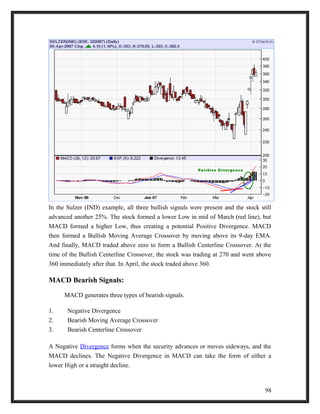
  • 94.
    In the abovechart red line shows Exponential moving Average and blue line indicates Simple Moving Average for 20 days. Every previous closing price in the data set is used in the calculation of each EMA that makes up the EMA line. While the impact of older data points diminishes over time, it never fully disappears whatever may be the duration of the EMA. The effects of older data diminish rapidly for shorter EMAs than for longer ones but, again, they never completely disappear. EMA Vs SMA: The difference between an exponential moving average and a simple moving average is minimal. The exponential moving average is consistently closer to the actual price. On average, the EMA is 3/8 of a point closer to the actual price than the SMA. Sometimes exponential moving averages are used for shorter time periods to capture changes quicker. Sometimes simple moving averages are preferred for long time periods to identify long-term trend changes. Moving average type and length of time depends greatly on the individual security and how it has reacted in the past. The more sensitive an indicator is, the more signals that will be given. These signals may prove timely, but with increased sensitivity leads to an increase in false signals. The less sensitive an indicator is, the fewer signals that will be given. The less sensitivity leads to fewer and more reliable signals. Sometimes these signals can be late as well. 94
  • 95.
    The EMA, whichis generally more sensitive than the SMA, is also likely to generate more signals. Longer moving averages will move slower and generate fewer signals. Because moving averages follow the trend, they work best when a security is trending and are ineffective when a security moves in a trading range. If price movements are choppy and volatile over an extended period of time, then a moving average is probably not the best choice for analysis. The more volatility there is, the more smoothing that will be required and hence the longer the moving average. Stocks that do not exhibit strong characteristics of trend may also require longer moving averages. There is no one set length, but some of the more popular lengths include 21, 50, 89, 150 and 200 days as well as 10, 30 and 40 weeks. Exponential moving averages are usually best for short-term situations. Simple moving averages work well for longer-term situations. Uses of Moving Averages: The three basic uses of moving averages are: 1. Trend identification/confirmation There are three ways to identify the direction of the trend with moving averages: direction, location and crossovers. The first trend identification technique uses the direction of the moving average to determine the trend. If the moving average is rising, the trend is considered up. If the moving average is declining, the trend is considered down. The second technique for trend identification is price location. The location of the price relative to the moving average can be used to determine the basic trend. If the price is above the moving average, the trend is considered up. If the price is below the moving average, the trend is considered down. Buy and sell signals are generated by crosses above and below the moving average. The third technique for trend identification is based on the location of the shorter moving average relative to the longer moving average. If the shorter moving average is above the longer moving average, the trend is considered up. If the shorter moving average is below the longer moving average, the trend is considered down. 2. Support and Resistance level identification/confirmation 95
  • 96.
    Another use isto identify support and resistance levels. This is usually accomplished with one moving average. As with trend identification, support and resistance level identification through moving averages works best in trending markets. 2. Moving Average Convergence / Divergence: (MACD) Moving Average Convergence/Divergence (MACD) is one of the simplest and most reliable indicators available. MACD uses moving averages, which are lagging indicator. These lagging indicators are turned into a momentum oscillator by subtracting the longer moving average from the shorter moving average. The resulting plot forms a line that oscillates above and below zero, without any upper or lower limits. MACD is a centered oscillator. MACD is the difference between a security's 26-day and 12-day Exponential Moving Averages (EMAs). Using shorter moving averages will produce a quicker, more responsive indicator, while using longer moving averages will produce a slower indicator. Of the two moving averages that make up MACD, the 12-day EMA is the faster and the 26-day EMA is the slower. Closing prices are used to form the moving averages. Usually, a 9-day EMA of MACD is plotted to act as a trigger line. A bullish crossover occurs when MACD moves above its 9-day EMA, and a bearish crossover occurs when MACD moves below its 9-day EMA. The histogram represents the difference between MACD and its 9-day EMA. The histogram is positive when MACD is above its 9-day EMA and negative when MACD is below its 9-day EMA. If MACD is positive and rising, then the gap between the 12-day EMA and the 26-day EMA is widening. This indicates that the rate-of-change of the faster moving average is higher than the rate-of-change for the slower moving average. If MACD is negative and declining further, then the negative gap between the faster moving average and the slower moving average is expanding. Downward momentum is increasing, indicating a bearish period of security. MACD centerline crossovers occur when the faster moving average crosses the slower moving average. MACD Bullish Signals: MACD generates three types of bullish signals: 96
  • 97.
    1. Positive Divergence 2. Bullish Moving Average Crossover 3. Bullish Centerline Crossover 1. Positive Divergence: A Positive Divergence occurs when MACD begins to advance and the security is still in a downtrend and makes a lower reaction low. MACD can either form as a series of higher Lows or a second Low that is higher than the previous Low. Positive Divergences are usually the most reliable, and lead to the biggest moves. 2. Bullish Moving Average Crossover: A Bullish Moving Average Crossover occurs when MACD moves above its 9- day EMA, or trigger line. Bullish Moving Average Crossovers are used occasionally to confirm a positive divergence. The second Low or higher Low of a positive divergence can be considered valid when it is followed by a Bullish Moving Average Crossover. Sometimes filters can be used with MACD. An example of a price filter would be to buy if MACD breaks above the 9-day EMA and remains above for three days. The buy signal would then commence at the end of the third day. 3. Bullish Centerline Crossover: A Bullish Centerline Crossover occurs when MACD moves above the zero line and into positive territory. This is a clear indication that momentum has changed from negative to positive, or from bearish to bullish. After a Positive Divergence and Bullish Centerline Crossover, the Bullish Centerline Crossover can act as a confirmation signal. 97
  • 98.
    In the Sulzer(IND) example, all three bullish signals were present and the stock still advanced another 25%. The stock formed a lower Low in mid of March (red line), but MACD formed a higher Low, thus creating a potential Positive Divergence. MACD then formed a Bullish Moving Average Crossover by moving above its 9-day EMA. And finally, MACD traded above zero to form a Bullish Centerline Crossover. At the time of the Bullish Centerline Crossover, the stock was trading at 270 and went above 360 immediately after that. In April, the stock traded above 360. MACD Bearish Signals: MACD generates three types of bearish signals. 1. Negative Divergence 2. Bearish Moving Average Crossover 3. Bearish Centerline Crossover A Negative Divergence forms when the security advances or moves sideways, and the MACD declines. The Negative Divergence in MACD can take the form of either a lower High or a straight decline. 98
  • 99.
    There are twopossible means of confirming a Negative Divergence. First, the indicator can form a lower Low. Second, a Bearish Moving Average Crossover can act to confirm a negative divergence. When MACD breaks below its 9-day EMA, it signals that the short-term trend for the indicator is weakening. A Bearish Moving Average Crossover occurs when MACD declines below its 9-day EMA. A Bearish Centerline Crossover occurs when MACD moves below zero and into negative territory. This is a clear indication that momentum has changed from positive to negative, or from bullish to bearish. The centerline crossover can act as an independent signal, or confirm a prior signal such as a moving average crossover or negative divergence. Once MACD crosses into negative territory, momentum, at least for the short term, has turned bearish. If MACD is positive for many weeks, begins to trend down, and then crosses into negative territory, it would be bearish. However, if MACD has been negative for a few months, breaks above zero, and then back below, it might be a correction. 99
  • 100.
    In 2006, DSKulkarni dropped from above 440 to below 340 in a few months. Looking at the technical chart we can observe following: 1. In December, a negative divergence formed in MACD. 2. Chaikin Money Flow turned negative on December 27. 3. Also in mid December, a Bearish Moving Average Crossover occurred in MACD (red line). 4. A Bearish Centerline Crossover occurred in MACD on 15 Jan (green circle). 5. On 12 February, support at 280 was broken. MACD Histogram: The MACD-Histogram represents the difference between the MACD and its trigger line, the 9-day EMA of MACD. The plot of this difference is presented as a histogram. A centerline crossover for the MACD-Histogram is the same as a moving average crossover for MACD. If the value of MACD is larger than the value of its 9-day EMA, then the value on the MACD-Histogram will be positive. Conversely, if the value of MACD is less than its 9- day EMA, then the value on the MACD-Histogram will be negative. Sharp increases in the MACD-Histogram indicate that MACD is rising faster than its 9- day EMA and bullish momentum is strengthening. Sharp declines in the MACD-Histogram indicate that MACD is falling faster than its 9-day EMA and bearish momentum is increasing. 100
  • 101.
    Usually a movein the MACD is preceded by a corresponding divergence in the MACD-Histogram. 1. The first point shows a sharp positive divergence in the MACD-Histogram that preceded a Bullish Moving Average Crossover. 2. On the second point, the MACD continued to new Highs but the MACD-Histogram formed two equal Highs. 3. A Positive Divergence formed when the MACD-Histogram formed a higher Low and the MACD continued lower. 4. A Negative Divergence formed when the MACD-Histogram formed a lower High and the MACD continued higher. The main signal generated by the MACD-Histogram is a divergence followed by a moving average crossover. A bullish signal is generated when a Positive Divergence forms and there is a Bullish Centerline Crossover. A bearish signal is generated when there is a Negative Divergence and a Bearish Centerline Crossover. Keep in mind that a centerline crossover for the MACD-Histogram represents a moving average crossover for the MACD. Divergences appear in the MACD-Histogram before MACD moving average crossovers do. 101
  • 102.
    3. Average directionalIndex (ADX): Average Directional Index (ADX) was established to evaluate the strength of a current trend, be it up or down. It's important to determine whether the market is trending or trading (moving sideways). The ADX is an oscillator that fluctuates between 0 and 100. Even though the scale is from 0 to 100, readings above 60 are relatively rare. Low readings, below 20, indicate a weak trend and high readings, above 40, indicate a strong trend. The indicator does not grade the trend as bullish or bearish, but only assesses the strength of the current trend. A reading above 40 can indicate a strong downtrend as well as a strong uptrend. When ADX begins to strengthen from below 20 and moves above 20, it is a sign that the trading range is ending and a trend is developing. When ADX begins to weaken from above 40 and moves below 40, it is a sign that the current trend is losing strength and a trading range could develop. Positive / Negative directional Indicators: The ADX is derived from two other indicators, called the Positive Directional Indicator (sometimes written +DI) and the Negative Directional Indicator (-DI). ADX is the thick black line with less fluctuation, +DI is green and -DI is red. +DI measures the force of the up moves and -DI measures the force of the down moves over a period. Buy and sell signals can be generated by +DI/-DI crosses. A buy signal occurs when +DI moves above -DI and a sell signal when -DI moves above the +DI. As ADX uses both +DI and -DI, ADX does not offer any indication of trend direction, just strength. Generally, readings above 40 indicate a strong trend and readings below 20 a weak trend. 102
  • 103.
    Above chart ofIFCI shows that current trend in stock strong and ADX moved above 40 which is an indication of strong trend. Momentum Indicators: 1. Rate Of Change (ROC): The Rate of Change (ROC) indicator is a momentum oscillator that measures the percent change in price from one period to the next. The ROC calculation compares the current price with the price n periods ago. ROC = ( (Today's close - Close n periods ago) / (Close n periods ago) ) * 100 The plot forms an oscillator that fluctuates above and below the zero line as the Rate of Change moves from positive to negative. 103
  • 104.
    The chart ofTata Steel shows that negative divergence formed in Dec-06 and the ROC moved into negative territory just before the decline. Similarly a positive divergence was formed in mid Feb-07 which indicated rally in February. 2. RSI (Relative Strength Index): Relative Strength Index (RSI) is one of the momentum oscillators. The RSI compares the magnitude of a stock's recent gains to the magnitude of its recent losses and turns that information into a number that ranges from 0 to 100. It takes only the number of time periods to use in the calculation. The RSI only needs one stock to be computed. 104
  • 105.
    When the AverageGain is greater than the Average Loss, the RSI rises because RS will be greater than 1. Conversely, when the average loss is greater than the average gain, the RSI declines because RS will be less than 1. The indicator oscillates between 0 and 100 If the Average Loss ever becomes zero, RSI becomes 100 by definition. Use Of RSI: Overbought/ Oversold Levels: For RSI, 70 and 30 and overbought and oversold levels respectively. If the RSI rises above 30 it is considered bullish for the stock. If the RSI falls below 70, it is a bearish signal. Divergences: Buy and sell signals can also be generated by looking for positive and negative divergences between the RSI and the stock. For example, consider a falling stock whose RSI rises from a low point of (for example) 15 back up to say, 55. Because of how the RSI is constructed, the underlying stock will often reverse its direction soon after such a divergence. As in that example, divergences that occur after an overbought or oversold reading usually provide more reliable signals. Centerline Crossover: The centerline for RSI is 50. Readings above and below can give the indicator a bullish or bearish signal. A reading above 50 indicates that average gains are higher than average losses and a reading below 50 indicates that losses are winning the battle. Many traders/investors look for a move above 50 to confirm bullish signals or a move below 50 to confirm bearish signals. 105
  • 106.
    The Multi Arcexample shows extreme readings as well as positive divergence. In Nov- 06, RSI reached oversold levels to mark the low around 43. The next extreme reading (oversold) occurred in Feb-07. RSI reached oversold levels in late March-07 and moved below 35. A positive divergence with centerline crossover formed in February followed by a rally. 3. Williams % R: Williams %R is a momentum indicator that works much like the Stochastic Oscillator. It is especially popular for measuring overbought and oversold levels. The scale ranges from 0 to -100 with readings from 0 to -20 considered overbought, and readings from -80 to -100 considered oversold. William %R, sometimes referred to as %R, shows the relationship of the close relative to the high-low range over a set period of time. The nearer the close is to the top of the range, the nearer to zero (higher) the indicator will be. The nearer the close is to the bottom of the range, the nearer to -100 (lower) the indicator will be. If the close equals the high of the high-low range, then the indicator will show 0 (the highest reading). If the close equals the low of the high-low range, then the result will be -100 (the lowest reading). %R = [(highest high over ? periods - close)/(highest high over ? periods - lowest low over ? periods)] * -100 106
  • 107.
    Williams %R iscalculated using 14 periods and can be used on intraday, daily, weekly or monthly data. The time frame and number of periods can vary. It is important to remember that overbought does not necessarily imply time to sell and oversold does not necessarily imply time to buy. One method might be to wait for Williams %R to cross above or below -50 for confirmations. One method of using Williams %R might be to identify the trend and then look for trading opportunities in the direction of the trend. In an uptrend, traders should look to oversold readings to establish long positions. In a downtrend, traders should look to overbought readings to establish short positions. The chart of Sasken Communications with a 14-day and 28-day Williams %R illustrates some key points:  14-day %R appears quite choppy and prone to false signals.  28-day %R smoothed the data series and the signals became less frequent and more reliable.  When the 28-day %R moved to overbought or oversold levels, it typically remained there for an extended period and the stock continued its trend. 107
  • 108.
     Some goodentry signals were given with the 28-day %R by waiting for a move above or below -50 for confirmation. Bombay Stock Exchange(BSE): The BSE Sensex or Bombay Stock Exchange Sensitive Index is a value-weighted index composed of 30 stocks with the base April 1979 = 100. It consists of the 30 largest and most actively traded stocks, representative of various sectors, on the Bombay Stock Exchange. These companies account for around one-fifth of the market capitalization of the BSE. The base value of the Sensex is 100 on April 1, 1979 and the base year of BSE-SENSEX is 1978-79. At irregular intervals, the Bombay Stock Exchange (BSE) authorities review and modify its composition to make sure it reflects current market conditions. The Bombay Stock Exchange was established in 1875. There are around 3,500 Indian companies listed with the stock exchange, and has a significant trading volume. At October 2006, the market capitalization of the BSE was about Rs. 33.4 trillion (US $ 730 billion). The BSE SENSEX (SENSitive indEX), also called the "BSE 30", is a widely used market index in India and Asia. As of 2005, it is among the five biggest stock exchanges in the world in terms of transactions volume. 108
  • 109.
    The abbreviated form"Sensex" was coined by Deepak Mohoni around 1990 while writing market analysis columns for some of the business newspapers and magazines. It gained popularity over the next year or two. Apart from BSE SENSEX, which is the most popular stock index in India, BSE uses other stock indices as well: • BSE 500 • BSE 100 • BSE 200 • BSE PSU • BSE MIDCAP • BSE SMLCAP • BSE BANKEX • BSE Teck • BSE Auto • BSE Pharma • BSE Fast Moving Consumer Goods (FMCG) • BSE Consumer Durables • BSE Metal The index has increased by over ten times from June 1990 to today. Using information from April 1979 onwards, the long-run rate of return on the BSE Sensex can be estimated to be 0.52% per week (continuously compounded) with a standard deviation of 3.67%. This translates to 27% per annum, which translates to roughly 18% per annum after compensating for inflation. Sensex Milestones: The Sensex crossed the 1,000 mark on July 25, 1990; the 2,000 mark on January 15, 1992; the 3,000 mark on February 29, 1992; the 4,000 mark on March 30, 1992; the 5,000 mark on October 11, 1999; the 6,000 mark on January 2, 2004; the 7,000 mark on June 21, 2005; the 8,000 mark on September 8, 2005; the 9,000 mark on December 09, 2005; and finally the historic 10,000 mark on February 7, 2006. It created another landmark when it touched 11,000 on March 27, 2006. The Sensex closed at a high of 12,903 on 28 Oct 2006. To reach from the 11,000 mark to the 12,000 mark only took 19 109
  • 110.
    working days, theshortest time interval for a 1000 points climb in BSE Sensex history, surpassing the just set record of 29 days that it took to reach 11,000 from 10,000. · 1000, July 25, 1990 - On July 25, 1990, the Sensex touched the four-digit figure for the first time and closed at 1,001 in the wake of a good monsoon and excellent corporate results. · 2000, January 15, 1992 - On January 15, 1992, the Sensex crossed the 2,000- mark and closed at 2,020 followed by the liberal economic policy initiatives undertaken by the then finance minister and current Prime Minister Dr Manmohan Singh. · 3000, February 29, 1992 - On February 29, 1992, the Sensex surged past the 3000 mark in the wake of the market-friendly Budget announced by the then Finance Minister, Dr Manmohan Singh. · 4000, March 30, 1992 - On March 30, 1992, the Sensex crossed the 4,000-mark and closed at 4,091 on the expectations of a liberal export-import policy. It was then that the Harshad Mehta scam hit the markets and Sensex witnessed unabated selling. · 5000, October 11, 1999 - On October 8, 1999, the Sensex crossed the 5,000- mark as the BJP-led coalition won the majority in the 13th Lok Sabha election. · 6000, February 11, 2000 - On February 11, 2000, the InfoTech boom helped the Sensex to cross the 6,000-mark and hit and all time high of 6,006. · 7000, June 21, 2005 - On June 20, 2005, the news of the settlement between the Ambani brothers boosted investor sentiments and the scrips of RIL, Reliance Energy, Reliance Capital and IPCL made huge gains. This helped the Sensex crossed 7,000 points for the first time. · 8000, September 8, 2005 - On September 8, 2005, the Bombay Stock Exchange's benchmark 30-share index -- the Sensex -- crossed the 8000 level following brisk buying by foreign and domestic funds in early trading. · 9000, December 09, 2005 - The Sensex on November 28, 2005 crossed 9000 to touch 9000.32 points during mid-session at the Bombay Stock Exchange on the back of frantic buying spree by foreign institutional investors and well supported by local operators as well as retail investors. · 10,000, February 7, 2006 - The Sensex on February 6, 2006 touched 10,003 points during mid-session. The Sensex finally closed above the 10K-mark on February 7, 2006. 110
  • 111.
    · 11,000, March27, 2006 - The Sensex on March 21, 2006 crossed 11,000 and touched a life-time peak of 11,001 points during mid-session at the Bombay Stock Exchange for the first time. However, it was on March 27, 2006 that the Sensex first closed at over 11,000 points. · 12,000, April 20, 2006 - The Sensex on April 20, 2006 crossed 12,000 and touched a life-time peak of 12,004 points during mid-session at the Bombay Stock Exchange for the first time. · 13,000, October 30, 2006 - The Sensex on October 30, 2006 crossed 13,000 and still riding high at the Bombay Stock Exchange for the first time. It took 135 days to reach 13,000 from 12,000. And 124 days to reach 13,000 from 12,500. On 30th October 2006 it touched a peak of 13,039.36 & closed at 13,024.26. · 14,000, December 5, 2006 - The Sensex on December 5, 2006 crossed 14,000 and touched a life-time peak of 14028 at 9.58AM (IST) while opening for the day December 5, 2006. · 15,000, July 06 2007 - The Sensex on July 05, 2007 crossed 15,000 and touched a life-time peak of 15,007in afternoon session On May 22, 2006, the Sensex plunged by a whopping 1100 points during intra-day trading, leading to the suspension of trading for the first time since May 17, 2004. The volatility of the Sensex had caused investors to lose Rs 6 lakh crore ($131 billion) within seven trading sessions. The Finance Minister of India, P. Chidambaram, made an unscheduled press statement when trading was suspended to assure investors that nothing was wrong with the fundamentals of the economy, and advised retail investors to stay invested. When trading resumed after the reassurances of the Reserve Bank of India and the Securities and Exchange Board of India, the Sensex managed to move up 700 points, still 450 points in the red. This is the largest ever intra-day crash (in points terms) in the history of the Sensex.The Sensex eventually recovered from the volatility, and on October 16, 2006, the Sensex closed at an all-time high of 12,928.18 with an intra-day high of 12,953.76. This was a result of increased confidence in the economy and reports that India's manufacturing sector grew by 11.1% in August 2006. SENSEX Calculation Methodology: SENSEX is calculated using the "Free-float Market Capitalization" methodology. As per this methodology, the level of index at any point of time reflects the Free-float market value of 30 component stocks relative to a base period. The market capitalization of a company is determined by multiplying the price of its stock by the number of shares issued by the company. This market capitalization is further multiplied by the free-float factor to determine the free-float market capitalization. The base period of SENSEX is 1978-79 and the base value is 100 index points. This is often indicated by the notation 1978-79=100. The calculation of SENSEX involves 111
  • 112.
    dividing the Free-floatmarket capitalization of 30 companies in the Index by a number called the Index Divisor. The Divisor is the only link to the original base period value of the SENSEX. It keeps the Index comparable over time and is the adjustment point for all Index adjustments arising out of corporate actions, replacement of scrips etc. During market hours, prices of the index scrips, at which latest trades are executed, are used by the trading system to calculate SENSEX every 15 seconds and disseminated in real time. SENSEX Constituents: (As of 10-Jul-07) Name Sector Adj.Factor ACC Ltd. Housing Related 0.60 Bajaj Auto Ltd. Transport Equipments 0.70 Bharat Heavy Electricals Ltd. Capital Goods 0.35 Bharti Airtel Ltd. Telecom 0.35 Cipla Ltd. Healthcare 0.65 Dr Reddy's Laboratories Ltd. Healthcare 0.75 Grasim Industries Ltd. Diversified 0.75 Ambuja Cements Ltd. Housing Related 0.70 HDFC Finance 0.90 HDFC Bank Ltd. Finance 0.80 Hindalco Industries Ltd. Metal,Metal Products & Mining 0.75 Hindustan Unilever Ltd. FMCG 0.50 ICICI Bank Ltd. Finance 1.00 Infosys Technologies Ltd. Information Technology 0.85 ITC Ltd. FMCG 0.70 Larsen & Toubro Limited Capital Goods 0.90 Mahindra & Mahindra Ltd. Transport Equipments 0.80 Maruti Udyog Ltd. Transport Equipments 0.40 NTPC Ltd. Power 0.15 ONGC Ltd. Oil & Gas 0.20 Ranbaxy Laboratories Ltd. Healthcare 0.70 Reliance Communications Ltd Telecom 0.35 Reliance Energy Ltd. Power 0.70 Reliance Industries Ltd. Oil & Gas 0.50 Satyam Computer Services Ltd. Information Technology 0.95 State Bank of India Finance 0.45 Tata Consultancy Services Ltd Information Technology 0.20 Tata Motors Ltd. Transport Equipments 0.60 Tata Steel Ltd. Metal,Metal Products & Mining 0.70 Wipro Ltd. Information Technology 0.20 112
  • 113.
    Beta, R2 ,Volatilityand Returns of SENSEX scrips for one year period (July 2006 - June 2007) Name Beta Value Co-efficient of determination (R2) Avg. Daily Volatility (%) Returns (1 Year) (%) Weightage (%) in SENSEX as on 29/06/07 Free-float Adj. Factor as on 29/06/07 A.C.C. 1.04 0.39 2.16 19.12 1.12 0.60 BAJAJ AUTO 0.74 0.23 2.00 -22.22 1.61 0.70 BHARTI TELEVENTURES 1.04 0.52 1.87 125.93 5.93 0.35 BHEL 1.05 0.47 1.97 57.62 2.82 0.35 CIPLA LTD. 0.82 0.30 1.96 -3.41 1.13 0.65 DR.REDDY'S 0.71 0.28 1.72 2.97 0.88 0.75 GRASIM IND. 0.88 0.36 1.91 36.45 1.94 0.75 GUJARAT AMBUJA CEMENT 0.99 0.35 2.15 25.18 1.41 0.70 HDFC 0.93 0.34 2.08 79.66 4.94 0.90 HDFC BANK 1.03 0.41 2.08 44.61 3.13 0.80 HERO HONDA 0.48 0.12 1.77 -12.96 0.74 0.50 HINDALCO 0.93 0.30 2.20 -8.46 1.58 0.75 HINDUSTAN LEVER 0.89 0.38 1.87 -17.57 2.23 0.50 ICICI BANK 1.13 0.49 2.10 96.00 9.19 1.00 INFOSYS TECHNOLOGIES 0.89 0.50 1.62 25.37 10.01 0.85 ITC LTD. 0.78 0.34 1.73 -15.12 4.36 0.70 LARSEN & TOUBRO 1.17 0.57 2.00 95.80 5.98 0.90 MARUTI UDYOG 1.06 0.53 1.88 -6.83 0.92 0.40 NATIONAL THERMAL POWER 0.63 0.23 1.68 37.19 2.01 0.15 ONGC 0.84 0.39 1.74 22.07 4.13 0.20 113
  • 114.
    RANBAXY LAB. 0.740.26 1.87 -0.41 0.99 0.70 RELIANCE 0.98 0.64 1.59 60.60 12.67 0.50 RELIANCE ENERGY 0.83 0.31 1.95 35.34 1.05 0.70 SATYAM COMPUTER 1.11 0.42 2.22 31.37 3.14 0.95 STATE BANK OF INDIA 1.24 0.53 2.20 109.69 3.86 0.45 TATA CONSULTANCY 0.98 0.52 1.76 32.43 2.40 0.20 TATA MOTORS 1.17 0.51 2.12 -15.70 1.66 0.60 RELIANCE COMMUNICATIONS 1.38 0.54 2.44 107.69 3.96 0.35 TATA STEEL 1.09 0.37 2.31 11.98 2.60 0.70 WIPRO LTD. 1.17 0.52 2.10 0.92 1.62 0.20 114
  • 115.
    The above chartis the daily chart of BSE Sensex for the last one year. Sensex has come down from 14250 to 13600-13700. It has a strong support at 13700 and it has touched it. IT means if it maintains closing above this level then it can again cross 14000 to 14500. Sensex has resistance at 14500. But if it breaks down 13700 then it can come down to 13540, 13310 which are it strong support levels. Indicators like MACD and RSI are in favor of existing short term down trend. But if we look at Fast STO indicator then we can know that %K line (black) has crossed %D line (red line). And it has already near to level of 20. So one can see some upward from here as a reaction rally. 115
  • 116.
    If we lookat weekly chart for the prediction of future of next 2-3 weeks, we can find that Sensex has strong support at 13500. And it has strong resistance at 14000. If we look at indicators then RSI is between 50 and 70. And there is a chance for upward movement from here. MACD Histogram also formed positive divergence and soon MACD line is going to cross trigger line which will be bullish signals for Index. For the next two weeks Sensex can go up to 14500 or it may cross 14500. 116
  • 117.
    National Stock Exchange(NSE): S & P CNX Nifty: S&P CNX Nifty: Nifty is also an adjective of 18th century American theatrical origin, possibly a shortening of "magnificant", and meaning "really good". The S&P CNX Nifty, or simply Nifty is the leading index for large companies on the National Stock Exchange of India. S&P CNX Nifty is a well diversified 50 stock index accounting for 22 sectors of the economy. It is used for a variety of purposes such as benchmarking fund portfolios, index based derivatives and index funds. Ownership and Management Nifty was developed by the economists Ajay Shah and Susan Thomas, then at IGIDR. Later on, it came to be owned and managed by India Index Services and Products Ltd. (IISL), which is a joint venture between NSE and CRISIL. IISL is India's first specialized company focused upon the index as a core product. IISL have a consulting and licensing agreement with Standard & Poor's (S&P), who are world leaders in index services. CNX stands for CRISIL NSE Indices. CNX ensures common branding of indices, to reflect the identities of both the promoters, i.e. NSE and CRISIL. Thus, 'C' stands for CRISIL, 'N' stands for NSE and X stands for Exchange or Index. The S&P prefix belongs to the US-based Standard & Poor's Financial Information Services. o The average total traded value for the last six months of all Nifty stocks is approximately 55.15% of the traded value of all stocks on the NSE. o Nifty stocks represent about 59.49% of the total market capitalization as on Sep 29, 2006. o Impact cost of the S&P CNX Nifty for a portfolio size of Rs.5 million is 0.06% o S&P CNX Nifty is professionally maintained and is ideal for derivatives trading. It is quoted using the symbol NSEI. It is calculated as a weighted average, so changes in the share price of larger companies have more effect. The base is defined as 1000 at the price level of November 3, 1995, at which time the total capitalization was Rs.2,060,000 million. As on 3rd January 2007, Index's value is 4007.40 117
  • 118.
    Criteria for inclusion · Average market capitalization of Rs.5,000 million or more during the last six months. · Liquidity: Cost of transaction (impact cost) of less than 0.75% for more than 90% of trades, over six months. · At least 12% floating stock (not held by promoters of the company or their associates). The Nifty has crossed 4500 as a record mark. Nifty components: This is a chart of companies listed in the S&P CNX Nifty index by market capitalization in Rs. Crores, Days weightage, P/E as of 16 July 2007. Company Market cap (Rs.Cr.) Days Weight PE NIFTY 2327773 100.00 21.65 Reliance Ind 254713 10.94 23.4 ONGC 195442 8.40 12.5 Bharti Artl 164037 7.05 40.4 Reliance Com 114785 4.93 36.3 Tata Consult 113102 4.86 26.8 Infosys Tech 110885 4.76 28.8 ICICI Bank 103327 4.44 33.2 SBI 83319 3.58 18.3 BHEL 79224 3.40 32.8 Wipro 73731 3.17 27.3 SAIL 63340 2.72 10.2 ITC 58577 2.52 21.7 HDFC 52651 2.26 33.5 118
  • 119.
    Reliance Pet 517282.22 0.0 Hind.Unileve 43445 1.87 24.1 Suzlon Enrgy 42296 1.82 48.9 HDFC Bank 38331 1.65 31.3 Tata Steel 37708 1.62 9.0 Sterl.Inds. 35510 1.53 8.1 Satyam Comp 32684 1.40 23.3 Tata Motors 28847 1.24 13.3 Grasim Inds. 26168 1.12 13.3 Maruti Udyog 23832 1.02 15.3 ABB 22983 0.99 61.2 Siemens 22685 0.97 56.8 Bajaj Auto 22493 0.97 18.0 HCL Techno. 22360 0.96 26.4 Ambuja Cemen 20902 0.90 14.2 ACC 20796 0.89 16.8 Hindalco 20702 0.89 8.1 Sun Pharma. 19805 0.85 25.6 M&M 19572 0.84 18.3 Pun.Nat.Bank 18089 0.78 11.7 Cipla 16047 0.69 24.3 Reliance Ene 16002 0.69 20.0 Zee Entert.E 15828 0.68 72.1 Hero Honda 13980 0.60 16.3 VSNL 13681 0.59 29.2 119
  • 120.
    Tata Power 132110.57 19.0 Ranbaxy Lab. 12901 0.55 22.6 BPCL 12027 0.52 3.7 Dr.Reddy's 11340 0.49 11.7 IPCL 10946 0.47 10.6 MTNL 10247 0.44 15.9 Dabur (I) 9243 0.40 32.6 HPCL 8765 0.38 5.6 The Chart of NIFTY shows that currently the index is in down trend. 120
  • 121.
    It has strongsupport levels at 4020, 4000, 3970, 3900. The indicators also support the existing down trend. MACD and RSI are in favor of down trend. MACD had formed negative divergence. ADX indicator shows that –DI is soon going to cross +DI from below with good strength. This shows that the down trend will continue in NIFTY. Weekly chart of the NIFTY shows that the index is trading in a range of 3500 to 4250 for the last 4 to 5 months. RSI is going to be negative. But ADX and MACD are in favor of up trend as MACD had formed positive divergence and ADX is strong in favor of up trend. I can’t say anything about the index for future as the direction of the index is not clear. So we will have to wait for the direction to be clear. 121
  • 122.
    Leading Stocks’ Shortterm & Medium Term Analysis Bharti Airtel Limited:(Medium Term) 122
  • 123.
    As shown inchart,Bharti is in uptrend in medium as well as in short term.The stock has good support at 20-day EMA at around 850-855, and It has very strong support at 90-Day EMA at 800-810.. RSI trendline violation is cause of worry. Stock will consolidate between 850-900 before any further upmove. Bharti Airtel Limited:(Short Term) 123
  • 124.
    Bharti Airtel isin short term uptrend . It is facing strong resistance at 880-900. RSI trendline is in uptrend also MACA 12.22 & Divergence 4.576 is indicators of future upmove. Stock has good support at 13-day EMA around 860 . Infosys Technologies Ltd.(Short Term) 124
  • 125.
    The stock isin short term downtrend. Stock is making lower high n lower bottom. Infosys has broken downtrend line n also RSI-65.02 n MACD 1.972 indicates the short-term downtrend will reverse.. Stock has significantly crossed downtrend line. Infosys should touch 2120-1250 in near term Larson & Toubro Ltd. (Short term) 125
  • 126.
    Stock has moveda lot. The uptrend line slope is very steep. RSI indicates that stock has been highly overbought. LT should come down for consolidation. It has very good support at 13-day EMA 2280-2300. Larson & Toubro Ltd. (Medium term) 126
  • 127.
    The stock wasin upward channel as shown in chart. It was moved away from channel n again came into mail channel. The short term channel is so steep also RSI,MACD indicators indicating stock overbought situation. The stock will consolidate. Stock has support at 2180-2200 n 1950-2000. Reliance Industries Ltd. (Medium term) After sharp up move during April- mid June, In medium term Reliance is uptrernd. Reliance is in consolidation...It has good support at 50-day EMA at 1660-1670.RSI & 127
  • 128.
    MACD are notindicating any clear bearish or bullish signals. Either way movement is possible. Reliance Industries Ltd. (Short term) 128
  • 129.
    Reliance is inshort term chart is consolidating. It is moving narrowly between 1680- 1730.It is moving in very small range.The triangle breakout on either side is possible. REPORT SUMMERY • Technical analysis can help investors in preserving capital and maximizing returns • Profitable chart patterns like head & shoulder top, Saucers, V bottom can help the investor in deciding appropriate time for buying and selling securities • All chart patterns are not followed in single chart • Technical analysis is more effective when used in combination with fundamental analysis. However, although technical analysis is a terrific tool, most agree it is much more effective when used in combination with fundamental analysis. 129
  • 130.
    References: Websites: www.bseindia.com www.nseindia.com www.stockcharts.com www.i-charts.com www.investopedia.com www.traderji.com www.wikipedia.com www.economictimes.com Books: Technical Analysis: ---Capital market Publication 130
  • 131.
  • 132.