Race and
Membership in
American History
An Interdisciplinary Approach
Monday, August 8
Registration
Welcome/Introductions
& Overview of week
Facilitators
Jason Porter, San Diego Museum of Man
Joaquin Ortiz, Museum of Photographic Arts
Mary Hendra, Facing History and Ourselves
Sasha Guzman, Social Justice Humanitas Academy & Facing
History Teacher Leader
Thank you to our sponsors!
8
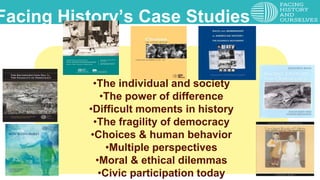
Facing History & Boston Public Schools:Facing History’s Case Studies
•The individual and society
•The power of difference
•Difficult moments in history
•The fragility of democracy
•Choices & human behavior
•Multiple perspectives
•Moral & ethical dilemmas
•Civic participation today
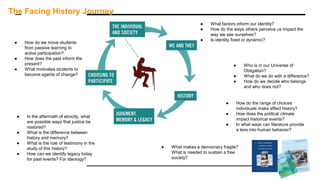
● What factors inform our identity?
● How do the ways others perceive us impact the
way we see ourselves?
● Is identity fixed or dynamic?
● Who is in our Universe of
Obligation?
● What do we do with a difference?
● How do we decide who belongs
and who does not?
● How do the range of choices
individuals make affect history?
● How does the political climate
impact historical events?
● In what ways can literature provide
a lens into human behavior?
● What makes a democracy fragile?
What is needed to sustain a free
society?
● In the aftermath of atrocity, what
are possible ways that justice be
restored?
● What is the difference between
history and memory?
● What is the role of testimony in the
study of this history?
● How can we identify legacy today
for past events? For ideology?
● How do we move students
from passive learning to
active participation?
● How does the past inform the
present?
● What motivates students to
become agents of change?
The Facing History Journey
Ladder of Inference
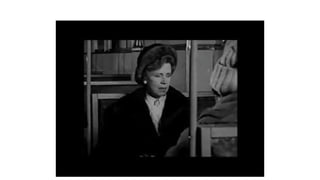
Film: The Lunch Date
Identity Charts
Binna Kandola on bias
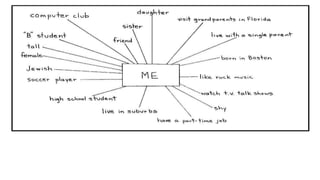
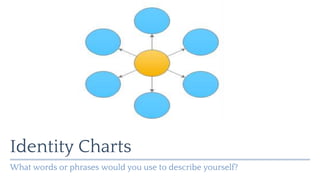
Identity Charts
What words or phrases would you use to describe yourself?
Contracting
Identity and Community
Icebreaker
To look at me you wouldn’t know...
Identity and Community
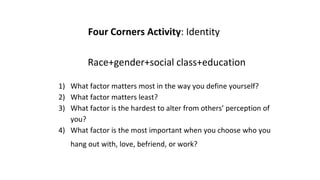
Four Corners Activity: Identity
Race+gender+social class+education
1) What factor matters most in the way you define yourself?

2) What factor matters least?
3) What factor is the hardest to alter from others’ perception of
you?
4) What factor is the most important when you choose who you
hang out with, love, befriend, or work?
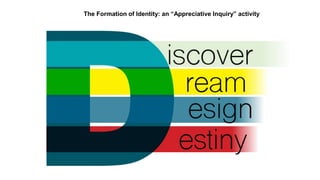
The Formation of Identity: an “Appreciative Inquiry” activity
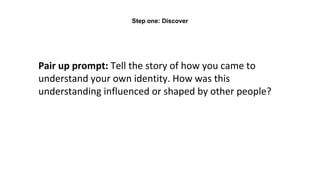
Pair up prompt: Tell the story of how you came to
understand your own identity. How was this
understanding influenced or shaped by other people?
Step one: Discover
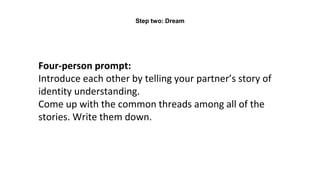
Four-person prompt:
Introduce each other by telling your partner’s story of
identity understanding.
Come up with the common threads among all of the
stories. Write them down.
Step two: Dream
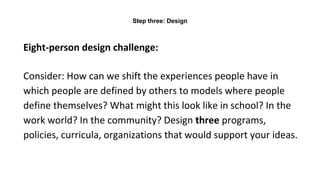
Eight-person design challenge:
Consider: How can we shift the experiences people have in
which people are defined by others to models where people
define themselves? What might this look like in school? In the
work world? In the community? Design three programs,
policies, curricula, organizations that would support your ideas.
Step three: Design
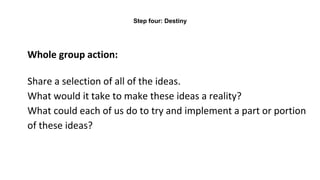
Whole group action:
Share a selection of all of the ideas.
What would it take to make these ideas a reality?
What could each of us do to try and implement a part or portion
of these ideas?
Step four: Destiny
Exploring “race” further
WHAT DIFFERENCES
MATTER?
Individual Identity
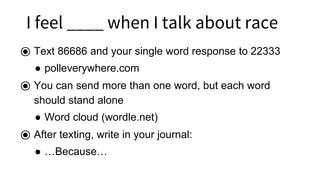
I I feel ____ when I talk about race
⦿ Text 86686 and your single word response to 22333
● polleverywhere.com
⦿ You can send more than one word, but each word
should stand alone
● Word cloud (wordle.net)
⦿ After texting, write in your journal:
● …Because…
Any addition to our own contracting?
Example: When discussing sensitive topics, we agree to...
Strategies:
Word Clouds
http://www.wordclouds.com/
Polleverywhere
https://www.polleverywhere.com/
Pair/Share
⦿ Who is Human –R&M, pg 36-38
⦿ Who is Equal? - R&M, pg 39-42
⦿Notes on the State of Virginia (1781-1785)
Handout
“What do we do with a variation?” (p. 2)
⦿ Connections
● Text-Text, thinking particularly of these three texts
you just read
● Text-Self
● Text-World
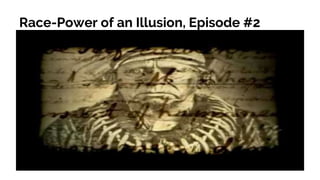
Race-Power of an Illusion, Episode #2
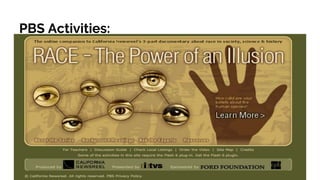
PBS Activities:
MOPA TOUR
Exit Cards

Interdisciplinary seminar day 1

  • 1.
    Race and Membership in AmericanHistory An Interdisciplinary Approach
  • 2.
  • 3.
  • 4.
    Facilitators Jason Porter, SanDiego Museum of Man Joaquin Ortiz, Museum of Photographic Arts Mary Hendra, Facing History and Ourselves Sasha Guzman, Social Justice Humanitas Academy & Facing History Teacher Leader
  • 5.
    Thank you toour sponsors!
  • 8.
  • 9.
    Facing History &Boston Public Schools:Facing History’s Case Studies •The individual and society •The power of difference •Difficult moments in history •The fragility of democracy •Choices & human behavior •Multiple perspectives •Moral & ethical dilemmas •Civic participation today
  • 11.
    ● What factorsinform our identity? ● How do the ways others perceive us impact the way we see ourselves? ● Is identity fixed or dynamic? ● Who is in our Universe of Obligation? ● What do we do with a difference? ● How do we decide who belongs and who does not? ● How do the range of choices individuals make affect history? ● How does the political climate impact historical events? ● In what ways can literature provide a lens into human behavior? ● What makes a democracy fragile? What is needed to sustain a free society? ● In the aftermath of atrocity, what are possible ways that justice be restored? ● What is the difference between history and memory? ● What is the role of testimony in the study of this history? ● How can we identify legacy today for past events? For ideology? ● How do we move students from passive learning to active participation? ● How does the past inform the present? ● What motivates students to become agents of change? The Facing History Journey
  • 12.
    Ladder of Inference Film:The Lunch Date Identity Charts
  • 15.
  • 16.
    Identity Charts What wordsor phrases would you use to describe yourself?
  • 17.
  • 18.
  • 19.
    Icebreaker To look atme you wouldn’t know...
  • 20.
  • 21.
    Four Corners Activity:Identity Race+gender+social class+education 1) What factor matters most in the way you define yourself? 2) What factor matters least? 3) What factor is the hardest to alter from others’ perception of you? 4) What factor is the most important when you choose who you hang out with, love, befriend, or work?
  • 22.
    The Formation ofIdentity: an “Appreciative Inquiry” activity
  • 23.
    Pair up prompt:Tell the story of how you came to understand your own identity. How was this understanding influenced or shaped by other people? Step one: Discover
  • 24.
    Four-person prompt: Introduce eachother by telling your partner’s story of identity understanding. Come up with the common threads among all of the stories. Write them down. Step two: Dream
  • 25.
    Eight-person design challenge: Consider:How can we shift the experiences people have in which people are defined by others to models where people define themselves? What might this look like in school? In the work world? In the community? Design three programs, policies, curricula, organizations that would support your ideas. Step three: Design
  • 26.
    Whole group action: Sharea selection of all of the ideas. What would it take to make these ideas a reality? What could each of us do to try and implement a part or portion of these ideas? Step four: Destiny
  • 27.
  • 28.
  • 29.
    I I feel____ when I talk about race ⦿ Text 86686 and your single word response to 22333 ● polleverywhere.com ⦿ You can send more than one word, but each word should stand alone ● Word cloud (wordle.net) ⦿ After texting, write in your journal: ● …Because…
  • 30.
    Any addition toour own contracting? Example: When discussing sensitive topics, we agree to...
  • 31.
  • 32.
    Pair/Share ⦿ Who isHuman –R&M, pg 36-38 ⦿ Who is Equal? - R&M, pg 39-42 ⦿Notes on the State of Virginia (1781-1785) Handout
  • 33.
    “What do wedo with a variation?” (p. 2) ⦿ Connections ● Text-Text, thinking particularly of these three texts you just read ● Text-Self ● Text-World
  • 34.
    Race-Power of anIllusion, Episode #2
  • 35.
  • 36.
  • 37.