ChoosING
to Participate
In an increasingly interconnected world, it is more important than ever to inspire
people of all ages to create positive social change. All are encouraged to consider
the consequences of our everyday choices—to discover how “little things are
big”—and to make a difference in their own communities.

A poster exhibit to encourage
dialogue, engagement, respect,
and participation in our
communities

Developed by Facing
History and Ourselves and
the Smithsonian Institution
Traveling Exhibition Service
“To bigotry no sanction, to
persecution no assistance”
George Washington, 1790

How has this idea, from a letter
by America’s first President, been
expressed and debated throughout
American history and echoed
throughout the world?
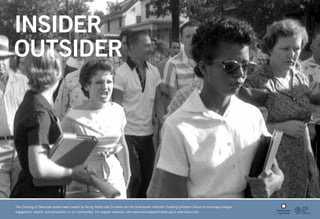
INSIDER
OUTSIDER

Photo courtesy of Will Counts Collection, Indiana University Archives

The Choosing to Participate posters were created by Facing History and Ourselves and the Smithsonian Institution Traveling Exhibition Service to encourage dialogue,
engagement, respect, and participation in our communities. For program resources, visit www.choosingtoparticipate.org or www.sites.si.edu.
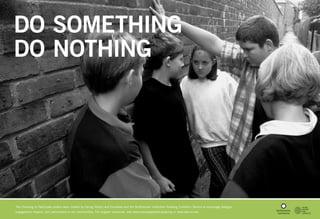
DO SOMETHING
DO NOTHING

The Choosing to Participate posters were created by Facing History and Ourselves and the Smithsonian Institution Traveling Exhibition Service to encourage dialogue,
engagement, respect, and participation in our communities. For program resources, visit www.choosingtoparticipate.org or www.sites.si.edu.
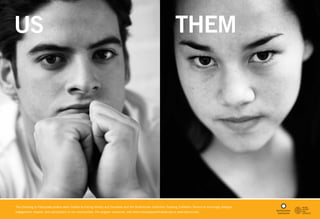
US

THEM

The Choosing to Participate posters were created by Facing History and Ourselves and the Smithsonian Institution Traveling Exhibition Service to encourage dialogue,
engagement, respect, and participation in our communities. For program resources, visit www.choosingtoparticipate.org or www.sites.si.edu.
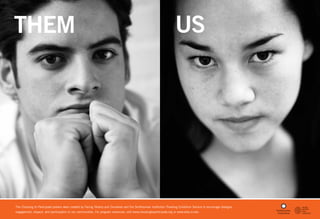
THEM

US

The Choosing to Participate posters were created by Facing History and Ourselves and the Smithsonian Institution Traveling Exhibition Service to encourage dialogue,
engagement, respect, and participation in our communities. For program resources, visit www.choosingtoparticipate.org or www.sites.si.edu.
Choose
Dialogue
EVERYONE
HAS A STORY

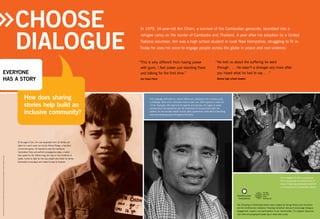
Photo courtesy of Arn Chorn Pond (left), Photos by Chean Long, Courtesy of Cambodian Living Arts (middle and right)

How does sharing
stories help build an
inclusive community?

In 1979, 14-year-old Arn Chorn, a survivor of the Cambodian genocide, stumbled into a
refugee camp on the border of Cambodia and Thailand. A year after his adoption by a United
Nations volunteer, Arn was a high school student in rural New Hampshire, struggling to fit in.
Today he uses his voice to engage people across the globe in peace and non-violence.
“This is very different from having power
with guns. I feel power just standing there
and talking for the first time.”
Arn Chorn Pond

“He told us about the suffering he went
through . . . He wasn’t a stranger any more after
you heard what he had to say . . .”
Boston high school student

From language difficulties to cultural differences, adjusting to life in America was
a challenge. While some classmates tried to reach out, others ignored or made fun
of him. Gradually, with help from his parents and teachers, Arn began to speak
publicly about his experiences and the importance of sharing stories with one
another. He has founded several human rights organizations dedicated to rebuilding
hope and spreading peace throughout the world.

At the age of nine, Arn was separated from his family and
taken to a work camp run by the Khmer Rouge, a fanatical
communist group. He learned to play the traditional
Cambodian flute and perform propaganda songs, a talent
that saved his life. Before long, Arn was on the frontlines of
battle, forced to fight for the very people who killed his family.
Eventually he escaped and made his way to freedom.

Arn’s engagement with young people
often incorporates his boyhood love of
music. Preserving Cambodian traditions
is one focus of his humanitarian efforts.

The Choosing to Participate posters were created by Facing History and Ourselves
and the Smithsonian Institution Traveling Exhibition Service to encourage dialogue,
engagement, respect, and participation in our communities. For program resources,
visit www.choosingtoparticipate.org or www.sites.si.edu.
Choose
RESPECT

CRISIS
IN LITTLE
ROCK

Who is in your
universe of
responsibility?

In 1957, nine African American students were accepted for enrollment to integrate
Central High, one of three all-white high schools in Little Rock, Arkansas. For 17 days
that September, the Arkansas National Guard kept the “Little Rock Nine” from entering
the school, but did nothing to disperse the crowd of angry whites gathered outside.
Riveted to their television sets, Americans nationwide watched the crisis unfold. Finally,
President Dwight Eisenhower sent 1,200 soldiers to Little Rock to protect the African
American students and restore order. The next year, the three integrated high schools
were closed.

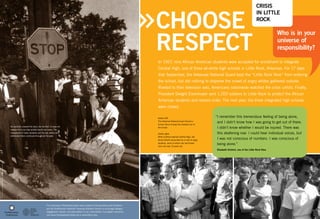
As reporters covered the story, the terrified 15-year-old
headed for a bus stop amidst taunts and jeers. The
harassment of black students and the few whites who
befriended them continued throughout the year.

(below left)
The Arkansas National Guard formed a
human fence to keep the students out of
the school.
(below right)
When Eckford reached Central High, she
found herself surrounded by a mob of angry
students, some of whom she had known
since she was 10 years old.

“I remember this tremendous feeling of being alone,
and I didn’t know how I was going to get out of there.
I didn’t know whether I would be injured. There was
this deafening roar. I could hear individual voices, but
I was not conscious of numbers. I was conscious of
being alone.”

Photos courtesy of Will Counts Collection, Indiana University Archives

Elizabeth Eckford, one of the Little Rock Nine

The Choosing to Participate posters were created by Facing History and Ourselves
and the Smithsonian Institution Traveling Exhibition Service to encourage dialogue,
engagement, respect, and participation in our communities. For program resources,
visit www.choosingtoparticipate.org or www.sites.si.edu.
LITTLE
THINGS ARE
BIG

Choose
ENGAGEMENT
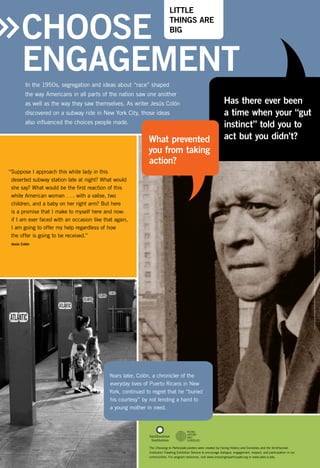
In the 1950s, segregation and ideas about “race” shaped
the way Americans in all parts of the nation saw one another
as well as the way they saw themselves. As writer Jesús Colón
discovered on a subway ride in New York City, those ideas
also influenced the choices people made.

What prevented
you from taking
action?

Has there ever been
a time when your “gut
instinct” told you to
act but you didn’t?

Photo courtesy of The Jesús Colón Papers. Archives of the Puerto Rican Diaspora Centro de Estudios Puertorriqueños, Hunter College, CUNY (right), Steve Brosnahan/RBH Multimedia Inc. (left)

“Suppose I approach this white lady in this
deserted subway station late at night? What would
she say? What would be the first reaction of this
white American woman . . . with a valise, two
children, and a baby on her right arm? But here
is a promise that I make to myself here and now:
if I am ever faced with an occasion like that again,
I am going to offer my help regardless of how
the offer is going to be received.”
Jesús Colón

Years later, Colón, a chronicler of the
everyday lives of Puerto Ricans in New
York, continued to regret that he “buried
his courtesy” by not lending a hand to
a young mother in need.

The Choosing to Participate posters were created by Facing History and Ourselves and the Smithsonian
Institution Traveling Exhibition Service to encourage dialogue, engagement, respect, and participation in our
communities. For program resources, visit www.choosingtoparticipate.org or www.sites.si.edu.
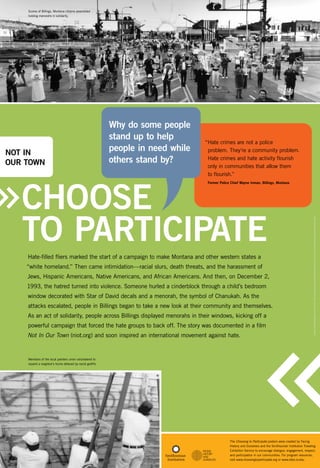
Scores of Billings, Montana citizens assembled
holding menorahs in solidarity.

NOT IN
OUR tOWN

Why do some people
stand up to help
people in need while
others stand by?

“Hate crimes are not a police
problem. They’re a community problem.
Hate crimes and hate activity flourish
only in communities that allow them
to flourish.”

Choose
to Participate

Former Police Chief Wayne Inman, Billings, Montana

“white homeland.” Then came intimidation—racial slurs, death threats, and the harassment of
Jews, Hispanic Americans, Native Americans, and African Americans. And then, on December 2,
1993, the hatred turned into violence. Someone hurled a cinderblock through a child’s bedroom
window decorated with Star of David decals and a menorah, the symbol of Chanukah. As the
attacks escalated, people in Billings began to take a new look at their community and themselves.
As an act of solidarity, people across Billings displayed menorahs in their windows, kicking off a
powerful campaign that forced the hate groups to back off. The story was documented in a film
Not In Our Town (niot.org) and soon inspired an international movement against hate.

Citizens Protesting Antisemitic Acts, Billings, MT, courtesy of the Howard Greenberg Gallery © Frédéric Brenner (top), photo courtesy of the Billings Gazette (bottom)

Hate-filled fliers marked the start of a campaign to make Montana and other western states a

Members of the local painters union volunteered to
repaint a neighbor’s home defaced by racist graffiti.

The Choosing to Participate posters were created by Facing
History and Ourselves and the Smithsonian Institution Traveling
Exhibition Service to encourage dialogue, engagement, respect,
and participation in our communities. For program resources,
visit www.choosingtoparticipate.org or www.sites.si.edu.
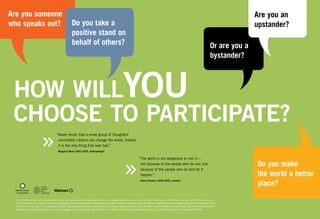
Are you someone
who speaks out?

Are you an
upstander?

Do you take a
positive stand on
behalf of others?

Or are you a
bystander?

HOW WILLYOU
CHOOSE TO PARTICIPATE?
“Never doubt that a small group of thoughtful
committed citizens can change the world. Indeed,
it is the only thing that ever has.”
Margaret Mead (1901-1978), anthropologist

“The world is too dangerous to live in—
not because of the people who do evil, but
because of the people who sit and let it
happen.”
Albert Einstein (1879-1955), scientist

Facing History and Ourselves (www.facinghistory.org) is an educational organization whose mission is to engage students in an examination of racism, prejudice, and antisemitism in order to promote the development
of a more humane and informed citizenry. By studying the historical development of the Holocaust and other examples of genocide, students make the essential connection between history and the moral choices they
confront in their own lives. The Smithsonian Institution Traveling Exhibition Service (www.sites.si.edu) creates tangible connections to the Institution through traveling and virtual exhibits that present the full breadth of
Smithsonian scholarly and collection resources that engage, educate, and inspire. Special thanks to the Walmart Foundation (www.walmartfoundation.org), the National Sponsor of Choosing to Participate.

Do you make
the world a better
place?

Choosing to Participate

  • 1.
    ChoosING to Participate In anincreasingly interconnected world, it is more important than ever to inspire people of all ages to create positive social change. All are encouraged to consider the consequences of our everyday choices—to discover how “little things are big”—and to make a difference in their own communities. A poster exhibit to encourage dialogue, engagement, respect, and participation in our communities Developed by Facing History and Ourselves and the Smithsonian Institution Traveling Exhibition Service
  • 2.
    “To bigotry nosanction, to persecution no assistance” George Washington, 1790 How has this idea, from a letter by America’s first President, been expressed and debated throughout American history and echoed throughout the world?
  • 3.
    INSIDER OUTSIDER Photo courtesy ofWill Counts Collection, Indiana University Archives The Choosing to Participate posters were created by Facing History and Ourselves and the Smithsonian Institution Traveling Exhibition Service to encourage dialogue, engagement, respect, and participation in our communities. For program resources, visit www.choosingtoparticipate.org or www.sites.si.edu.
  • 4.
    DO SOMETHING DO NOTHING TheChoosing to Participate posters were created by Facing History and Ourselves and the Smithsonian Institution Traveling Exhibition Service to encourage dialogue, engagement, respect, and participation in our communities. For program resources, visit www.choosingtoparticipate.org or www.sites.si.edu.
  • 5.
    US THEM The Choosing toParticipate posters were created by Facing History and Ourselves and the Smithsonian Institution Traveling Exhibition Service to encourage dialogue, engagement, respect, and participation in our communities. For program resources, visit www.choosingtoparticipate.org or www.sites.si.edu.
  • 6.
    THEM US The Choosing toParticipate posters were created by Facing History and Ourselves and the Smithsonian Institution Traveling Exhibition Service to encourage dialogue, engagement, respect, and participation in our communities. For program resources, visit www.choosingtoparticipate.org or www.sites.si.edu.
  • 7.
    Choose Dialogue EVERYONE HAS A STORY Photocourtesy of Arn Chorn Pond (left), Photos by Chean Long, Courtesy of Cambodian Living Arts (middle and right) How does sharing stories help build an inclusive community? In 1979, 14-year-old Arn Chorn, a survivor of the Cambodian genocide, stumbled into a refugee camp on the border of Cambodia and Thailand. A year after his adoption by a United Nations volunteer, Arn was a high school student in rural New Hampshire, struggling to fit in. Today he uses his voice to engage people across the globe in peace and non-violence. “This is very different from having power with guns. I feel power just standing there and talking for the first time.” Arn Chorn Pond “He told us about the suffering he went through . . . He wasn’t a stranger any more after you heard what he had to say . . .” Boston high school student From language difficulties to cultural differences, adjusting to life in America was a challenge. While some classmates tried to reach out, others ignored or made fun of him. Gradually, with help from his parents and teachers, Arn began to speak publicly about his experiences and the importance of sharing stories with one another. He has founded several human rights organizations dedicated to rebuilding hope and spreading peace throughout the world. At the age of nine, Arn was separated from his family and taken to a work camp run by the Khmer Rouge, a fanatical communist group. He learned to play the traditional Cambodian flute and perform propaganda songs, a talent that saved his life. Before long, Arn was on the frontlines of battle, forced to fight for the very people who killed his family. Eventually he escaped and made his way to freedom. Arn’s engagement with young people often incorporates his boyhood love of music. Preserving Cambodian traditions is one focus of his humanitarian efforts. The Choosing to Participate posters were created by Facing History and Ourselves and the Smithsonian Institution Traveling Exhibition Service to encourage dialogue, engagement, respect, and participation in our communities. For program resources, visit www.choosingtoparticipate.org or www.sites.si.edu.
  • 8.
    Choose RESPECT CRISIS IN LITTLE ROCK Who isin your universe of responsibility? In 1957, nine African American students were accepted for enrollment to integrate Central High, one of three all-white high schools in Little Rock, Arkansas. For 17 days that September, the Arkansas National Guard kept the “Little Rock Nine” from entering the school, but did nothing to disperse the crowd of angry whites gathered outside. Riveted to their television sets, Americans nationwide watched the crisis unfold. Finally, President Dwight Eisenhower sent 1,200 soldiers to Little Rock to protect the African American students and restore order. The next year, the three integrated high schools were closed. As reporters covered the story, the terrified 15-year-old headed for a bus stop amidst taunts and jeers. The harassment of black students and the few whites who befriended them continued throughout the year. (below left) The Arkansas National Guard formed a human fence to keep the students out of the school. (below right) When Eckford reached Central High, she found herself surrounded by a mob of angry students, some of whom she had known since she was 10 years old. “I remember this tremendous feeling of being alone, and I didn’t know how I was going to get out of there. I didn’t know whether I would be injured. There was this deafening roar. I could hear individual voices, but I was not conscious of numbers. I was conscious of being alone.” Photos courtesy of Will Counts Collection, Indiana University Archives Elizabeth Eckford, one of the Little Rock Nine The Choosing to Participate posters were created by Facing History and Ourselves and the Smithsonian Institution Traveling Exhibition Service to encourage dialogue, engagement, respect, and participation in our communities. For program resources, visit www.choosingtoparticipate.org or www.sites.si.edu.
  • 9.
    LITTLE THINGS ARE BIG Choose ENGAGEMENT In the1950s, segregation and ideas about “race” shaped the way Americans in all parts of the nation saw one another as well as the way they saw themselves. As writer Jesús Colón discovered on a subway ride in New York City, those ideas also influenced the choices people made. What prevented you from taking action? Has there ever been a time when your “gut instinct” told you to act but you didn’t? Photo courtesy of The Jesús Colón Papers. Archives of the Puerto Rican Diaspora Centro de Estudios Puertorriqueños, Hunter College, CUNY (right), Steve Brosnahan/RBH Multimedia Inc. (left) “Suppose I approach this white lady in this deserted subway station late at night? What would she say? What would be the first reaction of this white American woman . . . with a valise, two children, and a baby on her right arm? But here is a promise that I make to myself here and now: if I am ever faced with an occasion like that again, I am going to offer my help regardless of how the offer is going to be received.” Jesús Colón Years later, Colón, a chronicler of the everyday lives of Puerto Ricans in New York, continued to regret that he “buried his courtesy” by not lending a hand to a young mother in need. The Choosing to Participate posters were created by Facing History and Ourselves and the Smithsonian Institution Traveling Exhibition Service to encourage dialogue, engagement, respect, and participation in our communities. For program resources, visit www.choosingtoparticipate.org or www.sites.si.edu.
  • 10.
    Scores of Billings,Montana citizens assembled holding menorahs in solidarity. NOT IN OUR tOWN Why do some people stand up to help people in need while others stand by? “Hate crimes are not a police problem. They’re a community problem. Hate crimes and hate activity flourish only in communities that allow them to flourish.” Choose to Participate Former Police Chief Wayne Inman, Billings, Montana “white homeland.” Then came intimidation—racial slurs, death threats, and the harassment of Jews, Hispanic Americans, Native Americans, and African Americans. And then, on December 2, 1993, the hatred turned into violence. Someone hurled a cinderblock through a child’s bedroom window decorated with Star of David decals and a menorah, the symbol of Chanukah. As the attacks escalated, people in Billings began to take a new look at their community and themselves. As an act of solidarity, people across Billings displayed menorahs in their windows, kicking off a powerful campaign that forced the hate groups to back off. The story was documented in a film Not In Our Town (niot.org) and soon inspired an international movement against hate. Citizens Protesting Antisemitic Acts, Billings, MT, courtesy of the Howard Greenberg Gallery © Frédéric Brenner (top), photo courtesy of the Billings Gazette (bottom) Hate-filled fliers marked the start of a campaign to make Montana and other western states a Members of the local painters union volunteered to repaint a neighbor’s home defaced by racist graffiti. The Choosing to Participate posters were created by Facing History and Ourselves and the Smithsonian Institution Traveling Exhibition Service to encourage dialogue, engagement, respect, and participation in our communities. For program resources, visit www.choosingtoparticipate.org or www.sites.si.edu.
  • 11.
    Are you someone whospeaks out? Are you an upstander? Do you take a positive stand on behalf of others? Or are you a bystander? HOW WILLYOU CHOOSE TO PARTICIPATE? “Never doubt that a small group of thoughtful committed citizens can change the world. Indeed, it is the only thing that ever has.” Margaret Mead (1901-1978), anthropologist “The world is too dangerous to live in— not because of the people who do evil, but because of the people who sit and let it happen.” Albert Einstein (1879-1955), scientist Facing History and Ourselves (www.facinghistory.org) is an educational organization whose mission is to engage students in an examination of racism, prejudice, and antisemitism in order to promote the development of a more humane and informed citizenry. By studying the historical development of the Holocaust and other examples of genocide, students make the essential connection between history and the moral choices they confront in their own lives. The Smithsonian Institution Traveling Exhibition Service (www.sites.si.edu) creates tangible connections to the Institution through traveling and virtual exhibits that present the full breadth of Smithsonian scholarly and collection resources that engage, educate, and inspire. Special thanks to the Walmart Foundation (www.walmartfoundation.org), the National Sponsor of Choosing to Participate. Do you make the world a better place?