Neal Kamsler Upper School Head Steven Cohen  Asst. Upper School Head Facing History and Ourselves International Boys School Conference June 2007 The Allen-Stevenson School New York City
Facing History and Ourselves A course in… Racism Discrimination Citizenship Democracy Heroism …  that uses the Holocaust as a case study
Initial Reasons for Introducing Supported Diversity Work Kept “Seniors” Engaged Intriguing for Boys
Why It Works For Boys Issues of Power Leadership & Heroism Moral Questions Drama / Action Technology Talking & Moving Real
Structure Interdisciplinary English, History, Art Evolution a Process Pass / Fail Meets ≈ 10 hours/week for 7 Weeks Mentors
Structure Case Studies from history Holocaust Armenian Genocide Rwanda
Structure Case Studies from “Ourselves” Current Events Darfur, Child Soldiers, Gay Marriage School Issues Leadership Bullying / Social Cruelty
Requirements Coursework Readings, films, trips, speakers, discussions, journal responses, papers.  Blogs Art Project Faculty Presentation
Pedagogy Case Study Method Socratic / Constructivist Discussion, Observation, Action “ Complicating simple answers to complex questions”
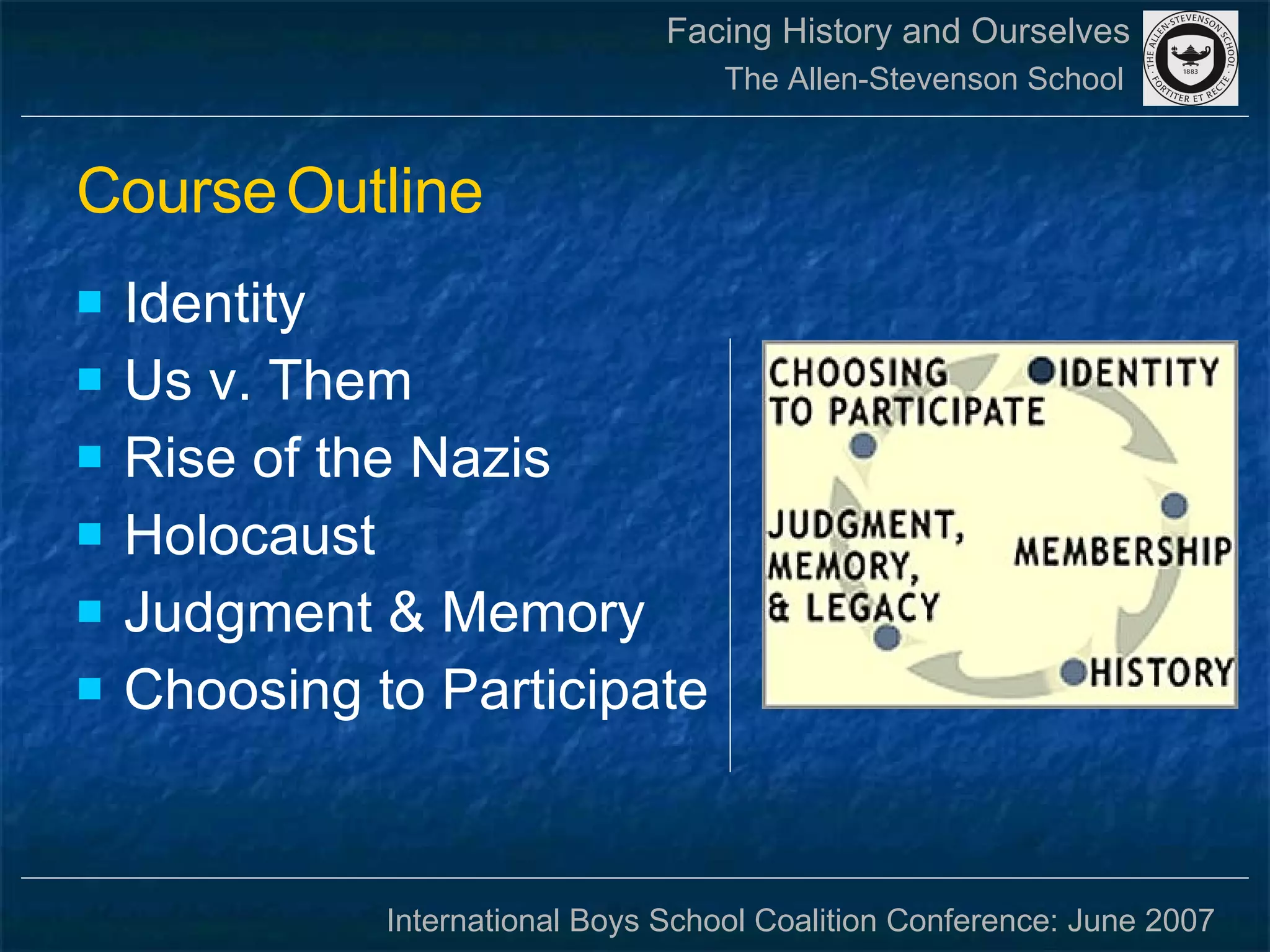
Course   Outline Identity Us v. Them Rise of the Nazis Holocaust Judgment & Memory Choosing to Participate
Unit 1: Identity Essential Questions Who am I?  How do I see myself? How do others see me? What factors influence how I think and behave?
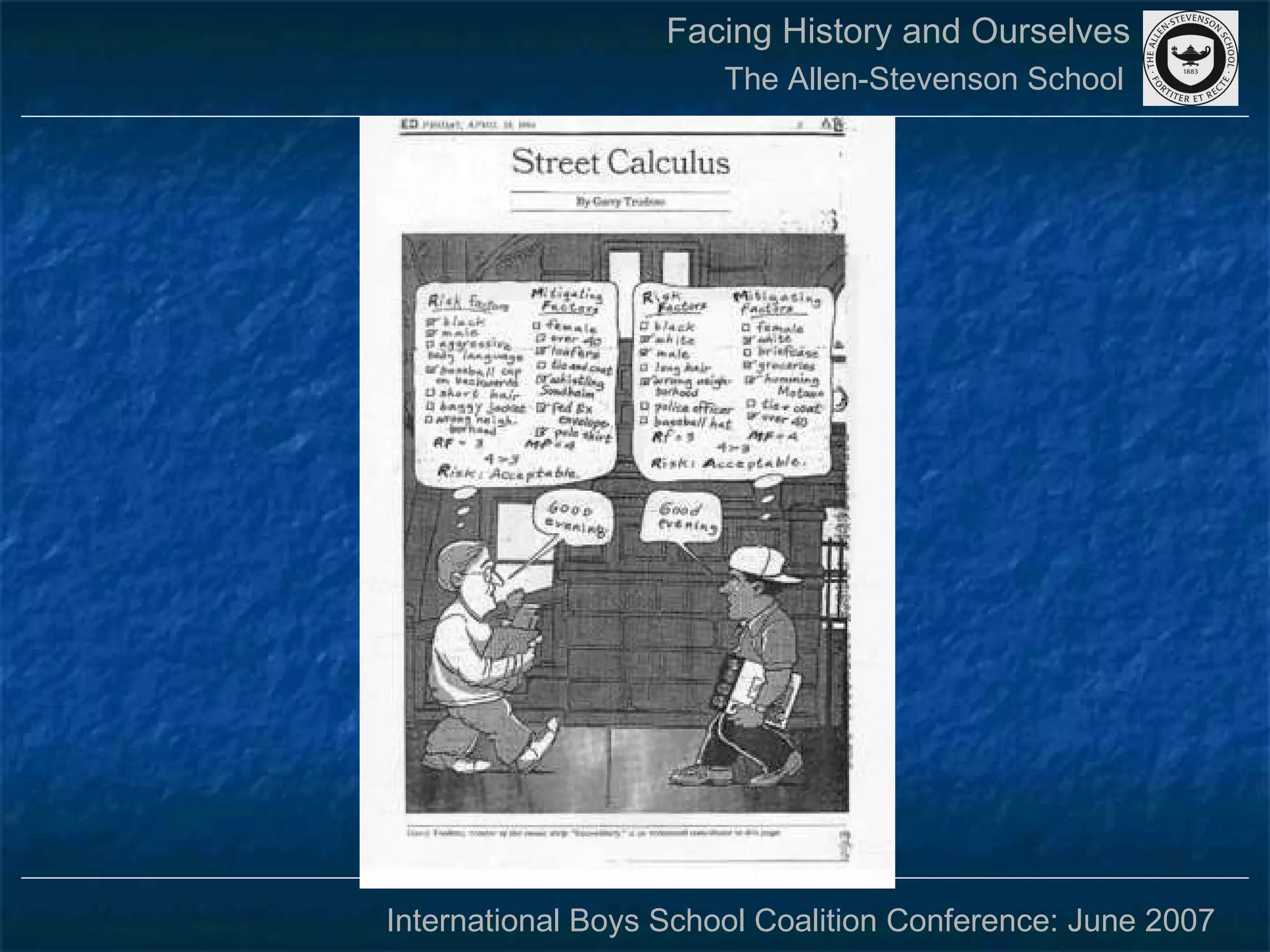
Unit 1: Identity Sample Activities / Texts The Bear That Wasn’t After the First “ If the World Were a Village of a 1,000 People” Ladder of Inference / Stereotyping “ Stolen Bicycle” Eye of the Storm
Identity Charts a Basic Tool Shows how we and others label ourselves Shows points of commonality and difference Exposes our lenses
If the World Were a Village of a 1000 people… How many would be… Christians? Muslims? Jews? Buddhists? Secular / Nonreligious?
 
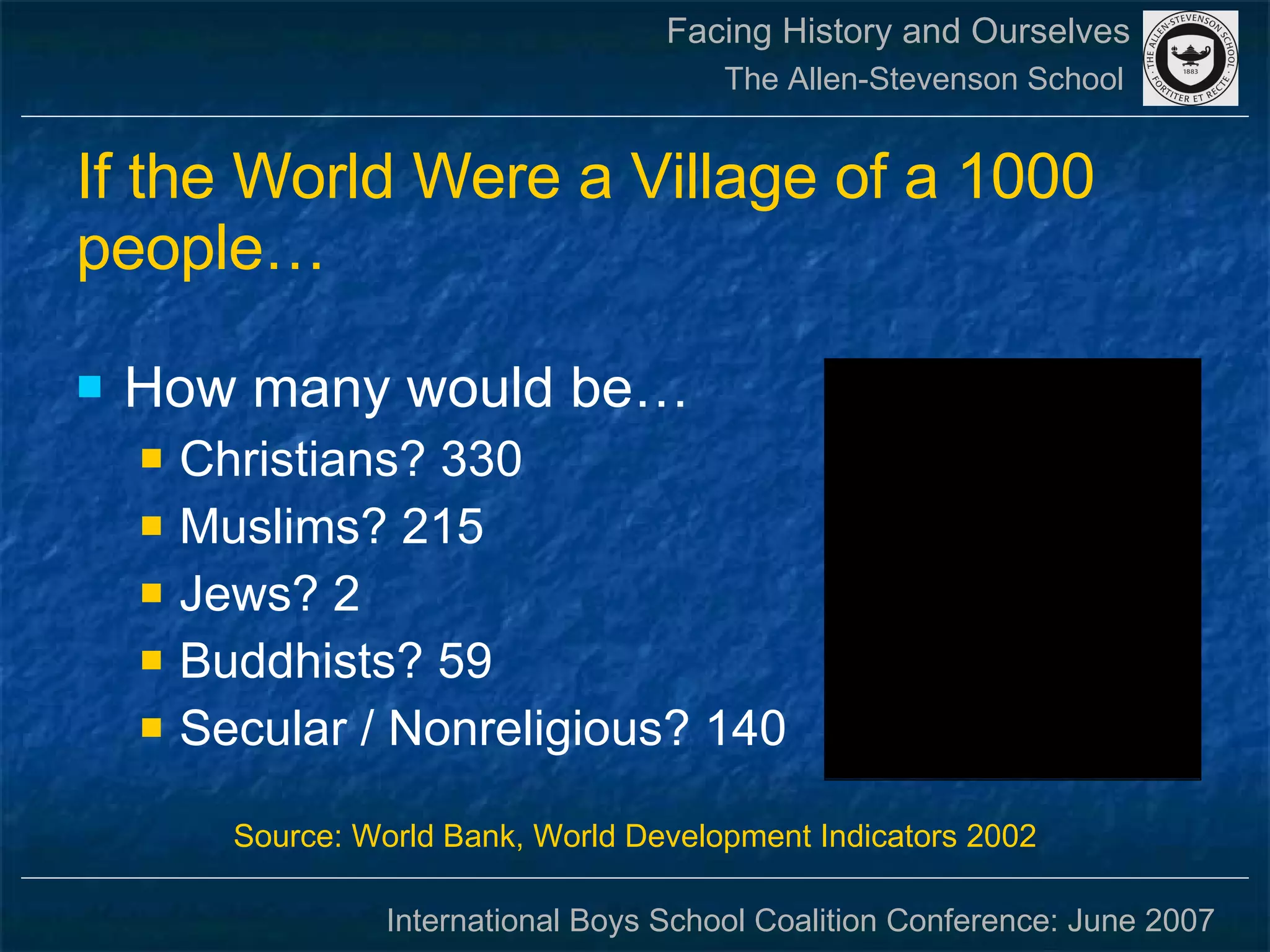
If the World Were a Village of a 1000 people… How many would be… Christians? 330 Muslims? 215 Jews? 2 Buddhists? 59 Secular / Nonreligious? 140 Source: World Bank, World Development Indicators 2002
Unit 2: Us v. Them Essential Questions Where do I belong? Why are some people included and others excluded? How can I belong to a group and still be true to myself? For whom am I responsible?
Unit 2: Us v. Them Sample Activities / Texts Fires in the Mirror “ Harrison Bergeron” Educating Peter Study of  Antisemitism
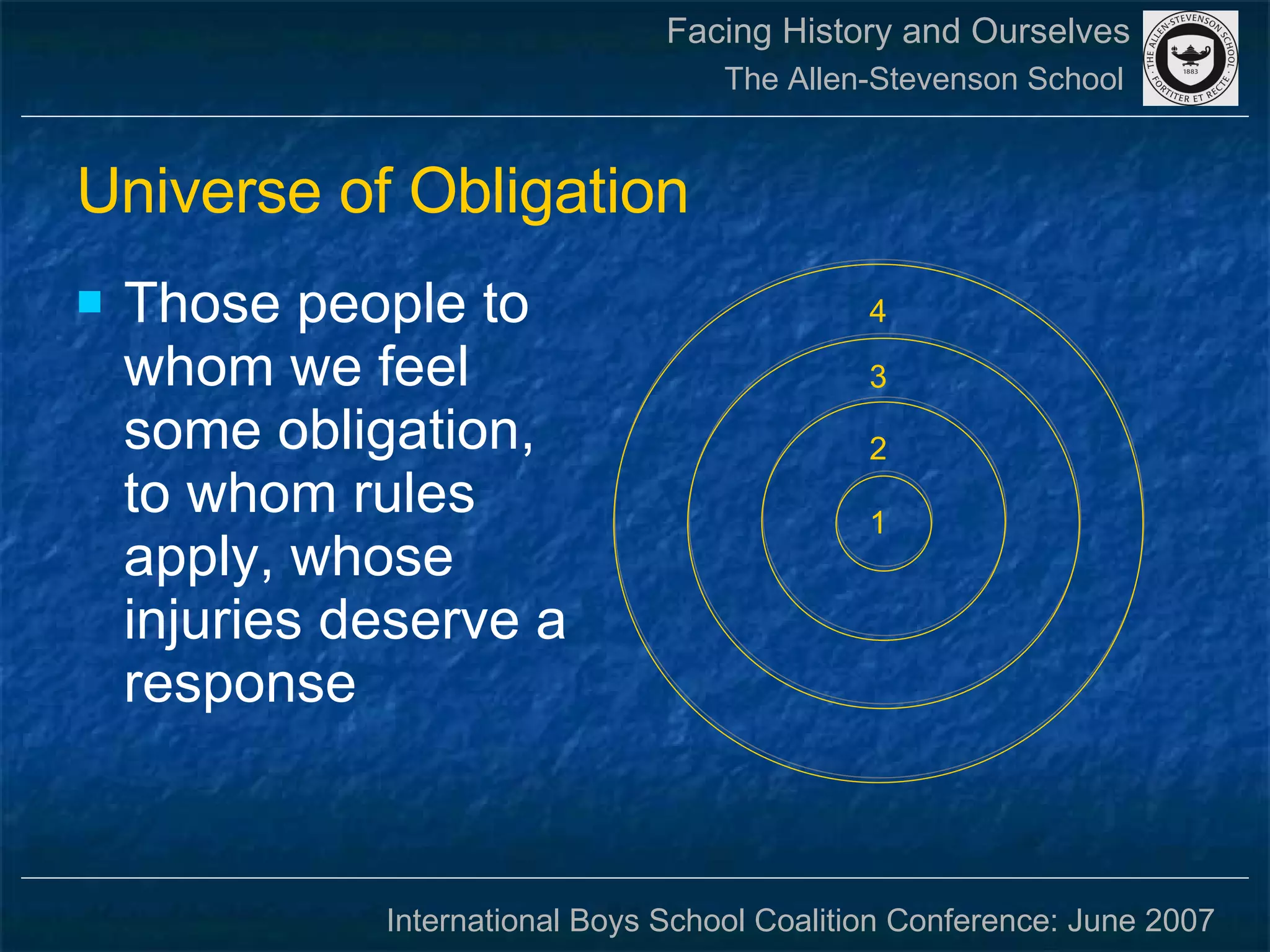
Universe of Obligation Those people to whom we feel some obligation, to whom rules apply, whose injuries deserve a response 1 2 3 4
Unit 3: The Rise of the Nazis Essential Questions:   Why did this happen?  How does prejudice become law? Why didn't people stop it? What could have been done?
Unit 3: The Rise of the Nazis Sample Activities  /  Texts The Wave /  “You Will Do As Directed”  Friedrich Propaganda Study What could have been done?  “ The Hangman,” Maurice Ogden
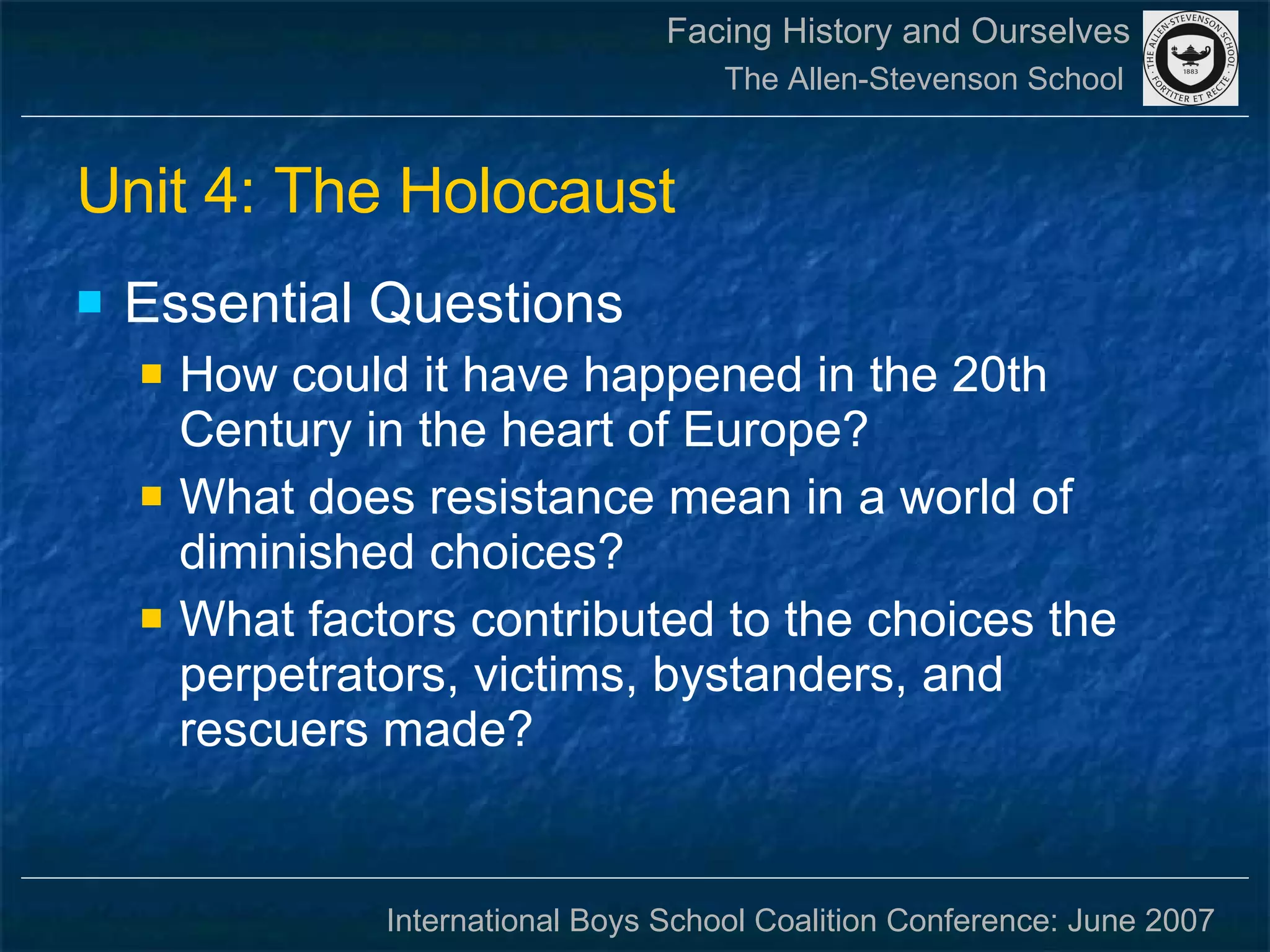
Unit 4: The Holocaust Essential Questions How could it have happened in the 20th Century in the heart of Europe? What does resistance mean in a world of diminished choices? What factors contributed to the choices the perpetrators, victims, bystanders, and rescuers made?
Unit 4: The Holocaust Sample Activities / Texts  Milgram Experiment “ Police Battalion 101  Night Schindler’s List Weapons of the Spirit What Makes a Rescuer?
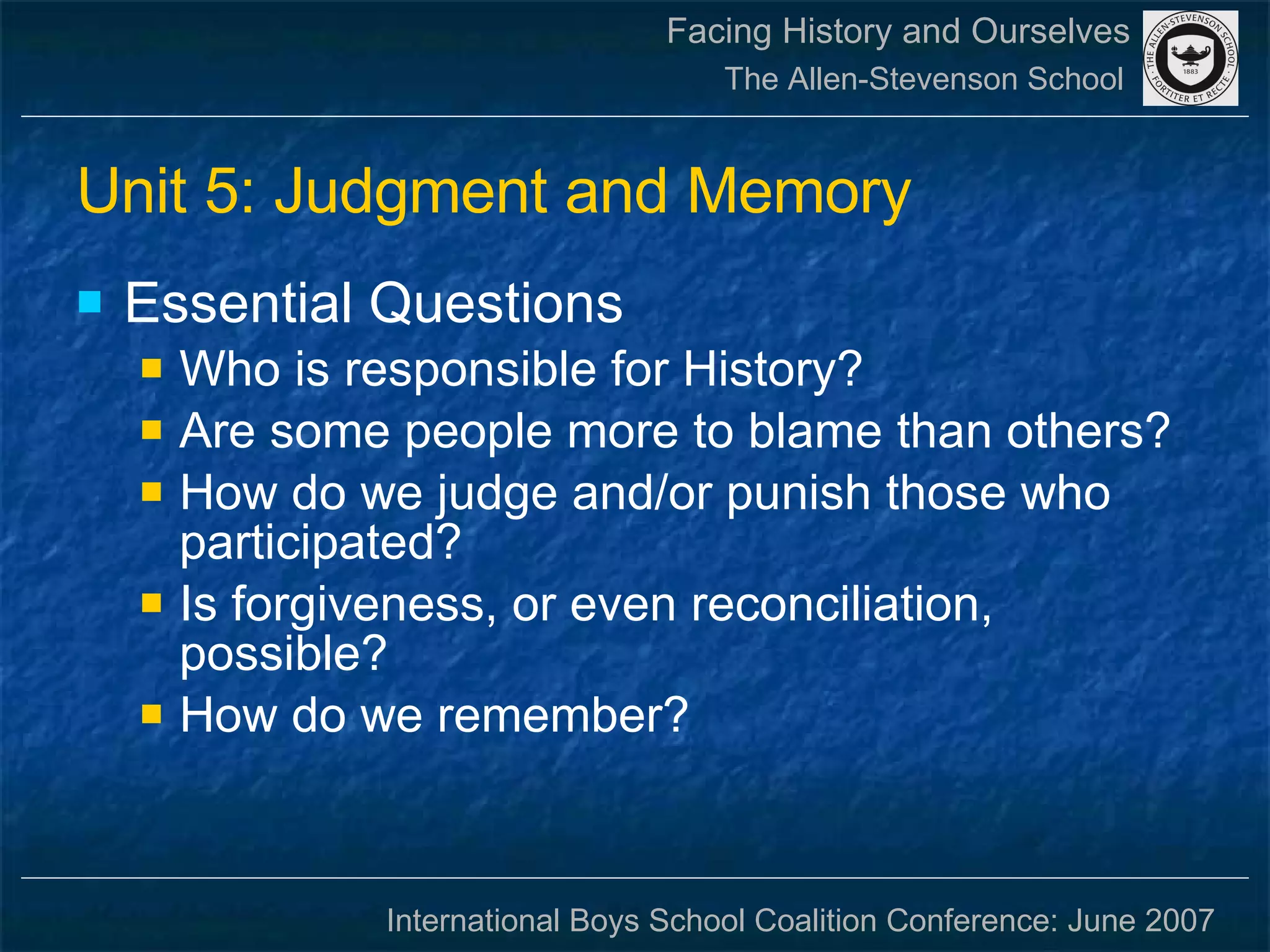
Unit 5: Judgment and Memory Essential Questions Who is responsible for History?  Are some people more to blame than others?  How do we judge and/or punish those who participated?  Is forgiveness, or even reconciliation, possible?  How do we remember?
Unit 5: Judgment and Memory Sample Activities / Texts Confessions of a Hitler Youth The Sunflower Nuremberg
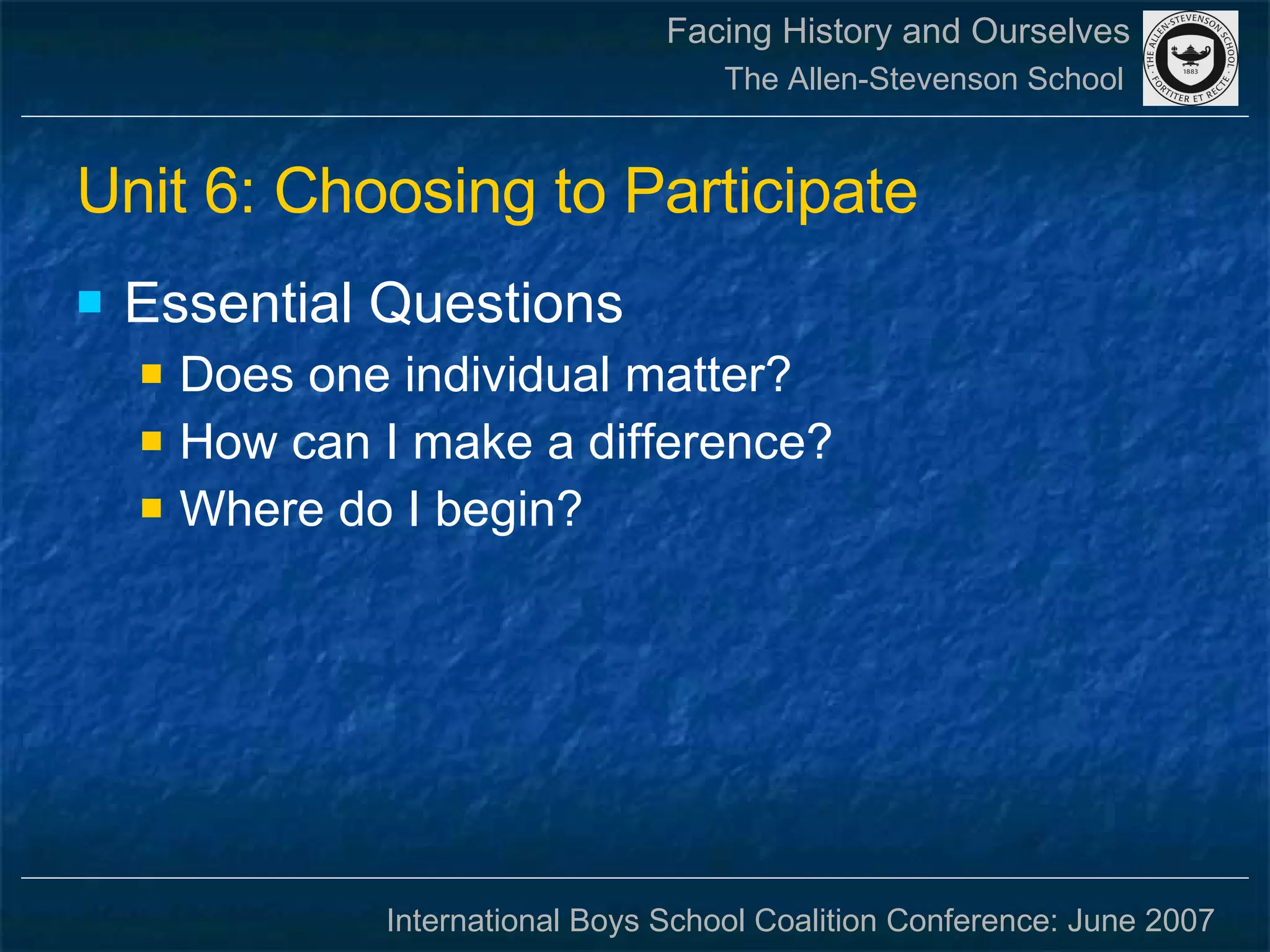
Unit 6: Choosing to Participate Essential Questions Does one individual matter? How can I make a difference? Where do I begin?
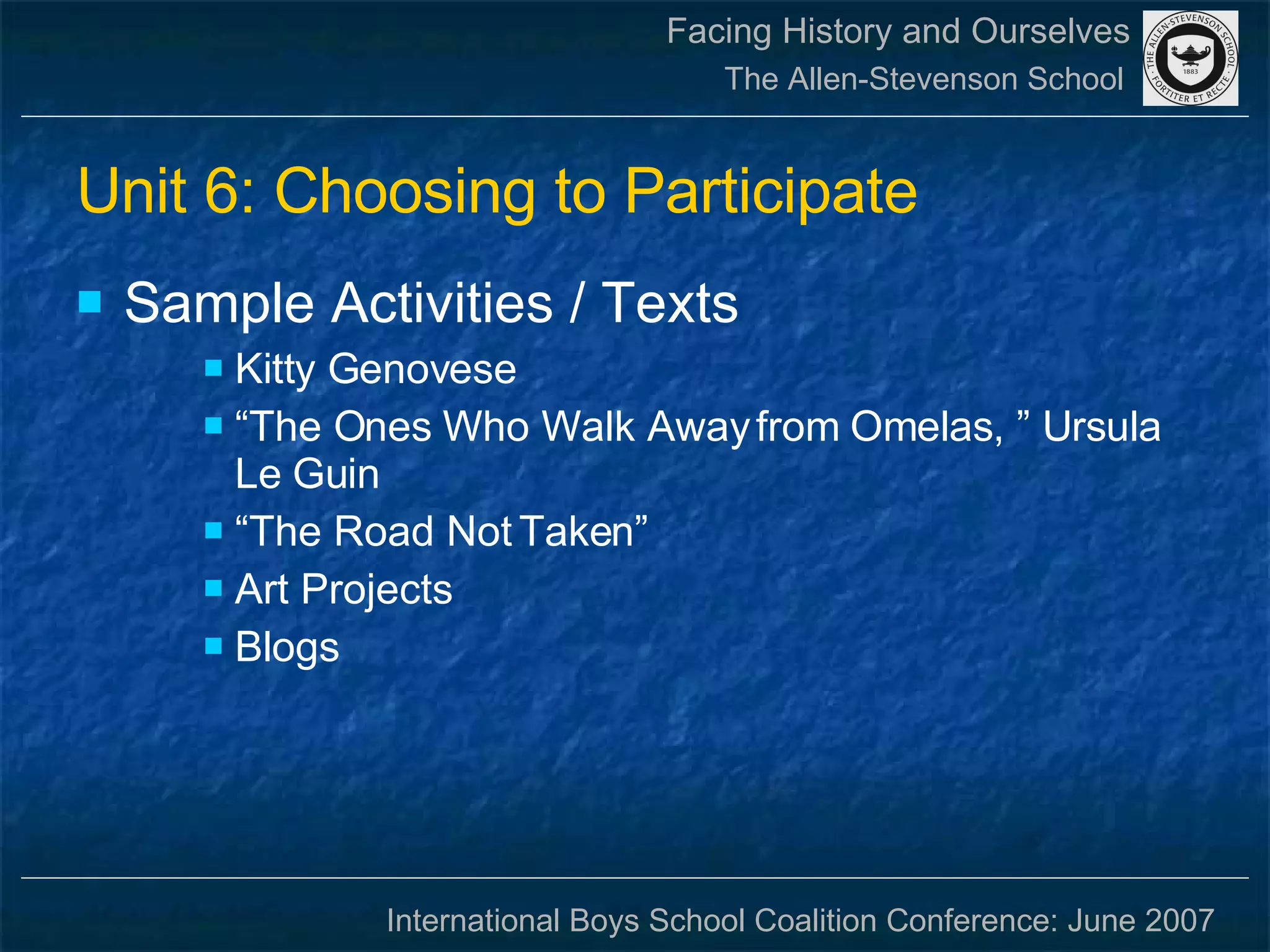
Unit 6: Choosing to Participate Sample Activities / Texts Kitty Genovese “ The Ones Who Walk Away from Omelas, ” Ursula Le Guin “ The Road Not Taken” Art Projects Blogs
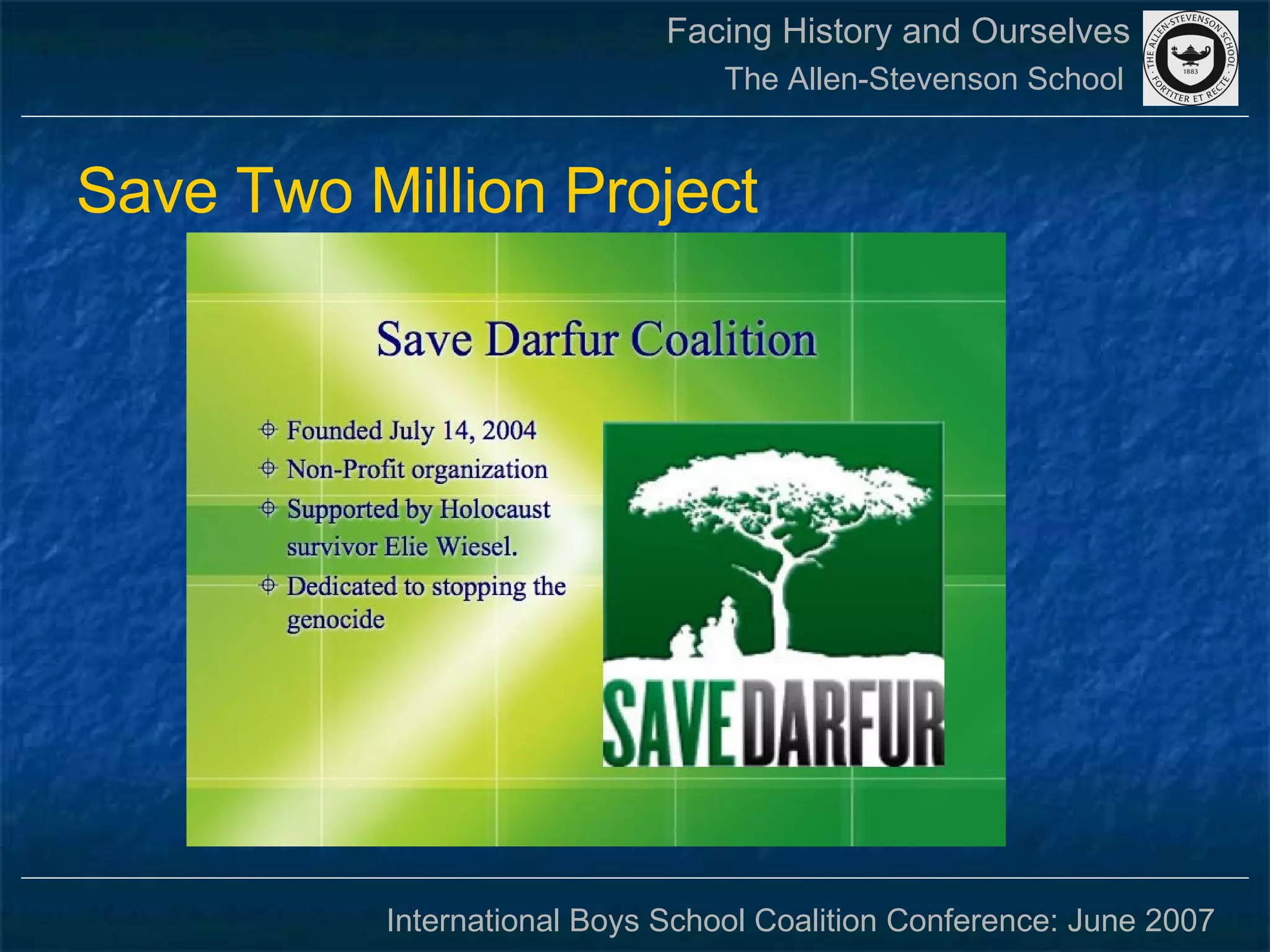
Save Two Million Project
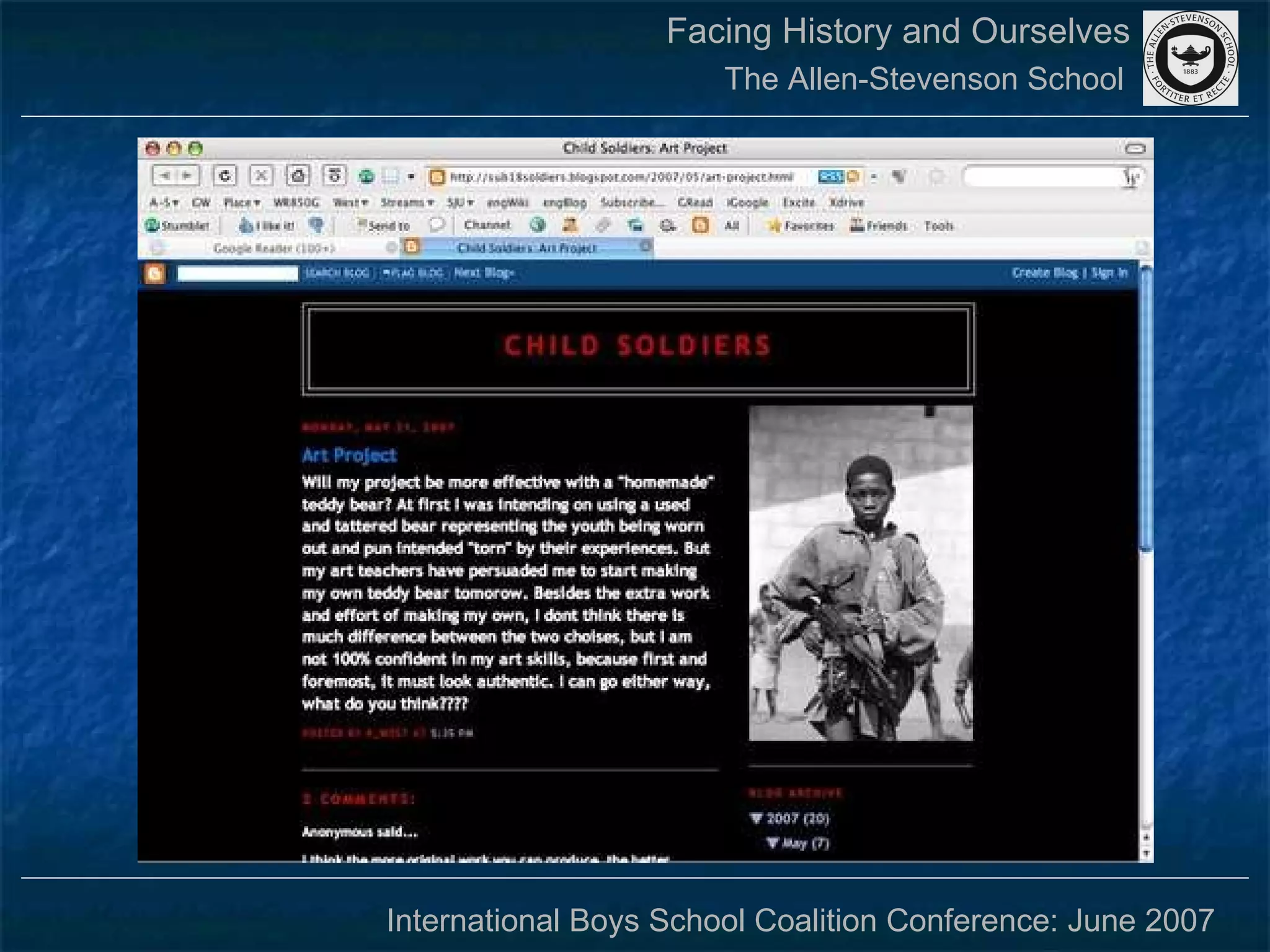
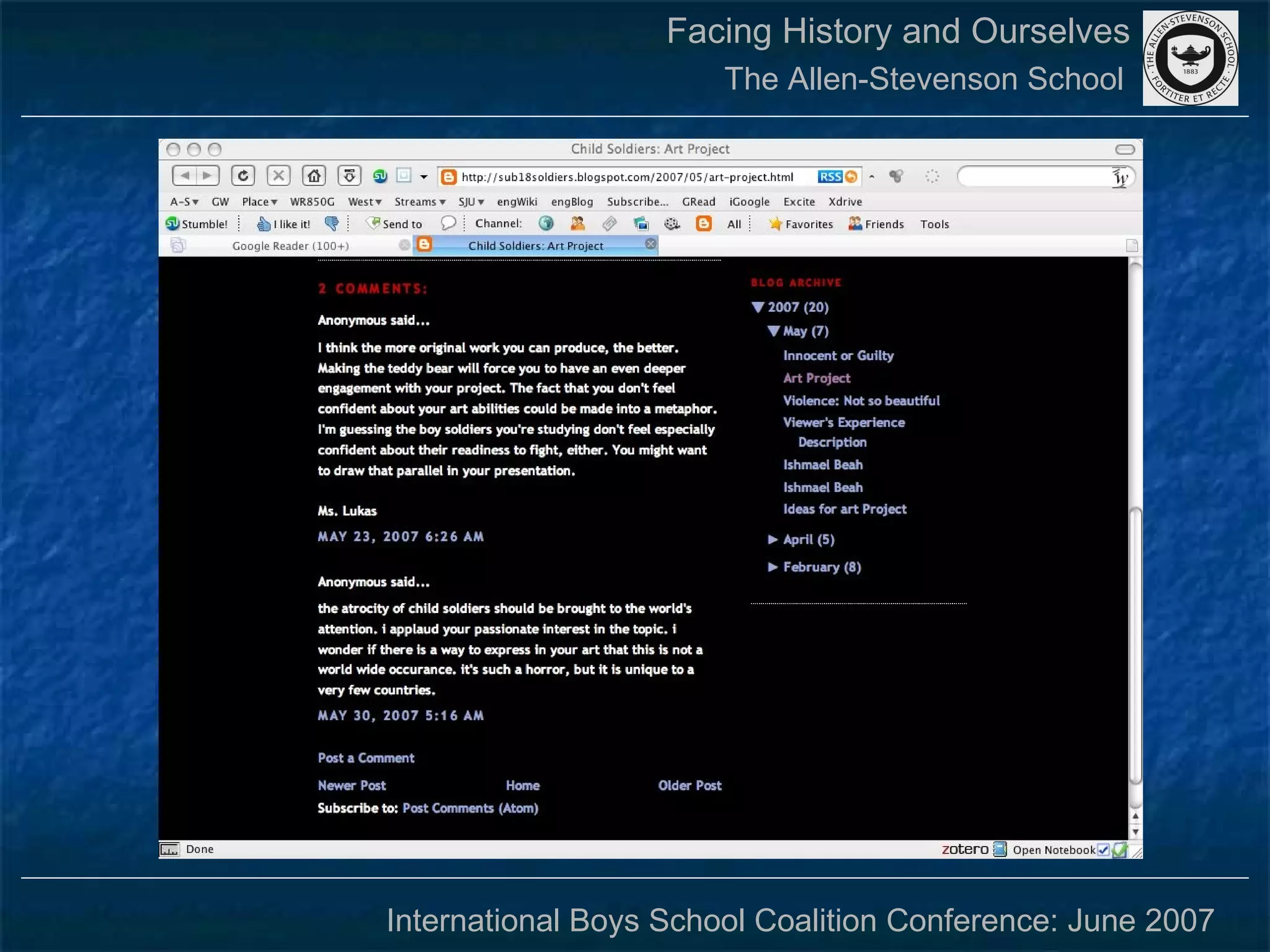
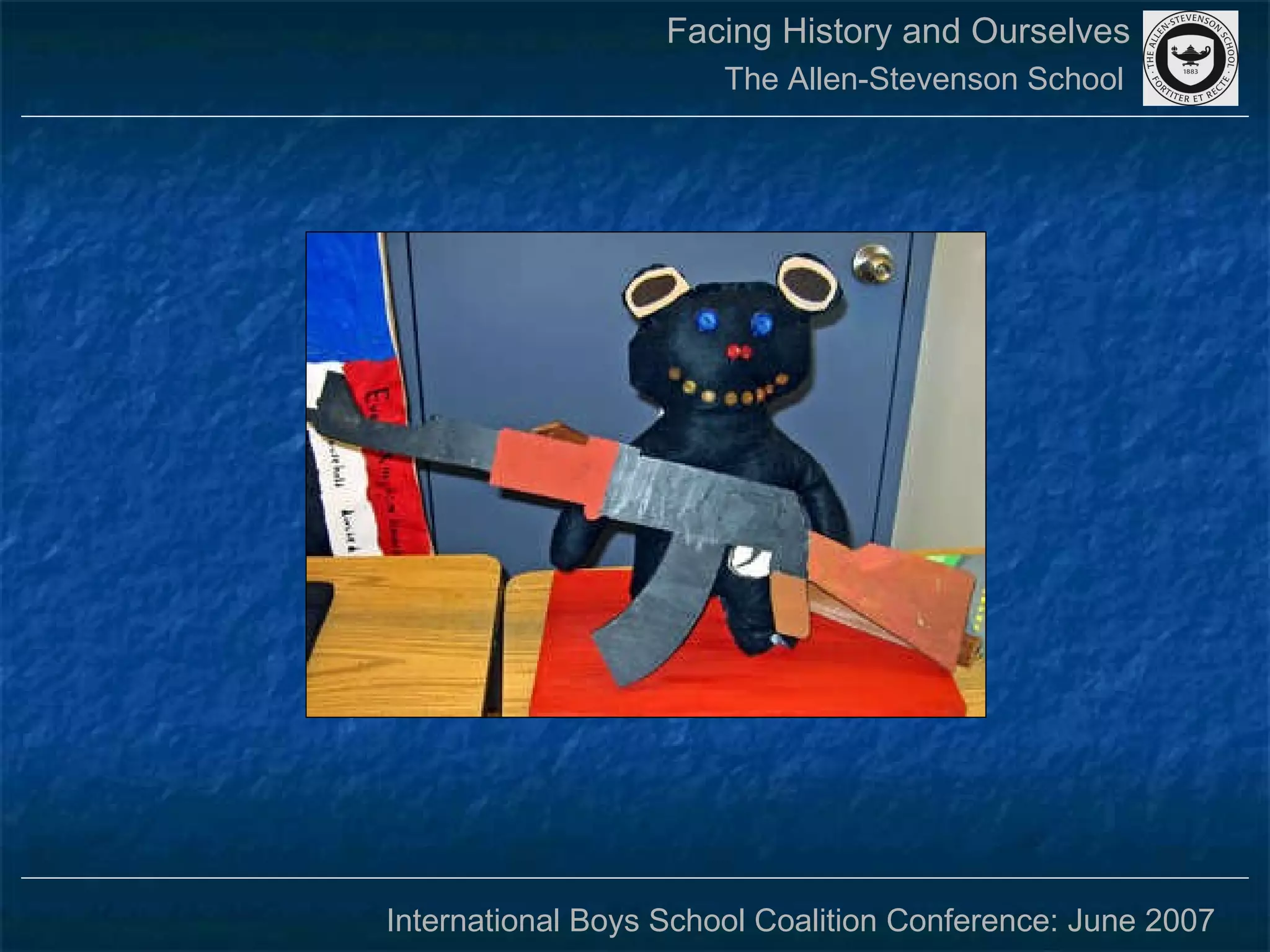
Art Project Crystallizing Activity Political Art Personally Relevant Current Event or Issue Any Medium Sculpture Film Painting


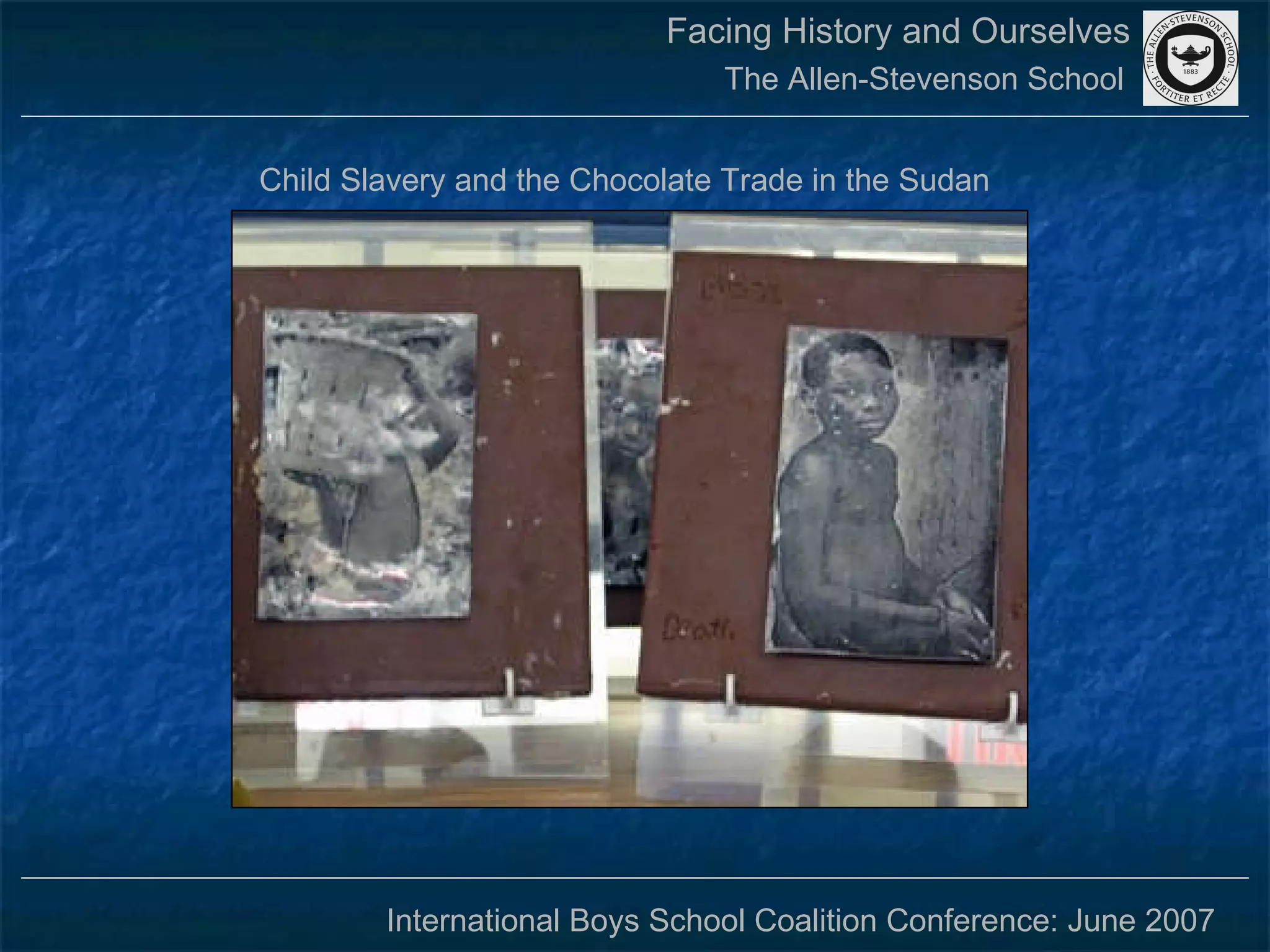
Child Slavery and the Chocolate Trade in the Sudan
“ It all happened so suddenly. At 11 o’clock Graciela Alatorre had an appointment to review her working permit. She was taken into another room where she was was was handcuffed like a criminal. She had never committed a crime or broken any law. All she did was work to support her family. In tears she was forced to board a plane. She was ripped away from her family so unexpectedly.”  Illegal Immigration
 
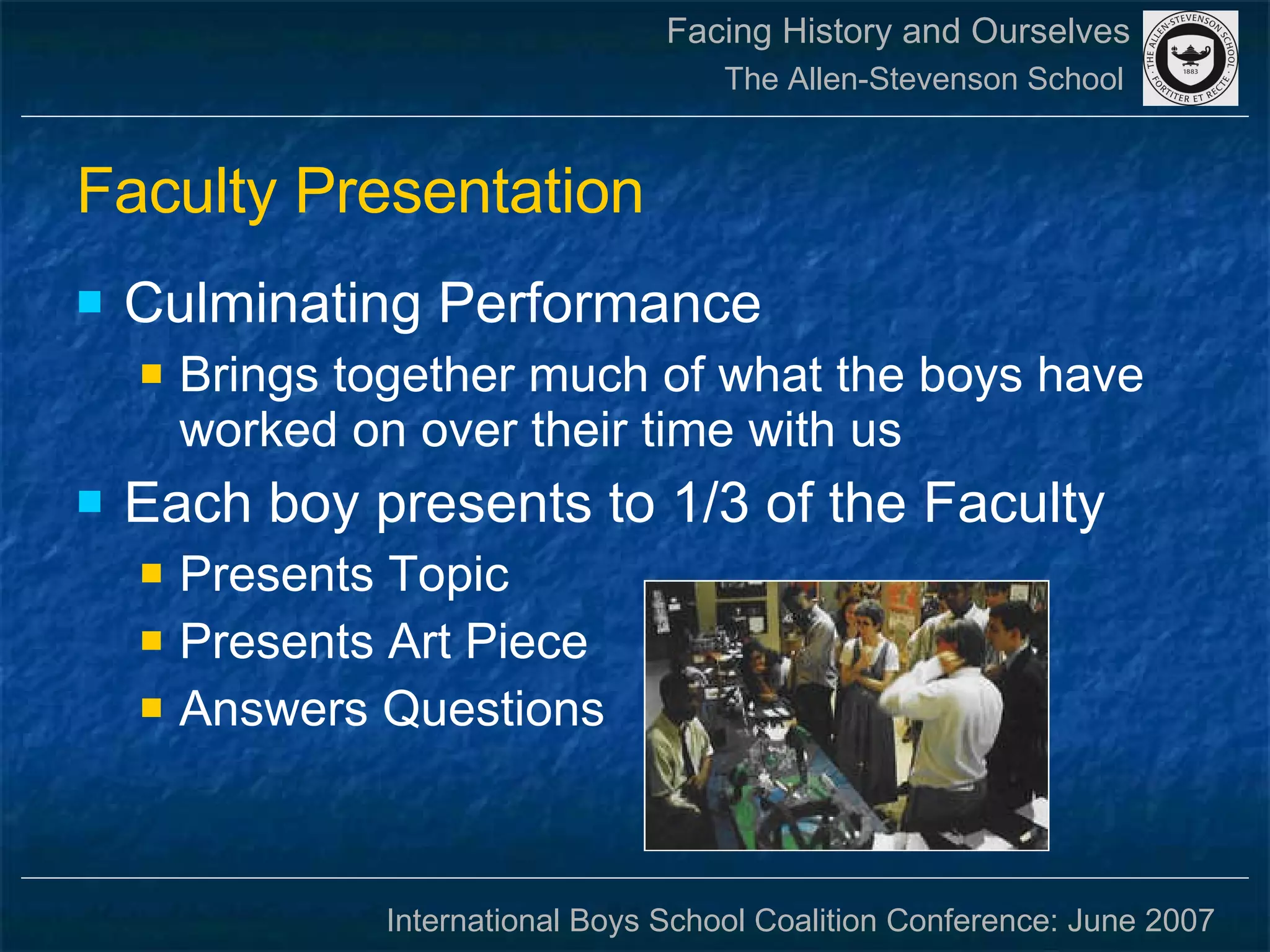
Faculty Presentation Culminating Performance Brings together much of what the boys have worked on over their time with us Each boy presents to 1/3 of the Faculty Presents Topic Presents Art Piece Answers Questions
Trips Public Art Washington, DC Archives Hero
Moral Vocabulary in Upper School Perpetrator Victim Bystander “ We want an Upper  School of heroes.”
From Students What are important themes of the course? “ Achieving a sense of identity, realizing one’s responsibilities as part of a privileged society, and to study human behavior from many different angles.” “ The worst person in a situation of crisis is the person who stands by and does nothing…” “ The theme of the course is… through self-control, analysis, thoughtfulness, we as people can make the world a better place.”
“The course does a good job in forcing kids to re-evaluate themselves and become more involved. You start asking yourself questions such as: ‘Was I partly responsible for not calling for help for that woman on the subway?’”
FHAO Web Site www.facinghistory.org

Ibsc Fhao Presentation

  • 1.
    Neal Kamsler UpperSchool Head Steven Cohen Asst. Upper School Head Facing History and Ourselves International Boys School Conference June 2007 The Allen-Stevenson School New York City
  • 2.
    Facing History andOurselves A course in… Racism Discrimination Citizenship Democracy Heroism … that uses the Holocaust as a case study
  • 3.
    Initial Reasons forIntroducing Supported Diversity Work Kept “Seniors” Engaged Intriguing for Boys
  • 4.
    Why It WorksFor Boys Issues of Power Leadership & Heroism Moral Questions Drama / Action Technology Talking & Moving Real
  • 5.
    Structure Interdisciplinary English,History, Art Evolution a Process Pass / Fail Meets ≈ 10 hours/week for 7 Weeks Mentors
  • 6.
    Structure Case Studiesfrom history Holocaust Armenian Genocide Rwanda
  • 7.
    Structure Case Studiesfrom “Ourselves” Current Events Darfur, Child Soldiers, Gay Marriage School Issues Leadership Bullying / Social Cruelty
  • 8.
    Requirements Coursework Readings,films, trips, speakers, discussions, journal responses, papers. Blogs Art Project Faculty Presentation
  • 9.
    Pedagogy Case StudyMethod Socratic / Constructivist Discussion, Observation, Action “ Complicating simple answers to complex questions”
  • 10.
    Course Outline Identity Us v. Them Rise of the Nazis Holocaust Judgment & Memory Choosing to Participate
  • 11.
    Unit 1: IdentityEssential Questions Who am I? How do I see myself? How do others see me? What factors influence how I think and behave?
  • 12.
    Unit 1: IdentitySample Activities / Texts The Bear That Wasn’t After the First “ If the World Were a Village of a 1,000 People” Ladder of Inference / Stereotyping “ Stolen Bicycle” Eye of the Storm
  • 13.
    Identity Charts aBasic Tool Shows how we and others label ourselves Shows points of commonality and difference Exposes our lenses
  • 14.
    If the WorldWere a Village of a 1000 people… How many would be… Christians? Muslims? Jews? Buddhists? Secular / Nonreligious?
  • 15.
  • 16.
    If the WorldWere a Village of a 1000 people… How many would be… Christians? 330 Muslims? 215 Jews? 2 Buddhists? 59 Secular / Nonreligious? 140 Source: World Bank, World Development Indicators 2002
  • 17.
    Unit 2: Usv. Them Essential Questions Where do I belong? Why are some people included and others excluded? How can I belong to a group and still be true to myself? For whom am I responsible?
  • 18.
    Unit 2: Usv. Them Sample Activities / Texts Fires in the Mirror “ Harrison Bergeron” Educating Peter Study of Antisemitism
  • 19.
    Universe of ObligationThose people to whom we feel some obligation, to whom rules apply, whose injuries deserve a response 1 2 3 4
  • 20.
    Unit 3: TheRise of the Nazis Essential Questions: Why did this happen? How does prejudice become law? Why didn't people stop it? What could have been done?
  • 21.
    Unit 3: TheRise of the Nazis Sample Activities / Texts The Wave / “You Will Do As Directed” Friedrich Propaganda Study What could have been done? “ The Hangman,” Maurice Ogden
  • 22.
    Unit 4: TheHolocaust Essential Questions How could it have happened in the 20th Century in the heart of Europe? What does resistance mean in a world of diminished choices? What factors contributed to the choices the perpetrators, victims, bystanders, and rescuers made?
  • 23.
    Unit 4: TheHolocaust Sample Activities / Texts Milgram Experiment “ Police Battalion 101 Night Schindler’s List Weapons of the Spirit What Makes a Rescuer?
  • 24.
    Unit 5: Judgmentand Memory Essential Questions Who is responsible for History? Are some people more to blame than others? How do we judge and/or punish those who participated? Is forgiveness, or even reconciliation, possible? How do we remember?
  • 25.
    Unit 5: Judgmentand Memory Sample Activities / Texts Confessions of a Hitler Youth The Sunflower Nuremberg
  • 26.
    Unit 6: Choosingto Participate Essential Questions Does one individual matter? How can I make a difference? Where do I begin?
  • 27.
    Unit 6: Choosingto Participate Sample Activities / Texts Kitty Genovese “ The Ones Who Walk Away from Omelas, ” Ursula Le Guin “ The Road Not Taken” Art Projects Blogs
  • 28.
  • 29.
  • 30.
    Art Project CrystallizingActivity Political Art Personally Relevant Current Event or Issue Any Medium Sculpture Film Painting
  • 31.
  • 32.
  • 33.
  • 34.
    Child Slavery andthe Chocolate Trade in the Sudan
  • 35.
    “ It allhappened so suddenly. At 11 o’clock Graciela Alatorre had an appointment to review her working permit. She was taken into another room where she was was was handcuffed like a criminal. She had never committed a crime or broken any law. All she did was work to support her family. In tears she was forced to board a plane. She was ripped away from her family so unexpectedly.” Illegal Immigration
  • 36.
  • 37.
    Faculty Presentation CulminatingPerformance Brings together much of what the boys have worked on over their time with us Each boy presents to 1/3 of the Faculty Presents Topic Presents Art Piece Answers Questions
  • 38.
    Trips Public ArtWashington, DC Archives Hero
  • 39.
    Moral Vocabulary inUpper School Perpetrator Victim Bystander “ We want an Upper School of heroes.”
  • 40.
    From Students Whatare important themes of the course? “ Achieving a sense of identity, realizing one’s responsibilities as part of a privileged society, and to study human behavior from many different angles.” “ The worst person in a situation of crisis is the person who stands by and does nothing…” “ The theme of the course is… through self-control, analysis, thoughtfulness, we as people can make the world a better place.”
  • 41.
    “The course doesa good job in forcing kids to re-evaluate themselves and become more involved. You start asking yourself questions such as: ‘Was I partly responsible for not calling for help for that woman on the subway?’”
  • 42.
    FHAO Web Sitewww.facinghistory.org