Interactive Transmission
System Computation Unit.
(I.T.S.C.U)
A project Report
Submitted to
Prof. S.Angalaeswari
EEE 228 – Power Systems
Winter 2015
Submitted by
Student’s name Registration no.
1) Suseel.Anil.Menon 13BEE1076
2) Mayank Raj 13BEE1073
3) Chandankumar 13BEE1031
Developed & Tested in : Dev C++ (v5.4.2)
Programing language : C (Dec C++ compiler with
C99 release)
Contents
S. No Chapter Title
1 Abstract
2 Introduction about your Project
3 Algorithm/Flowchart
4 C Code
5 Output
6 Conclusion and future scope
Abstract
Electricity has become a vital part of our lives since its discovery.
Transmission systems deliver this irreplaceable component to our homes
everyday. But most consumers are often unaware of the intricate and tedious
processes involved in the design and maintenance of these systems. Power
transmission lines often take months to design after taking into consideration
factors such as geography, climate, distribution range and budgetary
constraints. We through our projects aspire to set a tone towards making this
design process much less tedious. Computation of transmission line
parameters, resistances, inductances, capacitances, cost of the chosen
materials etc. can be a daunting task for designers. Our project will be the first
phase to minimising this workload and improving the efficiency of calculation
for better results.
Introduction
I.T.S.C.U or the Interactive Transmission System Computation Unit is
designed to swiftly compute the A,B,C,D parameters, voltage regulation, and
efficiency for short, medium, and long transmission lines. The unit will take
an input for line voltage, current, resistance, inductance, capacitance, and
length. Also in the case of medium transmission line an option has been
provided to compute using Nominal ‘T’ method or Nominal ‘π’ method.
Although the regulation and efficiency will remain the same in both cases,
values of the parameters will vary.
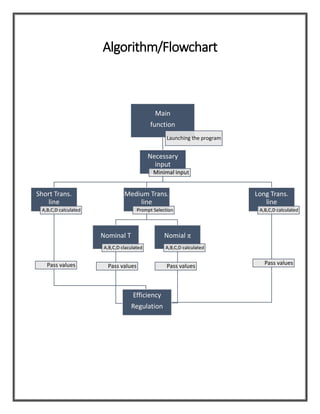
Algorithm/Flowchart
Main
function
Launching the program
Necessary
input
Minimal input
Short Trans.
line
A,B,C,D calculated
Pass values
Medium Trans.
line
Prompt Selection
Nominal T
A,B,C,D claculated
Pass values
Nomial π
A,B,C,D calculated
Pass values
Long Trans.
line
A,B,C,D calculated
Efficiency
Regulation
Pass values
C code
#include<stdio.h>
#include<conio.h>
#include<math.h>
#include<complex.h> //standard library for complex calculations.
// function declarations
void smalltrans(float,double complex,double complex,float,float,float,float,float);
void mediumtrans(float,double complex,double complex,float,float,float,float,float);
void longtrans(float,double complex,double complex,float,float,float,float,float);
void eff_reg(double complex,double complex,float,float,float,float,float,float);
void input_all();
float pi=3.14159; // common use
void main()
{
// program begins
printf("tt**************** INTERSTELLAR *******************n tttt Technologies
nn ttt ------ I.T.S.C.U------n");
printf("n tWelcome to the Interactive Trnasmission System Computation Unit" );
printf(" nn tThis System will help you calculate the constant parameters A,B,C,Dn tfor
short,medium,and long transmission linesn");
input_all();
//return 0;
}//main ends
// function to get INPUT.
void input_all()
{
//input variables
float lgt,l,r,pf,pr,f,vreal,vimag,ireal,iimag;
double complex v,vl,il;
printf("nt Enter the real part of line voltage:"); // input problem
scanf("%f",&vreal);
printf("nt Enter the imag part of line voltage:"); // input problem
scanf("%f",&vimag);
printf("nt Enter the real part of line current:"); // input problem
scanf("%f",&ireal);
printf("nt Enter the imag part of line current:"); // input problem
scanf("%f",&iimag);
printf("nt Enter the supply frequency:");
scanf("%f",&f);
printf("nt Enter the inductance per km:");
scanf("%f",&l);
printf("nt Enter the reistance per km:");
scanf("%f",&r);
printf("nt Enter the output power:");
scanf("%f",&pr);
printf("nt Enter the load power factor:");
scanf("%f",&pf);
// Making a complex number.
v= vreal + vimag*I;
il=ireal + iimag*I;
vl=v/sqrt(3);
// to determine weather short, medium or long.
printf("nnt Enter the Length of the Trasmission Line (in Km): ");
scanf("%f",&lgt);
if (lgt<80){
printf("nntLine Classified as Small Transmission Line");
smalltrans(lgt,vl,il,pf,pr,r,l,f);
}
else if(lgt>80 && lgt<250){
printf("nntLine Classified as Medium Transmission Line");
mediumtrans(lgt,vl,il,pf,pr,r,l,f);
}
else{
printf("nntLine Classified as Long Transmission Line");
longtrans(lgt,vl,il,pf,pr,r,l,f);
}
} // input_all ends
// for calculating ABCD const for SMALL line
void smalltrans(lgt,vl,il,pf,pr,r,l,f)
double complex vl,il; float lgt,pf,pr,r,l,f;
{
float xl;
int A,C,D;
double complex B;
xl=l*2*pi*f*lgt; // impedence
r=r*lgt;
A=1;C=0;D=1;
B= r + xl*I;
// printf("n %ft %ft %ft %ft %ft",lgt,r,l,f,xl);
printf("nntA= %d tB= %.2f + %.2fi ntC= %d tD= %d",A,creal(B),cimag(B),C,D);
// printf("n vreal= %ft vimag= %f",creal(vl),cimag(vl)); // used for testing certain functions while
debugging
// printf("n Line-V per phase = %.2f L%.2f",cabs(vl),carg(vl)); // used for testing certain functions
while debugging
eff_reg(vl,il,pf,pr,A,B,C,D);
}// SMALL ends
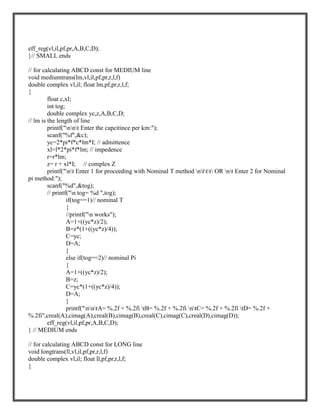
// for calculating ABCD const for MEDIUM line
void mediumtrans(lm,vl,il,pf,pr,r,l,f)
double complex vl,il; float lm,pf,pr,r,l,f;
{
float c,xl;
int tog;
double complex yc,z,A,B,C,D;
// lm is the length of line
printf("nnt Enter the capcitince per km:");
scanf("%f",&c);
yc=2*pi*f*c*lm*I; // admittence
xl=l*2*pi*f*lm; // impedence
r=r*lm;
z= r + xl*I; // complex Z
printf("nt Enter 1 for proceeding with Nominal T method nttt OR nt Enter 2 for Nominal
pi method:");
scanf("%d",&tog);
// printf("n tog= %d ",tog);
if(tog==1)// nominal T
{
//printf("n works");
A=1+((yc*z)/2);
B=z*(1+((yc*z)/4));
C=yc;
D=A;
}
else if(tog==2)// nominal Pi
{
A=1+((yc*z)/2);
B=z;
C=yc*(1+((yc*z)/4));
D=A;
}
printf("nntA= %.2f + %.2fi tB= %.2f + %.2fi ntC= %.2f + %.2fi tD= %.2f +
%.2fi",creal(A),cimag(A),creal(B),cimag(B),creal(C),cimag(C),creal(D),cimag(D));
eff_reg(vl,il,pf,pr,A,B,C,D);
} // MEDIUM ends
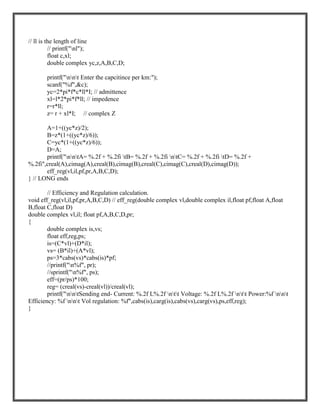
// for calculating ABCD const for LONG line
void longtrans(ll,vl,il,pf,pr,r,l,f)
double complex vl,il; float ll,pf,pr,r,l,f;
{
// ll is the length of line
// printf("nl");
float c,xl;
double complex yc,z,A,B,C,D;
printf("nnt Enter the capcitince per km:");
scanf("%f",&c);
yc=2*pi*f*c*ll*I; // admittence
xl=l*2*pi*f*ll; // impedence
r=r*ll;
z= r + xl*I; // complex Z
A=1+((yc*z)/2);
B=z*(1+((yc*z)/6));
C=yc*(1+((yc*z)/6));
D=A;
printf("nntA= %.2f + %.2fi tB= %.2f + %.2fi ntC= %.2f + %.2fi tD= %.2f +
%.2fi",creal(A),cimag(A),creal(B),cimag(B),creal(C),cimag(C),creal(D),cimag(D));
eff_reg(vl,il,pf,pr,A,B,C,D);
} // LONG ends
// Efficiency and Regulation calculation.
void eff_reg(vl,il,pf,pr,A,B,C,D) // eff_reg(double complex vl,double complex il,float pf,float A,float
B,float C,float D)
double complex vl,il; float pf,A,B,C,D,pr;
{
double complex is,vs;
float eff,reg,ps;
is=(C*vl)+(D*il);
vs= (B*il)+(A*vl);
ps=3*cabs(vs)*cabs(is)*pf;
//printf("n%f", pr);
//sprintf("n%f", ps);
eff=(pr/ps)*100;
reg= (creal(vs)-creal(vl))/creal(vl);
printf("nntSending end- Current: %.2f L%.2f ntt Voltage: %.2f L%.2f ntt Power:%f nnt
Efficiency: %f nnt Vol regulation: %f",cabs(is),carg(is),cabs(vs),carg(vs),ps,eff,reg);
}
OUTPUT
An example of long transmission line was computed to verify output.
Conclusion
Power systems are irreplaceable in the modern world with the entire
world depending on it to distribute power over long and short distances for
utilization in varied applications ranging from household usage to industrial
power behemoths. With the debate and discussion over global warming and
energy conservation gathering exponential momentum in recent times,
efficiency and durability have become the byword.
All future distribution and transmission network will have to be super-
efficient and we see I.T.S.C.U as the first phase to achieving this goal.
Future Scope
In future semesters we aspire to take forward our goal of developing
low power-high efficiency systems spanning micro-electronics to macro-
distribution systems as a solution to combat global problems for which
I.T.S.C.U has laid a foundation. We aim to make this program open source
over the internet, so that any student or technician can improve the efficiency
of their system. We further in the future, aim to remodel and expand I.T.S.C.U
to be more interactive and bring more computational power under its wings
using Visual Basic and Java.

Interactive Transmission System Computation Unit

  • 1.
    Interactive Transmission System ComputationUnit. (I.T.S.C.U) A project Report Submitted to Prof. S.Angalaeswari EEE 228 – Power Systems Winter 2015
  • 2.
    Submitted by Student’s nameRegistration no. 1) Suseel.Anil.Menon 13BEE1076 2) Mayank Raj 13BEE1073 3) Chandankumar 13BEE1031 Developed & Tested in : Dev C++ (v5.4.2) Programing language : C (Dec C++ compiler with C99 release)
  • 3.
    Contents S. No ChapterTitle 1 Abstract 2 Introduction about your Project 3 Algorithm/Flowchart 4 C Code 5 Output 6 Conclusion and future scope
  • 4.
    Abstract Electricity has becomea vital part of our lives since its discovery. Transmission systems deliver this irreplaceable component to our homes everyday. But most consumers are often unaware of the intricate and tedious processes involved in the design and maintenance of these systems. Power transmission lines often take months to design after taking into consideration factors such as geography, climate, distribution range and budgetary constraints. We through our projects aspire to set a tone towards making this design process much less tedious. Computation of transmission line parameters, resistances, inductances, capacitances, cost of the chosen materials etc. can be a daunting task for designers. Our project will be the first phase to minimising this workload and improving the efficiency of calculation for better results. Introduction I.T.S.C.U or the Interactive Transmission System Computation Unit is designed to swiftly compute the A,B,C,D parameters, voltage regulation, and efficiency for short, medium, and long transmission lines. The unit will take an input for line voltage, current, resistance, inductance, capacitance, and length. Also in the case of medium transmission line an option has been provided to compute using Nominal ‘T’ method or Nominal ‘π’ method. Although the regulation and efficiency will remain the same in both cases, values of the parameters will vary.
  • 5.
    Algorithm/Flowchart Main function Launching the program Necessary input Minimalinput Short Trans. line A,B,C,D calculated Pass values Medium Trans. line Prompt Selection Nominal T A,B,C,D claculated Pass values Nomial π A,B,C,D calculated Pass values Long Trans. line A,B,C,D calculated Efficiency Regulation Pass values
  • 6.
    C code #include<stdio.h> #include<conio.h> #include<math.h> #include<complex.h> //standardlibrary for complex calculations. // function declarations void smalltrans(float,double complex,double complex,float,float,float,float,float); void mediumtrans(float,double complex,double complex,float,float,float,float,float); void longtrans(float,double complex,double complex,float,float,float,float,float); void eff_reg(double complex,double complex,float,float,float,float,float,float); void input_all(); float pi=3.14159; // common use void main() { // program begins printf("tt**************** INTERSTELLAR *******************n tttt Technologies nn ttt ------ I.T.S.C.U------n"); printf("n tWelcome to the Interactive Trnasmission System Computation Unit" ); printf(" nn tThis System will help you calculate the constant parameters A,B,C,Dn tfor short,medium,and long transmission linesn"); input_all(); //return 0; }//main ends // function to get INPUT. void input_all() { //input variables float lgt,l,r,pf,pr,f,vreal,vimag,ireal,iimag; double complex v,vl,il; printf("nt Enter the real part of line voltage:"); // input problem scanf("%f",&vreal); printf("nt Enter the imag part of line voltage:"); // input problem scanf("%f",&vimag); printf("nt Enter the real part of line current:"); // input problem scanf("%f",&ireal); printf("nt Enter the imag part of line current:"); // input problem scanf("%f",&iimag); printf("nt Enter the supply frequency:"); scanf("%f",&f); printf("nt Enter the inductance per km:");
  • 7.
    scanf("%f",&l); printf("nt Enter thereistance per km:"); scanf("%f",&r); printf("nt Enter the output power:"); scanf("%f",&pr); printf("nt Enter the load power factor:"); scanf("%f",&pf); // Making a complex number. v= vreal + vimag*I; il=ireal + iimag*I; vl=v/sqrt(3); // to determine weather short, medium or long. printf("nnt Enter the Length of the Trasmission Line (in Km): "); scanf("%f",&lgt); if (lgt<80){ printf("nntLine Classified as Small Transmission Line"); smalltrans(lgt,vl,il,pf,pr,r,l,f); } else if(lgt>80 && lgt<250){ printf("nntLine Classified as Medium Transmission Line"); mediumtrans(lgt,vl,il,pf,pr,r,l,f); } else{ printf("nntLine Classified as Long Transmission Line"); longtrans(lgt,vl,il,pf,pr,r,l,f); } } // input_all ends // for calculating ABCD const for SMALL line void smalltrans(lgt,vl,il,pf,pr,r,l,f) double complex vl,il; float lgt,pf,pr,r,l,f; { float xl; int A,C,D; double complex B; xl=l*2*pi*f*lgt; // impedence r=r*lgt; A=1;C=0;D=1; B= r + xl*I; // printf("n %ft %ft %ft %ft %ft",lgt,r,l,f,xl); printf("nntA= %d tB= %.2f + %.2fi ntC= %d tD= %d",A,creal(B),cimag(B),C,D); // printf("n vreal= %ft vimag= %f",creal(vl),cimag(vl)); // used for testing certain functions while debugging // printf("n Line-V per phase = %.2f L%.2f",cabs(vl),carg(vl)); // used for testing certain functions while debugging
  • 8.
    eff_reg(vl,il,pf,pr,A,B,C,D); }// SMALL ends //for calculating ABCD const for MEDIUM line void mediumtrans(lm,vl,il,pf,pr,r,l,f) double complex vl,il; float lm,pf,pr,r,l,f; { float c,xl; int tog; double complex yc,z,A,B,C,D; // lm is the length of line printf("nnt Enter the capcitince per km:"); scanf("%f",&c); yc=2*pi*f*c*lm*I; // admittence xl=l*2*pi*f*lm; // impedence r=r*lm; z= r + xl*I; // complex Z printf("nt Enter 1 for proceeding with Nominal T method nttt OR nt Enter 2 for Nominal pi method:"); scanf("%d",&tog); // printf("n tog= %d ",tog); if(tog==1)// nominal T { //printf("n works"); A=1+((yc*z)/2); B=z*(1+((yc*z)/4)); C=yc; D=A; } else if(tog==2)// nominal Pi { A=1+((yc*z)/2); B=z; C=yc*(1+((yc*z)/4)); D=A; } printf("nntA= %.2f + %.2fi tB= %.2f + %.2fi ntC= %.2f + %.2fi tD= %.2f + %.2fi",creal(A),cimag(A),creal(B),cimag(B),creal(C),cimag(C),creal(D),cimag(D)); eff_reg(vl,il,pf,pr,A,B,C,D); } // MEDIUM ends // for calculating ABCD const for LONG line void longtrans(ll,vl,il,pf,pr,r,l,f) double complex vl,il; float ll,pf,pr,r,l,f; {
  • 9.
    // ll isthe length of line // printf("nl"); float c,xl; double complex yc,z,A,B,C,D; printf("nnt Enter the capcitince per km:"); scanf("%f",&c); yc=2*pi*f*c*ll*I; // admittence xl=l*2*pi*f*ll; // impedence r=r*ll; z= r + xl*I; // complex Z A=1+((yc*z)/2); B=z*(1+((yc*z)/6)); C=yc*(1+((yc*z)/6)); D=A; printf("nntA= %.2f + %.2fi tB= %.2f + %.2fi ntC= %.2f + %.2fi tD= %.2f + %.2fi",creal(A),cimag(A),creal(B),cimag(B),creal(C),cimag(C),creal(D),cimag(D)); eff_reg(vl,il,pf,pr,A,B,C,D); } // LONG ends // Efficiency and Regulation calculation. void eff_reg(vl,il,pf,pr,A,B,C,D) // eff_reg(double complex vl,double complex il,float pf,float A,float B,float C,float D) double complex vl,il; float pf,A,B,C,D,pr; { double complex is,vs; float eff,reg,ps; is=(C*vl)+(D*il); vs= (B*il)+(A*vl); ps=3*cabs(vs)*cabs(is)*pf; //printf("n%f", pr); //sprintf("n%f", ps); eff=(pr/ps)*100; reg= (creal(vs)-creal(vl))/creal(vl); printf("nntSending end- Current: %.2f L%.2f ntt Voltage: %.2f L%.2f ntt Power:%f nnt Efficiency: %f nnt Vol regulation: %f",cabs(is),carg(is),cabs(vs),carg(vs),ps,eff,reg); }
  • 10.
    OUTPUT An example oflong transmission line was computed to verify output.
  • 11.
    Conclusion Power systems areirreplaceable in the modern world with the entire world depending on it to distribute power over long and short distances for utilization in varied applications ranging from household usage to industrial power behemoths. With the debate and discussion over global warming and energy conservation gathering exponential momentum in recent times, efficiency and durability have become the byword. All future distribution and transmission network will have to be super- efficient and we see I.T.S.C.U as the first phase to achieving this goal. Future Scope In future semesters we aspire to take forward our goal of developing low power-high efficiency systems spanning micro-electronics to macro- distribution systems as a solution to combat global problems for which I.T.S.C.U has laid a foundation. We aim to make this program open source over the internet, so that any student or technician can improve the efficiency of their system. We further in the future, aim to remodel and expand I.T.S.C.U to be more interactive and bring more computational power under its wings using Visual Basic and Java.