BY
DEBANJAN SARKAR
ECE DEPARTMENT,3RD
YEAR
General Aspect of ‘C’
C WAS ORIGINALLY DEVELOPED IN THE 1970S, BY DENNIS RITCHIE
AT BELL TELEPHONE LABORATORIES, INC.
C IS A LOW LEVEL , GENERAL –PURPOSE STRUCTURED PROGRAMMING
LANGUAGE. INSTRUCTIONS OF C CONSISTS OF TERMS THAT ARE VERY
CLOSELY SAME TO ALGEBRAIC EXPRESSIONS, CONSISTING OF CERTAIN
ENGLISH KEYWORDS SUCH AS IF, ELSE, FOR ,DO AND WHILE
C CONTAINS CERTAIN ADDITIONAL FEATURES THAT ALLOWS IT TO
BE USED AT A LOWER LEVEL , ACTING AS BRIDGE BETWEEN
MACHINE LANGUAGE AND THE HIGH LEVEL LANGUAGES.
THIS ALLOWS C TO BE USED FOR SYSTEM PROGRAMMING AS WELL
AS FOR APPLICATIONS PROGRAMMING.
The Character set of ‘C’a z
C LANGUAGE CONSIST OF SOME CHARACTERS SET, NUMBERS AND
SOME SPECIAL SYMBOLS. THE CHARACTER SET OF C CONSIST OF ALL
THE ALPHABETS OF ENGLISH LANGUAGE. C CONSIST OF
ALPHABETS A TO Z, A TO Z
NUMERIC 0,1 TO 9
SPECIAL SYMBOLS {,},[,],?,+,-,*,/,%,!,;,AND MORE
THE WORDS FORMED FROM THE CHARACTER SET ARE BUILDING
BLOCKS OF C AND ARE SOMETIMES KNOWN AS TOKENS. THESE
TOKENS REPRESENT THE INDIVIDUAL ENTITY OF LANGUAGE. THE
FOLLOWING DIFFERENT TYPES OF TOKEN ARE USED IN C
1) IDENTIFIERS 2)KEYWORDS 3)CONSTANTS
4) OPERATORS 5)PUNCTUATION SYMBOLS
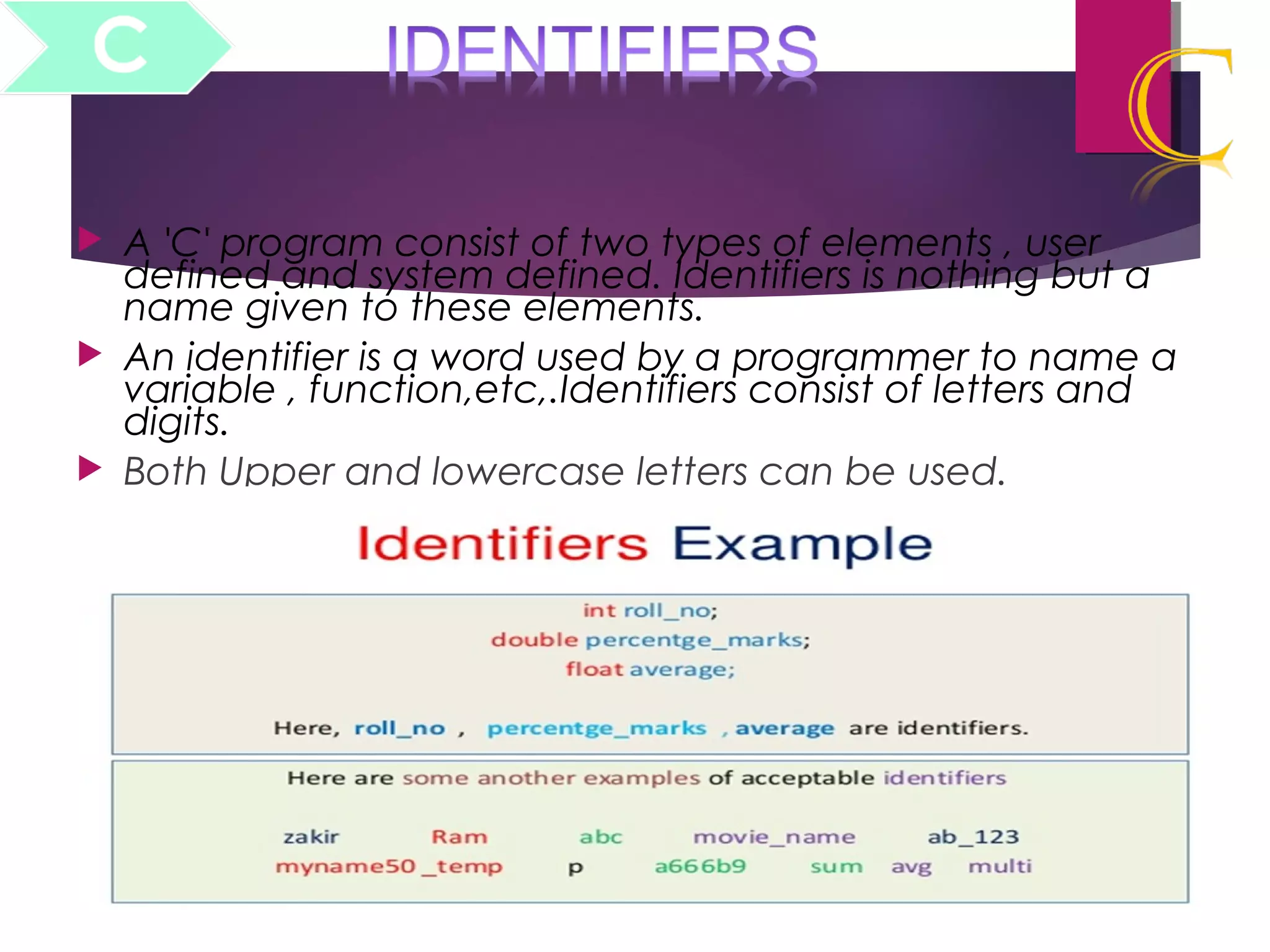
 A 'C' program consist of two types of elements , user
defined and system defined. Identifiers is nothing but a
name given to these elements.
 An identifier is a word used by a programmer to name a
variable , function,etc,.Identifiers consist of letters and
digits.
 Both Upper and lowercase letters can be used.
KEYWORDS
 Keywords are nothing but
system defined identifiers.
 Keywords are reserved
words of the language.
 They have specific meaning
in the language and
cannot be used by the
programmer as variable or
constant names
 C is case senitive, it means
these must be used as it is
 32 Keywords in C
Programming
auto double int struct
break else long switch
case enum register typedef
char extern return union
const float short unsigned
continue for signed void
default goto sizeof volatile
do if static while
C
Variables
 A variable is nothing but a name given to a storage area that our
programs can manipulate. Each variable in C has a specific type,
which determines the size and layout of the variable's memory; the
range of values that can be stored within that memory; and the set of
operations that can be applied to the variable.
 The name of a variable can be composed of letters, digits, and the
underscore character. It must begin with either a letter or an
underscore. Upper and lowercase letters are distinct because C is
case-sensitive. There are following basic variable types −
Type Description
 char Typically a single octet(one byte). This is an integer type.
 int The most natural size of integer for the machine.
 float A single-precision floating point value.
 double A double-precision floating point value to store decimal no.
 void Represents the absence of type.
 && 3X+20Y=0, where X and Y are variables which can be changed.
C
Global and Local Variables
 Local Variables
 These variables are
declared inside some
functions.
 Life time of a local
variable is the entire
execution period of the
function in which it is
defined.
 Cannot be accessed by any
other function.
 In general variables
declared inside a block
are accessible only in
that block.
/* Compute Area and Perimeter of a
circle */
#include <stdio.h>
float pi = 3.14159; /* Global */
main() {
float rad; /* Local */
printf( “Enter the radius “ );
scanf(“%f” , &rad);
if ( rad > 0.0 ) {
float area = pi * rad * rad;
float peri = 2 * pi * rad;
printf( “Area = %fn” , area );
printf( “Peri = %fn” , peri );
}
else
printf( “Negative radiusn”);
printf( “Area = %fn” , area );
}
/* Compute Area and Perimeter of a
circle */
#include <stdio.h>
float pi = 3.14159; /* Global */
main() {
float rad; /* Local */
printf( “Enter the radius “ );
scanf(“%f” , &rad);
if ( rad > 0.0 ) {
float area = pi * rad * rad;
float peri = 2 * pi * rad;
printf( “Area = %fn” , area );
printf( “Peri = %fn” , peri );
}
else
printf( “Negative radiusn”);
printf( “Area = %fn” , area );
}
Lectures on Numerical Methods
7
C
CONSTANTS
 A constant is a value or an identifier whose value cannot
be altered in a program. For example: 1, 2.5,
 As mentioned, an identifier also can be defined as a
constant. eg. constant double PI = 3.14
 Here, PI is a constant. Basically what it means is that, PI
and 3.14 is same for this program.
Integer constants
 A integer constant is a numeric constant (associated
with number) without any fractional or exponential
part.It can be positive or negative,and for 16 bit
computers range is -32768 to +32767.
 Example: 426
 +782
C
Constants
Floating-point constants
 A floating point constant is a numeric constant that
has either a fractional form or an exponent form.
For example: 2.0,0.0000234,-0.22E-5
Character constants
 A character constant is a constant which uses
single quotation around characters. For example:
'a', 'l', 'm', 'F'
String constants
 String constants are the constants which are
enclosed in a pair of double-quote marks. For
example: "good" ,"Earth is roundn”,etc,.
C
Escape Sequences
Sometimes, it is necessary to use characters which cannot be typed or has
special meaning in C programming. For example: newline(enter), tab,
question mark etc. In order to use these characters, escape sequence is
used.
 For example: n is used for newline. The backslash (  ) causes "escape"
from the normal way the characters are interpreted by the
compiler.Escape
Sequences Character
 b Backspace
 f Form feed
 n Newline
 r Return
 t Horizontal tab
 v Vertical tab
  Backslash
 ' Single quotation mark
 " Double quotation mark
 ? Question mark
 0 Null character
C
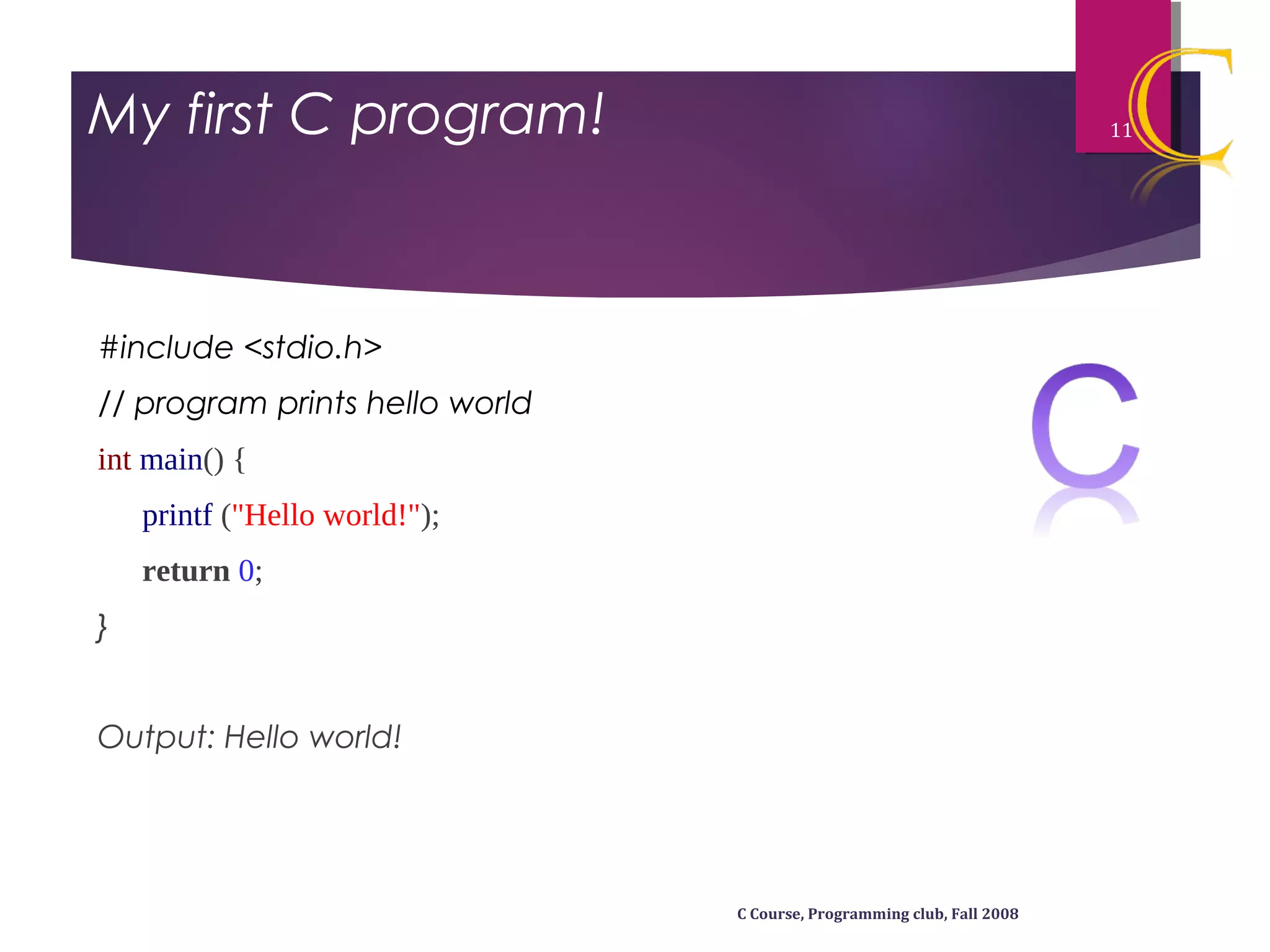
My first C program!
#include <stdio.h>
// program prints hello world
int main() {
printf ("Hello world!");
return 0;
}
Output: Hello world!
C Course, Programming club, Fall 2008
11
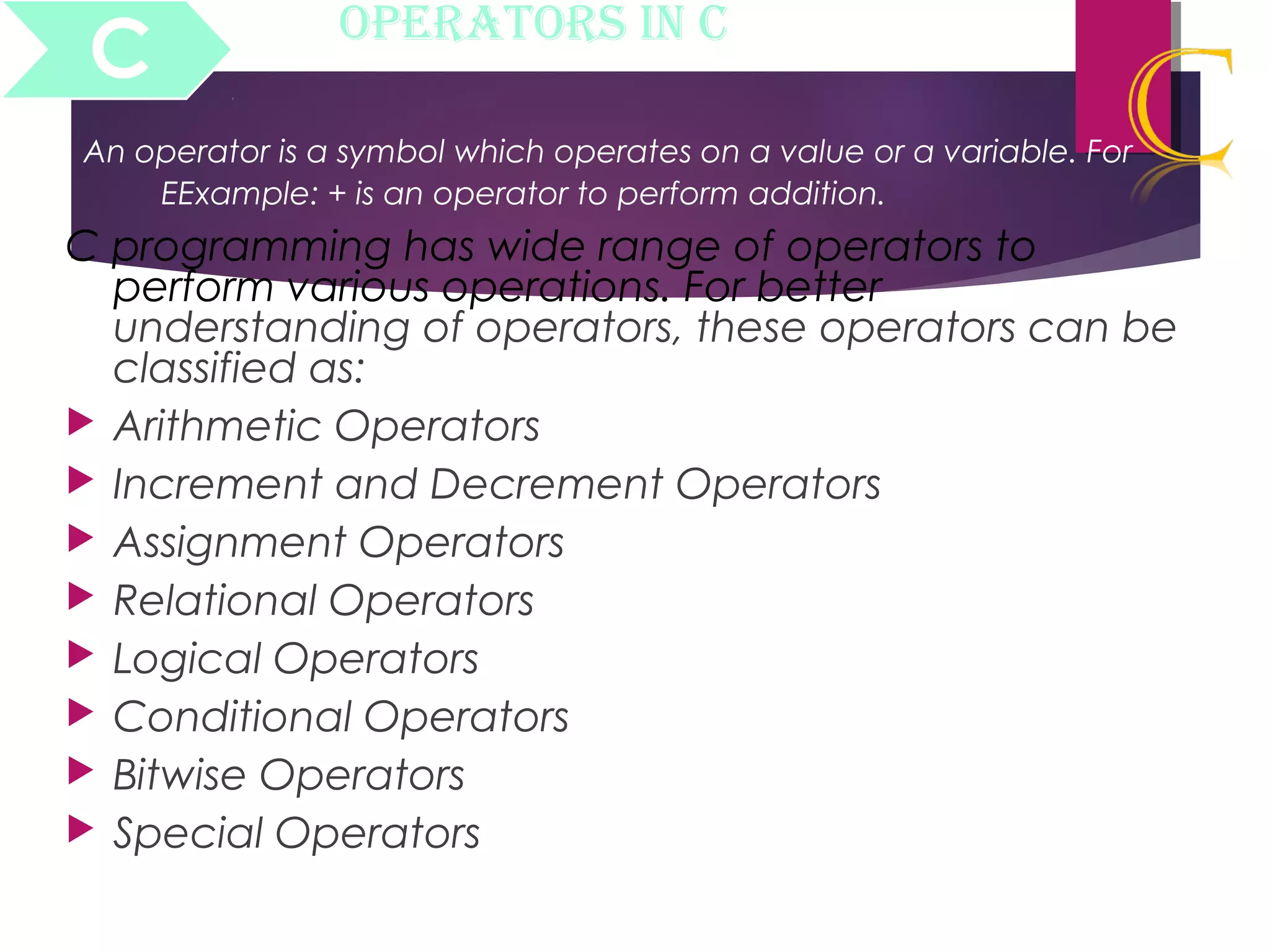
OperatOrs in C
An operator is a symbol which operates on a value or a variable. For
EExample: + is an operator to perform addition.
C programming has wide range of operators to
perform various operations. For better
understanding of operators, these operators can be
classified as:
 Arithmetic Operators
 Increment and Decrement Operators
 Assignment Operators
 Relational Operators
 Logical Operators
 Conditional Operators
 Bitwise Operators
 Special Operators
C
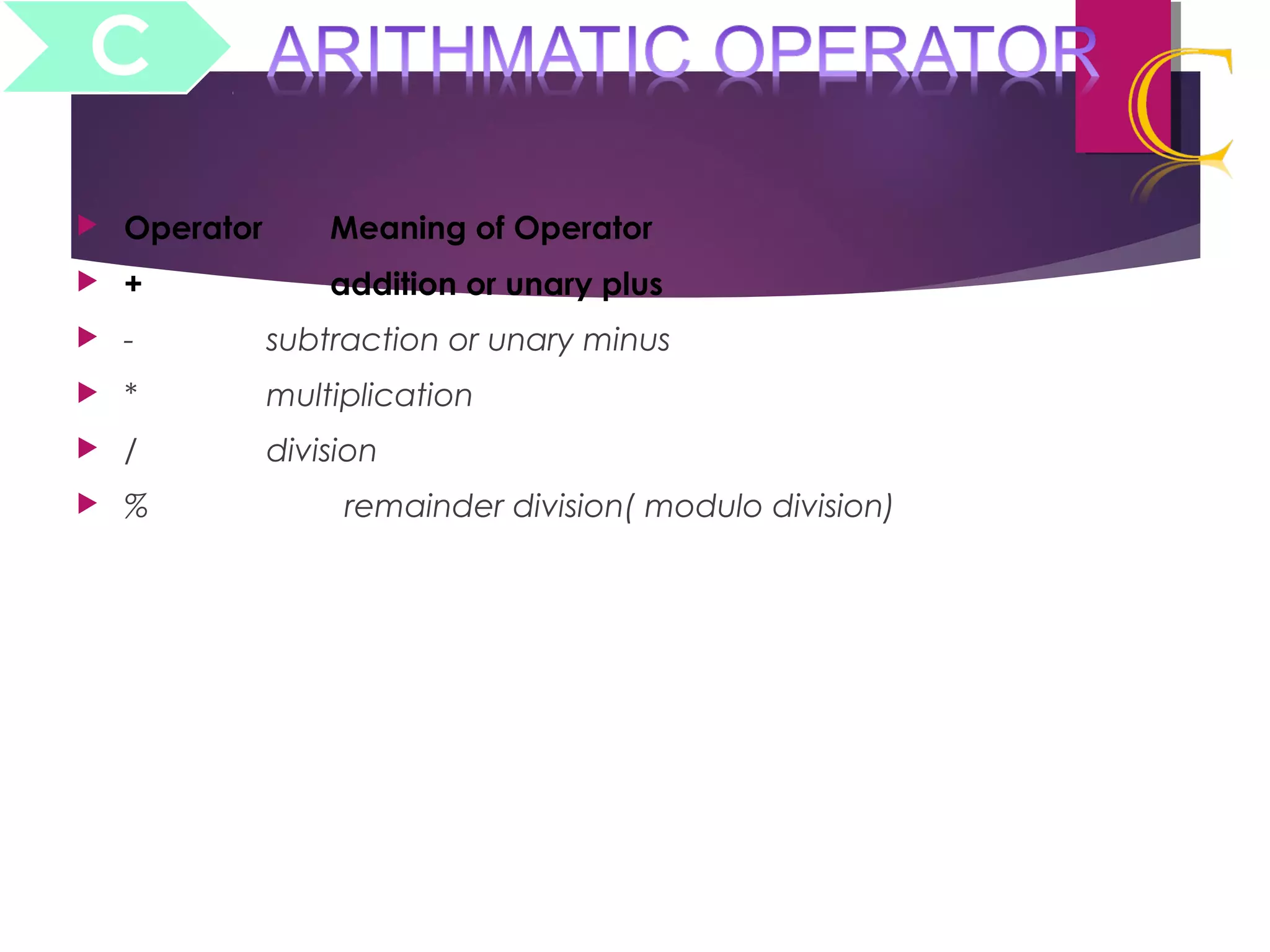
 Operator Meaning of Operator
 + addition or unary plus
 - subtraction or unary minus
 * multiplication
 / division
 % remainder division( modulo division)
C
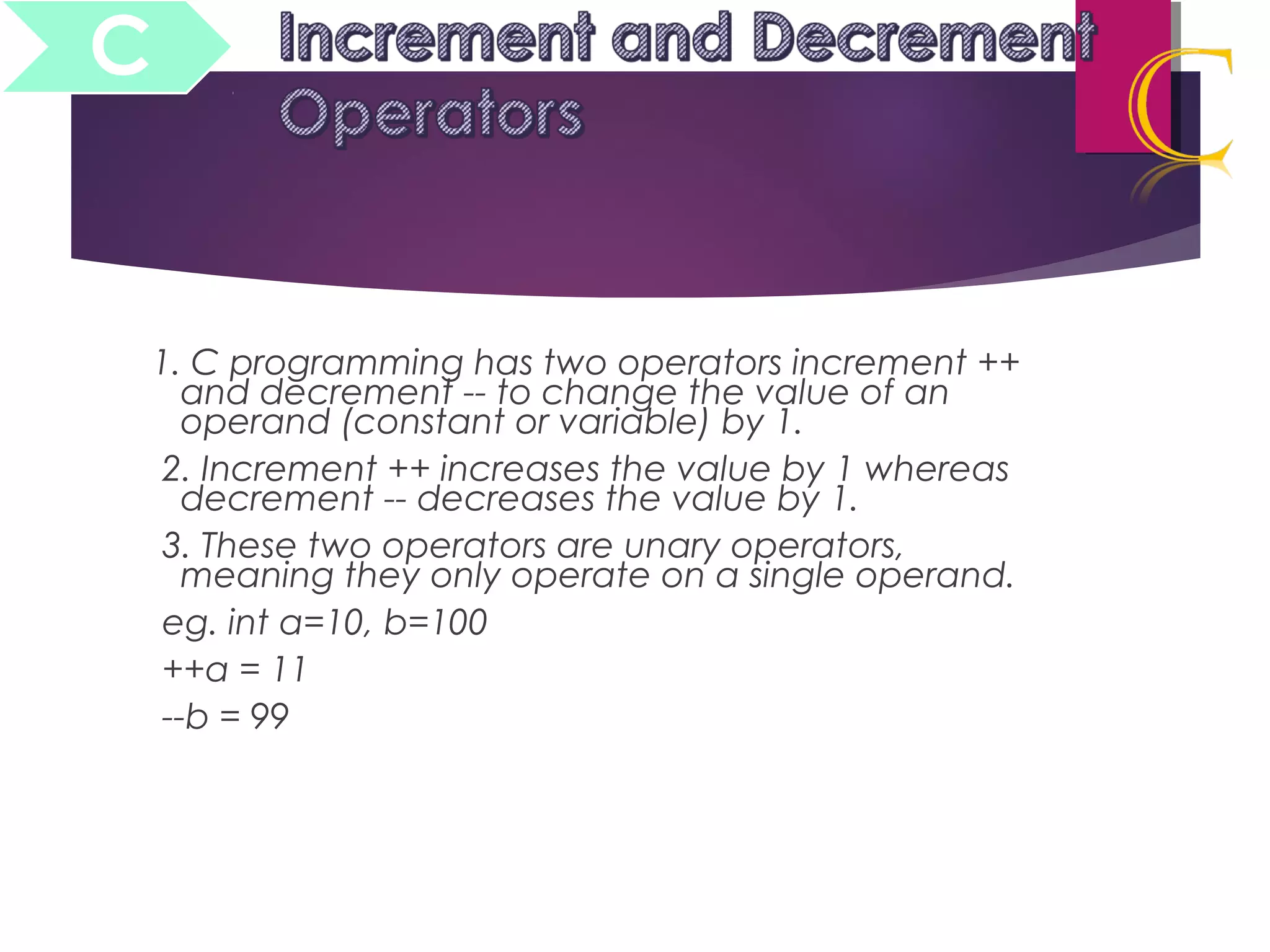
1. C programming has two operators increment ++
and decrement -- to change the value of an
operand (constant or variable) by 1.
2. Increment ++ increases the value by 1 whereas
decrement -- decreases the value by 1.
3. These two operators are unary operators,
meaning they only operate on a single operand.
eg. int a=10, b=100
++a = 11
--b = 99
C
 An assignment operator is used for assigning
a value to a variable. The most common
assignment operator is =
 Operator Example Same as
 = a =b a = b
 += a += b a = a+b
 -= a -= b a = a-b
 *= a *= b a = a*b
 /= a /= b a = a/b
 %= a %= b a = a%b
C
 A relational operator checks the relationship
between two operands. If the relation is true, it
returns 1; if the relation is false, it returns value 0.
 Relational operators are used in decision making
and loops.
Operator Meaning of Operator Example
 == Equal to 5 == 3 returns 0
 > Greater than 5 > 3 returns 1
 < Less than 5 < 3 returns 0
 != Not equal to 5 != 3 returns 1
 >= Greater than or equal to 5 >= 3 returns 1
 <= Less than or equal to 5 <= 3 return 0
C
17
Highest on top
++ -- (Postfix)
++ -- (Prefix)
* / % (Assignment Operator)
+ - (Unary plus/minus)
<< >>(Bitwise Left/Right Shift)
< >
&(Bitwise AND)
| (Bitwise OR)
&& (Logical AND)
|| (Logical OR)
sizeof (Find size in bytes)
C
 printf (); //used to print to console(screen)
 scanf (); //used to take an input from console(user).
 example: printf(“%c”, ’a’); scanf(“%d”, &a);
 More format specifiers
%c     The character format specifier.
%d     The integer format specifier.
%i     The integer format specifier (same as %d).
%f     The floating-point format specifier.
%o     The unsigned octal format specifier.
%s     The string format specifier.
%u     The unsigned integer format specifier.
%x     The unsigned hexadecimal format specifier.
%%     Outputs a percent sign.
18
C
19
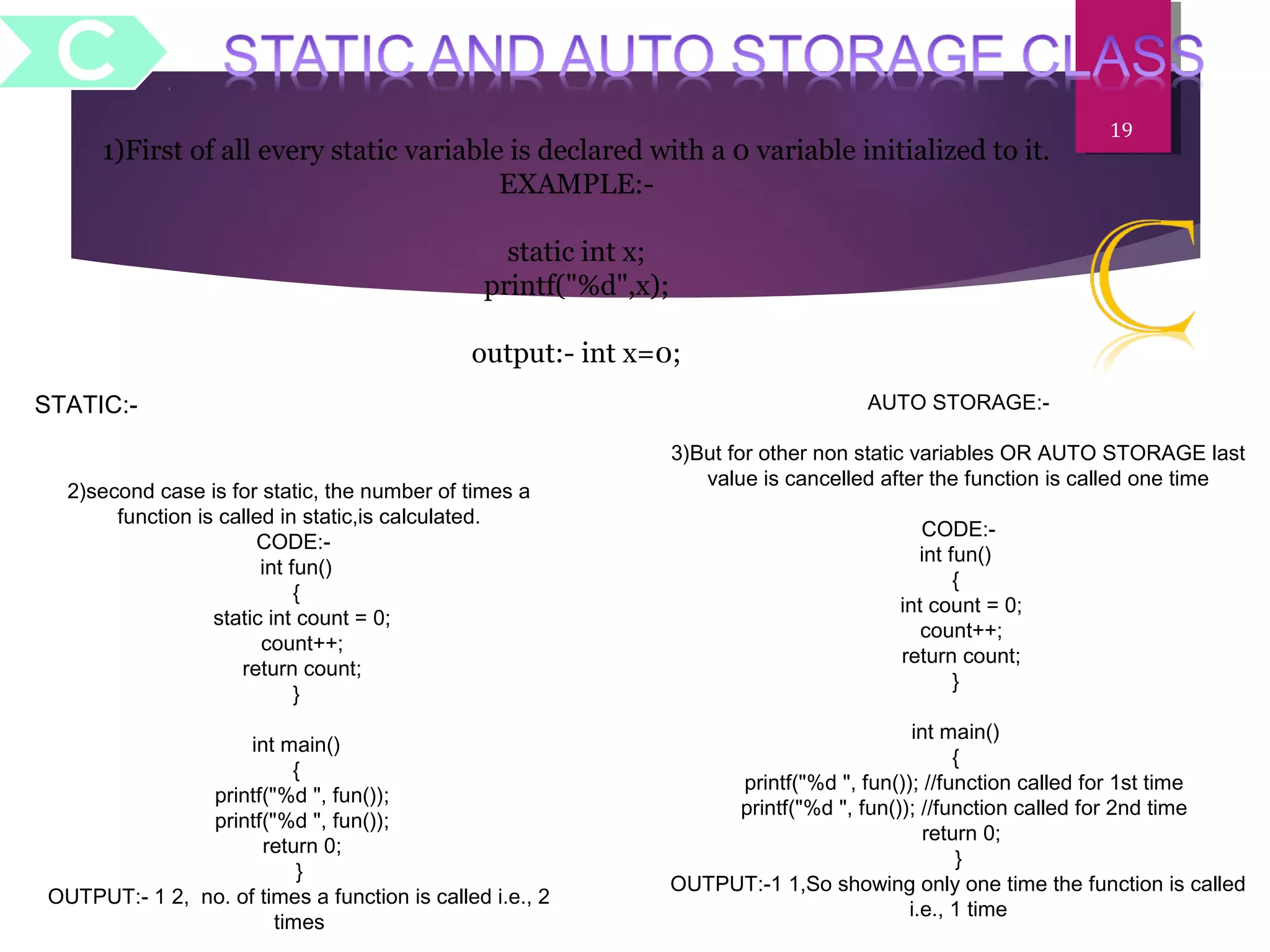
STATIC:-
2)second case is for static, the number of times a
function is called in static,is calculated.
CODE:-
int fun()
{
static int count = 0;
count++;
return count;
}
int main()
{
printf("%d ", fun());
return 0;
}
OUTPUT:- 1 2, no. of times a function is called i.e., 2
times
AUTO STORAGE:-
3)But for other non static variables OR AUTO STORAGE last
value is cancelled after the function is called one time
CODE:-
int fun()
{
int count = 0;
count++;
return count;
}
int main()
{
printf("%d ", fun()); //function called for 1st time
printf("%d ", fun()); //function called for 2nd time
return 0;
}
OUTPUT:-1 1,So showing only one time the function is called
i.e., 1 time
1)First of all every static variable is declared with a 0 variable initialized to it.
EXAMPLE:-
static int x;
printf("%d",x);
output:- int x=0;
C
REGISTER:-
They are faster then memory and are used in microprocessors.They are specially used for
variables which are frequently used in programmes and to access them faster.The
address is pointed if we use register in normal coding which is an error.So it is used in
pointer where the compiler points to the address only of the register.
EXTERN:-
Here the variales are not stored in the same block.It is stored in a different block.So thus
it is a global which can be accessed from anywhere we want.This is mainly used to access
between two different files which are a part of large program.
C
Program to Check Prime Number
#include <stdio.h>
int main() {
int n, i, flag = 0;
printf("Enter a positive integer: ");
scanf("%d", &n);
for(i = 2; i <= n/2; ++i) { // condition for nonprime number
if(n%i == 0) {
flag = 1; break; } }
if (n == 1) {
printf("1 is neither a prime nor a composite number."); }
else { if (flag == 0)
printf("%d is a prime number.", n);
else printf("%d is not a prime number.", n); }
return 0;
}
OUTPUT:-
Enter a positive integer=29
29 is a prime number
THANK YOU
22

Basics of c

  • 1.
  • 2.
    General Aspect of‘C’ C WAS ORIGINALLY DEVELOPED IN THE 1970S, BY DENNIS RITCHIE AT BELL TELEPHONE LABORATORIES, INC. C IS A LOW LEVEL , GENERAL –PURPOSE STRUCTURED PROGRAMMING LANGUAGE. INSTRUCTIONS OF C CONSISTS OF TERMS THAT ARE VERY CLOSELY SAME TO ALGEBRAIC EXPRESSIONS, CONSISTING OF CERTAIN ENGLISH KEYWORDS SUCH AS IF, ELSE, FOR ,DO AND WHILE C CONTAINS CERTAIN ADDITIONAL FEATURES THAT ALLOWS IT TO BE USED AT A LOWER LEVEL , ACTING AS BRIDGE BETWEEN MACHINE LANGUAGE AND THE HIGH LEVEL LANGUAGES. THIS ALLOWS C TO BE USED FOR SYSTEM PROGRAMMING AS WELL AS FOR APPLICATIONS PROGRAMMING.
  • 3.
    The Character setof ‘C’a z C LANGUAGE CONSIST OF SOME CHARACTERS SET, NUMBERS AND SOME SPECIAL SYMBOLS. THE CHARACTER SET OF C CONSIST OF ALL THE ALPHABETS OF ENGLISH LANGUAGE. C CONSIST OF ALPHABETS A TO Z, A TO Z NUMERIC 0,1 TO 9 SPECIAL SYMBOLS {,},[,],?,+,-,*,/,%,!,;,AND MORE THE WORDS FORMED FROM THE CHARACTER SET ARE BUILDING BLOCKS OF C AND ARE SOMETIMES KNOWN AS TOKENS. THESE TOKENS REPRESENT THE INDIVIDUAL ENTITY OF LANGUAGE. THE FOLLOWING DIFFERENT TYPES OF TOKEN ARE USED IN C 1) IDENTIFIERS 2)KEYWORDS 3)CONSTANTS 4) OPERATORS 5)PUNCTUATION SYMBOLS
  • 4.
     A 'C'program consist of two types of elements , user defined and system defined. Identifiers is nothing but a name given to these elements.  An identifier is a word used by a programmer to name a variable , function,etc,.Identifiers consist of letters and digits.  Both Upper and lowercase letters can be used.
  • 5.
    KEYWORDS  Keywords arenothing but system defined identifiers.  Keywords are reserved words of the language.  They have specific meaning in the language and cannot be used by the programmer as variable or constant names  C is case senitive, it means these must be used as it is  32 Keywords in C Programming auto double int struct break else long switch case enum register typedef char extern return union const float short unsigned continue for signed void default goto sizeof volatile do if static while C
  • 6.
    Variables  A variableis nothing but a name given to a storage area that our programs can manipulate. Each variable in C has a specific type, which determines the size and layout of the variable's memory; the range of values that can be stored within that memory; and the set of operations that can be applied to the variable.  The name of a variable can be composed of letters, digits, and the underscore character. It must begin with either a letter or an underscore. Upper and lowercase letters are distinct because C is case-sensitive. There are following basic variable types − Type Description  char Typically a single octet(one byte). This is an integer type.  int The most natural size of integer for the machine.  float A single-precision floating point value.  double A double-precision floating point value to store decimal no.  void Represents the absence of type.  && 3X+20Y=0, where X and Y are variables which can be changed. C
  • 7.
    Global and LocalVariables  Local Variables  These variables are declared inside some functions.  Life time of a local variable is the entire execution period of the function in which it is defined.  Cannot be accessed by any other function.  In general variables declared inside a block are accessible only in that block. /* Compute Area and Perimeter of a circle */ #include <stdio.h> float pi = 3.14159; /* Global */ main() { float rad; /* Local */ printf( “Enter the radius “ ); scanf(“%f” , &rad); if ( rad > 0.0 ) { float area = pi * rad * rad; float peri = 2 * pi * rad; printf( “Area = %fn” , area ); printf( “Peri = %fn” , peri ); } else printf( “Negative radiusn”); printf( “Area = %fn” , area ); } /* Compute Area and Perimeter of a circle */ #include <stdio.h> float pi = 3.14159; /* Global */ main() { float rad; /* Local */ printf( “Enter the radius “ ); scanf(“%f” , &rad); if ( rad > 0.0 ) { float area = pi * rad * rad; float peri = 2 * pi * rad; printf( “Area = %fn” , area ); printf( “Peri = %fn” , peri ); } else printf( “Negative radiusn”); printf( “Area = %fn” , area ); } Lectures on Numerical Methods 7 C
  • 8.
    CONSTANTS  A constantis a value or an identifier whose value cannot be altered in a program. For example: 1, 2.5,  As mentioned, an identifier also can be defined as a constant. eg. constant double PI = 3.14  Here, PI is a constant. Basically what it means is that, PI and 3.14 is same for this program. Integer constants  A integer constant is a numeric constant (associated with number) without any fractional or exponential part.It can be positive or negative,and for 16 bit computers range is -32768 to +32767.  Example: 426  +782 C
  • 9.
    Constants Floating-point constants  Afloating point constant is a numeric constant that has either a fractional form or an exponent form. For example: 2.0,0.0000234,-0.22E-5 Character constants  A character constant is a constant which uses single quotation around characters. For example: 'a', 'l', 'm', 'F' String constants  String constants are the constants which are enclosed in a pair of double-quote marks. For example: "good" ,"Earth is roundn”,etc,. C
  • 10.
    Escape Sequences Sometimes, itis necessary to use characters which cannot be typed or has special meaning in C programming. For example: newline(enter), tab, question mark etc. In order to use these characters, escape sequence is used.  For example: n is used for newline. The backslash ( ) causes "escape" from the normal way the characters are interpreted by the compiler.Escape Sequences Character  b Backspace  f Form feed  n Newline  r Return  t Horizontal tab  v Vertical tab  Backslash  ' Single quotation mark  " Double quotation mark  ? Question mark  0 Null character C
  • 11.
    My first Cprogram! #include <stdio.h> // program prints hello world int main() { printf ("Hello world!"); return 0; } Output: Hello world! C Course, Programming club, Fall 2008 11
  • 12.
    OperatOrs in C Anoperator is a symbol which operates on a value or a variable. For EExample: + is an operator to perform addition. C programming has wide range of operators to perform various operations. For better understanding of operators, these operators can be classified as:  Arithmetic Operators  Increment and Decrement Operators  Assignment Operators  Relational Operators  Logical Operators  Conditional Operators  Bitwise Operators  Special Operators C
  • 13.
     Operator Meaningof Operator  + addition or unary plus  - subtraction or unary minus  * multiplication  / division  % remainder division( modulo division) C
  • 14.
    1. C programminghas two operators increment ++ and decrement -- to change the value of an operand (constant or variable) by 1. 2. Increment ++ increases the value by 1 whereas decrement -- decreases the value by 1. 3. These two operators are unary operators, meaning they only operate on a single operand. eg. int a=10, b=100 ++a = 11 --b = 99 C
  • 15.
     An assignmentoperator is used for assigning a value to a variable. The most common assignment operator is =  Operator Example Same as  = a =b a = b  += a += b a = a+b  -= a -= b a = a-b  *= a *= b a = a*b  /= a /= b a = a/b  %= a %= b a = a%b C
  • 16.
     A relationaloperator checks the relationship between two operands. If the relation is true, it returns 1; if the relation is false, it returns value 0.  Relational operators are used in decision making and loops. Operator Meaning of Operator Example  == Equal to 5 == 3 returns 0  > Greater than 5 > 3 returns 1  < Less than 5 < 3 returns 0  != Not equal to 5 != 3 returns 1  >= Greater than or equal to 5 >= 3 returns 1  <= Less than or equal to 5 <= 3 return 0 C
  • 17.
    17 Highest on top ++-- (Postfix) ++ -- (Prefix) * / % (Assignment Operator) + - (Unary plus/minus) << >>(Bitwise Left/Right Shift) < > &(Bitwise AND) | (Bitwise OR) && (Logical AND) || (Logical OR) sizeof (Find size in bytes) C
  • 18.
     printf ();//used to print to console(screen)  scanf (); //used to take an input from console(user).  example: printf(“%c”, ’a’); scanf(“%d”, &a);  More format specifiers %c     The character format specifier. %d     The integer format specifier. %i     The integer format specifier (same as %d). %f     The floating-point format specifier. %o     The unsigned octal format specifier. %s     The string format specifier. %u     The unsigned integer format specifier. %x     The unsigned hexadecimal format specifier. %%     Outputs a percent sign. 18 C
  • 19.
    19 STATIC:- 2)second case isfor static, the number of times a function is called in static,is calculated. CODE:- int fun() { static int count = 0; count++; return count; } int main() { printf("%d ", fun()); printf("%d ", fun()); return 0; } OUTPUT:- 1 2, no. of times a function is called i.e., 2 times AUTO STORAGE:- 3)But for other non static variables OR AUTO STORAGE last value is cancelled after the function is called one time CODE:- int fun() { int count = 0; count++; return count; } int main() { printf("%d ", fun()); //function called for 1st time printf("%d ", fun()); //function called for 2nd time return 0; } OUTPUT:-1 1,So showing only one time the function is called i.e., 1 time 1)First of all every static variable is declared with a 0 variable initialized to it. EXAMPLE:- static int x; printf("%d",x); output:- int x=0; C
  • 20.
    REGISTER:- They are fasterthen memory and are used in microprocessors.They are specially used for variables which are frequently used in programmes and to access them faster.The address is pointed if we use register in normal coding which is an error.So it is used in pointer where the compiler points to the address only of the register. EXTERN:- Here the variales are not stored in the same block.It is stored in a different block.So thus it is a global which can be accessed from anywhere we want.This is mainly used to access between two different files which are a part of large program. C
  • 21.
    Program to CheckPrime Number #include <stdio.h> int main() { int n, i, flag = 0; printf("Enter a positive integer: "); scanf("%d", &n); for(i = 2; i <= n/2; ++i) { // condition for nonprime number if(n%i == 0) { flag = 1; break; } } if (n == 1) { printf("1 is neither a prime nor a composite number."); } else { if (flag == 0) printf("%d is a prime number.", n); else printf("%d is not a prime number.", n); } return 0; } OUTPUT:- Enter a positive integer=29 29 is a prime number
  • 22.