Interactive technologies for
children: new frontiers
Franca Garzotto
Matteo Valoriani

Dipartimento di Elettronica ed Informazione – HOC
Lab
Politecnico di Milano
Outline
Who we are

Children and Technology

New frontiers:
- Tangible Interaction
- Touchless Gesture Based Interaction
Who we are
HOC Lab
A multidisciplinary research lab at the Dept. of
Electronics and Information at Politecnico di Milano
Aplication domain:
• e-learning
• e-culture
• e-tourism
Technologies: web, mobile devices, tangibles,
gesture-based
http://hoc.elet.polimi.it/hoc/
Children and technology
• A huge amount of digital technologies for
 children

• Mostly for entertainment, education, and
 learning

• Children are a stimulating and wide target
 of users for current and new technologies
Example 1: tangible interaction
• physical representation of data and
  functions
• manipulation of digitally enriched
  physical objects
• Embodiment and embeddedness in real
  space
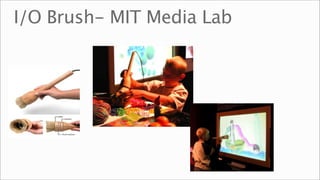
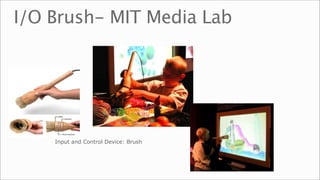
I/O Brush- MIT Media Lab


    Input and Control Device: Brush
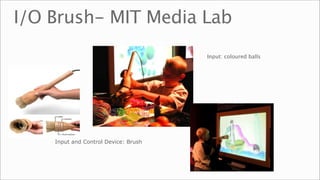
I/O Brush- MIT Media Lab
                                      
   Input: coloured balls


    Input and Control Device: Brush
Paper-based Multimedia
as Learning Tool for
Disabled Children
Tangible Interaction: Case
Goal
              To support learning

             in the school context

       for children with severe cognitive,

        linguistic and motor disabilities

   in the long term and in a sustainable way
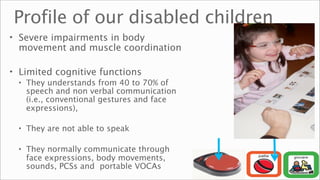
Profile of our disabled children
• Severe impairments in body
  movement and muscle coordination

• Limited cognitive functions
  • They understands from 40 to 70% of
    speech and non verbal communication
    (i.e., conventional gestures and face
    expressions),

  • They are not able to speak

  • They normally communicate through
    face expressions, body movements,
    sounds, PCSs and portable VOCAs
Requirements on the UX
•   Use of PCS based Communication
•   Customization (“each child is unique”)
•   Tangible Interaction
•   Use of familiar, situated material
•   Consolidation
•   Enagagement
•   Concentration and Timing
Requirements on Technology
• Open

• Flexible

• Easily adaptable

• “Construction Kit” and “End User Programming” paradigms
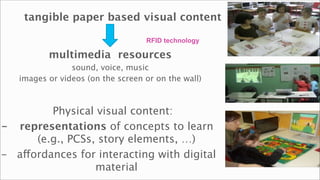
tangible paper based visual content

                                   RFID technology

          multimedia resources
                sound, voice, music
   images or videos (on the screen or on the wall)


         Physical visual content:
- representations of concepts to learn
      (e.g., PCSs, story elements, …)
- affordances for interacting with digital
                  material
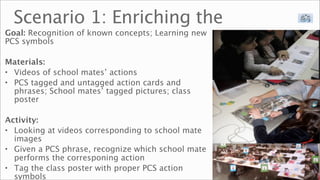
Scenario 1: Enriching the
Goal: Recognition of known concepts; Learning new
PCS symbols

Materials:
• Videos of school mates’ actions
• PCS tagged and untagged action cards and
  phrases; School mates’ tagged pictures; class
  poster

Activity:
• Looking at videos corresponding to school mate
  images
• Given a PCS phrase, recognize which school mate
  performs the corresponing action
• Tag the class poster with proper PCS action
  symbols
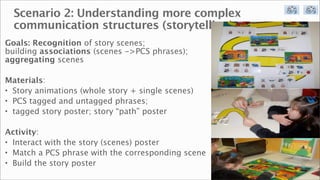
Scenario 2: Understanding more complex
  communication structures (storytelling)
Goals: Recognition of story scenes;
building associations (scenes ->PCS phrases);
aggregating scenes

Materials:
• Story animations (whole story + single scenes)
• PCS tagged and untagged phrases;
• tagged story poster; story “path” poster

Activity:
• Interact with the story (scenes) poster
• Match a PCS phrase with the corresponding scene
• Build the story poster
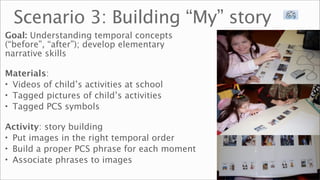
Scenario 3: Building “My” story
Goal: Understanding temporal concepts
(“before”, “after”); develop elementary
narrative skills

Materials:
• Videos of child’s activities at school
• Tagged pictures of child’s activities
• Tagged PCS symbols

Activity: story building
• Put images in the right temporal order
• Build a proper PCS phrase for each moment
• Associate phrases to images
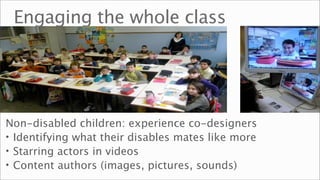
Engaging the whole class


Non-disabled children: experience co-designers
• Identifying what their disables mates like more
• Starring actors in videos
• Content authors (images, pictures, sounds)
Case study 2:


the    element
project
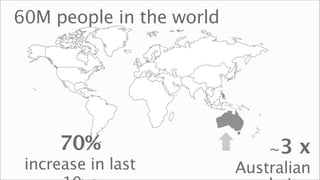
60M people in the world


      70%                     ∼3 x
 increase in last         Australian
new kinect-based, playful
learning application for
autistic children with innovative
cloud remote assistance
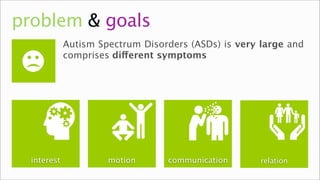
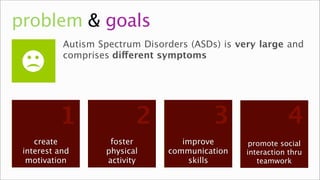
problem & goals
     Autism Spectrum Disorders (ASDs) is very large and
     comprises different symptoms
problem & goals
             Autism Spectrum Disorders (ASDs) is very large and
             comprises different symptoms


  interest            motion      communication       relation
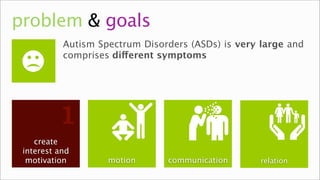
problem & goals
           Autism Spectrum Disorders (ASDs) is very large and
           comprises different symptoms


          1
    create
 interest and
  motivation
   interest         motion      communication       relation
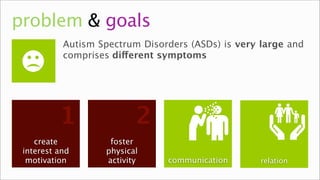
problem & goals
           Autism Spectrum Disorders (ASDs) is very large and
           comprises different symptoms


          1               2
    create          foster
 interest and      physical
  motivation
   interest        motion
                   activity     communication       relation
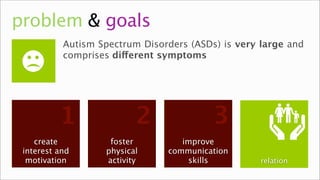
problem & goals
           Autism Spectrum Disorders (ASDs) is very large and
           comprises different symptoms


          1               2               3
    create          foster         improve
 interest and      physical     communication
  motivation
   interest        motion
                   activity     communication
                                    skills          relation
problem & goals
           Autism Spectrum Disorders (ASDs) is very large and
           comprises different symptoms


          1               2               3                 4
    create          foster         improve        promote social
 interest and      physical     communication    interaction thru
  motivation
   interest        motion
                   activity     communication
                                    skills          teamwork
                                                     relation
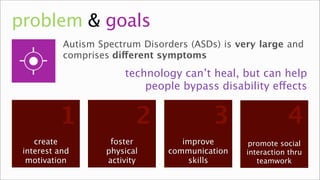
problem & goals
           Autism Spectrum Disorders (ASDs) is very large and
           comprises different symptoms
                       technology can’t heal, but can help
                           people bypass disability effects


          1               2               3                 4
    create          foster         improve        promote social
 interest and      physical     communication    interaction thru
  motivation
   interest        motion
                   activity     communication
                                    skills          teamwork
                                                     relation
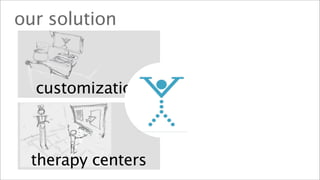
our solution
our solution


  customization
our solution


  customization


 therapy centers
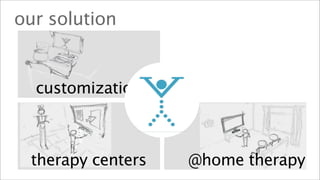
our solution


  customization


 therapy centers   @home therapy
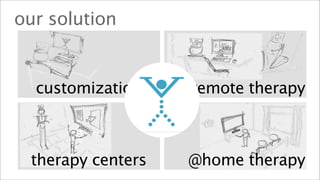
our solution


  customization    remote therapy


 therapy centers   @home therapy
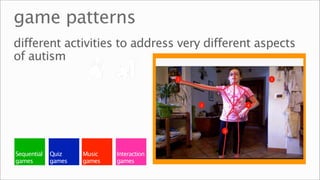
game patterns
different activities to address very different aspects
of autism


Sequential   Quiz    Music   Interaction
games        games   games   games
game patterns
different activities to address very different aspects
of autism


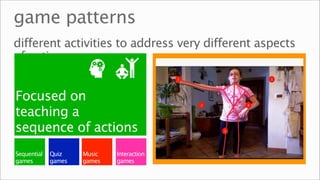
Focused on
teaching a
sequence of actions
Sequential   Quiz    Music   Interaction
games        games   games   games
game patterns
different activities to address very different aspects
of autism


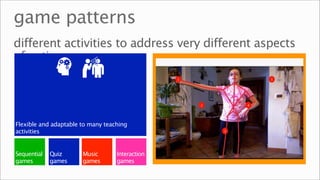
Flexible and adaptable to many teaching
activities


Sequential   Quiz      Music       Interaction
games        games     games       games
game patterns
different activities to address very different aspects
of autism

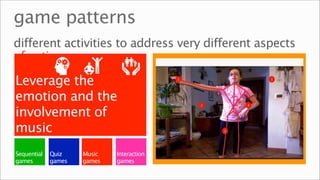
Leverage the
emotion and the
involvement of
music
Sequential   Quiz    Music   Interaction
games        games   games   games
game patterns
different activities to address very different aspects
of autism


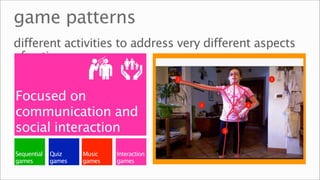
Focused on
communication and
social interaction
Sequential   Quiz    Music   Interaction
games        games   games   games
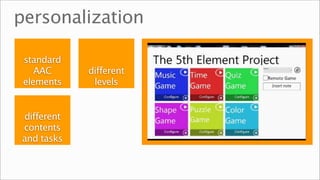
personalization

 standard
    AAC     different
 elements    levels


different
contents
and tasks
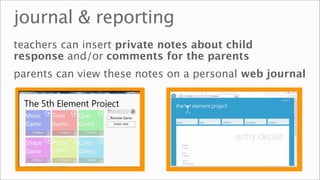
journal & reporting
teachers can insert private notes about child
response and/or comments for the parents
parents can view these notes on a personal web journal
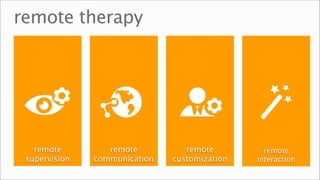
remote therapy
remote therapy


   remote         remote          remote         remote
 supervision   communication   customization   interaction
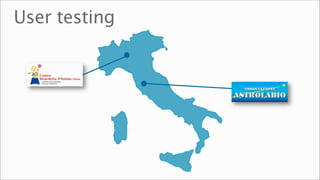
User testing
User testing
Thanks for your
attention
Franca Garzotto
Matteo Valoriani

Dipartimento di Elettronica ed Informazione – HOC Lab
Politecnico di Milano

[garzotto, valoriani@polimi.it]

Interactive technologies for children - Garzotto Valoriani

  • 1.
    Interactive technologies for children:new frontiers Franca Garzotto Matteo Valoriani Dipartimento di Elettronica ed Informazione – HOC Lab Politecnico di Milano
  • 2.
    Outline Who we are Childrenand Technology New frontiers: - Tangible Interaction - Touchless Gesture Based Interaction
  • 3.
    Who we are HOCLab A multidisciplinary research lab at the Dept. of Electronics and Information at Politecnico di Milano Aplication domain: • e-learning • e-culture • e-tourism Technologies: web, mobile devices, tangibles, gesture-based http://hoc.elet.polimi.it/hoc/
  • 4.
    Children and technology •A huge amount of digital technologies for children • Mostly for entertainment, education, and learning • Children are a stimulating and wide target of users for current and new technologies
  • 5.
    Example 1: tangibleinteraction • physical representation of data and functions • manipulation of digitally enriched physical objects • Embodiment and embeddedness in real space
  • 6.
    I/O Brush- MITMedia Lab
  • 7.
    I/O Brush- MITMedia Lab
  • 8.
    I/O Brush- MITMedia Lab Input and Control Device: Brush
  • 9.
    I/O Brush- MITMedia Lab Input: coloured balls Input and Control Device: Brush
  • 10.
    Paper-based Multimedia as LearningTool for Disabled Children Tangible Interaction: Case
  • 11.
    Goal To support learning in the school context for children with severe cognitive, linguistic and motor disabilities in the long term and in a sustainable way
  • 12.
    Profile of ourdisabled children • Severe impairments in body movement and muscle coordination • Limited cognitive functions • They understands from 40 to 70% of speech and non verbal communication (i.e., conventional gestures and face expressions), • They are not able to speak • They normally communicate through face expressions, body movements, sounds, PCSs and portable VOCAs
  • 13.
    Requirements on theUX • Use of PCS based Communication • Customization (“each child is unique”) • Tangible Interaction • Use of familiar, situated material • Consolidation • Enagagement • Concentration and Timing
  • 14.
    Requirements on Technology •Open • Flexible • Easily adaptable • “Construction Kit” and “End User Programming” paradigms
  • 15.
    tangible paper basedvisual content RFID technology multimedia resources sound, voice, music images or videos (on the screen or on the wall) Physical visual content: - representations of concepts to learn (e.g., PCSs, story elements, …) - affordances for interacting with digital material
  • 16.
    Scenario 1: Enrichingthe Goal: Recognition of known concepts; Learning new PCS symbols Materials: • Videos of school mates’ actions • PCS tagged and untagged action cards and phrases; School mates’ tagged pictures; class poster Activity: • Looking at videos corresponding to school mate images • Given a PCS phrase, recognize which school mate performs the corresponing action • Tag the class poster with proper PCS action symbols
  • 17.
    Scenario 2: Understandingmore complex communication structures (storytelling) Goals: Recognition of story scenes; building associations (scenes ->PCS phrases); aggregating scenes Materials: • Story animations (whole story + single scenes) • PCS tagged and untagged phrases; • tagged story poster; story “path” poster Activity: • Interact with the story (scenes) poster • Match a PCS phrase with the corresponding scene • Build the story poster
  • 18.
    Scenario 3: Building“My” story Goal: Understanding temporal concepts (“before”, “after”); develop elementary narrative skills Materials: • Videos of child’s activities at school • Tagged pictures of child’s activities • Tagged PCS symbols Activity: story building • Put images in the right temporal order • Build a proper PCS phrase for each moment • Associate phrases to images
  • 19.
    Engaging the wholeclass Non-disabled children: experience co-designers • Identifying what their disables mates like more • Starring actors in videos • Content authors (images, pictures, sounds)
  • 20.
    Case study 2: the element project
  • 21.
    60M people inthe world 70% ∼3 x increase in last Australian
  • 22.
    new kinect-based, playful learningapplication for autistic children with innovative cloud remote assistance
  • 23.
    problem & goals Autism Spectrum Disorders (ASDs) is very large and comprises different symptoms
  • 24.
    problem & goals Autism Spectrum Disorders (ASDs) is very large and comprises different symptoms interest motion communication relation
  • 25.
    problem & goals Autism Spectrum Disorders (ASDs) is very large and comprises different symptoms 1 create interest and motivation interest motion communication relation
  • 26.
    problem & goals Autism Spectrum Disorders (ASDs) is very large and comprises different symptoms 1 2 create foster interest and physical motivation interest motion activity communication relation
  • 27.
    problem & goals Autism Spectrum Disorders (ASDs) is very large and comprises different symptoms 1 2 3 create foster improve interest and physical communication motivation interest motion activity communication skills relation
  • 28.
    problem & goals Autism Spectrum Disorders (ASDs) is very large and comprises different symptoms 1 2 3 4 create foster improve promote social interest and physical communication interaction thru motivation interest motion activity communication skills teamwork relation
  • 29.
    problem & goals Autism Spectrum Disorders (ASDs) is very large and comprises different symptoms technology can’t heal, but can help people bypass disability effects 1 2 3 4 create foster improve promote social interest and physical communication interaction thru motivation interest motion activity communication skills teamwork relation
  • 30.
  • 31.
    our solution customization
  • 32.
    our solution customization therapy centers
  • 33.
    our solution customization therapy centers @home therapy
  • 34.
    our solution customization remote therapy therapy centers @home therapy
  • 35.
    game patterns different activitiesto address very different aspects of autism Sequential Quiz Music Interaction games games games games
  • 36.
    game patterns different activitiesto address very different aspects of autism Focused on teaching a sequence of actions Sequential Quiz Music Interaction games games games games
  • 37.
    game patterns different activitiesto address very different aspects of autism Flexible and adaptable to many teaching activities Sequential Quiz Music Interaction games games games games
  • 38.
    game patterns different activitiesto address very different aspects of autism Leverage the emotion and the involvement of music Sequential Quiz Music Interaction games games games games
  • 39.
    game patterns different activitiesto address very different aspects of autism Focused on communication and social interaction Sequential Quiz Music Interaction games games games games
  • 40.
    personalization standard AAC different elements levels different contents and tasks
  • 41.
    journal & reporting teacherscan insert private notes about child response and/or comments for the parents parents can view these notes on a personal web journal
  • 42.
  • 43.
    remote therapy remote remote remote remote supervision communication customization interaction
  • 44.
  • 45.
  • 46.
    Thanks for your attention FrancaGarzotto Matteo Valoriani Dipartimento di Elettronica ed Informazione – HOC Lab Politecnico di Milano [garzotto, valoriani@polimi.it]