Intensification
Options
revisited
Dr. Usama Ragab Youssif, MD
Lecturer of Medicine
Scientific Coordinator of ESMA
Intensification Options After
Basal Insulin
• Add an OAD
• Add a short-acting insulin at mealtime
• Switch to premixed insulins
• Novel insulin combinations
• Basal insulin/GLP-1 RA combinations
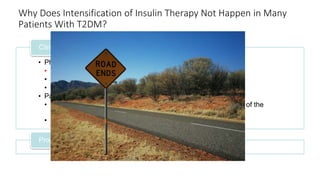
Why Does Intensification of Insulin Therapy Not Happen in Many
Patients With T2DM?
• Physician barriers
• Inexperience with using insulin; lack of resources/training
• Fear of hypoglycemia
• Not buying into HbA1c targets; don’t want to be too aggressive
• Patient barriers
• Insulin carries “baggage” (eg, negative family experience, “end of the
road” perception)
• Educational issues about insulin dose increases
Clinical inertia
Progressive nature of disease
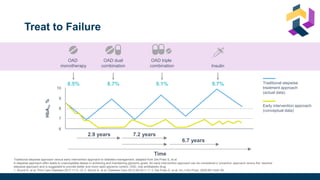
Treat to Failure
Traditional stepwise approach versus early intervention approach to diabetes management, adapted from Del Prato S, et al.
A stepwise approach often leads to unacceptable delays in achieving and maintaining glycemic goals. An early intervention approach can be considered a ‘proactive’ approach versus the ‘reactive’
stepwise approach and is suggested to provide better and more rapid glycemic control. OAD, oral antidiabetic drug.
1. Khunti K, et al. Prim Care Diabetes 2017;11:3–12; 2. Khunti K, et al. Diabetes Care 2013;36:3411‒7; 3. Del Prato S, et al. Int J Clin Pract. 2005;59:1345–55.
Early intervention approach
(conceptual data)
10
HbA
1c
%
9
8
7
6
2.9 years 7.2 years
6.7 years
Time
8.5%
OAD
monotherapy
9.7%
Insulin
8.7%
OAD dual
combination
9.1%
OAD triple
combination
Traditional stepwise
treatment approach
(actual data)
PPG
196–254 mg/dL
AER, albumin exctretion rate; BID, twice daily; BMI, body mass index; eGFR, estimated glomerular filtration rate; FPG, fasting plasma glucose; HbA1c, glycated
hemoglobin; HDL, high-density lipoprotein; LDL, low-density lipoprotein; PPG, postprandial glucose; QD, once daily
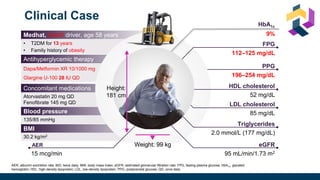
• T2DM for 13 years
• Family history of obesity
Medhat, forklift driver, age 58 years
135/85 mmHg
Blood pressure
30.2 kg/m2
BMI
Atorvastatin 20 mg QD
Fenofibrate 145 mg QD
Concomitant medications
Dapa/Metformin XR 10/1000 mg
Glargine U-100 28 IU QD
Antihyperglycemic therapy
FPG
112–125 mg/dL
HDL cholesterol
52 mg/dL
LDL cholesterol
85 mg/dL
Triglycerides
2.0 mmol/L (177 mg/dL)
Weight: 99 kg
HbA1c
9%
Height:
181 cm
eGFR
95 mL/min/1.73 m2
AER
15 mcg/min
Clinical Case
Copyright ADA/EASD 2022
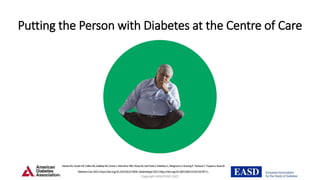
Putting the Person with Diabetes at the Centre of Care
DaviesMJ,ArodaVR,CollinsBS,GabbayRA,GreenJ,MaruthurNM,RosasSE,DelPratoS,MathieuC,MingroneG,RossingP,TankovaT,TsapasA,BuseJB
DiabetesCare2022;https://doi.org/10.2337/dci22-0034.Diabetologia2022;https://doi.org/10.1007/s00125-022-05787-2.
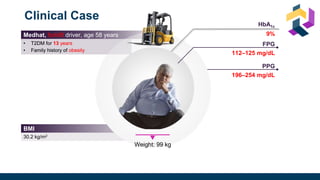
PPG
196–254 mg/dL
• T2DM for 13 years
• Family history of obesity
Medhat, forklift driver, age 58 years
30.2 kg/m2
BMI
Weight: 99 kg
HbA1c
9%
Clinical Case
• T2DM for 13 years
• Family history of obesity
Medhat, forklift driver, age 58 years
FPG
112–125 mg/dL
Copyright ADA/EASD 2022
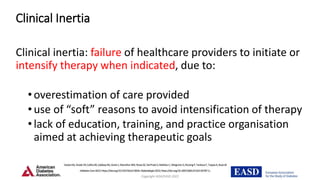
Clinical Inertia
Clinical inertia: failure of healthcare providers to initiate or
intensify therapy when indicated, due to:
•overestimation of care provided
•use of “soft” reasons to avoid intensification of therapy
•lack of education, training, and practice organisation
aimed at achieving therapeutic goals
DaviesMJ,ArodaVR,CollinsBS,GabbayRA,GreenJ,MaruthurNM,RosasSE,DelPratoS,MathieuC,MingroneG,RossingP,TankovaT,TsapasA,BuseJB
DiabetesCare2022;https://doi.org/10.2337/dci22-0034.Diabetologia2022;https://doi.org/10.1007/s00125-022-05787-2.
.
Copyright ADA/EASD 2022
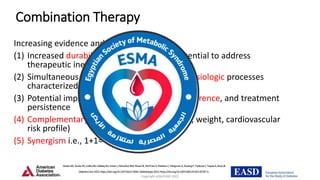
Combination Therapy
Increasing evidence and rationale:
(1) Increased durability of glycemic effect, potential to address
therapeutic inertia
(2) Simultaneous targeting of multiple pathophysiologic processes
characterized by type 2 diabetes
(3) Potential impact on medication burden, adherence, and treatment
persistence
(4) Complementary clinical benefits (glycaemia, weight, cardiovascular
risk profile)
(5) Synergism i.e., 1+1= 10
DaviesMJ,ArodaVR,CollinsBS,GabbayRA,GreenJ,MaruthurNM,RosasSE,DelPratoS,MathieuC,MingroneG,RossingP,TankovaT,TsapasA,BuseJB
DiabetesCare2022;https://doi.org/10.2337/dci22-0034.Diabetologia2022;https://doi.org/10.1007/s00125-022-05787-2.
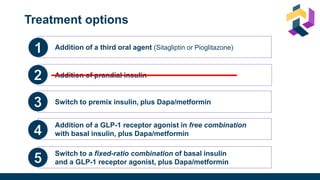
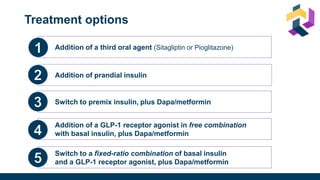
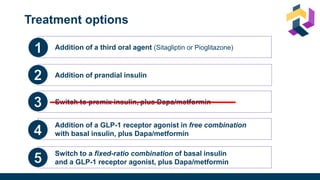
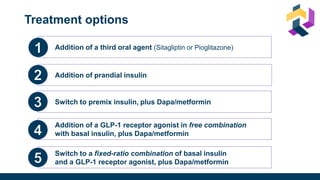
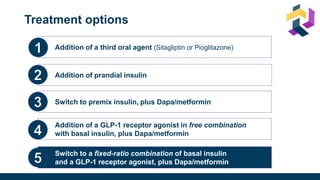
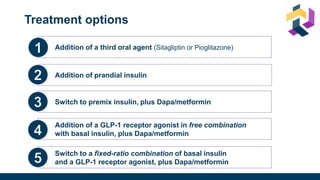
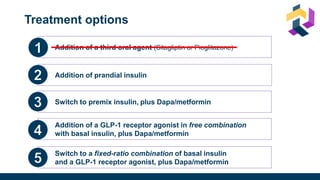
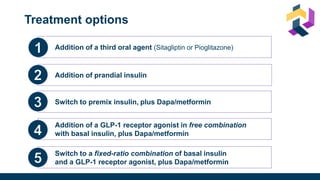
Addition of a third oral agent (Sitagliptin or Pioglitazone)
Addition of prandial insulin
Switch to premix insulin, plus Dapa/metformin
Addition of a GLP-1 receptor agonist in free combination
with basal insulin, plus Dapa/metformin
Switch to a fixed-ratio combination of basal insulin
and a GLP-1 receptor agonist, plus Dapa/metformin
Treatment options
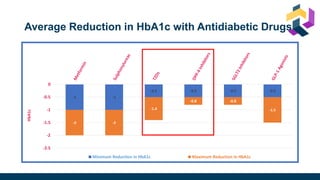
Average Reduction in HbA1c with Antidiabetic Drugs
-1 -1
-0.5 -0.5 -0.5 -0.5
-2 -2
-1.4
-0.8 -0.8
-1.5
-2.5
-2
-1.5
-1
-0.5
0
HbA1c
Minimum Reduction in HbA1c Maximum Reduction in HbA1c
Addition of a third oral agent (Sitagliptin or Pioglitazone)
Addition of prandial insulin
Switch to premix insulin, plus Dapa/metformin
Addition of a GLP-1 receptor agonist in free combination
with basal insulin, plus Dapa/metformin
Switch to a fixed-ratio combination of basal insulin
and a GLP-1 receptor agonist, plus Dapa/metformin
Treatment options
Addition of a third oral agent (Sitagliptin or Pioglitazone)
Addition of prandial insulin
Switch to premix insulin, plus Dapa/metformin
Addition of a GLP-1 receptor agonist in free combination
with basal insulin, plus Dapa/metformin
Switch to a fixed-ratio combination of basal insulin
and a GLP-1 receptor agonist, plus Dapa/metformin
Treatment options
Discussing Prandial
Therapy with
patients
• Contraindications
• PPG monitoring
• I shall eat everything
• Side effects
• Injections
• Insurance
• My Weight
• A lot of WhatsApp messages
Don’t Forget
Insulin = Titration
Simplifying therapy
for adults with Type 2
diabetes
MAT-EG-2201034-1.0-06/2022
Initiation of iGlarLixi vs basal–bolus insulin in adults
with type 2 diabetes advancing from basal insulin
therapy: the SoliComplex real-world study
Kevin M. Pantalone1, Caroline Heller2, Rosemarie Lajara3, Elisheva Lew4, Xuan Li5,
Terry Dex5, C. Rachel Kilpatrick6
1
ADA 2022
June 3–7, 2022
New Orleans, LA
Session: Sunday,
June 5; 12–1 PM
Poster # 733-P
1Cleveland Clinic, Cleveland, OH; 2Aetion, New York, NY; 3Southern Endocrinology, Plano, TX; 4Sanofi, Paris, France; 5Sanofi, Bridgewater, NJ;
6Washington Regional Endocrinology, Fayetteville, AR
Click icon to
add picture
Poster book
To download e-poster and/or
to listen to author summary
scan the QR code OR visit
www.scientificposterbook.com
Summary
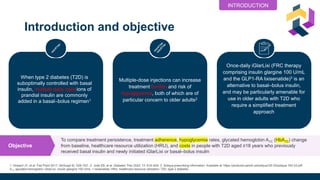
Introduction and objective
To compare treatment persistence, treatment adherence, hypoglycemia rates, glycated hemoglobin A1C (HbA1C) change
from baseline, healthcare resource utilization (HRU), and costs in people with T2D aged ≥18 years who previously
received basal insulin and newly initiated iGlarLixi or basal–bolus insulin
Objective
1. Howard JY, et al. Fed Pract 2017; 34(Suppl 8): S26–S31. 2. Jude EB, et al. Diabetes Ther 2022; 13: 619–634. 3. Soliqua prescribing information. Available at: https://products.sanofi.us/soliqua100-33/soliqua 100-33.pdf.
A1c, glycated hemoglobin; iGlarLixi, insulin glargine 100 U/mL + lixisenatide; HRU, healthcare resource utilization; T2D, type 2 diabetes
When type 2 diabetes (T2D) is
suboptimally controlled with basal
insulin, multiple daily injections of
prandial insulin are commonly
added in a basal–bolus regimen1
Once-daily iGlarLixi (FRC therapy
comprising insulin glargine 100 U/mL
and the GLP1-RA lixisenatide)3 is an
alternative to basal–bolus insulin,
and may be particularly amenable for
use in older adults with T2D who
require a simplified treatment
approach
Multiple-dose injections can increase
treatment burden and risk of
hypoglycemia, both of which are of
particular concern to older adults2
INTRODUCTION
Study design
A1C, glycated hemoglobin; ED, emergency department; HRU, healthcare resource utilization; iGlarLixi, insulin glargine 100 U/mL + lixisenatide; T2D, type 2 diabetes
Figure 1
• People with T2D aged ≥18 years
at index date
• During baseline period:
• ≥1 fill of basal insulin
• ≥1 valid A1C measurement
• No prior iGlarLixi or premix
insulin or bolus insulin fills
aPrimary outcome (statistical analysis was prespecified for the primary outcome [treatment persistence; overall population] only).
bLaboratory defined; using one count per person per day. cED visits and hospitalizations. dFor inclusion in the A1C analysis participants
had to have a valid baseline and a follow-up A1C value at 12 months; therefore, this analysis was conducted in a small proportion of the
overall population.
METHODS
Newly initiated
iGlarLixi
N = 1082
Newly initiated
basal-bolus
insulin
N = 21,208
N = 1070
N = 1070
6-month baseline treatment
Outcomes at
12 months:
• Persistencea
• Adherence
• Hypoglycemiab
• HRUc
• Costs
• A1c changed
Assessed in:
• Overall population
• Subgroup aged
> 65 years
Treatment initiation
= index date
Followed from index date for 12 months,
or plan disenrollment or death
Figure 2
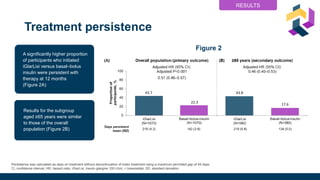
Treatment persistence
A significantly higher proportion
of participants who initiated
iGlarLixi versus basal–bolus
insulin were persistent with
therapy at 12 months
(Figure 2A)
Persistence was calculated as days on treatment without discontinuation of index treatment using a maximum permitted gap of 45 days.
CI, confidence interval; HR, hazard ratio; iGlarLixi, insulin glargine 100 U/mL + lixisenatide; SD, standard deviation
Results for the subgroup
aged ≥65 years were similar
to those of the overall
population (Figure 2B)
RESULTS
43.7
22.3
43.8
17.6
Figure 3
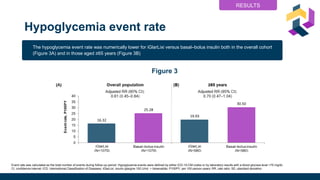
Hypoglycemia event rate
Event rate was calculated as the total number of events during follow-up period. Hypoglycemia events were defined by either ICD-10-CM codes or by laboratory results with a blood glucose level <70 mg/dL.
CI, confidence interval; ICD, International Classification of Diseases; iGlarLixi, insulin glargine 100 U/mL + lixisenatide; P100PY, per 100 person-years; RR, rate ratio; SD, standard deviation
The hypoglycemia event rate was numerically lower for iGlarLixi versus basal–bolus insulin both in the overall cohort
(Figure 3A) and in those aged ≥65 years (Figure 3B)
RESULTS
16.32
25.28
19.93
30.50
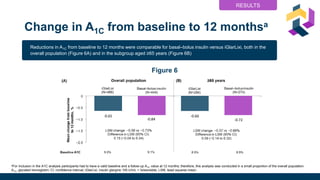
Change in A1C from baseline to 12 monthsa
aFor inclusion in the A1C analysis participants had to have a valid baseline and a follow-up A1C value at 12 months; therefore, this analysis was conducted in a small proportion of the overall population.
A1C, glycated hemoglobin; CI, confidence interval; iGlarLixi, insulin glargine 100 U/mL + lixisenatide; LSM, least squares mean.
Reductions in A1C from baseline to 12 months were comparable for basal–bolus insulin versus iGlarLixi, both in the
overall population (Figure 6A) and in the subgroup aged ≥65 years (Figure 6B)
RESULTS
-0.65
-0.84
-0.60
-0.72
Figure 6
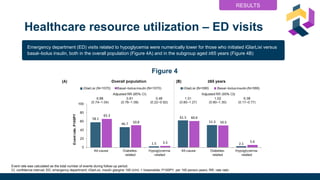
Healthcare resource utilization – ED visits
Event rate was calculated as the total number of events during follow-up period.
CI, confidence interval; ED, emergency department; iGlarLixi, insulin glargine 100 U/mL + lixisenatide; P100PY, per 100 person-years; RR, rate ratio
Emergency department (ED) visits related to hypoglycemia were numerically lower for those who initiated iGlarLixi versus
basal–bolus insulin, both in the overall population (Figure 4A) and in the subgroup aged ≥65 years (Figure 4B)
RESULTS
58.1
65.3
46.7 50.8
1.5 3.3
61.5 60.6
51.3 50.5
2.1
5.6
Figure 4
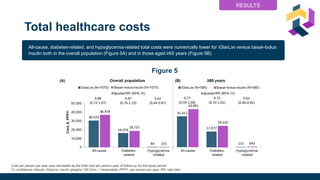
Total healthcare costs
Cost per person per year was calculated as the total cost per person-year of follow-up for the study period.
CI, confidence interval; iGlarLixi, insulin glargine 100 U/mL + lixisenatide; PPPY, per person per year; RR, rate ratio.
All-cause, diabetes-related, and hypoglycemia-related total costs were numerically lower for iGlarLixi versus basal–bolus
insulin both in the overall population (Figure 5A) and in those aged ≥65 years (Figure 5B)
RESULTS
30.523
36.978
16.076
18.737
84 255
35.413
43.601
17.977
24.620
115 642
0.77
(0.59-1.00)
0.75
(0.55-1.01)
0.61
(0.40-0.91)
0.88
(0.72-1.07)
0.97
(0.76-1.23)
0.62
(0.44-0.87)
Figure 5
SoliComplex
Bottomline
• Once-daily iGlarLixi administration = adherence,
less hypoglycemia than basal-bolus insulin
without huge HRU or costs.
• The results for the 65-year-old subgroup were
similar to the general population, indicating that
once-daily iGlarLixi is a suitable option to basal-
bolus insulin for older adults who may require
less treatment complexity.
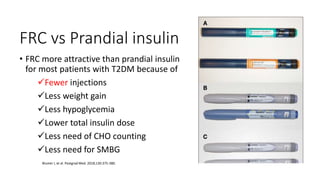
FRC vs Prandial insulin
• FRC more attractive than prandial insulin
for most patients with T2DM because of
Fewer injections
Less weight gain
Less hypoglycemia
Lower total insulin dose
Less need of CHO counting
Less need for SMBG
Blumer I, et al. Postgrad Med. 2018;130:375-380.
What about IDegAsp
FRC?
What IDegAsp?
• It is long-acting insulin analogue +
rapid acting insulin analogue
• I.e., insulin + insulin
• I.e., complications of insulin
• I.e., weight gain & Hypo risk
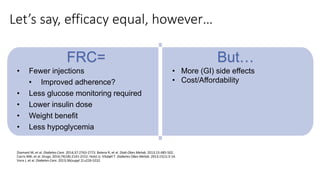
Let’s say, efficacy equal, however…
Diamant M, et al. Diabetes Care. 2014;37:2763-2773. Balena R, et al. Diab Obes Metab. 2013;15:485-502.
Carris NW, et al. Drugs. 2014;74(18):2141-2152. Holst JJ, Vilsbøll T. Diabetes Obes Metab. 2013;15(1):3-14.
Vora J, et al. Diabetes Care. 2013;36(suppl 2):s226-S232.
• Fewer injections
• Improved adherence?
• Less glucose monitoring required
• Lower insulin dose
• Weight benefit
• Less hypoglycemia
• More (GI) side effects
• Cost/Affordability
FRC= But…
Addition of a third oral agent (Sitagliptin or Pioglitazone)
Addition of prandial insulin
Switch to premix insulin, plus Dapa/metformin
Addition of a GLP-1 receptor agonist in free combination
with basal insulin, plus Dapa/metformin
Switch to a fixed-ratio combination of basal insulin
and a GLP-1 receptor agonist, plus Dapa/metformin
Treatment options
Addition of a third oral agent (Sitagliptin or Pioglitazone)
Addition of prandial insulin
Switch to premix insulin, plus Dapa/metformin
Addition of a GLP-1 receptor agonist in free combination
with basal insulin, plus Dapa/metformin
Switch to a fixed-ratio combination of basal insulin
and a GLP-1 receptor agonist, plus Dapa/metformin
Treatment options
The SoliMix Trial
First head-to-head comparison
of iGlarLixi and premix insulin
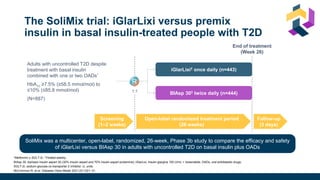
The SoliMix trial: iGlarLixi versus premix
insulin in basal insulin-treated people with T2D
*Metformin ± SGLT-2i; †Titrated weekly.
BIAsp 30, biphasic insulin aspart 30 (30% insulin aspart and 70% insulin aspart protamine); iGlarLixi, insulin glargine 100 U/mL + lixisenatide; OADs, oral antidiabetic drugs;
SGLT-2i, sodium-glucose co-transporter 2 inhibitor; U, units.
McCrimmon R, et al. Diabetes Obes Metab 2021;23:1221–31.
SoliMix was a multicenter, open-label, randomized, 26-week, Phase 3b study to compare the efficacy and safety
of iGlarLixi versus BIAsp 30 in adults with uncontrolled T2D on basal insulin plus OADs
Adults with uncontrolled T2D despite
treatment with basal insulin
combined with one or two OADs*
HbA1c ≥7.5% (≥58.5 mmol/mol) to
≤10% (≤85.8 mmol/mol)
(N=887)
iGlarLixi† once daily (n=443)
BIAsp 30† twice daily (n=444)
Open-label randomized treatment period
(26 weeks)
Screening
(1–2 weeks)
Follow-up
(3 days)
End of treatment
(Week 26)
1:1
R
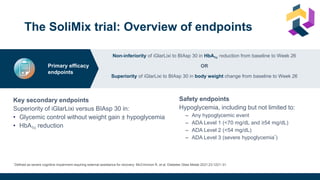
The SoliMix trial: Overview of endpoints
*Defined as severe cognitive impairment requiring external assistance for recovery. McCrimmon R, et al. Diabetes Obes Metab 2021;23:1221–31.
Key secondary endpoints
Superiority of iGlarLixi versus BIAsp 30 in:
• Glycemic control without weight gain ± hypoglycemia
• HbA1c reduction
Safety endpoints
Hypoglycemia, including but not limited to:
– Any hypoglycemic event
– ADA Level 1 (<70 mg/dL and ≥54 mg/dL)
– ADA Level 2 (<54 mg/dL)
– ADA Level 3 (severe hypoglycemia*)
Primary efficacy
endpoints
Non-inferiority of iGlarLixi to BIAsp 30 in HbA1c reduction from baseline to Week 26
OR
Superiority of iGlarLixi to BIAsp 30 in body weight change from baseline to Week 26
Once-daily iGlarLixi provided better glycemic control with weight benefit
compared with twice-daily premix BIAsp 30
*Non-inferiority margin 0.3 %.
BIAsp 30, biphasic insulin aspart 30 (30% insulin aspart and 70% insulin aspart protamine); CI, confidence interval; iGlarLixi, a fixed-ratio combination of insulin glargine 100 U/mL and the glucagon-like peptide-1 receptor agonist, lixisenatide;
ITT, intention-to-treat; LS mean, least squares mean; SD, standard deviation; SE, standard error; U, units.
Rosenstock J et al. Diabetes Care 2021;[accepted ahead of publication]
iGlarLixi
(ITT population;
n=443)
BIAsp 30
(ITT population;
n=444)
vs
LS mean ± SE change in HbA1c
from baseline to Week 26, %
−1.3 ± 0.1
−1.1 ± 0.1
Non-inferiority (achieved)
LS mean difference (97.5% CI):
−0.2 (−0.4, −0.1) %; p<0.001
Superiority (achieved)
LS mean difference (95% CI):
−0.2 (−0.4, −0.1) %; p<0.001
LS mean ± SE change in bodyweight
from baseline to Week 26, kg
−0.7 ± 0.2
+1.2 ± 0.2
Superiority (achieved)
LS mean difference (95% CI):
−1.9 (−2.3, −1.4) kg; p<0.001
Subsequent hierarchical testing showed HbA1c reductions were superior with iGlarLixi
versus BIAsp 30 (p=0.001; key secondary endpoint)
iGlarLixi was non-inferior* to BIAsp 30 in
change in HbA1c from baseline to Week 26
HbA1c
iGlarLixi was superior to BIAsp 30 in change in
bodyweight from baseline to Week 26
Mean ± SD HbA1c, % iGlarLixi BIAsp 30
Baseline 8.6 ± 0.7 8.6 ± 0.7
Week 26 7.3 ± 1.1 7.5 ± 1.0
Mean ± SD bodyweight, kg iGlarLixi BIAsp 30
Baseline 80.7 ± 16.6 82.2 ± 18.5
Week 26 80.2 ± 16.6 83.4 ± 19.0
HbA1c target achievement without weight gain and without
hypoglycemia was greater with iGlarLixi vs BIAsp 30
*Not included in the multiple testing procedure. †Hierarchical analysis adjusted for multiplicity. ITT, intent-to-treat; OR, odds ratio.
Rosenstock J, et al. Diabetes Care 2021;dc210393 [online ahead of print].
27.5 (n=122)
12.4 (n=55)
19.4 (n=86)
7.0
(n=31)
1.65 (1.25, 2.19)*
0 10 20 30 40 50
Percentage of participants reaching target (%)
HbA1c <7 %
(Exploratory analysis*)
HbA1c <7 % without
weight gain
(Key secondary endpoint†)
HbA1c <7 % without
weight gain and
without hypoglycemia
(Key secondary endpoint†)
OR (95% CI)
iGlarLixi
(ITT population; N=443)
BIAsp 30
(ITT population; N=444)
42.2 (n=187)
31.8 (n=141)
3.40 (2.19, 5.28)†
p<0.001
2.83 (1.98, 4.04)†
p<0.001
Addition of a third oral agent (Sitagliptin or Pioglitazone)
Addition of prandial insulin
Switch to premix insulin, plus Dapa/metformin
Addition of a GLP-1 receptor agonist in free combination
with basal insulin, plus Dapa/metformin
Switch to a fixed-ratio combination of basal insulin
and a GLP-1 receptor agonist, plus Dapa/metformin
Treatment options
Addition of a third oral agent (Sitagliptin or Pioglitazone)
Addition of prandial insulin
Switch to premix insulin, plus Dapa/metformin
Addition of a GLP-1 receptor agonist in free combination
with basal insulin, plus Dapa/metformin
Switch to a fixed-ratio combination of basal insulin
and a GLP-1 receptor agonist, plus Dapa/metformin
Treatment options
Adherence
Insulin and
GLP1-RA: The
Ideal
Combination
Clinical evidence
for FRCs
Copyright ADA/EASD 2022
DaviesMJ,ArodaVR,CollinsBS,GabbayRA,GreenJ,MaruthurNM,RosasSE,DelPratoS,MathieuC,MingroneG,RossingP,TankovaT,TsapasA,BuseJB
DiabetesCare2022;https://doi.org/10.2337/dci22-0034.Diabetologia2022;https://doi.org/10.1007/s00125-022-05787-2.
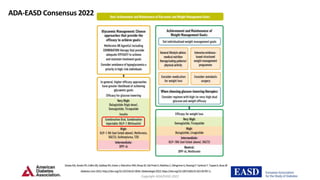
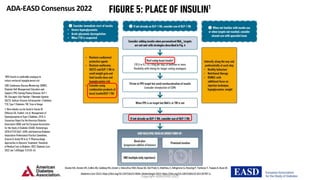
ADA-EASD Consensus 2022
Copyright ADA/EASD 2022
DaviesMJ,ArodaVR,CollinsBS,GabbayRA,GreenJ,MaruthurNM,RosasSE,DelPratoS,MathieuC,MingroneG,RossingP,TankovaT,TsapasA,BuseJB
DiabetesCare2022;https://doi.org/10.2337/dci22-0034.Diabetologia2022;https://doi.org/10.1007/s00125-022-05787-2.
ADA-EASD Consensus 2022
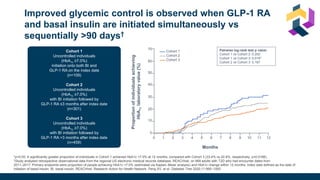
Improved glycemic control is observed when GLP-1 RA
and basal insulin are initiated simultaneously vs
sequentially >90 days†
*p<0.05. A significantly greater proportion of individuals in Cohort 1 achieved HbA1c <7.0% at 12 months, compared with Cohort 3 (33.4% vs 20.9%, respectively; p=0.0186).
†Study analysed retrospective observational data from the regional US electronic medical records database, REACHnet, on 869 adults with T2D who had encounter dates from
2011–2017. Primary endpoints were proportion of people achieving HbA1c <7.0% (estimated via Kaplan–Meier analysis) and HbA1c change within 12 months. Index date defined as the date of
initiation of basal insulin. BI, basal insulin; REACHnet, Research Action for Health Network. Peng XV, et al. Diabetes Ther 2020;11:995–1005.
Cohort 1
Uncontrolled individuals
(HbA1c ≥7.0%)
initiation onto both BI and
GLP-1 RA on the index date
(n=109)
Cohort 2
Uncontrolled individuals
(HbA1c ≥7.0%)
with BI initiation followed by
GLP-1 RA ≤3 months after index date
(n=301)
Cohort 3
Uncontrolled individuals
(HbA1c ≥7.0%)
with BI initiation followed by
GLP-1 RA >3 months after index date
(n=459)
Pairwise log-rank test p value:
Cohort 1 vs Cohort 2: 0.202
Cohort 1 vs Cohort 3: 0.019*
Cohort 2 vs Cohort 3: 0.187
Cohort 1
Cohort 2
Cohort 3
70
60
50
40
30
20
10
0
0 1 2 3 4 5 6 7 8 9 10 11
Proportion
of
individuals
achieving
HbA
1c
laboratory
value
(%)
Months
12
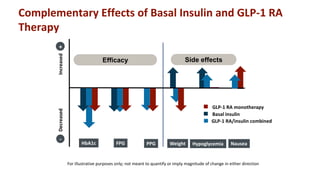
Complementary Effects of Basal Insulin and GLP-1 RA
Therapy
For illustrative purposes only; not meant to quantify or imply magnitude of change in either direction
HbA1c FPG PPG Weight Hypoglycemia
Basal insulin
GLP-1 RA monotherapy
+
GLP-1 RA/insulin combined
Increased
Decreased
-
Efficacy Side effects
Nausea
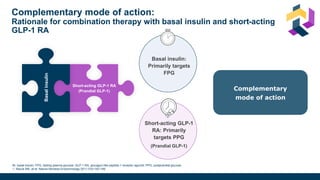
Complementary mode of action:
Rationale for combination therapy with basal insulin and short-acting
GLP-1 RA
Short-acting GLP-1 RA
(Prandial GLP-1)
Basal
insulin
Complementary
mode of action
Short-acting GLP-1
RA: Primarily
targets PPG
(Prandial GLP-1)
Basal insulin:
Primarily targets
FPG
BI, basal insulin; FPG, fasting plasma glucose; GLP-1 RA, glucagon-like peptide-1 receptor agonist; PPG, postprandial glucose.
1. Nauck MA, et al. Nature Reviews Endocrinology 2011;7(4):193-195.
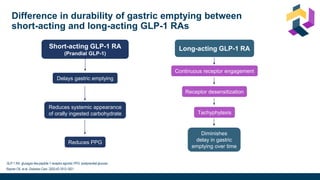
Difference in durability of gastric emptying between
short-acting and long-acting GLP-1 RAs
Short-acting GLP-1 RA
(Prandial GLP-1)
Delays gastric emptying
Reduces systemic appearance
of orally ingested carbohydrate
Reduces PPG
Long-acting GLP-1 RA
Tachyphylaxis
Continuous receptor engagement
Receptor desensitization
Diminishes
delay in gastric
emptying over time
GLP-1 RA: glucagon-like peptide-1 receptor agonist; PPG: postprandial glucose.
Rayner CK, et al. Diabetes Care. 2020;43:1813-1821.
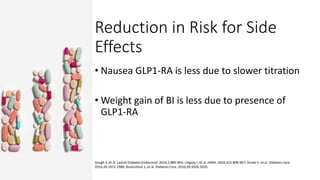
Reduction in Risk for Side
Effects
• Nausea GLP1-RA is less due to slower titration
• Weight gain of BI is less due to presence of
GLP1-RA
Gough S, et al. Lancet Diabetes Endocrinol. 2014;2:885-893; Lingvay I, et al..IAMA. 2016;315:898-907; Aroda V, et al. Diabetes Care.
2016;39:1972-1980; Rosenstock 1, et al. Diabetes Core. 2016;39:2026-2035.
Addition of a third oral agent (Sitagliptin or Pioglitazone)
Addition of prandial insulin
Switch to premix insulin, plus Dapa/metformin
Addition of a GLP-1 receptor agonist in free combination
with basal insulin, plus Dapa/metformin
Switch to a fixed-ratio combination of basal insulin
and a GLP-1 receptor agonist, plus Dapa/metformin
Treatment options
AER, albumin exctretion rate; BID, twice daily; BMI, body mass index; eGFR, estimated glomerular filtration rate; FPG, fasting plasma glucose; HbA1c, glycated
hemoglobin; HDL, high-density lipoprotein; LDL, low-density lipoprotein; PPG, postprandial glucose; QD, once daily
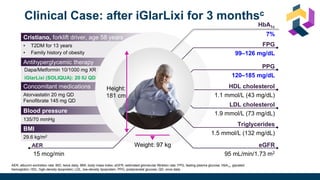
• T2DM for 13 years
• Family history of obesity
Cristiano, forklift driver, age 58 years
135/70 mmHg
Blood pressure
29.6 kg/m2
BMI
Atorvastatin 20 mg QD
Fenofibrate 145 mg QD
Concomitant medications
Antihyperglycemic therapy
FPG
99–126 mg/dL
PPG
HDL cholesterol
1.1 mmol/L (43 mg/dL)
LDL cholesterol
1.9 mmol/L (73 mg/dL)
Triglycerides
1.5 mmol/L (132 mg/dL)
eGFR
95 mL/min/1.73 m2
Weight: 97 kg
HbA1c
7%
120–185 mg/dL
Height:
181 cm
AER
15 mcg/min
Dapa/Metformin 10/1000 mg XR
iGlarLixi (SOLIQUA): 20 IU QD
Clinical Case: after iGlarLixi for 3 monthsc
Prof. Ihab’s
Protocol
Why not simply increase basal?
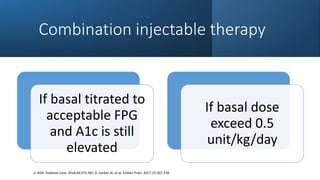
Combination injectable therapy
If basal titrated to
acceptable FPG
and A1c is still
elevated
If basal dose
exceed 0.5
unit/kg/day
a. ADA. Diabetes Care. 2018;40:S73-S85; b. Garber Al, et al. Endocr Pract. 2017;23:207-238.
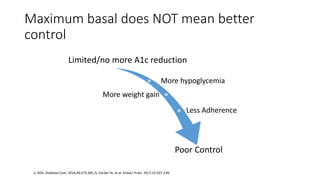
Maximum basal does NOT mean better
control
Limited/no more A1c reduction
More hypoglycemia
More weight gain
Less Adherence
Poor Control
a. ADA. Diabetes Care. 2018;40:S73-S85; b. Garber Al, et al. Endocr Pract. 2017;23:207-238.
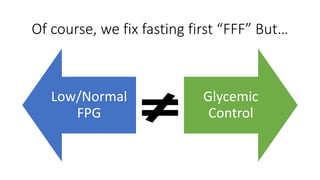
Of course, we fix fasting first “FFF” But…
Low/Normal
FPG
Glycemic
Control
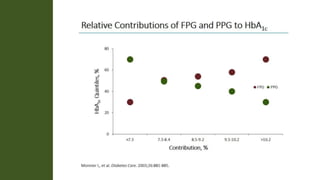
When basal insulin is not enough1
PPG excursion should be addressed with another agent if insulin dose reached
~0.5 U/kg/d without enough control
U/Kg/D: International unit or unit per Kilogram per day, FPG: fasting plasm glucose
Standards of Medical Care in Diabetes - 2022. Diabetes Care 2022;45(Suppl. 1):S125-S143ar
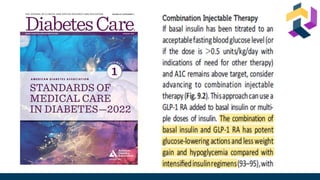
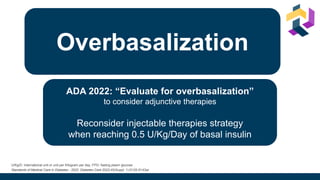
ADA 2022: “Evaluate for overbasalization”
to consider adjunctive therapies
Reconsider injectable therapies strategy
when reaching 0.5 U/Kg/Day of basal insulin
Overbasalization
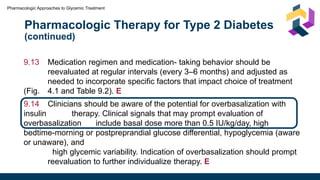
Pharmacologic Therapy for Type 2 Diabetes
(continued)
Pharmacologic Approaches to Glycemic Treatment
9.13 Medication regimen and medication- taking behavior should be
reevaluated at regular intervals (every 3–6 months) and adjusted as
needed to incorporate specific factors that impact choice of treatment
(Fig. 4.1 and Table 9.2). E
9.14 Clinicians should be aware of the potential for overbasalization with
insulin therapy. Clinical signals that may prompt evaluation of
overbasalization include basal dose more than 0.5 IU/kg/day, high
bedtime-morning or postpreprandial glucose differential, hypoglycemia (aware
or unaware), and
high glycemic variability. Indication of overbasalization should prompt
reevaluation to further individualize therapy. E
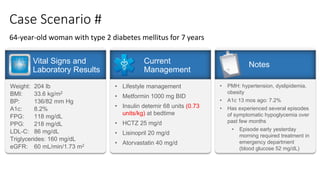
Case Scenario #
64-year-old woman with type 2 diabetes mellitus for 7 years
Weight: 204 lb
BMI: 33.6 kg/m2
BP: 136/82 mm Hg
A1c: 8.2%
FPG: 118 mg/dL
PPG: 218 mg/dL
LDL-C: 86 mg/dL
Triglycerides: 160 mg/dL
eGFR: 60 mL/min/1.73 m2
Vital Signs and
Laboratory Results
• Lifestyle management
• Metformin 1000 mg BID
• Insulin detemir 68 units (0.73
units/kg) at bedtime
• HCTZ 25 mg/d
• Lisinopril 20 mg/d
• Atorvastatin 40 mg/d
Current
Management
• PMH: hypertension, dyslipidemia,
obesity
• A1c 13 mos ago: 7.2%
• Has experienced several episodes
of symptomatic hypoglycemia over
past few months
• Episode early yesterday
morning required treatment in
emergency department
(blood glucose 52 mg/dL)
Notes
How to use?
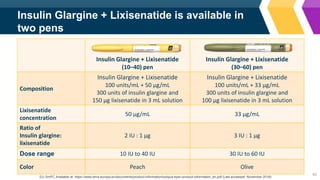
65
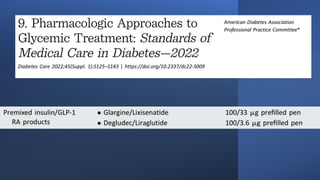
Insulin Glargine + Lixisenatide
(10–40) pen
Insulin Glargine + Lixisenatide
(30–60) pen
Composition
Insulin Glargine + Lixisenatide
100 units/mL + 50 µg/mL
300 units of insulin glargine and
150 µg lixisenatide in 3 mL solution
Insulin Glargine + Lixisenatide
100 units/mL + 33 µg/mL
300 units of insulin glargine and
100 µg lixisenatide in 3 mL solution
Lixisenatide
concentration
50 µg/mL 33 µg/mL
Ratio of
Insulin glargine:
lixisenatide
2 IU : 1 µg 3 IU : 1 µg
Dose range 10 IU to 40 IU 30 IU to 60 IU
Color Peach Olive
EU SmPC Available at: https://www.ema.europa.eu/documents/product-information/suliqua-epar-product-information_en.pdf (Last accessed: November 2018)
Insulin Glargine + Lixisenatide is available in
two pens
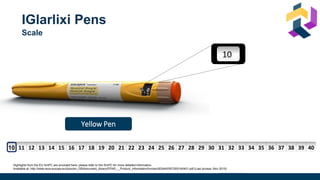
10
11
12
13
14
15
16
17
18
19
20
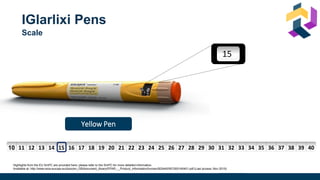
Scale
IGlarlixi Pens
Yellow Pen
Highlights from the EU SmPC are provided here; please refer to the SmPC for more detailed information.
Available at: http://www.ema.europa.eu/docs/en_GB/document_library/EPAR_-_Product_Information/human/002445/WC500140401.pdf (Last access: Nov 2019)
10 11 12 13 14 15 16 17 18 19 20 21 22 23 24 25 26 27 28 29 30 31 32 33 34 35 36 37 38 39 40
10
11
12
13
14
15
16
17
18
19
20
21
22
23
24
25
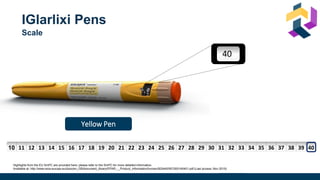
Scale
IGlarlixi Pens
Yellow Pen
Highlights from the EU SmPC are provided here; please refer to the SmPC for more detailed information.
Available at: http://www.ema.europa.eu/docs/en_GB/document_library/EPAR_-_Product_Information/human/002445/WC500140401.pdf (Last access: Nov 2019)
10 11 12 13 14 15 16 17 18 19 20 21 22 23 24 25 26 27 28 29 30 31 32 33 34 35 36 37 38 39 40
35
36
37
38
39
40
41
42
43
45
46
47
48
49
50
51
52
Scale
IGlarlixi Pens
Yellow Pen
Highlights from the EU SmPC are provided here; please refer to the SmPC for more detailed information.
Available at: http://www.ema.europa.eu/docs/en_GB/document_library/EPAR_-_Product_Information/human/002445/WC500140401.pdf (Last access: Nov 2019)
10 11 12 13 14 15 16 17 18 19 20 21 22 23 24 25 26 27 28 29 30 31 32 33 34 35 36 37 38 39 40
25
26
27
28
29
30
31
32
33
34
35
36
37
38
39
40
41
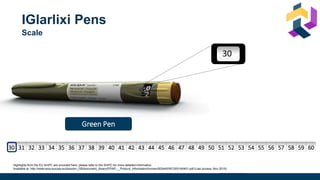
Scale
IGlarlixi Pens
Highlights from the EU SmPC are provided here; please refer to the SmPC for more detailed information.
Available at: http://www.ema.europa.eu/docs/en_GB/document_library/EPAR_-_Product_Information/human/002445/WC500140401.pdf (Last access: Nov 2019)
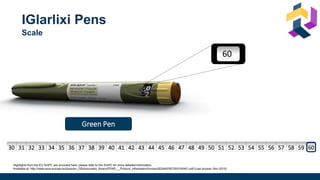
Green Pen
30 31 32 33 34 35 36 37 38 39 40 41 42 43 44 45 46 47 48 49 50 51 52 53 54 55 56 57 58 59 60
30
31
32
33
34
35
36
37
38
39
40
41
42
43
45
46
47
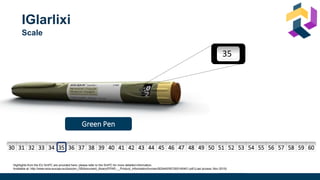
Scale
IGlarlixi
Highlights from the EU SmPC are provided here; please refer to the SmPC for more detailed information.
Available at: http://www.ema.europa.eu/docs/en_GB/document_library/EPAR_-_Product_Information/human/002445/WC500140401.pdf (Last access: Nov 2019)
Green Pen
30 31 32 33 34 35 36 37 38 39 40 41 42 43 44 45 46 47 48 49 50 51 52 53 54 55 56 57 58 59 60
55
56
57
58
59
60
Scale
IGlarlixi Pens
Highlights from the EU SmPC are provided here; please refer to the SmPC for more detailed information.
Available at: http://www.ema.europa.eu/docs/en_GB/document_library/EPAR_-_Product_Information/human/002445/WC500140401.pdf (Last access: Nov 2019)
Green Pen
30 31 32 33 34 35 36 37 38 39 40 41 42 43 44 45 46 47 48 49 50 51 52 53 54 55 56 57 58 59 60
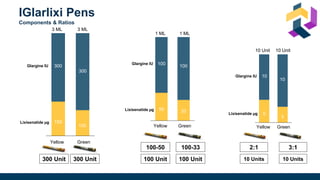
Components & Ratios
IGlarlixi Pens
Lixisenatide µg
Green
Yellow
100
50
100
33
Glargine IU
1 ML 1 ML
10
5
Yellow
3
10 Unit
10
Glargine IU
Green
Lixisenatide µg
10 Unit
2:1 3:1
100-50 100-33
100 Unit 100 Unit 10 Units 10 Units
Lixisenatide µg
100
300
150
Yellow Green
300
Glargine IU
3 ML 3 ML
300 Unit 300 Unit
IGlarlixi Dosing
per each profile
OAD Uncontrolled Patients Basal insulin Uncontrolled Patients
Highlights from the EU SmPC are provided here; please refer to the SmPC for more detailed information.
Available at: http://www.ema.europa.eu/docs/en_GB/document_library/EPAR_-_Product_Information/human/002445/WC500140401.pdf (Last access: Nov 2019)
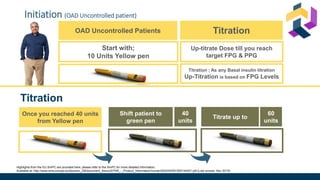
Initiation (OAD Uncontrolled patient)
OAD Uncontrolled Patients
Start with;
10 Units Yellow pen
Titration
Titration ; As any Basal insulin titration
Up-Titration is based on FPG Levels
Up-titrate Dose till you reach
target FPG & PPG
Once you reached 40 units
from Yellow pen
Shift patient to
green pen
40
units
Titrate up to
60
units
Titration
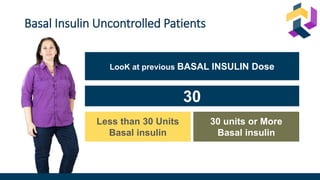
Basal Insulin Uncontrolled Patients
30
Less than 30 Units
Basal insulin
30 units or More
Basal insulin
LooK at previous BASAL INSULIN Dose
Highlights from the EU SmPC are provided here; please refer to the SmPC for more detailed information.
Available at: http://www.ema.europa.eu/docs/en_GB/document_library/EPAR_-_Product_Information/human/002445/WC500140401.pdf (Last access: Nov 2019)
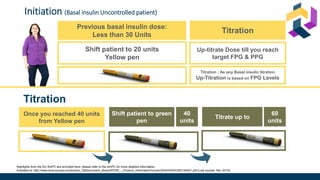
Initiation (Basal insulin Uncontrolled patient)
Previous basal insulin dose:
Less than 30 Units
Shift patient to 20 units
Yellow pen
Titration
Up-titrate Dose till you reach
target FPG & PPG
Titration ; As any Basal insulin titration
Up-Titration is based on FPG Levels
Once you reached 40 units
from Yellow pen
Shift patient to green
pen
40
units
Titrate up to
60
units
Titration
Highlights from the EU SmPC are provided here; please refer to the SmPC for more detailed information.
Available at: http://www.ema.europa.eu/docs/en_GB/document_library/EPAR_-_Product_Information/human/002445/WC500140401.pdf (Last access: Nov 2019)
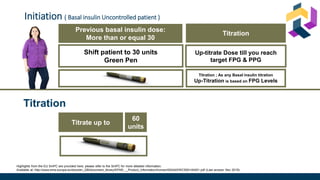
Initiation ( Basal insulin Uncontrolled patient )
Previous basal insulin dose:
More than or equal 30
Shift patient to 30 units
Green Pen
Titration
Up-titrate Dose till you reach
target FPG & PPG
Titration ; As any Basal insulin titration
Up-Titration is based on FPG Levels
Titrate up to
60
units
Titration
78
EU SmPC Available at: https://www.ema.europa.eu/documents/product-information/suliqua-epar-product-information_en.pdf (Last accessed: November 2018)
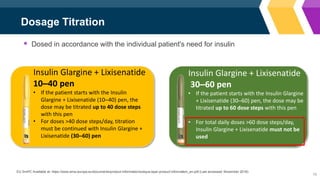
Dosage Titration
 Dosed in accordance with the individual patient's need for insulin
Insulin Glargine + Lixisenatide
10–40 pen
• If the patient starts with the Insulin
Glargine + Lixisenatide (10–40) pen, the
dose may be titrated up to 40 dose steps
with this pen
• For doses >40 dose steps/day, titration
must be continued with Insulin Glargine +
Lixisenatide (30–60) pen
Insulin Glargine + Lixisenatide
30–60 pen
• If the patient starts with the Insulin Glargine
+ Lixisenatide (30–60) pen, the dose may be
titrated up to 60 dose steps with this pen
• For total daily doses >60 dose steps/day,
Insulin Glargine + Lixisenatide must not be
used
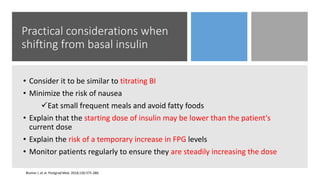
Practical considerations when
shifting from basal insulin
• Consider it to be similar to titrating BI
• Minimize the risk of nausea
Eat small frequent meals and avoid fatty foods
• Explain that the starting dose of insulin may be lower than the patient's
current dose
• Explain the risk of a temporary increase in FPG levels
• Monitor patients regularly to ensure they are steadily increasing the dose
Blumer I, et al. Postgrad Med. 2018;130:375-380.
Soliqua For All??
No One
Size Fit All
Catabolic
Very high doses of insulin
More than 60 units of olive pen
Individualize
Take-home
message
Highlights from the EU SmPC are provided here; please refer to the SmPC for more detailed information.
Available at: http://www.ema.europa.eu/docs/en_GB/document_library/EPAR_-_Product_Information/human/002445/WC500140401.pdf (Last access: Nov 2019)
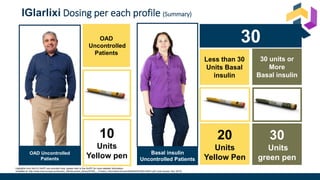
IGlarlixi Dosing per each profile (Summary)
OAD
Uncontrolled
Patients
10
Units
Yellow pen
30
Less than 30
Units Basal
insulin
20
Units
Yellow Pen
30 units or
More
Basal insulin
30
Units
green pen
OAD Uncontrolled
Patients
Basal insulin
Uncontrolled Patients
Highlights from the EU SmPC are provided here; please refer to the SmPC for more detailed information.
Available at: http://www.ema.europa.eu/docs/en_GB/document_library/EPAR_-_Product_Information/human/002445/WC500140401.pdf (Last access: Nov 2019)
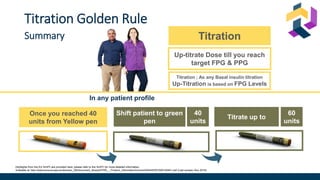
Titration Golden Rule
Summary
In any patient profile
Titration
Up-titrate Dose till you reach
target FPG & PPG
Titration ; As any Basal insulin titration
Up-Titration is based on FPG Levels
Once you reached 40
units from Yellow pen
Shift patient to green
pen
40
units
Titrate up to
60
units
Highlights from the EU SmPC are provided here; please refer to the SmPC for more detailed information.
Available at: http://www.ema.europa.eu/docs/en_GB/document_library/EPAR_-_Product_Information/human/002445/WC500140401.pdf (Last access: Nov 2019)
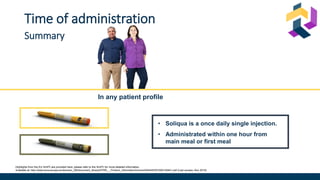
Time of administration
Summary
In any patient profile
• Soliqua is a once daily single injection.
• Administrated within one hour from
main meal or first meal
Final Bottom-line
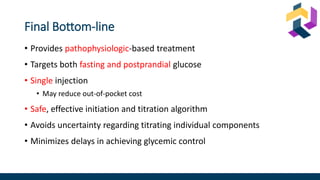
• Provides pathophysiologic-based treatment
• Targets both fasting and postprandial glucose
• Single injection
• May reduce out-of-pocket cost
• Safe, effective initiation and titration algorithm
• Avoids uncertainty regarding titrating individual components
• Minimizes delays in achieving glycemic control
Thank You

Intensification Options after basal Insulin Revisited

  • 1.
    Intensification Options revisited Dr. Usama RagabYoussif, MD Lecturer of Medicine Scientific Coordinator of ESMA
  • 2.
    Intensification Options After BasalInsulin • Add an OAD • Add a short-acting insulin at mealtime • Switch to premixed insulins • Novel insulin combinations • Basal insulin/GLP-1 RA combinations
  • 3.
    Why Does Intensificationof Insulin Therapy Not Happen in Many Patients With T2DM? • Physician barriers • Inexperience with using insulin; lack of resources/training • Fear of hypoglycemia • Not buying into HbA1c targets; don’t want to be too aggressive • Patient barriers • Insulin carries “baggage” (eg, negative family experience, “end of the road” perception) • Educational issues about insulin dose increases Clinical inertia Progressive nature of disease
  • 4.
    Treat to Failure Traditionalstepwise approach versus early intervention approach to diabetes management, adapted from Del Prato S, et al. A stepwise approach often leads to unacceptable delays in achieving and maintaining glycemic goals. An early intervention approach can be considered a ‘proactive’ approach versus the ‘reactive’ stepwise approach and is suggested to provide better and more rapid glycemic control. OAD, oral antidiabetic drug. 1. Khunti K, et al. Prim Care Diabetes 2017;11:3–12; 2. Khunti K, et al. Diabetes Care 2013;36:3411‒7; 3. Del Prato S, et al. Int J Clin Pract. 2005;59:1345–55. Early intervention approach (conceptual data) 10 HbA 1c % 9 8 7 6 2.9 years 7.2 years 6.7 years Time 8.5% OAD monotherapy 9.7% Insulin 8.7% OAD dual combination 9.1% OAD triple combination Traditional stepwise treatment approach (actual data)
  • 5.
    PPG 196–254 mg/dL AER, albuminexctretion rate; BID, twice daily; BMI, body mass index; eGFR, estimated glomerular filtration rate; FPG, fasting plasma glucose; HbA1c, glycated hemoglobin; HDL, high-density lipoprotein; LDL, low-density lipoprotein; PPG, postprandial glucose; QD, once daily • T2DM for 13 years • Family history of obesity Medhat, forklift driver, age 58 years 135/85 mmHg Blood pressure 30.2 kg/m2 BMI Atorvastatin 20 mg QD Fenofibrate 145 mg QD Concomitant medications Dapa/Metformin XR 10/1000 mg Glargine U-100 28 IU QD Antihyperglycemic therapy FPG 112–125 mg/dL HDL cholesterol 52 mg/dL LDL cholesterol 85 mg/dL Triglycerides 2.0 mmol/L (177 mg/dL) Weight: 99 kg HbA1c 9% Height: 181 cm eGFR 95 mL/min/1.73 m2 AER 15 mcg/min Clinical Case
  • 6.
    Copyright ADA/EASD 2022 Puttingthe Person with Diabetes at the Centre of Care DaviesMJ,ArodaVR,CollinsBS,GabbayRA,GreenJ,MaruthurNM,RosasSE,DelPratoS,MathieuC,MingroneG,RossingP,TankovaT,TsapasA,BuseJB DiabetesCare2022;https://doi.org/10.2337/dci22-0034.Diabetologia2022;https://doi.org/10.1007/s00125-022-05787-2.
  • 7.
    PPG 196–254 mg/dL • T2DMfor 13 years • Family history of obesity Medhat, forklift driver, age 58 years 30.2 kg/m2 BMI Weight: 99 kg HbA1c 9% Clinical Case • T2DM for 13 years • Family history of obesity Medhat, forklift driver, age 58 years FPG 112–125 mg/dL
  • 8.
    Copyright ADA/EASD 2022 ClinicalInertia Clinical inertia: failure of healthcare providers to initiate or intensify therapy when indicated, due to: •overestimation of care provided •use of “soft” reasons to avoid intensification of therapy •lack of education, training, and practice organisation aimed at achieving therapeutic goals DaviesMJ,ArodaVR,CollinsBS,GabbayRA,GreenJ,MaruthurNM,RosasSE,DelPratoS,MathieuC,MingroneG,RossingP,TankovaT,TsapasA,BuseJB DiabetesCare2022;https://doi.org/10.2337/dci22-0034.Diabetologia2022;https://doi.org/10.1007/s00125-022-05787-2. .
  • 9.
    Copyright ADA/EASD 2022 CombinationTherapy Increasing evidence and rationale: (1) Increased durability of glycemic effect, potential to address therapeutic inertia (2) Simultaneous targeting of multiple pathophysiologic processes characterized by type 2 diabetes (3) Potential impact on medication burden, adherence, and treatment persistence (4) Complementary clinical benefits (glycaemia, weight, cardiovascular risk profile) (5) Synergism i.e., 1+1= 10 DaviesMJ,ArodaVR,CollinsBS,GabbayRA,GreenJ,MaruthurNM,RosasSE,DelPratoS,MathieuC,MingroneG,RossingP,TankovaT,TsapasA,BuseJB DiabetesCare2022;https://doi.org/10.2337/dci22-0034.Diabetologia2022;https://doi.org/10.1007/s00125-022-05787-2.
  • 10.
    Addition of athird oral agent (Sitagliptin or Pioglitazone) Addition of prandial insulin Switch to premix insulin, plus Dapa/metformin Addition of a GLP-1 receptor agonist in free combination with basal insulin, plus Dapa/metformin Switch to a fixed-ratio combination of basal insulin and a GLP-1 receptor agonist, plus Dapa/metformin Treatment options
  • 11.
    Average Reduction inHbA1c with Antidiabetic Drugs -1 -1 -0.5 -0.5 -0.5 -0.5 -2 -2 -1.4 -0.8 -0.8 -1.5 -2.5 -2 -1.5 -1 -0.5 0 HbA1c Minimum Reduction in HbA1c Maximum Reduction in HbA1c
  • 12.
    Addition of athird oral agent (Sitagliptin or Pioglitazone) Addition of prandial insulin Switch to premix insulin, plus Dapa/metformin Addition of a GLP-1 receptor agonist in free combination with basal insulin, plus Dapa/metformin Switch to a fixed-ratio combination of basal insulin and a GLP-1 receptor agonist, plus Dapa/metformin Treatment options
  • 13.
    Addition of athird oral agent (Sitagliptin or Pioglitazone) Addition of prandial insulin Switch to premix insulin, plus Dapa/metformin Addition of a GLP-1 receptor agonist in free combination with basal insulin, plus Dapa/metformin Switch to a fixed-ratio combination of basal insulin and a GLP-1 receptor agonist, plus Dapa/metformin Treatment options
  • 14.
    Discussing Prandial Therapy with patients •Contraindications • PPG monitoring • I shall eat everything • Side effects • Injections • Insurance • My Weight • A lot of WhatsApp messages Don’t Forget Insulin = Titration
  • 15.
    Simplifying therapy for adultswith Type 2 diabetes MAT-EG-2201034-1.0-06/2022
  • 16.
    Initiation of iGlarLixivs basal–bolus insulin in adults with type 2 diabetes advancing from basal insulin therapy: the SoliComplex real-world study Kevin M. Pantalone1, Caroline Heller2, Rosemarie Lajara3, Elisheva Lew4, Xuan Li5, Terry Dex5, C. Rachel Kilpatrick6 1 ADA 2022 June 3–7, 2022 New Orleans, LA Session: Sunday, June 5; 12–1 PM Poster # 733-P 1Cleveland Clinic, Cleveland, OH; 2Aetion, New York, NY; 3Southern Endocrinology, Plano, TX; 4Sanofi, Paris, France; 5Sanofi, Bridgewater, NJ; 6Washington Regional Endocrinology, Fayetteville, AR Click icon to add picture Poster book To download e-poster and/or to listen to author summary scan the QR code OR visit www.scientificposterbook.com Summary
  • 17.
    Introduction and objective Tocompare treatment persistence, treatment adherence, hypoglycemia rates, glycated hemoglobin A1C (HbA1C) change from baseline, healthcare resource utilization (HRU), and costs in people with T2D aged ≥18 years who previously received basal insulin and newly initiated iGlarLixi or basal–bolus insulin Objective 1. Howard JY, et al. Fed Pract 2017; 34(Suppl 8): S26–S31. 2. Jude EB, et al. Diabetes Ther 2022; 13: 619–634. 3. Soliqua prescribing information. Available at: https://products.sanofi.us/soliqua100-33/soliqua 100-33.pdf. A1c, glycated hemoglobin; iGlarLixi, insulin glargine 100 U/mL + lixisenatide; HRU, healthcare resource utilization; T2D, type 2 diabetes When type 2 diabetes (T2D) is suboptimally controlled with basal insulin, multiple daily injections of prandial insulin are commonly added in a basal–bolus regimen1 Once-daily iGlarLixi (FRC therapy comprising insulin glargine 100 U/mL and the GLP1-RA lixisenatide)3 is an alternative to basal–bolus insulin, and may be particularly amenable for use in older adults with T2D who require a simplified treatment approach Multiple-dose injections can increase treatment burden and risk of hypoglycemia, both of which are of particular concern to older adults2 INTRODUCTION
  • 18.
    Study design A1C, glycatedhemoglobin; ED, emergency department; HRU, healthcare resource utilization; iGlarLixi, insulin glargine 100 U/mL + lixisenatide; T2D, type 2 diabetes Figure 1 • People with T2D aged ≥18 years at index date • During baseline period: • ≥1 fill of basal insulin • ≥1 valid A1C measurement • No prior iGlarLixi or premix insulin or bolus insulin fills aPrimary outcome (statistical analysis was prespecified for the primary outcome [treatment persistence; overall population] only). bLaboratory defined; using one count per person per day. cED visits and hospitalizations. dFor inclusion in the A1C analysis participants had to have a valid baseline and a follow-up A1C value at 12 months; therefore, this analysis was conducted in a small proportion of the overall population. METHODS Newly initiated iGlarLixi N = 1082 Newly initiated basal-bolus insulin N = 21,208 N = 1070 N = 1070 6-month baseline treatment Outcomes at 12 months: • Persistencea • Adherence • Hypoglycemiab • HRUc • Costs • A1c changed Assessed in: • Overall population • Subgroup aged > 65 years Treatment initiation = index date Followed from index date for 12 months, or plan disenrollment or death
  • 19.
    Figure 2 Treatment persistence Asignificantly higher proportion of participants who initiated iGlarLixi versus basal–bolus insulin were persistent with therapy at 12 months (Figure 2A) Persistence was calculated as days on treatment without discontinuation of index treatment using a maximum permitted gap of 45 days. CI, confidence interval; HR, hazard ratio; iGlarLixi, insulin glargine 100 U/mL + lixisenatide; SD, standard deviation Results for the subgroup aged ≥65 years were similar to those of the overall population (Figure 2B) RESULTS 43.7 22.3 43.8 17.6
  • 20.
    Figure 3 Hypoglycemia eventrate Event rate was calculated as the total number of events during follow-up period. Hypoglycemia events were defined by either ICD-10-CM codes or by laboratory results with a blood glucose level <70 mg/dL. CI, confidence interval; ICD, International Classification of Diseases; iGlarLixi, insulin glargine 100 U/mL + lixisenatide; P100PY, per 100 person-years; RR, rate ratio; SD, standard deviation The hypoglycemia event rate was numerically lower for iGlarLixi versus basal–bolus insulin both in the overall cohort (Figure 3A) and in those aged ≥65 years (Figure 3B) RESULTS 16.32 25.28 19.93 30.50
  • 21.
    Change in A1Cfrom baseline to 12 monthsa aFor inclusion in the A1C analysis participants had to have a valid baseline and a follow-up A1C value at 12 months; therefore, this analysis was conducted in a small proportion of the overall population. A1C, glycated hemoglobin; CI, confidence interval; iGlarLixi, insulin glargine 100 U/mL + lixisenatide; LSM, least squares mean. Reductions in A1C from baseline to 12 months were comparable for basal–bolus insulin versus iGlarLixi, both in the overall population (Figure 6A) and in the subgroup aged ≥65 years (Figure 6B) RESULTS -0.65 -0.84 -0.60 -0.72 Figure 6
  • 22.
    Healthcare resource utilization– ED visits Event rate was calculated as the total number of events during follow-up period. CI, confidence interval; ED, emergency department; iGlarLixi, insulin glargine 100 U/mL + lixisenatide; P100PY, per 100 person-years; RR, rate ratio Emergency department (ED) visits related to hypoglycemia were numerically lower for those who initiated iGlarLixi versus basal–bolus insulin, both in the overall population (Figure 4A) and in the subgroup aged ≥65 years (Figure 4B) RESULTS 58.1 65.3 46.7 50.8 1.5 3.3 61.5 60.6 51.3 50.5 2.1 5.6 Figure 4
  • 23.
    Total healthcare costs Costper person per year was calculated as the total cost per person-year of follow-up for the study period. CI, confidence interval; iGlarLixi, insulin glargine 100 U/mL + lixisenatide; PPPY, per person per year; RR, rate ratio. All-cause, diabetes-related, and hypoglycemia-related total costs were numerically lower for iGlarLixi versus basal–bolus insulin both in the overall population (Figure 5A) and in those aged ≥65 years (Figure 5B) RESULTS 30.523 36.978 16.076 18.737 84 255 35.413 43.601 17.977 24.620 115 642 0.77 (0.59-1.00) 0.75 (0.55-1.01) 0.61 (0.40-0.91) 0.88 (0.72-1.07) 0.97 (0.76-1.23) 0.62 (0.44-0.87) Figure 5
  • 24.
    SoliComplex Bottomline • Once-daily iGlarLixiadministration = adherence, less hypoglycemia than basal-bolus insulin without huge HRU or costs. • The results for the 65-year-old subgroup were similar to the general population, indicating that once-daily iGlarLixi is a suitable option to basal- bolus insulin for older adults who may require less treatment complexity.
  • 25.
    FRC vs Prandialinsulin • FRC more attractive than prandial insulin for most patients with T2DM because of Fewer injections Less weight gain Less hypoglycemia Lower total insulin dose Less need of CHO counting Less need for SMBG Blumer I, et al. Postgrad Med. 2018;130:375-380.
  • 26.
  • 27.
    What IDegAsp? • Itis long-acting insulin analogue + rapid acting insulin analogue • I.e., insulin + insulin • I.e., complications of insulin • I.e., weight gain & Hypo risk
  • 29.
    Let’s say, efficacyequal, however… Diamant M, et al. Diabetes Care. 2014;37:2763-2773. Balena R, et al. Diab Obes Metab. 2013;15:485-502. Carris NW, et al. Drugs. 2014;74(18):2141-2152. Holst JJ, Vilsbøll T. Diabetes Obes Metab. 2013;15(1):3-14. Vora J, et al. Diabetes Care. 2013;36(suppl 2):s226-S232. • Fewer injections • Improved adherence? • Less glucose monitoring required • Lower insulin dose • Weight benefit • Less hypoglycemia • More (GI) side effects • Cost/Affordability FRC= But…
  • 30.
    Addition of athird oral agent (Sitagliptin or Pioglitazone) Addition of prandial insulin Switch to premix insulin, plus Dapa/metformin Addition of a GLP-1 receptor agonist in free combination with basal insulin, plus Dapa/metformin Switch to a fixed-ratio combination of basal insulin and a GLP-1 receptor agonist, plus Dapa/metformin Treatment options
  • 31.
    Addition of athird oral agent (Sitagliptin or Pioglitazone) Addition of prandial insulin Switch to premix insulin, plus Dapa/metformin Addition of a GLP-1 receptor agonist in free combination with basal insulin, plus Dapa/metformin Switch to a fixed-ratio combination of basal insulin and a GLP-1 receptor agonist, plus Dapa/metformin Treatment options
  • 32.
    The SoliMix Trial Firsthead-to-head comparison of iGlarLixi and premix insulin
  • 33.
    The SoliMix trial:iGlarLixi versus premix insulin in basal insulin-treated people with T2D *Metformin ± SGLT-2i; †Titrated weekly. BIAsp 30, biphasic insulin aspart 30 (30% insulin aspart and 70% insulin aspart protamine); iGlarLixi, insulin glargine 100 U/mL + lixisenatide; OADs, oral antidiabetic drugs; SGLT-2i, sodium-glucose co-transporter 2 inhibitor; U, units. McCrimmon R, et al. Diabetes Obes Metab 2021;23:1221–31. SoliMix was a multicenter, open-label, randomized, 26-week, Phase 3b study to compare the efficacy and safety of iGlarLixi versus BIAsp 30 in adults with uncontrolled T2D on basal insulin plus OADs Adults with uncontrolled T2D despite treatment with basal insulin combined with one or two OADs* HbA1c ≥7.5% (≥58.5 mmol/mol) to ≤10% (≤85.8 mmol/mol) (N=887) iGlarLixi† once daily (n=443) BIAsp 30† twice daily (n=444) Open-label randomized treatment period (26 weeks) Screening (1–2 weeks) Follow-up (3 days) End of treatment (Week 26) 1:1 R
  • 34.
    The SoliMix trial:Overview of endpoints *Defined as severe cognitive impairment requiring external assistance for recovery. McCrimmon R, et al. Diabetes Obes Metab 2021;23:1221–31. Key secondary endpoints Superiority of iGlarLixi versus BIAsp 30 in: • Glycemic control without weight gain ± hypoglycemia • HbA1c reduction Safety endpoints Hypoglycemia, including but not limited to: – Any hypoglycemic event – ADA Level 1 (<70 mg/dL and ≥54 mg/dL) – ADA Level 2 (<54 mg/dL) – ADA Level 3 (severe hypoglycemia*) Primary efficacy endpoints Non-inferiority of iGlarLixi to BIAsp 30 in HbA1c reduction from baseline to Week 26 OR Superiority of iGlarLixi to BIAsp 30 in body weight change from baseline to Week 26
  • 35.
    Once-daily iGlarLixi providedbetter glycemic control with weight benefit compared with twice-daily premix BIAsp 30 *Non-inferiority margin 0.3 %. BIAsp 30, biphasic insulin aspart 30 (30% insulin aspart and 70% insulin aspart protamine); CI, confidence interval; iGlarLixi, a fixed-ratio combination of insulin glargine 100 U/mL and the glucagon-like peptide-1 receptor agonist, lixisenatide; ITT, intention-to-treat; LS mean, least squares mean; SD, standard deviation; SE, standard error; U, units. Rosenstock J et al. Diabetes Care 2021;[accepted ahead of publication] iGlarLixi (ITT population; n=443) BIAsp 30 (ITT population; n=444) vs LS mean ± SE change in HbA1c from baseline to Week 26, % −1.3 ± 0.1 −1.1 ± 0.1 Non-inferiority (achieved) LS mean difference (97.5% CI): −0.2 (−0.4, −0.1) %; p<0.001 Superiority (achieved) LS mean difference (95% CI): −0.2 (−0.4, −0.1) %; p<0.001 LS mean ± SE change in bodyweight from baseline to Week 26, kg −0.7 ± 0.2 +1.2 ± 0.2 Superiority (achieved) LS mean difference (95% CI): −1.9 (−2.3, −1.4) kg; p<0.001 Subsequent hierarchical testing showed HbA1c reductions were superior with iGlarLixi versus BIAsp 30 (p=0.001; key secondary endpoint) iGlarLixi was non-inferior* to BIAsp 30 in change in HbA1c from baseline to Week 26 HbA1c iGlarLixi was superior to BIAsp 30 in change in bodyweight from baseline to Week 26 Mean ± SD HbA1c, % iGlarLixi BIAsp 30 Baseline 8.6 ± 0.7 8.6 ± 0.7 Week 26 7.3 ± 1.1 7.5 ± 1.0 Mean ± SD bodyweight, kg iGlarLixi BIAsp 30 Baseline 80.7 ± 16.6 82.2 ± 18.5 Week 26 80.2 ± 16.6 83.4 ± 19.0
  • 36.
    HbA1c target achievementwithout weight gain and without hypoglycemia was greater with iGlarLixi vs BIAsp 30 *Not included in the multiple testing procedure. †Hierarchical analysis adjusted for multiplicity. ITT, intent-to-treat; OR, odds ratio. Rosenstock J, et al. Diabetes Care 2021;dc210393 [online ahead of print]. 27.5 (n=122) 12.4 (n=55) 19.4 (n=86) 7.0 (n=31) 1.65 (1.25, 2.19)* 0 10 20 30 40 50 Percentage of participants reaching target (%) HbA1c <7 % (Exploratory analysis*) HbA1c <7 % without weight gain (Key secondary endpoint†) HbA1c <7 % without weight gain and without hypoglycemia (Key secondary endpoint†) OR (95% CI) iGlarLixi (ITT population; N=443) BIAsp 30 (ITT population; N=444) 42.2 (n=187) 31.8 (n=141) 3.40 (2.19, 5.28)† p<0.001 2.83 (1.98, 4.04)† p<0.001
  • 37.
    Addition of athird oral agent (Sitagliptin or Pioglitazone) Addition of prandial insulin Switch to premix insulin, plus Dapa/metformin Addition of a GLP-1 receptor agonist in free combination with basal insulin, plus Dapa/metformin Switch to a fixed-ratio combination of basal insulin and a GLP-1 receptor agonist, plus Dapa/metformin Treatment options
  • 38.
    Addition of athird oral agent (Sitagliptin or Pioglitazone) Addition of prandial insulin Switch to premix insulin, plus Dapa/metformin Addition of a GLP-1 receptor agonist in free combination with basal insulin, plus Dapa/metformin Switch to a fixed-ratio combination of basal insulin and a GLP-1 receptor agonist, plus Dapa/metformin Treatment options
  • 39.
  • 40.
  • 41.
  • 44.
  • 45.
  • 47.
    Improved glycemic controlis observed when GLP-1 RA and basal insulin are initiated simultaneously vs sequentially >90 days† *p<0.05. A significantly greater proportion of individuals in Cohort 1 achieved HbA1c <7.0% at 12 months, compared with Cohort 3 (33.4% vs 20.9%, respectively; p=0.0186). †Study analysed retrospective observational data from the regional US electronic medical records database, REACHnet, on 869 adults with T2D who had encounter dates from 2011–2017. Primary endpoints were proportion of people achieving HbA1c <7.0% (estimated via Kaplan–Meier analysis) and HbA1c change within 12 months. Index date defined as the date of initiation of basal insulin. BI, basal insulin; REACHnet, Research Action for Health Network. Peng XV, et al. Diabetes Ther 2020;11:995–1005. Cohort 1 Uncontrolled individuals (HbA1c ≥7.0%) initiation onto both BI and GLP-1 RA on the index date (n=109) Cohort 2 Uncontrolled individuals (HbA1c ≥7.0%) with BI initiation followed by GLP-1 RA ≤3 months after index date (n=301) Cohort 3 Uncontrolled individuals (HbA1c ≥7.0%) with BI initiation followed by GLP-1 RA >3 months after index date (n=459) Pairwise log-rank test p value: Cohort 1 vs Cohort 2: 0.202 Cohort 1 vs Cohort 3: 0.019* Cohort 2 vs Cohort 3: 0.187 Cohort 1 Cohort 2 Cohort 3 70 60 50 40 30 20 10 0 0 1 2 3 4 5 6 7 8 9 10 11 Proportion of individuals achieving HbA 1c laboratory value (%) Months 12
  • 48.
    Complementary Effects ofBasal Insulin and GLP-1 RA Therapy For illustrative purposes only; not meant to quantify or imply magnitude of change in either direction HbA1c FPG PPG Weight Hypoglycemia Basal insulin GLP-1 RA monotherapy + GLP-1 RA/insulin combined Increased Decreased - Efficacy Side effects Nausea
  • 49.
    Complementary mode ofaction: Rationale for combination therapy with basal insulin and short-acting GLP-1 RA Short-acting GLP-1 RA (Prandial GLP-1) Basal insulin Complementary mode of action Short-acting GLP-1 RA: Primarily targets PPG (Prandial GLP-1) Basal insulin: Primarily targets FPG BI, basal insulin; FPG, fasting plasma glucose; GLP-1 RA, glucagon-like peptide-1 receptor agonist; PPG, postprandial glucose. 1. Nauck MA, et al. Nature Reviews Endocrinology 2011;7(4):193-195.
  • 50.
    Difference in durabilityof gastric emptying between short-acting and long-acting GLP-1 RAs Short-acting GLP-1 RA (Prandial GLP-1) Delays gastric emptying Reduces systemic appearance of orally ingested carbohydrate Reduces PPG Long-acting GLP-1 RA Tachyphylaxis Continuous receptor engagement Receptor desensitization Diminishes delay in gastric emptying over time GLP-1 RA: glucagon-like peptide-1 receptor agonist; PPG: postprandial glucose. Rayner CK, et al. Diabetes Care. 2020;43:1813-1821.
  • 51.
    Reduction in Riskfor Side Effects • Nausea GLP1-RA is less due to slower titration • Weight gain of BI is less due to presence of GLP1-RA Gough S, et al. Lancet Diabetes Endocrinol. 2014;2:885-893; Lingvay I, et al..IAMA. 2016;315:898-907; Aroda V, et al. Diabetes Care. 2016;39:1972-1980; Rosenstock 1, et al. Diabetes Core. 2016;39:2026-2035.
  • 52.
    Addition of athird oral agent (Sitagliptin or Pioglitazone) Addition of prandial insulin Switch to premix insulin, plus Dapa/metformin Addition of a GLP-1 receptor agonist in free combination with basal insulin, plus Dapa/metformin Switch to a fixed-ratio combination of basal insulin and a GLP-1 receptor agonist, plus Dapa/metformin Treatment options
  • 53.
    AER, albumin exctretionrate; BID, twice daily; BMI, body mass index; eGFR, estimated glomerular filtration rate; FPG, fasting plasma glucose; HbA1c, glycated hemoglobin; HDL, high-density lipoprotein; LDL, low-density lipoprotein; PPG, postprandial glucose; QD, once daily • T2DM for 13 years • Family history of obesity Cristiano, forklift driver, age 58 years 135/70 mmHg Blood pressure 29.6 kg/m2 BMI Atorvastatin 20 mg QD Fenofibrate 145 mg QD Concomitant medications Antihyperglycemic therapy FPG 99–126 mg/dL PPG HDL cholesterol 1.1 mmol/L (43 mg/dL) LDL cholesterol 1.9 mmol/L (73 mg/dL) Triglycerides 1.5 mmol/L (132 mg/dL) eGFR 95 mL/min/1.73 m2 Weight: 97 kg HbA1c 7% 120–185 mg/dL Height: 181 cm AER 15 mcg/min Dapa/Metformin 10/1000 mg XR iGlarLixi (SOLIQUA): 20 IU QD Clinical Case: after iGlarLixi for 3 monthsc
  • 54.
  • 55.
    Why not simplyincrease basal?
  • 56.
    Combination injectable therapy Ifbasal titrated to acceptable FPG and A1c is still elevated If basal dose exceed 0.5 unit/kg/day a. ADA. Diabetes Care. 2018;40:S73-S85; b. Garber Al, et al. Endocr Pract. 2017;23:207-238.
  • 57.
    Maximum basal doesNOT mean better control Limited/no more A1c reduction More hypoglycemia More weight gain Less Adherence Poor Control a. ADA. Diabetes Care. 2018;40:S73-S85; b. Garber Al, et al. Endocr Pract. 2017;23:207-238.
  • 58.
    Of course, wefix fasting first “FFF” But… Low/Normal FPG Glycemic Control
  • 60.
    When basal insulinis not enough1 PPG excursion should be addressed with another agent if insulin dose reached ~0.5 U/kg/d without enough control U/Kg/D: International unit or unit per Kilogram per day, FPG: fasting plasm glucose Standards of Medical Care in Diabetes - 2022. Diabetes Care 2022;45(Suppl. 1):S125-S143ar ADA 2022: “Evaluate for overbasalization” to consider adjunctive therapies Reconsider injectable therapies strategy when reaching 0.5 U/Kg/Day of basal insulin Overbasalization
  • 61.
    Pharmacologic Therapy forType 2 Diabetes (continued) Pharmacologic Approaches to Glycemic Treatment 9.13 Medication regimen and medication- taking behavior should be reevaluated at regular intervals (every 3–6 months) and adjusted as needed to incorporate specific factors that impact choice of treatment (Fig. 4.1 and Table 9.2). E 9.14 Clinicians should be aware of the potential for overbasalization with insulin therapy. Clinical signals that may prompt evaluation of overbasalization include basal dose more than 0.5 IU/kg/day, high bedtime-morning or postpreprandial glucose differential, hypoglycemia (aware or unaware), and high glycemic variability. Indication of overbasalization should prompt reevaluation to further individualize therapy. E
  • 62.
    Case Scenario # 64-year-oldwoman with type 2 diabetes mellitus for 7 years Weight: 204 lb BMI: 33.6 kg/m2 BP: 136/82 mm Hg A1c: 8.2% FPG: 118 mg/dL PPG: 218 mg/dL LDL-C: 86 mg/dL Triglycerides: 160 mg/dL eGFR: 60 mL/min/1.73 m2 Vital Signs and Laboratory Results • Lifestyle management • Metformin 1000 mg BID • Insulin detemir 68 units (0.73 units/kg) at bedtime • HCTZ 25 mg/d • Lisinopril 20 mg/d • Atorvastatin 40 mg/d Current Management • PMH: hypertension, dyslipidemia, obesity • A1c 13 mos ago: 7.2% • Has experienced several episodes of symptomatic hypoglycemia over past few months • Episode early yesterday morning required treatment in emergency department (blood glucose 52 mg/dL) Notes
  • 63.
  • 64.
    65 Insulin Glargine +Lixisenatide (10–40) pen Insulin Glargine + Lixisenatide (30–60) pen Composition Insulin Glargine + Lixisenatide 100 units/mL + 50 µg/mL 300 units of insulin glargine and 150 µg lixisenatide in 3 mL solution Insulin Glargine + Lixisenatide 100 units/mL + 33 µg/mL 300 units of insulin glargine and 100 µg lixisenatide in 3 mL solution Lixisenatide concentration 50 µg/mL 33 µg/mL Ratio of Insulin glargine: lixisenatide 2 IU : 1 µg 3 IU : 1 µg Dose range 10 IU to 40 IU 30 IU to 60 IU Color Peach Olive EU SmPC Available at: https://www.ema.europa.eu/documents/product-information/suliqua-epar-product-information_en.pdf (Last accessed: November 2018) Insulin Glargine + Lixisenatide is available in two pens
  • 65.
    10 11 12 13 14 15 16 17 18 19 20 Scale IGlarlixi Pens Yellow Pen Highlightsfrom the EU SmPC are provided here; please refer to the SmPC for more detailed information. Available at: http://www.ema.europa.eu/docs/en_GB/document_library/EPAR_-_Product_Information/human/002445/WC500140401.pdf (Last access: Nov 2019) 10 11 12 13 14 15 16 17 18 19 20 21 22 23 24 25 26 27 28 29 30 31 32 33 34 35 36 37 38 39 40
  • 66.
    10 11 12 13 14 15 16 17 18 19 20 21 22 23 24 25 Scale IGlarlixi Pens Yellow Pen Highlightsfrom the EU SmPC are provided here; please refer to the SmPC for more detailed information. Available at: http://www.ema.europa.eu/docs/en_GB/document_library/EPAR_-_Product_Information/human/002445/WC500140401.pdf (Last access: Nov 2019) 10 11 12 13 14 15 16 17 18 19 20 21 22 23 24 25 26 27 28 29 30 31 32 33 34 35 36 37 38 39 40
  • 67.
    35 36 37 38 39 40 41 42 43 45 46 47 48 49 50 51 52 Scale IGlarlixi Pens Yellow Pen Highlightsfrom the EU SmPC are provided here; please refer to the SmPC for more detailed information. Available at: http://www.ema.europa.eu/docs/en_GB/document_library/EPAR_-_Product_Information/human/002445/WC500140401.pdf (Last access: Nov 2019) 10 11 12 13 14 15 16 17 18 19 20 21 22 23 24 25 26 27 28 29 30 31 32 33 34 35 36 37 38 39 40
  • 68.
    25 26 27 28 29 30 31 32 33 34 35 36 37 38 39 40 41 Scale IGlarlixi Pens Highlights fromthe EU SmPC are provided here; please refer to the SmPC for more detailed information. Available at: http://www.ema.europa.eu/docs/en_GB/document_library/EPAR_-_Product_Information/human/002445/WC500140401.pdf (Last access: Nov 2019) Green Pen 30 31 32 33 34 35 36 37 38 39 40 41 42 43 44 45 46 47 48 49 50 51 52 53 54 55 56 57 58 59 60
  • 69.
    30 31 32 33 34 35 36 37 38 39 40 41 42 43 45 46 47 Scale IGlarlixi Highlights from theEU SmPC are provided here; please refer to the SmPC for more detailed information. Available at: http://www.ema.europa.eu/docs/en_GB/document_library/EPAR_-_Product_Information/human/002445/WC500140401.pdf (Last access: Nov 2019) Green Pen 30 31 32 33 34 35 36 37 38 39 40 41 42 43 44 45 46 47 48 49 50 51 52 53 54 55 56 57 58 59 60
  • 70.
    55 56 57 58 59 60 Scale IGlarlixi Pens Highlights fromthe EU SmPC are provided here; please refer to the SmPC for more detailed information. Available at: http://www.ema.europa.eu/docs/en_GB/document_library/EPAR_-_Product_Information/human/002445/WC500140401.pdf (Last access: Nov 2019) Green Pen 30 31 32 33 34 35 36 37 38 39 40 41 42 43 44 45 46 47 48 49 50 51 52 53 54 55 56 57 58 59 60
  • 71.
    Components & Ratios IGlarlixiPens Lixisenatide µg Green Yellow 100 50 100 33 Glargine IU 1 ML 1 ML 10 5 Yellow 3 10 Unit 10 Glargine IU Green Lixisenatide µg 10 Unit 2:1 3:1 100-50 100-33 100 Unit 100 Unit 10 Units 10 Units Lixisenatide µg 100 300 150 Yellow Green 300 Glargine IU 3 ML 3 ML 300 Unit 300 Unit
  • 72.
    IGlarlixi Dosing per eachprofile OAD Uncontrolled Patients Basal insulin Uncontrolled Patients
  • 73.
    Highlights from theEU SmPC are provided here; please refer to the SmPC for more detailed information. Available at: http://www.ema.europa.eu/docs/en_GB/document_library/EPAR_-_Product_Information/human/002445/WC500140401.pdf (Last access: Nov 2019) Initiation (OAD Uncontrolled patient) OAD Uncontrolled Patients Start with; 10 Units Yellow pen Titration Titration ; As any Basal insulin titration Up-Titration is based on FPG Levels Up-titrate Dose till you reach target FPG & PPG Once you reached 40 units from Yellow pen Shift patient to green pen 40 units Titrate up to 60 units Titration
  • 74.
    Basal Insulin UncontrolledPatients 30 Less than 30 Units Basal insulin 30 units or More Basal insulin LooK at previous BASAL INSULIN Dose
  • 75.
    Highlights from theEU SmPC are provided here; please refer to the SmPC for more detailed information. Available at: http://www.ema.europa.eu/docs/en_GB/document_library/EPAR_-_Product_Information/human/002445/WC500140401.pdf (Last access: Nov 2019) Initiation (Basal insulin Uncontrolled patient) Previous basal insulin dose: Less than 30 Units Shift patient to 20 units Yellow pen Titration Up-titrate Dose till you reach target FPG & PPG Titration ; As any Basal insulin titration Up-Titration is based on FPG Levels Once you reached 40 units from Yellow pen Shift patient to green pen 40 units Titrate up to 60 units Titration
  • 76.
    Highlights from theEU SmPC are provided here; please refer to the SmPC for more detailed information. Available at: http://www.ema.europa.eu/docs/en_GB/document_library/EPAR_-_Product_Information/human/002445/WC500140401.pdf (Last access: Nov 2019) Initiation ( Basal insulin Uncontrolled patient ) Previous basal insulin dose: More than or equal 30 Shift patient to 30 units Green Pen Titration Up-titrate Dose till you reach target FPG & PPG Titration ; As any Basal insulin titration Up-Titration is based on FPG Levels Titrate up to 60 units Titration
  • 77.
    78 EU SmPC Availableat: https://www.ema.europa.eu/documents/product-information/suliqua-epar-product-information_en.pdf (Last accessed: November 2018) Dosage Titration  Dosed in accordance with the individual patient's need for insulin Insulin Glargine + Lixisenatide 10–40 pen • If the patient starts with the Insulin Glargine + Lixisenatide (10–40) pen, the dose may be titrated up to 40 dose steps with this pen • For doses >40 dose steps/day, titration must be continued with Insulin Glargine + Lixisenatide (30–60) pen Insulin Glargine + Lixisenatide 30–60 pen • If the patient starts with the Insulin Glargine + Lixisenatide (30–60) pen, the dose may be titrated up to 60 dose steps with this pen • For total daily doses >60 dose steps/day, Insulin Glargine + Lixisenatide must not be used
  • 78.
    Practical considerations when shiftingfrom basal insulin • Consider it to be similar to titrating BI • Minimize the risk of nausea Eat small frequent meals and avoid fatty foods • Explain that the starting dose of insulin may be lower than the patient's current dose • Explain the risk of a temporary increase in FPG levels • Monitor patients regularly to ensure they are steadily increasing the dose Blumer I, et al. Postgrad Med. 2018;130:375-380.
  • 79.
  • 80.
    No One Size FitAll Catabolic Very high doses of insulin More than 60 units of olive pen Individualize
  • 81.
  • 82.
    Highlights from theEU SmPC are provided here; please refer to the SmPC for more detailed information. Available at: http://www.ema.europa.eu/docs/en_GB/document_library/EPAR_-_Product_Information/human/002445/WC500140401.pdf (Last access: Nov 2019) IGlarlixi Dosing per each profile (Summary) OAD Uncontrolled Patients 10 Units Yellow pen 30 Less than 30 Units Basal insulin 20 Units Yellow Pen 30 units or More Basal insulin 30 Units green pen OAD Uncontrolled Patients Basal insulin Uncontrolled Patients
  • 83.
    Highlights from theEU SmPC are provided here; please refer to the SmPC for more detailed information. Available at: http://www.ema.europa.eu/docs/en_GB/document_library/EPAR_-_Product_Information/human/002445/WC500140401.pdf (Last access: Nov 2019) Titration Golden Rule Summary In any patient profile Titration Up-titrate Dose till you reach target FPG & PPG Titration ; As any Basal insulin titration Up-Titration is based on FPG Levels Once you reached 40 units from Yellow pen Shift patient to green pen 40 units Titrate up to 60 units
  • 84.
    Highlights from theEU SmPC are provided here; please refer to the SmPC for more detailed information. Available at: http://www.ema.europa.eu/docs/en_GB/document_library/EPAR_-_Product_Information/human/002445/WC500140401.pdf (Last access: Nov 2019) Time of administration Summary In any patient profile • Soliqua is a once daily single injection. • Administrated within one hour from main meal or first meal
  • 85.
    Final Bottom-line • Providespathophysiologic-based treatment • Targets both fasting and postprandial glucose • Single injection • May reduce out-of-pocket cost • Safe, effective initiation and titration algorithm • Avoids uncertainty regarding titrating individual components • Minimizes delays in achieving glycemic control
  • 86.