


Intelligent
Cloud Computing
        Julie Kim
(kjulee114@gmail.com)


                        1
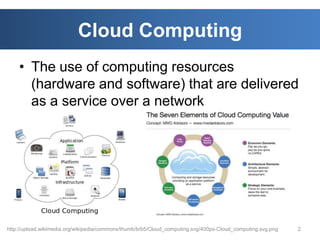
Cloud Computing
    • The use of computing resources
      (hardware and software) that are delivered
      as a service over a network


http://upload.wikimedia.org/wikipedia/commons/thumb/b/b5/Cloud_computing.svg/400px-Cloud_computing.svg.png   2
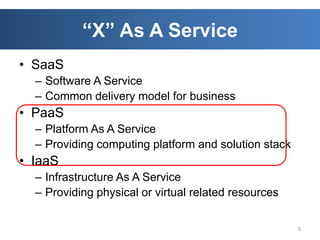
“X” As A Service
• SaaS
  – Software A Service
  – Common delivery model for business
• PaaS
  – Platform As A Service
  – Providing computing platform and solution stack
• IaaS
  – Infrastructure As A Service
  – Providing physical or virtual related resources

                                                      3
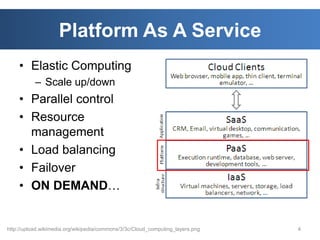
Platform As A Service
    • Elastic Computing
           – Scale up/down
    • Parallel control
    • Resource
      management
    • Load balancing
    • Failover
    • ON DEMAND…

http://upload.wikimedia.org/wikipedia/commons/3/3c/Cloud_computing_layers.png   4
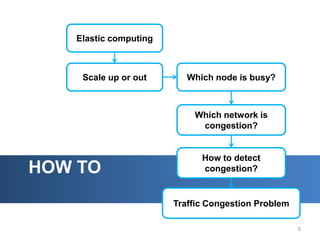
Elastic computing


    Scale up or out       Which node is busy?


                           Which network is
                            congestion?


                             How to detect
HOW TO                       congestion?


                       Traffic Congestion Problem

                                                    5
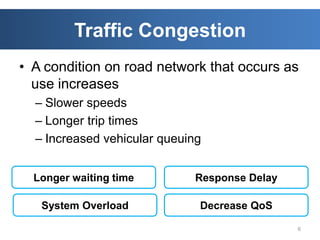
Traffic Congestion
• A condition on road network that occurs as
  use increases
  – Slower speeds
  – Longer trip times
  – Increased vehicular queuing


  Longer waiting time        Response Delay

   System Overload            Decrease QoS

                                              6
Intelligent Transport System
• Applied various area
• Wireless communication
• Computational technologies
  – Hardware memory management
  – Process control


• How about apply it to Cloud system..?
                                          7
Keyword: Intelligent
• Grid Load Balancing Using Intelligent
  Agents
• Prediction-based Virtual Instance
  Migration for Balanced Workload in the
  Cloud Datacenters


                                           8
ACM Future Generation Computer Systems 2005 Pages 135 - 149

GRID LOAD BALANCING
USING INTELLIGENT AGENTS

                                                              9
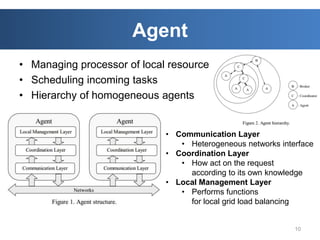
Agent
• Managing processor of local resource
• Scheduling incoming tasks
• Hierarchy of homogeneous agents


                             • Communication Layer
                                • Heterogeneous networks interface
                             • Coordination Layer
                                • How act on the request
                                  according to its own knowledge
                             • Local Management Layer
                                • Performs functions
                                  for local grid load balancing


                                                             10
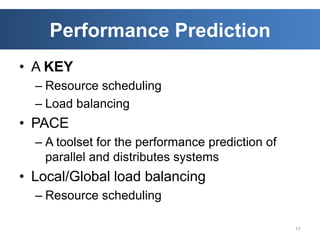
Performance Prediction
• A KEY
  – Resource scheduling
  – Load balancing
• PACE
  – A toolset for the performance prediction of
    parallel and distributes systems
• Local/Global load balancing
  – Resource scheduling

                                                  11
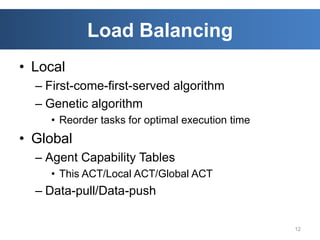
Load Balancing
• Local
  – First-come-first-served algorithm
  – Genetic algorithm
    • Reorder tasks for optimal execution time
• Global
  – Agent Capability Tables
    • This ACT/Local ACT/Global ACT
  – Data-pull/Data-push

                                                 12
RIT
PREDICTION-BASED VIRTUAL INSTANCE
MIGRATION FOR BALANCED WORKLOAD
IN THE CLOUD DATACENTERS

                                    13
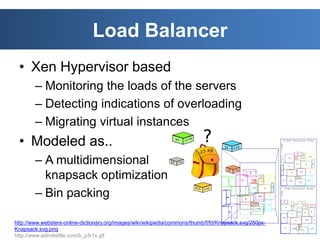
Load Balancer
 • Xen Hypervisor based
        – Monitoring the loads of the servers
        – Detecting indications of overloading
        – Migrating virtual instances
 • Modeled as..
        – A multidimensional
          knapsack optimization
        – Bin packing

http://www.websters-online-dictionary.org/images/wiki/wikipedia/commons/thumb/f/fd/Knapsack.svg/250px-
Knapsack.svg.png                                                                                         14
http://www.astrokettle.com/b_y3r1x.gif
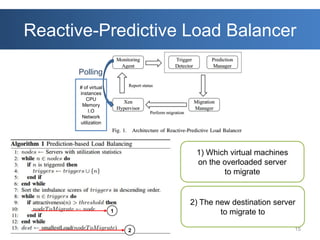
Reactive-Predictive Load Balancer

      Polling
      # of virtual
      instances
         CPU
       Memory
           I.O
       Network
      utilization


                              1) Which virtual machines
                              on the overloaded server
                                     to migrate


                             2) The new destination server
                     1               to migrate to

                         2                                15
Conclusion
• Key problem
  – How to be Intelligent?
  – How to control data congestion?
  – Traditional approach
    • Prediction performance of each virtual node
    • Task migration
  – Future work
    • Allocate request before congestion
    • Data flow monitoring and request scheduling

                                                    16
Q&A


      17
THANKS


         18
References
• http://en.wikipedia.org/wiki/Infrastructure_as_a_service
• http://en.wikipedia.org/wiki/Platform_as_a_service
• http://en.wikipedia.org/wiki/Intelligent_transportation_system
• Junwei Cao, Daniel P. Spooner, Stephen A. Jarvis, Grahan R. Nudd,
  Grid load balancing using intelligent agents, ACM Future Generation
  Computer Systems, 2005, Page 135-149
• Shibu Daniel, Minseok Kwon, Prediction-based Virtual Instance
  Migration for Balanced Workload in the Cloud Datacenters, RIT,
  2011
• Fei-Yue Wang, Parallel Control and Management for Intelligent
  Transportation Systems: Concepts, Architectures, and Applications,
  IEEE Intelligent Transportation Systems, 2010, Page 630-638


                                                                   19

Intelligent cloud computing

  • 1.
    Intelligent Cloud Computing Julie Kim (kjulee114@gmail.com) 1
  • 2.
    Cloud Computing • The use of computing resources (hardware and software) that are delivered as a service over a network http://upload.wikimedia.org/wikipedia/commons/thumb/b/b5/Cloud_computing.svg/400px-Cloud_computing.svg.png 2
  • 3.
    “X” As AService • SaaS – Software A Service – Common delivery model for business • PaaS – Platform As A Service – Providing computing platform and solution stack • IaaS – Infrastructure As A Service – Providing physical or virtual related resources 3
  • 4.
    Platform As AService • Elastic Computing – Scale up/down • Parallel control • Resource management • Load balancing • Failover • ON DEMAND… http://upload.wikimedia.org/wikipedia/commons/3/3c/Cloud_computing_layers.png 4
  • 5.
    Elastic computing Scale up or out Which node is busy? Which network is congestion? How to detect HOW TO congestion? Traffic Congestion Problem 5
  • 6.
    Traffic Congestion • Acondition on road network that occurs as use increases – Slower speeds – Longer trip times – Increased vehicular queuing Longer waiting time Response Delay System Overload Decrease QoS 6
  • 7.
    Intelligent Transport System •Applied various area • Wireless communication • Computational technologies – Hardware memory management – Process control • How about apply it to Cloud system..? 7
  • 8.
    Keyword: Intelligent • GridLoad Balancing Using Intelligent Agents • Prediction-based Virtual Instance Migration for Balanced Workload in the Cloud Datacenters 8
  • 9.
    ACM Future GenerationComputer Systems 2005 Pages 135 - 149 GRID LOAD BALANCING USING INTELLIGENT AGENTS 9
  • 10.
    Agent • Managing processorof local resource • Scheduling incoming tasks • Hierarchy of homogeneous agents • Communication Layer • Heterogeneous networks interface • Coordination Layer • How act on the request according to its own knowledge • Local Management Layer • Performs functions for local grid load balancing 10
  • 11.
    Performance Prediction • AKEY – Resource scheduling – Load balancing • PACE – A toolset for the performance prediction of parallel and distributes systems • Local/Global load balancing – Resource scheduling 11
  • 12.
    Load Balancing • Local – First-come-first-served algorithm – Genetic algorithm • Reorder tasks for optimal execution time • Global – Agent Capability Tables • This ACT/Local ACT/Global ACT – Data-pull/Data-push 12
  • 13.
    RIT PREDICTION-BASED VIRTUAL INSTANCE MIGRATIONFOR BALANCED WORKLOAD IN THE CLOUD DATACENTERS 13
  • 14.
    Load Balancer •Xen Hypervisor based – Monitoring the loads of the servers – Detecting indications of overloading – Migrating virtual instances • Modeled as.. – A multidimensional knapsack optimization – Bin packing http://www.websters-online-dictionary.org/images/wiki/wikipedia/commons/thumb/f/fd/Knapsack.svg/250px- Knapsack.svg.png 14 http://www.astrokettle.com/b_y3r1x.gif
  • 15.
    Reactive-Predictive Load Balancer Polling # of virtual instances CPU Memory I.O Network utilization 1) Which virtual machines on the overloaded server to migrate 2) The new destination server 1 to migrate to 2 15
  • 16.
    Conclusion • Key problem – How to be Intelligent? – How to control data congestion? – Traditional approach • Prediction performance of each virtual node • Task migration – Future work • Allocate request before congestion • Data flow monitoring and request scheduling 16
  • 17.
    Q&A 17
  • 18.
  • 19.
    References • http://en.wikipedia.org/wiki/Infrastructure_as_a_service • http://en.wikipedia.org/wiki/Platform_as_a_service •http://en.wikipedia.org/wiki/Intelligent_transportation_system • Junwei Cao, Daniel P. Spooner, Stephen A. Jarvis, Grahan R. Nudd, Grid load balancing using intelligent agents, ACM Future Generation Computer Systems, 2005, Page 135-149 • Shibu Daniel, Minseok Kwon, Prediction-based Virtual Instance Migration for Balanced Workload in the Cloud Datacenters, RIT, 2011 • Fei-Yue Wang, Parallel Control and Management for Intelligent Transportation Systems: Concepts, Architectures, and Applications, IEEE Intelligent Transportation Systems, 2010, Page 630-638 19