The following is intended to outline our general
product direction. It is intended for information
purposes only, and may not be incorporated into any
contract. It is not a commitment to deliver any
material, code, or functionality, and should not be
relied upon in making purchasing decisions.
The development, release, and timing of any
features or functionality described for Oracle’s
products remains at the sole discretion of Oracle.
Connected Clouds: Middleware
    Infrastructure
Brian Oliver                                      劳虎 Tiger Hsiao
Global Solutions Architect | Oracle Coherence |   首席解决方案架构师 | 产品战略部 |
Oracle Fusion Middleware Product Management       Oracle 大中华区
Agenda


• Not about…
  –   Amazon EC2, EBS, S3, VIP (or other cloud vendor)
  –   Licensing and Pricing Models
  –   Auto-Scaling
  –   Fault Tolerance
  –   High Availability
  –   “On demand” / “Map Reduce” …


• There’s enough information available about these
  things.
Agenda


• How to make a globally distributed stateful
  application appear and operate as a single stateful
  application.
• A stateful application that may be deployed across
  multiple;
  – Cloud Regions
  – Cloud Providers
  – Data Centers


• Case Study: Globally Distributed Auction
Agenda


•   Why one site isn’t enough…         <Insert Picture Here>

•   Introduction to Oracle Coherence
•   Multi-Site Challenges
•   The Push Replication Pattern
•   Deployment Models
•   Real-World Use Case
•   Demonstration
Why one site isn’t enough…


• Two reasons for multi-site deployments
  – Business Continuity (disaster recovery)
  – Regional Scalability (reduce latency)


• You don’t need to be a multi-national corporation
  – Simple Web-based Application with global adoption
  – Simple iPhone Application with global adoption


• Use Coherence for Shared Memory
  – Local high-availability and scalability
  – Interconnect for global availability and scalability
Agenda


•   Why one site isn’t enough…         <Insert Picture Here>

•   Introduction to Oracle Coherence
•   Multi-Site Challenges
•   The Push Replication Pattern
•   Deployment Models
•   Real-World Use Case
•   Demonstration
Introduction to Oracle Coherence


• Software Development Library
  – Provides a Data Grid for Application Developers
     • Clustering Technology
     • Distributed Data Structures and Compute Services
  – Pure Java 1.4.2+ (servers & clients)
  – Pure .Net 1.1, 2.x, 3.x (client)
  – Pure C++ (client)
  – No Third-Party or Open Source Dependencies

• Other Libraries Support…
  – Database and File System Integration
  – Top Link, Hibernate, Http Session Management…
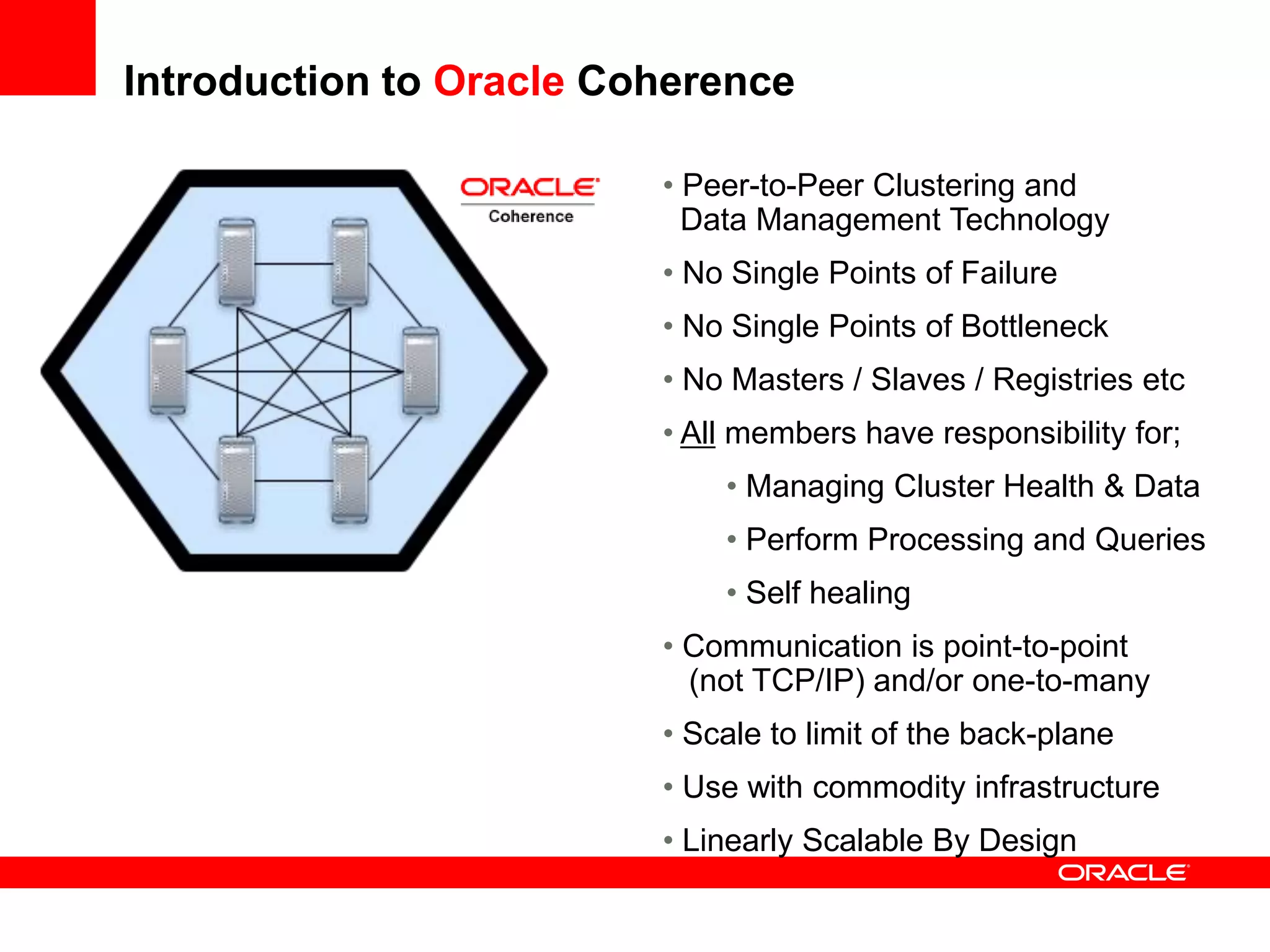
Introduction to Oracle Coherence

                         • Peer-to-Peer Clustering and
                           Data Management Technology
                         • No Single Points of Failure
                         • No Single Points of Bottleneck
                         • No Masters / Slaves / Registries etc
                         • All members have responsibility for;
                             • Managing Cluster Health & Data
                             • Perform Processing and Queries
                             • Self healing
                         • Communication is point-to-point
                           (not TCP/IP) and/or one-to-many
                         • Scale to limit of the back-plane
                         • Use with commodity infrastructure
                         • Linearly Scalable By Design
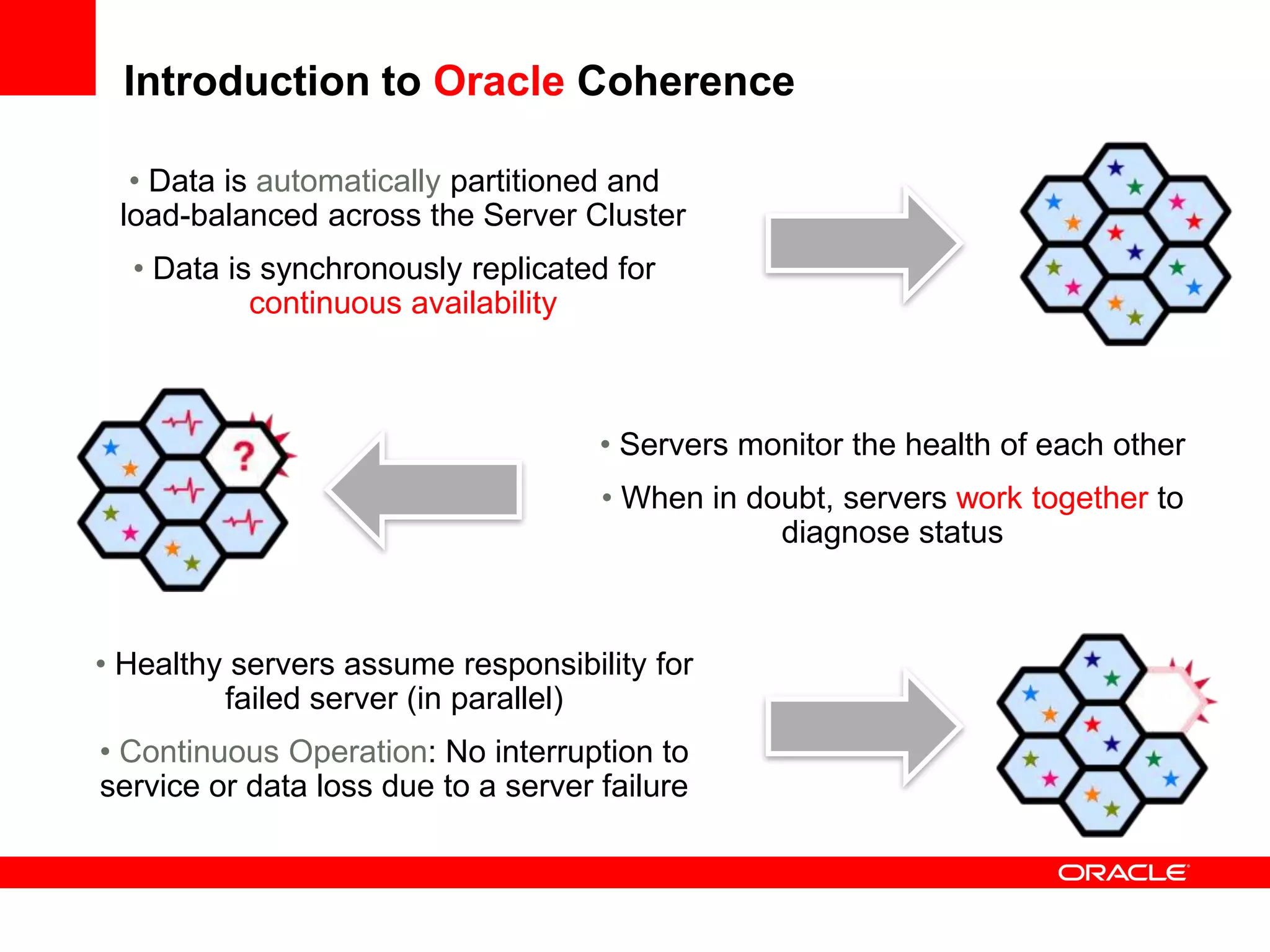
Introduction to Oracle Coherence

  • Data is automatically partitioned and
 load-balanced across the Server Cluster
  • Data is synchronously replicated for
           continuous availability


                                     • Servers monitor the health of each other
                                     • When in doubt, servers work together to
                                                 diagnose status


• Healthy servers assume responsibility for
         failed server (in parallel)
• Continuous Operation: No interruption to
service or data loss due to a server failure
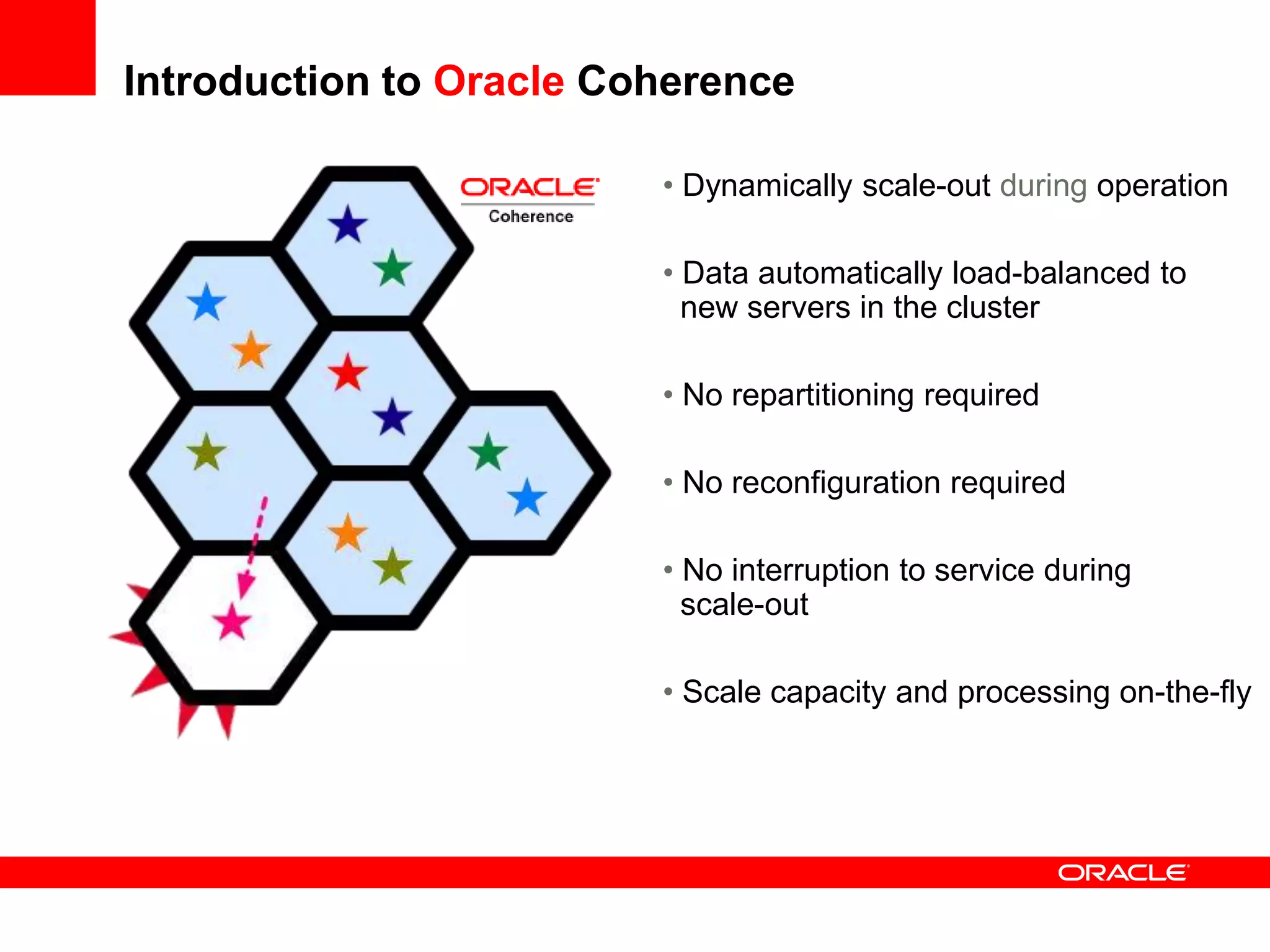
Introduction to Oracle Coherence

                         • Dynamically scale-out during operation

                         • Data automatically load-balanced to
                           new servers in the cluster

                         • No repartitioning required

                         • No reconfiguration required

                         • No interruption to service during
                           scale-out

                         • Scale capacity and processing on-the-fly
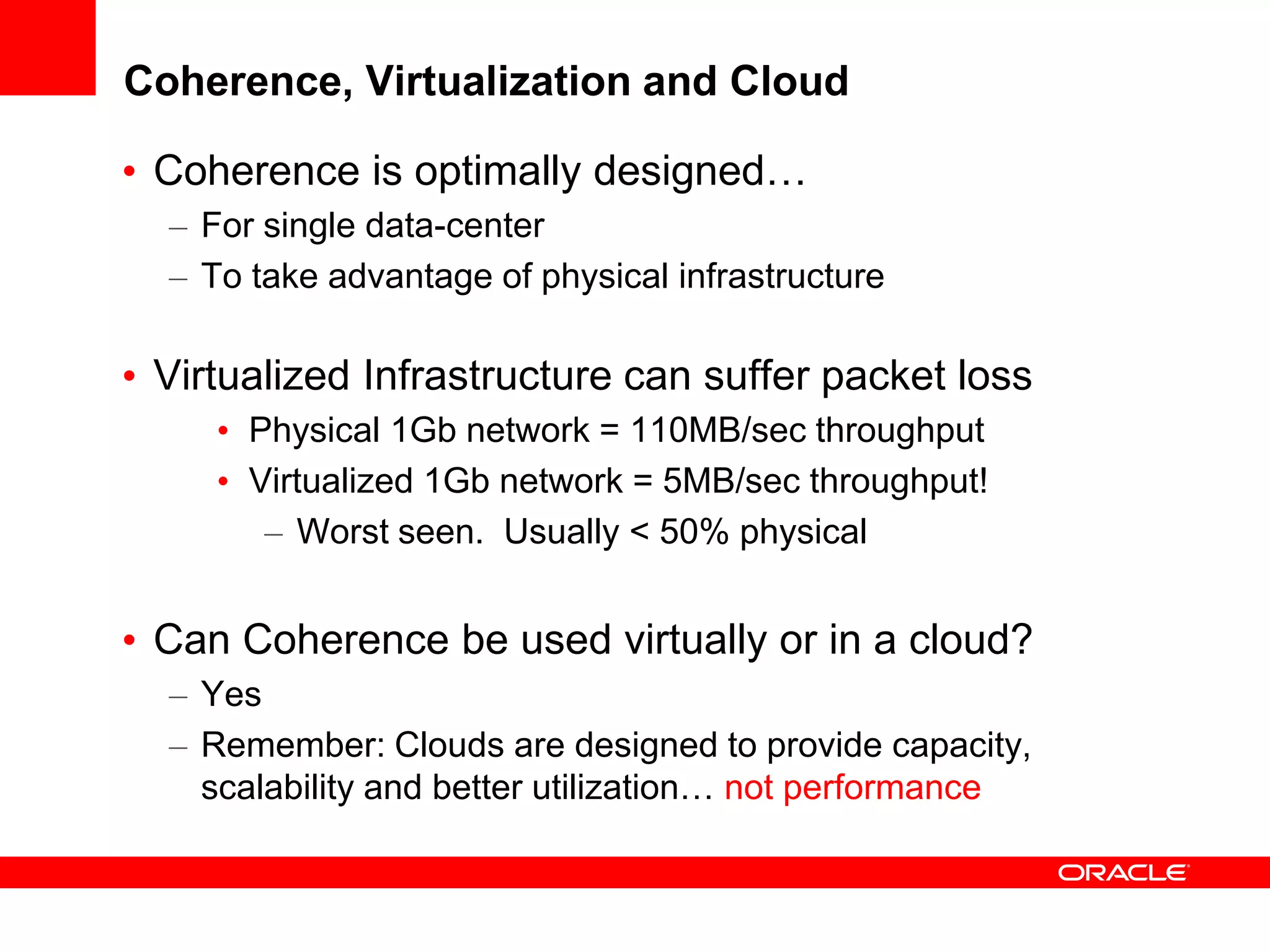
Coherence, Virtualization and Cloud

• Coherence is optimally designed…
  – For single data-center
  – To take advantage of physical infrastructure

• Virtualized Infrastructure can suffer packet loss
     • Physical 1Gb network = 110MB/sec throughput
     • Virtualized 1Gb network = 5MB/sec throughput!
        – Worst seen. Usually < 50% physical


• Can Coherence be used virtually or in a cloud?
  – Yes
  – Remember: Clouds are designed to provide capacity,
    scalability and better utilization… not performance
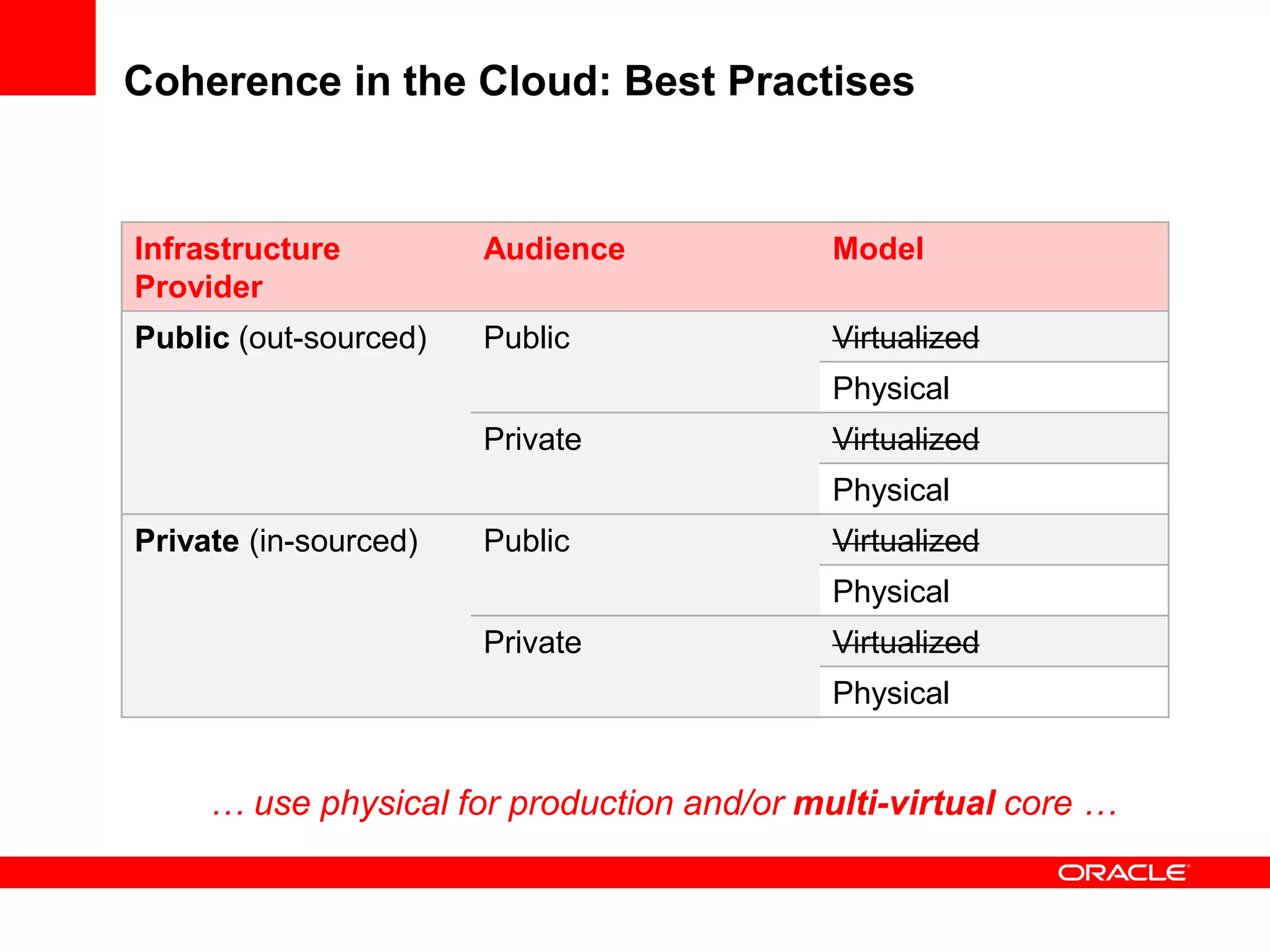
Coherence in the Cloud: Best Practises


Infrastructure         Audience             Model
Provider
Public (out-sourced)   Public               Virtualized
                                            Physical
                       Private              Virtualized
                                            Physical
Private (in-sourced)   Public               Virtualized
                                            Physical
                       Private              Virtualized
                                            Physical


     … use physical for production and/or multi-virtual core …
Agenda


•   Why one site isn’t enough…         <Insert Picture Here>

•   Introduction to Oracle Coherence
•   Multi-Site Challenges
•   The Push Replication Pattern
•   Deployment Models
•   Real-World Use Case
•   Demonstration
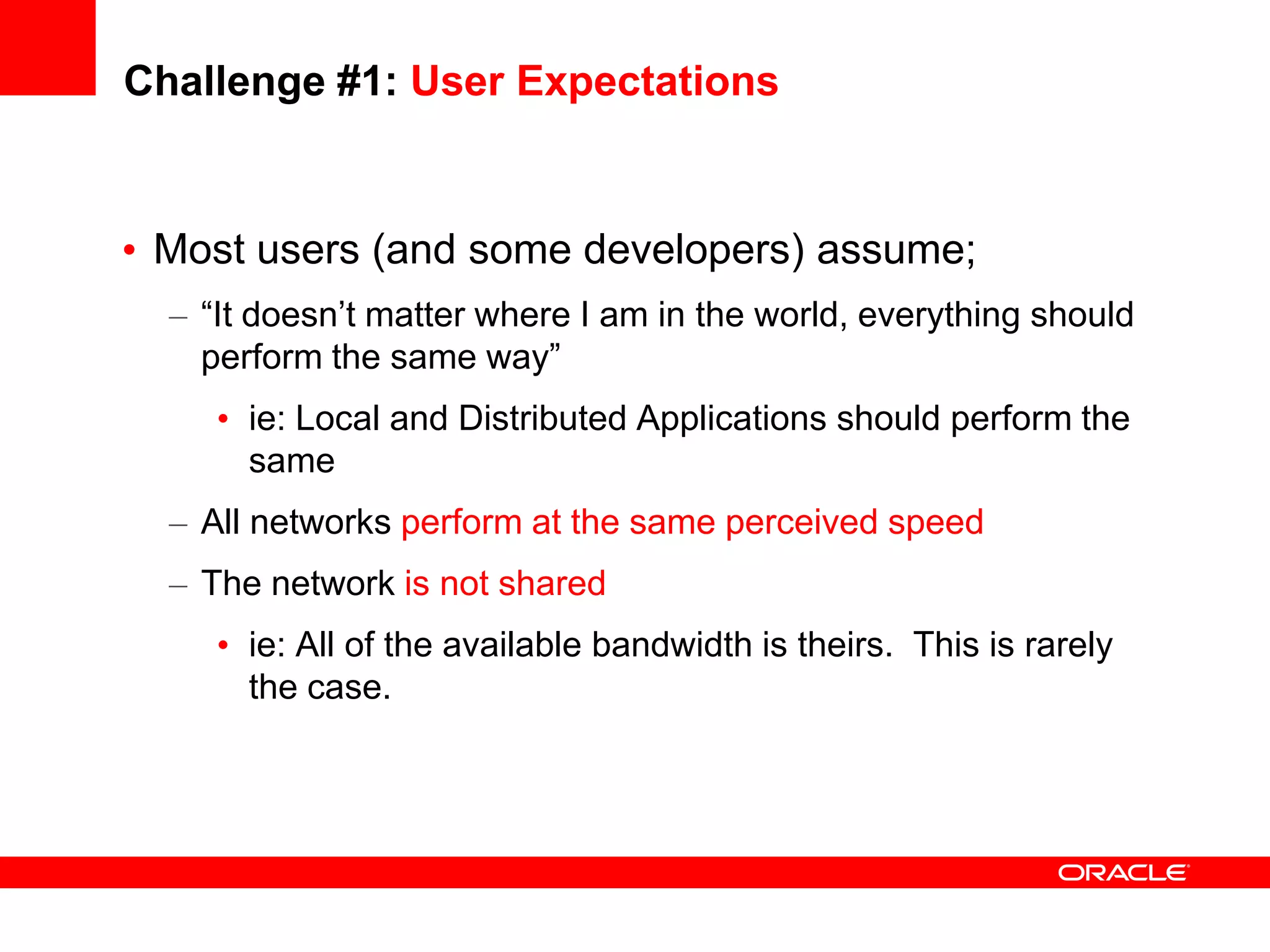
Challenge #1: User Expectations


• Most users (and some developers) assume;
  – “It doesn’t matter where I am in the world, everything should
    perform the same way”
     • ie: Local and Distributed Applications should perform the
       same
  – All networks perform at the same perceived speed
  – The network is not shared
     • ie: All of the available bandwidth is theirs. This is rarely
       the case.
Challenge #1: The Reality


• Applications aren’t deployed or deployable
  everywhere
  – They often rely on local resources
• All networks behave differently
• Network is always shared by many
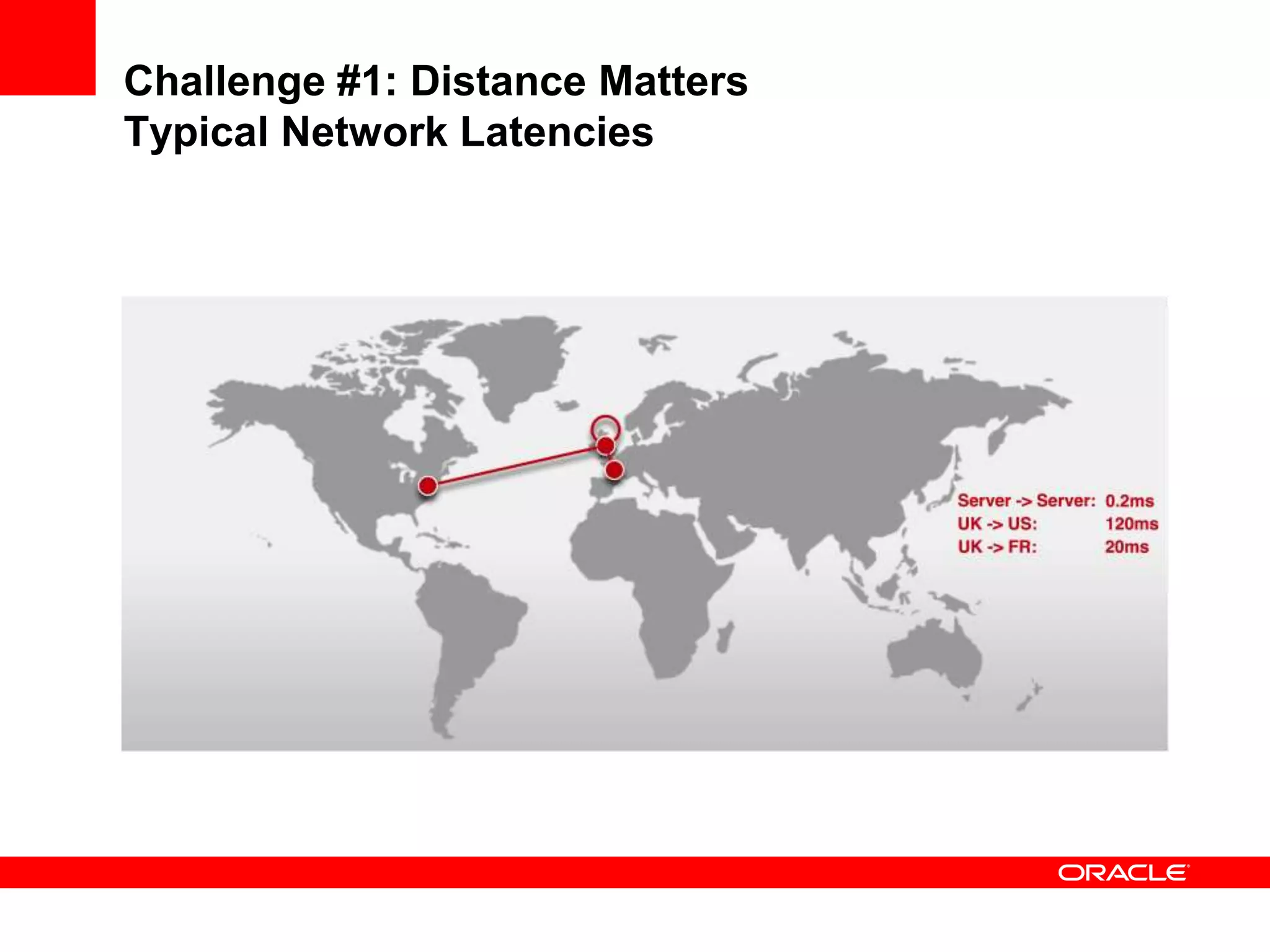
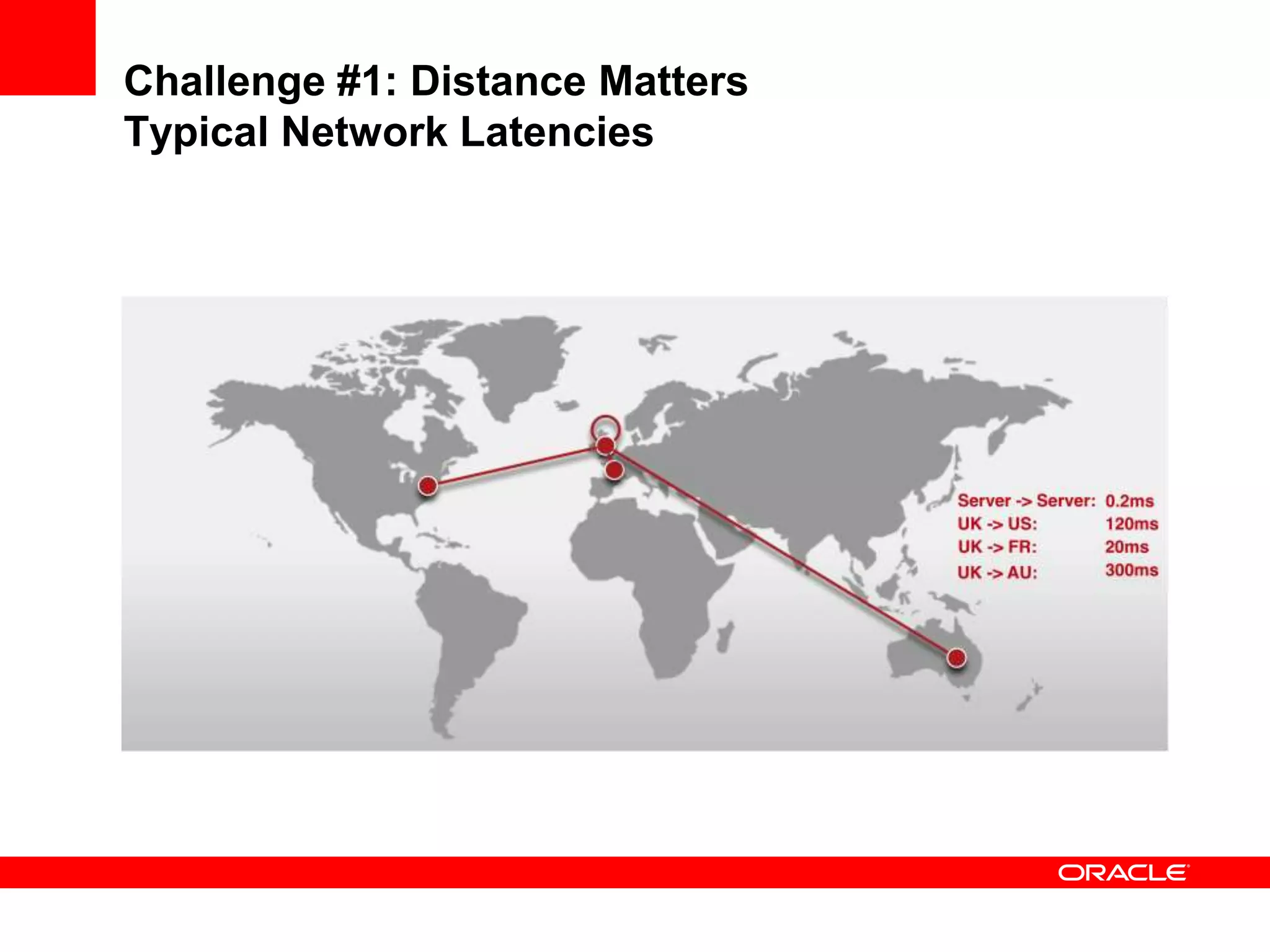
• The speed of light is actually incredibly SLOW!
  – Very noticeable over long distances
  – Networks are slower than the speed of light
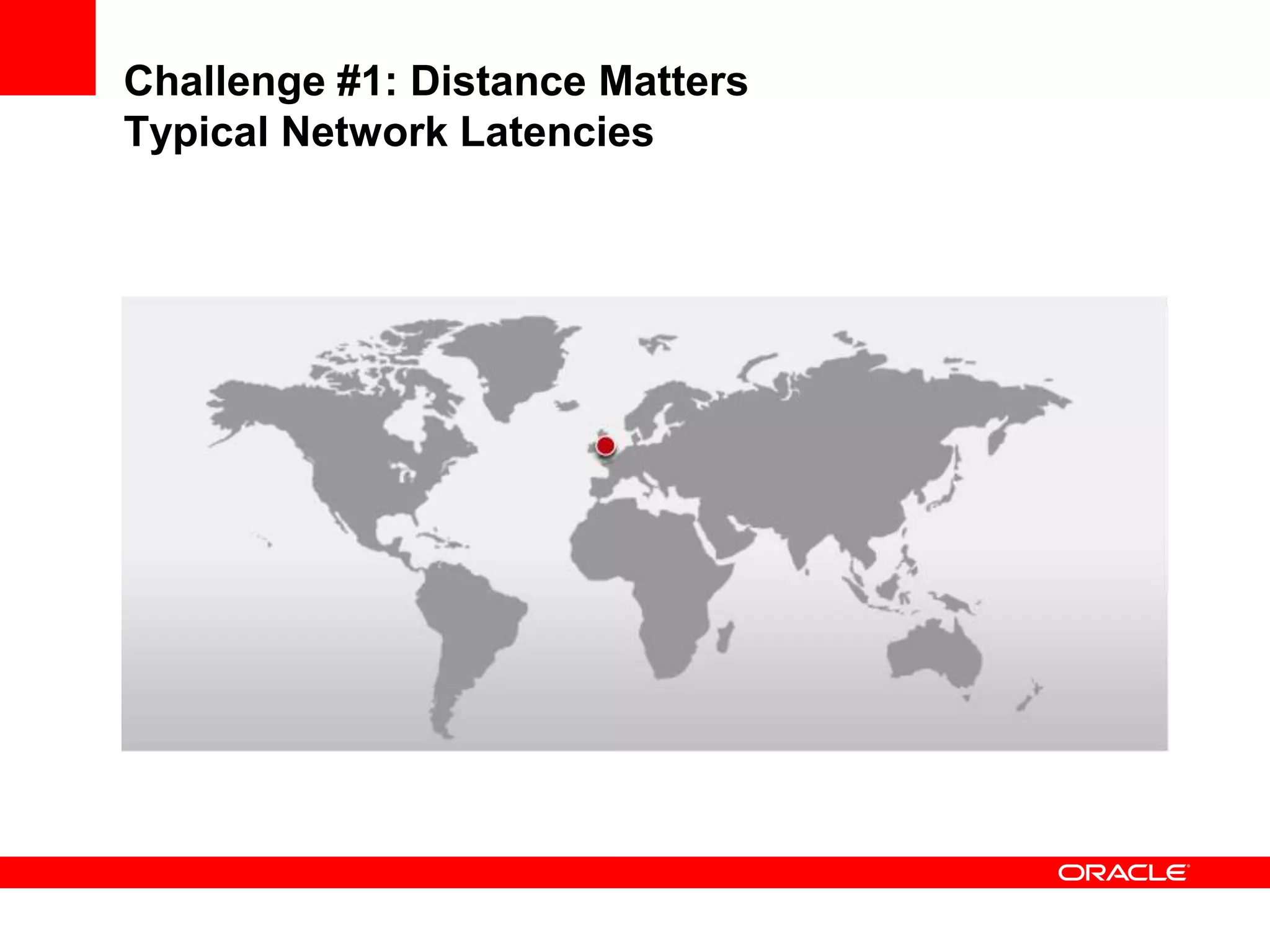
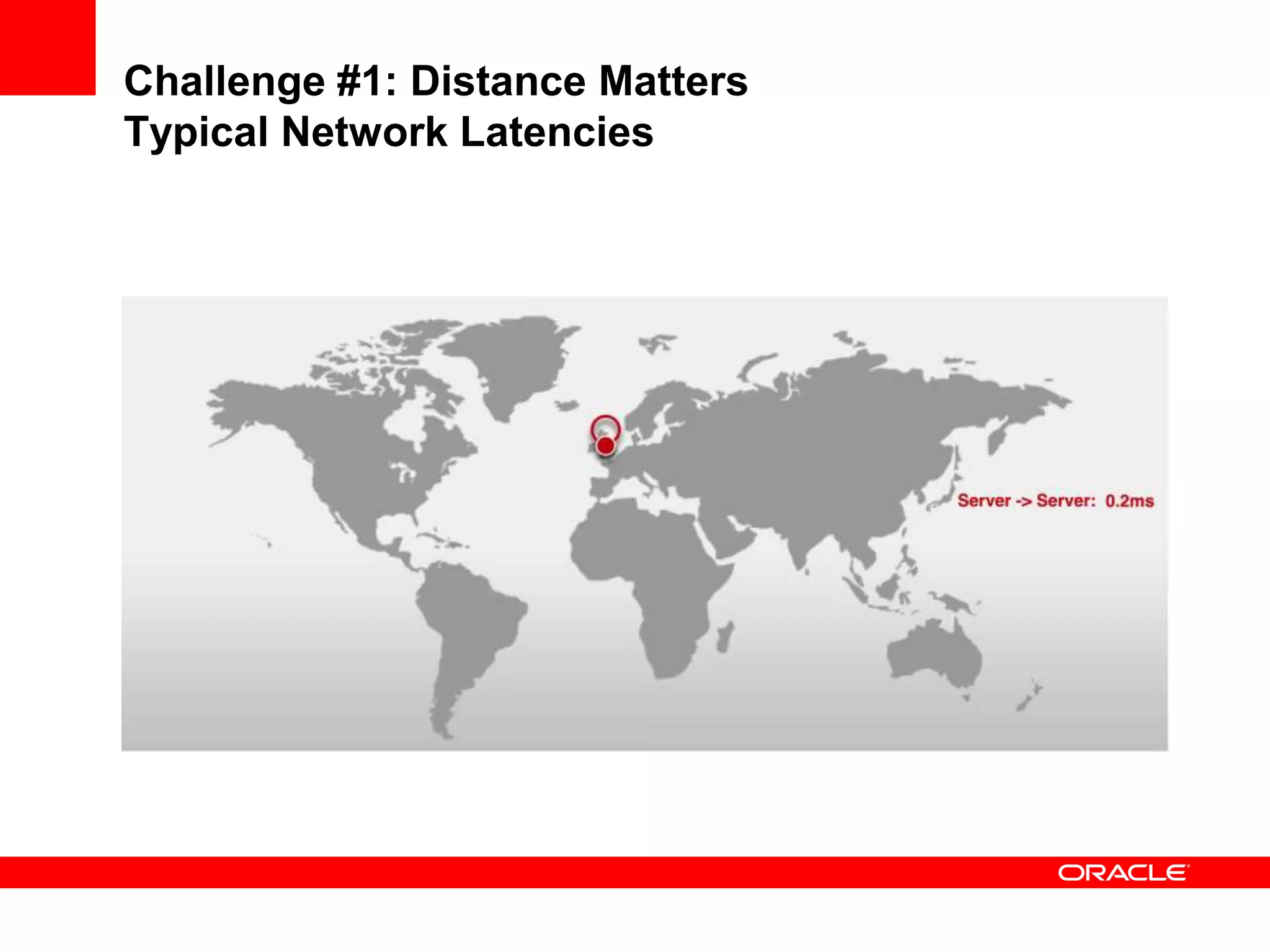
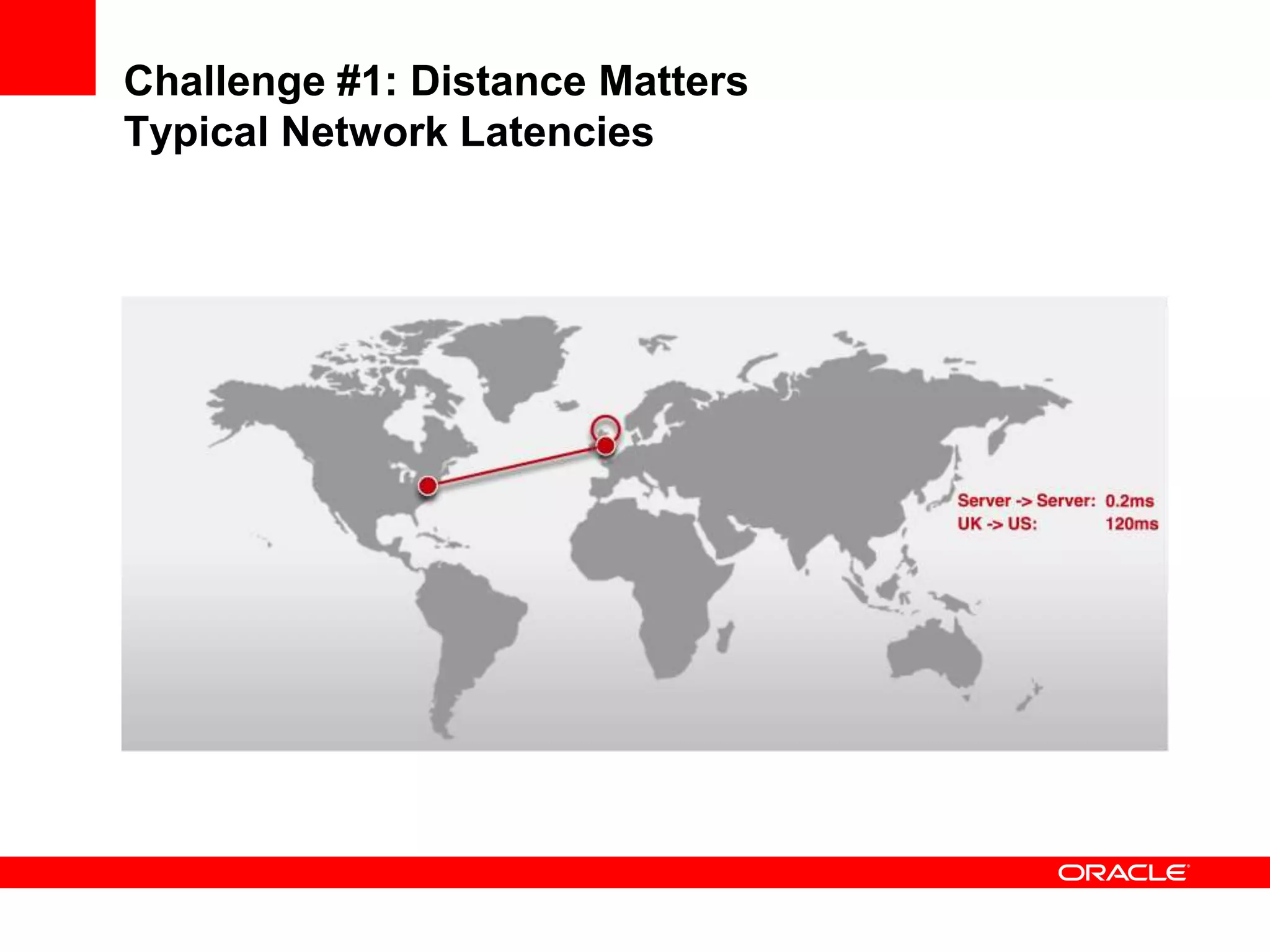
Challenge #1: Distance Matters
Typical Network Latencies
Challenge #1: Distance Matters
Typical Network Latencies
Challenge #1: Distance Matters
Typical Network Latencies
Challenge #1: Distance Matters
Typical Network Latencies
Challenge #1: Distance Matters
Typical Network Latencies
Challenge #1: The Reality


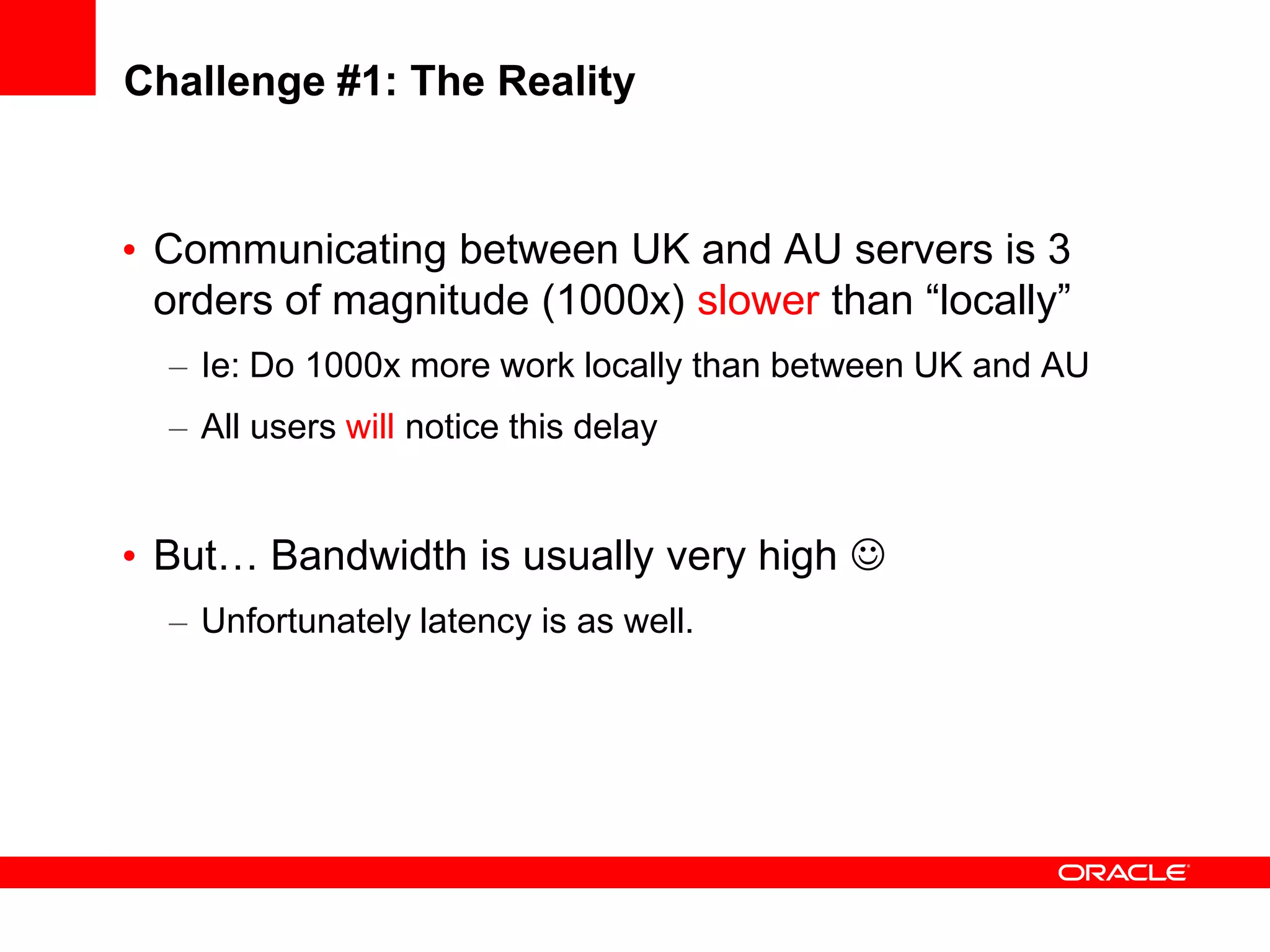
• Communicating between UK and AU servers is 3
  orders of magnitude (1000x) slower than “locally”
  – Ie: Do 1000x more work locally than between UK and AU
  – All users will notice this delay


• But… Bandwidth is usually very high 
  – Unfortunately latency is as well.
Challenge #1: The Lessons


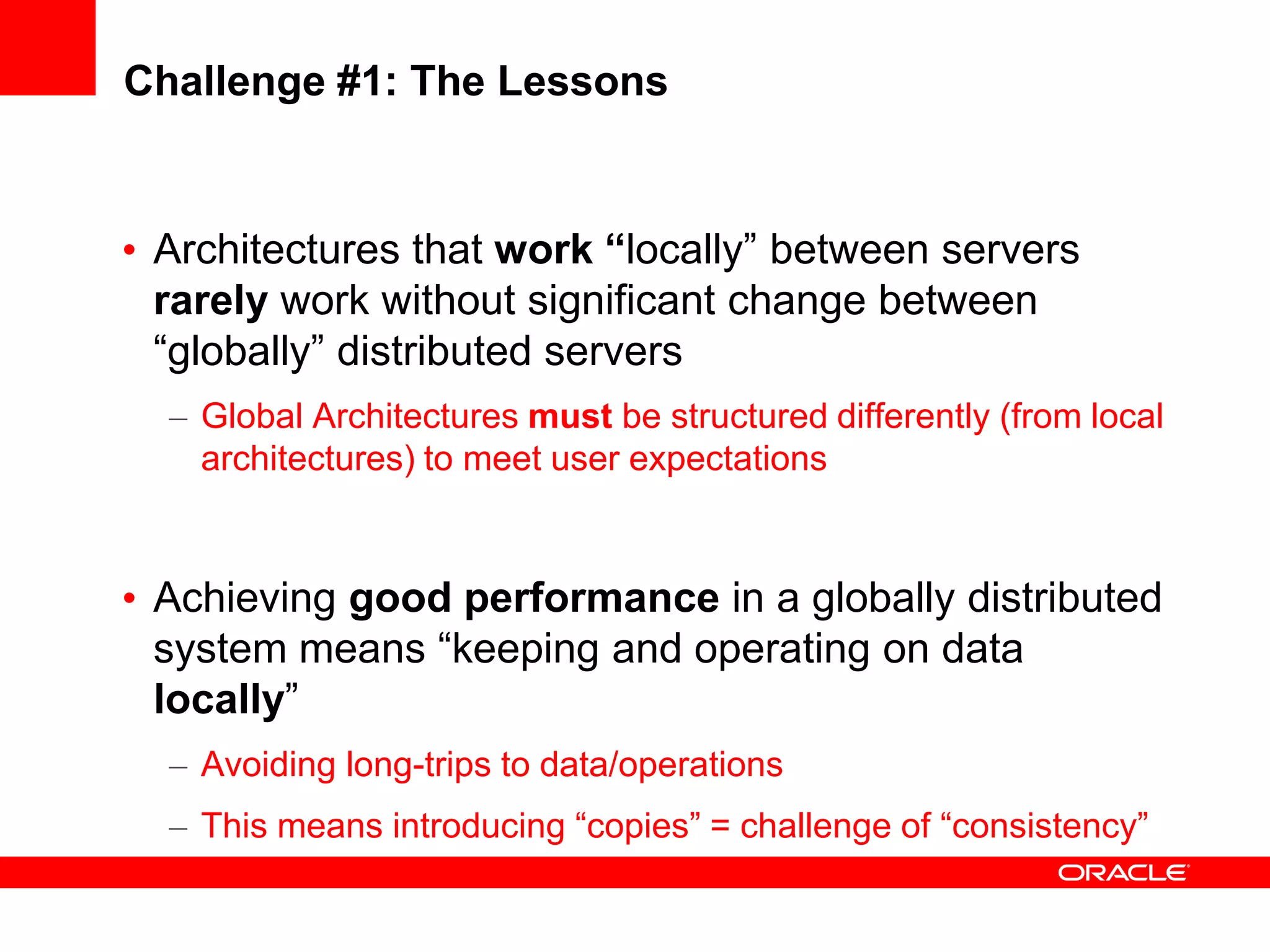
• Architectures that work “locally” between servers
  rarely work without significant change between
  “globally” distributed servers
  – Global Architectures must be structured differently (from local
    architectures) to meet user expectations


• Achieving good performance in a globally distributed
  system means “keeping and operating on data
  locally”
  – Avoiding long-trips to data/operations
  – This means introducing “copies” = challenge of “consistency”
Challenge #1: The Lessons


• It’s easy to give users the “illusion” of good
  performance
  – Perform operations asynchronously
  – This will change the application model for the user


• The greater the physical distance between servers,
  the more “illusion” is required
  – Asynchronous APIs are very different from Synchronous APIs


• Take advantage of available bandwidth!
  – Batch work for Asynchronous Processing
Challenge #2: Where to locate data/services?


• Deciding on “where” isn’t easy
• Different Strategies:
  – Site-based, Geography-based, Team/User-based, Domain-
    based, Legality-based
  – Can be Static or Dynamic
    eg: follow the sun or load-based
Challenge #2: The Reality


• Global Architectures typically require many strategies
  – Case Study uses two strategies
• Some data/services need to be everywhere 
  – “reference data” needs to be everywhere
• Achieving “efficiency” may require changing the
  business model
Challenge #3: How is Data updated?


• Pessimistic Strategy:
  – “Global Locking Transactions”
  – Incredibly slow due to multiple round trips
  – Rarely viable over long distances or with multiple sites
  – Delivers “Guaranteed Consistency”
• Optimistic Strategy:
  – “Perform Updates Locally, Replicate and Resolve Conflicts”
  – Latency is close to theoretically possibilities (Real time)
  – Relies on “Eventual Consistency”
  – May be impossible to resolve conflicts
Agenda


•   What is a DataGrid?            <Insert Picture Here>

•   Why one site isn’t enough…
•   Multi-Site Challenges
•   The Push Replication Pattern
•   Deployment Models
•   Real-World Use Case
•   Demonstration
The Push Replication Pattern
The Rationale


… provides and extensible, flexible, high-
 performance, highly-available and scalable
 solution to support the in-order optimistic replication
 of data and operations occurring in one Coherence
 Data Grids to one or more possibly globally
 distributed other Coherence Data Grids.
The Push Replication Pattern


• The Push Replication Pattern advocates that
  – Operations (such as insert, update and delete) occurring on
    Data in one Location should be pushed using one or more
    Publishers to an associated Device.

  – A Publisher is responsible for optimistically replicating
    Operations (in the order in which the said Operations
    originally occurred) on or with the associated Device.

  – If a Device is unavailable for some reason, the associated
    Publisher will be queued and executed (in the original order)
    at a later point in time.
Agenda


•   What is a DataGrid?            <Insert Picture Here>

•   Why one site isn’t enough…
•   Multi-Site Challenges
•   The Push Replication Pattern
•   Deployment Models
•   Real-World Use Case
•   Demonstration
Deployment Models
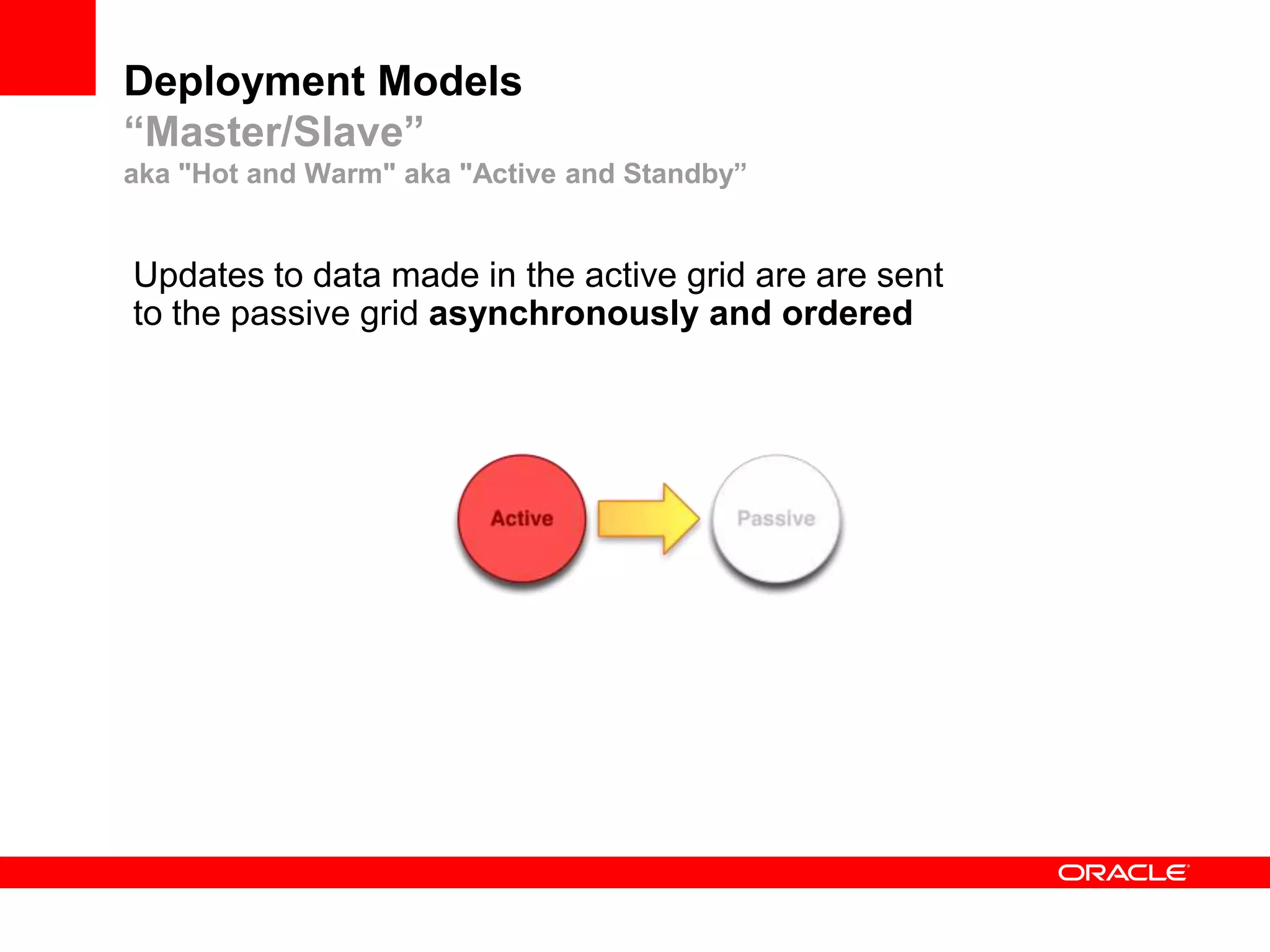
“Master/Slave”
aka "Hot and Warm" aka "Active and Standby”


Updates to data made in the active grid are are sent
to the passive grid asynchronously and ordered
Deployment Models
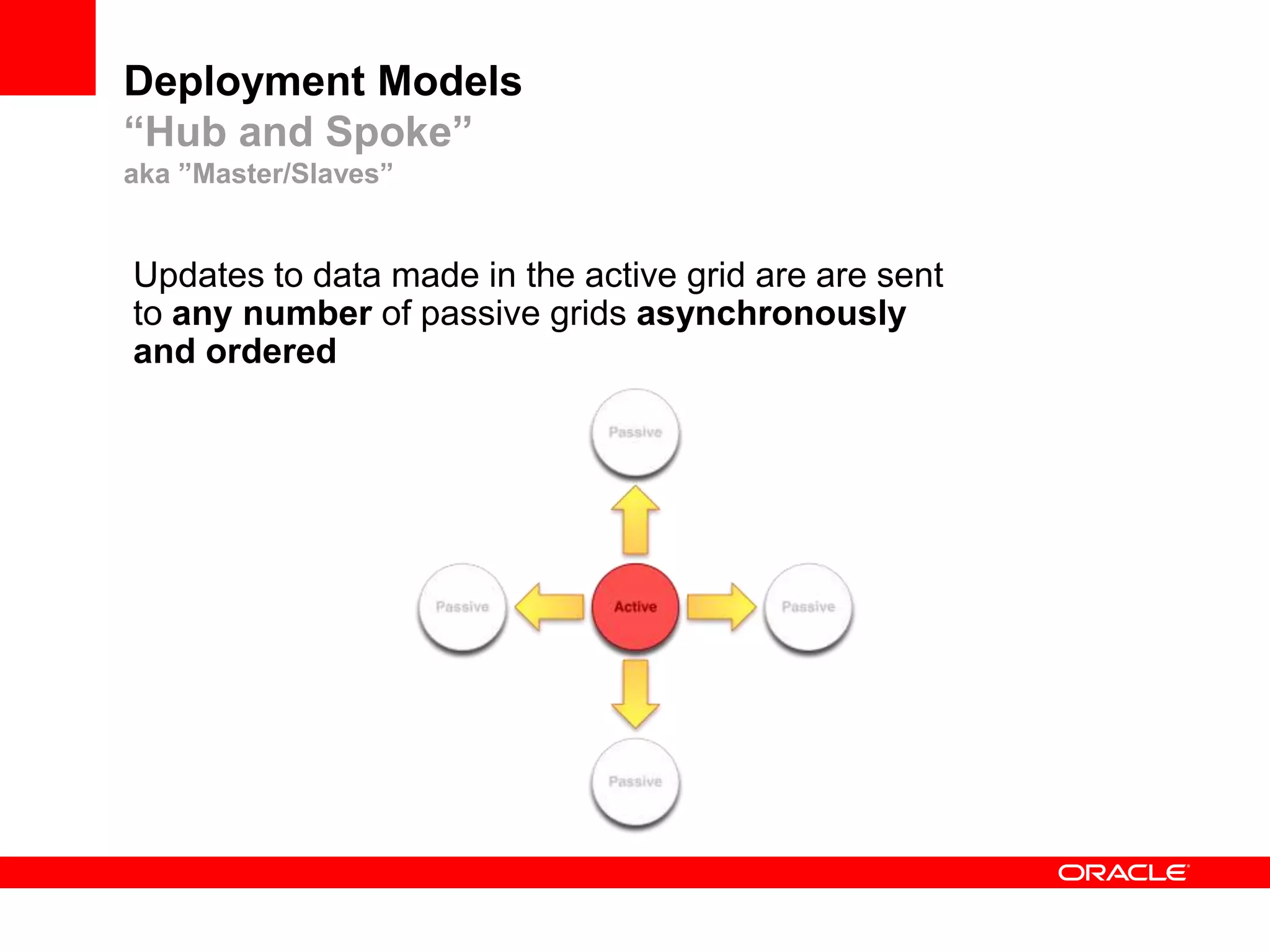
“Hub and Spoke”
aka ”Master/Slaves”


Updates to data made in the active grid are are sent
to any number of passive grids asynchronously
and ordered
Deployment Models
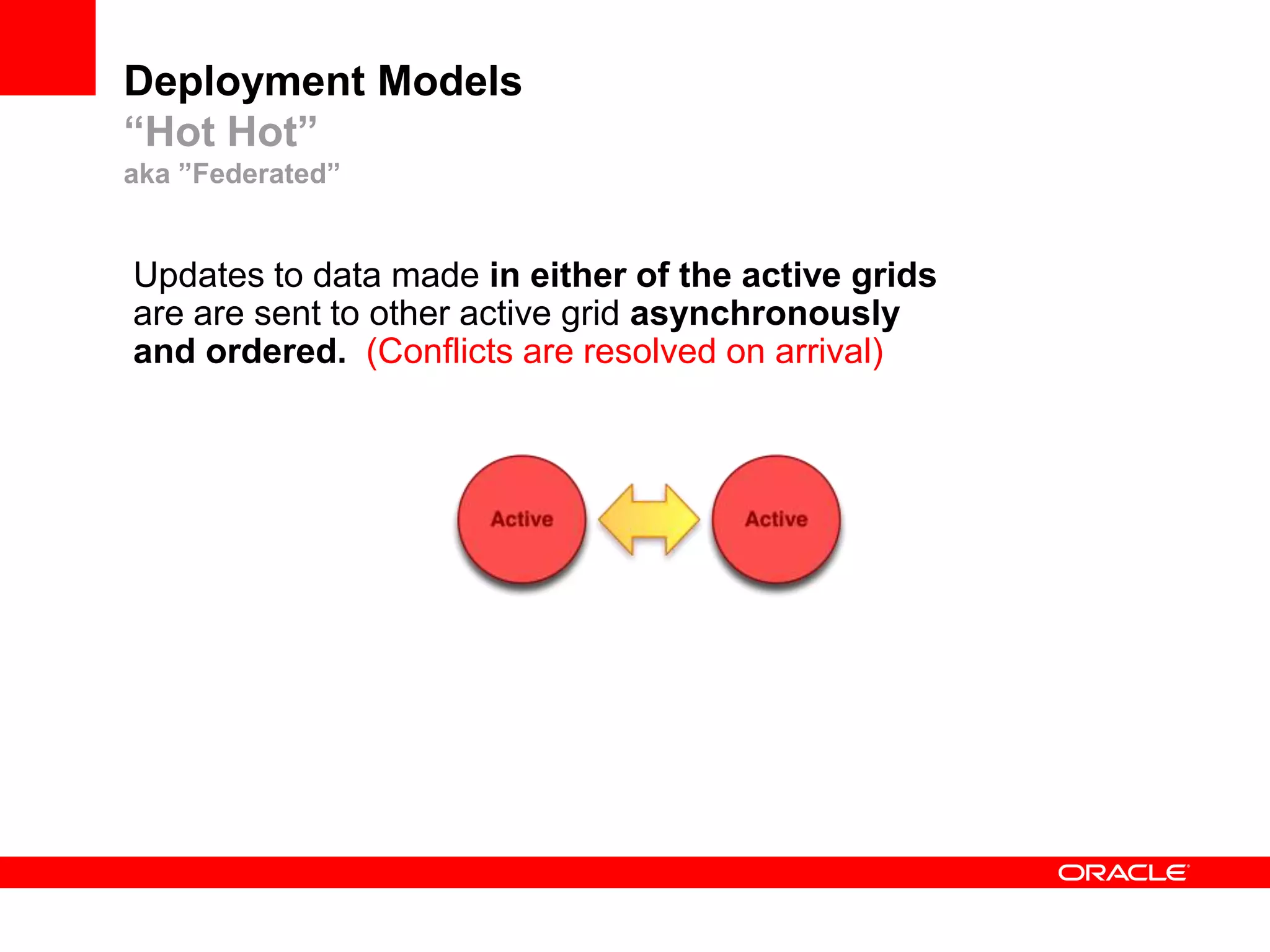
“Hot Hot”
aka ”Federated”


Updates to data made in either of the active grids
are are sent to other active grid asynchronously
and ordered. (Conflicts are resolved on arrival)
Deployment Models
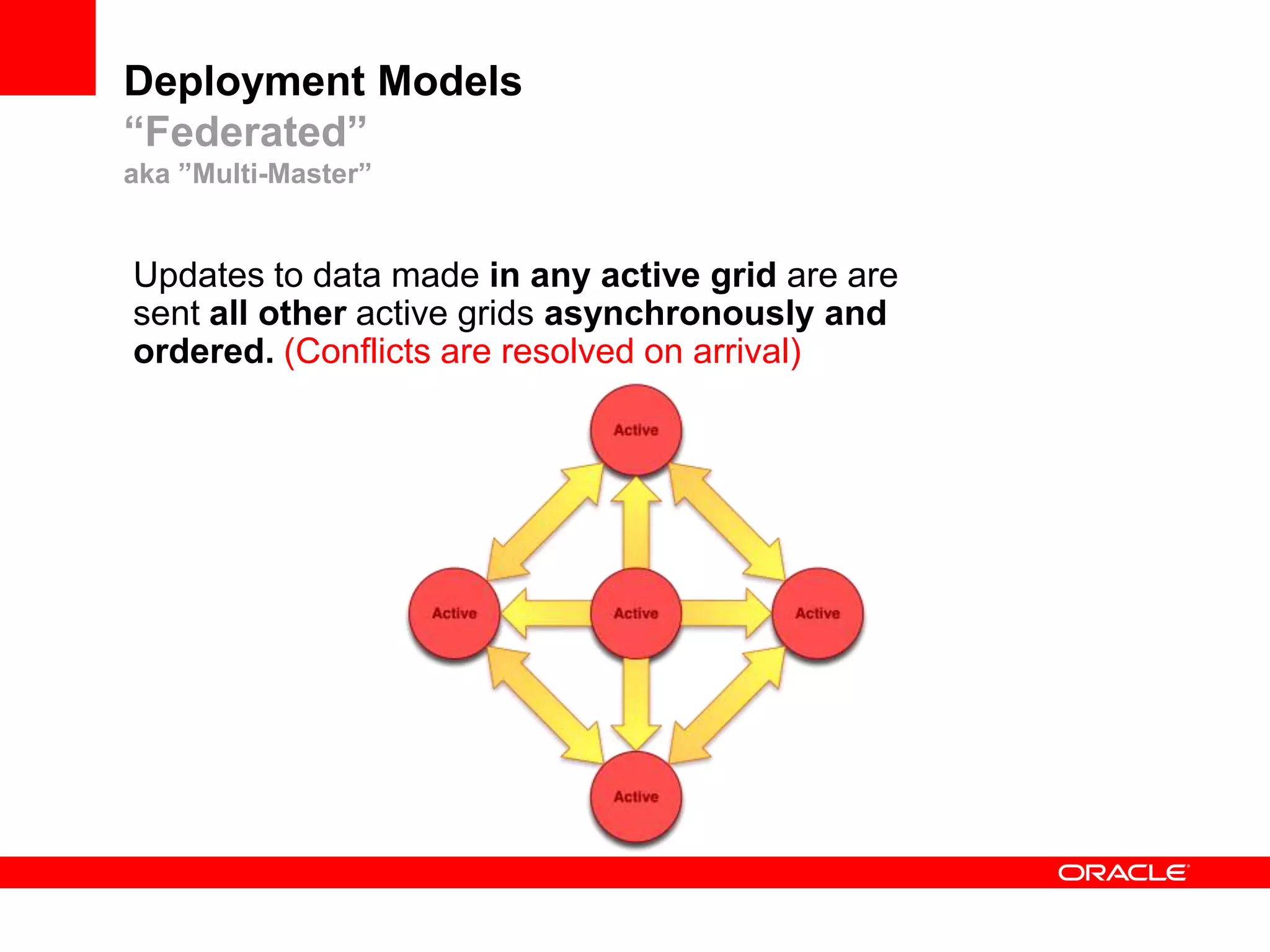
“Federated”
aka ”Multi-Master”


Updates to data made in any active grid are are
sent all other active grids asynchronously and
ordered. (Conflicts are resolved on arrival)
Agenda


•   What is a DataGrid?            <Insert Picture Here>

•   Why one site isn’t enough…
•   Multi-Site Challenges
•   The Push Replication Pattern
•   Deployment Models
•   Real-World Use Case
•   Demonstration
Real-World Usecase
Real-Time Auction


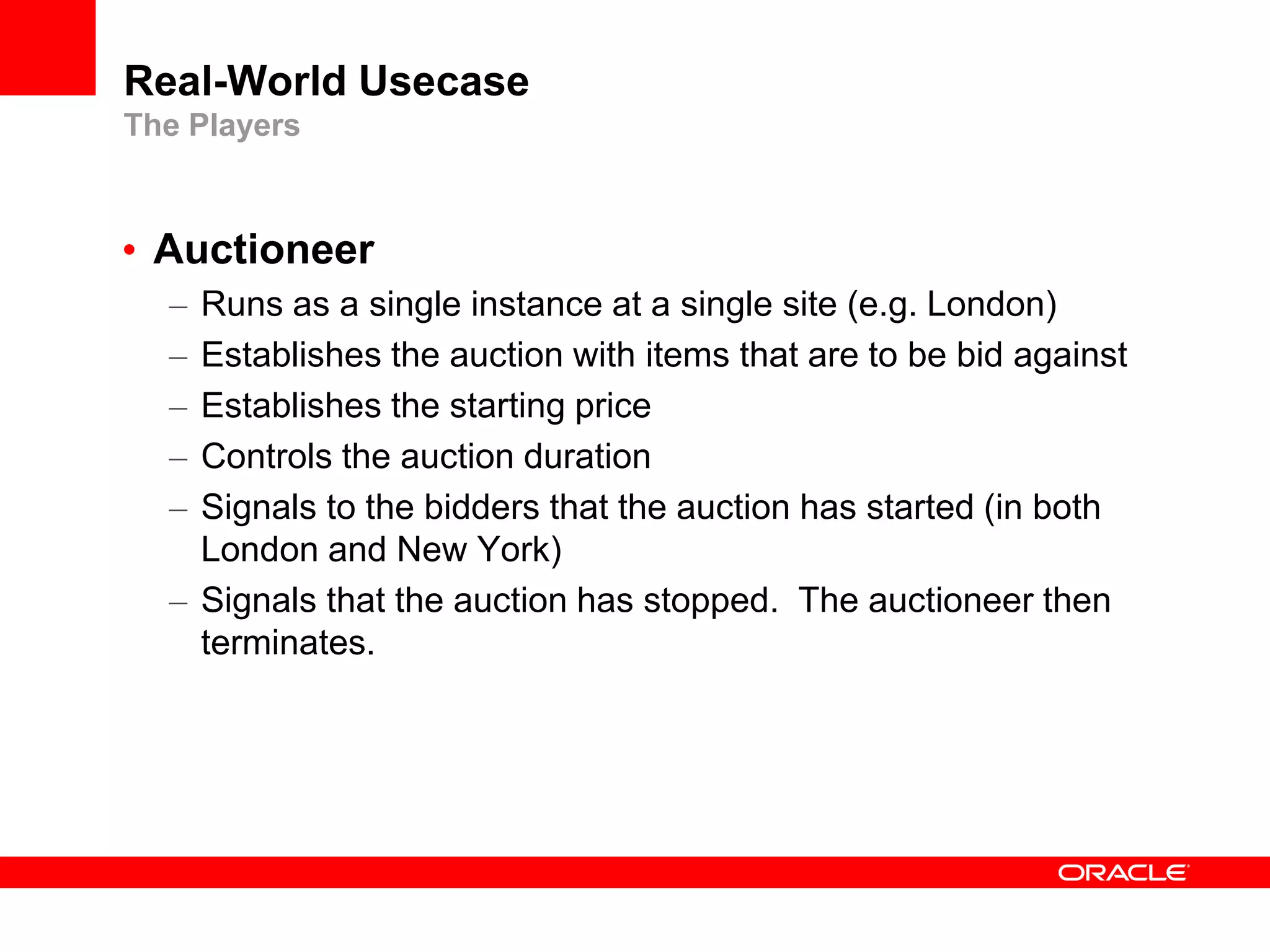
• Real-Time Auction- Real-time online auction
  between independent New York and London Data
  Grids

• Fairness – Customers (Bidders) in either location see
  recent “global” bids, and if they make the highest bid it
  will be replicated to other locations.

• Scalability - Application must support increase in
  demand, usage, catalogue, etc.
Real-World Usecase
The Players


• Auctioneer
  – Runs as a single instance at a single site (e.g. London)
  – Establishes the auction with items that are to be bid against
  – Establishes the starting price
  – Controls the auction duration
  – Signals to the bidders that the auction has started (in both
    London and New York)
  – Signals that the auction has stopped. The auctioneer then
    terminates.
Real-World Usecase
The Players


• Bidders
  – Run as independent threads in New York and London Data
    Grids
  – Wait for an auction to start
  – Picks an item up for bid, gets the current bid, increases the
    bid and submits it to the auction (locally)
  – Bidders compete with each other within a site
     • Replication between sites means they compete against
        each other globally
  – All bids are processed
  – Bidder stops bidding when the auctioneer signals that the
    auction is closed.
Real-World Usecase
What is Going On?


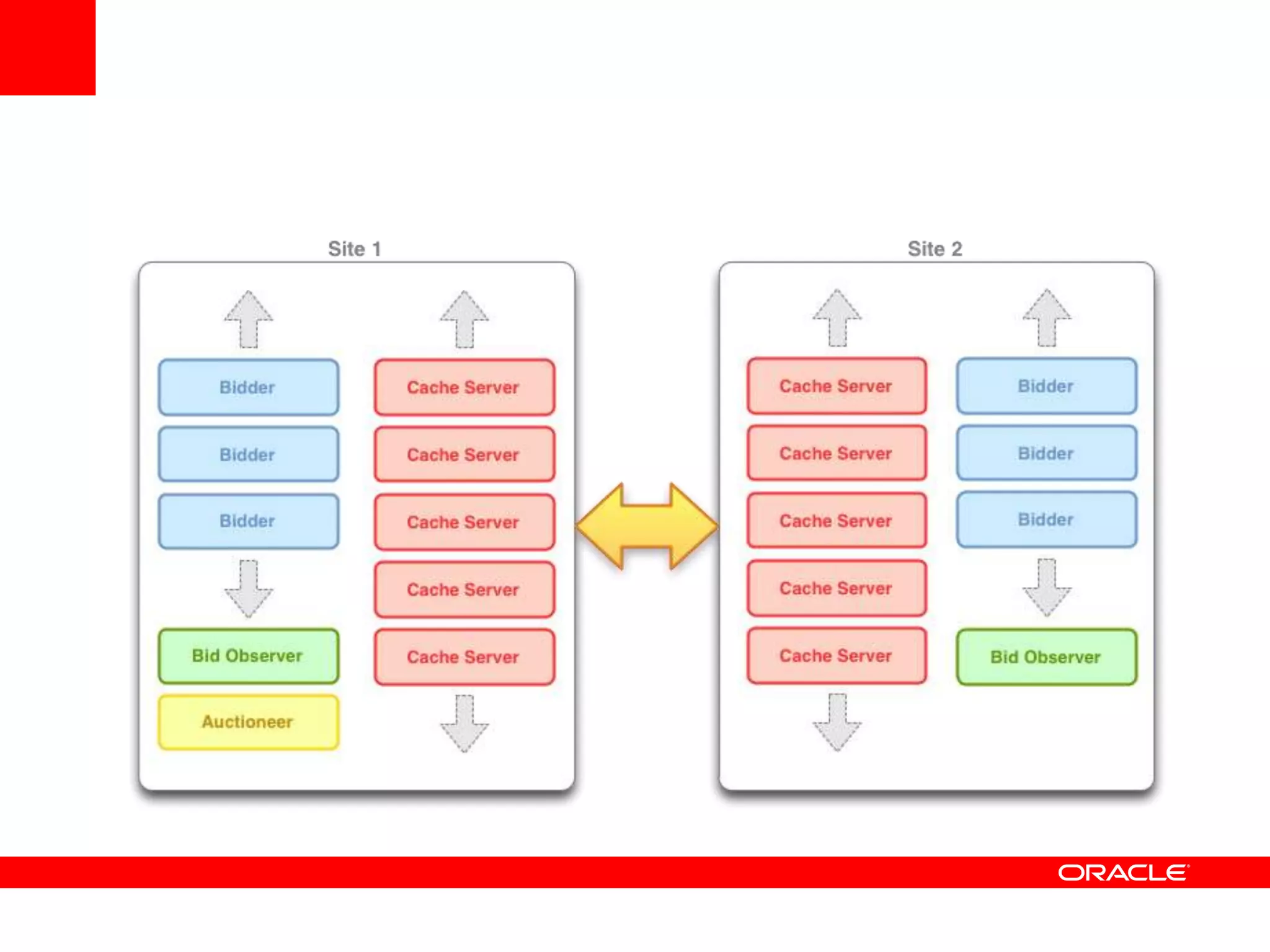
• Two separate Coherence clusters are running in New
  York and London operating against two caches (i.e.
  the bidding-cache and the control-cache)
• The clusters are using Coherence Incubator Push
  Replication to push bidding activity to New York from
  London and vice versa (active-active replication).
• It is also using Push Replication to push a single
  control object to both clusters (active-passive
  replication).
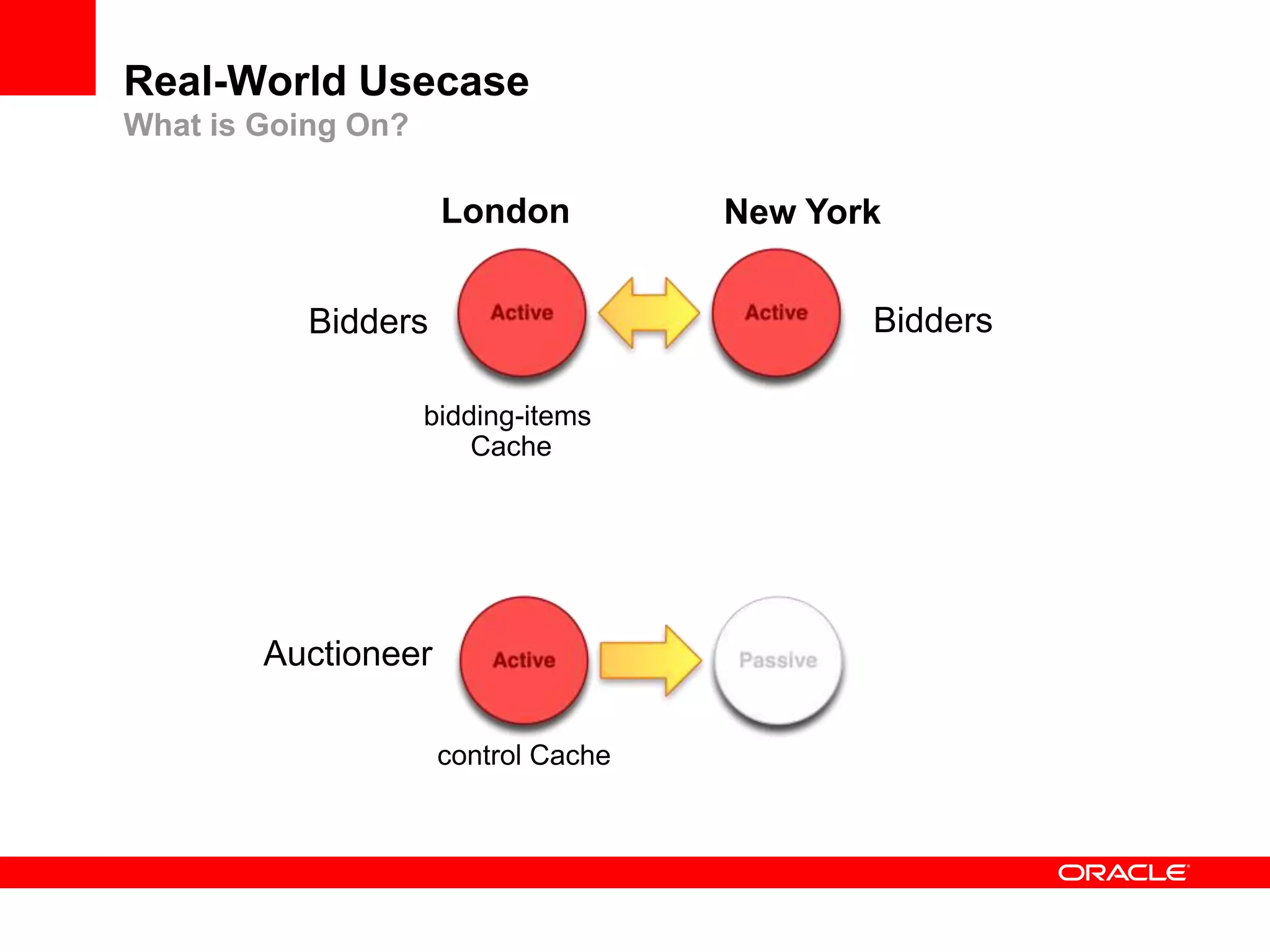
• Concurrent bidding is happening both within a cluster
  and between clusters.
Real-World Usecase
What is Going On?

                     London          New York


           Bidders                          Bidders

                    bidding-items
                        Cache


        Auctioneer

                     control Cache
Real-World Usecase
What is Going On?


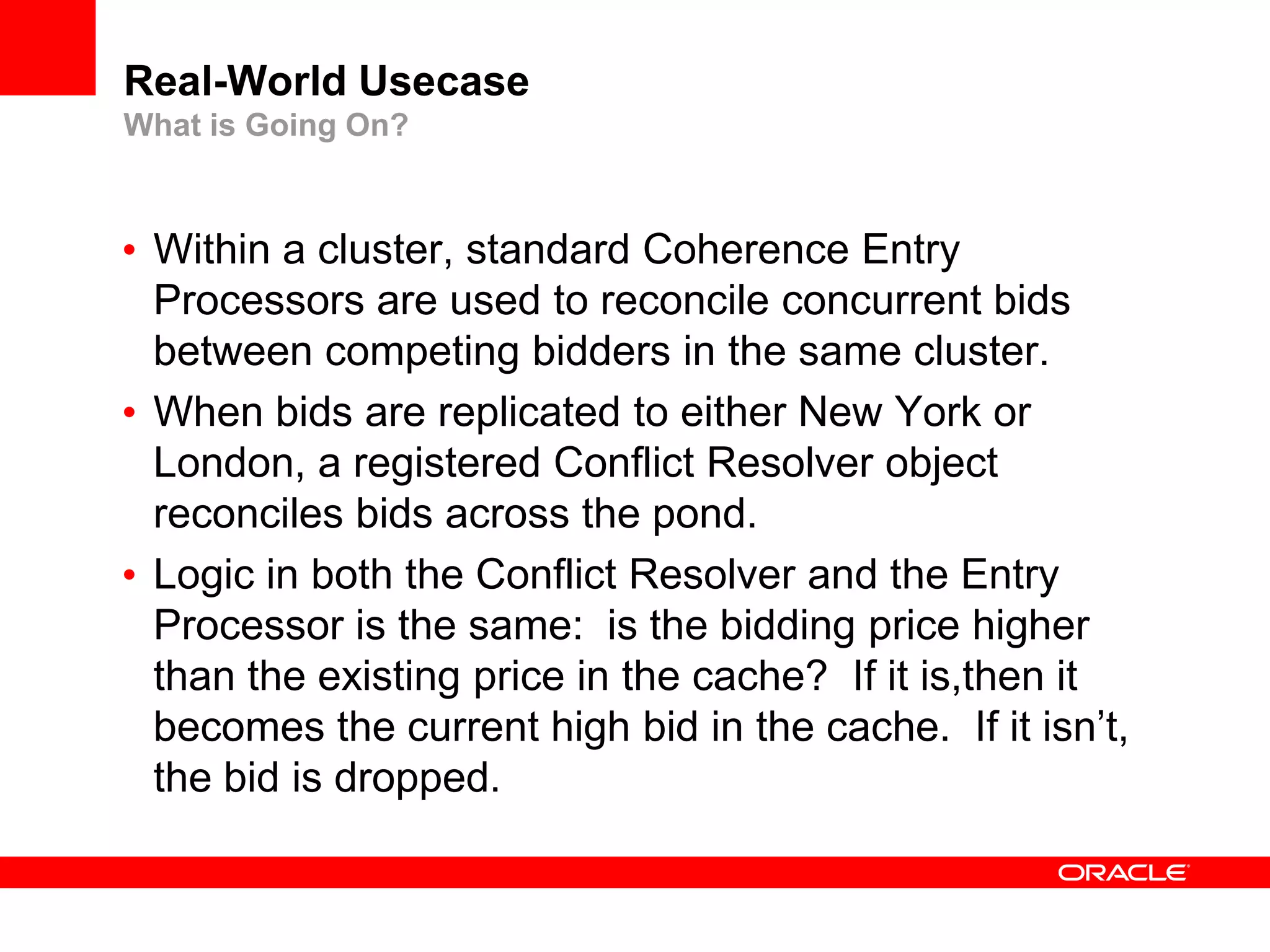
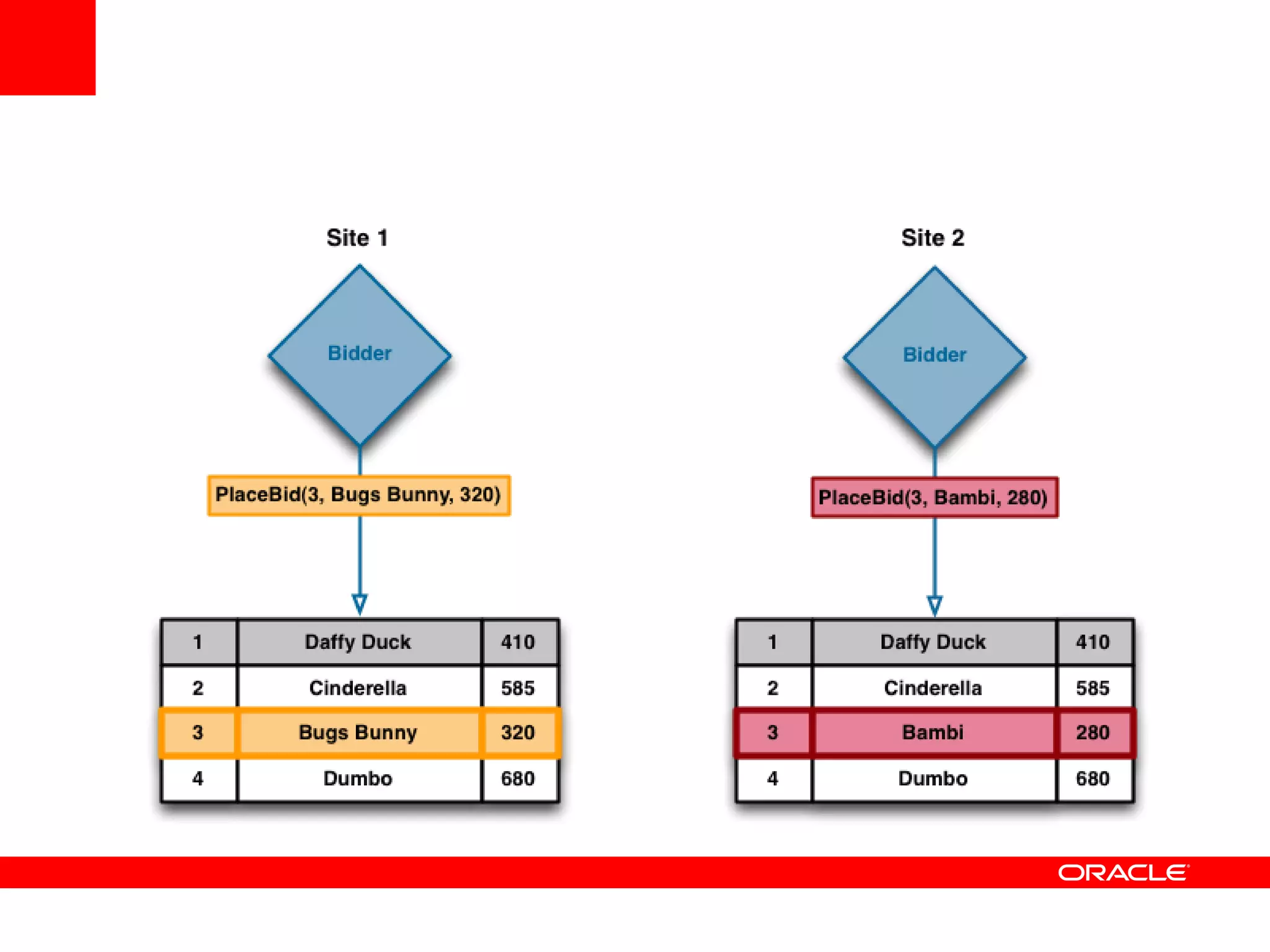
• Within a cluster, standard Coherence Entry
  Processors are used to reconcile concurrent bids
  between competing bidders in the same cluster.
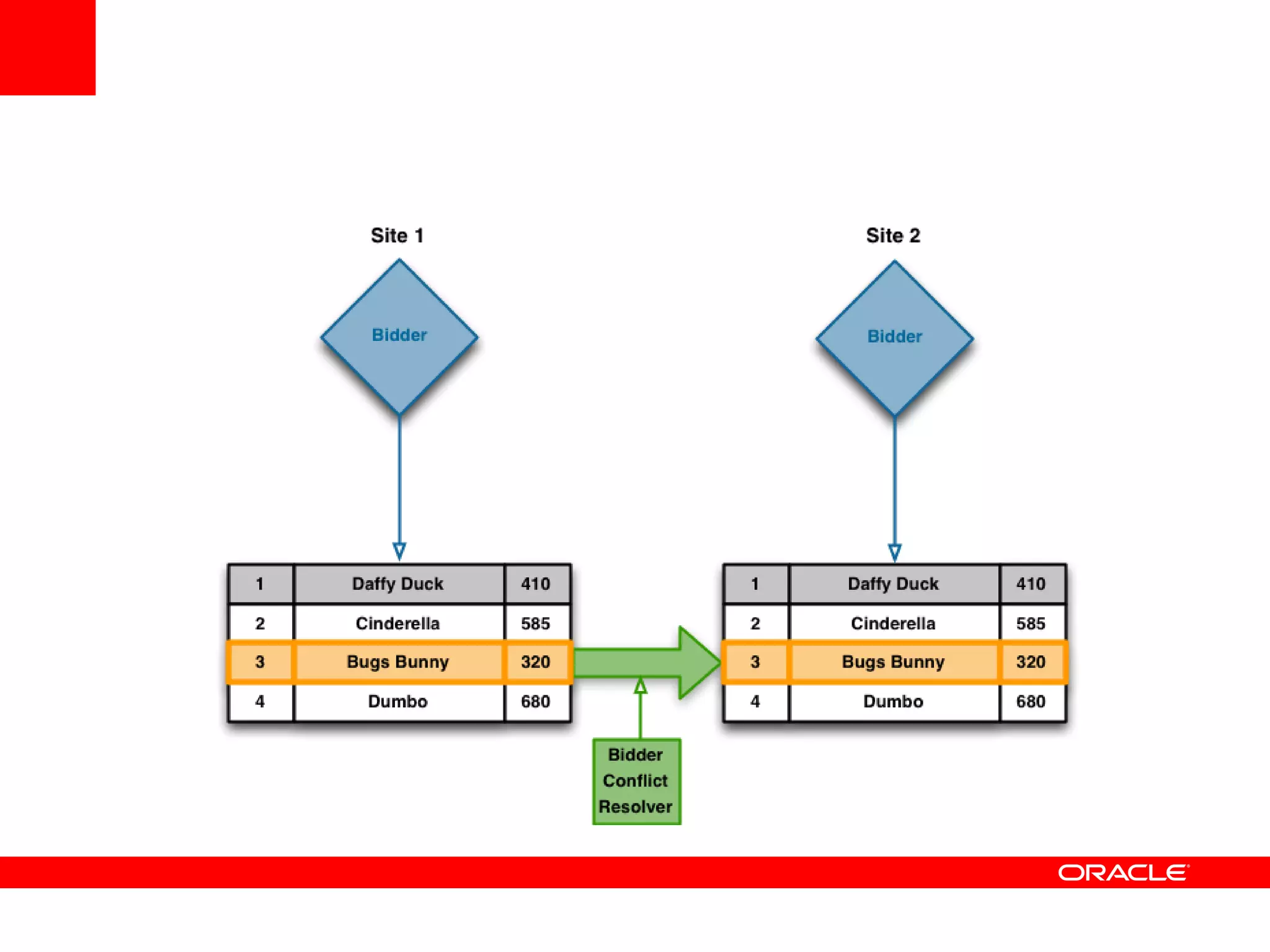
• When bids are replicated to either New York or
  London, a registered Conflict Resolver object
  reconciles bids across the pond.
• Logic in both the Conflict Resolver and the Entry
  Processor is the same: is the bidding price higher
  than the existing price in the cache? If it is,then it
  becomes the current high bid in the cache. If it isn’t,
  the bid is dropped.
Agenda


•   What is a DataGrid?            <Insert Picture Here>

•   Why one site isn’t enough…
•   Multi-Site Challenges
•   The Push Replication Pattern
•   Deployment Models
•   Real-World Use Case
•   Demonstration
Other uses


• Global Http Session Management
  – Using Coherence and Push Replication to permit highly
    available multi-continent seamless availability
• Coherence Global System of Record
  – Trades / Shopping Carts
  – Integrating Multi Domain Systems
• Messaging
  – Replacing traditional message-based systems
  – Systems become “state based” not message-based.


• “If you can cache it, Coherence can distribute it”
For More Information


          search.oracle.com
               Coherence


                    or
oracle.com/products/middleware/coherence
The Push Replication Pattern and today’s Demo


            Coherence Incubator


       Coherence Incubator Auction Demo
The preceding is intended to outline our general
product direction. It is intended for information
purposes only, and may not be incorporated into any
contract. It is not a commitment to deliver any
material, code, or functionality, and should not be
relied upon in making purchasing decisions.
The development, release, and timing of any
features or functionality described for Oracle’s
products remains at the sole discretion of Oracle.
Tiger oracle

Tiger oracle

  • 2.
    The following isintended to outline our general product direction. It is intended for information purposes only, and may not be incorporated into any contract. It is not a commitment to deliver any material, code, or functionality, and should not be relied upon in making purchasing decisions. The development, release, and timing of any features or functionality described for Oracle’s products remains at the sole discretion of Oracle.
  • 3.
    Connected Clouds: Middleware Infrastructure Brian Oliver 劳虎 Tiger Hsiao Global Solutions Architect | Oracle Coherence | 首席解决方案架构师 | 产品战略部 | Oracle Fusion Middleware Product Management Oracle 大中华区
  • 4.
    Agenda • Not about… – Amazon EC2, EBS, S3, VIP (or other cloud vendor) – Licensing and Pricing Models – Auto-Scaling – Fault Tolerance – High Availability – “On demand” / “Map Reduce” … • There’s enough information available about these things.
  • 5.
    Agenda • How tomake a globally distributed stateful application appear and operate as a single stateful application. • A stateful application that may be deployed across multiple; – Cloud Regions – Cloud Providers – Data Centers • Case Study: Globally Distributed Auction
  • 6.
    Agenda • Why one site isn’t enough… <Insert Picture Here> • Introduction to Oracle Coherence • Multi-Site Challenges • The Push Replication Pattern • Deployment Models • Real-World Use Case • Demonstration
  • 7.
    Why one siteisn’t enough… • Two reasons for multi-site deployments – Business Continuity (disaster recovery) – Regional Scalability (reduce latency) • You don’t need to be a multi-national corporation – Simple Web-based Application with global adoption – Simple iPhone Application with global adoption • Use Coherence for Shared Memory – Local high-availability and scalability – Interconnect for global availability and scalability
  • 8.
    Agenda • Why one site isn’t enough… <Insert Picture Here> • Introduction to Oracle Coherence • Multi-Site Challenges • The Push Replication Pattern • Deployment Models • Real-World Use Case • Demonstration
  • 9.
    Introduction to OracleCoherence • Software Development Library – Provides a Data Grid for Application Developers • Clustering Technology • Distributed Data Structures and Compute Services – Pure Java 1.4.2+ (servers & clients) – Pure .Net 1.1, 2.x, 3.x (client) – Pure C++ (client) – No Third-Party or Open Source Dependencies • Other Libraries Support… – Database and File System Integration – Top Link, Hibernate, Http Session Management…
  • 10.
    Introduction to OracleCoherence • Peer-to-Peer Clustering and Data Management Technology • No Single Points of Failure • No Single Points of Bottleneck • No Masters / Slaves / Registries etc • All members have responsibility for; • Managing Cluster Health & Data • Perform Processing and Queries • Self healing • Communication is point-to-point (not TCP/IP) and/or one-to-many • Scale to limit of the back-plane • Use with commodity infrastructure • Linearly Scalable By Design
  • 11.
    Introduction to OracleCoherence • Data is automatically partitioned and load-balanced across the Server Cluster • Data is synchronously replicated for continuous availability • Servers monitor the health of each other • When in doubt, servers work together to diagnose status • Healthy servers assume responsibility for failed server (in parallel) • Continuous Operation: No interruption to service or data loss due to a server failure
  • 12.
    Introduction to OracleCoherence • Dynamically scale-out during operation • Data automatically load-balanced to new servers in the cluster • No repartitioning required • No reconfiguration required • No interruption to service during scale-out • Scale capacity and processing on-the-fly
  • 13.
    Coherence, Virtualization andCloud • Coherence is optimally designed… – For single data-center – To take advantage of physical infrastructure • Virtualized Infrastructure can suffer packet loss • Physical 1Gb network = 110MB/sec throughput • Virtualized 1Gb network = 5MB/sec throughput! – Worst seen. Usually < 50% physical • Can Coherence be used virtually or in a cloud? – Yes – Remember: Clouds are designed to provide capacity, scalability and better utilization… not performance
  • 14.
    Coherence in theCloud: Best Practises Infrastructure Audience Model Provider Public (out-sourced) Public Virtualized Physical Private Virtualized Physical Private (in-sourced) Public Virtualized Physical Private Virtualized Physical … use physical for production and/or multi-virtual core …
  • 15.
    Agenda • Why one site isn’t enough… <Insert Picture Here> • Introduction to Oracle Coherence • Multi-Site Challenges • The Push Replication Pattern • Deployment Models • Real-World Use Case • Demonstration
  • 16.
    Challenge #1: UserExpectations • Most users (and some developers) assume; – “It doesn’t matter where I am in the world, everything should perform the same way” • ie: Local and Distributed Applications should perform the same – All networks perform at the same perceived speed – The network is not shared • ie: All of the available bandwidth is theirs. This is rarely the case.
  • 17.
    Challenge #1: TheReality • Applications aren’t deployed or deployable everywhere – They often rely on local resources • All networks behave differently • Network is always shared by many • The speed of light is actually incredibly SLOW! – Very noticeable over long distances – Networks are slower than the speed of light
  • 18.
    Challenge #1: DistanceMatters Typical Network Latencies
  • 19.
    Challenge #1: DistanceMatters Typical Network Latencies
  • 20.
    Challenge #1: DistanceMatters Typical Network Latencies
  • 21.
    Challenge #1: DistanceMatters Typical Network Latencies
  • 22.
    Challenge #1: DistanceMatters Typical Network Latencies
  • 23.
    Challenge #1: TheReality • Communicating between UK and AU servers is 3 orders of magnitude (1000x) slower than “locally” – Ie: Do 1000x more work locally than between UK and AU – All users will notice this delay • But… Bandwidth is usually very high  – Unfortunately latency is as well.
  • 24.
    Challenge #1: TheLessons • Architectures that work “locally” between servers rarely work without significant change between “globally” distributed servers – Global Architectures must be structured differently (from local architectures) to meet user expectations • Achieving good performance in a globally distributed system means “keeping and operating on data locally” – Avoiding long-trips to data/operations – This means introducing “copies” = challenge of “consistency”
  • 25.
    Challenge #1: TheLessons • It’s easy to give users the “illusion” of good performance – Perform operations asynchronously – This will change the application model for the user • The greater the physical distance between servers, the more “illusion” is required – Asynchronous APIs are very different from Synchronous APIs • Take advantage of available bandwidth! – Batch work for Asynchronous Processing
  • 26.
    Challenge #2: Whereto locate data/services? • Deciding on “where” isn’t easy • Different Strategies: – Site-based, Geography-based, Team/User-based, Domain- based, Legality-based – Can be Static or Dynamic eg: follow the sun or load-based
  • 27.
    Challenge #2: TheReality • Global Architectures typically require many strategies – Case Study uses two strategies • Some data/services need to be everywhere  – “reference data” needs to be everywhere • Achieving “efficiency” may require changing the business model
  • 28.
    Challenge #3: Howis Data updated? • Pessimistic Strategy: – “Global Locking Transactions” – Incredibly slow due to multiple round trips – Rarely viable over long distances or with multiple sites – Delivers “Guaranteed Consistency” • Optimistic Strategy: – “Perform Updates Locally, Replicate and Resolve Conflicts” – Latency is close to theoretically possibilities (Real time) – Relies on “Eventual Consistency” – May be impossible to resolve conflicts
  • 29.
    Agenda • What is a DataGrid? <Insert Picture Here> • Why one site isn’t enough… • Multi-Site Challenges • The Push Replication Pattern • Deployment Models • Real-World Use Case • Demonstration
  • 30.
    The Push ReplicationPattern The Rationale … provides and extensible, flexible, high- performance, highly-available and scalable solution to support the in-order optimistic replication of data and operations occurring in one Coherence Data Grids to one or more possibly globally distributed other Coherence Data Grids.
  • 31.
    The Push ReplicationPattern • The Push Replication Pattern advocates that – Operations (such as insert, update and delete) occurring on Data in one Location should be pushed using one or more Publishers to an associated Device. – A Publisher is responsible for optimistically replicating Operations (in the order in which the said Operations originally occurred) on or with the associated Device. – If a Device is unavailable for some reason, the associated Publisher will be queued and executed (in the original order) at a later point in time.
  • 32.
    Agenda • What is a DataGrid? <Insert Picture Here> • Why one site isn’t enough… • Multi-Site Challenges • The Push Replication Pattern • Deployment Models • Real-World Use Case • Demonstration
  • 33.
    Deployment Models “Master/Slave” aka "Hotand Warm" aka "Active and Standby” Updates to data made in the active grid are are sent to the passive grid asynchronously and ordered
  • 34.
    Deployment Models “Hub andSpoke” aka ”Master/Slaves” Updates to data made in the active grid are are sent to any number of passive grids asynchronously and ordered
  • 35.
    Deployment Models “Hot Hot” aka”Federated” Updates to data made in either of the active grids are are sent to other active grid asynchronously and ordered. (Conflicts are resolved on arrival)
  • 36.
    Deployment Models “Federated” aka ”Multi-Master” Updatesto data made in any active grid are are sent all other active grids asynchronously and ordered. (Conflicts are resolved on arrival)
  • 37.
    Agenda • What is a DataGrid? <Insert Picture Here> • Why one site isn’t enough… • Multi-Site Challenges • The Push Replication Pattern • Deployment Models • Real-World Use Case • Demonstration
  • 38.
    Real-World Usecase Real-Time Auction •Real-Time Auction- Real-time online auction between independent New York and London Data Grids • Fairness – Customers (Bidders) in either location see recent “global” bids, and if they make the highest bid it will be replicated to other locations. • Scalability - Application must support increase in demand, usage, catalogue, etc.
  • 39.
    Real-World Usecase The Players •Auctioneer – Runs as a single instance at a single site (e.g. London) – Establishes the auction with items that are to be bid against – Establishes the starting price – Controls the auction duration – Signals to the bidders that the auction has started (in both London and New York) – Signals that the auction has stopped. The auctioneer then terminates.
  • 40.
    Real-World Usecase The Players •Bidders – Run as independent threads in New York and London Data Grids – Wait for an auction to start – Picks an item up for bid, gets the current bid, increases the bid and submits it to the auction (locally) – Bidders compete with each other within a site • Replication between sites means they compete against each other globally – All bids are processed – Bidder stops bidding when the auctioneer signals that the auction is closed.
  • 41.
    Real-World Usecase What isGoing On? • Two separate Coherence clusters are running in New York and London operating against two caches (i.e. the bidding-cache and the control-cache) • The clusters are using Coherence Incubator Push Replication to push bidding activity to New York from London and vice versa (active-active replication). • It is also using Push Replication to push a single control object to both clusters (active-passive replication). • Concurrent bidding is happening both within a cluster and between clusters.
  • 42.
    Real-World Usecase What isGoing On? London New York Bidders Bidders bidding-items Cache Auctioneer control Cache
  • 44.
    Real-World Usecase What isGoing On? • Within a cluster, standard Coherence Entry Processors are used to reconcile concurrent bids between competing bidders in the same cluster. • When bids are replicated to either New York or London, a registered Conflict Resolver object reconciles bids across the pond. • Logic in both the Conflict Resolver and the Entry Processor is the same: is the bidding price higher than the existing price in the cache? If it is,then it becomes the current high bid in the cache. If it isn’t, the bid is dropped.
  • 47.
    Agenda • What is a DataGrid? <Insert Picture Here> • Why one site isn’t enough… • Multi-Site Challenges • The Push Replication Pattern • Deployment Models • Real-World Use Case • Demonstration
  • 48.
    Other uses • GlobalHttp Session Management – Using Coherence and Push Replication to permit highly available multi-continent seamless availability • Coherence Global System of Record – Trades / Shopping Carts – Integrating Multi Domain Systems • Messaging – Replacing traditional message-based systems – Systems become “state based” not message-based. • “If you can cache it, Coherence can distribute it”
  • 49.
    For More Information search.oracle.com Coherence or oracle.com/products/middleware/coherence
  • 50.
    The Push ReplicationPattern and today’s Demo Coherence Incubator Coherence Incubator Auction Demo
  • 51.
    The preceding isintended to outline our general product direction. It is intended for information purposes only, and may not be incorporated into any contract. It is not a commitment to deliver any material, code, or functionality, and should not be relied upon in making purchasing decisions. The development, release, and timing of any features or functionality described for Oracle’s products remains at the sole discretion of Oracle.