Intelligence   Rachel Goza 10/27/2011
My Intelligence
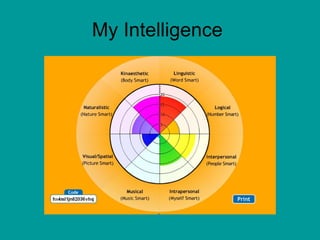
Results  I scored lowest in the areas of musical and logical (number smart) intelligence. These both make perfect sense. I don’t listen to a lot of music, other than gospel in the car or at church. I do tend to walk around singing under my breath a lot though, and I also sing in church. But, I have never learned to play an instrument, although I did try to learn piano when I was seven. I have also never been in a band or been able to learn notes of any kind. I am just not very musically inclined. I also am not logic smart. I tend to think about things differently than most people, sometimes I over analyze in my head. If I am thinking aloud, people are sometimes thrown off by the way I think. Numbers are definitely not my thing. I work very hard to get an A in math. It does not come natural. I scored in the middle on visual spatial, as I do better hands on than I do just seeing something done. I was also in the middle on nature smart. I love to be outside, I just don’t know a whole lot about trees and plants and such. They’re all the same to me. As for intrapersonal and interpersonal, I scored a little higher. I pretty much know who I am; I am just still trying to figure out what I want to do with my life. I am more interpersonal though, which makes sense because I love meeting new people and interacting with others. I scored highest in the areas of linguistic and kinaesthetic intelligence. I am usually good with words. Whether speaking or writing, I always have something to say. As for the kinaesthetic intelligence, it says I am body smart. I suppose I really am, since I am athletic and enjoy running and working out. I know how my body operates. So overall, I agree with this chart and the conclusion it came up with according to my answers.
Kinaesthetic Intelligence My greatest intelligence is kinaesthetic, or body smart intelligence. This means I am a hands on, do it and see it for myself kind of learner. I like to think and learn through touch and movement, and I think this could be made into something fun in the classroom or elsewhere. One unit I enjoyed was the one on classical conditioning. To help the kinesthetic learners, we could be told we have to do an outside project that involved us getting a classically conditioned response. Like from a parent, sibling, friend, or animal. We would have to do something over and over again for a week, and have an associated sound or something with it, to test if it works. By the end of the week, the person/animal may respond before we even got around to the unconditioned stimulus. For example, we could bring our dog a treat every single day. Every time the door opened at a certain time each day, he would probably be already slobbering for the food. That may not be a great example, but there are many things you could do. We would required to make a chart or table of some sort to keep up with each day of that week and what happened with the response, if there was any. Having to actually do what we were learning about may have helped me retain information by testing it out and putting it in my memory bank.
 
Linguistic Intelligence  My second strongest intelligence is linguistic, which means I am good with words: reading, writing, comprehension, ect. I have an activity in mind to help with learning, which may have already been employed in this class and is used in many other types of classes. It’s the tried and true method and usually doesn’t fail. I was especially interested in the Environmental influences on behavior unit, because it is really enlightening as to why people act they way they do. There was talk of social norms, gender development and roles, culture and schemas, and of course the never ending debate of nature versus nurture. I think it would be helpful in learning this material if we delved in a little deeper, perhaps made it even more personal. Like, we could be asked to write “X” amount of journals, describing “X” ways that our lives are the way they are due to environment. I can already think of some really good topics. Media and culture are direct or indirect influences on the way we dress, talk, and live. Parents and family influence a great many things, including gender roles and such. Writing journals would feed my linguistic intelligence, as I would learn to distinguish the differences between words such as authoritarian parents and gender schema. I think writing about it would help me to learn it better, especially when being told to explain it.
 
Interpersonal Intelligence Right up there with my kinaesthetic and linguistic intelligence is my interpersonal intelligence. I have some ideas for this. I chose to do an activity in the unit on infancy and childhood, as I was amazed and interested by the rate children learn and grow. And, I saw how important a good childhood life is, that it many times reflects the life the child has as an adult later on. But, what seemed to boggle my mind were the different stages (preoperational, concrete, and formal). It took me more time to learn these and not get them confused with one another. I also had trouble learning what things happened in each stage. I think it would be helpful if we did an activity involving teaching others. If forced to do more in depth research and then tell others what we learned and maybe even make a lesson plan about it, I think I would learn it better. Maybe if I had to teach the vocabulary and talk about what happens in each stage, I would better know the material. This activity may involve making a video and then posting it online, but it would be pretty in depth and have visuals for the viewer.  This would involve both interpersonal learning and kinaesthetic/hands on learning. But most of all, teaching others in real life would help the interpersonal concept of this. Interacting socially would perhaps elicit discussion and maybe even debates. If there was a way we could post a video on the GAVS website that would allow every student in the class to see it, which would be pretty cool I think. This would help my interpersonal intelligence.
 

Intelligence

  • 1.
    Intelligence Rachel Goza 10/27/2011
  • 2.
  • 3.
    Results Iscored lowest in the areas of musical and logical (number smart) intelligence. These both make perfect sense. I don’t listen to a lot of music, other than gospel in the car or at church. I do tend to walk around singing under my breath a lot though, and I also sing in church. But, I have never learned to play an instrument, although I did try to learn piano when I was seven. I have also never been in a band or been able to learn notes of any kind. I am just not very musically inclined. I also am not logic smart. I tend to think about things differently than most people, sometimes I over analyze in my head. If I am thinking aloud, people are sometimes thrown off by the way I think. Numbers are definitely not my thing. I work very hard to get an A in math. It does not come natural. I scored in the middle on visual spatial, as I do better hands on than I do just seeing something done. I was also in the middle on nature smart. I love to be outside, I just don’t know a whole lot about trees and plants and such. They’re all the same to me. As for intrapersonal and interpersonal, I scored a little higher. I pretty much know who I am; I am just still trying to figure out what I want to do with my life. I am more interpersonal though, which makes sense because I love meeting new people and interacting with others. I scored highest in the areas of linguistic and kinaesthetic intelligence. I am usually good with words. Whether speaking or writing, I always have something to say. As for the kinaesthetic intelligence, it says I am body smart. I suppose I really am, since I am athletic and enjoy running and working out. I know how my body operates. So overall, I agree with this chart and the conclusion it came up with according to my answers.
  • 4.
    Kinaesthetic Intelligence Mygreatest intelligence is kinaesthetic, or body smart intelligence. This means I am a hands on, do it and see it for myself kind of learner. I like to think and learn through touch and movement, and I think this could be made into something fun in the classroom or elsewhere. One unit I enjoyed was the one on classical conditioning. To help the kinesthetic learners, we could be told we have to do an outside project that involved us getting a classically conditioned response. Like from a parent, sibling, friend, or animal. We would have to do something over and over again for a week, and have an associated sound or something with it, to test if it works. By the end of the week, the person/animal may respond before we even got around to the unconditioned stimulus. For example, we could bring our dog a treat every single day. Every time the door opened at a certain time each day, he would probably be already slobbering for the food. That may not be a great example, but there are many things you could do. We would required to make a chart or table of some sort to keep up with each day of that week and what happened with the response, if there was any. Having to actually do what we were learning about may have helped me retain information by testing it out and putting it in my memory bank.
  • 5.
  • 6.
    Linguistic Intelligence My second strongest intelligence is linguistic, which means I am good with words: reading, writing, comprehension, ect. I have an activity in mind to help with learning, which may have already been employed in this class and is used in many other types of classes. It’s the tried and true method and usually doesn’t fail. I was especially interested in the Environmental influences on behavior unit, because it is really enlightening as to why people act they way they do. There was talk of social norms, gender development and roles, culture and schemas, and of course the never ending debate of nature versus nurture. I think it would be helpful in learning this material if we delved in a little deeper, perhaps made it even more personal. Like, we could be asked to write “X” amount of journals, describing “X” ways that our lives are the way they are due to environment. I can already think of some really good topics. Media and culture are direct or indirect influences on the way we dress, talk, and live. Parents and family influence a great many things, including gender roles and such. Writing journals would feed my linguistic intelligence, as I would learn to distinguish the differences between words such as authoritarian parents and gender schema. I think writing about it would help me to learn it better, especially when being told to explain it.
  • 7.
  • 8.
    Interpersonal Intelligence Rightup there with my kinaesthetic and linguistic intelligence is my interpersonal intelligence. I have some ideas for this. I chose to do an activity in the unit on infancy and childhood, as I was amazed and interested by the rate children learn and grow. And, I saw how important a good childhood life is, that it many times reflects the life the child has as an adult later on. But, what seemed to boggle my mind were the different stages (preoperational, concrete, and formal). It took me more time to learn these and not get them confused with one another. I also had trouble learning what things happened in each stage. I think it would be helpful if we did an activity involving teaching others. If forced to do more in depth research and then tell others what we learned and maybe even make a lesson plan about it, I think I would learn it better. Maybe if I had to teach the vocabulary and talk about what happens in each stage, I would better know the material. This activity may involve making a video and then posting it online, but it would be pretty in depth and have visuals for the viewer. This would involve both interpersonal learning and kinaesthetic/hands on learning. But most of all, teaching others in real life would help the interpersonal concept of this. Interacting socially would perhaps elicit discussion and maybe even debates. If there was a way we could post a video on the GAVS website that would allow every student in the class to see it, which would be pretty cool I think. This would help my interpersonal intelligence.
  • 9.