Intelligence Juliann Watson October 27, 2011 Mrs. Mitchell
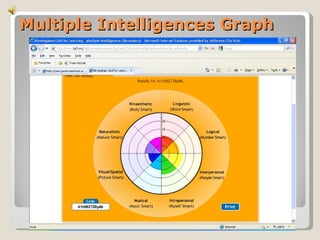
Multiple Intelligences Graph
According to my intelligence assessment, my intrapersonal and interpersonal intelligence are equal and are the highest scores, meaning I understand myself and others better than the other skills I posses. I scored high in the intrapersonal intelligence area because I understand myself, and I take this as I know what I want out of life and I’m focused on accomplishing tasks that will be good for me in the future. In a sense, I know what’s best for me most of the time; however, this doesn’t mean I ALWAYS do what’s best. I wouldn’t say I’ve “found myself” because I don’t really care for trying to “find myself.” I know what I want out of life and what I have to do to get it. I tend to keep to myself; I would label myself as an introvert, although I’ve become more social in the past year. I prefer staying home and spending time with my family as opposed to being a social butterfly and hanging out with my friends. I don’t agree with the site’s conclusion that I have interpersonal intelligence because I’m not very good with understanding and helping people. For example, I feel really awkward when one of my friends are crying because I’m not sure what to say or do. I agree with my logic and linguistic scores because I’d say neither is that much higher than the other. I don’t really enjoy math and using numbers because I feel like I’m not very good at the subject. However, I feel my linguistic score should’ve been higher than the logic because I’m pretty good at writing papers, our assignments, and other activities we do in my language arts class.  My kinaesthetic score appears to be correct because I don’t spend a majority of my time focusing on the physical aspect of my life; I spend most of it focusing on school. I’m also not naturalistically intelligent because, once again, I don’t care much for the environment in that I’m very aware of it. I don’t think a lot about how I can reduce my footprint. I don’t agree much with the visual/spatial score, because I feel like I am a visual learner, so seeing pictures helps me quite a bit when trying to remember something. When I need to, I can visualize a word or graph from my notes when I’m taking a test. I’d also agree with the musical intelligence score because I can play an instrument; however, I’m not musically intelligent in pitches and things of that nature. I’m not that good at reading rhythms, either.
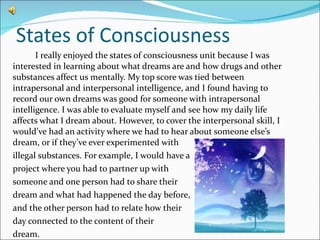
States of Consciousness I really enjoyed the states of consciousness unit because I was interested in learning about what dreams are and how drugs and other substances affect us mentally. My top score was tied between intrapersonal and interpersonal intelligence, and I found having to record our own dreams was good for someone with intrapersonal intelligence. I was able to evaluate myself and see how my daily life affects what I dream about. However, to cover the interpersonal skill, I would’ve had an activity where we had to hear about someone else’s dream, or if they’ve ever experimented with  illegal substances. For example, I would have a project where you had to partner up with  someone and one person had to share their dream and what had happened the day before, and the other person had to relate how their day connected to the content of their  dream.
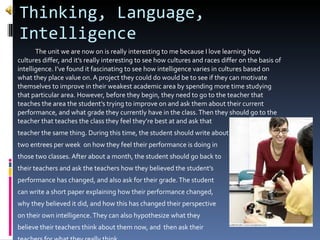
Thinking, Language, Intelligence The unit we are now on is really interesting to me because I love learning how cultures differ, and it’s really interesting to see how cultures and races differ on the basis of intelligence. I’ve found it fascinating to see how intelligence varies in cultures based on what they place value on. A project they could do would be to see if they can motivate themselves to improve in their weakest academic area by spending more time studying that particular area. However, before they begin, they need to go to the teacher that teaches the area the student’s trying to improve on and ask them about their current  performance, and what grade they currently have in the class. Then they should go to the teacher that teaches the class they feel they’re best at and ask that  teacher the same thing. During this time, the student should write about two entrees per week  on how they feel their performance is doing in  those two classes. After about a month, the student should go back to their teachers and ask the teachers how they believed the student’s performance has changed, and also ask for their grade. The student can write a short paper explaining how their performance changed, why they believed it did, and how this has changed their perspective  on their own intelligence. They can also hypothesize what they  believe their teachers think about them now, and  then ask their  teachers for what they really think.
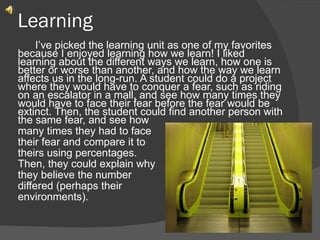
Learning I’ve picked the learning unit as one of my favorites because I enjoyed learning how we learn! I liked learning about the different ways we learn, how one is better or worse than another, and how the way we learn affects us in the long-run. A student could do a project where they would have to conquer a fear, such as riding on an escalator in a mall, and see how many times they would have to face their fear before the fear would be extinct. Then, the student could find another person with the same fear, and see how many times they had to face  their fear and compare it to  theirs using percentages.  Then, they could explain why  they believe the number  differed (perhaps their  environments).
References Miller, G. (2005, August 11).  Dream dicitonary . Retrieved from  http://www.eso-garden.com/index.php?/weblog/C37/  (States of Consciousness picture) Teacher talking to student in laboratory . (n.d.). Retrieved from  http://www.visualphotos.com/image/2x4438874/teacher_talking_to_student_in_laboratory  (Thinking, Language, Intelligence picture) Escalators . (n.d.). Retrieved from  http://www.eso-garden.com/index.php?/weblog/C37/   (Learning picture)

WatsonJuliann_Intelligence Assessment

  • 1.
    Intelligence Juliann WatsonOctober 27, 2011 Mrs. Mitchell
  • 2.
  • 3.
    According to myintelligence assessment, my intrapersonal and interpersonal intelligence are equal and are the highest scores, meaning I understand myself and others better than the other skills I posses. I scored high in the intrapersonal intelligence area because I understand myself, and I take this as I know what I want out of life and I’m focused on accomplishing tasks that will be good for me in the future. In a sense, I know what’s best for me most of the time; however, this doesn’t mean I ALWAYS do what’s best. I wouldn’t say I’ve “found myself” because I don’t really care for trying to “find myself.” I know what I want out of life and what I have to do to get it. I tend to keep to myself; I would label myself as an introvert, although I’ve become more social in the past year. I prefer staying home and spending time with my family as opposed to being a social butterfly and hanging out with my friends. I don’t agree with the site’s conclusion that I have interpersonal intelligence because I’m not very good with understanding and helping people. For example, I feel really awkward when one of my friends are crying because I’m not sure what to say or do. I agree with my logic and linguistic scores because I’d say neither is that much higher than the other. I don’t really enjoy math and using numbers because I feel like I’m not very good at the subject. However, I feel my linguistic score should’ve been higher than the logic because I’m pretty good at writing papers, our assignments, and other activities we do in my language arts class. My kinaesthetic score appears to be correct because I don’t spend a majority of my time focusing on the physical aspect of my life; I spend most of it focusing on school. I’m also not naturalistically intelligent because, once again, I don’t care much for the environment in that I’m very aware of it. I don’t think a lot about how I can reduce my footprint. I don’t agree much with the visual/spatial score, because I feel like I am a visual learner, so seeing pictures helps me quite a bit when trying to remember something. When I need to, I can visualize a word or graph from my notes when I’m taking a test. I’d also agree with the musical intelligence score because I can play an instrument; however, I’m not musically intelligent in pitches and things of that nature. I’m not that good at reading rhythms, either.
  • 4.
    States of ConsciousnessI really enjoyed the states of consciousness unit because I was interested in learning about what dreams are and how drugs and other substances affect us mentally. My top score was tied between intrapersonal and interpersonal intelligence, and I found having to record our own dreams was good for someone with intrapersonal intelligence. I was able to evaluate myself and see how my daily life affects what I dream about. However, to cover the interpersonal skill, I would’ve had an activity where we had to hear about someone else’s dream, or if they’ve ever experimented with illegal substances. For example, I would have a project where you had to partner up with someone and one person had to share their dream and what had happened the day before, and the other person had to relate how their day connected to the content of their dream.
  • 5.
    Thinking, Language, IntelligenceThe unit we are now on is really interesting to me because I love learning how cultures differ, and it’s really interesting to see how cultures and races differ on the basis of intelligence. I’ve found it fascinating to see how intelligence varies in cultures based on what they place value on. A project they could do would be to see if they can motivate themselves to improve in their weakest academic area by spending more time studying that particular area. However, before they begin, they need to go to the teacher that teaches the area the student’s trying to improve on and ask them about their current performance, and what grade they currently have in the class. Then they should go to the teacher that teaches the class they feel they’re best at and ask that teacher the same thing. During this time, the student should write about two entrees per week on how they feel their performance is doing in those two classes. After about a month, the student should go back to their teachers and ask the teachers how they believed the student’s performance has changed, and also ask for their grade. The student can write a short paper explaining how their performance changed, why they believed it did, and how this has changed their perspective on their own intelligence. They can also hypothesize what they believe their teachers think about them now, and then ask their teachers for what they really think.
  • 6.
    Learning I’ve pickedthe learning unit as one of my favorites because I enjoyed learning how we learn! I liked learning about the different ways we learn, how one is better or worse than another, and how the way we learn affects us in the long-run. A student could do a project where they would have to conquer a fear, such as riding on an escalator in a mall, and see how many times they would have to face their fear before the fear would be extinct. Then, the student could find another person with the same fear, and see how many times they had to face their fear and compare it to theirs using percentages. Then, they could explain why they believe the number differed (perhaps their environments).
  • 7.
    References Miller, G.(2005, August 11). Dream dicitonary . Retrieved from http://www.eso-garden.com/index.php?/weblog/C37/ (States of Consciousness picture) Teacher talking to student in laboratory . (n.d.). Retrieved from http://www.visualphotos.com/image/2x4438874/teacher_talking_to_student_in_laboratory (Thinking, Language, Intelligence picture) Escalators . (n.d.). Retrieved from http://www.eso-garden.com/index.php?/weblog/C37/ (Learning picture)