Miranda Helton
   2/17/12
 Mrs. Mitchell
   http://www.bgfl.org/bgfl/custom/resources_
    ftp/client_ftp/ks3/ict/multiple_int/results/re
    sults_action.cfm


( The website wouldn’t allow copying and pasting
   and I couldn’t get my scanner to work)
The personality test I have taken put my intelligence in this order from greatest to
least: linguistic, musical, intrapersonal, interpersonal, logical, naturalistic, kinaesthetic,
and visual/ spatial. It is no great surprise to me that linguistics is my greatest
intelligence. I love to read and write, and I absorb new words and even words in
different languages like a sponge. My musical and intrapersonal intelligences came to a
tie on the graph, but I put musical intelligence first because I love to listen to music, I
play the clarinet well and I have a knack for remembering rhythms and notes fairly
easily. I’ve always had very good intrapersonal smarts. I’ve always known my own
mind and my limits and exactly what I wanted to achieve. I am very interpersonally
intelligent most of the time, and I’m slightly surprised that my “people smarts” weren’t
higher on the graph. I’m extremely good at reading facial expressions and body
language, and I usually act as the mediator in arguments because of this. I’m also very
good a discerning temperaments and figuring out how far people can be pushed with
certain things. I’ve got pretty good logical intelligence most of the time, but I tend to go
with my gut instinct on most things instead of thinking things through. I’m not very
naturalistically intelligent at all. It’s not that I don’t care about the environment; it’s that I
just don’t think about it most of the time. Last and certainly least is my visual
intelligence. I had a photographic memory when I was younger that I depended on to
remember what things looked like, but it has deteriorated as I have gotten older which
means that I have the worst time describing things that I have seen. The images just
won’t stick in my mind.
For the topic of Nature, Nurture, and Human
Diversity, a research paper could have been assigned to
study the effects of nature and nurture on human
diversity by comparing and contrasting different
cultures around the world with your own life, making
sure to include such topics as language, music, art, and
history.
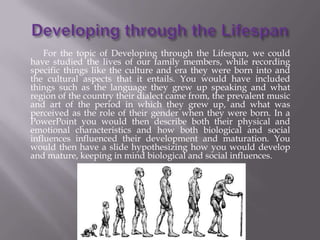
For the topic of Developing through the Lifespan, we could
have studied the lives of our family members, while recording
specific things like the culture and era they were born into and
the cultural aspects that it entails. You would have included
things such as the language they grew up speaking and what
region of the country their dialect came from, the prevalent music
and art of the period in which they grew up, and what was
perceived as the role of their gender when they were born. In a
PowerPoint you would then describe both their physical and
emotional characteristics and how both biological and social
influences influenced their development and maturation. You
would then have a slide hypothesizing how you would develop
and mature, keeping in mind biological and social influences.
For the topic of Thinking, Language, and Intelligence,
we could have gathered a diverse group of people and
asked them to take a small series of tests that would test
different intelligences. The tests would cover all
intelligences including musicality and linguistic
intelligence. We could have then put together our own
scientific study that compared the data from the tests
with data from previous scientific studies. If the data
had been comparable, then we could have explained
why it had been, and if the data had not been
comparable, we could have explained why it had not
been. Then you could write up a small paragraph
explaining if you thought your own conclusions were
valid or not and why.

Intelligence

  • 1.
    Miranda Helton 2/17/12 Mrs. Mitchell
  • 2.
    http://www.bgfl.org/bgfl/custom/resources_ ftp/client_ftp/ks3/ict/multiple_int/results/re sults_action.cfm ( The website wouldn’t allow copying and pasting and I couldn’t get my scanner to work)
  • 3.
    The personality testI have taken put my intelligence in this order from greatest to least: linguistic, musical, intrapersonal, interpersonal, logical, naturalistic, kinaesthetic, and visual/ spatial. It is no great surprise to me that linguistics is my greatest intelligence. I love to read and write, and I absorb new words and even words in different languages like a sponge. My musical and intrapersonal intelligences came to a tie on the graph, but I put musical intelligence first because I love to listen to music, I play the clarinet well and I have a knack for remembering rhythms and notes fairly easily. I’ve always had very good intrapersonal smarts. I’ve always known my own mind and my limits and exactly what I wanted to achieve. I am very interpersonally intelligent most of the time, and I’m slightly surprised that my “people smarts” weren’t higher on the graph. I’m extremely good at reading facial expressions and body language, and I usually act as the mediator in arguments because of this. I’m also very good a discerning temperaments and figuring out how far people can be pushed with certain things. I’ve got pretty good logical intelligence most of the time, but I tend to go with my gut instinct on most things instead of thinking things through. I’m not very naturalistically intelligent at all. It’s not that I don’t care about the environment; it’s that I just don’t think about it most of the time. Last and certainly least is my visual intelligence. I had a photographic memory when I was younger that I depended on to remember what things looked like, but it has deteriorated as I have gotten older which means that I have the worst time describing things that I have seen. The images just won’t stick in my mind.
  • 4.
    For the topicof Nature, Nurture, and Human Diversity, a research paper could have been assigned to study the effects of nature and nurture on human diversity by comparing and contrasting different cultures around the world with your own life, making sure to include such topics as language, music, art, and history.
  • 5.
    For the topicof Developing through the Lifespan, we could have studied the lives of our family members, while recording specific things like the culture and era they were born into and the cultural aspects that it entails. You would have included things such as the language they grew up speaking and what region of the country their dialect came from, the prevalent music and art of the period in which they grew up, and what was perceived as the role of their gender when they were born. In a PowerPoint you would then describe both their physical and emotional characteristics and how both biological and social influences influenced their development and maturation. You would then have a slide hypothesizing how you would develop and mature, keeping in mind biological and social influences.
  • 6.
    For the topicof Thinking, Language, and Intelligence, we could have gathered a diverse group of people and asked them to take a small series of tests that would test different intelligences. The tests would cover all intelligences including musicality and linguistic intelligence. We could have then put together our own scientific study that compared the data from the tests with data from previous scientific studies. If the data had been comparable, then we could have explained why it had been, and if the data had not been comparable, we could have explained why it had not been. Then you could write up a small paragraph explaining if you thought your own conclusions were valid or not and why.