COMMERCIAL ASPECTS OF
Intellectual Property Rights
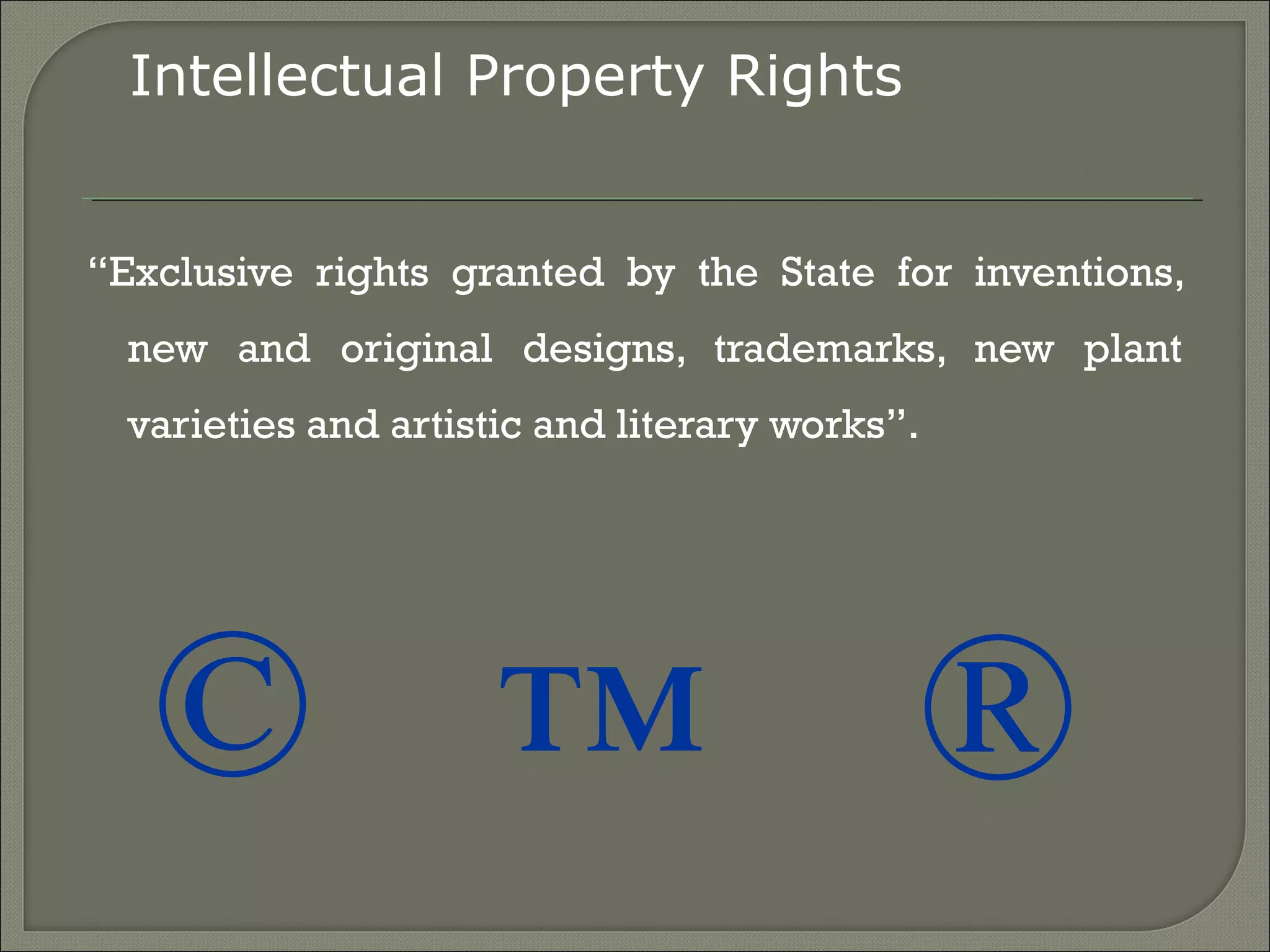
“Exclusive rights granted by the State for inventions,
new and original designs, trademarks, new plant
varieties and artistic and literary works”.
© ®™
Intellectual Property Rights
The right to prevent others from
• using
• manufacturing
• distributing
 products
 processes
 applications
 trade names
 geographical names
 ideas
 designs
Industrial Property Rights
Intellectual Property Rights
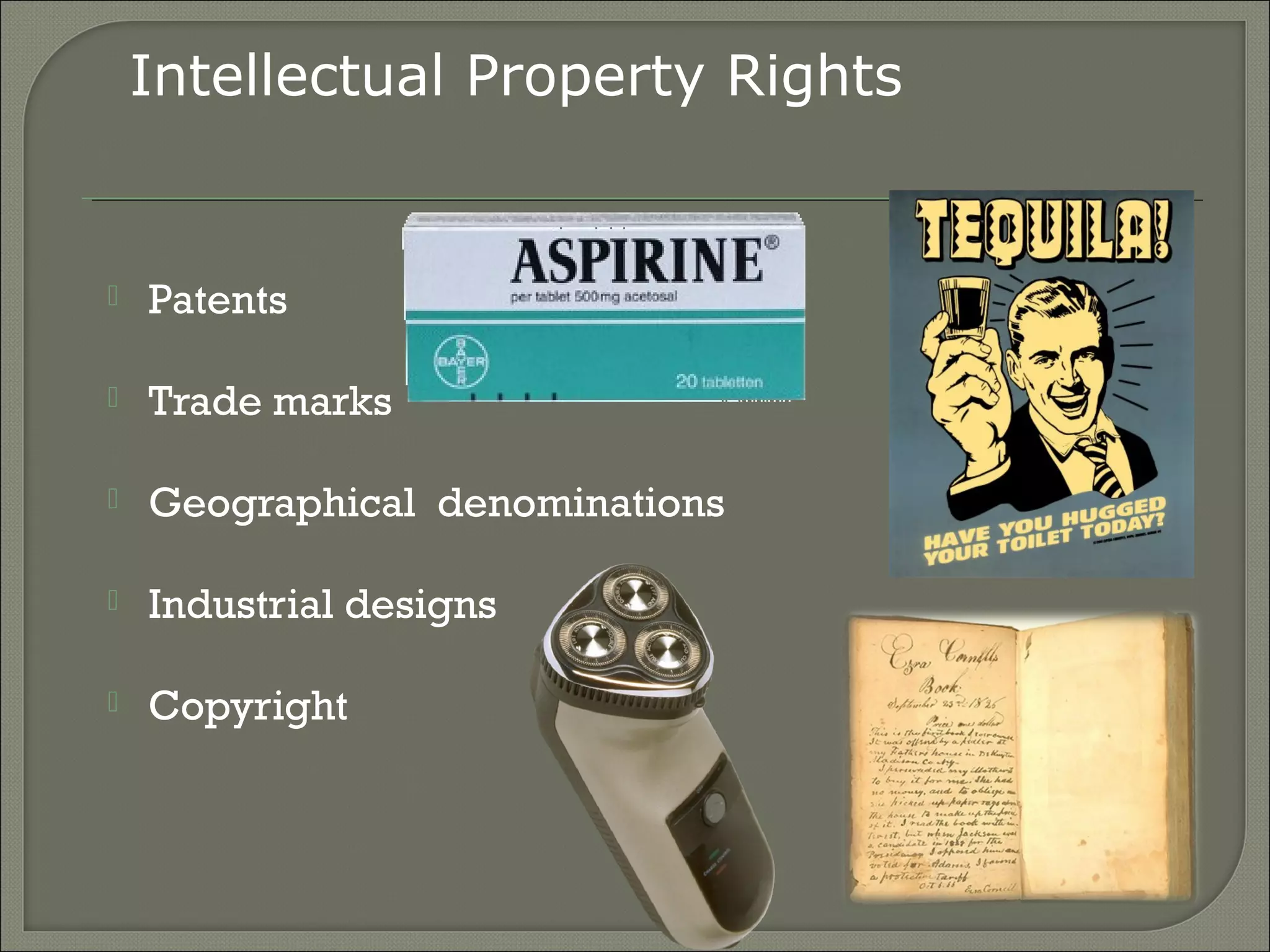
 Patents
 Trade marks
 Geographical denominations
 Industrial designs
 Copyright
 "Copyright" is a protection that covers published
and unpublished literary, scientific, and artistic
works, whatever the form of expression, provided
such works are fixed in a tangible or material
form.
 This means that if you can see it, hear it, and/or
touch it-- it is protected.
 Anything tangible – in a fixed form
 Examples
 Literary works, including software
 Musical works, including accompanying words
 Dramatic works, including accompanying music
 Pantomimes and choreographic works
 Pictorial, graphic and sculptural works
 Motion pictures and other audiovisual works
 Sound recordings
 Architectural works
 Works that have not been fixed in a tangible form of
expression; for example, improvisational speeches or
performances that have not been written or recorded.
 Titles, names, short phrases and slogans; familiar symbols
or designs; variations of typographic ornamentation,
lettering or coloring; listing of ingredients or contents.
 Ideal procedures, methods, systems , processes, concepts,
principles, discoveries, or devices, as distinguished from
a description, explanation or illustration.
 Everything on the Internet is copyrighted
World Wide Web pages
Courses
Electronic mail, listservs and newsgroups
 The same copyright laws apply to
electronic materials as to print materials
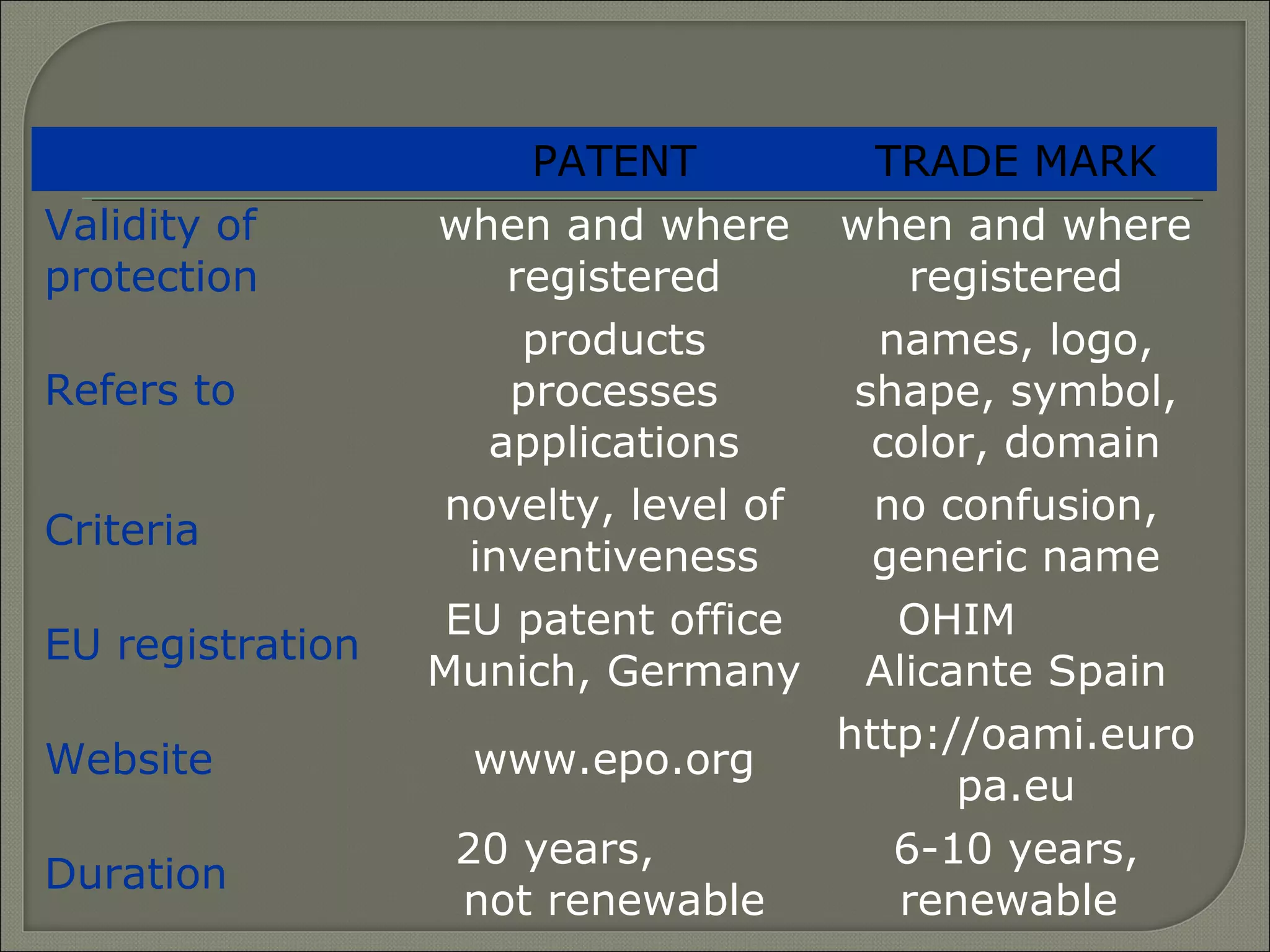
PATENT TRADE MARK
Validity of
protection
when and where
registered
when and where
registered
Refers to
products
processes
applications
names, logo,
shape, symbol,
color, domain
Criteria
novelty, level of
inventiveness
no confusion,
generic name
EU registration
EU patent office
Munich, Germany
OHIM
Alicante Spain
Website www.epo.org
http://oami.euro
pa.eu
Duration
20 years,
not renewable
6-10 years,
renewable
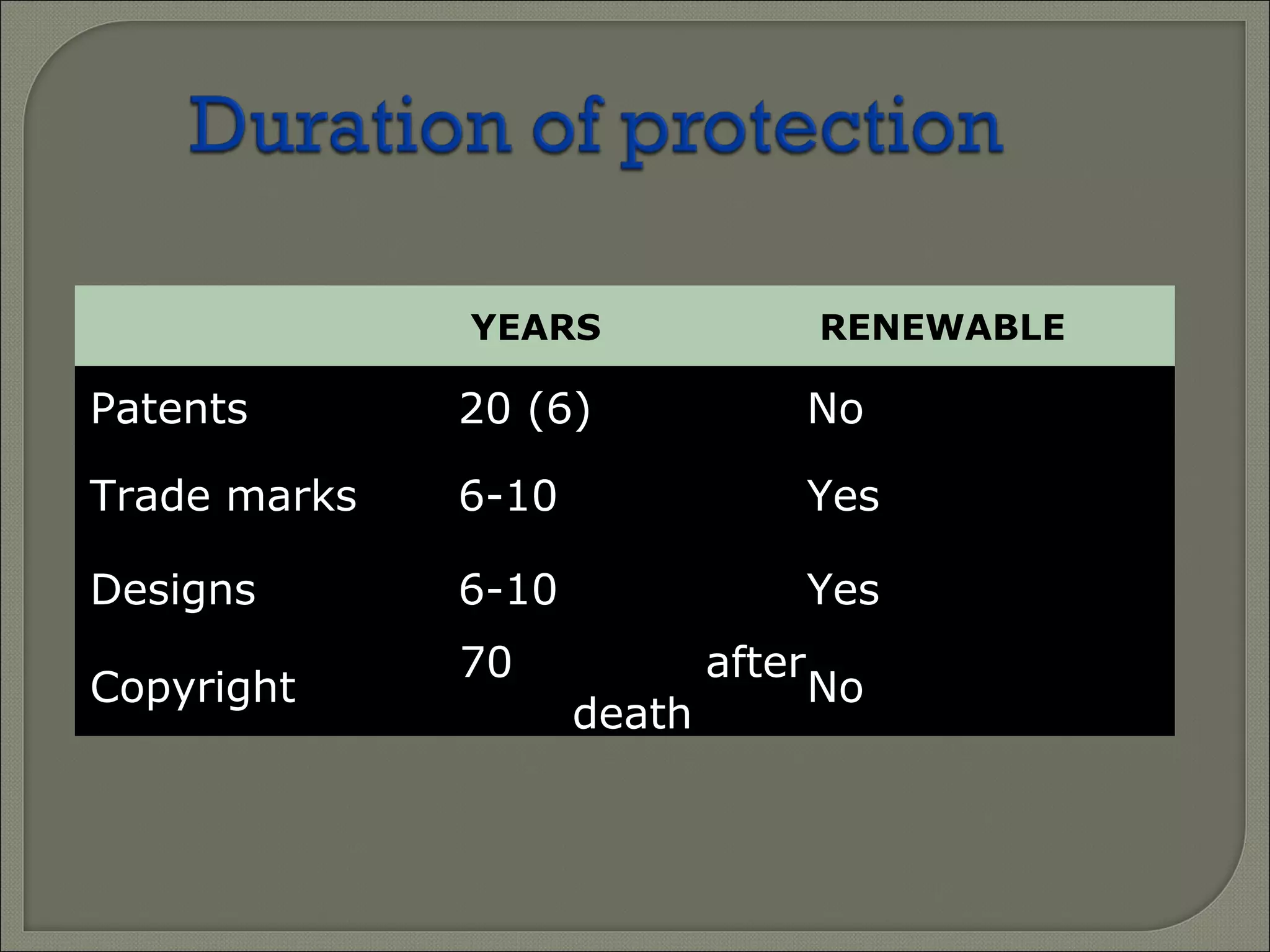
YEARS RENEWABLE
Patents 20 (6) No
Trade marks 6-10 Yes
Designs 6-10 Yes
Copyright
70 after
death
No
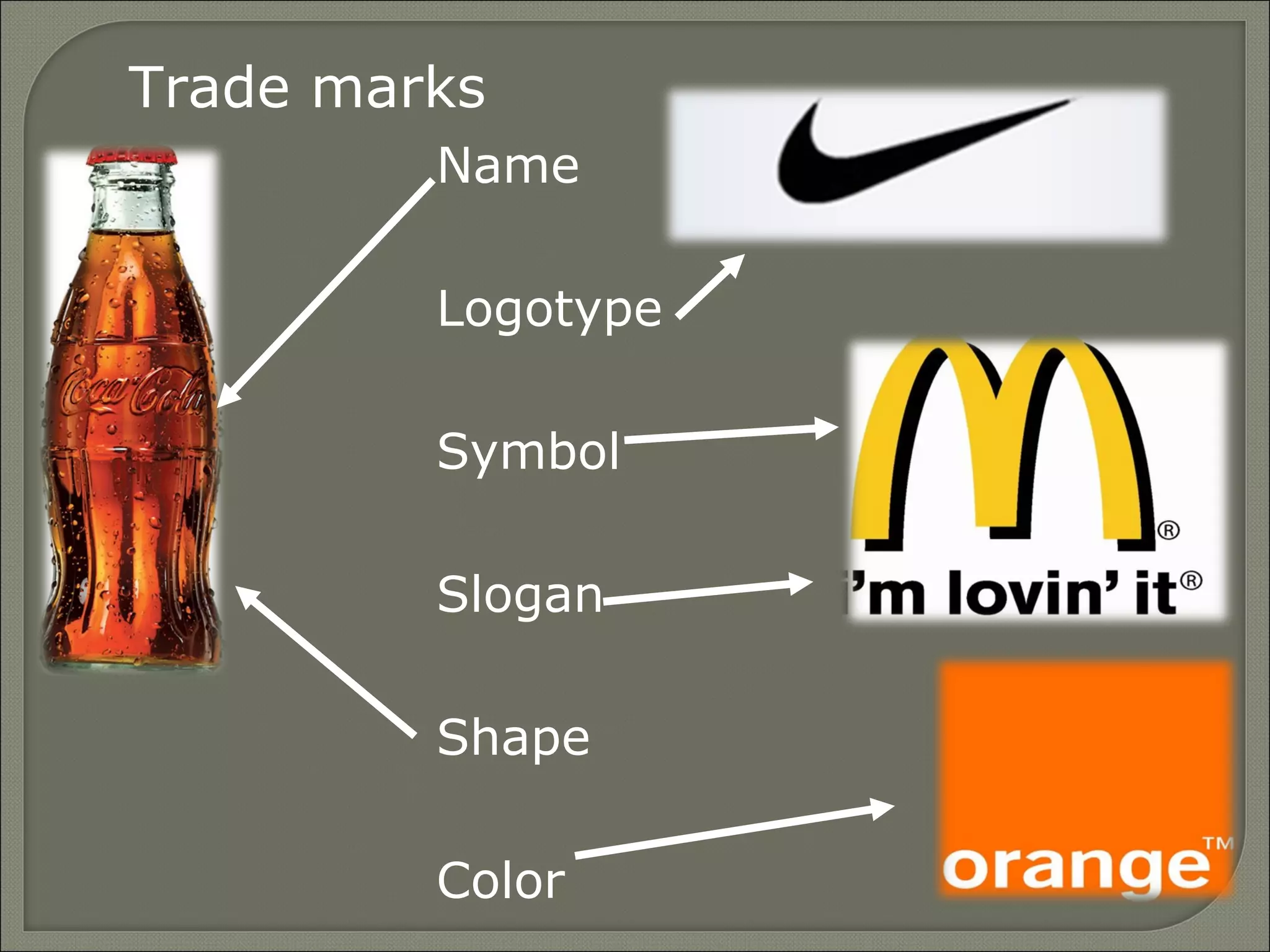
Trade marks
Name
Logotype
Symbol
Slogan
Shape
Color
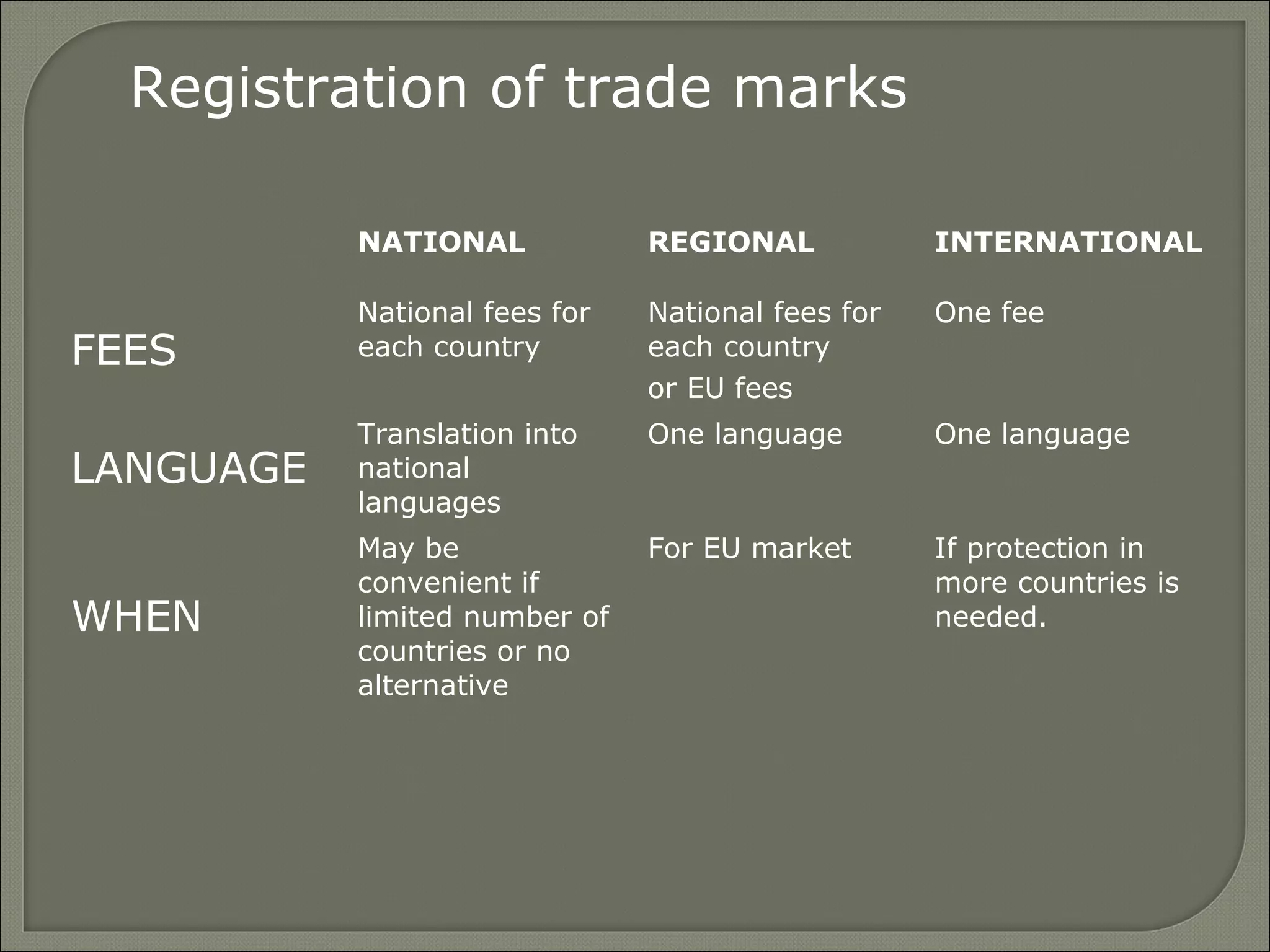
Registration of trade marks
NATIONAL REGIONAL INTERNATIONAL
FEES
National fees for
each country
National fees for
each country
or EU fees
One fee
LANGUAGE
Translation into
national
languages
One language One language
WHEN
May be
convenient if
limited number of
countries or no
alternative
For EU market If protection in
more countries is
needed.
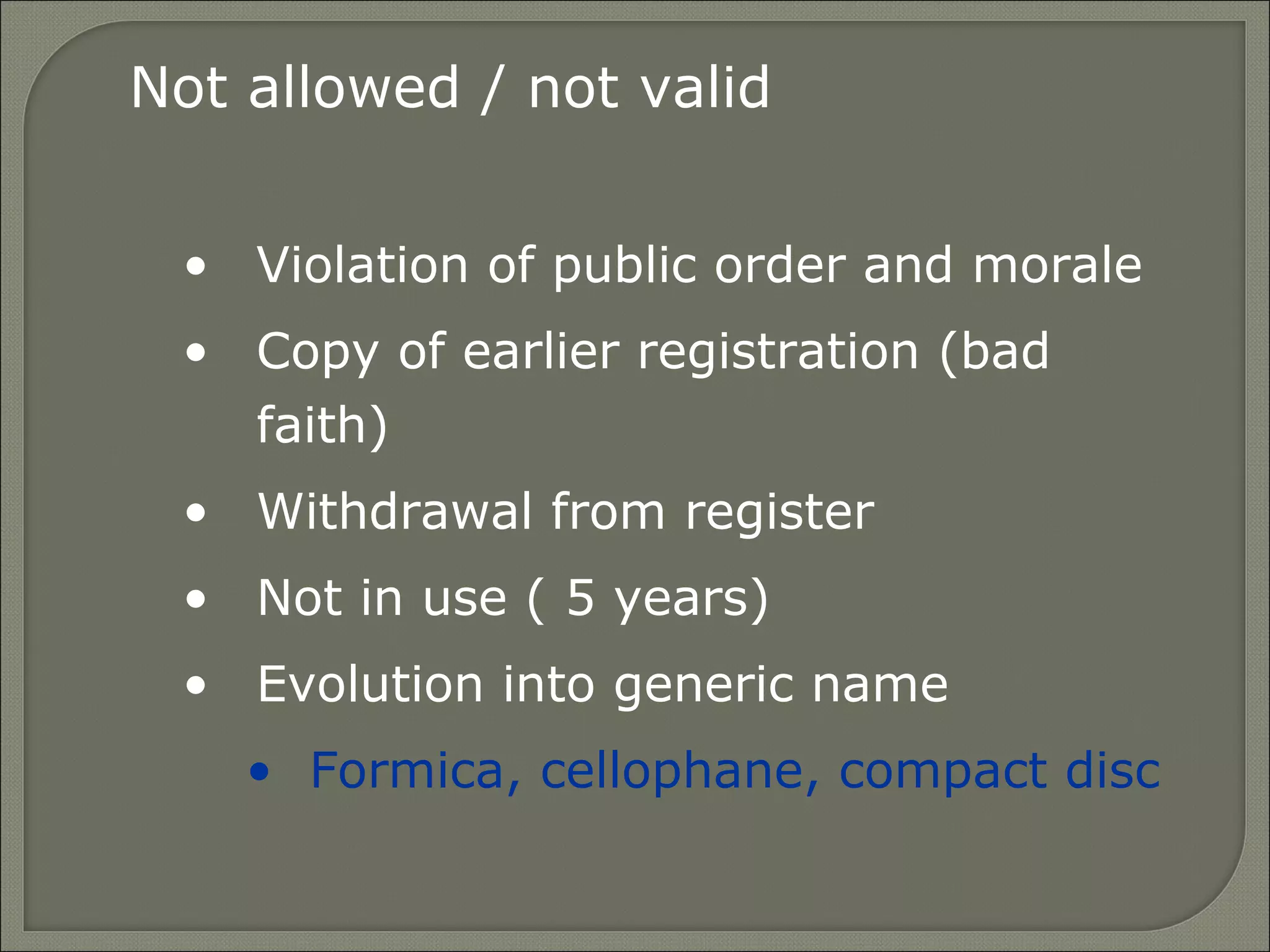
Not allowed / not valid
• Violation of public order and morale
• Copy of earlier registration (bad
faith)
• Withdrawal from register
• Not in use ( 5 years)
• Evolution into generic name
• Formica, cellophane, compact disc
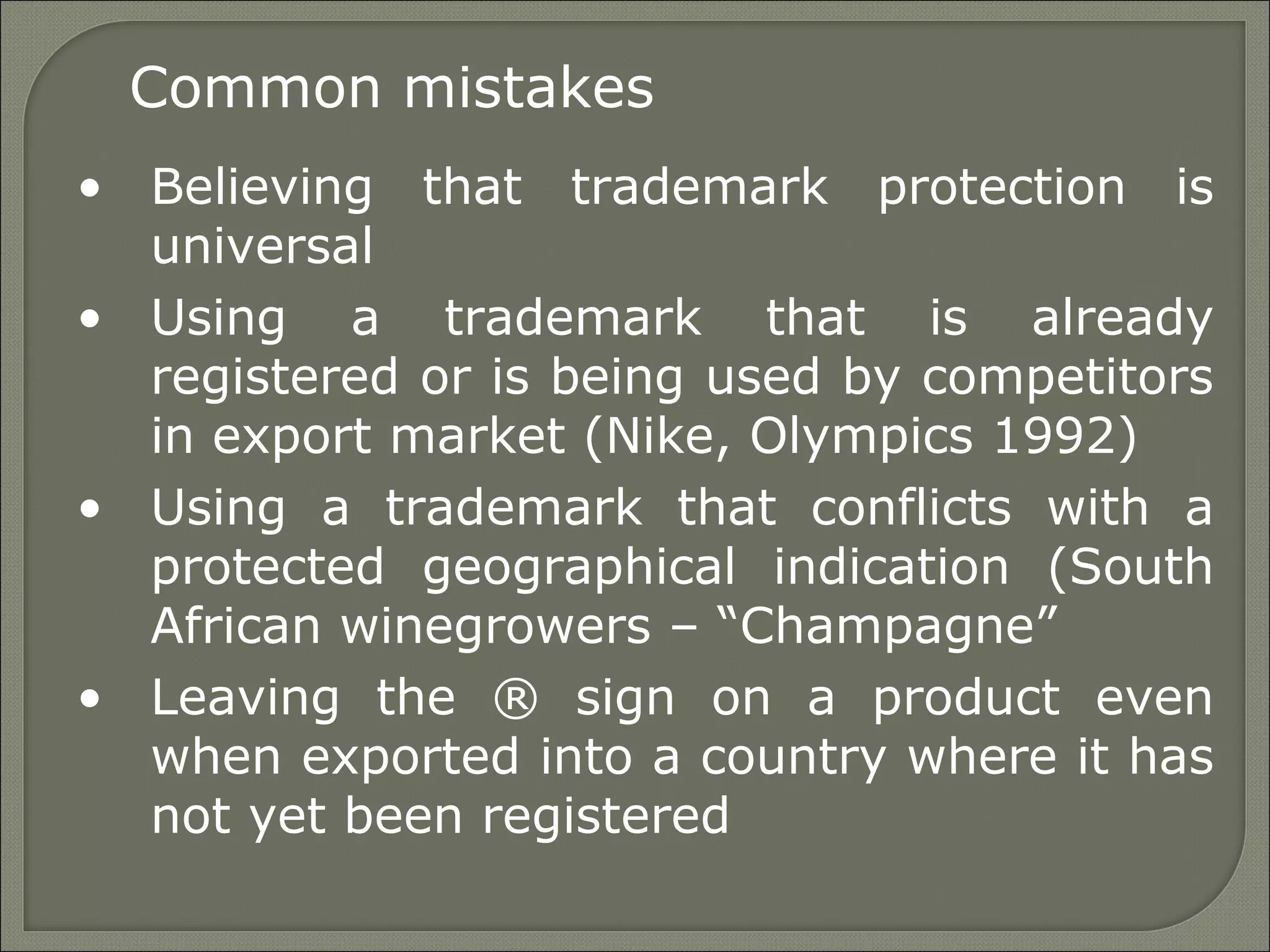
Common mistakes
• Believing that trademark protection is
universal
• Using a trademark that is already
registered or is being used by competitors
in export market (Nike, Olympics 1992)
• Using a trademark that conflicts with a
protected geographical indication (South
African winegrowers – “Champagne”
• Leaving the ® sign on a product even
when exported into a country where it has
not yet been registered
“The right to exclusively produce,
use and/or market a
• Product
• Process
• Application
Patents
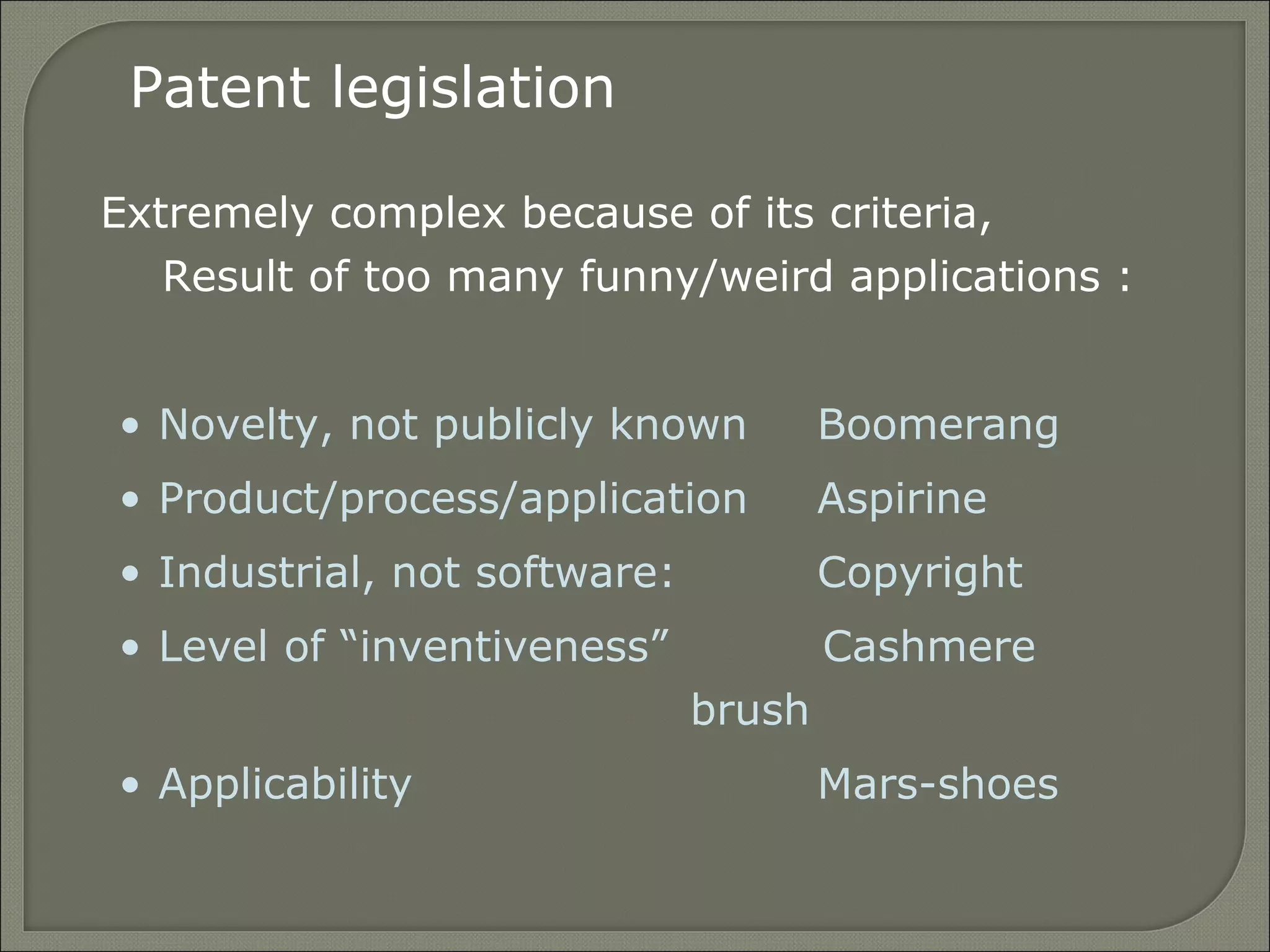
Extremely complex because of its criteria,
Result of too many funny/weird applications :
• Novelty, not publicly known Boomerang
• Product/process/application Aspirine
• Industrial, not software: Copyright
• Level of “inventiveness” Cashmere
brush
• Applicability Mars-shoes
Patent legislation
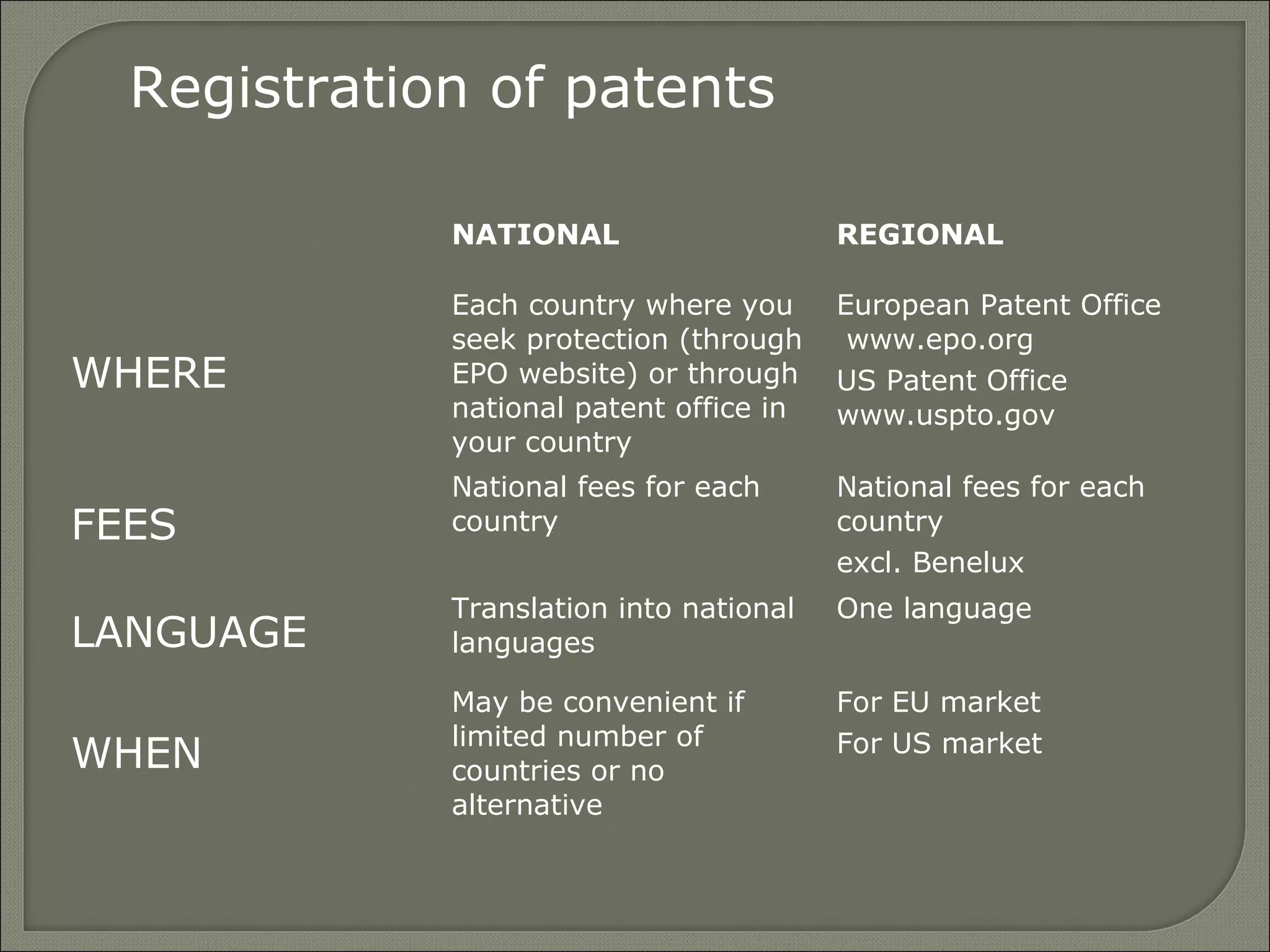
Registration of patents
NATIONAL REGIONAL
WHERE
Each country where you
seek protection (through
EPO website) or through
national patent office in
your country
European Patent Office
www.epo.org
US Patent Office
www.uspto.gov
FEES
National fees for each
country
National fees for each
country
excl. Benelux
LANGUAGE
Translation into national
languages
One language
WHEN
May be convenient if
limited number of
countries or no
alternative
For EU market
For US market
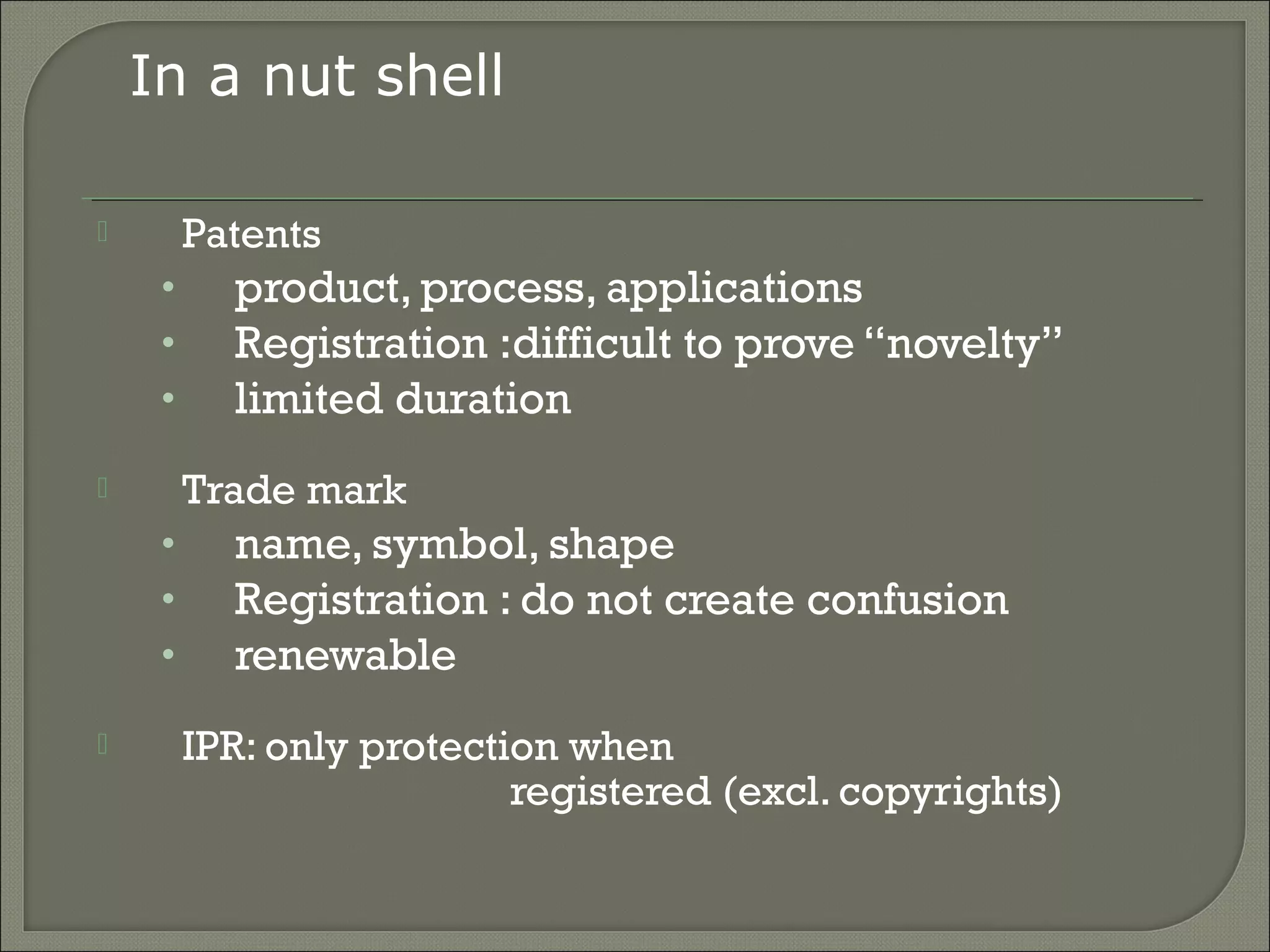
 Patents
• product, process, applications
• Registration :difficult to prove “novelty”
• limited duration
 Trade mark
• name, symbol, shape
• Registration : do not create confusion
• renewable
 IPR: only protection when
registered (excl. copyrights)
In a nut shell
19
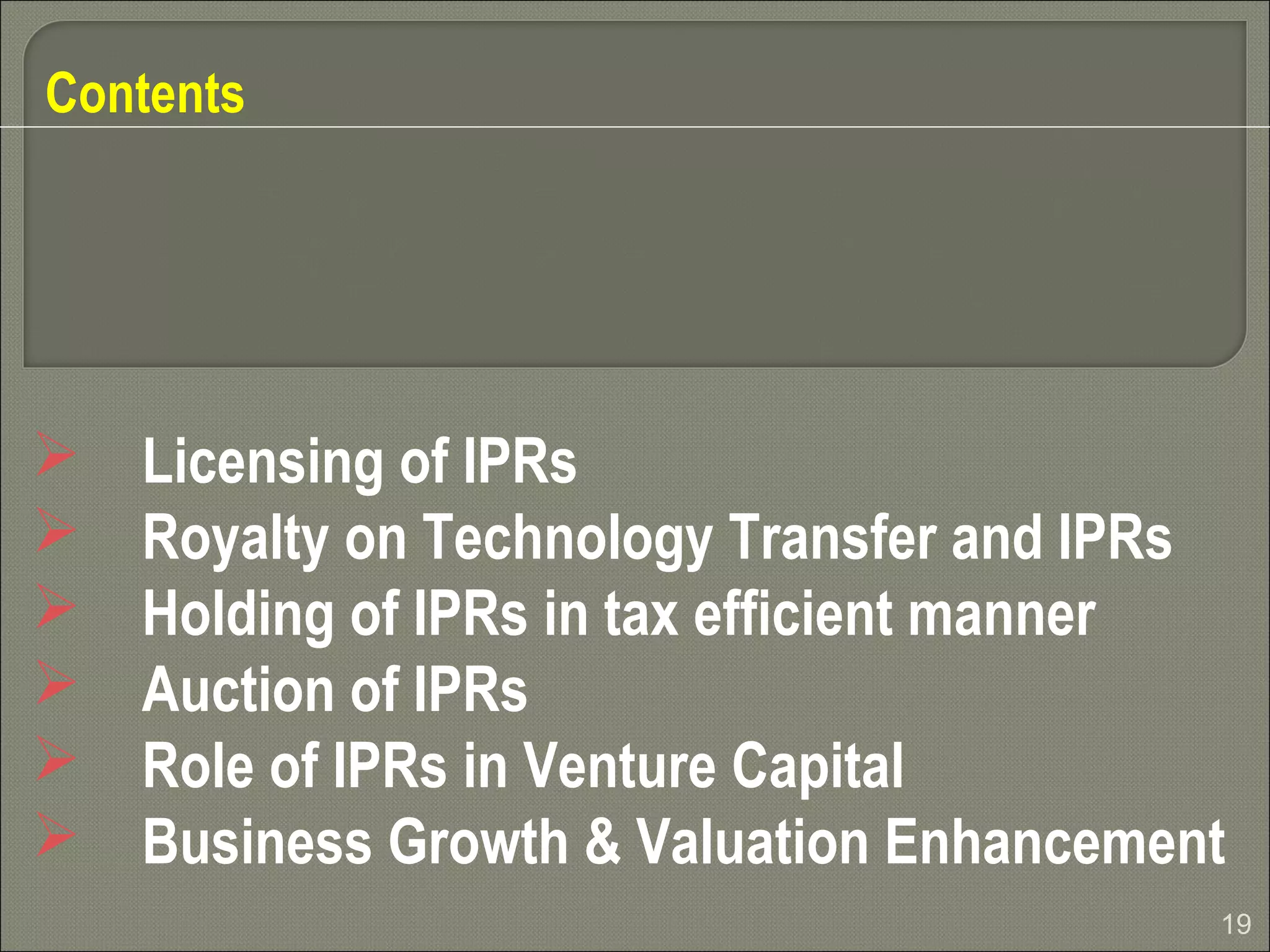
Contents
 Licensing of IPRs
 Royalty on Technology Transfer and IPRs
 Holding of IPRs in tax efficient manner
 Auction of IPRs
 Role of IPRs in Venture Capital
 Business Growth & Valuation Enhancement
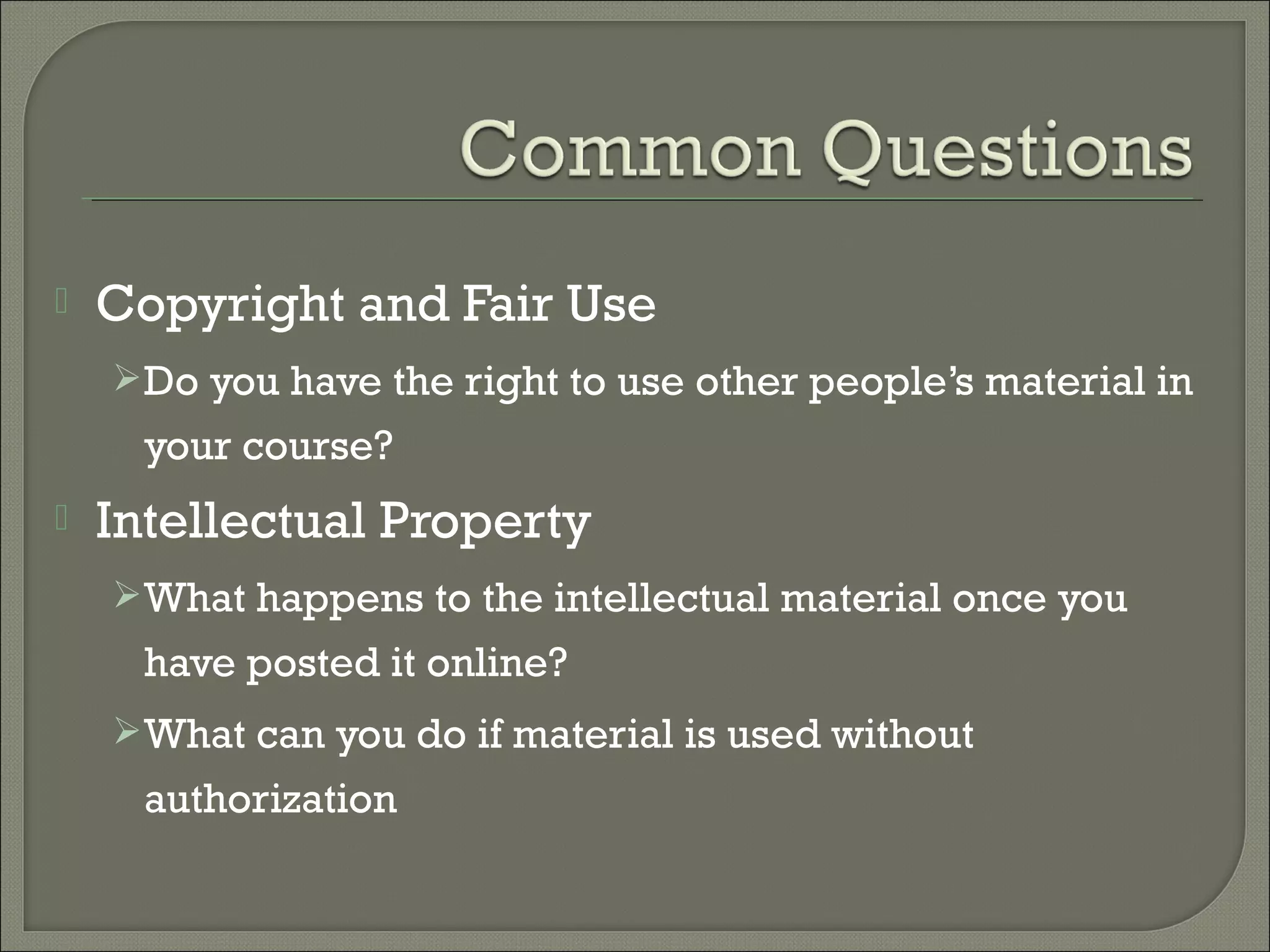
 Copyright and Fair Use
Do you have the right to use other people’s material in
your course?
 Intellectual Property
What happens to the intellectual material once you
have posted it online?
What can you do if material is used without
authorization
21
Licensing of IPRs
Important issues in software licensing
•Define Licensor & Licensee
•Software Description
•Term of License
•Expiry / Termination
•Renewal
•Upgradation
•Single or Multi-user
•Concurrent User
•Network in which it is to be used
22
Licensing of IPRs
•Home or Commercial use
•Access to source code
•Transferability
•Division of Components of Software
•Downloading & uploading
•Sub-licensing
•Operating Systems for software
•Non Liability through wrong usage
•Anti Piracy clause
23
Licensing of IPRs
•Software Auditing
•Remedies - damages / injunction /
criminal liability
•Liability & Obligation of Licensee
•Territory
•OEM unbundling
•Royalty
•Taxation
•Repatriation
24
Royalty on Technology Transfer and IPRs
Royalty can be
Lump-sum fee percentage of sales
25
Royalty on Technology Transfer and IPRs
Royalty for Technology (Patents)
o Lump sum payments upto $ 2 mn
o Upto 5% for domestic sales and
8% for exports, without any
restriction on the duration of the
royalty payments.
Royalty for use of TM and brand
can be paid upto 2% on exports
and upto 1% on domestic sales.
26
Royalty on Technology Transfer and IPRs
o Define Technology and List of IPRs
o Grant of License
o Rights & Obligations of Licensee and Licensor
o Exclusive / Non-exclusive
o Transferability and Sub-licensing
o Term
o Revocability
o Territory
o Advertising & Promotion
o Audit of accounts from outside agency
o Royalty Payment and Calculation
Issues in Technology Transfer
27
Role of IPRs in Venture Capital
Venture Capital (VC) has been major drivers
of innovation, economic growth, knowledge
base industry and start ups. VC industry
follow the concept of “high risk high gain.”
VC value intangible assets while making
equity investments, which generally
conventional sources of financing may not
consider.
28
Role of IPRs in Venture Capital
Increases the valuation of
the company
Better IPR portfolio
gives competitive edge
in attracting VC
29
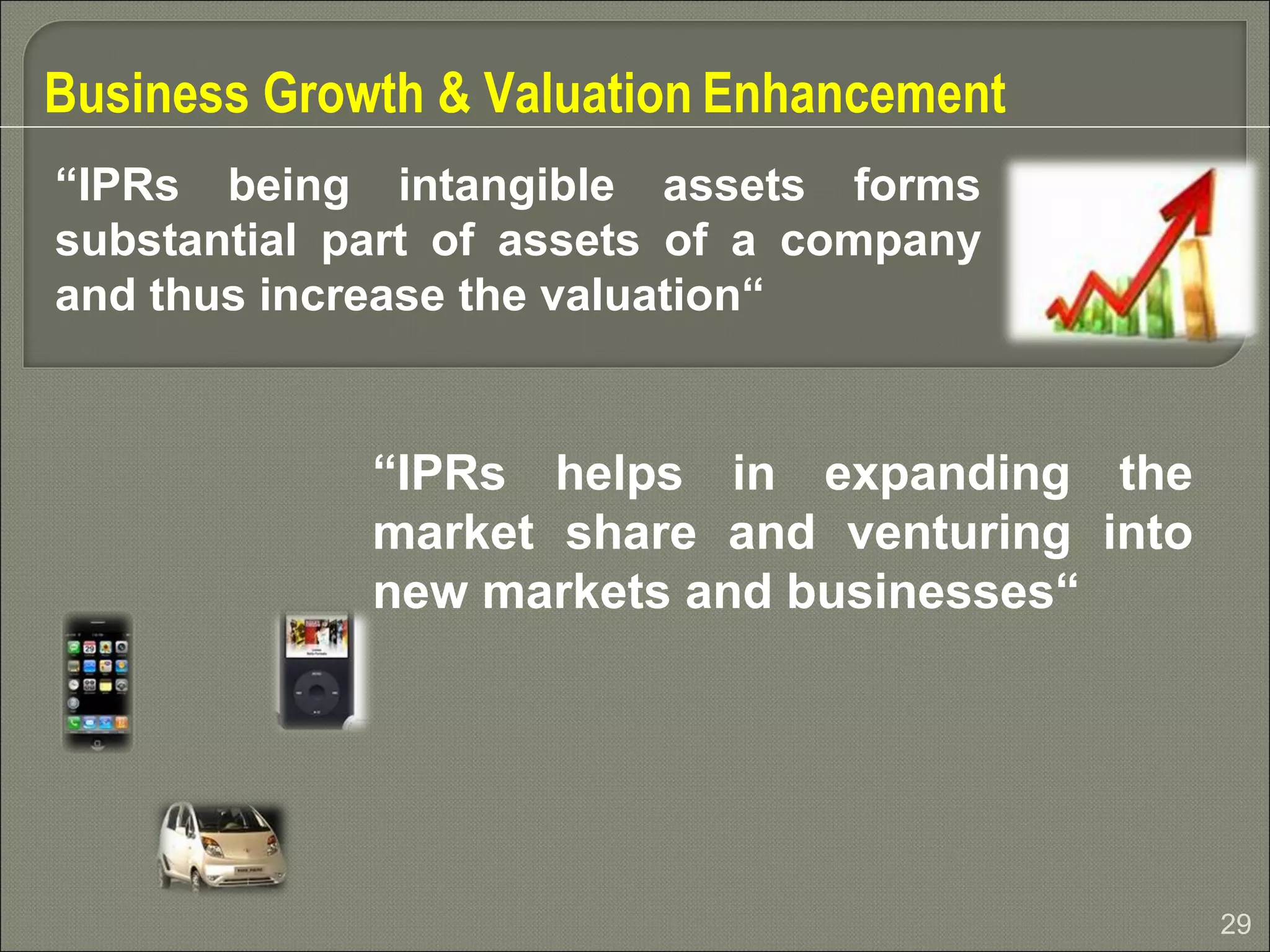
Business Growth & Valuation Enhancement
“IPRs being intangible assets forms
substantial part of assets of a company
and thus increase the valuation“
“IPRs helps in expanding the
market share and venturing into
new markets and businesses“
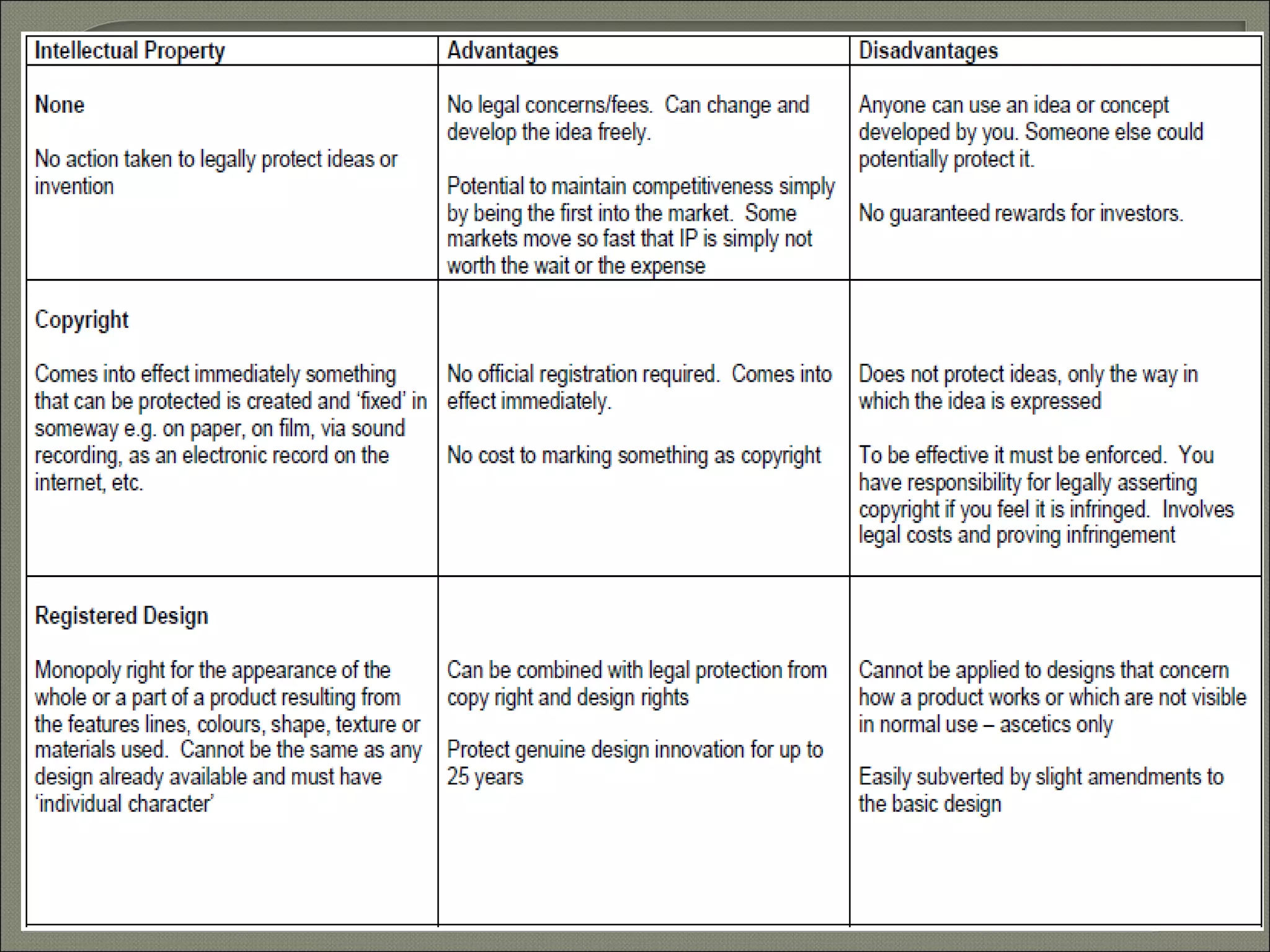
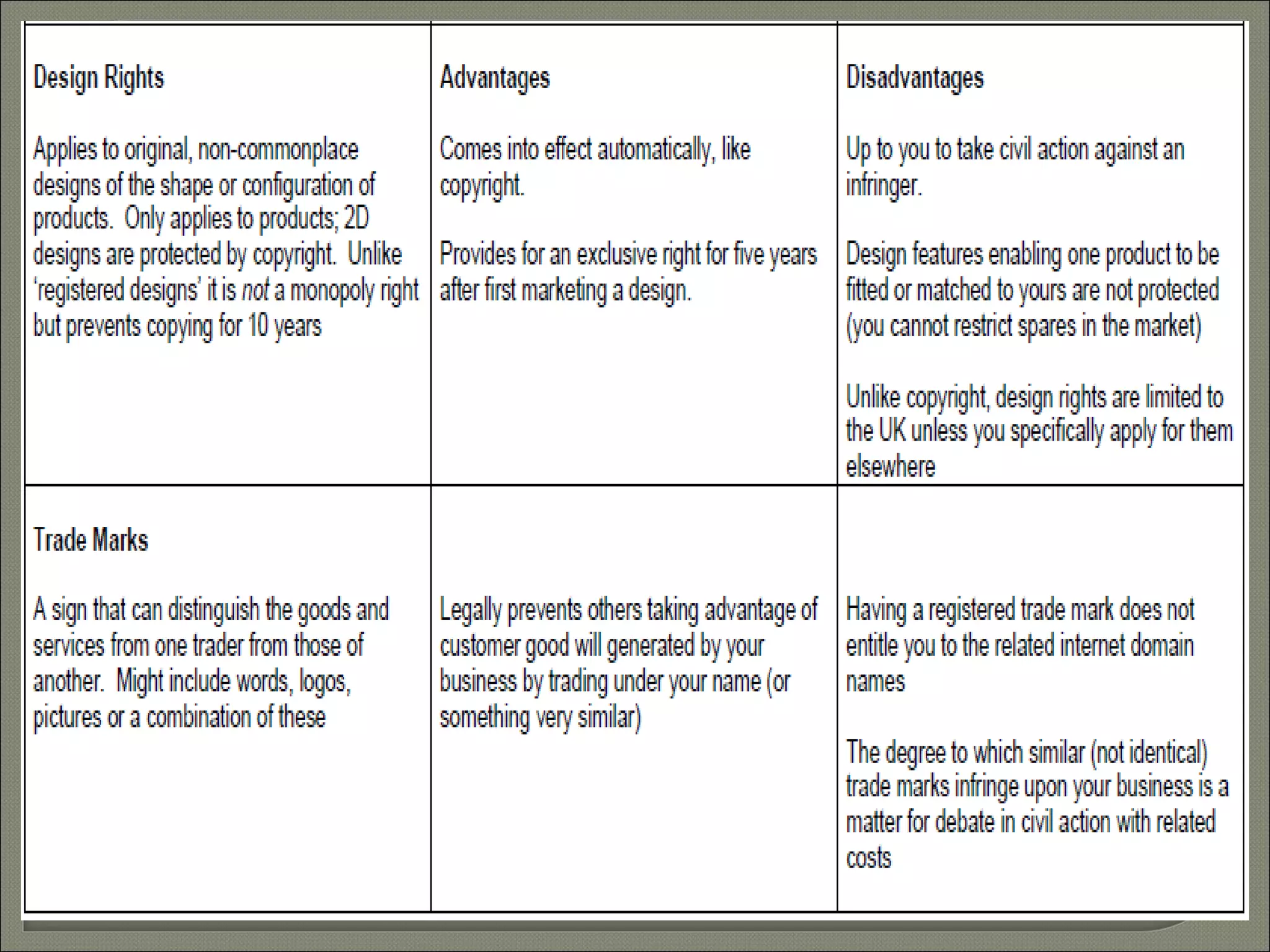
 Advantages and Disadvantages of IPR
intellectual prperty right

intellectual prperty right

  • 1.
  • 2.
    “Exclusive rights grantedby the State for inventions, new and original designs, trademarks, new plant varieties and artistic and literary works”. © ®™ Intellectual Property Rights
  • 3.
    The right toprevent others from • using • manufacturing • distributing  products  processes  applications  trade names  geographical names  ideas  designs Industrial Property Rights
  • 4.
    Intellectual Property Rights Patents  Trade marks  Geographical denominations  Industrial designs  Copyright
  • 5.
     "Copyright" isa protection that covers published and unpublished literary, scientific, and artistic works, whatever the form of expression, provided such works are fixed in a tangible or material form.  This means that if you can see it, hear it, and/or touch it-- it is protected.
  • 6.
     Anything tangible– in a fixed form  Examples  Literary works, including software  Musical works, including accompanying words  Dramatic works, including accompanying music  Pantomimes and choreographic works  Pictorial, graphic and sculptural works  Motion pictures and other audiovisual works  Sound recordings  Architectural works
  • 7.
     Works thathave not been fixed in a tangible form of expression; for example, improvisational speeches or performances that have not been written or recorded.  Titles, names, short phrases and slogans; familiar symbols or designs; variations of typographic ornamentation, lettering or coloring; listing of ingredients or contents.  Ideal procedures, methods, systems , processes, concepts, principles, discoveries, or devices, as distinguished from a description, explanation or illustration.
  • 8.
     Everything onthe Internet is copyrighted World Wide Web pages Courses Electronic mail, listservs and newsgroups  The same copyright laws apply to electronic materials as to print materials
  • 9.
    PATENT TRADE MARK Validityof protection when and where registered when and where registered Refers to products processes applications names, logo, shape, symbol, color, domain Criteria novelty, level of inventiveness no confusion, generic name EU registration EU patent office Munich, Germany OHIM Alicante Spain Website www.epo.org http://oami.euro pa.eu Duration 20 years, not renewable 6-10 years, renewable
  • 10.
    YEARS RENEWABLE Patents 20(6) No Trade marks 6-10 Yes Designs 6-10 Yes Copyright 70 after death No
  • 11.
  • 12.
    Registration of trademarks NATIONAL REGIONAL INTERNATIONAL FEES National fees for each country National fees for each country or EU fees One fee LANGUAGE Translation into national languages One language One language WHEN May be convenient if limited number of countries or no alternative For EU market If protection in more countries is needed.
  • 13.
    Not allowed /not valid • Violation of public order and morale • Copy of earlier registration (bad faith) • Withdrawal from register • Not in use ( 5 years) • Evolution into generic name • Formica, cellophane, compact disc
  • 14.
    Common mistakes • Believingthat trademark protection is universal • Using a trademark that is already registered or is being used by competitors in export market (Nike, Olympics 1992) • Using a trademark that conflicts with a protected geographical indication (South African winegrowers – “Champagne” • Leaving the ® sign on a product even when exported into a country where it has not yet been registered
  • 15.
    “The right toexclusively produce, use and/or market a • Product • Process • Application Patents
  • 16.
    Extremely complex becauseof its criteria, Result of too many funny/weird applications : • Novelty, not publicly known Boomerang • Product/process/application Aspirine • Industrial, not software: Copyright • Level of “inventiveness” Cashmere brush • Applicability Mars-shoes Patent legislation
  • 17.
    Registration of patents NATIONALREGIONAL WHERE Each country where you seek protection (through EPO website) or through national patent office in your country European Patent Office www.epo.org US Patent Office www.uspto.gov FEES National fees for each country National fees for each country excl. Benelux LANGUAGE Translation into national languages One language WHEN May be convenient if limited number of countries or no alternative For EU market For US market
  • 18.
     Patents • product,process, applications • Registration :difficult to prove “novelty” • limited duration  Trade mark • name, symbol, shape • Registration : do not create confusion • renewable  IPR: only protection when registered (excl. copyrights) In a nut shell
  • 19.
    19 Contents  Licensing ofIPRs  Royalty on Technology Transfer and IPRs  Holding of IPRs in tax efficient manner  Auction of IPRs  Role of IPRs in Venture Capital  Business Growth & Valuation Enhancement
  • 20.
     Copyright andFair Use Do you have the right to use other people’s material in your course?  Intellectual Property What happens to the intellectual material once you have posted it online? What can you do if material is used without authorization
  • 21.
    21 Licensing of IPRs Importantissues in software licensing •Define Licensor & Licensee •Software Description •Term of License •Expiry / Termination •Renewal •Upgradation •Single or Multi-user •Concurrent User •Network in which it is to be used
  • 22.
    22 Licensing of IPRs •Homeor Commercial use •Access to source code •Transferability •Division of Components of Software •Downloading & uploading •Sub-licensing •Operating Systems for software •Non Liability through wrong usage •Anti Piracy clause
  • 23.
    23 Licensing of IPRs •SoftwareAuditing •Remedies - damages / injunction / criminal liability •Liability & Obligation of Licensee •Territory •OEM unbundling •Royalty •Taxation •Repatriation
  • 24.
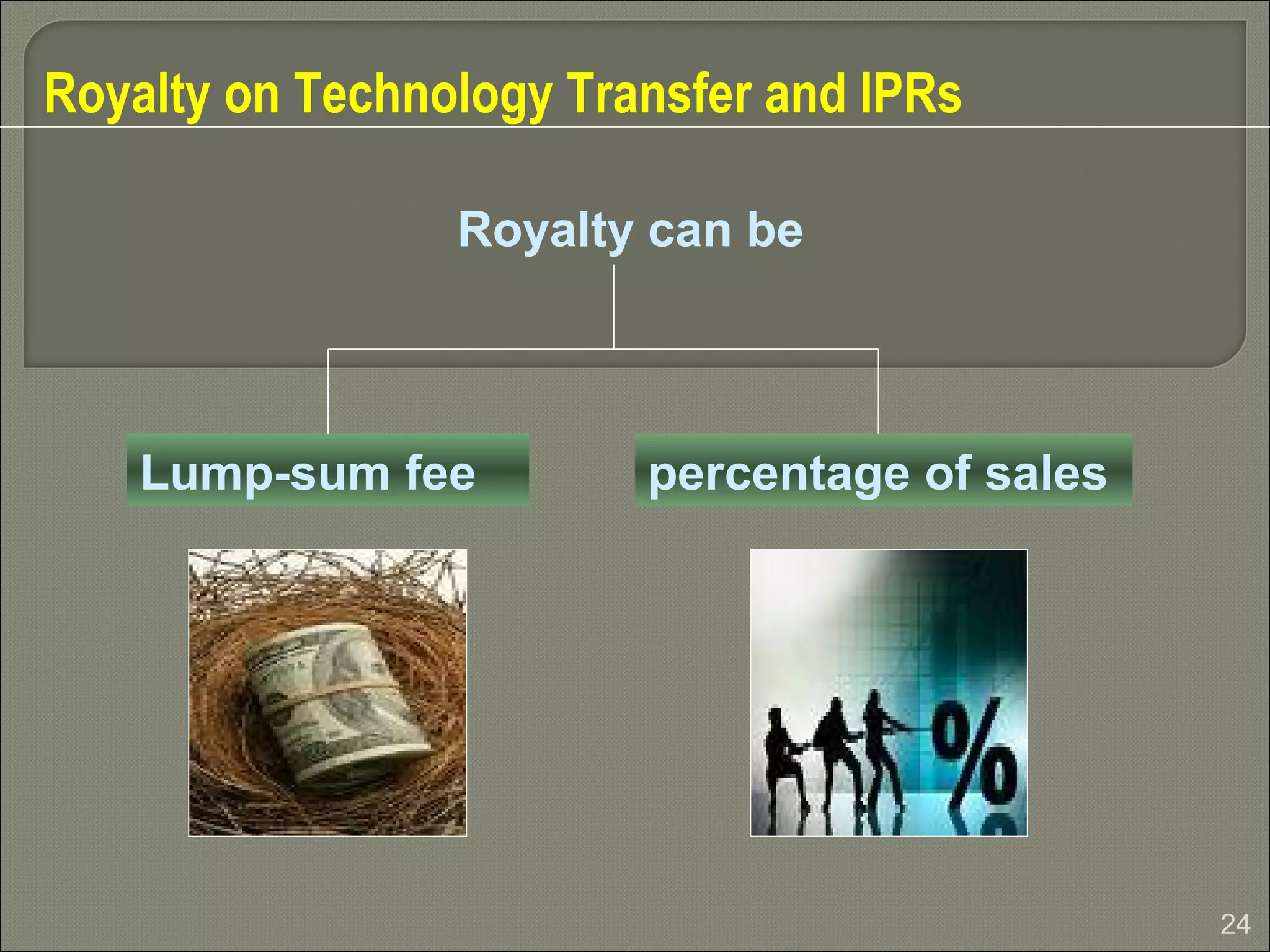
    24 Royalty on TechnologyTransfer and IPRs Royalty can be Lump-sum fee percentage of sales
  • 25.
    25 Royalty on TechnologyTransfer and IPRs Royalty for Technology (Patents) o Lump sum payments upto $ 2 mn o Upto 5% for domestic sales and 8% for exports, without any restriction on the duration of the royalty payments. Royalty for use of TM and brand can be paid upto 2% on exports and upto 1% on domestic sales.
  • 26.
    26 Royalty on TechnologyTransfer and IPRs o Define Technology and List of IPRs o Grant of License o Rights & Obligations of Licensee and Licensor o Exclusive / Non-exclusive o Transferability and Sub-licensing o Term o Revocability o Territory o Advertising & Promotion o Audit of accounts from outside agency o Royalty Payment and Calculation Issues in Technology Transfer
  • 27.
    27 Role of IPRsin Venture Capital Venture Capital (VC) has been major drivers of innovation, economic growth, knowledge base industry and start ups. VC industry follow the concept of “high risk high gain.” VC value intangible assets while making equity investments, which generally conventional sources of financing may not consider.
  • 28.
    28 Role of IPRsin Venture Capital Increases the valuation of the company Better IPR portfolio gives competitive edge in attracting VC
  • 29.
    29 Business Growth &Valuation Enhancement “IPRs being intangible assets forms substantial part of assets of a company and thus increase the valuation“ “IPRs helps in expanding the market share and venturing into new markets and businesses“
  • 30.
     Advantages andDisadvantages of IPR