INTRODUCTION TO
INTELLECTUAL PROPERTY
LEGAL ASPECTS OF PROCUREMENT AND
SUPPLY CHAIN MANAGEMENT-BPSM 3211
introduction
 Businesses often expend considerable
time and money developing ideas,
processes, designs and other
intangible assets that will enable them
to generate profits. As a result they
need to ensure that they reap the
benefits without disturbance from
others. The law provides protection to
such intellectual property.
Introduction cont’d
 Technological inventions may be
protected by the law relating to
patents.
 Products carrying a distinctive design
may be protected by the law relating
to registered designs
 The goodwill attached to a product or
logo used by a business may be
protected by the trade marks law .
Intellectual property rights
• Intellectual property is an intangible
property
• It has its unique features
• It is created by human intellect
• It cover ideas, inventions, literary
creations, unique names, models, logos,
industrial processes, computer software
programs etc.
• It can have a monetary value
• It can be owned, transferred, sold or
licensed to another person to use
Types of intellectual property
rights
 IP covers three main important areas:
◦ Patent Rights
◦ Copy Rights
◦ Trade and Service Marks
Patents
• Patent Rights
• An individual or organization that has invented a
new device or new process , may apply for a
patent to be granted.
• Patent rights are given for products or processes
of technological nature.
• To qualify for a patent, the idea must satisfy a
certain criteria;
• -it must be new
• e.g. New machine to pluck tea leaves, coconuts,
new engine developed to run on waste oil, new
drug to cure COVID -19, new process to improve
extraction of cinnamon oil.
Patents
 -it must be something that would not
be obvious to a large number of
people.
 Note:
 Inventions which are contrally to public
morality can not be patented e.g
human cloning.
 If an employee as a member of a
research department finds a new
invention while working for his
Rationale underlying patents
–To encourage inventors to publicize their
inventions upon a guarantee that
inventors are given an exclusive right to
use it for a specific period.
–A social contract where state grants a
monopoly for the inventor to profit from his
or her invention in return for making the
product available for general use and for
enabling further research and
development
Patents.
invention belongs to the employer
 If the employee finds the invention
during his spare time, the invention
belongs to him alone.
 involves an inventive step and
 is industrially applicable
Registration of patents
 To secure protection of an invention
,the owner applies to IPO for award of
a patent, so that the patent is
registered and listed along with the
date of the grant.
 The patent holder is given monopoly rights
in the commercial exploitation of the
invention. He may choose to license others
to participate in such an exploitation.
Validity of patents
◦ A patent is valid for 20 years after
the filing date of application at the
Patents Office
◦ After two years from the date of
grant, it must be renewed each year
until the expiration of the term of
patent.
Rights of the owner of patents
◦ Exclusive right to
Exploit the patented inventions
Assign the patent to another one
License the patent to another one
to use
Infringement on patent rights
 if a patent is registered in a country
and a competitor without permission
manufactures the patented product,
he infringes on the patent.
 a civil action may be brought to seek
an injunction to prevent further abuse
as well as damages on account of
profit.
 However an overseas investor can
manufacture the product without
Infringement on patent rights
Restriction, only that he cannot sell in
the country where it is patented.
 To protect against this, investors can
apply for the patent in other countries
as well e.g World Intellectual Property
Organization(WIPO).
 a person infringes on a patent if;
 -he makes, disposes of, uses or
imports a product covered by the
patent.
infringement
 -uses a product covered by the patent,
or offers it for use.
 -disposes of, offers to dispose of any
product obtained by means of the
patented process.
Design rights
 The term design refers to the features
of shape, pattern or ornament applied
to an article by an industrial process
 In case of registered design, these
features must be such as to appeal,
not merely functional features.
 Such a design must be registered.
 The owner of the design enjoys
protection for five years and this can
be
Design right
 extended in 5 –year periods to a
maximum of 25 years.
 Even if the design is unregistered, an
automatic design right attaches for a
period of 10 years from the end of the
year the article is first marketed or 15
years after it was first designed.
 During the last five years of this period, any
one can obtain license to make the article,
by paying loyalty to the owner.
Copy right
 The copy rights act gives protection to
any original literally, dramatic, musical
and artistic work that has not
previously been published.
 Copy right of the work is first invested
in the author, though in some cases it
may belong to the employer, where
the author is an employee.
Copy right
 The right to protection arises
automatically, no registration is
required
 For literally, dramatic and artistic
works, copyright expires 70 years from
the end of the calendar year in which
the author dies.
 The remedies for copyright
infringement are an injunction plus
damages on account of profits.
Enforcement of copyrights
◦ An injunction could be obtained from
court
◦ ( Commercial High Court) for
prohibiting the infringement and also
can claim damages
◦ Infringement of copyright is a crime
punishable by court.
Trade Marks and Service Marks
These are governed by Intellectual
Property Act
Definitions of Trade Marks and
Service Marks
A trademark is any visible sign
serving to distinguish the goods of
one enterprise from those of others
enterprises.
Trade marks
A service Mark is any visible sign to
distinguish the services of one
enterprise from those of other
enterprises
Trade marks are attached to products
and Service marks are attached to
services.
Other than that there is no practical
difference in both. Same principles of
Law are applicable for both.
trade mark
• Functions of a trade mark
–It serves to distinguish goods or
services of different enterprises .
–It indicates the source and quality of
the goods and services to the
consumer
–It enables the owners to individualize
the mark and promote the product to
consumers
–It allows the owner to improve the
Trade marks
• Exclusive right to a mark
• Upon proper registration one will get an
exclusive right to use the mark
• The law does not make registration
compulsory
• Even a non registered mark may seek
legal redress under other laws such as
unfair competition. Under Common law
“Passing off”( pretence of one person
that his goods are those of another).
• But it is always better to be registered
under WIPO to get better protection and
rights
Trade marks
• What constitutes a mark
• Any visible sign capable of
distinguishing goods or services of
different enterprise can generally
constitute a lawful mark. A mark may
consists of
–Arbitrary or fanciful designations
–Names
–Geographical names
–Slogans
–Letters
–Numbers
–Labels
–Combination or arrangements of
colours and shapes of goods or
containers etc.
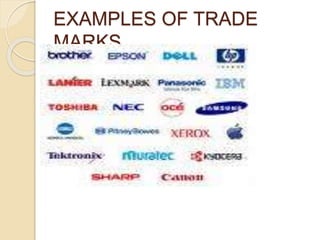
EXAMPLES OF TRADE
MARKS
 EXAMPLES OF TRADE MARKS
Trade marks
 Marks incapable of distinguishing
goods or services
A mark should always have a
distinctive character. If not it cannot
serve as a mode of distinguishing the
goods or services of different
enterprises..
Trade marks
 Immoral, scandalous and antisocial
marks
◦ Scandalous design
◦ -contrary to morality
◦ Offend racial or religious
susceptibilities
◦ e.g.. Ghandi Samba, a cross or a
Buddha’s image, a sign or image
considered by the general society as
vulgar may not be registered as of
Trade marks
 Misleading marks
◦ Mark will not be registered if it is likely to
mislead the public or the trade as to the
 Nature
 Source
 Manufacturing process
 Characteristics
 Suitability for the purpose of goods/services
concerned
• Names of individuals and enterprises
names can be registered subject to
certain rules but it should be of actual
persons living or an existing
organisation. ( a mark which doe not
represent in a special or particular
manner the name of an individual or
enterprise shall not be registered. )
Duration of registered mark
• Registration is valid for 10 years. On
the expiration of the period, it could be
renewed for further periods of 10
years
Registration
 Trade marks, Patents, Industrial designs
(other than copy rights) have to be
registered as per the IPO
 Once the application is filed, the trade Mark
, Patent or Industrial Design will be
gazetted. Objections can be made within 3
months to Director General Intellectual
Property
 If no objections are made it will be
registered.
 If objections are not made but found later by
the original owner still he can go to court for
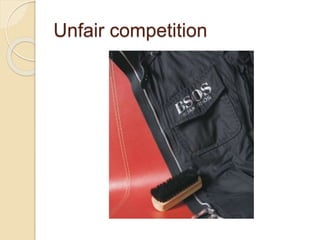
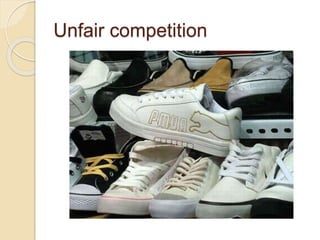
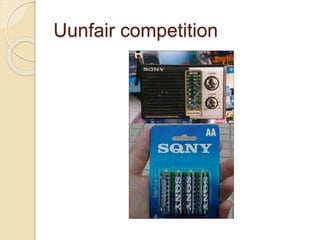
Unfair competition
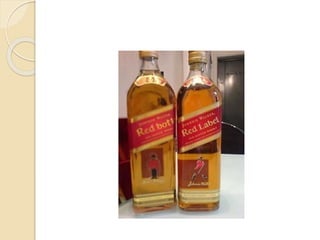
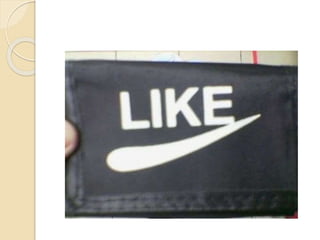
 Any act or practice carried or engaged
in, in the course of industrial or
commercial activities, that causes, or
is likely to cause, confusion with
respect to another’s enterprise or its
activities, in particular, the products or
services offered by such enterprise,
shall constitute an act of unfair
competition.
Unfair competition
Unfair competition
Unfair competition
Uunfair competition
THE LAW OF PASSING FF
 in case of an un authorized use or
exploitation of an unregistered trade
mark, the main recourse for the
business is to bring an action for
passing off.
 passing off refers to an action of a
person or organization that deceives
the public by deliberately causing
confusion with another(usually much
better known) person or organization)
Passing off
 Passing off can only be established
where the public would be deceived
into believing that they were buying
from one source when in fact they
were buying from another.
 to succeed in a passing off action ,it is
necessary to show that the goods you
seek to protect are known to the
public.
Passing off
 The remedies for passing off are an
injunction and damages
Intellectual property crime
 Infringement of TM and copy rights
can be a criminal offense as well as
actionable in civil law.
 IPC essentially involves counterfeiting
and piracy of goods. counterfeiting is
defined as the manufacture,
importation distribution and sale of
products which falsely carry the TM of
a genuine brand.
Intellectual property crime
 Piracy includes coping, distribution
and importation of copy righted works.
 Common pirated and infringed works
include; digital media(software and
games), music fashion ware and foot
ware.
 Advance in technology has made it
easier to mass produce fake goods,
undistinguishable from the real goods.
Intellectual property crime.
 Counterfeit has a negative impact on
consumers and business consumers
are at risk of poor quality or unsafe
goods such as fake pharmaceuticals.
 Businesses suffer economic harm
through loss of sales which can lead o
job losses and reputation damage.
 There are also extra costs for law
enforcement and loss of tax revenue.
Protection of confidentiality and
trade secrets
 Certain info is protected as
confidential if it has the necessary
quality of confidence about it.
 It should be of some gravity not ‘tittle
tattle’
 It is protected by common law, equity
and breach of contract.
 Confidential information are personal
secrets, commercial records, trade
secrets
 Government secrets and ideas:
Ackroyds Ltd vs Islington Plastics ltd
(1962).
 With regard to ideas, for a breach of
confidence to be successful, the
claimant must prove a number of
things, that the idea:
 -contains some significant element of
originality.
 -is clearly identifiable with the
confidentiality
 Is of potential commercial
attractiveness.
 Is sufficiently well developed as to be
capable of actual realization.
 An employee owes a duty of faithful
service to the employer and the
employer may rely on that duty to
protect trade secrets.
 To succeed in an action for disclosure
of confidential information , the
confidentiality
 Must show that the information
abused by the employee was
confidential and given to him in a
situation suggesting confidentiality and
there has been actual or threatened
disclosure.
 Important tests were laid down in the
case of Thomas Marshall vs Guinle:
 -the owner must believe that the
information is confidential or secret.
confidentiality
 The information must be such that the
owner believes that its release would
be injurious to him or of advantage to
his rivals.
 The owners belief under the above
two headings must be reasonable.
 The information must be judged in the
light of the usages and practices of the
particular industry concerned.
confidentiality
 The law distinguishes between
confidential information and general
knowledge acquired in the course of
employment.
 Confidentiality/non disclosure
clauses
 confidentiality clauses are designed to
protect either party ,in cases where
they need to give the other party
access
confidentiality
 to information about their operations
in course of the contract.
 In contracts where the buyer needs to
give the seller access to information
regarding its operations, it is advisable
for the buyer to have an express term
in the contract relating to
confidentiality.
 In contracts of services, the clause on
confidentiality is more wide and
confidentiality
 Include references to the seller’s
obligation under data protection act,
particularly where the supplier will be
processing personal data e.g an
outsourced payroll service.
 Where the main contract lacks
appropriate confidentiality clause, the
party may be required to sign a
separate non –disclosure
agreement(NDA)
confidentiality
 This is particularly important in fields
such as research, design and
development.
 the information should not be made
public before an application for a
patent is made, because this means
that it cannot be patented.
 NDA is a written agreement regarding
the conditions under which a party
may disclose info or ideas in
Non-disclosure agreement
 A duty to keep information confident
can arise in absence of NDA, but
without a written agreement the IP
owner may not be able to prove that
the person to whom he disclosed the
information has a legally binding duty
to keep it confident.
 The NDA may be mutual where both
parties are disclosing information to
each other in the course of dealings or
confidentiality
 unilateral where there is a one way
NDA.
 it may have to be executed as a deed
in order to make it enforceable.
QUESTIONS
1.What criteria must be satisfied before a product or
process may be patented.
2(a) Describe what a patent is.
 (b) Analyse four attributes of a patentable invention
3. Distinguish beteween background and foreground
intellectual property
(b) What is meany by intellectual property crime?
(c) What happens if an employee finds a new invention in
the course of his employment.

CHAPTER 7 intellectual property law.pptx

  • 1.
    INTRODUCTION TO INTELLECTUAL PROPERTY LEGALASPECTS OF PROCUREMENT AND SUPPLY CHAIN MANAGEMENT-BPSM 3211
  • 2.
    introduction  Businesses oftenexpend considerable time and money developing ideas, processes, designs and other intangible assets that will enable them to generate profits. As a result they need to ensure that they reap the benefits without disturbance from others. The law provides protection to such intellectual property.
  • 3.
    Introduction cont’d  Technologicalinventions may be protected by the law relating to patents.  Products carrying a distinctive design may be protected by the law relating to registered designs  The goodwill attached to a product or logo used by a business may be protected by the trade marks law .
  • 4.
    Intellectual property rights •Intellectual property is an intangible property • It has its unique features • It is created by human intellect • It cover ideas, inventions, literary creations, unique names, models, logos, industrial processes, computer software programs etc. • It can have a monetary value • It can be owned, transferred, sold or licensed to another person to use
  • 5.
    Types of intellectualproperty rights  IP covers three main important areas: ◦ Patent Rights ◦ Copy Rights ◦ Trade and Service Marks
  • 6.
    Patents • Patent Rights •An individual or organization that has invented a new device or new process , may apply for a patent to be granted. • Patent rights are given for products or processes of technological nature. • To qualify for a patent, the idea must satisfy a certain criteria; • -it must be new • e.g. New machine to pluck tea leaves, coconuts, new engine developed to run on waste oil, new drug to cure COVID -19, new process to improve extraction of cinnamon oil.
  • 7.
    Patents  -it mustbe something that would not be obvious to a large number of people.  Note:  Inventions which are contrally to public morality can not be patented e.g human cloning.  If an employee as a member of a research department finds a new invention while working for his
  • 8.
    Rationale underlying patents –Toencourage inventors to publicize their inventions upon a guarantee that inventors are given an exclusive right to use it for a specific period. –A social contract where state grants a monopoly for the inventor to profit from his or her invention in return for making the product available for general use and for enabling further research and development
  • 9.
    Patents. invention belongs tothe employer  If the employee finds the invention during his spare time, the invention belongs to him alone.  involves an inventive step and  is industrially applicable
  • 10.
    Registration of patents To secure protection of an invention ,the owner applies to IPO for award of a patent, so that the patent is registered and listed along with the date of the grant.  The patent holder is given monopoly rights in the commercial exploitation of the invention. He may choose to license others to participate in such an exploitation.
  • 11.
    Validity of patents ◦A patent is valid for 20 years after the filing date of application at the Patents Office ◦ After two years from the date of grant, it must be renewed each year until the expiration of the term of patent.
  • 12.
    Rights of theowner of patents ◦ Exclusive right to Exploit the patented inventions Assign the patent to another one License the patent to another one to use
  • 13.
    Infringement on patentrights  if a patent is registered in a country and a competitor without permission manufactures the patented product, he infringes on the patent.  a civil action may be brought to seek an injunction to prevent further abuse as well as damages on account of profit.  However an overseas investor can manufacture the product without
  • 14.
    Infringement on patentrights Restriction, only that he cannot sell in the country where it is patented.  To protect against this, investors can apply for the patent in other countries as well e.g World Intellectual Property Organization(WIPO).  a person infringes on a patent if;  -he makes, disposes of, uses or imports a product covered by the patent.
  • 15.
    infringement  -uses aproduct covered by the patent, or offers it for use.  -disposes of, offers to dispose of any product obtained by means of the patented process.
  • 16.
    Design rights  Theterm design refers to the features of shape, pattern or ornament applied to an article by an industrial process  In case of registered design, these features must be such as to appeal, not merely functional features.  Such a design must be registered.  The owner of the design enjoys protection for five years and this can be
  • 17.
    Design right  extendedin 5 –year periods to a maximum of 25 years.  Even if the design is unregistered, an automatic design right attaches for a period of 10 years from the end of the year the article is first marketed or 15 years after it was first designed.  During the last five years of this period, any one can obtain license to make the article, by paying loyalty to the owner.
  • 18.
    Copy right  Thecopy rights act gives protection to any original literally, dramatic, musical and artistic work that has not previously been published.  Copy right of the work is first invested in the author, though in some cases it may belong to the employer, where the author is an employee.
  • 19.
    Copy right  Theright to protection arises automatically, no registration is required  For literally, dramatic and artistic works, copyright expires 70 years from the end of the calendar year in which the author dies.  The remedies for copyright infringement are an injunction plus damages on account of profits.
  • 20.
    Enforcement of copyrights ◦An injunction could be obtained from court ◦ ( Commercial High Court) for prohibiting the infringement and also can claim damages ◦ Infringement of copyright is a crime punishable by court.
  • 21.
    Trade Marks andService Marks These are governed by Intellectual Property Act Definitions of Trade Marks and Service Marks A trademark is any visible sign serving to distinguish the goods of one enterprise from those of others enterprises.
  • 22.
    Trade marks A serviceMark is any visible sign to distinguish the services of one enterprise from those of other enterprises Trade marks are attached to products and Service marks are attached to services. Other than that there is no practical difference in both. Same principles of Law are applicable for both.
  • 23.
    trade mark • Functionsof a trade mark –It serves to distinguish goods or services of different enterprises . –It indicates the source and quality of the goods and services to the consumer –It enables the owners to individualize the mark and promote the product to consumers –It allows the owner to improve the
  • 24.
    Trade marks • Exclusiveright to a mark • Upon proper registration one will get an exclusive right to use the mark • The law does not make registration compulsory • Even a non registered mark may seek legal redress under other laws such as unfair competition. Under Common law “Passing off”( pretence of one person that his goods are those of another). • But it is always better to be registered under WIPO to get better protection and rights
  • 25.
    Trade marks • Whatconstitutes a mark • Any visible sign capable of distinguishing goods or services of different enterprise can generally constitute a lawful mark. A mark may consists of –Arbitrary or fanciful designations –Names –Geographical names –Slogans
  • 26.
    –Letters –Numbers –Labels –Combination or arrangementsof colours and shapes of goods or containers etc.
  • 27.
  • 28.
     EXAMPLES OFTRADE MARKS
  • 29.
    Trade marks  Marksincapable of distinguishing goods or services A mark should always have a distinctive character. If not it cannot serve as a mode of distinguishing the goods or services of different enterprises..
  • 30.
    Trade marks  Immoral,scandalous and antisocial marks ◦ Scandalous design ◦ -contrary to morality ◦ Offend racial or religious susceptibilities ◦ e.g.. Ghandi Samba, a cross or a Buddha’s image, a sign or image considered by the general society as vulgar may not be registered as of
  • 31.
    Trade marks  Misleadingmarks ◦ Mark will not be registered if it is likely to mislead the public or the trade as to the  Nature  Source  Manufacturing process  Characteristics  Suitability for the purpose of goods/services concerned
  • 32.
    • Names ofindividuals and enterprises names can be registered subject to certain rules but it should be of actual persons living or an existing organisation. ( a mark which doe not represent in a special or particular manner the name of an individual or enterprise shall not be registered. )
  • 33.
    Duration of registeredmark • Registration is valid for 10 years. On the expiration of the period, it could be renewed for further periods of 10 years
  • 34.
    Registration  Trade marks,Patents, Industrial designs (other than copy rights) have to be registered as per the IPO  Once the application is filed, the trade Mark , Patent or Industrial Design will be gazetted. Objections can be made within 3 months to Director General Intellectual Property  If no objections are made it will be registered.  If objections are not made but found later by the original owner still he can go to court for
  • 35.
    Unfair competition  Anyact or practice carried or engaged in, in the course of industrial or commercial activities, that causes, or is likely to cause, confusion with respect to another’s enterprise or its activities, in particular, the products or services offered by such enterprise, shall constitute an act of unfair competition.
  • 36.
  • 37.
  • 38.
  • 39.
  • 43.
    THE LAW OFPASSING FF  in case of an un authorized use or exploitation of an unregistered trade mark, the main recourse for the business is to bring an action for passing off.  passing off refers to an action of a person or organization that deceives the public by deliberately causing confusion with another(usually much better known) person or organization)
  • 44.
    Passing off  Passingoff can only be established where the public would be deceived into believing that they were buying from one source when in fact they were buying from another.  to succeed in a passing off action ,it is necessary to show that the goods you seek to protect are known to the public.
  • 45.
    Passing off  Theremedies for passing off are an injunction and damages
  • 46.
    Intellectual property crime Infringement of TM and copy rights can be a criminal offense as well as actionable in civil law.  IPC essentially involves counterfeiting and piracy of goods. counterfeiting is defined as the manufacture, importation distribution and sale of products which falsely carry the TM of a genuine brand.
  • 47.
    Intellectual property crime Piracy includes coping, distribution and importation of copy righted works.  Common pirated and infringed works include; digital media(software and games), music fashion ware and foot ware.  Advance in technology has made it easier to mass produce fake goods, undistinguishable from the real goods.
  • 48.
    Intellectual property crime. Counterfeit has a negative impact on consumers and business consumers are at risk of poor quality or unsafe goods such as fake pharmaceuticals.  Businesses suffer economic harm through loss of sales which can lead o job losses and reputation damage.  There are also extra costs for law enforcement and loss of tax revenue.
  • 49.
    Protection of confidentialityand trade secrets  Certain info is protected as confidential if it has the necessary quality of confidence about it.  It should be of some gravity not ‘tittle tattle’  It is protected by common law, equity and breach of contract.  Confidential information are personal secrets, commercial records, trade secrets
  • 50.
     Government secretsand ideas: Ackroyds Ltd vs Islington Plastics ltd (1962).  With regard to ideas, for a breach of confidence to be successful, the claimant must prove a number of things, that the idea:  -contains some significant element of originality.  -is clearly identifiable with the
  • 51.
    confidentiality  Is ofpotential commercial attractiveness.  Is sufficiently well developed as to be capable of actual realization.  An employee owes a duty of faithful service to the employer and the employer may rely on that duty to protect trade secrets.  To succeed in an action for disclosure of confidential information , the
  • 52.
    confidentiality  Must showthat the information abused by the employee was confidential and given to him in a situation suggesting confidentiality and there has been actual or threatened disclosure.  Important tests were laid down in the case of Thomas Marshall vs Guinle:  -the owner must believe that the information is confidential or secret.
  • 53.
    confidentiality  The informationmust be such that the owner believes that its release would be injurious to him or of advantage to his rivals.  The owners belief under the above two headings must be reasonable.  The information must be judged in the light of the usages and practices of the particular industry concerned.
  • 54.
    confidentiality  The lawdistinguishes between confidential information and general knowledge acquired in the course of employment.  Confidentiality/non disclosure clauses  confidentiality clauses are designed to protect either party ,in cases where they need to give the other party access
  • 55.
    confidentiality  to informationabout their operations in course of the contract.  In contracts where the buyer needs to give the seller access to information regarding its operations, it is advisable for the buyer to have an express term in the contract relating to confidentiality.  In contracts of services, the clause on confidentiality is more wide and
  • 56.
    confidentiality  Include referencesto the seller’s obligation under data protection act, particularly where the supplier will be processing personal data e.g an outsourced payroll service.  Where the main contract lacks appropriate confidentiality clause, the party may be required to sign a separate non –disclosure agreement(NDA)
  • 57.
    confidentiality  This isparticularly important in fields such as research, design and development.  the information should not be made public before an application for a patent is made, because this means that it cannot be patented.  NDA is a written agreement regarding the conditions under which a party may disclose info or ideas in
  • 58.
    Non-disclosure agreement  Aduty to keep information confident can arise in absence of NDA, but without a written agreement the IP owner may not be able to prove that the person to whom he disclosed the information has a legally binding duty to keep it confident.  The NDA may be mutual where both parties are disclosing information to each other in the course of dealings or
  • 59.
    confidentiality  unilateral wherethere is a one way NDA.  it may have to be executed as a deed in order to make it enforceable.
  • 60.
    QUESTIONS 1.What criteria mustbe satisfied before a product or process may be patented. 2(a) Describe what a patent is.  (b) Analyse four attributes of a patentable invention 3. Distinguish beteween background and foreground intellectual property (b) What is meany by intellectual property crime? (c) What happens if an employee finds a new invention in the course of his employment.