We are aprofessional training institute with an extensive
portfolio of professional certification courses. Our training
programs are meant for those who want to expand their
horizons by acquiring professional certifications across
the spectrum. We train small- and medium-sized
organizations all around the world, including in USA,
Canada, Australia, Europe, Middle-East and Africa.
About Unichrone
Guaranteed Quality Handpicked
Trainers
Global Presence Online Training
Option
We’ve trained professionals across
global companies
Course Syllabus
• Module1: Intellectual Property Introduction
• Module 2: Patents
• Module 3: Confidential Information and Nondisclosure Agreements
• Module 4: Licensing Agreements and IP Licensing Contract Issues
• Module 5: Copyright and Database Right
• Module 6: Other IP Rights
Intellectual Property Introduction
Intellectual property refers to the legal rights granted to individuals or entities for
the ownership and use of their creative and innovative works, such as inventions,
literary and artistic works, designs, symbols, and images.
The primary purpose of intellectual property is to protect the creator's exclusive
rights to their work and prevent others from using it without permission or
compensation.
Intellectual property laws provide a framework for creators to benefit from their
creations by allowing them to license, sell or assign their works to others for
financial gain.
The importance of intellectual property cannot be overstated, as it promotes
innovation, creativity, and economic growth.
It provides an incentive for creators to invest their time, energy, and resources
into developing new and better products, technologies, and services, and helps
ensure that they can profit from their efforts.
7.
Patents
Patents aregranted for inventions that are new, non-obvious, and useful.
This means that the invention must not have been publicly disclosed or available
to the public before the filing of the patent application.
The invention must also be non-obvious, meaning that it cannot be an obvious
improvement on an existing invention or combination of known elements.
Finally, the invention must be useful, meaning that it must have some practical
application or utility.
To obtain a patent, the inventor must file a patent application with the relevant
patent office, which will review the application to determine if the invention meets
the legal requirements for patentability.
The application must include a detailed description of the invention, as well as any
drawings or other supporting materials.
8.
Patents
(Continued)
If thepatent office determines that the invention is patentable, it will grant a
patent to the inventor, providing them with the exclusive right to use and profit
from their invention for the patent term.
This exclusive right allows the inventor to prevent others from making, using, or
selling the invention without their permission.
Patents are important for promoting innovation and encouraging investment in
research and development.
By providing inventors with exclusive rights to their inventions, patents incentivise
them to invest time and resources into creating new and useful products and
technologies.
In turn, this can lead to economic growth and the creation of new industries and
jobs.
9.
Trademarks
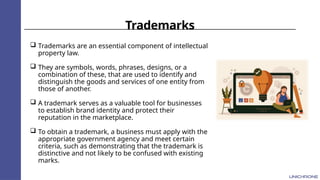
Trademarks arean essential component of intellectual
property law.
They are symbols, words, phrases, designs, or a
combination of these, that are used to identify and
distinguish the goods and services of one entity from
those of another.
A trademark serves as a valuable tool for businesses
to establish brand identity and protect their
reputation in the marketplace.
To obtain a trademark, a business must apply with the
appropriate government agency and meet certain
criteria, such as demonstrating that the trademark is
distinctive and not likely to be confused with existing
marks.
10.
Trademarks
(Continued)
Once atrademark is registered, the owner has the
exclusive right to use the mark in connection with
their goods and services and can take legal action
against others who use a similar mark in a way
that could confuse consumers.
Trademark law also includes provisions for the
enforcement of trademarks and the remedies
available to owners whose marks have been
infringed upon.
These remedies may include injunctive relief,
damages, and in some cases, criminal penalties.
11.
Designs
Designs arean important aspect of intellectual
property law, particularly in industries such as
fashion, furniture, and industrial design.
A design refers to the appearance of a product, such
as its shape, colour, texture, and ornamentation.
In many jurisdictions, designers can protect their
designs through design registration.
This involves filing an application with the
appropriate government agency and demonstrating
that the design is new and distinctive.
12.
Designs
(Continued)
Design protectionis important because it allows
designers to prevent competitors from
exploiting their creations, which can help them
to build and maintain a reputation for quality
and innovation in the marketplace.
It can also encourage investment in the design
industry and support economic growth.
13.
Copyright
Copyright lawis concerned with safeguarding and exploiting creative expression
in tangible form, and has evolved over centuries to adapt to changing ideas and
technologies.
Today, it not only provides legal protection for individual creators, but also
supports the publication of works by major cultural industries such as film,
broadcasting, and software development.
Copyright protection covers various types of works, including literary, dramatic,
musical, and artistic works, as well as cinematic films and sound recordings.
For a work to be eligible for copyright protection, it must be expressed in an
original form.
Copyright law recognises the economic and moral rights of the copyright owner,
and allows for fair use of copyrighted material by others without permission.
Through the doctrine of fair use, copyright law seeks to balance the interests of
copyright owners with the public's right to access and use creative works.
14.
Interaction Between Rights
Intellectual property law encompasses a range of different rights, including
copyrights, patents, trademarks, and designs, each of which serves a distinct
purpose in protecting different types of intellectual creations.
However, there are situations where these different rights may overlap or conflict
with each other, requiring careful consideration of their interaction.
For example, a patent may protect an invention, but that invention may also be
subject to copyright protection if it involves an original creative expression.
Similarly, a trademark may overlap with a design if the design is used as a logo or
brand identifier.
In cases where there is a conflict or overlap between different intellectual
property rights, the courts will have to weigh the interests of the different parties
involved and determine which right should take precedence.
This can be a complex and contentious process, requiring a careful analysis of the
specific facts and legal precedents involved.
15.
Ensuring Full Valueand Dispute
Avoidance
Ensuring the full value of intellectual property and avoiding disputes are essential
aspects of intellectual property law.
Intellectual property rights provide creators with the legal means to protect and
monetise their creations, and the efficient management of those rights can help
to maximise their value.
One way to ensure the full value of intellectual property is through effective
licensing agreements.
Licensing agreements allow creators to grant others the right to use their
intellectual property in exchange for compensation while retaining ownership of
the intellectual property.
Effective licensing agreements can help to prevent the unauthorised use of
intellectual property and maximise its commercial potential.
Registered Patents forUK and Abroad
Interventions
Patents are a crucial aspect of intellectual property law, providing inventors with
exclusive rights to exploit their inventions commercially.
In the UK, patents are registered through the Intellectual Property Office (IPO),
which grants the inventor the exclusive right to prevent others from
manufacturing, selling, or importing their invention without permission for a
limited time.
To register a patent in the UK, inventors must apply for the IPO, which will then
examine the application to determine whether the invention meets the criteria for
patentability.
This includes ensuring that the invention is new, non-obvious, and capable of
industrial application.
In addition to UK patents, inventors may also choose to seek patent protection
abroad.
18.
Registered Patents forUK and Abroad
Interventions
(Continued)
This can be done by filing an international patent application under the Patent
Cooperation Treaty (PCT), which provides a unified system for filing patent
applications in multiple countries.
Alternatively, inventors can file individual patent applications in the countries
where they wish to seek protection.
Seeking patent protection abroad can be complex and costly, and may require the
assistance of specialist patent attorneys.
However, it can also be essential for inventors seeking to exploit their inventions
on a global scale and prevent competitors from copying their technology.
19.
What do PatentsProtect?
Patents are a crucial aspect of intellectual property law, providing inventors with
exclusive rights to exploit their inventions commercially.
Patents protect a wide range of innovations, including physical devices,
machinery, chemical compounds, software algorithms, and business methods.
To be eligible for patent protection, an invention must meet certain criteria,
including novelty, non-obviousness, and industrial applicability.
Novelty means that the invention must be new and not previously disclosed to the
public. Non-obviousness means that the invention must not be obvious to
someone skilled in the relevant field.
Industrial applicability means that the invention must be capable of being made
or used in an industry.
20.
What do PatentsProtect?
(Continued)
Patent protection provides inventors with the exclusive right to prevent others
from manufacturing, using, selling, or importing their inventions without
permission for a limited time. In the UK, this period is usually 20 years from the
date of filing the patent application.
This exclusive right enables inventors to profit from their inventions and prevent
competitors from exploiting their technology without permission.
In addition to providing exclusive rights to inventors, patents also play an
important role in promoting innovation and economic growth.
By providing inventors with an incentive to invest in research and development,
patents encourage the development of new and useful technologies that can
benefit society as a whole.
21.
Patenting Cost andValue
Patenting an invention can be a complex and costly process.
In addition to legal fees and other expenses associated with preparing and filing a
patent application, inventors must also conduct a thorough search of existing
patents and publications to ensure that their invention is novel and non-obvious.
The cost of obtaining a patent can vary depending on a variety of factors,
including the complexity of the invention, the jurisdiction in which the patent is
being sought, and the length of the patent application.
In some cases, the cost of obtaining a patent can be substantial, particularly for
complex inventions or those requiring international patent protection.
22.
Patenting Cost andValue
(Continued)
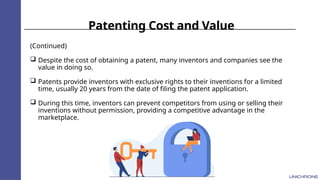
Despite the cost of obtaining a patent, many inventors and companies see the
value in doing so.
Patents provide inventors with exclusive rights to their inventions for a limited
time, usually 20 years from the date of filing the patent application.
During this time, inventors can prevent competitors from using or selling their
inventions without permission, providing a competitive advantage in the
marketplace.
23.
When to Applyfor Patents
Deciding when to apply for a patent can be a crucial strategic decision for
inventors and companies. In general, it is advisable to apply for a patent as
soon as possible after the invention has been developed and before any
public disclosure or commercialisation of the invention. Public disclosure of
an invention before a patent application is filed can jeopardise the novelty
and non-obviousness requirements for patentability, as well as trigger a
statutory bar that can prevent the inventor from obtaining a patent in
certain jurisdictions. As a result, it is generally recommended that inventors
and companies keep their inventions confidential until a patent application
has been filed. Another important factor to consider when deciding when to
apply for a patent is the competitive landscape. If other inventors or
companies are developing similar inventions or filing patent applications for
similar technology, it may be advantageous to file a patent application as
soon as possible to secure exclusive rights to the invention.
24.
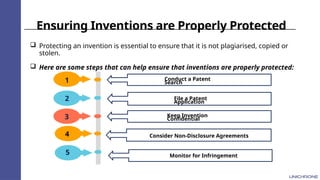
Ensuring Inventions areProperly Protected
Protecting an invention is essential to ensure that it is not plagiarised, copied or
stolen.
Here are some steps that can help ensure that inventions are properly protected:
1
2
3
Conduct a Patent
Search
File a Patent
Application
Keep Invention
Confidential
4
5
Consider Non-Disclosure Agreements
Monitor for Infringement
25.
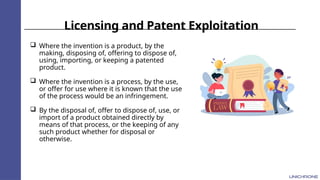
Licensing and PatentExploitation
Where the invention is a product, by the
making, disposing of, offering to dispose of,
using, importing, or keeping a patented
product.
Where the invention is a process, by the use,
or offer for use where it is known that the use
of the process would be an infringement.
By the disposal of, offer to dispose of, use, or
import of a product obtained directly by
means of that process, or the keeping of any
such product whether for disposal or
otherwise.
26.
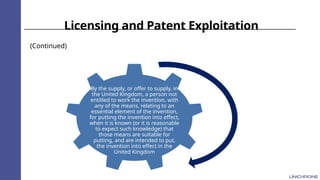
Licensing and PatentExploitation
(Continued)
By the supply, or offer to supply, in
the United Kingdom, a person not
entitled to work the invention, with
any of the means, relating to an
essential element of the invention,
for putting the invention into effect,
when it is known (or it is reasonable
to expect such knowledge) that
those means are suitable for
putting, and are intended to put,
the invention into effect in the
United Kingdom
Practical Guidance
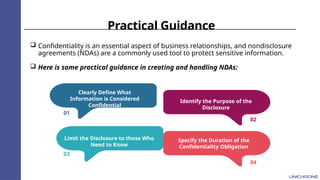
Confidentialityis an essential aspect of business relationships, and nondisclosure
agreements (NDAs) are a commonly used tool to protect sensitive information.
Here is some practical guidance in creating and handling NDAs:
01
03
02
04
Clearly Define What
Information is Considered
Confidential
Limit the Disclosure to those Who
Need to Know
Identify the Purpose of the
Disclosure
Specify the Duration of the
Confidentiality Obligation
29.
Practical Guidance
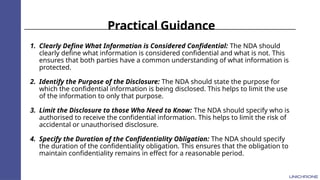
1. ClearlyDefine What Information is Considered Confidential: The NDA should
clearly define what information is considered confidential and what is not. This
ensures that both parties have a common understanding of what information is
protected.
2. Identify the Purpose of the Disclosure: The NDA should state the purpose for
which the confidential information is being disclosed. This helps to limit the use
of the information to only that purpose.
3. Limit the Disclosure to those Who Need to Know: The NDA should specify who is
authorised to receive the confidential information. This helps to limit the risk of
accidental or unauthorised disclosure.
4. Specify the Duration of the Confidentiality Obligation: The NDA should specify
the duration of the confidentiality obligation. This ensures that the obligation to
maintain confidentiality remains in effect for a reasonable period.
30.
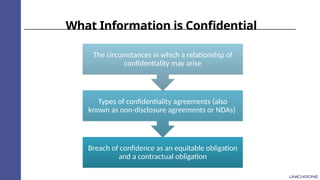
What Information isConfidential
Breach of confidence as an equitable obligation
and a contractual obligation
Types of confidentiality agreements (also
known as non-disclosure agreements or NDAs)
The circumstances in which a relationship of
confidentiality may arise
31.
What Information isConfidential
Confidential Information refers to any information,
data, or knowledge that is not generally known or
available to the public, and that has been identified as
confidential by one or both parties involved in a
business transaction.
This could include trade secrets, customer lists, financial
data, technical specifications, designs, patents,
copyrights, and other proprietary information that gives
a business a competitive advantage.
Nondisclosure agreements are contracts that protect
this type of confidential information from being
disclosed or shared with third parties without the
consent of the owner.
32.
Disclosure Risks
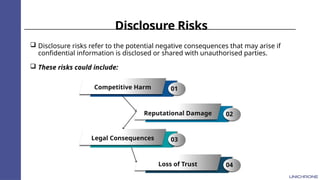
Disclosurerisks refer to the potential negative consequences that may arise if
confidential information is disclosed or shared with unauthorised parties.
These risks could include:
Competitive Harm
Reputational Damage
Legal Consequences
Loss of Trust
01
02
03
04
33.
Disclosure Risks
Ifconfidential information falls into the
hands of a competitor, they may use it to
gain an unfair advantage in the market,
harming the business that owns the
information.
Competitive
Harm 01
Disclosure Risks
Legal
Consequences
03
Ifconfidential information is disclosed in
violation of a nondisclosure agreement, legal
action may be taken against the person or
entity responsible for the disclosure. This
could result in costly lawsuits, fines, or other
legal penalties.
36.
Disclosure Risks
Loss ofTrust 04
When confidential information is disclosed
without authorisation, it can result in the loss
of trust between parties. The disclosure can
cause damage to the reputation of the
disclosing party, leading to a loss of business
and opportunities.
37.
NDA Enforcement
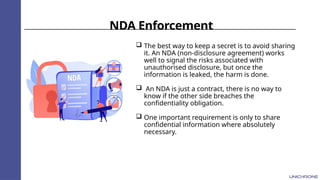
Thebest way to keep a secret is to avoid sharing
it. An NDA (non-disclosure agreement) works
well to signal the risks associated with
unauthorised disclosure, but once the
information is leaked, the harm is done.
An NDA is just a contract, there is no way to
know if the other side breaches the
confidentiality obligation.
One important requirement is only to share
confidential information where absolutely
necessary.
38.
Litigation Issues
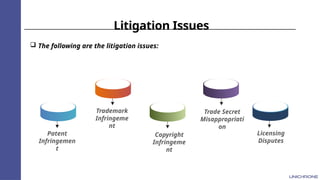
Thefollowing are the litigation issues:
Trade Secret
Misappropriati
on
Copyright
Infringeme
nt
Patent
Infringemen
t
Trademark
Infringeme
nt
Licensing
Disputes
NDA Effectiveness
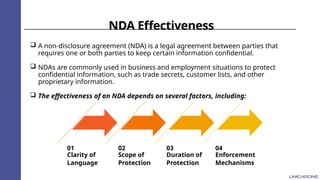
Anon-disclosure agreement (NDA) is a legal agreement between parties that
requires one or both parties to keep certain information confidential.
NDAs are commonly used in business and employment situations to protect
confidential information, such as trade secrets, customer lists, and other
proprietary information.
The effectiveness of an NDA depends on several factors, including:
Clarity of
Language
01
Scope of
Protection
02
Duration of
Protection
03
Enforcement
Mechanisms
04
R&D Agreements
A researchand development (R&D) agreement in the context of
intellectual property (IP) is a legal agreement that outlines the
terms and conditions under which one party agrees to conduct
research and development activities for another party in
exchange for certain rights to the resulting IP. Typically, the
agreement will include provisions related to the ownership,
protection, and exploitation of the IP. For example, the
agreement may specify that the party conducting the R&D will
retain ownership of any IP created as a result of the research, or
it may require that the IP be jointly owned by both parties. The
agreement may also address issues related to confidentiality
and non-disclosure, to ensure that any sensitive information
shared during the course of the R&D activities is kept
confidential.
44.
Relevant Law andManagement of IP Rights
Intellectual Property (IP) refers to the legal rights that arise from intellectual
creations, such as inventions, literary and artistic works, designs, and symbols.
The law of IP encompasses a range of legal protections that aim to promote
innovation and creativity by granting exclusive rights to the creators and owners
of intellectual property.
In general, IP rights are divided into two main categories: industrial property and
copyright.
Industrial property includes patents, trademarks, industrial designs, and trade
secrets.
Patents grant inventors the exclusive right to use and profit from their inventions
for a limited period, while trademarks protect the unique names, logos, and
designs that identify a company's products or services.
Industrial designs protect the visual appearance of products, while trade secrets
protect confidential business information.
45.
Relevant Law andManagement of IP Rights
(Continued)
Copyright, on the other hand, protects the rights of creators and owners of
original works of authorship, such as books, music, art, and software.
Copyright provides the exclusive right to reproduce, distribute, display, and
perform the work, as well as the right to create derivative works.
The management of IP rights involves a range of strategies and practices aimed
at maximising the value of intellectual property assets.
This may include licensing the use of patents, trademarks, and copyrights to
others, enforcing IP rights against infringers, and developing strategies to protect
confidential business information.
Effective IP management requires a combination of legal knowledge, business
acumen, and technical expertise.
46.
Commercial Protection inContract Clauses
Commercial protection is a crucial consideration in business contracts, as it helps
to safeguard the interests of the parties involved and minimise the risk of
disputes or financial losses.
One of the key ways to achieve commercial protection in a contract is through the
inclusion of carefully drafted and negotiated clauses that address specific risks
and concerns.
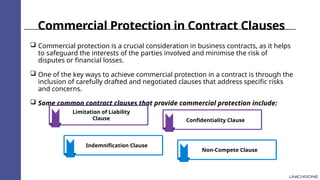
Some common contract clauses that provide commercial protection include:
Limitation of Liability
Clause
Indemnification Clause
Confidentiality Clause
Non-Compete Clause
47.
Rights Exploitation andFull Royalties Pay
Rights exploitation refers to the process of generating revenue from the use or
licensing of intellectual property rights, such as patents, trademarks, and
copyrights.
To ensure that rights owners receive full royalties for the use of their intellectual
property, it is important to have clear and enforceable licensing agreements in
place.
Licensing agreements typically outline the terms and conditions under which the
licensee may use the licensor's intellectual property.
This may include restrictions on the scope of use, the duration of the license, and
the geographic territory in which the intellectual property may be used.
In exchange for the right to use the intellectual property, the licensee typically
pays the licensor a royalty fee, which may be based on a percentage of the
licensee's revenue or a flat fee.
To ensure that rights owners receive full royalties for the use of their intellectual
48.
EU and UKCompetition Rules
The European Union (EU) and the United Kingdom (UK) have competition laws in
place that apply to licensing agreements and IP licensing contracts.
These laws are designed to prevent anti-competitive practices and promote fair
competition in the marketplace.
Under EU and UK competition laws, licensing agreements must be structured in a
way that does not restrict competition.
This means that licensing agreements should not contain provisions that limit the
licensee's ability to compete with the licensor or other third parties.
Such provisions may include exclusive dealing, territorial restrictions, and price-
fixing arrangements.
In addition, licensing agreements must not have the effect of creating a dominant
market position for the licensor or licensee, as this may lead to anti-competitive
behaviour.
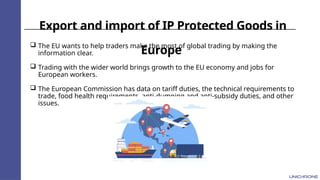
Export and importof IP Protected Goods in
Europe
The EU wants to help traders make the most of global trading by making the
information clear.
Trading with the wider world brings growth to the EU economy and jobs for
European workers.
The European Commission has data on tariff duties, the technical requirements to
trade, food health requirements, anti-dumping and anti-subsidy duties, and other
issues.
51.
Parallel Imports andLegal Issues
Parallel imports, also known as grey market goods, refer to genuine products that
are imported into a country without the permission of the manufacturer or
trademark owner.
These products are often sold at a lower price than those sold through official
distribution channels.
Parallel imports can raise several legal issues in intellectual property (IP) law.
One of the main issues with parallel imports is the potential for trademark
infringement. Trademark owners have the exclusive right to use their trademark
in connection with the sale and distribution of their goods.
If parallel importers use the trademark without permission, they may be
infringing on the trademark owner's rights.
However, in some countries, parallel imports are permitted under the principle of
exhaustion of IP rights.
52.
Parallel Imports andLegal Issues
(Continued)
This means that once a trademark owner has sold their product in one country,
they cannot use their trademark to prevent the product from being imported and
sold in another country.
Another issue with parallel imports is the potential for patent infringement.
Patents give inventors the exclusive right to use, make, and sell their inventions
for a certain period.
If parallel importers sell products that are protected by a patent, they may be
infringing on the patent owner's rights.
However, like with trademark law, some countries allow parallel imports under the
principle of exhaustion of IP rights.
53.
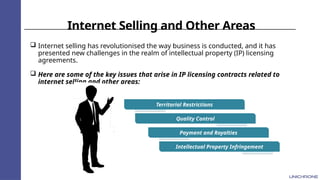
Internet Selling andOther Areas
Internet selling has revolutionised the way business is conducted, and it has
presented new challenges in the realm of intellectual property (IP) licensing
agreements.
Here are some of the key issues that arise in IP licensing contracts related to
internet selling and other areas:
Territorial Restrictions
Quality Control
Payment and Royalties
Intellectual Property Infringement
Tender and OtherDocuments
Tender and other documents refer to a wide range of materials created during
the tendering process for a project or contract.
These documents can include bid proposals, project plans, contracts,
specifications, designs, technical documents, and other materials submitted by
bidders in response to a request for proposal (RFP) or a request for tender (RFT).
Tender and other documents are crucial in the procurement process, as they
provide information about the project or contract, the requirements and criteria
for bidders, and the proposals submitted by bidders.
They also establish the terms and conditions of the contract, including the scope
of work, timelines, and payment terms.
59.
Tender and OtherDocuments
(Continued)
In terms of intellectual property law, tender and
other documents may be subject to copyright
and database rights protection, as discussed in
the previous response.
Therefore, it is important to ensure that the
ownership and use of any intellectual property
created during the tendering process are
properly protected and respected.
This can be achieved through careful review of
any terms or conditions included in the tender
or document creation process, as well as by
obtaining legal advice when necessary.
60.
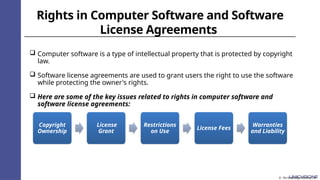
Computer Software andCopyright Law
Computer software is a type of intellectual property that is protected by copyright
law.
Copyright protection gives the creator of the software exclusive rights to control
its use, distribution, and reproduction.
These rights help protect the investment that the software creator has made in
developing the software.
Under copyright law, computer software is considered a literary work and is
protected as such.
Copyright protection extends to the source code, object code, and user interfaces
of the software.
The exclusive rights of the copyright holder generally last for the life of the creator
plus a certain number of years after their death.
61.
Computer Software andCopyright Law
(Continued)
To protect their software, creators can register their copyright with the relevant
intellectual property office.
Registration provides additional legal protection and can help establish ownership
in the event of a dispute.
Software copyright infringement occurs when someone uses or distributes
software without the permission of the copyright holder.
This can include unauthorised copying, modification, or distribution of the
software.
Software copyright infringement can result in legal action, including damages,
injunctions, and criminal penalties.
62.
Protection of Databases
In terms of copyright protection, databases may be eligible for protection as
compilations.
Under copyright law, a compilation is a work formed by the selection,
coordination, and arrangement of pre-existing materials.
Thus, if a database meets the criteria for originality, such as the selection and
arrangement of data that reflects a creative effort, it may be protected by
copyright law.
However, copyright protection may not be sufficient to protect databases in all
circumstances.
In such cases, database rights protection may be more appropriate.
Database right is a form of intellectual property protection that provides exclusive
rights to the maker of a database, such as the right to prevent unauthorised
extraction or re-utilisation of the database contents.
63.
Protection of Databases
(Continued)
Database rights protection is available in the
European Union under the Database Directive.
To be eligible for database rights protection, a
database must be the result of a substantial
investment in either the obtaining, verification,
or presentation of the contents.
The database maker must be a citizen of a
European Economic Area (EEA) member state or
have a place of business in an EEA member state.
64.
Notices Placed onDocuments
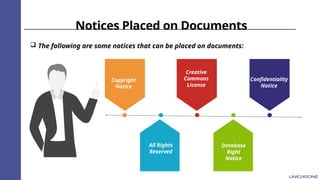
The following are some notices that can be placed on documents:
Copyright
Notice
Creative
Commons
License
Confidentiality
Notice
All Rights
Reserved
Database
Right
Notice
65.
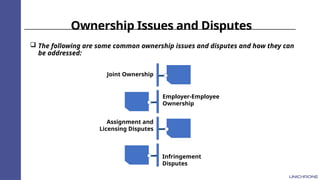
Ownership Issues andDisputes
The following are some common ownership issues and disputes and how they can
be addressed:
Employer-Employee
Ownership
Infringement
Disputes
Assignment and
Licensing Disputes
Joint Ownership
66.
Ownership Issues andDisputes
1. Joint Ownership: Joint ownership can arise when two or
more individuals contribute to the creation of a work or
a database. In such cases, each joint owner has an
equal right to use and license the work or database.
However, joint ownership can also lead to disputes over
how the work or database should be used or licensed.
To avoid disputes, joint owners should have a clear
agreement outlining the terms of joint ownership,
including how profits will be shared, and how disputes
will be resolved.
2. Employer-Employee Ownership: In some cases,
disputes can arise over the ownership of works or
databases created by employees. Generally, employers
own the copyright in works created by employees in
the course of their employment. However, ownership
issues can arise when an employee creates work
outside the scope of their employment or in their spare
time. To avoid disputes, employers should have clear
67.
Ownership Issues andDisputes
3. Assignment and Licensing Disputes: Disputes can arise over the assignment or
licensing of intellectual property. For example, a copyright owner may claim that
a licensee has exceeded the scope of their license, or a licensee may claim that
the copyright owner has breached the terms of the license agreement. To avoid
disputes, both parties should have a clear understanding of the terms of the
license agreement, including the scope of the license, payment terms, and
termination rights.
4. Infringement Disputes: Infringement disputes can arise when a third party uses a
work or database without permission. In such cases, the copyright or database
right owner may need to take legal action to enforce their rights. To avoid
infringement disputes, copyright and database rights owners should take steps
to protect their intellectual property, including registering their works or
databases with relevant intellectual property offices and monitoring for potential
infringement.
68.
Significance of ContractualClauses in
Agreements
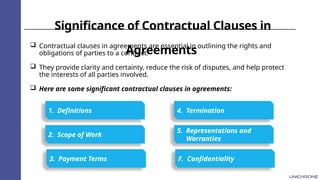
Contractual clauses in agreements are essential in outlining the rights and
obligations of parties to a contract.
They provide clarity and certainty, reduce the risk of disputes, and help protect
the interests of all parties involved.
Here are some significant contractual clauses in agreements:
1. Definitions 4. Termination
2. Scope of Work
5. Representations and
Warranties
3. Payment Terms F. Confidentiality
Trademarks and DesignRights
Trademarks and design rights are important intellectual property rights that
protect the distinctiveness and appearance of products, services, and branding.
Trademarks are signs or symbols that are used to distinguish the goods or
services of one business from those of another.
They can include words, logos, slogans, or other visual elements.
Trademarks can be registered with a national or regional trademark office to
provide exclusive rights to use the trademark with certain goods or services.
Registered trademarks give their owners the right to prevent others from using
identical or similar signs that might confuse consumers about the origin of goods
or services.
71.
Trademarks and DesignRights
(Continued)
Design rights, on the other hand, protect the visual
appearance of products.
They cover the shape, configuration, pattern, and
ornamentation of a product, and may include
features such as colours, lines, and textures.
Design rights can be registered but may also exist
as unregistered rights that arise automatically
upon the creation of the design.
The scope of protection for design rights may vary
depending on the jurisdiction and the type of
protection sought.
72.
Trademarks and DesignRights
(Continued)
In some cases, trademarks and design rights can overlap.
For example, a product design may also serve as a trademark, identifying the
source of the product. In such cases, both design rights and trademark protection
may be sought.
Both trademarks and design rights are important tools for businesses seeking to
protect their intellectual property and establish brand recognition.
They can provide exclusivity in the marketplace, deter potential infringers, and
increase the value of a business.
It is important for businesses to properly register and enforce their trademark
and design rights to ensure maximum protection and enforcement of their
intellectual property.
Protection for UnregisteredRights
Intellectual property (IP) laws provide legal protection for a wide range of creative
and innovative works, including trademarks, patents, copyrights, and trade
secrets.
However, in some cases, individuals or businesses may have unregistered rights
that are not covered by these traditional IP laws.
Fortunately, there are still some legal protections available for these unregistered
rights.
One way to protect unregistered rights is through common law principles.
Common law provides legal protections for certain types of intellectual property
that have not been formally registered with the government.
For example, if a company has used a particular logo or trade name for a
significant period and has established a reputation or goodwill associated with
that logo or trade name, they may have common law trademark rights that can be
enforced against others who attempt to use a similar mark.
76.
Protection for UnregisteredRights
(Continued)
Another way to protect unregistered rights is through contract law. Contracts can
be used to establish ownership of intellectual property, define the scope of use,
and provide for remedies in the event of infringement or breach.
For example, a business may enter into a contract with a supplier to create a
unique product design, and the contract may specify that the design is the
exclusive property of the business and cannot be used by the supplier for any
other purpose.
In some jurisdictions, unfair competition laws may also protect unregistered
rights. Unfair competition laws typically prohibit businesses from engaging in
deceptive or misleading practices that are likely to cause confusion among
consumers or harm the reputation of a competitor.
For example, a business may be prohibited from using a similar logo or trade
name to a competitor if it is likely to confuse consumers.
#8 However, patents can also be controversial, as some argue that they can stifle competition and lead to high prices for patented products.
Additionally, the patent system can be complex and costly, making it difficult for small inventors and entrepreneurs to obtain patent protection for their inventions.
#15 Another important aspect of ensuring the full value of intellectual property is through careful management of the intellectual property portfolio.
This may involve a periodic review of intellectual property holdings, identifying opportunities for licensing or monetisation, and enforcing intellectual property rights through legal action when necessary.
To avoid disputes, it is essential to ensure that intellectual property rights are clearly defined and protected. This may involve taking steps such as registering trademarks and patents, and ensuring that all intellectual property agreements are properly drafted and executed.
#23 In some cases, inventors and companies may choose to delay filing a patent application in order to further develop the invention or gather additional data to support the patent application.
However, delaying the filing of a patent application can also increase the risk of public disclosure or the development of competing technologies, which can impact the novelty and non-obviousness requirements for patentability.
#24 General Patent Databases:
Google Patents:
A comprehensive database indexing patents and patent applications from various patent offices worldwide.
USPTO's Patent Public Search:
The official database for U.S. patents, offering access to patent documents and information.
WIPO's PATENTSCOPE:
Provides access to international patent applications (PCT) and patent documents from participating national and regional patent offices.
Espacenet:
A free service offering access to patent information from around the world, including patent publications and technical documents.
Conduct a Patent Search: Before filing a patent application, it's crucial to conduct a thorough search to ensure that no one else has already patented the invention. A patent search will help you identify any similar inventions or patents that may exist.
File a Patent Application: Once you have conducted a patent search and determined that your invention is unique, it's time to file a patent application. The patent application will describe the invention in detail and include any necessary drawings or diagrams.
Keep Invention Confidential: It's important to keep the invention confidential until the patent application is filed. If the invention is publicly disclosed before the patent application is filed, it may no longer be eligible for patent protection.
Consider Non-Disclosure Agreements: If you need to discuss your invention with others, consider using non-disclosure agreements (NDAs) to protect the invention's confidentiality. An NDA is a legally binding agreement that requires the other party to keep the information confidential.
Monitor for Infringement: Once the patent is granted, it's essential to monitor for infringement. If someone is using or selling the invention without permission, you may need to take legal action to enforce your patent rights.
#38 Patent Infringement: Patent infringement occurs when someone uses, sells, or manufactures a patented invention without the permission of the patent owner. This can lead to patent infringement litigation, where the patent owner seeks damages and/or an injunction to stop the infringing activity.
Trademark Infringement: Trademark infringement occurs when someone uses a trademark that is identical or similar to another party's registered trademark without permission. This can lead to trademark litigation, where the trademark owner seeks damages and/or an injunction to stop the infringing activity.
Copyright Infringement: Copyright infringement occurs when someone uses a copyrighted work without permission, such as by reproducing, distributing, or displaying the work. This can lead to copyright litigation, where the copyright owner seeks damages and/or an injunction to stop the infringing activity.
Trade Secret Misappropriation: Trade secret misappropriation occurs when someone improperly acquires, uses, or discloses another party's trade secrets. This can lead to trade secret litigation, where the trade secret owner seeks damages and/or an injunction to stop the misappropriation.
Licensing Disputes: Licensing disputes can arise when there is a disagreement between the licensor and licensee over the terms of a licensing agreement. This can lead to litigation, where one party seeks to enforce the terms of the agreement or terminate the agreement.
#41 Clarity of Language: The language used in the NDA should be unambiguous to ensure that both parties understand their obligations under the agreement. If the language is too vague or unclear, it may be difficult to enforce the NDA.
Scope of protection: The NDA should clearly define what information is considered confidential and what is not. If the scope of protection is too broad or too narrow, it may not effectively protect the information that needs to be kept confidential.
Duration of Protection: The NDA should specify the duration of the obligation to keep the information confidential. If the duration is too short, the information may not be adequately protected, while if it is too long, it may be overly restrictive and difficult to enforce.
Enforcement Mechanisms: The NDA should outline the consequences for a breach of the agreement, such as monetary damages or injunctive relief. If there are no clear enforcement mechanisms, the NDA may not be effective in deterring breaches.
#43 Other important provisions that may be included in an R&D agreement include those related to the scope of the R&D activities, the timeline for completion, the payment structure, and any warranties or guarantees related to the quality of the research.
It is important to note that R&D agreements can be complex and may require the involvement of legal professionals with expertise in IP law to ensure that all parties are protected and that the agreement is enforceable.
#45 In recent years, the importance of IP has grown significantly, as businesses increasingly rely on innovation and creativity to compete in the global marketplace.
As a result, governments around the world have developed laws and policies to protect and promote the creation and use of intellectual property.
Businesses that are able to effectively manage their IP assets can gain a competitive advantage, enhance their reputation, and generate significant revenue through licensing and other forms of IP monetisation.
#46 Limitation of Liability Clause: This clause sets out the extent of a party's liability in the event of a breach of contract or other dispute. It may limit liability to a specific amount or exclude certain types of damages altogether.
Indemnification Clause: This clause requires one party to compensate the other for any losses, damages, or liabilities that arise as a result of the contract. It may also require the indemnifying party to defend the other party against any legal claims or actions.
Confidentiality Clause: This clause protects confidential information that is disclosed during the contract, and may require the parties to keep such information confidential and not disclose it to third parties.
Non-Compete Clause: This clause restricts one party from engaging in certain competitive activities for a specified time after the contract has ended. This helps to prevent the other party from losing business or suffering financial losses as a result of the former party's activities.
#47 In addition, licensing agreements may include provisions for the termination or modification of the license in the event of breach or non-payment of royalties.
It is important to have clear and enforceable remedies in place to ensure that the licensor can take appropriate action if the licensee fails to comply with the terms of the agreement.
#48 The licensing agreement should not limit the ability of other parties to enter the market, nor should it create artificial barriers to entry.
Furthermore, EU and UK competition laws prohibit certain types of licensing agreements that are considered to be anti-competitive.
These may include agreements that involve the exchange of sensitive information between competitors, agreements that involve the use of intellectual property rights to limit competition, and agreements that involve the allocation of markets or customers.
In order to comply with EU and UK competition laws, it is important to work with experienced legal counsel to ensure that licensing agreements are structured in a way that promotes fair competition and does not violate competition rules.
This may involve conducting a competition analysis to identify potential issues and ensuring that the licensing agreement includes appropriate provisions to address these concerns.
#53 Territorial Restrictions: Internet selling blurs geographical boundaries, which can make it difficult to enforce territorial restrictions. IP licensors often want to limit their licensees' sales to specific regions or countries, but this can be challenging in the digital age. To address this issue, licensors must define the territories where licensees can sell their products and outline how Internet sales will be managed.
Quality Control: Maintaining quality control can be difficult with internet selling. IP licensors may want to ensure that their products are sold only through certain channels to maintain their brand reputation and ensure consistent quality. However, enforcing these restrictions with online sales can be tricky. To address this issue, licensors must include provisions in their licensing agreements that address quality control and specify the licensee's responsibilities in this area.
Payment and Royalties: Online sales can also create challenges for payment and royalty structures. Tracking online sales can be difficult, and it may be hard to ensure that licensees are paying the correct royalties. Licensors need to include provisions in their licensing agreements that outline how payment and royalties will be handled, including how online sales will be tracked and how royalties will be calculated.
Intellectual Property Infringement: Internet selling has also created new opportunities for intellectual property infringement. Licensees may accidentally or intentionally infringe on the IP rights of others through their online sales. To address this issue, licensors must include provisions in their licensing agreements that address IP infringement and outline the licensee's responsibilities in this area.
#61 Businesses need to ensure that they are using software legally and ethically.
This can be achieved by purchasing software licenses from legitimate vendors, and by ensuring that employees are trained in the appropriate use of software.
#68 Definitions: The definitions clause establishes the meanings of key terms used throughout the agreement. It is important to define terms precisely to avoid ambiguity and misunderstandings.
Scope of Work: The scope of work clause outlines the specific services, products, or deliverables that one party will provide to the other party. This clause should be specific and clear to avoid misunderstandings and disputes.
Payment Terms: The payment terms clause outlines the amount, timing, and method of payment for services or products provided under the agreement. It should also specify what happens in the event of late payment or non-payment.
Termination: The termination clause specifies the circumstances under which the agreement can be terminated by either party. It should also outline the notice period required for termination and any consequences of termination.
Representations and Warranties: The representations and warranties clause sets out the promises made by each party regarding their ability to perform under the agreement. It is important to be accurate and truthful when making representations and warranties to avoid disputes.
Confidentiality: The confidentiality clause outlines the obligations of each party to protect confidential information shared under the agreement. This clause should specify what information is considered confidential, how it should be protected, and the consequences of a breach of confidentiality.
#78 It is important to note that design rights protect the appearance of articles and not their functional aspects. For example, a design right cannot protect the functional features of a product, such as its mechanism or technical specifications.
These aspects of a product may be protected by other forms of IP, such as patents or trade secrets.