INTELLECTUAL PROPERTY
“Know Your Rights”
Presented by:-
Shatrughna chaudhary
M.Pharm(1st Year)
(Department of Pharmaceutics)
 Law governing IP
 Meaning
 Types of IP
- Patent
- Trademark
- Copyright
- Geographical
indication
 Infringement
 Case Studies
 Conclusion
 References 2
 WIPO ( World Intellectual Property
Organization ) was established by the
WIPO Convention in 1967
 The WIPO is a specialized agency of
the United Nations.
 It promote the protection of IP
throughout the world.
 Its headquarters are in Geneva,
Switzerland
3
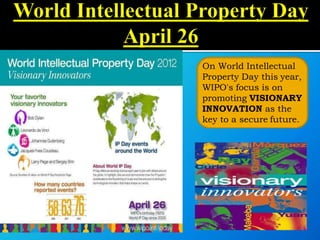
On World Intellectual
Property Day this year,
WIPO's focus is on
promoting VISIONARY
INNOVATION as the
key to a secure future.
2009WORLD IPDAY
4
 There are many big and small intellectual
property law firms worldwide, like in India,
USA, UK etc, providing qualitative help to
inventors and creators of product.
 In India intellectual property rights are
safely protected and controlled by well-
established statutory and judicial
framework.
 Apart From that, there are many attorneys
and law firm of intellectual property in
India in various states. 5
 Intellectual Property is a property that
arises from the human intellect. It is a
product of human creation.
 Intellectual Property comprises 2 distinct
forms:
* Literary & Artistic Works
* Industrial Property
6
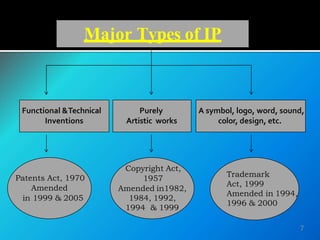
Major Types of IP
Functional &Technical
Inventions
Patents Act, 1970
Amended
in 1999 & 2005
Purely
Artistic works
Copyright Act,
1957
Amended in1982,
1984, 1992,
1994 & 1999
A symbol, logo, word, sound,
color, design, etc.
Trademark
Act, 1999
Amended in 1994,
1996 & 2000
7
(1) It is covered under the Act called the
Patents Act, 1970 [Amended by
Patents Act, 2005]
(2) It extends to the whole of India.
(3) It shall come into force on such date
as the Central Government may
publish, by notification in
the Official Gazette.
8
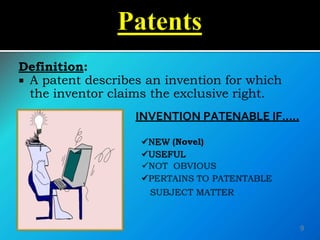
Definition:
 A patent describes an invention for which
the inventor claims the exclusive right.
INVENTION PATENABLE IF.....
NEW (Novel)
USEFUL

9
Patent Facilitator Centers In India
 Technology Information, Forecasting &
Assessment Council (TIFAC), New Delhi
Intellectual Property Management (IPM)
Division, CSIR, New Delhi
National Research Development
Corporation (NRDC), New Delhi
Patent Information System (PIS),
Nagpur
National Information Centre, New Delhi
10
 Term of the patent is 20 years from
the date of filling for all types of
inventions.
 Priority date- first to file
 The date of patent is the date of filing
the application for patent.
 The term of the patent is
counted from this date.
11
 The Government fee for filing a patent
application in India is Rs.750/- for
individuals and Rs.3,000/- for legal
entities.
 No fee for 1st and 2nd year
 Renewal fee, on yearly basis, is
required to be paid for 3rd to 20th for
keeping the patent enforce.
 Patent lapses if renewal fee is not paid
within the prescribed period.
12
A Compulsory License has recently been granted to
Sorafinib of Natco against Naxaver of Bayer, who has been
granted a patent in India
Bayer has been found by Controller General of Patents to
have:
Not made the medicine available in sufficient quantities to
patient
Priced the medicine exorbitantly (Rs. 2,80,000/- as against
Rs. 8,800/- of Natco)
Not worked in the territory of India
In the meantime, Cipla has reduced the price below that of
Natco
Recent Patent Disputes And Litigations In
India
13
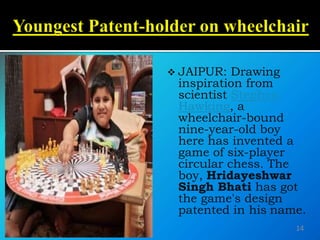
 JAIPUR: Drawing
inspiration from
scientist Stephen
Hawking, a
wheelchair-bound
nine-year-old boy
here has invented a
game of six-player
circular chess. The
boy, Hridayeshwar
Singh Bhati has got
the game's design
patented in his name.
14
15
1. It is covered under the Act called the
Trade Marks Act, 1999.
2. The Act came into effect on
September 15, 2003. It replaced the
Trade and Merchandise Marks Act,
1958.
3. It extends to the whole of India.
4. It shall come into force on such date
as the Central Government may
publish, by notification in the Official
Gazette
16
 Trademark:
A symbol, logo, word, sound, color,
design, or other device that is used to
identify a business or a product in
commerce.
Different Symbols are :
™ Intent to use application filed for product
SM Intent to use application filed for services
® Registered trademark
17
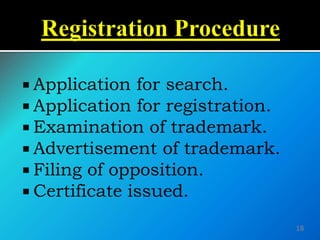
 Application for search.
 Application for registration.
 Examination of trademark.
 Advertisement of trademark.
 Filing of opposition.
 Certificate issued.
18
 Trademark is valid for 10 years from
the date of application which may be
renewed for further period of 10 years
on payment of prescribed fees.
 Service mark Rights are reserved
exclusively for owners for 17 year & it
can also be renewed.
 The Govt. fees is Rs. 2,500 for each
class of goods or services.
19
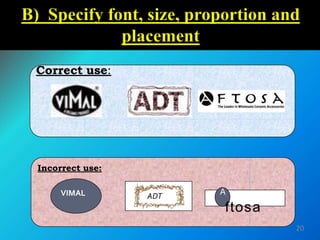
Correct use:
Incorrect use:
VIMAL ADT A
ftosa
20
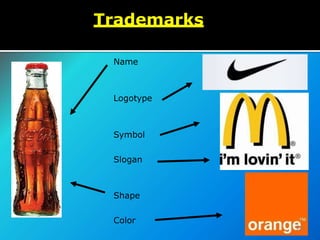
Trademarks
Name
Logotype
Symbol
Slogan
Shape
Color
21
 The Indian CopyrightAct,1957 governs
the system of copyrights in India.
[Amended in 1982, 1984, 1992, 1994
& 1999]
 Meaning : It is a right which Grants
protection to the unique expression of
Ideas.
22
 The term original in the copyright
law means that the work
originated with the author.
 There is no requirement for
novelty or uniqueness as there is
in patent law.
 Copyright law protects the
expression of an idea. Not the
idea itself. 23
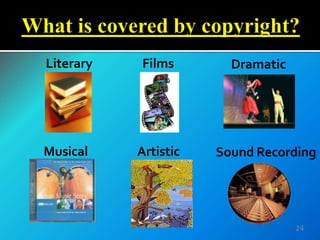
Literary Films Dramatic
Musical Sound RecordingArtistic
24
 Ideas
 Facts
 Recipes
 Works lacking originality (e.g. The phone book)
 Names, titles or short phrases
25
 Register a copyright by completing a
simple application form, along with the
appropriate fee
 Need not send a copy of your work,
 It may appear with the same title, but if
each work has been created
independently, each will have its own
copyright protection.
26
Copyright lasts for the-
 Author‟s lifetime + 50 years from the end
of the calendar year in which the author
dies,
 50 years for films and sound recordings,
 25 years for typographical arrangements
of a published edition,
 Copyright protection always expires on
December 31 of the last calendar year of
protection.
27
India as a member of WTO enacted the
Geographical Indication of Goods Act 1999 has
come into force wef 15th Sept 2003.
Geographical indications ensures that none
other than those regd. As authorized uses are
allowed to use popular product name.
Darjeeling tea become the first GI tagged
product in India in 2004-05.
Since then by 2010. 132 had been added to the
list.
Geographical Indication
28
Take action against
Infringements
29
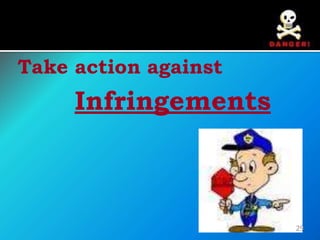
 Any reproduction, use , distribution,
performance, etc. of the work without
the permission of the owner.
 An identical or substantial similar
reproduction is also covered
 Infringement – Damages - Injunction
30
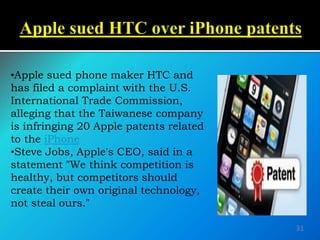
•Apple sued phone maker HTC and
has filed a complaint with the U.S.
International Trade Commission,
alleging that the Taiwanese company
is infringing 20 Apple patents related
to the iPhone
•Steve Jobs, Apple's CEO, said in a
statement "We think competition is
healthy, but competitors should
create their own original technology,
not steal ours."
31
A suit can lie in District
or High court
• Punishment extends from
6 months to 3 years
• A permanent bans on
engaging in commercial
activities
32
 A suit can lie in the
district court or in a
high court u/s 63 of
the copyright act,
1957
 Punishable with
imprisonment upto 3
years and fined as
per the claims. 33
• Create yourself, rather than
using others creations.
• Do not use competitor‟s mark in
such way that it harms
competitor in unfair way.
• No comparisons that are likely to
cause confusion.
34
1) Bedi Neena et al. Patenting and R&D in Indian Pharmaceutical
Industry: Post- TRIPS Scenario. Journal of Intellectual Property
Rights; Vol 18, March 2013, pp 105-110
2) Janodia D. Manthan et al. Impact of Patents in Pharma Industry’s
Competency: A viewpoint of Pharmaceutical Companies of India;
Journal of Intellectual Property Rights; Vol 14, September 2009,
pp 432-436
3) Nair G. Gopakumar . Intellectual Property Rights in Pharma
Industry. Pharma Times; Vol 44, July 2012, pp 31-43
4) Kulkarni Suhas et al. Analysis of Patent Filing Procedure in India.
Pharma Times; Vol 44, July 2012, pp 23-26
5) Prabu S. Lakshmana et al. Intellectual Property Rights and its
Development in India; Pharma Times; Vol 44, July 2012, pp 19-22
REFERENCES
35
36

IPR

  • 1.
    INTELLECTUAL PROPERTY “Know YourRights” Presented by:- Shatrughna chaudhary M.Pharm(1st Year) (Department of Pharmaceutics)
  • 2.
     Law governingIP  Meaning  Types of IP - Patent - Trademark - Copyright - Geographical indication  Infringement  Case Studies  Conclusion  References 2
  • 3.
     WIPO (World Intellectual Property Organization ) was established by the WIPO Convention in 1967  The WIPO is a specialized agency of the United Nations.  It promote the protection of IP throughout the world.  Its headquarters are in Geneva, Switzerland 3
  • 4.
    On World Intellectual PropertyDay this year, WIPO's focus is on promoting VISIONARY INNOVATION as the key to a secure future. 2009WORLD IPDAY 4
  • 5.
     There aremany big and small intellectual property law firms worldwide, like in India, USA, UK etc, providing qualitative help to inventors and creators of product.  In India intellectual property rights are safely protected and controlled by well- established statutory and judicial framework.  Apart From that, there are many attorneys and law firm of intellectual property in India in various states. 5
  • 6.
     Intellectual Propertyis a property that arises from the human intellect. It is a product of human creation.  Intellectual Property comprises 2 distinct forms: * Literary & Artistic Works * Industrial Property 6
  • 7.
    Major Types ofIP Functional &Technical Inventions Patents Act, 1970 Amended in 1999 & 2005 Purely Artistic works Copyright Act, 1957 Amended in1982, 1984, 1992, 1994 & 1999 A symbol, logo, word, sound, color, design, etc. Trademark Act, 1999 Amended in 1994, 1996 & 2000 7
  • 8.
    (1) It iscovered under the Act called the Patents Act, 1970 [Amended by Patents Act, 2005] (2) It extends to the whole of India. (3) It shall come into force on such date as the Central Government may publish, by notification in the Official Gazette. 8
  • 9.
    Definition:  A patentdescribes an invention for which the inventor claims the exclusive right. INVENTION PATENABLE IF..... NEW (Novel) USEFUL  9
  • 10.
    Patent Facilitator CentersIn India  Technology Information, Forecasting & Assessment Council (TIFAC), New Delhi Intellectual Property Management (IPM) Division, CSIR, New Delhi National Research Development Corporation (NRDC), New Delhi Patent Information System (PIS), Nagpur National Information Centre, New Delhi 10
  • 11.
     Term ofthe patent is 20 years from the date of filling for all types of inventions.  Priority date- first to file  The date of patent is the date of filing the application for patent.  The term of the patent is counted from this date. 11
  • 12.
     The Governmentfee for filing a patent application in India is Rs.750/- for individuals and Rs.3,000/- for legal entities.  No fee for 1st and 2nd year  Renewal fee, on yearly basis, is required to be paid for 3rd to 20th for keeping the patent enforce.  Patent lapses if renewal fee is not paid within the prescribed period. 12
  • 13.
    A Compulsory Licensehas recently been granted to Sorafinib of Natco against Naxaver of Bayer, who has been granted a patent in India Bayer has been found by Controller General of Patents to have: Not made the medicine available in sufficient quantities to patient Priced the medicine exorbitantly (Rs. 2,80,000/- as against Rs. 8,800/- of Natco) Not worked in the territory of India In the meantime, Cipla has reduced the price below that of Natco Recent Patent Disputes And Litigations In India 13
  • 14.
     JAIPUR: Drawing inspirationfrom scientist Stephen Hawking, a wheelchair-bound nine-year-old boy here has invented a game of six-player circular chess. The boy, Hridayeshwar Singh Bhati has got the game's design patented in his name. 14
  • 15.
  • 16.
    1. It iscovered under the Act called the Trade Marks Act, 1999. 2. The Act came into effect on September 15, 2003. It replaced the Trade and Merchandise Marks Act, 1958. 3. It extends to the whole of India. 4. It shall come into force on such date as the Central Government may publish, by notification in the Official Gazette 16
  • 17.
     Trademark: A symbol,logo, word, sound, color, design, or other device that is used to identify a business or a product in commerce. Different Symbols are : ™ Intent to use application filed for product SM Intent to use application filed for services ® Registered trademark 17
  • 18.
     Application forsearch.  Application for registration.  Examination of trademark.  Advertisement of trademark.  Filing of opposition.  Certificate issued. 18
  • 19.
     Trademark isvalid for 10 years from the date of application which may be renewed for further period of 10 years on payment of prescribed fees.  Service mark Rights are reserved exclusively for owners for 17 year & it can also be renewed.  The Govt. fees is Rs. 2,500 for each class of goods or services. 19
  • 20.
  • 21.
  • 22.
     The IndianCopyrightAct,1957 governs the system of copyrights in India. [Amended in 1982, 1984, 1992, 1994 & 1999]  Meaning : It is a right which Grants protection to the unique expression of Ideas. 22
  • 23.
     The termoriginal in the copyright law means that the work originated with the author.  There is no requirement for novelty or uniqueness as there is in patent law.  Copyright law protects the expression of an idea. Not the idea itself. 23
  • 24.
    Literary Films Dramatic MusicalSound RecordingArtistic 24
  • 25.
     Ideas  Facts Recipes  Works lacking originality (e.g. The phone book)  Names, titles or short phrases 25
  • 26.
     Register acopyright by completing a simple application form, along with the appropriate fee  Need not send a copy of your work,  It may appear with the same title, but if each work has been created independently, each will have its own copyright protection. 26
  • 27.
    Copyright lasts forthe-  Author‟s lifetime + 50 years from the end of the calendar year in which the author dies,  50 years for films and sound recordings,  25 years for typographical arrangements of a published edition,  Copyright protection always expires on December 31 of the last calendar year of protection. 27
  • 28.
    India as amember of WTO enacted the Geographical Indication of Goods Act 1999 has come into force wef 15th Sept 2003. Geographical indications ensures that none other than those regd. As authorized uses are allowed to use popular product name. Darjeeling tea become the first GI tagged product in India in 2004-05. Since then by 2010. 132 had been added to the list. Geographical Indication 28
  • 29.
  • 30.
     Any reproduction,use , distribution, performance, etc. of the work without the permission of the owner.  An identical or substantial similar reproduction is also covered  Infringement – Damages - Injunction 30
  • 31.
    •Apple sued phonemaker HTC and has filed a complaint with the U.S. International Trade Commission, alleging that the Taiwanese company is infringing 20 Apple patents related to the iPhone •Steve Jobs, Apple's CEO, said in a statement "We think competition is healthy, but competitors should create their own original technology, not steal ours." 31
  • 32.
    A suit canlie in District or High court • Punishment extends from 6 months to 3 years • A permanent bans on engaging in commercial activities 32
  • 33.
     A suitcan lie in the district court or in a high court u/s 63 of the copyright act, 1957  Punishable with imprisonment upto 3 years and fined as per the claims. 33
  • 34.
    • Create yourself,rather than using others creations. • Do not use competitor‟s mark in such way that it harms competitor in unfair way. • No comparisons that are likely to cause confusion. 34
  • 35.
    1) Bedi Neenaet al. Patenting and R&D in Indian Pharmaceutical Industry: Post- TRIPS Scenario. Journal of Intellectual Property Rights; Vol 18, March 2013, pp 105-110 2) Janodia D. Manthan et al. Impact of Patents in Pharma Industry’s Competency: A viewpoint of Pharmaceutical Companies of India; Journal of Intellectual Property Rights; Vol 14, September 2009, pp 432-436 3) Nair G. Gopakumar . Intellectual Property Rights in Pharma Industry. Pharma Times; Vol 44, July 2012, pp 31-43 4) Kulkarni Suhas et al. Analysis of Patent Filing Procedure in India. Pharma Times; Vol 44, July 2012, pp 23-26 5) Prabu S. Lakshmana et al. Intellectual Property Rights and its Development in India; Pharma Times; Vol 44, July 2012, pp 19-22 REFERENCES 35
  • 36.