
INTELLECTUAL PROPERTY ACT
Submitted By:
Udit Jain
Vanshika Gupta
Sonakshi Govil
Shruti Mittal
Sunita Sahu
Sreevatsan Natrajan
Definition
Creations of mind for which exclusive
rights are recognized.
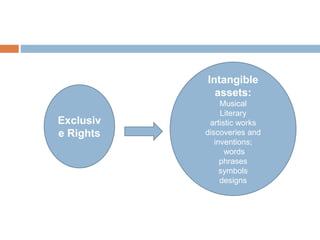
Exclusiv
e Rights
Intangible
assets:
Musical
Literary
artistic works
discoveries and
inventions;
words
phrases
symbols
designs
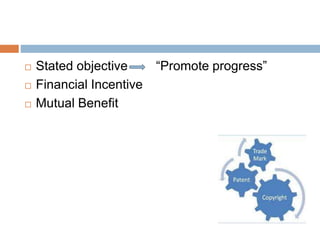
 Stated objective “Promote progress”
 Financial Incentive
 Mutual Benefit
Includes
 Copyright
 Trademarks
 Patents
 Layout of integrated circuit design
 Industrial design rights
 Trade dress
 Trade secrets
CASE :
YAHOO vs.
SUPER
CASSETTES
INDUSTRIES
In Super Cassettes Industries Ltd. V Yahoo Inc. the Honorable High Court
of Delhi On Friday, May 30th 2008 issued notice to Yahoo Inc. and its
Indian subsidiary Yahoo Web Services (India) Pvt. Ltd on a suit filed by
Super Cassettes Industries Limited (SCIL) owner of the largest Indian
music label "T-Series" for infringement of their copyright caused by
unlicensed streaming of SCIL's copyright works on Yahoo's portal
video.yahoo.com
Hima Kohli J. passed an order that the defendant
is restrained from reproducing, adapting, distributing
or transmitting in any manner on its website,
`www.video.yahoo.com’ or otherwise infringing
in any manner, the cinematograph films,
sound recordings and/or the underlying
literary or musical works of the plaintiff,
in which the plaintiff claims copyright,
without obtaining an appropriate license
from the plaintiff.
Similar case was filed against Youtube.Com by
the plaintiff and injunctive orders were issued by
the court.
CASE :
Oxford University Press , Press Of The
Cambridge University, Cambridge
University Press India Pvt. Ltd,
Informa UK Ltd vs.
Rameshwari Photocopy Services and
The University of Delhi
The defendants (i.e. Rameshwari Photocopy shop and
Delhi University) are accused by the plaintiffs that they
regularly compiles up the data from copyrighted books and
make them available to students.
• Plaintiffs whereas in this case say that “publishers are not
charity house” and questions the system ''why publishers
should be giving out their works for free” as they have also
paid the authors of the books enough money to sell their
written material.
• Also plaintiffs have asked for money relief that amounts for
around Rs.60,01200 for court fees and jurisdiction and
Rs.65000 for court fees
In October 2012, the court passed a stay order on the
production of course pack. In March this year ASEAK
was formed to protect the interest of the students. In
April this Year (2013), during the hearing, the students
pleaded for rejection of the stay order on the sale of
course pack as the exams were near. But the judge
rejected their plea and the stay order remained
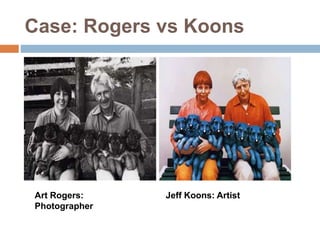
Case: Rogers vs Koons
Art Rogers:
Photographer
Jeff Koons: Artist
Outcome
 Similarities between the 2 images
 Koons defence was rejected
 Koons was forced to pay a monetary
settlement to Rodgers.
Significance
 Can you build upon another’s work to create
your own original piece?
 It also brought up the issue of photography as
art, was photography just a documentation of
the world, or is it a creative and artistic
product?
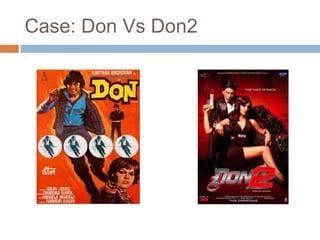
Case: Don Vs Don2
Brief
 allegations of criminal breach of trust and
misappropriation of property levelled by the
makers of the 1978 film Don against the makers
of the 2011 film 'Don 2'.
 In 2011, Nariman Films partner Nadir Irani filed
complaints against 'Don 2' co-producers Ritesh
Sidhwani, Farhan Akhtar and Shah Rukh Khan.
 Irani's contention was Nariman Films gave
remake rights only for the first instalment of 'Don',
which released in 2006. Irani said the agreement
expired in 2009 and that the makers had no right
to make 'Don 2'.
 Director Farhan Akhtar's father Javed, who
was a close friend of the Iranis, convinced
them to part with the remake rights.
 Nariman Films filed a civil suit alleging
that Don 2 violated copyright laws by adopting
the original Don's signature tune, songs, script,
characters and music.
 Ahead of Don 2's release in December
2011,Irani approached the High Court seeking
a stay on the film. The court did not grant the
stay, saying theatres had already been
booked. The company then filed a private
complaint against the 'Don 2' production team,
seeking the filing of an FIR.
 Magistrate ask the police to first investigate the
case and submit a report.
Verdict
 The complaint also names Red Chillies,
Reliance Entertainment, Baba Arts, Bipin
Salva and 10 others.
 The dispute ended only when the two parties
agreed for an out-of-court settlement.
The Trade Marks
Act,1999
Introduction
Section 2 (1) (zb) of the Act defines a ‘trade mark’ as a mark
capable of being represented graphically and which is
capable of distinguishing the goods or services of one person
from those of others and may include shape of goods, their
packaging and combination of colours.
Section 2 (1) (m) of the Act defines ‘mark’ as including a
device, brand, heading, label, ticket, name, signature, word,
letter, numeral, shape of goods, packaging or combination of
colours or any combination thereof.
Importance
Trademarks do not prevent competition in a particular type of
product but confer a monopoly in the mark. Competitors are only
prevented from using the same or similar mark to identify their
product.
The importance of trademarks lies in their association with quality
and consumer expectations in a product or service. They can be
seen as serving four main purposes:
 First, identifying the product of its origin,
 Secondly, advertising the product/service and lending it a brand
name,
 Thirdly, protecting the business’ reputation and goodwill, and
 Fourthly, protecting consumers from deception, that is to prevent the
buying public purchasing inferior goods or services in the mistaken
belief that they originate from or are provided by another trader.
Trade Marks infringement
Trademark infringement is a violation of the exclusive rights
attached to a trademark without the authorization of the
trademark owner or any licensees.
Trademark infringement occurs if a person other than the
registered proprietor in the course of trade, in relation to the
same good or services for which the mark is registered, uses
the same mark or a deceptively similar mark. This particularly
harms the goodwill of a brand if its trademark is well-known.
The laws relating to trade mark infringement are enshrined
under Section 29 of the Trade Marks Act, 1999.
Pantaloons vs. Shoppers’ Stop
 Shoppers’ Stop and Lifestyle dragged their rival Pantaloon to court
as they were miffed with an advertisement issued by the flagship
company of Kishore Biyani owned Future Group that offered 10%
extra discount to their loyal customers vide an advertisement
issued in The Times of India, New Delhi, dated 28th June, 2008. The
complainant retailers had accused Pantaloon of trademark
violations and unfair business practices.
 Pantaloon’s ‘Central’ mall at Gurgaon had offered 30% discounts to
its customers over the weekend. Loyalty card holders of competing
retailers like Shopper’s Stop, Lifestyle and Westside, were lured by
Pantaloon by offering an additional 10% discount on select brands
of apparel.
 The advertisement asked such customers to “present their
membership card to avail this offer.
 The petitioners contended that Pantaloon was luring the
former’s customers by using their name in an unfair manner.
The Hon’ble Delhi High Court issued an injunction restraining
Pantaloon from using names of its rivals in the ads until the
next hearing.
Cadbury vs. Nestle
 Nestle SA, challenged a trademark ruling stating that a colour
cannot be protected under Section-3(1) (a) of Trade Marks
Act, 1994(UK Act)and this colour doesn’t have a meaning.
 Cadbury subsequently filed a counterstatement denying the
grounds of opposition. Cadbury proved to the court that they
have been using this colour for a century now.
 Cadbury was granted trademark for purple (Pantone 2685C)
colour on 20th October 2011. The registered mark was to be
used for Chocolate in bar and tablet form; eating chocolate;
drinking chocolate; preparations for making drinking
chocolate
 According to the Birmingham Mail, on 1st October,
2012 Judge Colin Birss in London high court dismissed
Nestlé's primary case stating that: “Since on the evidence the
public associates the colour purple itself with Cadbury’s
chocolate, Cadbury is entitled to a registered trade mark for
that colour on the relevant goods.”
 However, the ruling does not extend to Cadbury's boxes of
chocolates, or dark or white chocolate, as the judge ruled that
the colour was not distinctive to chocolate in general.
CASE :
Tata's Mount Everest
vs. Bisleri
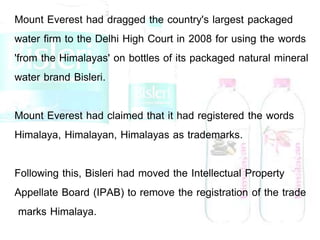
Mount Everest had dragged the country's largest packaged
water firm to the Delhi High Court in 2008 for using the words
'from the Himalayas' on bottles of its packaged natural mineral
water brand Bisleri.
Mount Everest had claimed that it had registered the words
Himalaya, Himalayan, Himalayas as trademarks.
Following this, Bisleri had moved the Intellectual Property
Appellate Board (IPAB) to remove the registration of the trade
marks Himalaya.
• The order ends a three-year dispute between Bisleri and Mount Everest in the
former's favour and clears way for packaged water companies to use terms such
as 'Himalaya' and 'Himalayan' for water sourced from the mountains.
• In its order, IPAB said, "A condition shall be imposed to the effect that registration
does not confer an exclusive right to use of the device of mountain or the word
'Himalayan' and that the word Himalayan shall be used in respect of water sourced
from Himalayan mountain.“
• The writ petition is accordingly allowed with costs of Rs.10,000/- to
be paid by Respondent No.1 BIPL to the Petitioner within four weeks
from today. The application also stands disposed of.
 HONDA using the trade mark “HONDA” in India
since 1957
 1983- Hero Honda Motors Ltd. permitted to use
the mark “HERO HONDA”
 1985- Honda Siel Power Products Ltd. permitted
to use the mark "SHRIRAM HONDA“
 1997- Honda Siel Cars India, manufacture and
sale of motor cars under the house mark HONDA.
 Registered trade mark HONDA in India in various
classes under the Trade and Merchandise Marks
Act, 1958
Case (28th November 2002)
• Application for registration of trade mark HONDA in respect
of pressure cookers (non-electric) had been filed in the
name of M/s. Steel India
• The company opposed the said application by taking out
opposition proceedings before the Registrar, Trade Marks
• 1999 - Defendants moving another application for
registration of trade mark HONDA in class 21.
• Still using the trade mark HONDA, a cease and desist
notice was served & they did not reply.
• present suit for permanent injunction, passing off, rendition
of accounts and delivery up
Plaintiff Defender
Plaintiff’s Allegations
 Using the mark HONDA in respect of their goods pressure cookers, are
passing off the same as the goods of the plaintiff
 en-cashing upon the plaintiff's goodwill and reputation attached to its mark
HONDA.
Defender’s Arguments
 Goods of defender are completely different from plaintiff’s goods
 carrying on the business of manufacturing and marketing of 'pressure
cookers' under the trade mark HONDA since the year 1985.
 the visual presentation of the mark HONDA, under which the defendants'
products are being marked, is such that no confusion and deception of any
kind can arise.
 HONDA is common to the trade and is a common surname in India
 plaintiff has not used the mark HONDA in India independently but is using it
with some added matter like Hero-HONDA
 Suit suffers from delays and latches.
Proceedings
 defendants placed on record a search report and copies of the invoices,
to indicate that they had been using the trade mark HONDA for many
years.
 1st application- “SI PRODUCTS” overlooked by HONDA & in 2nd
removed
 Affidavit to the effect that the name of charanjit’s uncle is S. Honda
Singh not valid
 Using Honda separately as Hero and other marks are registered
separately
 Honda did not know about the refiling of application by defender thus
delays and latches are not prominent
Conclusion
 plaintiff's suit is an action for passing off
 the reputation and goodwill attached to HONDA is of international
repute
 used by the defendants for pressure cooker, to acquire the benefit of its
goodwill so as to create deception for the public who are likely to buy
Industrial Design Rights
 protects the visual design of objects that are not
purely utilitarian
 industrial design consists of the creation of a
shape, configuration or composition of pattern or
colour, or combination of pattern and colour in
three dimensional form containing aesthetic value.
 An industrial design can be a two- or three-
dimensional pattern used to produce a product,
industrial commodity or handicraft
 India's Design Act, 2000
 Semiconductor Chip Protection Act
BROOKTREE CORPORATION VS
ADVANCED MICRO DEVICES
Plaintiff
 Brooktree was granted mask work registration for its chips identified as
Bt451 and Bt458, combines the functions of a static random access
memory (SRAM) and a digital to analog converter (DAC).
 considered as "color palette", producing the colours in colour video
displays having high speed and high resolution
 Infringement of mask work registrations in connection with
semiconductor chips used in colour video displays
 critical component of the Brooktree chips is the core cell, 80% of chip
coverage, copied by AMD, thus infringing Brooktree's mask work
registrations.
 Brooktree must show that A.M.D.'s mask works are substantially similar
to a material portion of the mask works in Brooktree's chips
Defender
 non-SRAM portion of its accused chip was not copied, the
chips are not "substantially similar“
 Infringement under the statute does not require that all parts
of the accused chip be copied.
 core cell was the product of reverse engineering of the
Brooktree chip, and therefore does not constitute
infringement under the Semiconductor Chip Protection Act
 AMD's defense was that its chips were independently
designed after the Brooktree chips were subjected to
reverse engineering to learn the Brooktree design.
 AMD pointed to its "paper trail" of its two and a half years of
effort at a cost in excess of three million dollars.
 Counter argue- AMD's lengthy and expensive failures at
designing a layout and could not further invest thus copied
Conclusion
 agreed that Brooktree's color palette chips
were superior to others then available
 AMD’s arguments were not accepted and
found guilty under semiconductor
protection Act.
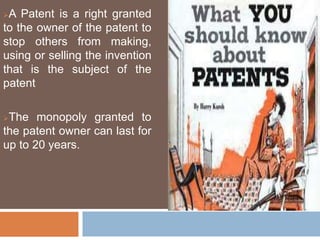
A Patent is a right granted
to the owner of the patent to
stop others from making,
using or selling the invention
that is the subject of the
patent
The monopoly granted to
the patent owner can last for
up to 20 years.
1. UTILITY
 It is the most important type of patent that is granted .
 It protects the functional aspect of the invention
 It is also the most sought after & requires a lot of skill in drafting &
prosecuting the application on front of the patent granting official
2. DESIGN
 This type of patent is granted to protect the ornamental or external
appearance of the invention and not the actual invention.
 If a design is of functional necessity then it cannot be registered for
a design patent.
3. PLANT
 It is granted for plant variety made through asexual reproduction of
plant varieties.
 An invention which claims anything obvious contrary to
well established natural laws.
An invention in the intended use of which can be
injurious to public health.
The mere discovery of a scientific principle or the
formulation of an abstract theory.
 A susbtance obtained by a mere mixture of matter
resulting only in the aggregation of the properties of the
components or a process for producing such substance
Madras High Court dismisses
patent infringement case
 The Madras High Court has refused to restrain Mishra Dhatu Nigam
(MIDHANI) Limited, a Hyderabad-based enterprise, from
manufacturing and selling titanium knee prosthesis on a cost-to-cost
basis for cancer patients.
 The dismissed suit filed by proprietor of a Chennai-based private
enterprise held that the plaintiff had not made out a case as
MIDHANI selling the prosthesis at Rs 39,200, whereas the private
enterprise sold it for Rs 1.36 lakh each.
Conclusion:
 The verdict of the case was that the distinguishing features of the
MIDHANI product may not qualify their product for a valid patent
registration. But they will certainly provide a shield for a defendant
against an action in infringement of the patent
Apple had filed an infringement case on Samsung for using one of its
patented features.
Judge Lucy Koh, who has been heading the ongoing patent battle
between the two tech giants, ruled that Samsung violated Apple's
'autocomplete' patent by using it in its keyboard on Galaxy Nexus, Note
and other older devices.
Samsung argued that Apple's patent could only refer to a hardware
keyboard, not the on-screen one used on both iOS and Android
Conclusion :
However, Judge Koh found the infringement clear and granted Apple
summary judgment and a suit of $ 290 million.
The report said that Samsung would be now required to prove that the
patent is invalid in order to win and if it fails, Google too could be involved
and would have to work its way out to ensure its Android OS doesn't get
dragged in lawsuits.

Intellectual Property Act

  • 1.
    INTELLECTUAL PROPERTY ACT SubmittedBy: Udit Jain Vanshika Gupta Sonakshi Govil Shruti Mittal Sunita Sahu Sreevatsan Natrajan
  • 2.
    Definition Creations of mindfor which exclusive rights are recognized.
  • 3.
  • 4.
     Stated objective“Promote progress”  Financial Incentive  Mutual Benefit
  • 5.
    Includes  Copyright  Trademarks Patents  Layout of integrated circuit design  Industrial design rights  Trade dress  Trade secrets
  • 6.
  • 7.
    In Super CassettesIndustries Ltd. V Yahoo Inc. the Honorable High Court of Delhi On Friday, May 30th 2008 issued notice to Yahoo Inc. and its Indian subsidiary Yahoo Web Services (India) Pvt. Ltd on a suit filed by Super Cassettes Industries Limited (SCIL) owner of the largest Indian music label "T-Series" for infringement of their copyright caused by unlicensed streaming of SCIL's copyright works on Yahoo's portal video.yahoo.com
  • 8.
    Hima Kohli J.passed an order that the defendant is restrained from reproducing, adapting, distributing or transmitting in any manner on its website, `www.video.yahoo.com’ or otherwise infringing in any manner, the cinematograph films, sound recordings and/or the underlying literary or musical works of the plaintiff, in which the plaintiff claims copyright, without obtaining an appropriate license from the plaintiff. Similar case was filed against Youtube.Com by the plaintiff and injunctive orders were issued by the court.
  • 9.
    CASE : Oxford UniversityPress , Press Of The Cambridge University, Cambridge University Press India Pvt. Ltd, Informa UK Ltd vs. Rameshwari Photocopy Services and The University of Delhi
  • 10.
    The defendants (i.e.Rameshwari Photocopy shop and Delhi University) are accused by the plaintiffs that they regularly compiles up the data from copyrighted books and make them available to students. • Plaintiffs whereas in this case say that “publishers are not charity house” and questions the system ''why publishers should be giving out their works for free” as they have also paid the authors of the books enough money to sell their written material. • Also plaintiffs have asked for money relief that amounts for around Rs.60,01200 for court fees and jurisdiction and Rs.65000 for court fees
  • 11.
    In October 2012,the court passed a stay order on the production of course pack. In March this year ASEAK was formed to protect the interest of the students. In April this Year (2013), during the hearing, the students pleaded for rejection of the stay order on the sale of course pack as the exams were near. But the judge rejected their plea and the stay order remained
  • 12.
    Case: Rogers vsKoons Art Rogers: Photographer Jeff Koons: Artist
  • 13.
    Outcome  Similarities betweenthe 2 images  Koons defence was rejected  Koons was forced to pay a monetary settlement to Rodgers.
  • 14.
    Significance  Can youbuild upon another’s work to create your own original piece?  It also brought up the issue of photography as art, was photography just a documentation of the world, or is it a creative and artistic product?
  • 15.
  • 16.
    Brief  allegations ofcriminal breach of trust and misappropriation of property levelled by the makers of the 1978 film Don against the makers of the 2011 film 'Don 2'.  In 2011, Nariman Films partner Nadir Irani filed complaints against 'Don 2' co-producers Ritesh Sidhwani, Farhan Akhtar and Shah Rukh Khan.  Irani's contention was Nariman Films gave remake rights only for the first instalment of 'Don', which released in 2006. Irani said the agreement expired in 2009 and that the makers had no right to make 'Don 2'.
  • 17.
     Director FarhanAkhtar's father Javed, who was a close friend of the Iranis, convinced them to part with the remake rights.  Nariman Films filed a civil suit alleging that Don 2 violated copyright laws by adopting the original Don's signature tune, songs, script, characters and music.
  • 18.
     Ahead ofDon 2's release in December 2011,Irani approached the High Court seeking a stay on the film. The court did not grant the stay, saying theatres had already been booked. The company then filed a private complaint against the 'Don 2' production team, seeking the filing of an FIR.  Magistrate ask the police to first investigate the case and submit a report.
  • 19.
    Verdict  The complaintalso names Red Chillies, Reliance Entertainment, Baba Arts, Bipin Salva and 10 others.  The dispute ended only when the two parties agreed for an out-of-court settlement.
  • 20.
  • 21.
    Introduction Section 2 (1)(zb) of the Act defines a ‘trade mark’ as a mark capable of being represented graphically and which is capable of distinguishing the goods or services of one person from those of others and may include shape of goods, their packaging and combination of colours. Section 2 (1) (m) of the Act defines ‘mark’ as including a device, brand, heading, label, ticket, name, signature, word, letter, numeral, shape of goods, packaging or combination of colours or any combination thereof.
  • 22.
    Importance Trademarks do notprevent competition in a particular type of product but confer a monopoly in the mark. Competitors are only prevented from using the same or similar mark to identify their product. The importance of trademarks lies in their association with quality and consumer expectations in a product or service. They can be seen as serving four main purposes:  First, identifying the product of its origin,  Secondly, advertising the product/service and lending it a brand name,  Thirdly, protecting the business’ reputation and goodwill, and  Fourthly, protecting consumers from deception, that is to prevent the buying public purchasing inferior goods or services in the mistaken belief that they originate from or are provided by another trader.
  • 23.
    Trade Marks infringement Trademarkinfringement is a violation of the exclusive rights attached to a trademark without the authorization of the trademark owner or any licensees. Trademark infringement occurs if a person other than the registered proprietor in the course of trade, in relation to the same good or services for which the mark is registered, uses the same mark or a deceptively similar mark. This particularly harms the goodwill of a brand if its trademark is well-known. The laws relating to trade mark infringement are enshrined under Section 29 of the Trade Marks Act, 1999.
  • 24.
    Pantaloons vs. Shoppers’Stop  Shoppers’ Stop and Lifestyle dragged their rival Pantaloon to court as they were miffed with an advertisement issued by the flagship company of Kishore Biyani owned Future Group that offered 10% extra discount to their loyal customers vide an advertisement issued in The Times of India, New Delhi, dated 28th June, 2008. The complainant retailers had accused Pantaloon of trademark violations and unfair business practices.  Pantaloon’s ‘Central’ mall at Gurgaon had offered 30% discounts to its customers over the weekend. Loyalty card holders of competing retailers like Shopper’s Stop, Lifestyle and Westside, were lured by Pantaloon by offering an additional 10% discount on select brands of apparel.
  • 25.
     The advertisementasked such customers to “present their membership card to avail this offer.  The petitioners contended that Pantaloon was luring the former’s customers by using their name in an unfair manner. The Hon’ble Delhi High Court issued an injunction restraining Pantaloon from using names of its rivals in the ads until the next hearing.
  • 26.
    Cadbury vs. Nestle Nestle SA, challenged a trademark ruling stating that a colour cannot be protected under Section-3(1) (a) of Trade Marks Act, 1994(UK Act)and this colour doesn’t have a meaning.  Cadbury subsequently filed a counterstatement denying the grounds of opposition. Cadbury proved to the court that they have been using this colour for a century now.  Cadbury was granted trademark for purple (Pantone 2685C) colour on 20th October 2011. The registered mark was to be used for Chocolate in bar and tablet form; eating chocolate; drinking chocolate; preparations for making drinking chocolate
  • 27.
     According tothe Birmingham Mail, on 1st October, 2012 Judge Colin Birss in London high court dismissed Nestlé's primary case stating that: “Since on the evidence the public associates the colour purple itself with Cadbury’s chocolate, Cadbury is entitled to a registered trade mark for that colour on the relevant goods.”  However, the ruling does not extend to Cadbury's boxes of chocolates, or dark or white chocolate, as the judge ruled that the colour was not distinctive to chocolate in general.
  • 28.
    CASE : Tata's MountEverest vs. Bisleri
  • 29.
    Mount Everest haddragged the country's largest packaged water firm to the Delhi High Court in 2008 for using the words 'from the Himalayas' on bottles of its packaged natural mineral water brand Bisleri. Mount Everest had claimed that it had registered the words Himalaya, Himalayan, Himalayas as trademarks. Following this, Bisleri had moved the Intellectual Property Appellate Board (IPAB) to remove the registration of the trade marks Himalaya.
  • 30.
    • The orderends a three-year dispute between Bisleri and Mount Everest in the former's favour and clears way for packaged water companies to use terms such as 'Himalaya' and 'Himalayan' for water sourced from the mountains. • In its order, IPAB said, "A condition shall be imposed to the effect that registration does not confer an exclusive right to use of the device of mountain or the word 'Himalayan' and that the word Himalayan shall be used in respect of water sourced from Himalayan mountain.“ • The writ petition is accordingly allowed with costs of Rs.10,000/- to be paid by Respondent No.1 BIPL to the Petitioner within four weeks from today. The application also stands disposed of.
  • 31.
     HONDA usingthe trade mark “HONDA” in India since 1957  1983- Hero Honda Motors Ltd. permitted to use the mark “HERO HONDA”  1985- Honda Siel Power Products Ltd. permitted to use the mark "SHRIRAM HONDA“  1997- Honda Siel Cars India, manufacture and sale of motor cars under the house mark HONDA.  Registered trade mark HONDA in India in various classes under the Trade and Merchandise Marks Act, 1958
  • 32.
    Case (28th November2002) • Application for registration of trade mark HONDA in respect of pressure cookers (non-electric) had been filed in the name of M/s. Steel India • The company opposed the said application by taking out opposition proceedings before the Registrar, Trade Marks • 1999 - Defendants moving another application for registration of trade mark HONDA in class 21. • Still using the trade mark HONDA, a cease and desist notice was served & they did not reply. • present suit for permanent injunction, passing off, rendition of accounts and delivery up Plaintiff Defender
  • 33.
    Plaintiff’s Allegations  Usingthe mark HONDA in respect of their goods pressure cookers, are passing off the same as the goods of the plaintiff  en-cashing upon the plaintiff's goodwill and reputation attached to its mark HONDA. Defender’s Arguments  Goods of defender are completely different from plaintiff’s goods  carrying on the business of manufacturing and marketing of 'pressure cookers' under the trade mark HONDA since the year 1985.  the visual presentation of the mark HONDA, under which the defendants' products are being marked, is such that no confusion and deception of any kind can arise.  HONDA is common to the trade and is a common surname in India  plaintiff has not used the mark HONDA in India independently but is using it with some added matter like Hero-HONDA  Suit suffers from delays and latches.
  • 34.
    Proceedings  defendants placedon record a search report and copies of the invoices, to indicate that they had been using the trade mark HONDA for many years.  1st application- “SI PRODUCTS” overlooked by HONDA & in 2nd removed  Affidavit to the effect that the name of charanjit’s uncle is S. Honda Singh not valid  Using Honda separately as Hero and other marks are registered separately  Honda did not know about the refiling of application by defender thus delays and latches are not prominent Conclusion  plaintiff's suit is an action for passing off  the reputation and goodwill attached to HONDA is of international repute  used by the defendants for pressure cooker, to acquire the benefit of its goodwill so as to create deception for the public who are likely to buy
  • 35.
    Industrial Design Rights protects the visual design of objects that are not purely utilitarian  industrial design consists of the creation of a shape, configuration or composition of pattern or colour, or combination of pattern and colour in three dimensional form containing aesthetic value.  An industrial design can be a two- or three- dimensional pattern used to produce a product, industrial commodity or handicraft  India's Design Act, 2000  Semiconductor Chip Protection Act
  • 36.
    BROOKTREE CORPORATION VS ADVANCEDMICRO DEVICES Plaintiff  Brooktree was granted mask work registration for its chips identified as Bt451 and Bt458, combines the functions of a static random access memory (SRAM) and a digital to analog converter (DAC).  considered as "color palette", producing the colours in colour video displays having high speed and high resolution  Infringement of mask work registrations in connection with semiconductor chips used in colour video displays  critical component of the Brooktree chips is the core cell, 80% of chip coverage, copied by AMD, thus infringing Brooktree's mask work registrations.  Brooktree must show that A.M.D.'s mask works are substantially similar to a material portion of the mask works in Brooktree's chips Defender
  • 37.
     non-SRAM portionof its accused chip was not copied, the chips are not "substantially similar“  Infringement under the statute does not require that all parts of the accused chip be copied.  core cell was the product of reverse engineering of the Brooktree chip, and therefore does not constitute infringement under the Semiconductor Chip Protection Act  AMD's defense was that its chips were independently designed after the Brooktree chips were subjected to reverse engineering to learn the Brooktree design.  AMD pointed to its "paper trail" of its two and a half years of effort at a cost in excess of three million dollars.  Counter argue- AMD's lengthy and expensive failures at designing a layout and could not further invest thus copied
  • 38.
    Conclusion  agreed thatBrooktree's color palette chips were superior to others then available  AMD’s arguments were not accepted and found guilty under semiconductor protection Act.
  • 39.
    A Patent isa right granted to the owner of the patent to stop others from making, using or selling the invention that is the subject of the patent The monopoly granted to the patent owner can last for up to 20 years.
  • 40.
    1. UTILITY  Itis the most important type of patent that is granted .  It protects the functional aspect of the invention  It is also the most sought after & requires a lot of skill in drafting & prosecuting the application on front of the patent granting official 2. DESIGN  This type of patent is granted to protect the ornamental or external appearance of the invention and not the actual invention.  If a design is of functional necessity then it cannot be registered for a design patent. 3. PLANT  It is granted for plant variety made through asexual reproduction of plant varieties.
  • 41.
     An inventionwhich claims anything obvious contrary to well established natural laws. An invention in the intended use of which can be injurious to public health. The mere discovery of a scientific principle or the formulation of an abstract theory.  A susbtance obtained by a mere mixture of matter resulting only in the aggregation of the properties of the components or a process for producing such substance
  • 42.
    Madras High Courtdismisses patent infringement case  The Madras High Court has refused to restrain Mishra Dhatu Nigam (MIDHANI) Limited, a Hyderabad-based enterprise, from manufacturing and selling titanium knee prosthesis on a cost-to-cost basis for cancer patients.  The dismissed suit filed by proprietor of a Chennai-based private enterprise held that the plaintiff had not made out a case as MIDHANI selling the prosthesis at Rs 39,200, whereas the private enterprise sold it for Rs 1.36 lakh each. Conclusion:  The verdict of the case was that the distinguishing features of the MIDHANI product may not qualify their product for a valid patent registration. But they will certainly provide a shield for a defendant against an action in infringement of the patent
  • 43.
    Apple had filedan infringement case on Samsung for using one of its patented features. Judge Lucy Koh, who has been heading the ongoing patent battle between the two tech giants, ruled that Samsung violated Apple's 'autocomplete' patent by using it in its keyboard on Galaxy Nexus, Note and other older devices. Samsung argued that Apple's patent could only refer to a hardware keyboard, not the on-screen one used on both iOS and Android Conclusion : However, Judge Koh found the infringement clear and granted Apple summary judgment and a suit of $ 290 million. The report said that Samsung would be now required to prove that the patent is invalid in order to win and if it fails, Google too could be involved and would have to work its way out to ensure its Android OS doesn't get dragged in lawsuits.

Editor's Notes

  • #5 an incentive is created for inventors and authors to create and disclose their work. providing a financial incentive for the creation of an investment in intellectual property
  • #13 Photographer Art Rogers shot a photograph of a couple holding a line of puppies in a row and sold it for use in greeting cards and similar products. Internationally, renowned artist Jeff Koons in the process of creating an exhibit on the banality of everyday items, ran across Rodgers’ photograph and used it to create a set of statues based on the image. Koons sold several of these structures, making a significant profit. Upon discovering the copy, Rodgers sued Koons for copyright. Koons responded by claiming fair use by parody.