•Intellectual property is the creation of human mind, the human
intellect and hence called intellectual property.

•By acquiring a legal right over the property, the creator of the
intellectual property seeks to ensure that he has exclusive rights
over it and that property can be put to use by others only with his
content.

•Common types of intellectual property rights include :
• Copyrights

• Trademarks

• Patents

• Industrial design rights

• Trade secrets.
   IPRs are key elements needed to maintain the competitive
    edge of any industry.

   Impart success to the business by creating and preserving
    exclusive markets.

   Increasing costs of R&D in developing new products and
    processes.

   To provide incentives to inventors for further research and
    investment in R&D.
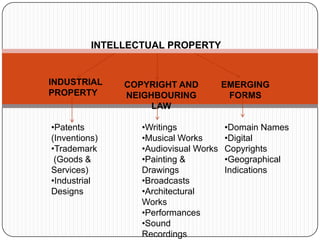
INTELLECTUAL PROPERTY


INDUSTRIAL     COPYRIGHT AND           EMERGING
PROPERTY       NEIGHBOURING             FORMS
                    LAW

•Patents          •Writings            •Domain Names
(Inventions)      •Musical Works       •Digital
•Trademark        •Audiovisual Works   Copyrights
 (Goods &         •Painting &          •Geographical
Services)         Drawings             Indications
•Industrial       •Broadcasts
Designs           •Architectural
                  Works
                  •Performances
                  •Sound
                  Recordings
TATA SONS v/s BODACIOUS TATAs
 Trade mark violations through meta-tags.


 The defendants had hyperlinks to pornographic
 sites.

 The  moment a user queried for TATAs, the
 defendant's web site would show up in the search
 results right at the top.

 The Delhi High Court restrained the use of the
 famous trade mark “TATA” not only as a domain
 name and as a trade mark but also as a meta-tag.
Tata Sons Limited v/s Manu Kosuri
 The trade mark “TATA” had been copied in various forms
  by the domain name registrant, namely as jrdtata.com,
  ratantata.com, tatayodogawa.com, tatahoneywell.com, etc.

 The case was filed against in the Delhi High Court.

 The Delhi High Court found similarity between the trade
  mark TATA and each of these domain names.

 The domain names were put on hold by NSI.

 NSI filed a declaration in court stating that they would
  abide by the orders of the Delhi High Court in respect of
  these domain names.
Puneet Industrial Controls Pvt. Ltd.
                    v/s.
            Classic Electronics:
 The plaintiff was engaged in the manufacturing and
 selling broad range of electric goods.

 The plaintiff alleged that his relative, misusing the
 trade secret and confidential information, had started
 his own manufacturing unit and started imitating the
 products.

 The court held that plaintiff had copyright over the
 information and restrained the defendants from
 imitating the products of the plaintiff.
BCCI v/s REDIFF.COM:
 Issued a notice against Rediff.com on a petition from the
  BCCI.

 To restrain the web portal from using the domain name
  “indianfantasyleague.com” in an online cricket game.

 Also to restrain the respondent using logo depicting a
  batsman playing a shot in the game, as they were
  deceptively similar to BCCI's Indian Premier League
  (IPL) trademark and the logo.

 Sought a direction to Rediff.com to render a true and
  faithful account of all profits earned by them by using the
  impugned trademark "IFL" as well as the logo.

 Claimed damages to the tune of Rs 10 lakhs.
BASMATI RICE ISSUE
 In September 1997, a Texas company called RiceTec won
  a patent on "basmati rice lines and grains”.

 RiceTec, owned by Prince Hans-Adam of Liechtenstein,
  faced international outrage over allegations of biopiracy.

 India threatened to take the matter to WTO as a violation
  of TRIPS which could have resulted in a major
  embarrassment for the United States.

 Both voluntarily and due to review decisions by the United
  States Patent Office, RiceTec has lost most of the claims
  of the patent, including, most importantly, the right to call
  their rice lines "basmati”.

 Huge victory for Indian farmers who could have faced
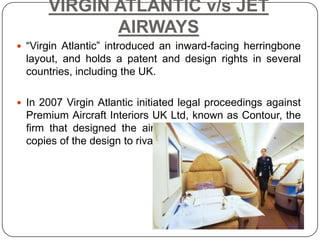
VIRGIN ATLANTIC v/s JET
             AIRWAYS
 “Virgin Atlantic” introduced an inward-facing herringbone
  layout, and holds a patent and design rights in several
  countries, including the UK.

 In 2007 Virgin Atlantic initiated legal proceedings against
  Premium Aircraft Interiors UK Ltd, known as Contour, the
  firm that designed the airline’s flatbed seats for selling
  copies of the design to rivals, including Jet Airways.
CONTD….
 Virgin was unsuccessful at the first instance in Jan’09.But
  in Oct’09, the previous decision was overturned and ruled
  in favor of Virgin, holding the Patent to be valid and
  infringed.

 Virgin has filed an infringement suit against Jet Airways in
  the UK.

 The pre-grant opposition to the Indian Patent application
  is pending at the Chennai Patent Office and is presently
  at hearing stage.

 Jet Airways, if unsuccessful will incur huge loss (money
  and time), and subsequent patent infringement suits if
  Virgin is successful in obtaining a patent in India.
THANK YOU

Intellectual property rights

  • 2.
    •Intellectual property isthe creation of human mind, the human intellect and hence called intellectual property. •By acquiring a legal right over the property, the creator of the intellectual property seeks to ensure that he has exclusive rights over it and that property can be put to use by others only with his content. •Common types of intellectual property rights include : • Copyrights • Trademarks • Patents • Industrial design rights • Trade secrets.
  • 3.
    IPRs are key elements needed to maintain the competitive edge of any industry.  Impart success to the business by creating and preserving exclusive markets.  Increasing costs of R&D in developing new products and processes.  To provide incentives to inventors for further research and investment in R&D.
  • 4.
    INTELLECTUAL PROPERTY INDUSTRIAL COPYRIGHT AND EMERGING PROPERTY NEIGHBOURING FORMS LAW •Patents •Writings •Domain Names (Inventions) •Musical Works •Digital •Trademark •Audiovisual Works Copyrights (Goods & •Painting & •Geographical Services) Drawings Indications •Industrial •Broadcasts Designs •Architectural Works •Performances •Sound Recordings
  • 6.
    TATA SONS v/sBODACIOUS TATAs  Trade mark violations through meta-tags.  The defendants had hyperlinks to pornographic sites.  The moment a user queried for TATAs, the defendant's web site would show up in the search results right at the top.  The Delhi High Court restrained the use of the famous trade mark “TATA” not only as a domain name and as a trade mark but also as a meta-tag.
  • 7.
    Tata Sons Limitedv/s Manu Kosuri  The trade mark “TATA” had been copied in various forms by the domain name registrant, namely as jrdtata.com, ratantata.com, tatayodogawa.com, tatahoneywell.com, etc.  The case was filed against in the Delhi High Court.  The Delhi High Court found similarity between the trade mark TATA and each of these domain names.  The domain names were put on hold by NSI.  NSI filed a declaration in court stating that they would abide by the orders of the Delhi High Court in respect of these domain names.
  • 9.
    Puneet Industrial ControlsPvt. Ltd. v/s. Classic Electronics:  The plaintiff was engaged in the manufacturing and selling broad range of electric goods.  The plaintiff alleged that his relative, misusing the trade secret and confidential information, had started his own manufacturing unit and started imitating the products.  The court held that plaintiff had copyright over the information and restrained the defendants from imitating the products of the plaintiff.
  • 10.
    BCCI v/s REDIFF.COM: Issued a notice against Rediff.com on a petition from the BCCI.  To restrain the web portal from using the domain name “indianfantasyleague.com” in an online cricket game.  Also to restrain the respondent using logo depicting a batsman playing a shot in the game, as they were deceptively similar to BCCI's Indian Premier League (IPL) trademark and the logo.  Sought a direction to Rediff.com to render a true and faithful account of all profits earned by them by using the impugned trademark "IFL" as well as the logo.  Claimed damages to the tune of Rs 10 lakhs.
  • 12.
    BASMATI RICE ISSUE In September 1997, a Texas company called RiceTec won a patent on "basmati rice lines and grains”.  RiceTec, owned by Prince Hans-Adam of Liechtenstein, faced international outrage over allegations of biopiracy.  India threatened to take the matter to WTO as a violation of TRIPS which could have resulted in a major embarrassment for the United States.  Both voluntarily and due to review decisions by the United States Patent Office, RiceTec has lost most of the claims of the patent, including, most importantly, the right to call their rice lines "basmati”.  Huge victory for Indian farmers who could have faced
  • 13.
    VIRGIN ATLANTIC v/sJET AIRWAYS  “Virgin Atlantic” introduced an inward-facing herringbone layout, and holds a patent and design rights in several countries, including the UK.  In 2007 Virgin Atlantic initiated legal proceedings against Premium Aircraft Interiors UK Ltd, known as Contour, the firm that designed the airline’s flatbed seats for selling copies of the design to rivals, including Jet Airways.
  • 14.
    CONTD….  Virgin wasunsuccessful at the first instance in Jan’09.But in Oct’09, the previous decision was overturned and ruled in favor of Virgin, holding the Patent to be valid and infringed.  Virgin has filed an infringement suit against Jet Airways in the UK.  The pre-grant opposition to the Indian Patent application is pending at the Chennai Patent Office and is presently at hearing stage.  Jet Airways, if unsuccessful will incur huge loss (money and time), and subsequent patent infringement suits if Virgin is successful in obtaining a patent in India.
  • 15.