Module 3: lesson 4
group 3
Lesson 4: making curriculum connections
2
After completing this lesson, you should
be able to:
1.Discuss integrated teaching in
relation to literature-based instruction.
2.Design an integrated lesson for a
content area subject.
1.
Why Integrated Teaching?
Mary Rose Niogan
3
4
When someone tells us a story, we can't help but conjure images
of our own experiences as the narrative unfolds. This is our way
of making connections with what our friend is saying. And this
is how we make sense of and comprehend what we are hearing.
It is only when we can see the relationship or connection
between things that an idea becomes meaningful.
Developing comprehension then becomes a matter of
increasing the intersection between the experiences of the
reader and the experiences of the character/s in the story.
5
Learning is about making connections, and the
more connections we make and the more
encounters we have with an idea, the more we
are able to think about it and retain it in our
minds. So how can making connections be
fostered in the classroom?
Literature may be used as the context for
developing understanding across a variety of
subject areas.
6
How to integrate
Janet Wison
7
8
"Integrated teaching involves planning and
organizing curriculum and instruction so the
subject matter disciplines are related to one
another in a design matching the developmental
needs of the students and connecting their
learning in meaningful ways to their
experiences" (Sunal et al., 2000).
Integration can be across subject areas, or within
a literature lesson.
9
2.1 Using the story as springboard
Integration across subject areas may be achieved by using
literature as the springboard for the various lessons.
Learning is facilitated when the subject matter is presented
within a context. It is therefore important to choose a context
to which the students can relate. And because we are using
one context throughout the day across different lessons,
these repetitive encounters will lead to better retention,
which in turn may improve comprehension.
10
2.2 Deepening understanding of content area
subject matter
We can also achieve integration within a literature
lesson. That is, we can present insights from different
content areas and tackle them in one literature lesson.
This helps students to appreciate a topic from multiple
perspectives. It also helps students to see the
relationship between what they are learning in the
classroom and real life situations. As Sunal et al.
(2000) point out, integration within a lesson
strengthens the relationship between in-class
learning and out-of-school living
11
In an integrated lesson, we can address different
learning styles by providing hands-on activities that
are geared toward students' particular interests and
abilities. This type of integration increases not only
student motivation, but also their continuous
participation in the meaning-making process.
Providing activities anchored on the arts is
recommended as this enables students to
demonstrate what they know in a creative way.
.
Explicit instruction and
integration
Bella Lhou Elecho
12
13
Creating an integrated lesson begins with deciding on the
mode of integration i.e., whether to integrate (1) across subject
areas, or (2) within the literature lesson.
After you have zeroed in on the content area of choice, identify
the topic that you would like to develop. This will be the basis
for crafting learning objectives for the lesson and for drawing
up a lesson plan using the explicit instruction framework.
14
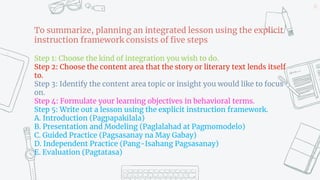
Step 1: Choose the kind of integration you wish to do.
Step 2: Choose the content area that the story or literary text lends itself
to.
Step 3: Identify the content area topic or insight you would like to focus
on.
Step 4: Formulate your learning objectives in behavioral terms.
Step 5: Write out a lesson using the explicit instruction framework.
A. Introduction (Pagpapakilala)
B. Presentation and Modeling (Paglalahad at Pagmomodelo)
C. Guided Practice (Pagsasanay na May Gabay)
D. Independent Practice (Pang-Isahang Pagsasanay)
E. Evaluation (Pagtatasa)
To summarize, planning an integrated lesson using the explicit
instruction framework consists of five steps
15
Thank you for Listening

integrated teaching

  • 1.
  • 2.
    Lesson 4: makingcurriculum connections 2 After completing this lesson, you should be able to: 1.Discuss integrated teaching in relation to literature-based instruction. 2.Design an integrated lesson for a content area subject.
  • 3.
  • 4.
    4 When someone tellsus a story, we can't help but conjure images of our own experiences as the narrative unfolds. This is our way of making connections with what our friend is saying. And this is how we make sense of and comprehend what we are hearing. It is only when we can see the relationship or connection between things that an idea becomes meaningful. Developing comprehension then becomes a matter of increasing the intersection between the experiences of the reader and the experiences of the character/s in the story.
  • 5.
    5 Learning is aboutmaking connections, and the more connections we make and the more encounters we have with an idea, the more we are able to think about it and retain it in our minds. So how can making connections be fostered in the classroom? Literature may be used as the context for developing understanding across a variety of subject areas.
  • 6.
  • 7.
  • 8.
    8 "Integrated teaching involvesplanning and organizing curriculum and instruction so the subject matter disciplines are related to one another in a design matching the developmental needs of the students and connecting their learning in meaningful ways to their experiences" (Sunal et al., 2000). Integration can be across subject areas, or within a literature lesson.
  • 9.
    9 2.1 Using thestory as springboard Integration across subject areas may be achieved by using literature as the springboard for the various lessons. Learning is facilitated when the subject matter is presented within a context. It is therefore important to choose a context to which the students can relate. And because we are using one context throughout the day across different lessons, these repetitive encounters will lead to better retention, which in turn may improve comprehension.
  • 10.
    10 2.2 Deepening understandingof content area subject matter We can also achieve integration within a literature lesson. That is, we can present insights from different content areas and tackle them in one literature lesson. This helps students to appreciate a topic from multiple perspectives. It also helps students to see the relationship between what they are learning in the classroom and real life situations. As Sunal et al. (2000) point out, integration within a lesson strengthens the relationship between in-class learning and out-of-school living
  • 11.
    11 In an integratedlesson, we can address different learning styles by providing hands-on activities that are geared toward students' particular interests and abilities. This type of integration increases not only student motivation, but also their continuous participation in the meaning-making process. Providing activities anchored on the arts is recommended as this enables students to demonstrate what they know in a creative way.
  • 12.
  • 13.
    13 Creating an integratedlesson begins with deciding on the mode of integration i.e., whether to integrate (1) across subject areas, or (2) within the literature lesson. After you have zeroed in on the content area of choice, identify the topic that you would like to develop. This will be the basis for crafting learning objectives for the lesson and for drawing up a lesson plan using the explicit instruction framework.
  • 14.
    14 Step 1: Choosethe kind of integration you wish to do. Step 2: Choose the content area that the story or literary text lends itself to. Step 3: Identify the content area topic or insight you would like to focus on. Step 4: Formulate your learning objectives in behavioral terms. Step 5: Write out a lesson using the explicit instruction framework. A. Introduction (Pagpapakilala) B. Presentation and Modeling (Paglalahad at Pagmomodelo) C. Guided Practice (Pagsasanay na May Gabay) D. Independent Practice (Pang-Isahang Pagsasanay) E. Evaluation (Pagtatasa) To summarize, planning an integrated lesson using the explicit instruction framework consists of five steps
  • 15.